
11 4 HardyWeinberg Equilibrium HMD Bio Chapter 11
11. 4 Hardy-Weinberg Equilibrium HMD Bio Chapter 11 Section 4 KEY CONCEPT Hardy-Weinberg equilibrium provides a framework for understanding how populations evolve.
11. 4 Hardy-Weinberg Equilibrium Hardy-Weinberg equilibrium describes populations that are not evolving. • Biologists use models to study populations. • Hardy-Weinberg equilibrium is a type of model.
11. 4 Hardy-Weinberg Equilibrium Hardy-Weinberg equilibrium describes populations that are not evolving. • Genotype frequencies stay the same if five conditions are met. – 1) very large population: no genetic drift – 2) no emigration or immigration: no gene flow – 3) no mutations: no new alleles added to gene pool – 4) random mating: no sexual selection – 5) no natural selection: all traits aid equally in survival
11. 4 Hardy-Weinberg Equilibrium Hardy-Weinberg equilibrium describes populations that are not evolving. • Real populations rarely meet all five conditions. – Real population data is compared to a model. – Models are used to study how populations evolve.
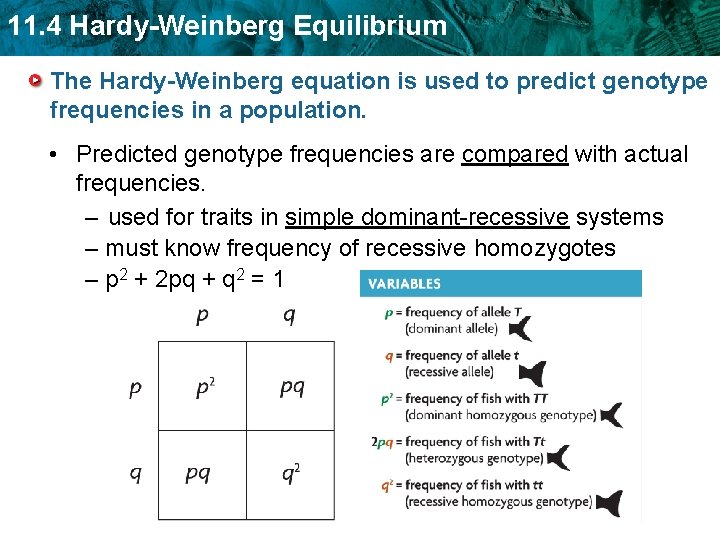
11. 4 Hardy-Weinberg Equilibrium The Hardy-Weinberg equation is used to predict genotype frequencies in a population. • Predicted genotype frequencies are compared with actual frequencies. – used for traits in simple dominant-recessive systems – must know frequency of recessive homozygotes – p 2 + 2 pq + q 2 = 1 "The Hardy-Weinberg equation is based on Mendelian genetics. It is derived from a simple Punnett square in which p is the frequency of the dominant allele and q is the frequency of the recessive allele. "
11. 4 Hardy-Weinberg Equilibrium There are five factors that can lead to evolution.
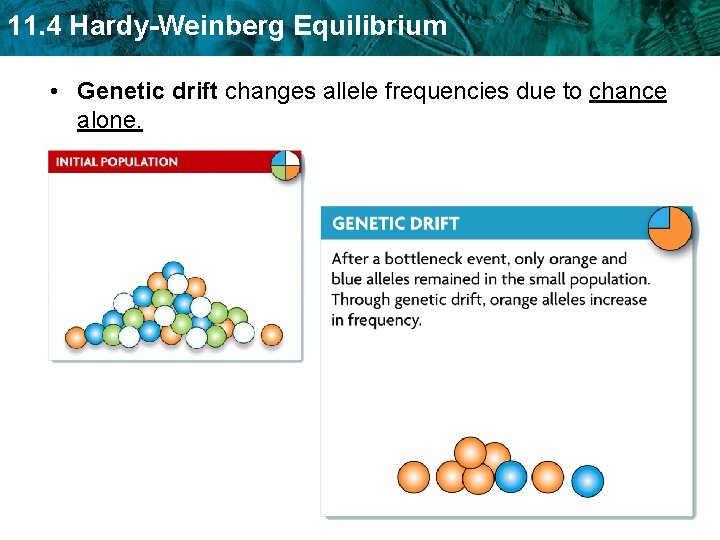
11. 4 Hardy-Weinberg Equilibrium • Genetic drift changes allele frequencies due to chance alone.
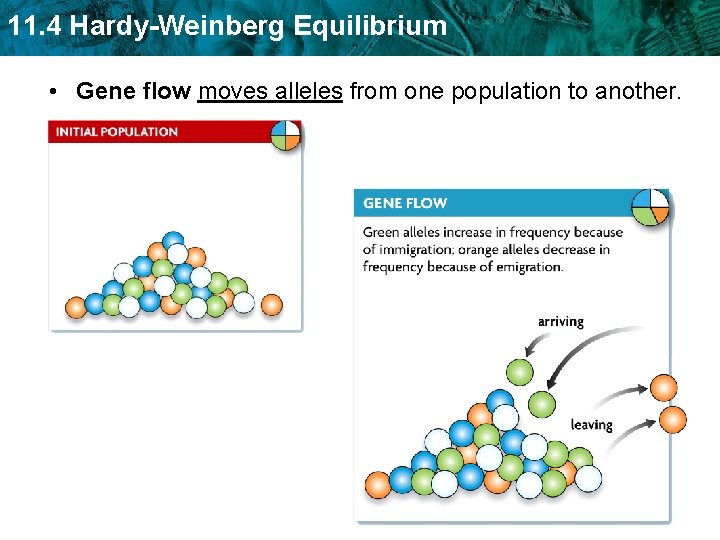
11. 4 Hardy-Weinberg Equilibrium • Gene flow moves alleles from one population to another.
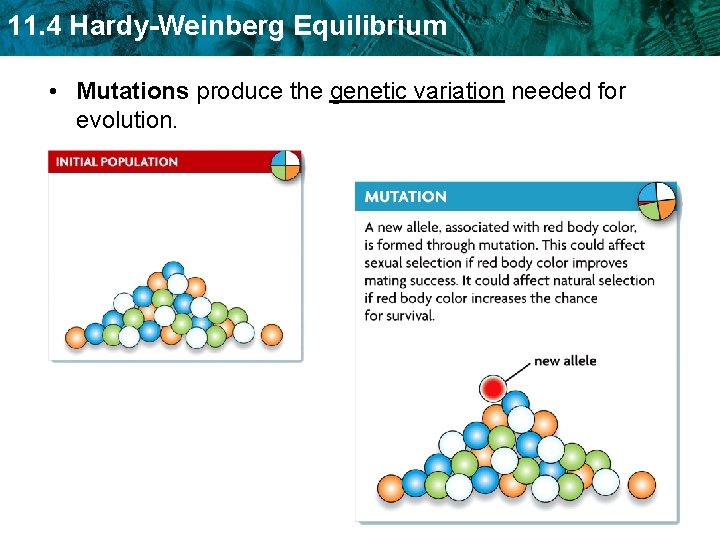
11. 4 Hardy-Weinberg Equilibrium • Mutations produce the genetic variation needed for evolution.
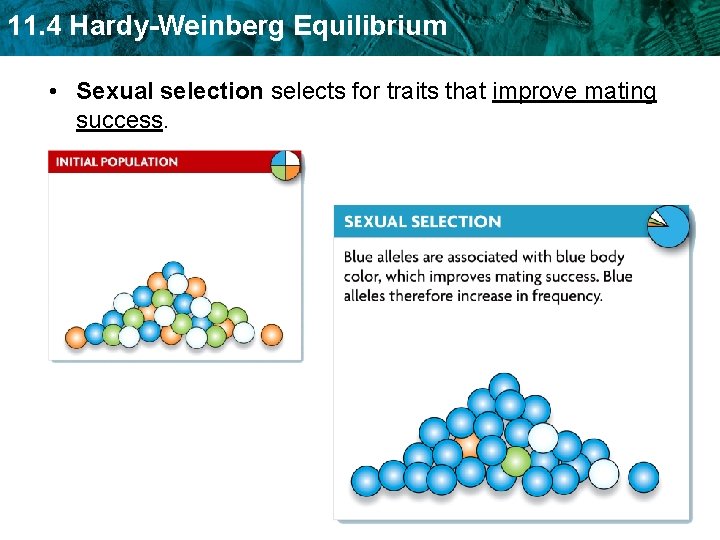
11. 4 Hardy-Weinberg Equilibrium • Sexual selection selects for traits that improve mating success.
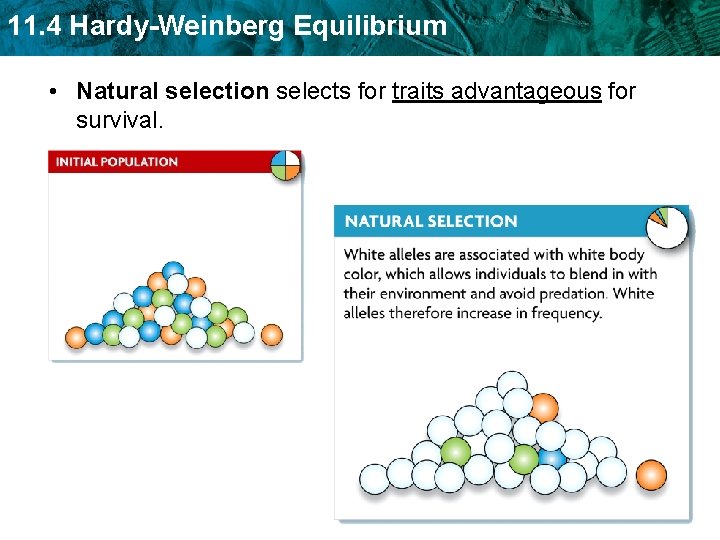
11. 4 Hardy-Weinberg Equilibrium • Natural selection selects for traits advantageous for survival.
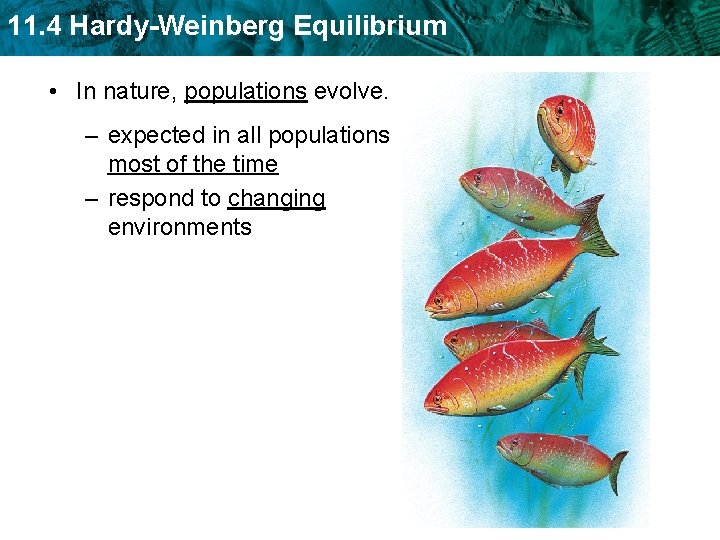
11. 4 Hardy-Weinberg Equilibrium • In nature, populations evolve. – expected in all populations most of the time – respond to changing environments
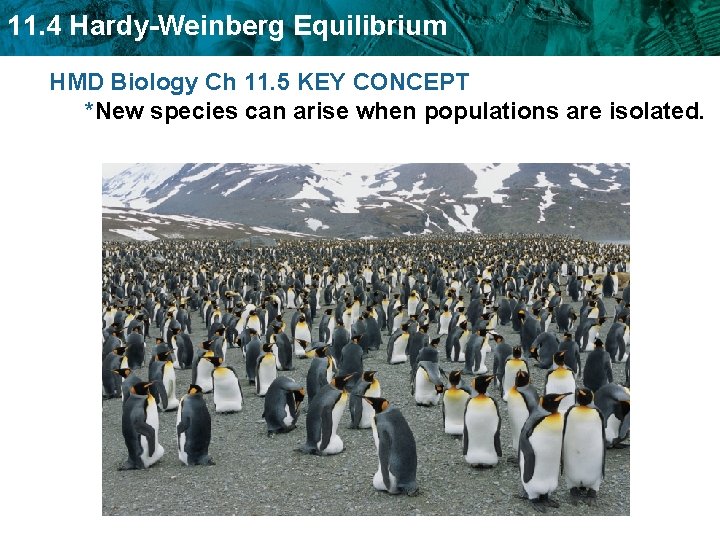
11. 4 Hardy-Weinberg Equilibrium HMD Biology Ch 11. 5 KEY CONCEPT *New species can arise when populations are isolated.
11. 4 Hardy-Weinberg Equilibrium The isolation of populations can lead to speciation (new species). • Populations become isolated when there is no gene flow. – Isolated populations adapt to their own environments. – Genetic differences can add up over generations.
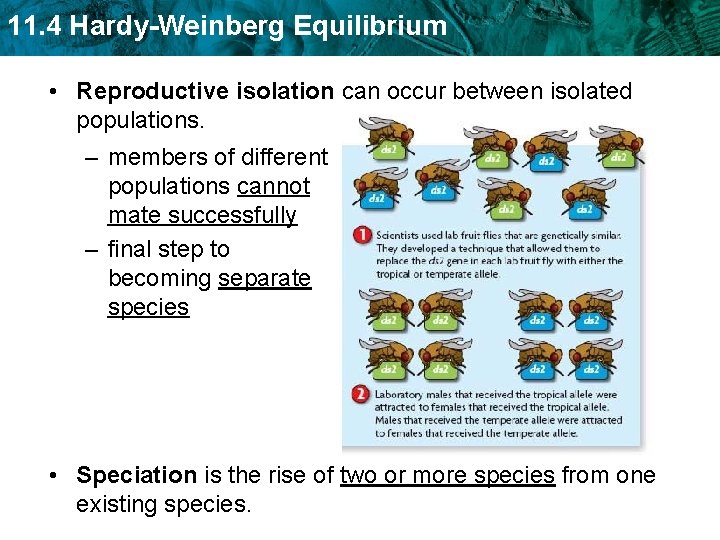
11. 4 Hardy-Weinberg Equilibrium • Reproductive isolation can occur between isolated populations. – members of different populations cannot mate successfully – final step to becoming separate species • Speciation is the rise of two or more species from one existing species.
11. 4 Hardy-Weinberg Equilibrium Populations can become isolated in several ways. • Behavioral barriers can cause isolation. – called behavioral isolation – includes differences in courtship or mating behaviors
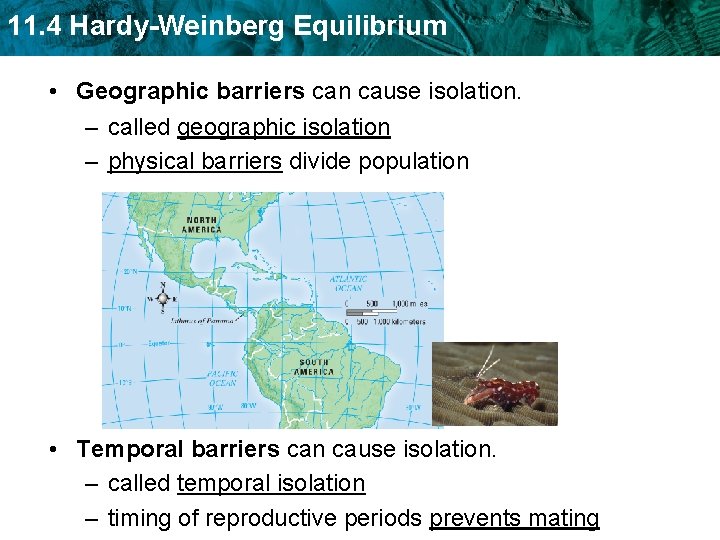
11. 4 Hardy-Weinberg Equilibrium • Geographic barriers can cause isolation. – called geographic isolation – physical barriers divide population • Temporal barriers can cause isolation. – called temporal isolation – timing of reproductive periods prevents mating
11. 4 Hardy-Weinberg Equilibrium HMD Biology Ch 11. 6 KEY CONCEPT Evolution occurs in patterns.
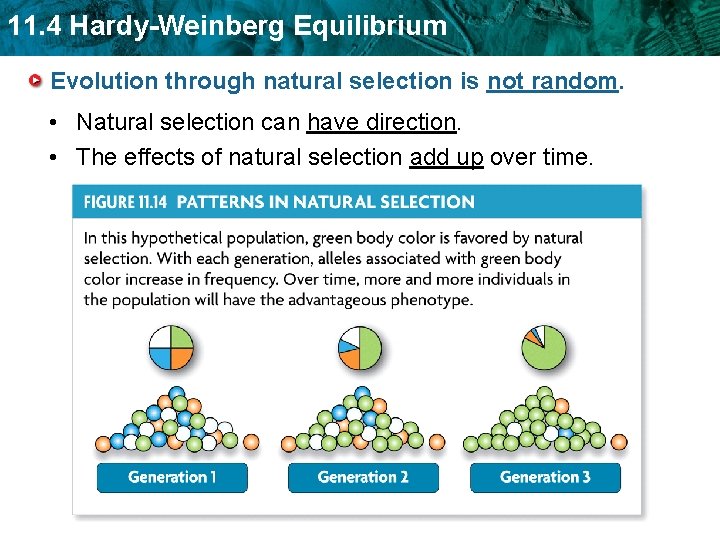
11. 4 Hardy-Weinberg Equilibrium Evolution through natural selection is not random. • Natural selection can have direction. • The effects of natural selection add up over time.
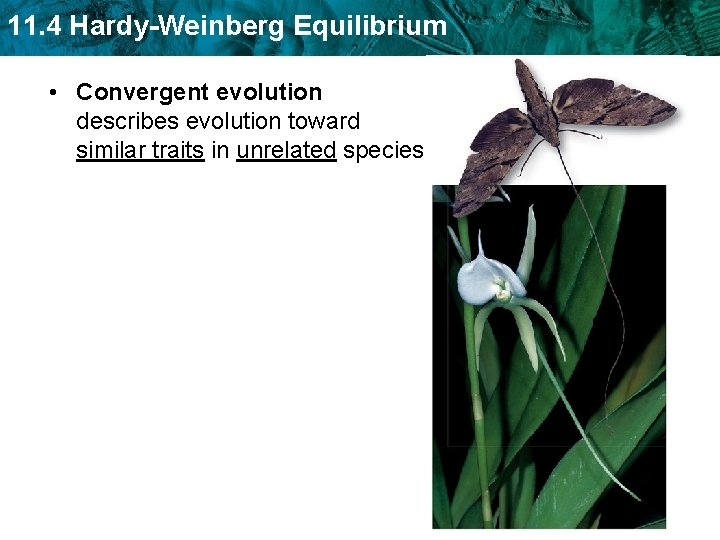
11. 4 Hardy-Weinberg Equilibrium • Convergent evolution describes evolution toward similar traits in unrelated species.
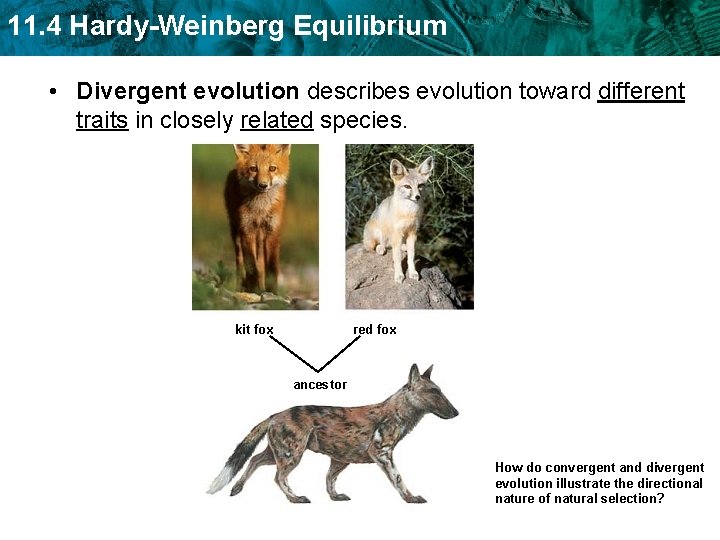
11. 4 Hardy-Weinberg Equilibrium • Divergent evolution describes evolution toward different traits in closely related species. kit fox red fox ancestor How do convergent and divergent evolution illustrate the directional nature of natural selection?
11. 4 Hardy-Weinberg Equilibrium Species can shape each other over time. • Two or more species can evolve together through coevolution. – evolutionary paths become connected – species evolve in response to changes in each other
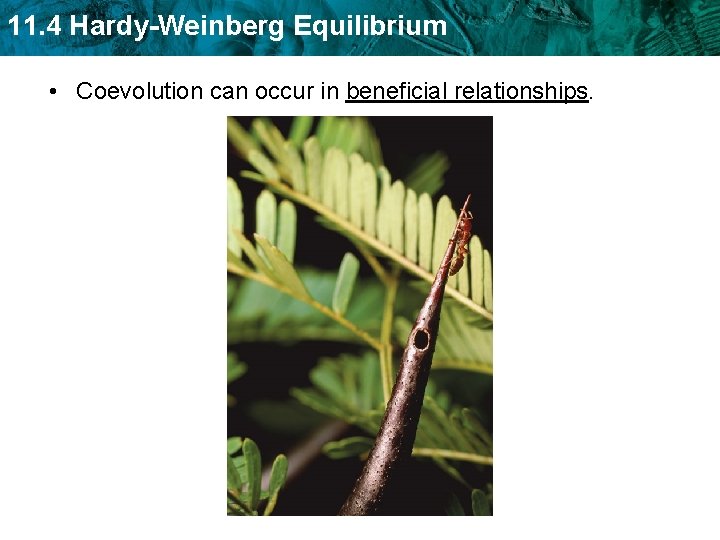
11. 4 Hardy-Weinberg Equilibrium • Coevolution can occur in beneficial relationships.
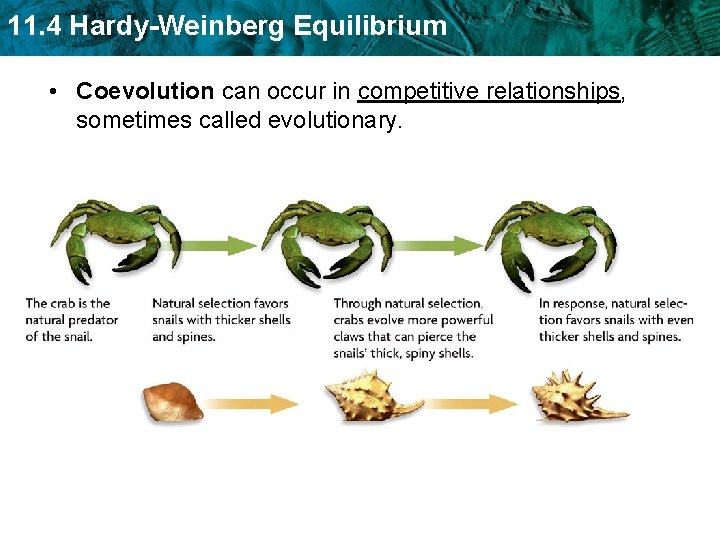
11. 4 Hardy-Weinberg Equilibrium • Coevolution can occur in competitive relationships, sometimes called evolutionary.
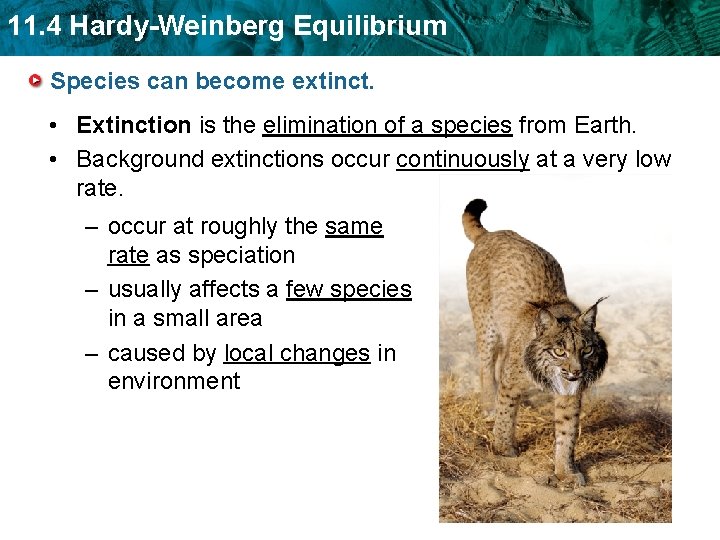
11. 4 Hardy-Weinberg Equilibrium Species can become extinct. • Extinction is the elimination of a species from Earth. • Background extinctions occur continuously at a very low rate. – occur at roughly the same rate as speciation – usually affects a few species in a small area – caused by local changes in environment
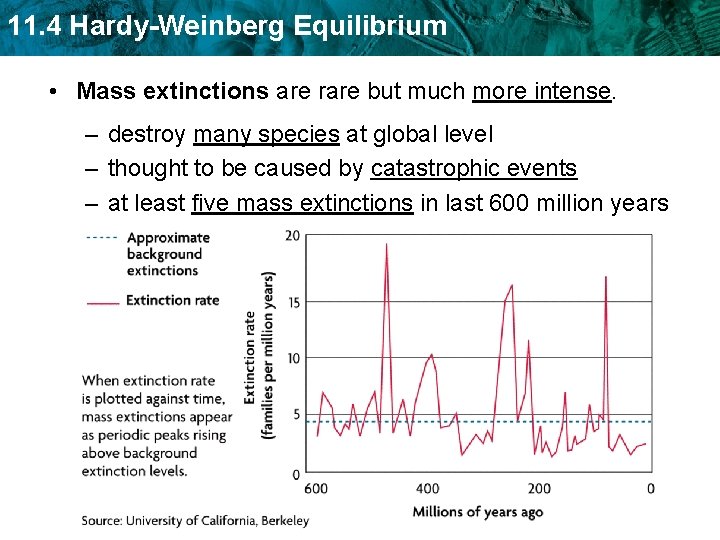
11. 4 Hardy-Weinberg Equilibrium • Mass extinctions are rare but much more intense. – destroy many species at global level – thought to be caused by catastrophic events – at least five mass extinctions in last 600 million years
11. 4 Hardy-Weinberg Equilibrium Speciation often occurs in patterns. • A pattern of punctuated equilibrium exists in the fossil record. – theory proposed by Eldredge and Gould in 1972 – episodes of speciation occur suddenly in geologic time – followed by long periods of little evolutionary change – revised Darwin’s idea that species arose through gradual transformations Gradualism = idea that speciation occurs slowly or gradually over time.
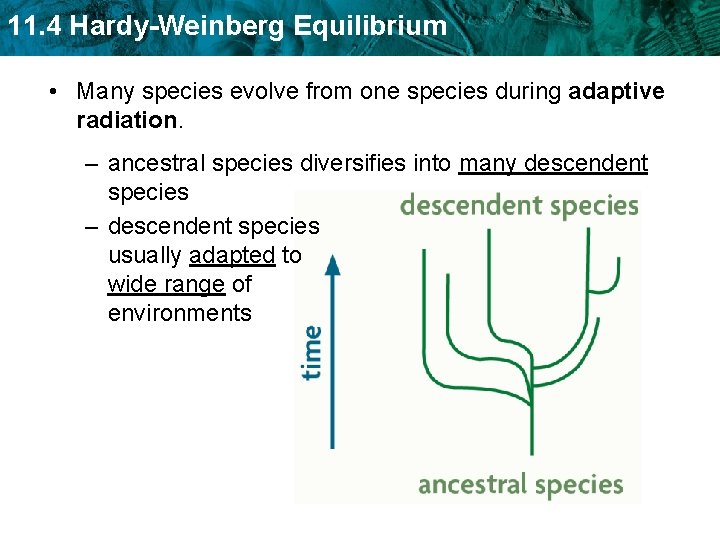
11. 4 Hardy-Weinberg Equilibrium • Many species evolve from one species during adaptive radiation. – ancestral species diversifies into many descendent species – descendent species usually adapted to wide range of environments
- Slides: 28