
11 26 17 Introduction to Earth Science Do



- Slides: 27
11 -26 -17 Introduction to Earth Science
Do Now: Complete in your Science Notebook 3. Gravity • Show Mr. Santos your signed Science Fair Question (if you have 4. Density not already done so) 5. Crust • Write the following vocabulary terms in your notebook. You will 6. Mantle be quizzed on the definitions of 7. Lithosphere these terms on Friday, 12/1! 8. Asthenosphere 1. Sphere 9. Core 2. Geosphere 10. Magnetosphere
Reminder: Science Fair Research & Hypothesis is Due Friday, 12/1
Textbooks: Online Access • Mr. Santos will be assigning online textbook access. • Use the same username and password for your Civics textbook. • Please let Mr. Santos know if you do not have online access at home. • Log into connect. ED at https: //connected. mcgraw-hill. com
Chapter 1, Lesson 1: Spherical Earth Essential Questions: • What are Earth’s major systems and how do they interact? • Why does Earth have a spherical shape?
Why Study Earth Science? • Take a few minutes to walk around the room and look at the headlines. • Class discussion about earthquakes • What do you know about the 2010 earthquakes in Haiti and Chile or more recent earthquakes? What have they heard on the news or first hand? • Has anyone ever been in an earthquake? • For the next few class periods you will be learning about the Earth processes responsible for earthquakes and other processes.
Why Study Earth Science? • https: //www. youtube. com/watch? v=j 1 c. KBux. BWKY • As we watch the following video, ask yourself, “Why is it important to study the Earth? ” • To understand how to care for our planet • To be able to predict how the Earth may change and be ready for natural disasters
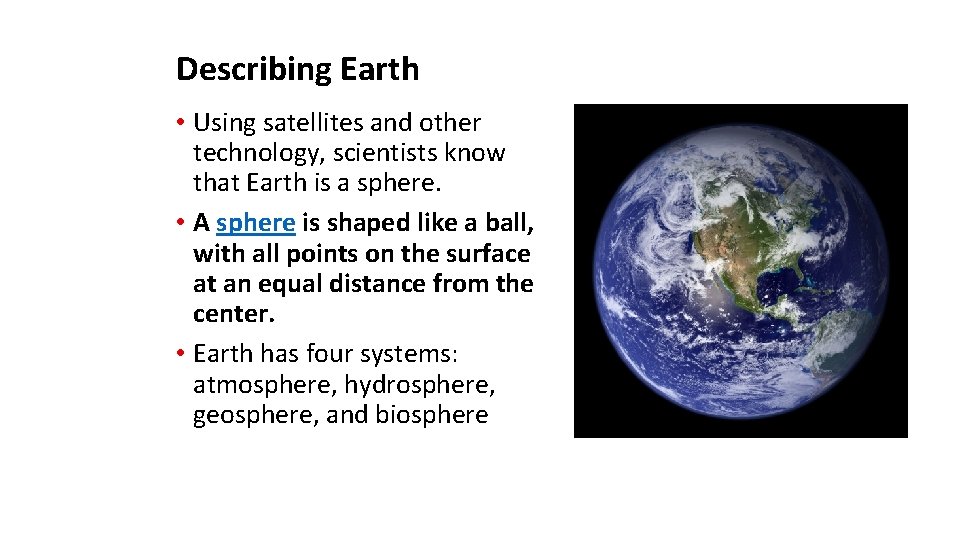
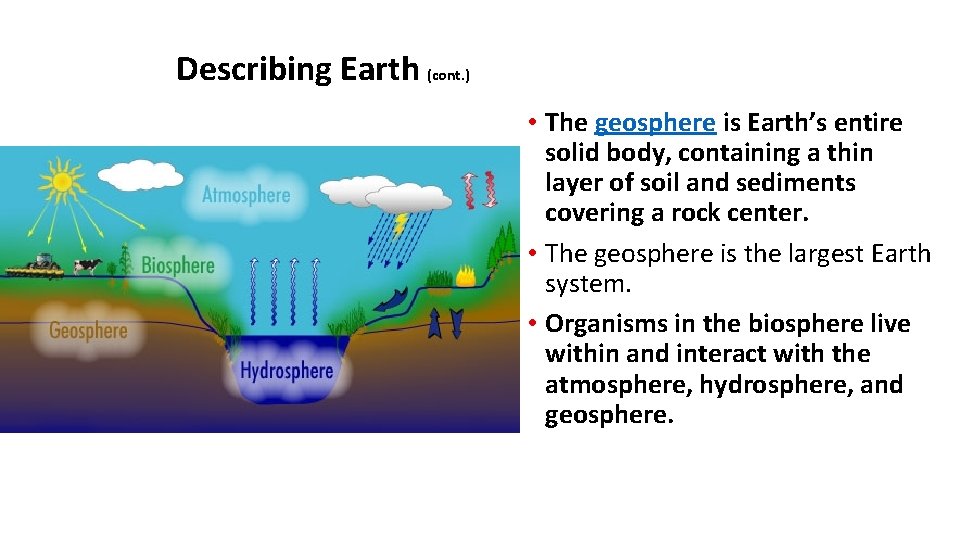
Describing Earth • Using satellites and other technology, scientists know that Earth is a sphere. • A sphere is shaped like a ball, with all points on the surface at an equal distance from the center. • Earth has four systems: atmosphere, hydrosphere, geosphere, and biosphere
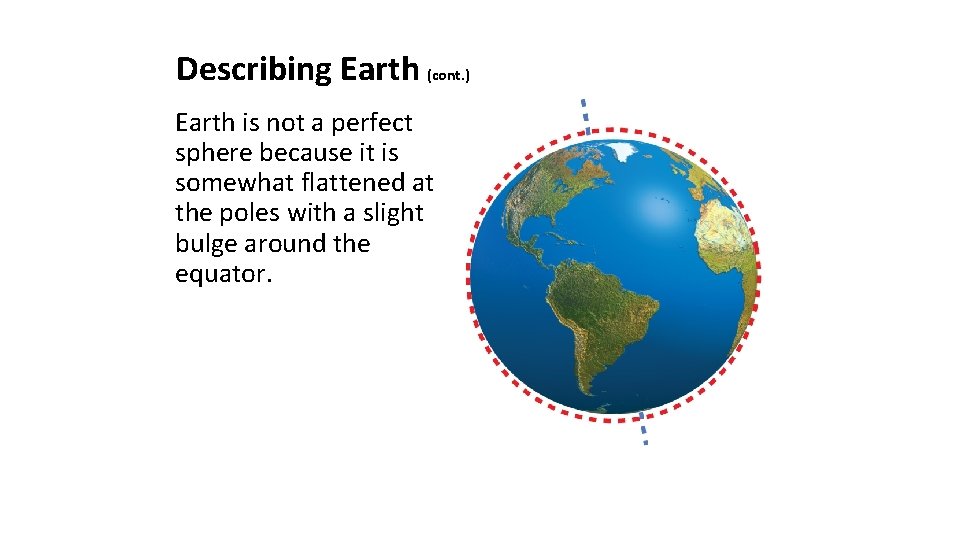
Describing Earth (cont. ) Earth is not a perfect sphere because it is somewhat flattened at the poles with a slight bulge around the equator.
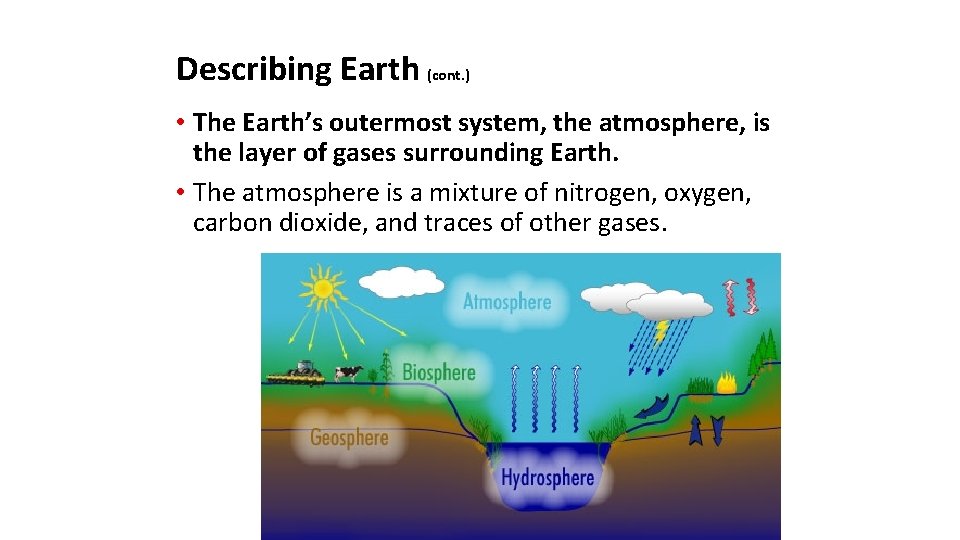
Describing Earth (cont. ) • The Earth’s outermost system, the atmosphere, is the layer of gases surrounding Earth. • The atmosphere is a mixture of nitrogen, oxygen, carbon dioxide, and traces of other gases.
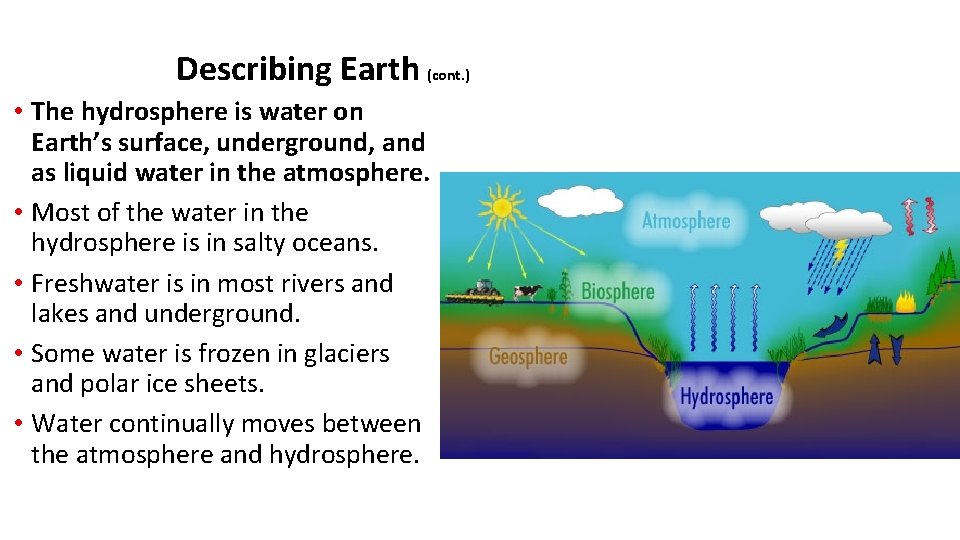
Describing Earth (cont. ) • The hydrosphere is water on Earth’s surface, underground, and as liquid water in the atmosphere. • Most of the water in the hydrosphere is in salty oceans. • Freshwater is in most rivers and lakes and underground. • Some water is frozen in glaciers and polar ice sheets. • Water continually moves between the atmosphere and hydrosphere.
Describing Earth (cont. ) • The geosphere is Earth’s entire solid body, containing a thin layer of soil and sediments covering a rock center. • The geosphere is the largest Earth system. • Organisms in the biosphere live within and interact with the atmosphere, hydrosphere, and geosphere.
Describing Earth: Think, Pair, Share Identify Earth’s four major systems. Answer: Atmosphere, Hydrosphere, Geosphere, Biosphere
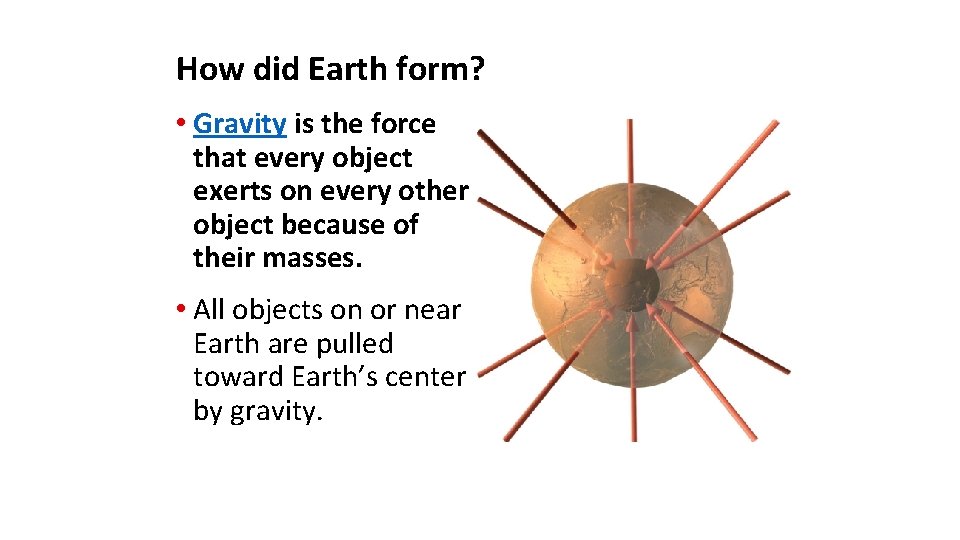
How did Earth form? • Gravity is the force that every object exerts on every other object because of their masses. • All objects on or near Earth are pulled toward Earth’s center by gravity.
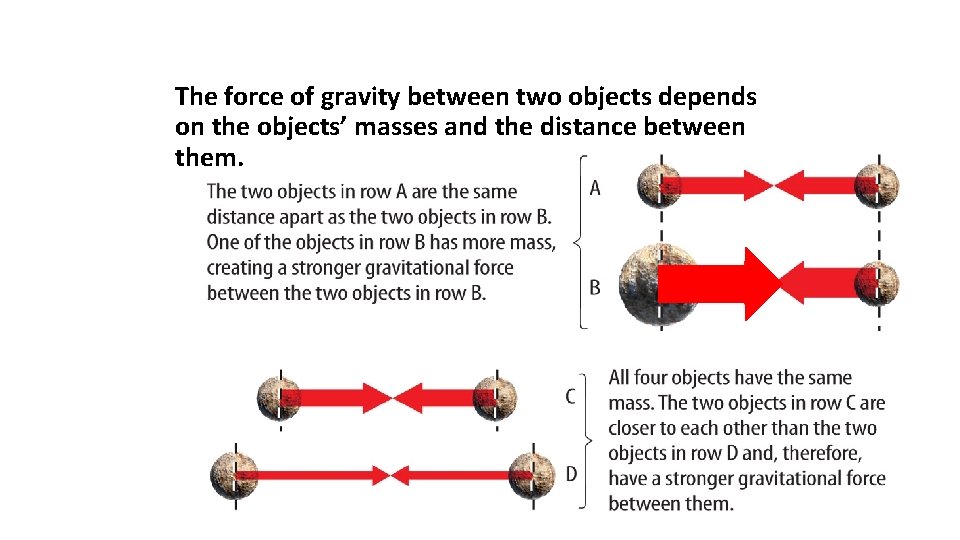
The force of gravity between two objects depends on the objects’ masses and the distance between them.
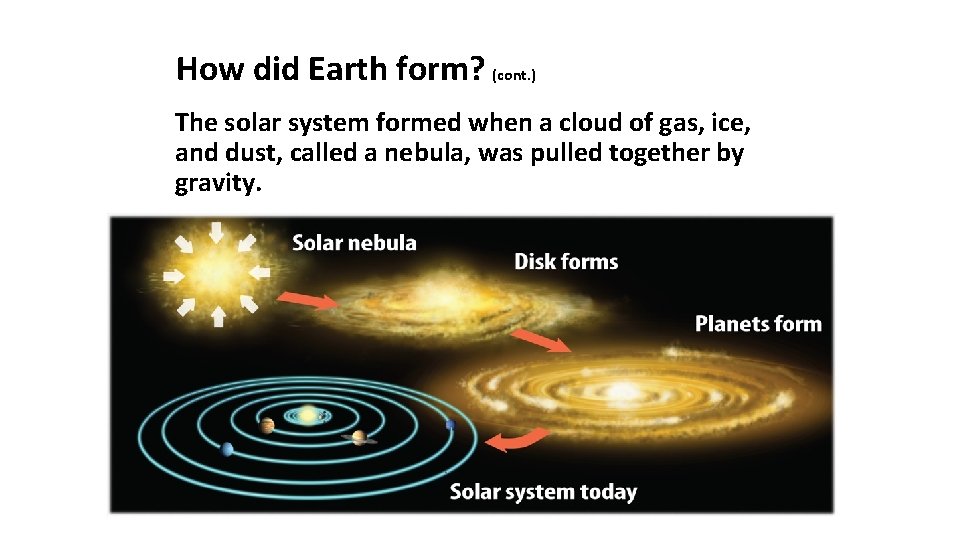
How did Earth form? (cont. ) The solar system formed when a cloud of gas, ice, and dust, called a nebula, was pulled together by gravity.
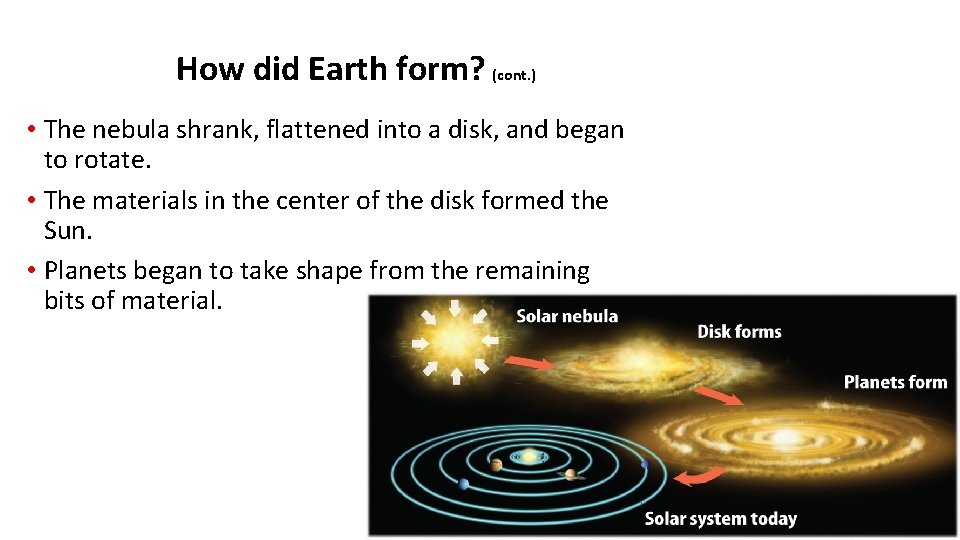
How did Earth form? (cont. ) • The nebula shrank, flattened into a disk, and began to rotate. • The materials in the center of the disk formed the Sun. • Planets began to take shape from the remaining bits of material.
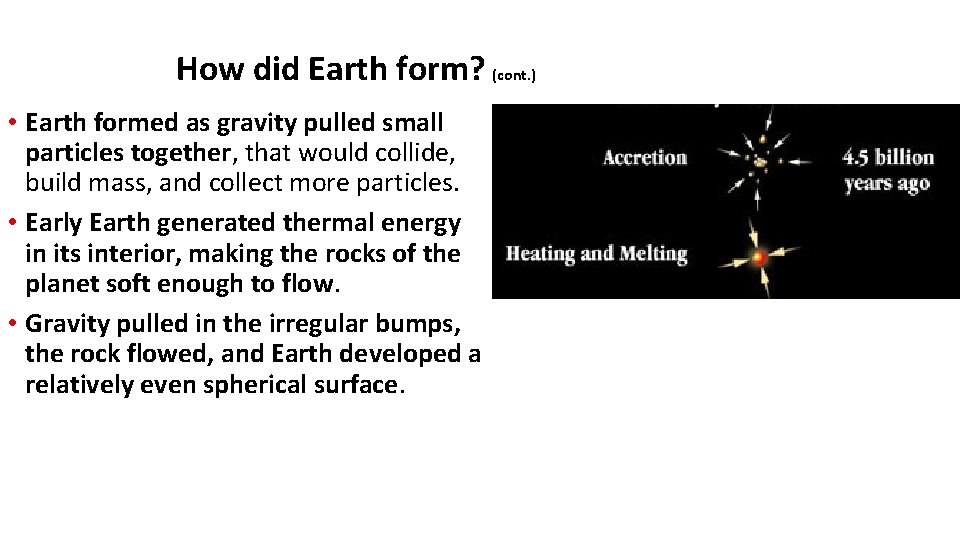
How did Earth form? (cont. ) • Earth formed as gravity pulled small particles together, that would collide, build mass, and collect more particles. • Early Earth generated thermal energy in its interior, making the rocks of the planet soft enough to flow. • Gravity pulled in the irregular bumps, the rock flowed, and Earth developed a relatively even spherical surface.
How did Earth form? : Stand Up, Hand Up, Pair up What force caused the planets to take shape? Answer: The force of gravity caused the planets to take shape.
How did Earth form? : Stand Up, Hand Up, Pair Up The solar system formed from what type of cloud? Answer: The solar system formed from a cloud of dust, gas, and ice called a nebula
How did Earth form? : Stand Up, Hand Up, Pair Up How did Earth develop its spherical shape? Answer: After enough matter had collected and formed Earth, the rocks in Earth’s interior began to melt and flow. Gravity pulled in Earth’s irregular bumps. The rocks flowed, and Earth developed a spherical surface.
The Formation of Earth’s Layers • Earth developed distinct layers of different material after thermal energy melted some of the material and it began to flow. • Different materials formed layers according to their densities.
The Formation of Earth’s Layers (cont. ) • Density is the amount of mass in a material per unit volume and can be described as D = m/V (density is mass divided by volume). density from Latin densus, means “thick, crowded”
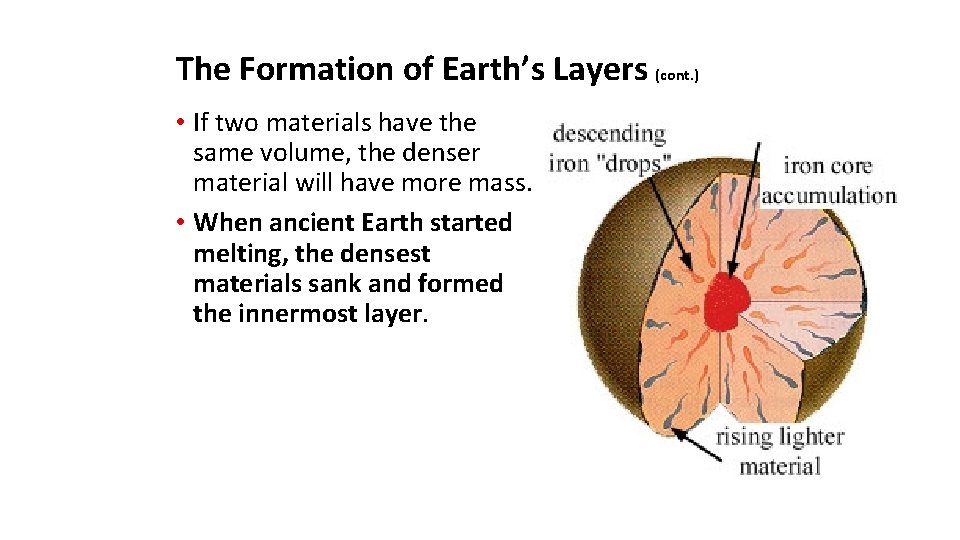
The Formation of Earth’s Layers (cont. ) • If two materials have the same volume, the denser material will have more mass. • When ancient Earth started melting, the densest materials sank and formed the innermost layer.
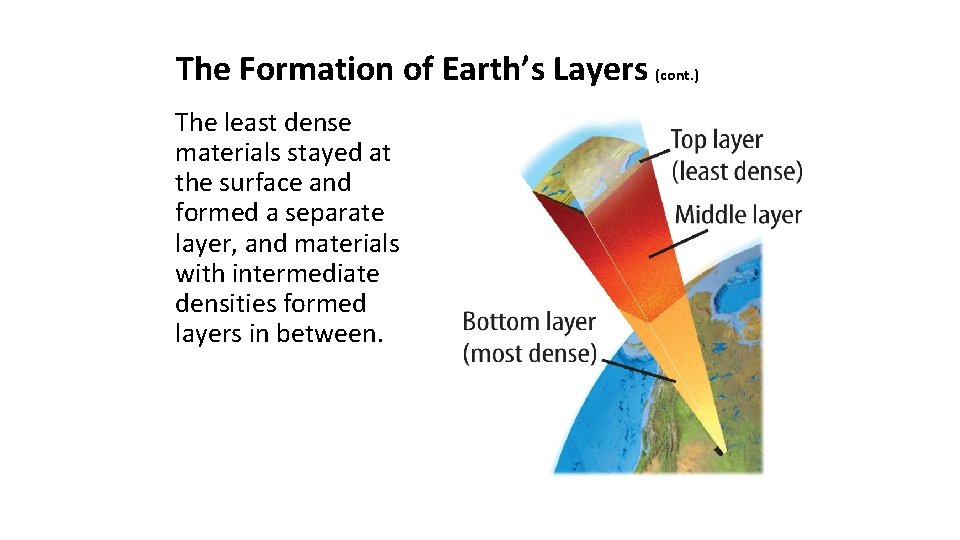
The Formation of Earth’s Layers (cont. ) The least dense materials stayed at the surface and formed a separate layer, and materials with intermediate densities formed layers in between.
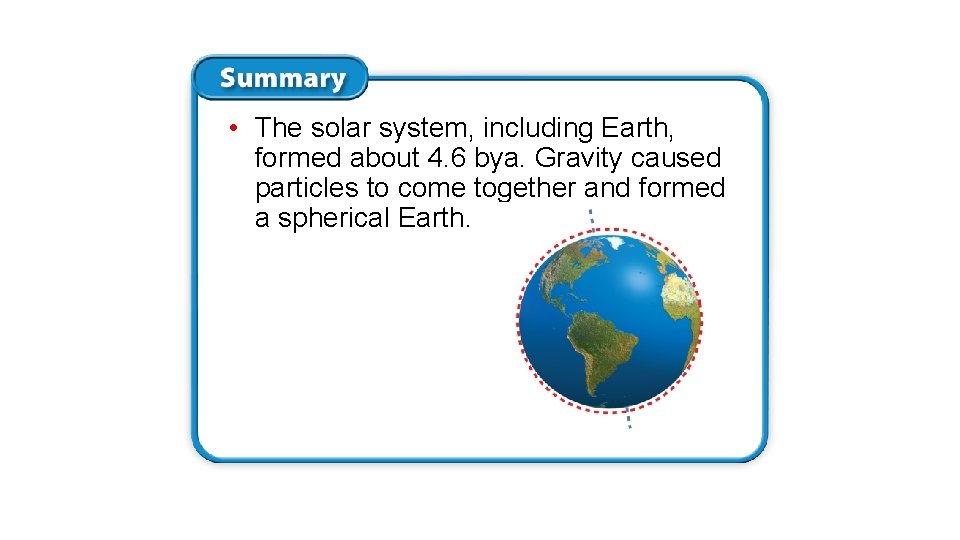
• The solar system, including Earth, formed about 4. 6 bya. Gravity caused particles to come together and formed a spherical Earth.
Homework: Spherical Earth worksheet