
11 2 Techniques for Evaluating Limits Copyright Cengage
- Slides: 27
11. 2 Techniques for Evaluating Limits Copyright © Cengage Learning. All rights reserved.
What You Should Learn • Use the dividing out technique to evaluate limits of functions • Use the rationalizing technique to evaluate limits of functions • Use technology to approximate limits of functions graphically and numerically 2
What You Should Learn • Evaluate one-sided limits of functions • Evaluate limits of difference quotients from calculus 3
Dividing Out Technique 4
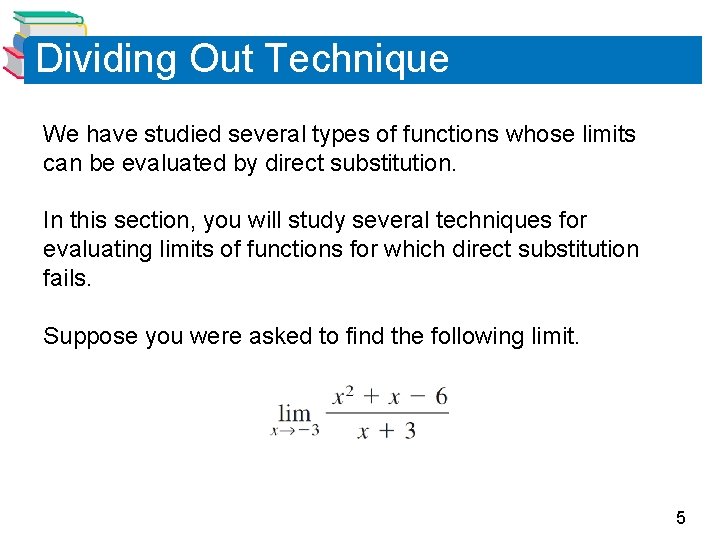
Dividing Out Technique We have studied several types of functions whose limits can be evaluated by direct substitution. In this section, you will study several techniques for evaluating limits of functions for which direct substitution fails. Suppose you were asked to find the following limit. 5
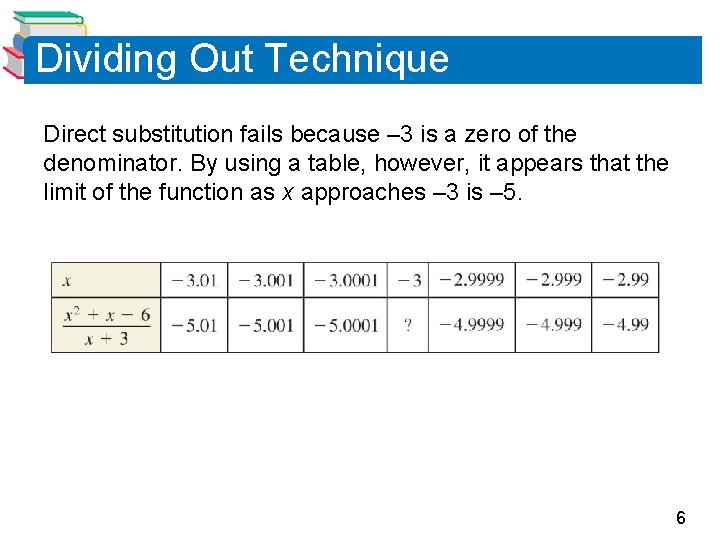
Dividing Out Technique Direct substitution fails because – 3 is a zero of the denominator. By using a table, however, it appears that the limit of the function as x approaches – 3 is – 5. 6
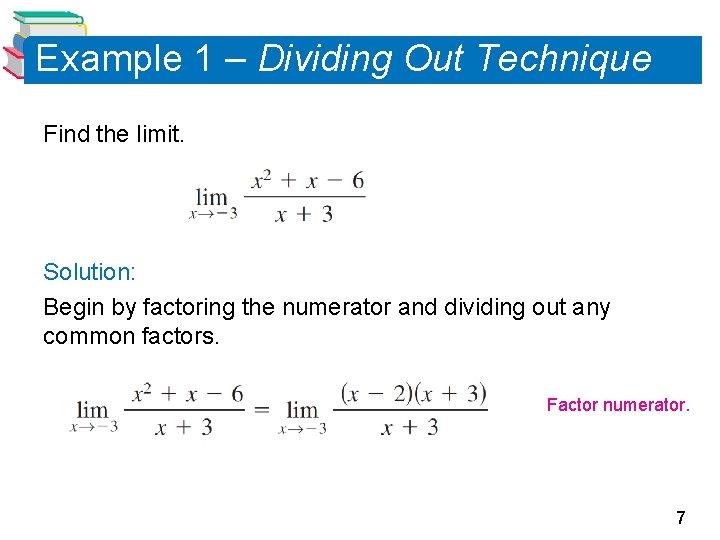
Example 1 – Dividing Out Technique Find the limit. Solution: Begin by factoring the numerator and dividing out any common factors. Factor numerator. 7
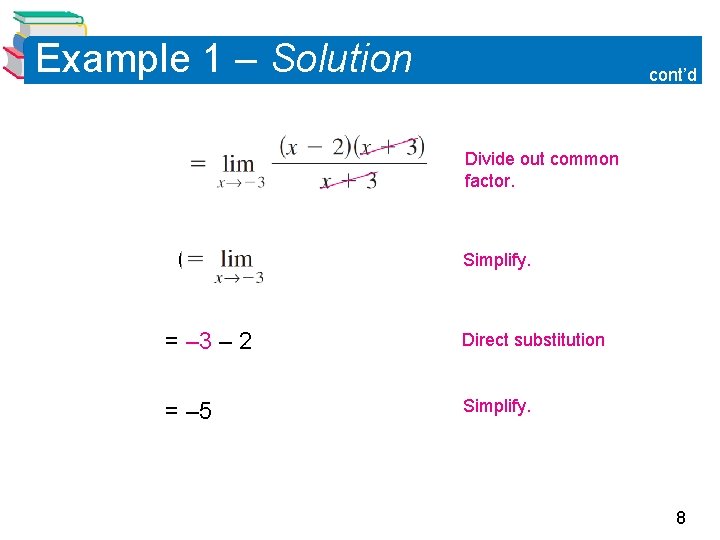
Example 1 – Solution cont’d Divide out common factor. (x – 2) Simplify. = – 3 – 2 Direct substitution = – 5 Simplify. 8
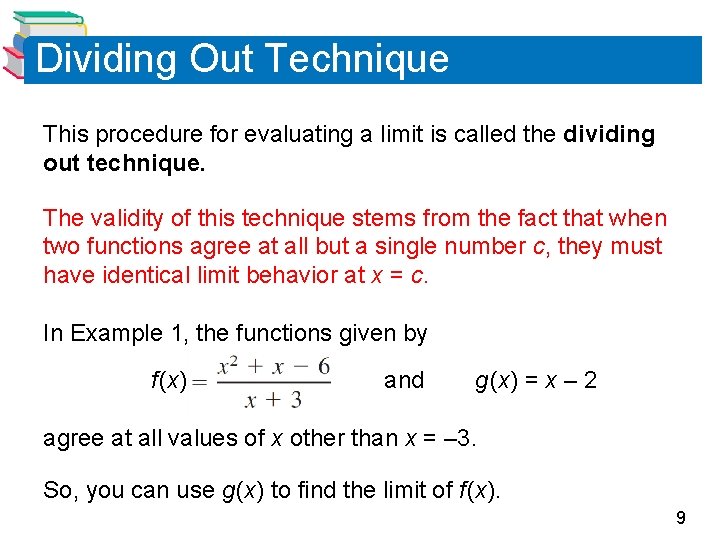
Dividing Out Technique This procedure for evaluating a limit is called the dividing out technique. The validity of this technique stems from the fact that when two functions agree at all but a single number c, they must have identical limit behavior at x = c. In Example 1, the functions given by f (x) and g (x) = x – 2 agree at all values of x other than x = – 3. So, you can use g (x) to find the limit of f (x). 9
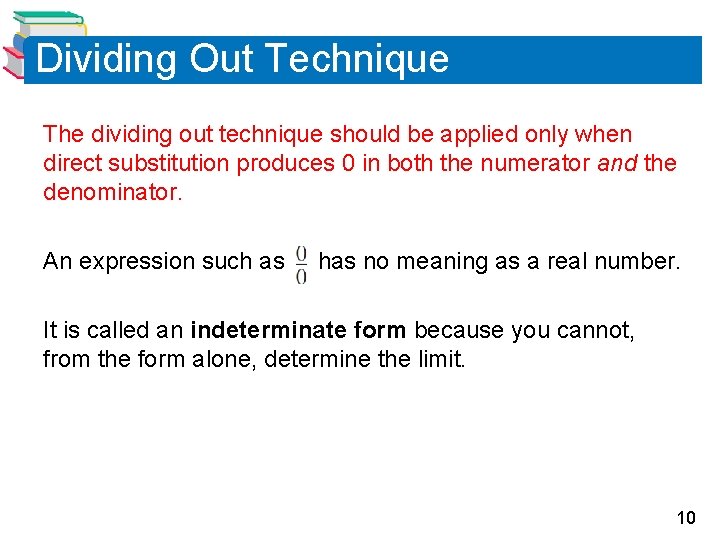
Dividing Out Technique The dividing out technique should be applied only when direct substitution produces 0 in both the numerator and the denominator. An expression such as has no meaning as a real number. It is called an indeterminate form because you cannot, from the form alone, determine the limit. 10
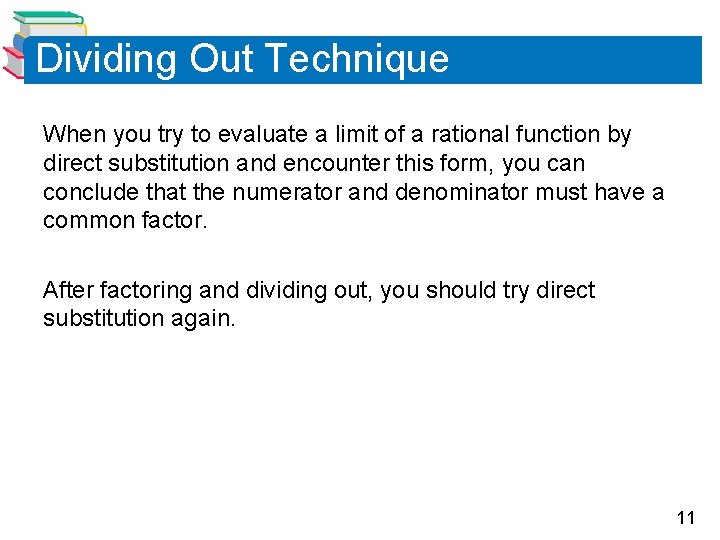
Dividing Out Technique When you try to evaluate a limit of a rational function by direct substitution and encounter this form, you can conclude that the numerator and denominator must have a common factor. After factoring and dividing out, you should try direct substitution again. 11
Rationalizing Technique 12
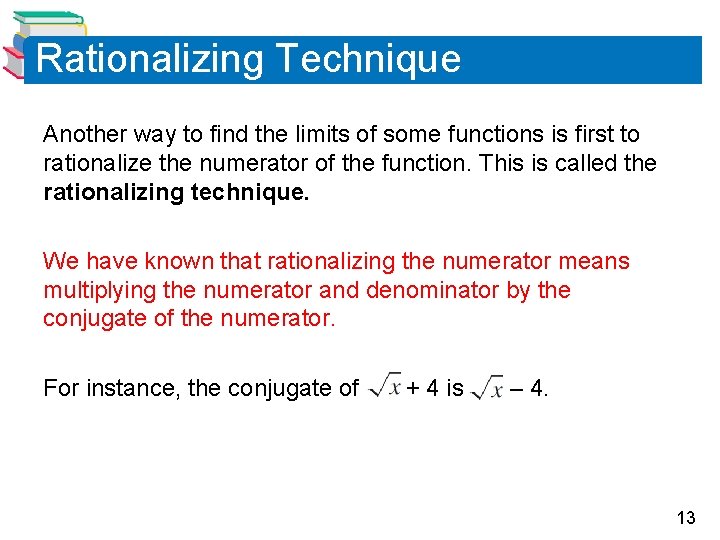
Rationalizing Technique Another way to find the limits of some functions is first to rationalize the numerator of the function. This is called the rationalizing technique. We have known that rationalizing the numerator means multiplying the numerator and denominator by the conjugate of the numerator. For instance, the conjugate of + 4 is – 4. 13
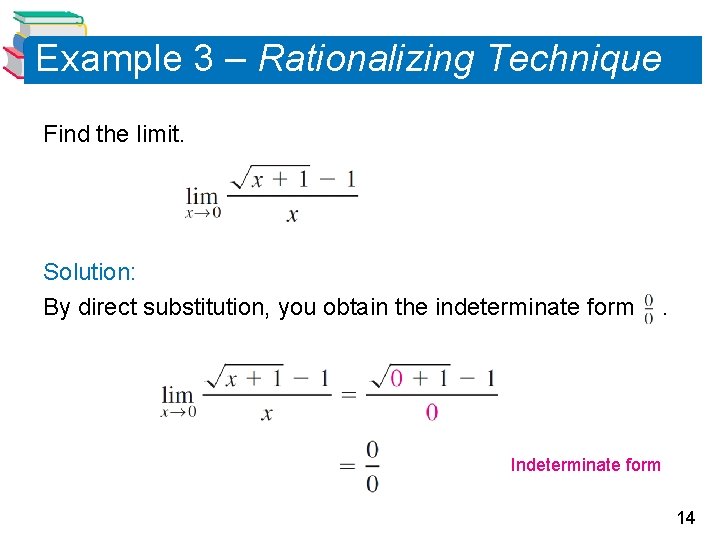
Example 3 – Rationalizing Technique Find the limit. Solution: By direct substitution, you obtain the indeterminate form . Indeterminate form 14
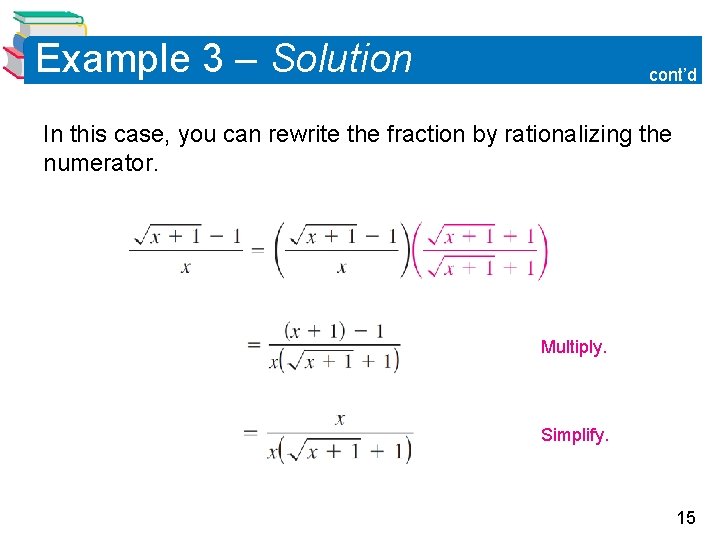
Example 3 – Solution cont’d In this case, you can rewrite the fraction by rationalizing the numerator. Multiply. Simplify. 15
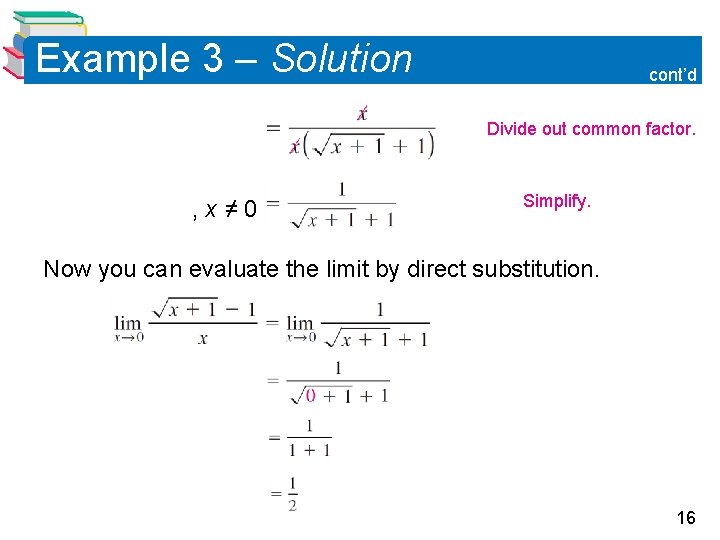
Example 3 – Solution cont’d Divide out common factor. , x≠ 0 Simplify. Now you can evaluate the limit by direct substitution. 16
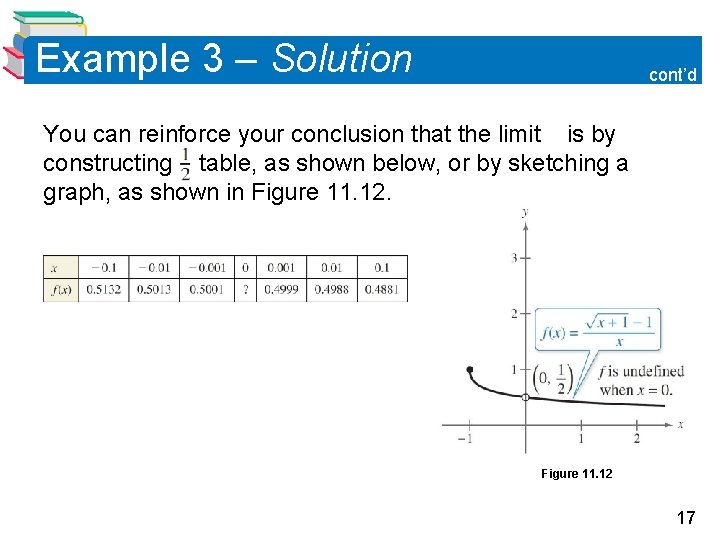
Example 3 – Solution cont’d You can reinforce your conclusion that the limit is by constructing a table, as shown below, or by sketching a graph, as shown in Figure 11. 12 17
One-Sided Limits 18
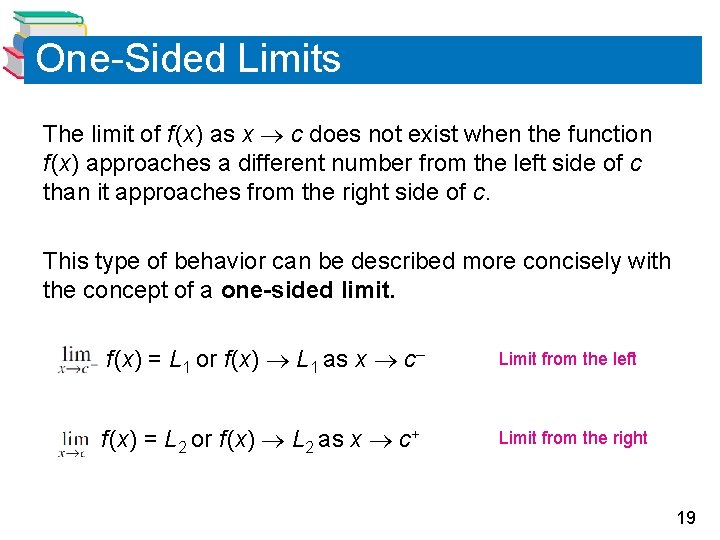
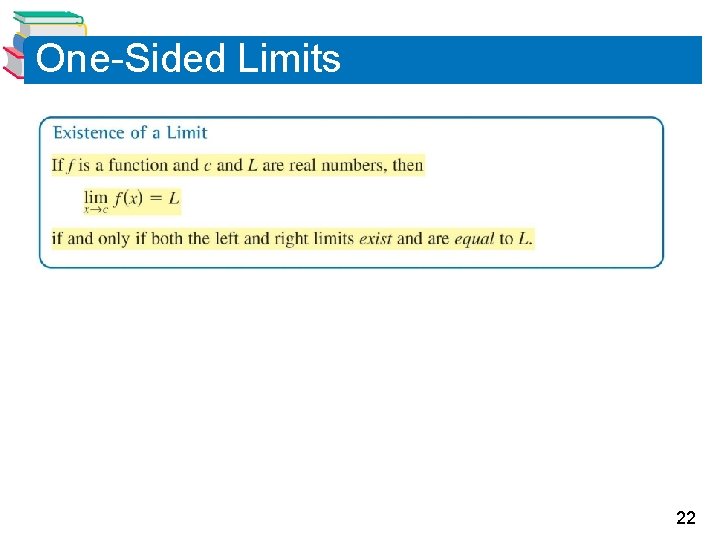
One-Sided Limits The limit of f (x) as x c does not exist when the function f (x) approaches a different number from the left side of c than it approaches from the right side of c. This type of behavior can be described more concisely with the concept of a one-sided limit. f (x) = L 1 or f (x) L 1 as x c– Limit from the left f (x) = L 2 or f (x) L 2 as x c+ Limit from the right 19
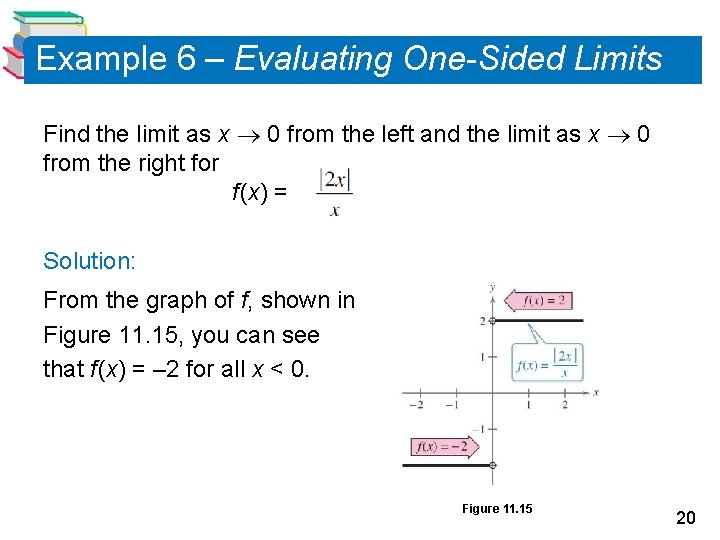
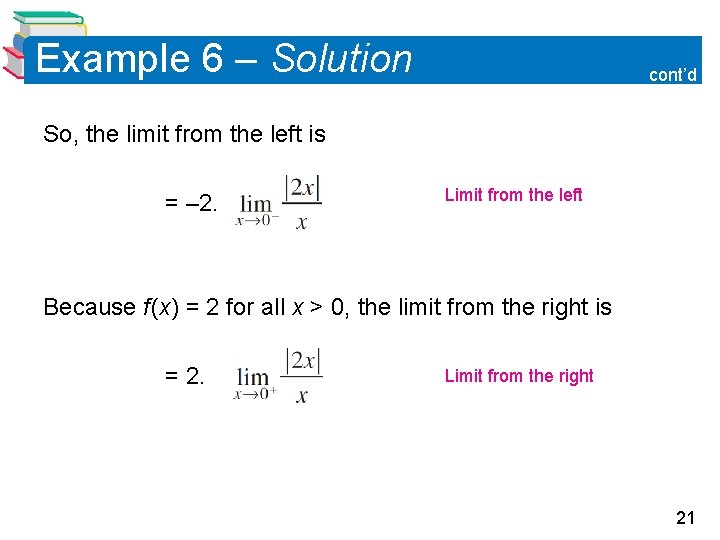
Example 6 – Evaluating One-Sided Limits Find the limit as x 0 from the left and the limit as x 0 from the right for f (x) =. Solution: From the graph of f, shown in Figure 11. 15, you can see that f (x) = – 2 for all x < 0. Figure 11. 15 20
Example 6 – Solution cont’d So, the limit from the left is = – 2. Limit from the left Because f (x) = 2 for all x > 0, the limit from the right is = 2. Limit from the right 21
One-Sided Limits 22
A Limit from Calculus 23
A Limit from Calculus In the next section, you will study an important type of limit from calculus—the limit of a difference quotient. 24
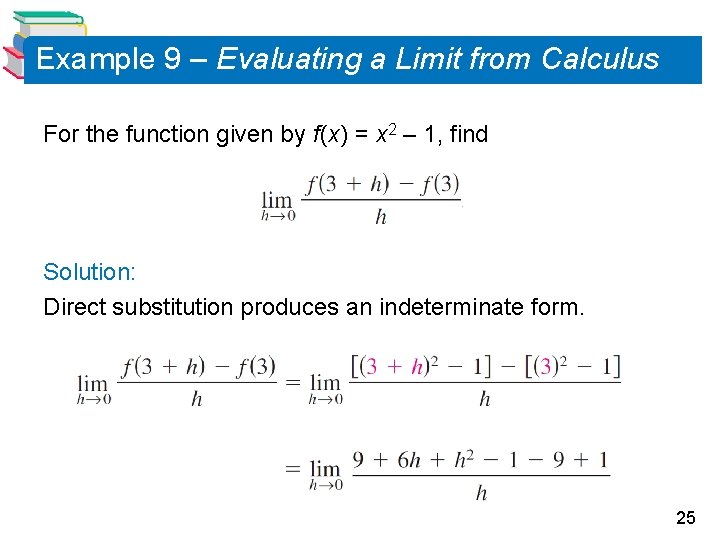
Example 9 – Evaluating a Limit from Calculus For the function given by f (x) = x 2 – 1, find Solution: Direct substitution produces an indeterminate form. 25
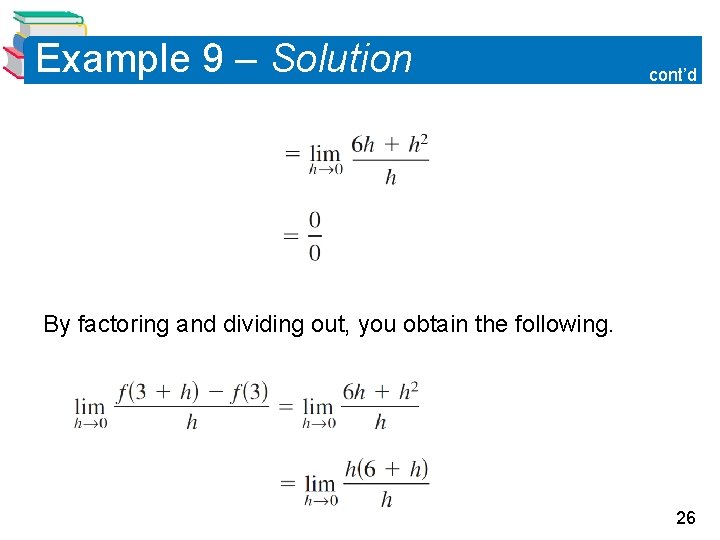
Example 9 – Solution cont’d By factoring and dividing out, you obtain the following. 26
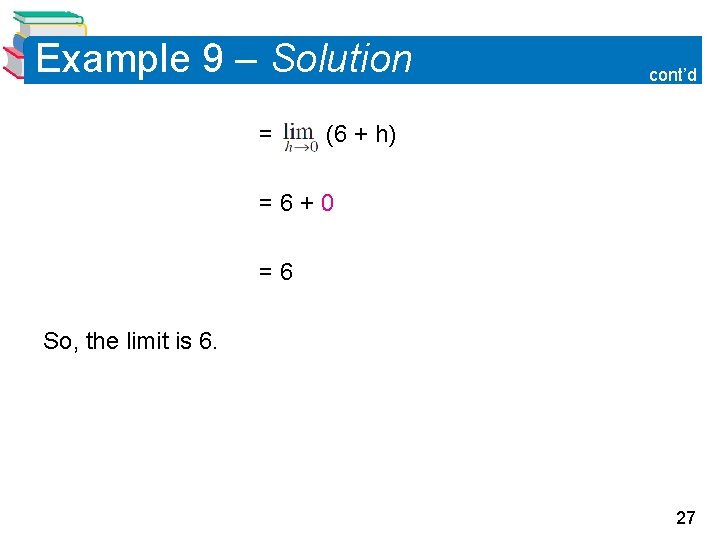
Example 9 – Solution = cont’d (6 + h) =6+0 =6 So, the limit is 6. 27