
11 2 Human Activity and Climate Change Climate

- Slides: 12
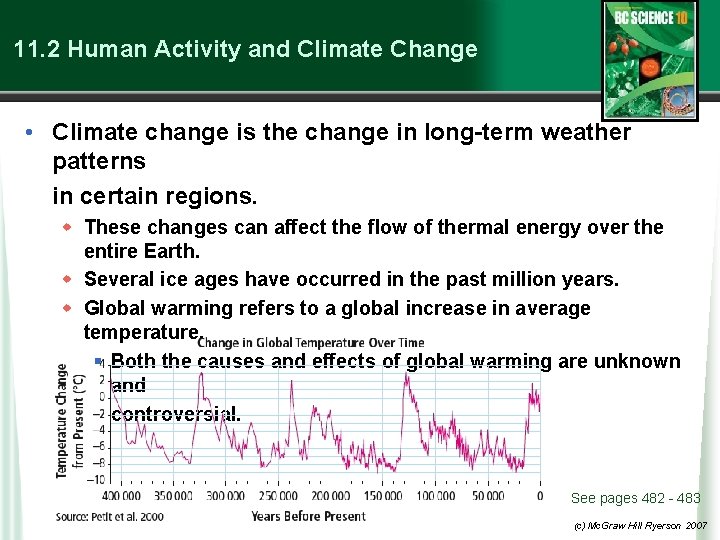
11. 2 Human Activity and Climate Change • Climate change is the change in long-term weather patterns in certain regions. w These changes can affect the flow of thermal energy over the entire Earth. w Several ice ages have occurred in the past million years. w Global warming refers to a global increase in average temperature. § Both the causes and effects of global warming are unknown and controversial. See pages 482 - 483 (c) Mc. Graw Hill Ryerson 2007
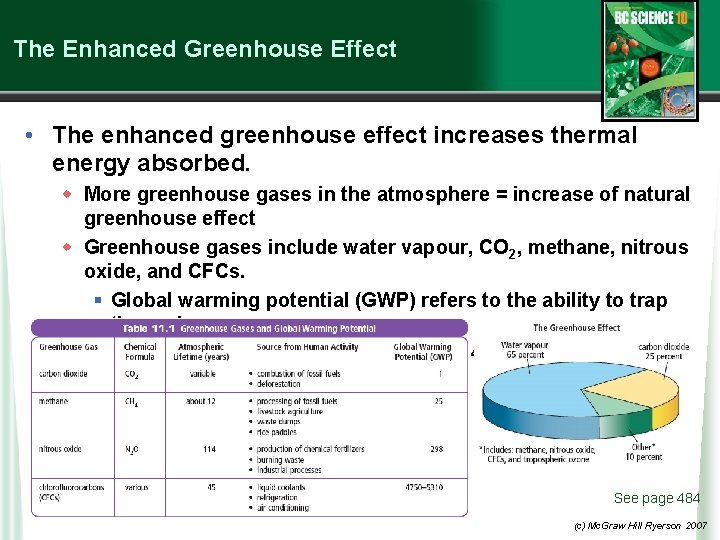
The Enhanced Greenhouse Effect • The enhanced greenhouse effect increases thermal energy absorbed. w More greenhouse gases in the atmosphere = increase of natural greenhouse effect w Greenhouse gases include water vapour, CO 2, methane, nitrous oxide, and CFCs. § Global warming potential (GWP) refers to the ability to trap thermal energy. • CO 2 is given a GWP of 1; CFCs are 4750 -5310. See page 484 (c) Mc. Graw Hill Ryerson 2007
The Enhanced Greenhouse Effect: Carbon Dioxide and Methane • CO 2 levels have increased greatly in the past 200 years. w Since the Industrial Revolution, humans have greatly increased their overall use of fossil fuels, which release CO 2 when burned. w Deforestation has changed carbon sinks, such as forests, into carbon sources. w Many people are attempting to reduce CO 2 emissions by using alternative energy sources or by reducing their energy use. Livestock produce w Carbon offsets, such as wind farms, can be purchased 18 percent of the total methane in to offset CO 2 emissions. • Methane is very efficient at trapping thermal energy. the atmosphere. w 25 X more efficient than CO 2 w Methane is produced by bacteria breaking down wastes in oxygen-free environments, animals digesting plant matter, rice paddies (and other natural wetlands), and the burning of fossil fuels. See page 485 (c) Mc. Graw Hill Ryerson 2007
The Enhanced Greenhouse Effect: Nitrous Oxide, Ozone, and Halocarbons • Nitrous oxide, N 2 O, is the third largest contributor to the enhanced greenhouse effect. w Even though there are only small amounts, it has 300 X more GWP than CO 2. w N 2 O comes from bacteria, fertilizers, and improper disposal of human and animal waste. • Ozone is an important UV radiation blocker in the stratosphere. w At lower altitudes, however, it is a very powerful greenhouse gas. § This ozone comes from solar radiation reacting with pollution from the burning of fossil fuels, and is released from photocopiers and certain air conditioners. • Halocarbons, used as refrigerants, are strong greenhouse gases. See page 486 (c) Mc. Graw Hill Ryerson 2007 w Chlorofluorocarbons (CFCs) are the best-known halocarbons.
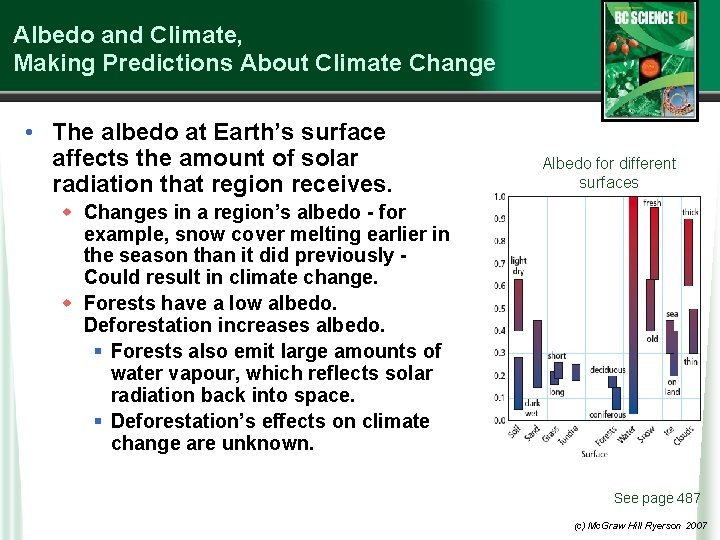
Albedo and Climate, Making Predictions About Climate Change • The albedo at Earth’s surface affects the amount of solar radiation that region receives. Albedo for different surfaces w Changes in a region’s albedo - for example, snow cover melting earlier in the season than it did previously Could result in climate change. w Forests have a low albedo. Deforestation increases albedo. § Forests also emit large amounts of water vapour, which reflects solar radiation back into space. § Deforestation’s effects on climate change are unknown. See page 487 (c) Mc. Graw Hill Ryerson 2007
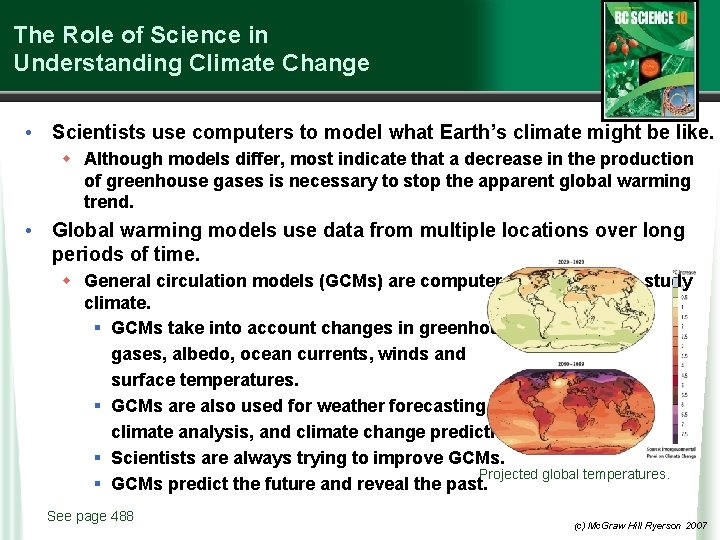
The Role of Science in Understanding Climate Change • Scientists use computers to model what Earth’s climate might be like. w Although models differ, most indicate that a decrease in the production of greenhouse gases is necessary to stop the apparent global warming trend. • Global warming models use data from multiple locations over long periods of time. w General circulation models (GCMs) are computer models used to study climate. § GCMs take into account changes in greenhouse gases, albedo, ocean currents, winds and surface temperatures. § GCMs are also used for weather forecasting, climate analysis, and climate change predictions. § Scientists are always trying to improve GCMs. Projected global temperatures. § GCMs predict the future and reveal the past. See page 488 (c) Mc. Graw Hill Ryerson 2007
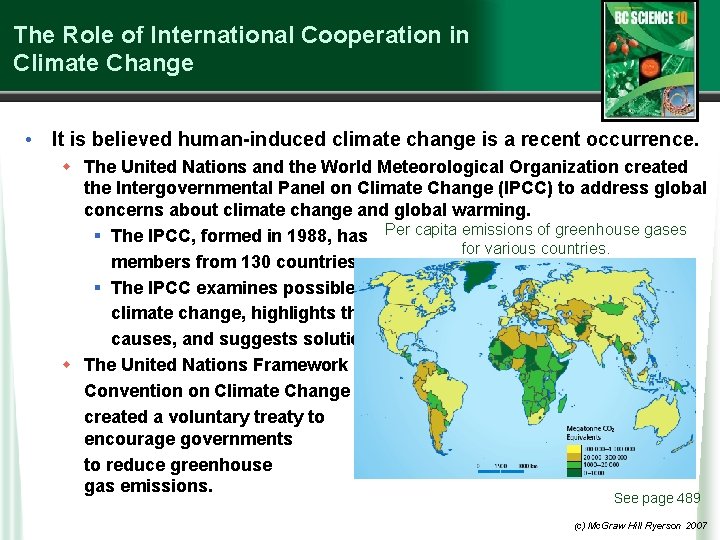
The Role of International Cooperation in Climate Change • It is believed human-induced climate change is a recent occurrence. w The United Nations and the World Meteorological Organization created the Intergovernmental Panel on Climate Change (IPCC) to address global concerns about climate change and global warming. § The IPCC, formed in 1988, has Per capita emissions of greenhouse gases for various countries. members from 130 countries. § The IPCC examines possible climate change, highlights the causes, and suggests solutions. w The United Nations Framework Convention on Climate Change created a voluntary treaty to encourage governments to reduce greenhouse gas emissions. See page 489 (c) Mc. Graw Hill Ryerson 2007
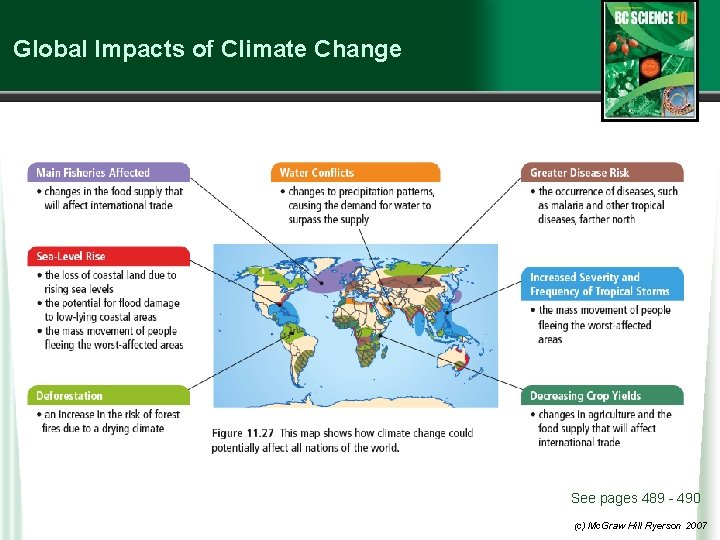
Global Impacts of Climate Change See pages 489 - 490 (c) Mc. Graw Hill Ryerson 2007
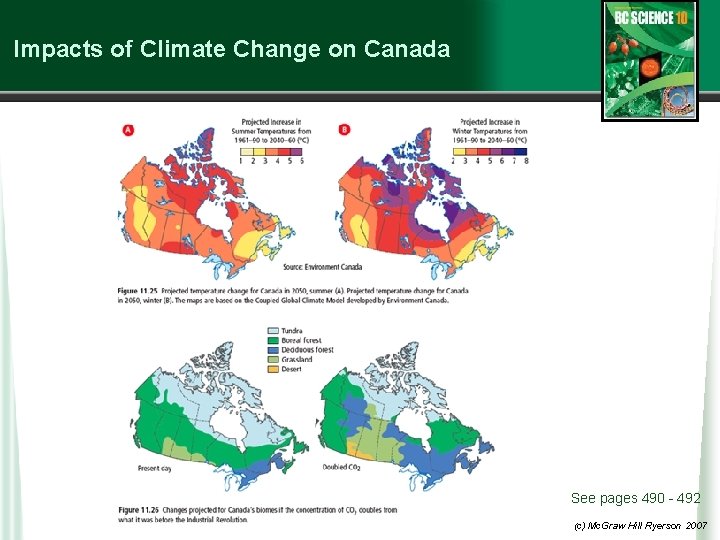
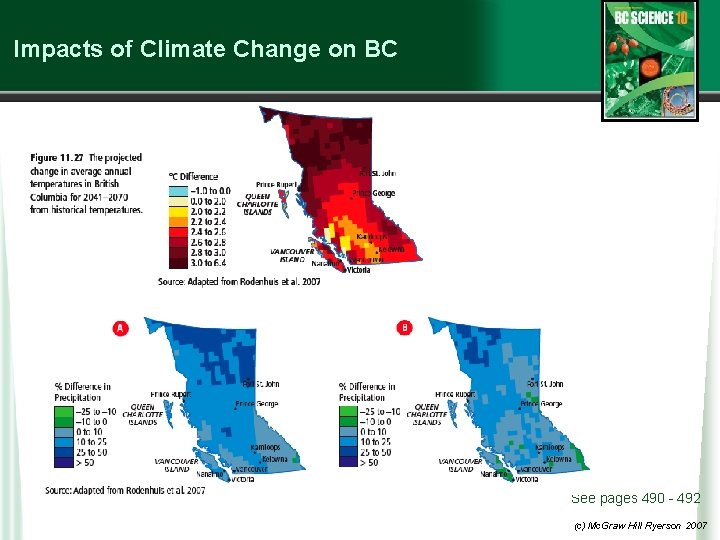
Impacts of Climate Change on Canada • Being in the northern hemisphere, Canada could be strongly affected by global warming. w Parts of Canada have had average temperature increases of 0. 5ºC to 1. 5ºC. § Southern and western parts of the country have been most affected. § The Arctic regions are losing permafrost and Arctic Ocean ice cover. § Growing seasons are getting longer and more precipitation is falling. • There could be heavier spring rains and severe droughts in the future. • Fisheries could be very negatively affected. • Pollution concerns could lead to health issues. See pages 490 - 492 § Most regions of British Columbia will probably be(c) warmer, sea Mc. Graw Hill Ryerson 2007
Impacts of Climate Change on Canada See pages 490 - 492 (c) Mc. Graw Hill Ryerson 2007
Impacts of Climate Change on BC See pages 490 - 492 (c) Mc. Graw Hill Ryerson 2007
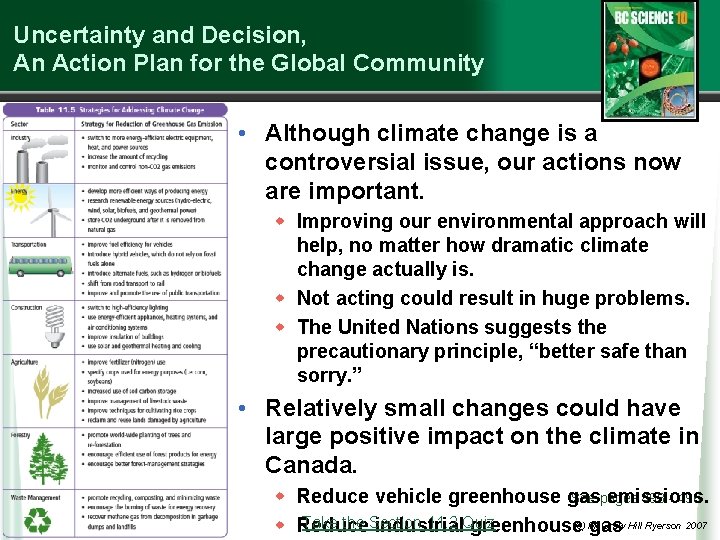
Uncertainty and Decision, An Action Plan for the Global Community • Although climate change is a controversial issue, our actions now are important. w Improving our environmental approach will help, no matter how dramatic climate change actually is. w Not acting could result in huge problems. w The United Nations suggests the precautionary principle, “better safe than sorry. ” • Relatively small changes could have large positive impact on the climate in Canada. w Reduce vehicle greenhouse gas emissions. See pages 493 - 496 Take the Section 11. 2 Quiz w Reduce industrial greenhouse(c) Mc. Graw gas Hill Ryerson 2007