
108 1 Medical English Course Introduction Peihying Lu
- Slides: 28
108 -1 Medical English Course Introduction Peih-ying Lu Professor/ Head Department of Medical Humanities and Education ALLPPT. com _ Free Power. Point Templates, Diagrams and Charts
Why Medical English? Another class of medical terminology? !!
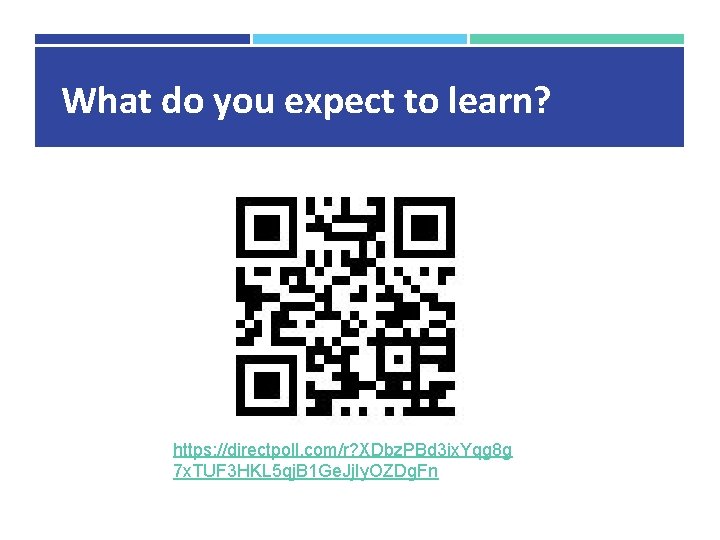
What do you expect to learn? https: //directpoll. com/r? XDbz. PBd 3 ix. Yqg 8 g 7 x. TUF 3 HKL 5 qj. B 1 Ge. Jj. Iy. OZDg. Fn
Why Medical English? In this course, you will be able: To analyze the structure of medical terms To learn basic knowledge of common diseases To use medical knowledge in a group discussion To discuss about issues related to medical humanities To deliver proper academic presentations of medical topics To carry out a doctor/patient conversation in English with fluency
Course Objectives To develop students’ competence in using English in academic or clinical environments. To facilitate students’ learning in four skills, i. e. Listening, Speaking, Reading and Writing. To integrate professionalism development with the medical English learning.
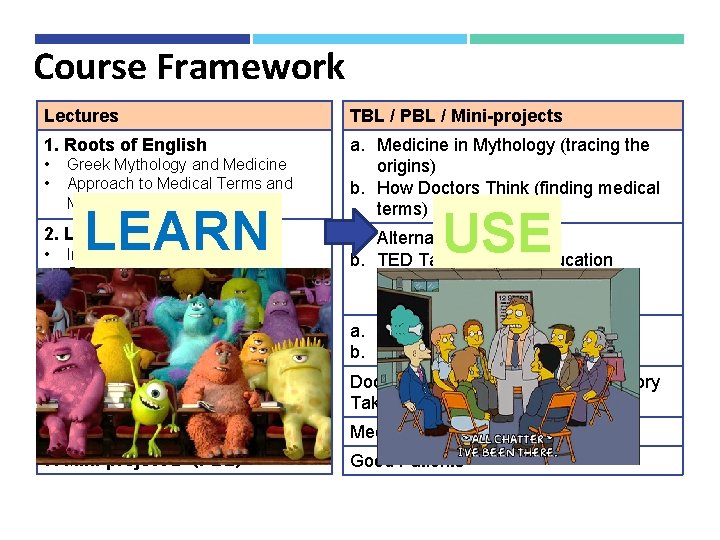
Course Framework Lectures TBL / PBL / Mini-projects 1. Roots of English a. Medicine in Mythology (tracing the origins) b. How Doctors Think (finding medical terms) • • Greek Mythology and Medicine Approach to Medical Terms and Medical Professions LEARN 2. Learning about the Body • • Internal Medicine Surgery USE a. Alternative Medicine b. TED Talks / Health Education 3. Learning about the Brain 4. Learning about Children’s and Women’s Health a. Unwanted Pregnancies b. Birth Plan 5. Medical Communication Doctor/Patient Communication: History Taking 6. Mini-project 1(PBL) Medicine and Society 7. Mini-project 2(PBL) Good Patients
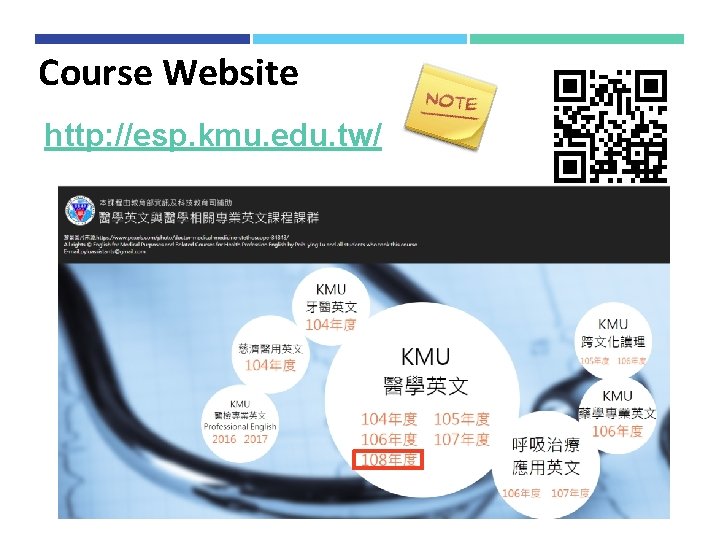
Course Website http: //esp. kmu. edu. tw/
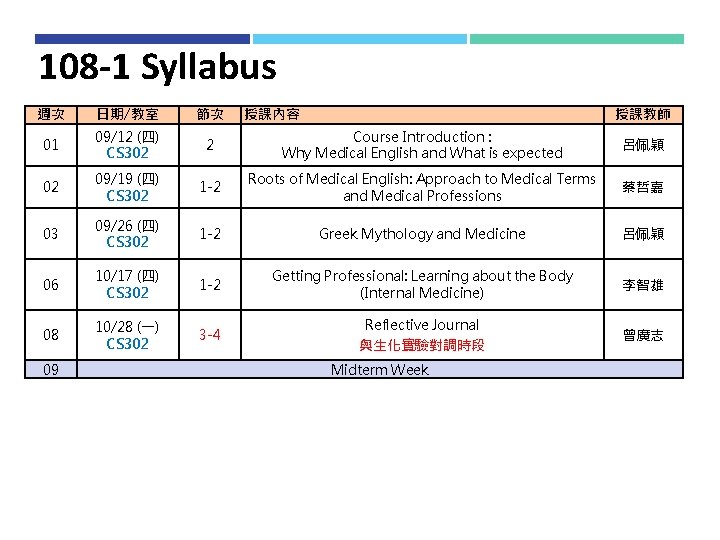
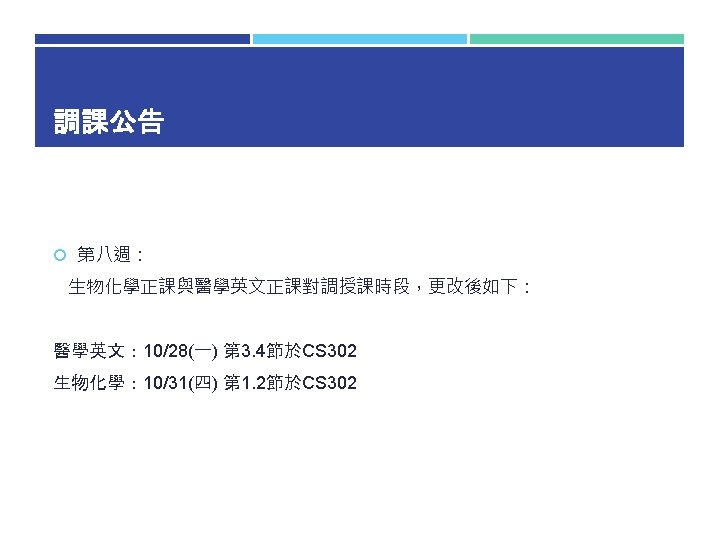
108 -1 Syllabus 週次 日期/教室 節次 01 09/12 (四) CS 302 2 Course Introduction : Why Medical English and What is expected 呂佩穎 02 09/19 (四) CS 302 1 -2 Roots of Medical English: Approach to Medical Terms and Medical Professions 蔡哲嘉 03 09/26 (四) CS 302 1 -2 Greek Mythology and Medicine 呂佩穎 06 10/17 (四) CS 302 1 -2 Getting Professional: Learning about the Body (Internal Medicine) 李智雄 08 10/28 (一) CS 302 3 -4 Reflective Journal 與生化實驗對調時段 曾廣志 09 授課內容 授課教師 Midterm Week
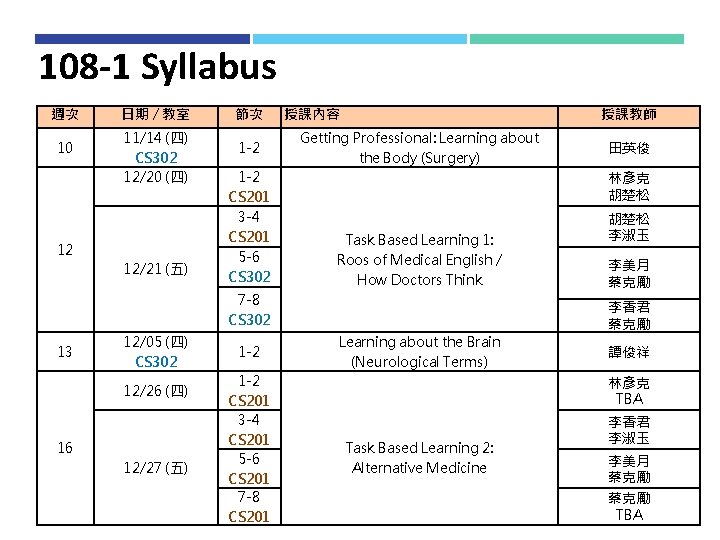
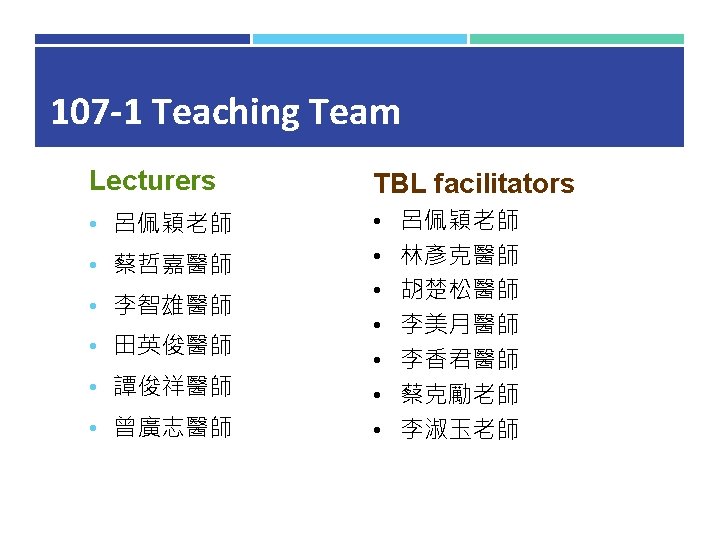
108 -1 Syllabus 週次 10 日期 / 教室 11/14 (四) CS 302 12/20 (四) 12 12/21 (五) 節次 授課內容 1 -2 CS 201 3 -4 CS 201 5 -6 CS 302 授課教師 Getting Professional: Learning about the Body (Surgery) 林彥克 胡楚松 Task Based Learning 1: Roos of Medical English / How Doctors Think 7 -8 CS 302 13 12/05 (四) CS 302 12/26 (四) 16 12/27 (五) 1 -2 CS 201 3 -4 CS 201 5 -6 CS 201 7 -8 CS 201 田英俊 Learning about the Brain (Neurological Terms) 胡楚松 李淑玉 李美月 蔡克勵 李香君 蔡克勵 譚俊祥 林彥克 TBA Task Based Learning 2: Alternative Medicine 李香君 李淑玉 李美月 蔡克勵 TBA
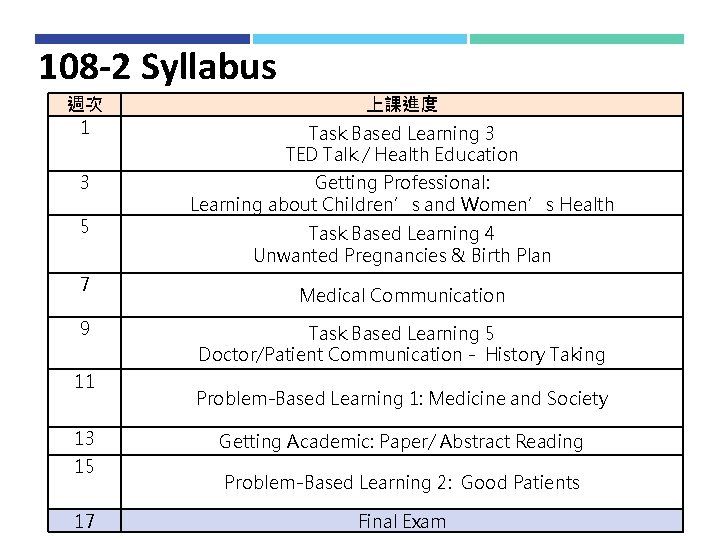
108 -2 Syllabus 週次 1 3 5 7 9 11 13 15 17 上課進度 Task Based Learning 3 TED Talk / Health Education Getting Professional: Learning about Children’s and Women’s Health Task Based Learning 4 Unwanted Pregnancies & Birth Plan Medical Communication Task Based Learning 5 Doctor/Patient Communication - History Taking Problem-Based Learning 1: Medicine and Society Getting Academic: Paper/ Abstract Reading Problem-Based Learning 2: Good Patients Final Exam
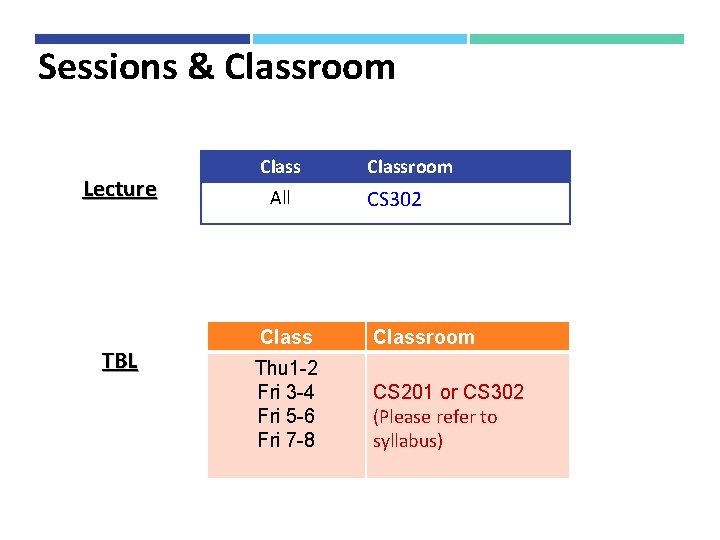
Sessions & Classroom Lecture TBL Class All Classroom CS 302 Classroom Thu 1 -2 Fri 3 -4 Fri 5 -6 Fri 7 -8 CS 201 or CS 302 (Please refer to syllabus)
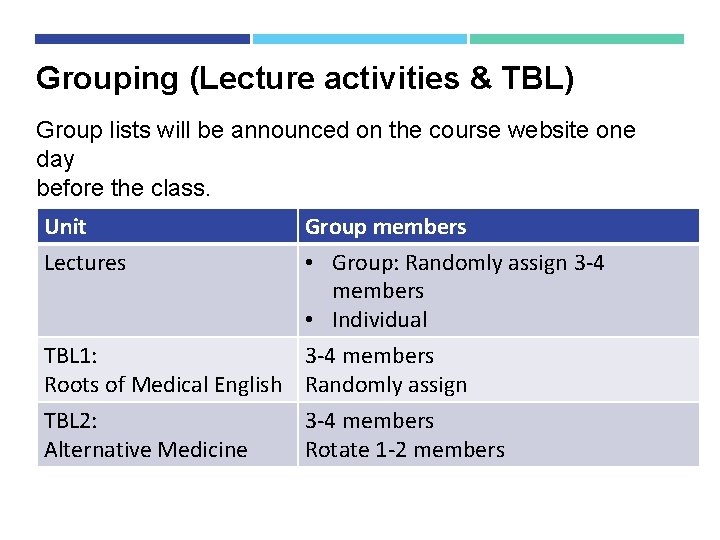
Grouping (Lecture activities & TBL) Group lists will be announced on the course website one day before the class. Unit Lectures Group members • Group: Randomly assign 3 -4 members • Individual TBL 1: Roots of Medical English TBL 2: Alternative Medicine 3 -4 members Randomly assign 3 -4 members Rotate 1 -2 members
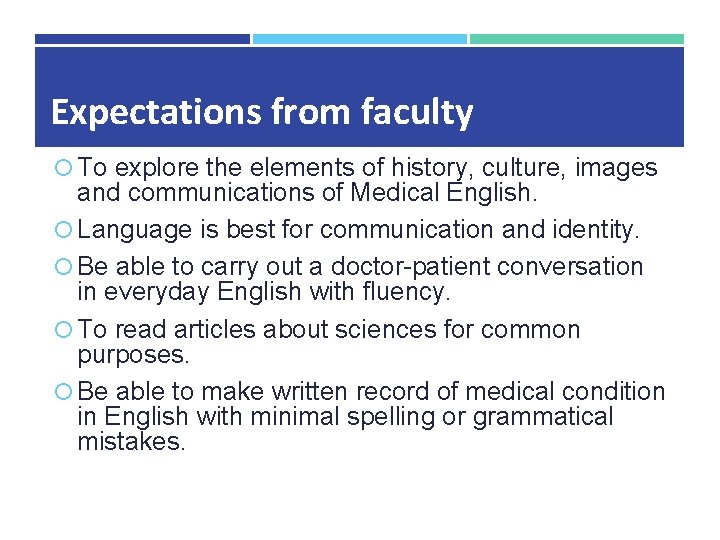
Expectations from faculty To explore the elements of history, culture, images and communications of Medical English. Language is best for communication and identity. Be able to carry out a doctor-patient conversation in everyday English with fluency. To read articles about sciences for common purposes. Be able to make written record of medical condition in English with minimal spelling or grammatical mistakes.
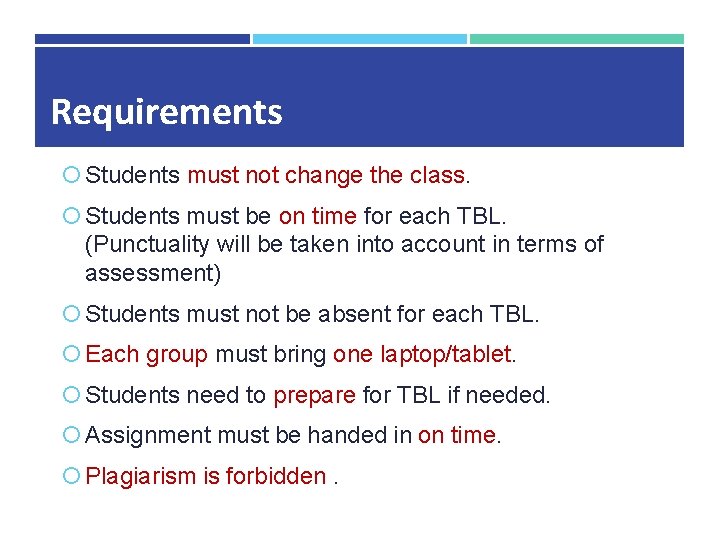
Requirements Students must not change the class. Students must be on time for each TBL. (Punctuality will be taken into account in terms of assessment) Students must not be absent for each TBL. Each group must bring one laptop/tablet. Students need to prepare for TBL if needed. Assignment must be handed in on time. Plagiarism is forbidden.
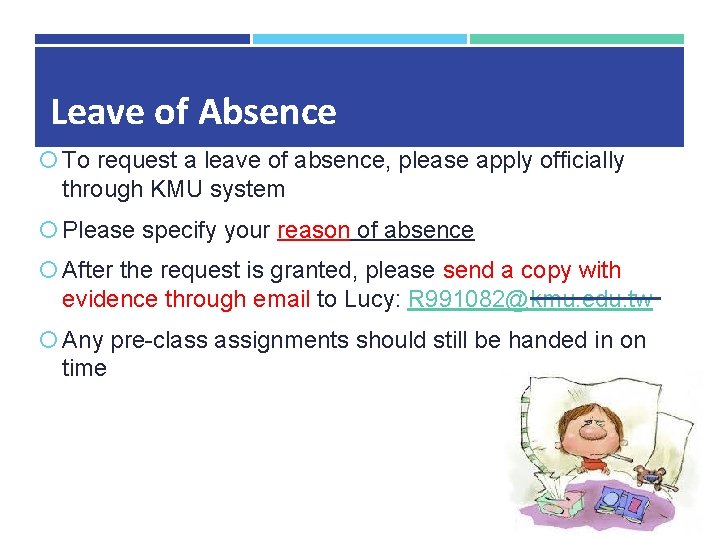
Leave of Absence To request a leave of absence, please apply officially through KMU system Please specify your reason of absence After the request is granted, please send a copy with evidence through email to Lucy: R 991082@kmu. edu. tw Any pre-class assignments should still be handed in on time
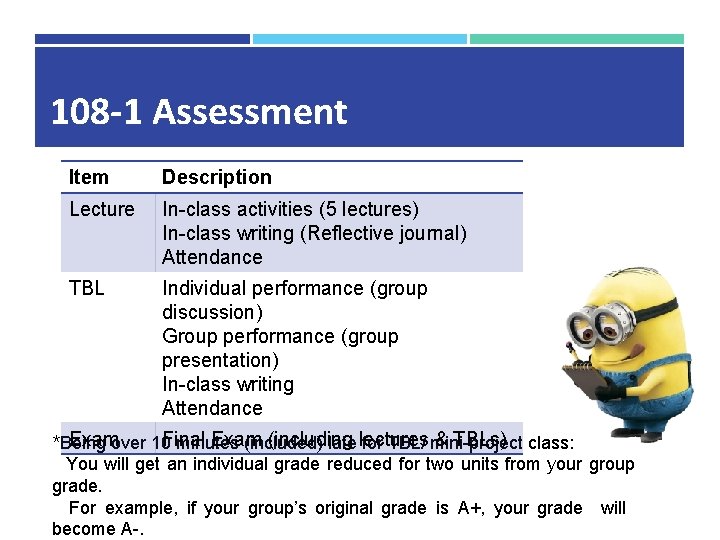
108 -1 Assessment Item Description Lecture In-class activities (5 lectures) In-class writing (Reflective journal) Attendance TBL Individual performance (group discussion) Group performance (group presentation) In-class writing Attendance Exam Final Exam (including lectures & TBLs) *Being over 10 minutes (included) late for TBL/ mini-project class: You will get an individual grade reduced for two units from your group grade. For example, if your group’s original grade is A+, your grade will become A-.
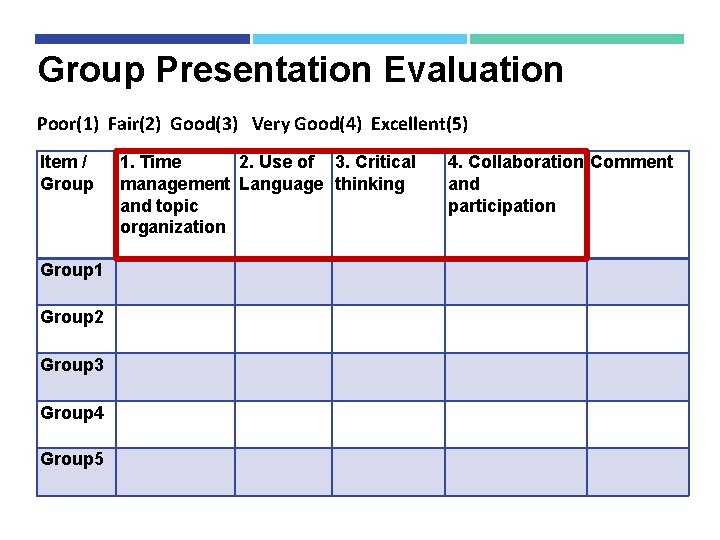
Group Presentation Evaluation Poor(1) Fair(2) Good(3) Very Good(4) Excellent(5) Item / Group 1. Time 2. Use of management Language and topic organization Group 1 3. Critical thinking 4. Collaboration Comment and participation Group 2 Group 3 Group 4 Group 5
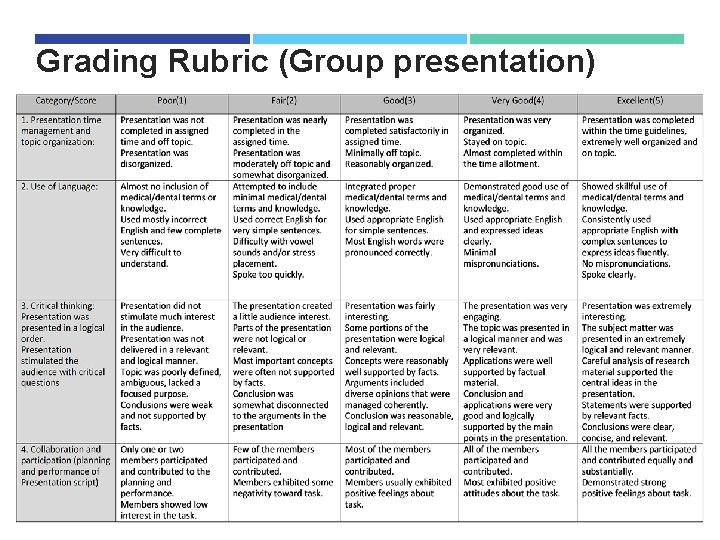
Grading Rubric (Group presentation)
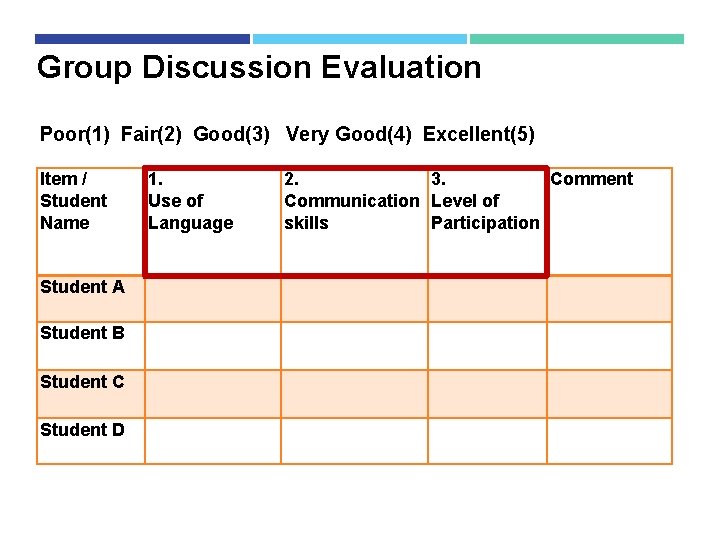
Group Discussion Evaluation Poor(1) Fair(2) Good(3) Very Good(4) Excellent(5) Item / Student Name 1. Use of Language 2. 3. Comment Communication Level of skills Participation Student A Student B Student C Student D
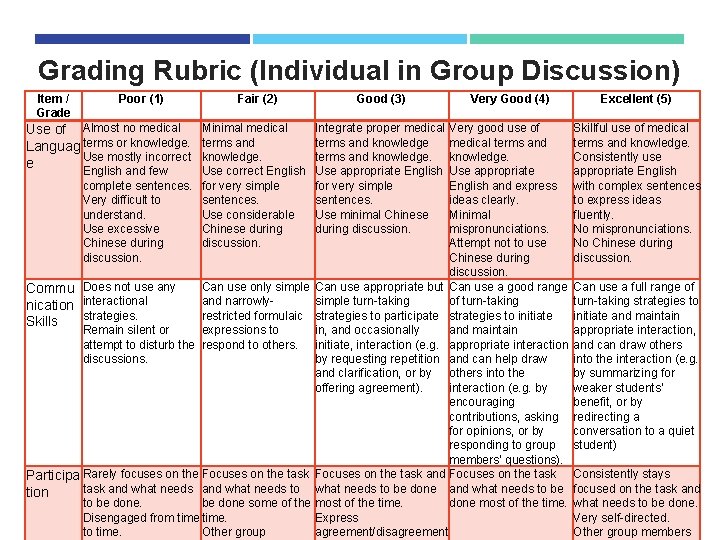
Grading Rubric (Individual in Group Discussion) Item / Grade Poor (1) Fair (2) Use of Almost no medical Minimal medical Languag terms or knowledge. terms and Use mostly incorrect knowledge. e Good (3) Very Good (4) Excellent (5) Integrate proper medical Very good use of Skillful use of medical terms and knowledge. Consistently use English and few Use correct English Use appropriate English complete sentences. for very simple English and express with complex sentences Very difficult to sentences. ideas clearly. to express ideas understand. Use considerable Use minimal Chinese Minimal fluently. Use excessive Chinese during discussion. mispronunciations. No mispronunciations. Chinese during discussion. Attempt not to use No Chinese during discussion. Does not use any Can use only simple Can use appropriate but Can use a good range Can use a full range of Commu and narrowlysimple turn-taking of turn-taking strategies to nication interactional strategies. restricted formulaic strategies to participate strategies to initiate and maintain Skills Remain silent or expressions to in, and occasionally and maintain appropriate interaction, attempt to disturb the respond to others. initiate, interaction (e. g. appropriate interaction and can draw others discussions. by requesting repetition and can help draw into the interaction (e. g. and clarification, or by others into the by summarizing for offering agreement). interaction (e. g. by weaker students’ encouraging benefit, or by contributions, asking redirecting a for opinions, or by conversation to a quiet responding to group student) members’ questions). Participa Rarely focuses on the Focuses on the task and Focuses on the task Consistently stays task and what needs to be done and what needs to be focused on the task and tion to be done some of the most of the time. done most of the time. what needs to be done. Disengaged from time. Express Very self-directed. to time. Other group agreement/disagreement Other group members
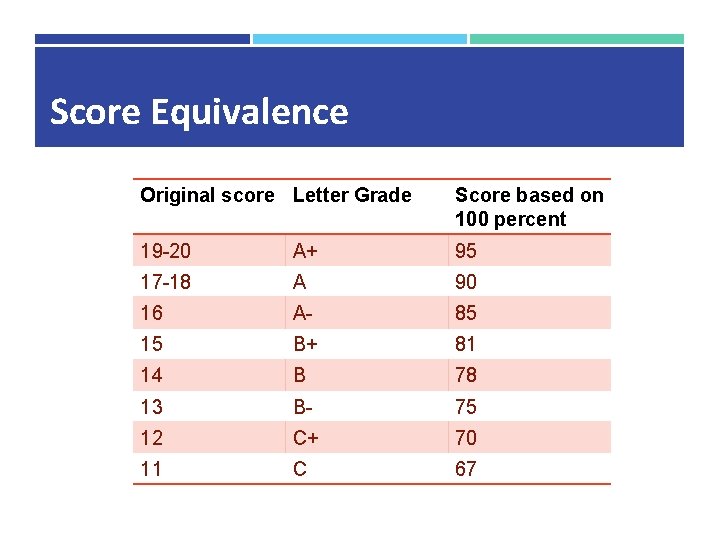
Score Equivalence Original score Letter Grade Score based on 100 percent 19 -20 A+ 95 17 -18 A 90 16 A- 85 15 B+ 81 14 B 78 13 B- 75 12 C+ 70 11 C 67
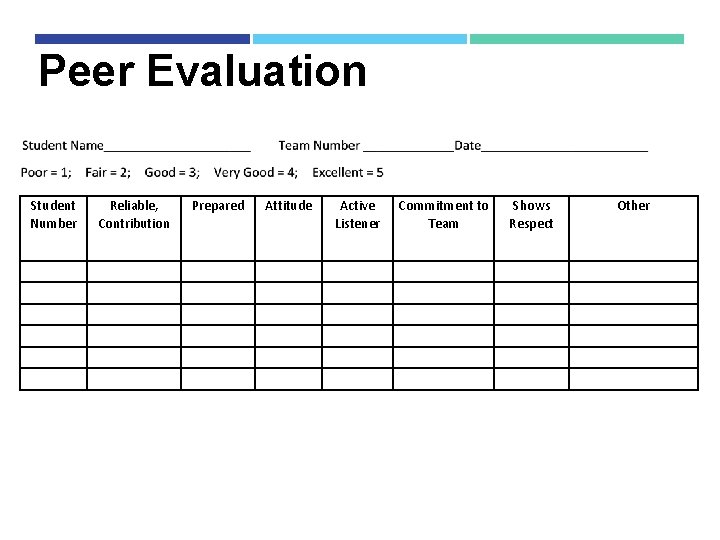
Peer Evaluation Student Number Reliable, Contribution Prepared Attitude Active Listener Commitment to Team Shows Respect Other
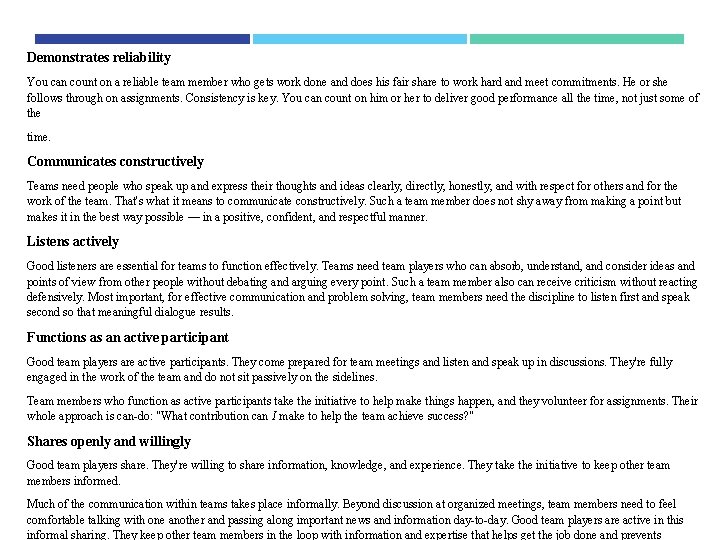
Demonstrates reliability You can count on a reliable team member who gets work done and does his fair share to work hard and meet commitments. He or she follows through on assignments. Consistency is key. You can count on him or her to deliver good performance all the time, not just some of the time. Communicates constructively Teams need people who speak up and express their thoughts and ideas clearly, directly, honestly, and with respect for others and for the work of the team. That's what it means to communicate constructively. Such a team member does not shy away from making a point but makes it in the best way possible — in a positive, confident, and respectful manner. Listens actively Good listeners are essential for teams to function effectively. Teams need team players who can absorb, understand, and consider ideas and points of view from other people without debating and arguing every point. Such a team member also can receive criticism without reacting defensively. Most important, for effective communication and problem solving, team members need the discipline to listen first and speak second so that meaningful dialogue results. Functions as an active participant Good team players are active participants. They come prepared for team meetings and listen and speak up in discussions. They're fully engaged in the work of the team and do not sit passively on the sidelines. Team members who function as active participants take the initiative to help make things happen, and they volunteer for assignments. Their whole approach is can-do: "What contribution can I make to help the team achieve success? " Shares openly and willingly Good team players share. They're willing to share information, knowledge, and experience. They take the initiative to keep other team members informed. Much of the communication within teams takes place informally. Beyond discussion at organized meetings, team members need to feel comfortable talking with one another and passing along important news and information day-to-day. Good team players are active in this informal sharing. They keep other team members in the loop with information and expertise that helps get the job done and prevents
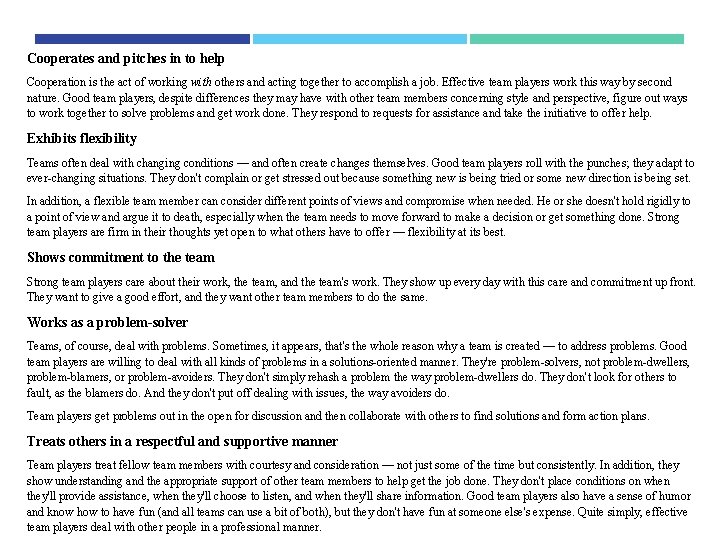
Cooperates and pitches in to help Cooperation is the act of working with others and acting together to accomplish a job. Effective team players work this way by second nature. Good team players, despite differences they may have with other team members concerning style and perspective, figure out ways to work together to solve problems and get work done. They respond to requests for assistance and take the initiative to offer help. Exhibits flexibility Teams often deal with changing conditions — and often create changes themselves. Good team players roll with the punches; they adapt to ever-changing situations. They don't complain or get stressed out because something new is being tried or some new direction is being set. In addition, a flexible team member can consider different points of views and compromise when needed. He or she doesn't hold rigidly to a point of view and argue it to death, especially when the team needs to move forward to make a decision or get something done. Strong team players are firm in their thoughts yet open to what others have to offer — flexibility at its best. Shows commitment to the team Strong team players care about their work, the team, and the team's work. They show up every day with this care and commitment up front. They want to give a good effort, and they want other team members to do the same. Works as a problem-solver Teams, of course, deal with problems. Sometimes, it appears, that's the whole reason why a team is created — to address problems. Good team players are willing to deal with all kinds of problems in a solutions-oriented manner. They're problem-solvers, not problem-dwellers, problem-blamers, or problem-avoiders. They don't simply rehash a problem the way problem-dwellers do. They don't look for others to fault, as the blamers do. And they don't put off dealing with issues, the way avoiders do. Team players get problems out in the open for discussion and then collaborate with others to find solutions and form action plans. Treats others in a respectful and supportive manner Team players treat fellow team members with courtesy and consideration — not just some of the time but consistently. In addition, they show understanding and the appropriate support of other team members to help get the job done. They don't place conditions on when they'll provide assistance, when they'll choose to listen, and when they'll share information. Good team players also have a sense of humor and know how to have fun (and all teams can use a bit of both), but they don't have fun at someone else's expense. Quite simply, effective team players deal with other people in a professional manner.
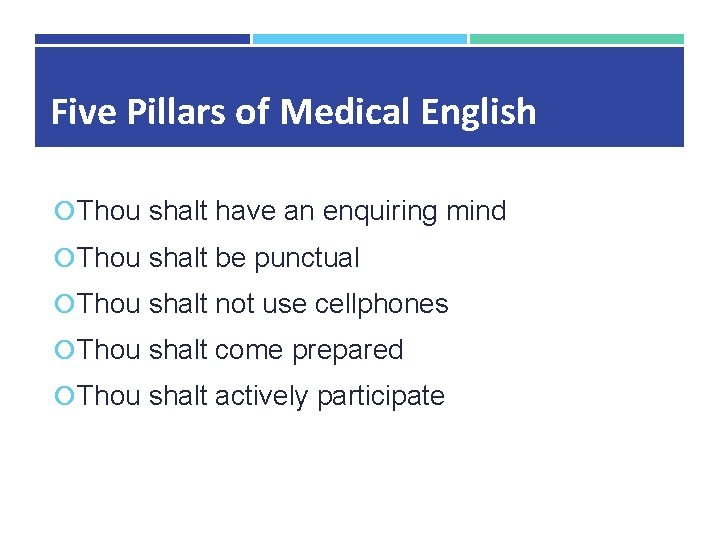
Five Pillars of Medical English Thou shalt have an enquiring mind Thou shalt be punctual Thou shalt not use cellphones Thou shalt come prepared Thou shalt actively participate
Thank you & Enjoy the Class!