
1022020 Learning and Remembering Overview of Long Term


10/2/2020 • Learning and Remembering » Overview of Long Term Memory ◊ Mnemonics and Mnemonists ◊ Ebbinghaus Tradition » Storing to Episodic Memory ◊ Encoding specificity » Retrieval from Episodic Memory ◊ Decay and interference ◊ Encoding specificity » Implicit /Explicit memory Study Question. • Why would it likely be better for a student to write their exams in the same classroom in which they attend lecture? Relate Tulving’s encoding specificity principle to this phenomenon. • Describe the levels (depth) of processing approach to memory. What are incidental learning task and how have they been used to support the depth of processing position.
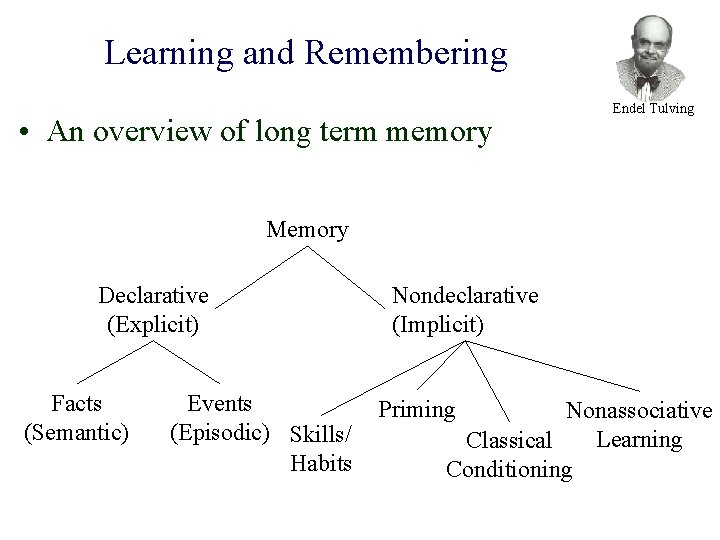
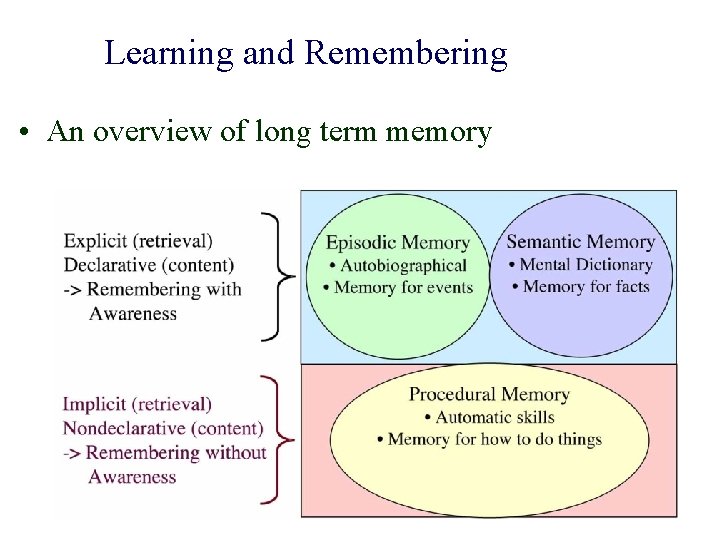
Learning and Remembering • An overview of long term memory Endel Tulving Memory Declarative (Explicit) Facts (Semantic) Events (Episodic) Skills/ Habits Nondeclarative (Implicit) Priming Nonassociative Learning Classical Conditioning
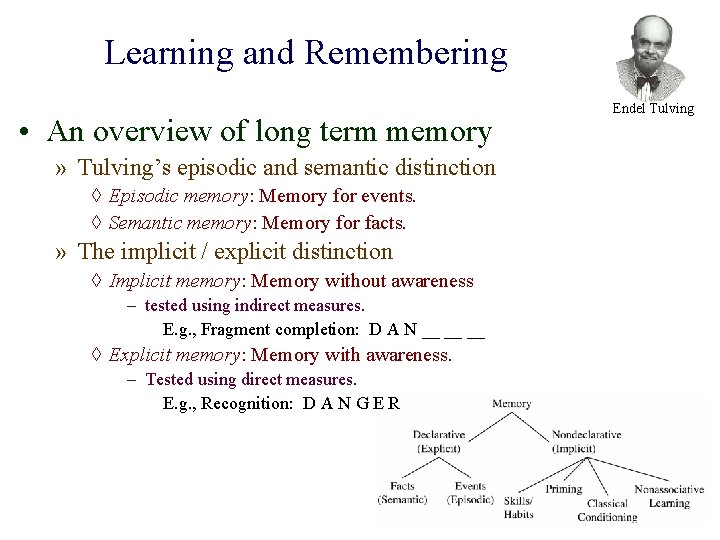
Learning and Remembering • An overview of long term memory » Tulving’s episodic and semantic distinction ◊ Episodic memory: Memory for events. ◊ Semantic memory: Memory for facts. » The implicit / explicit distinction ◊ Implicit memory: Memory without awareness – tested using indirect measures. E. g. , Fragment completion: D A N __ __ __ ◊ Explicit memory: Memory with awareness. – Tested using direct measures. E. g. , Recognition: D A N G E R Endel Tulving
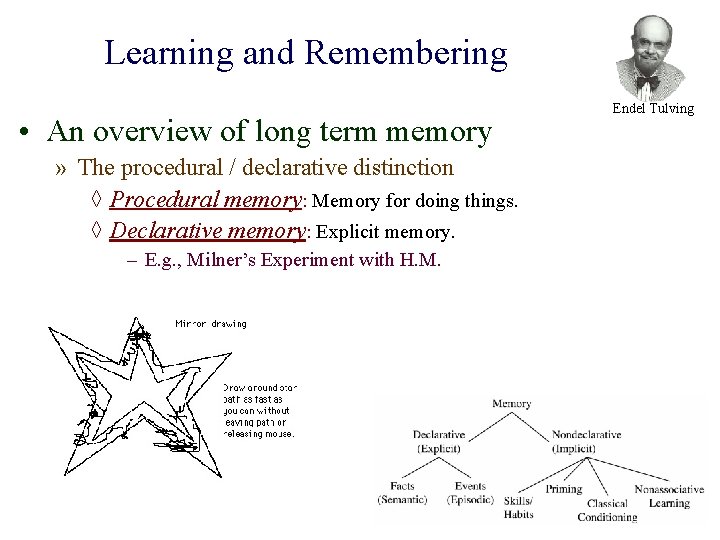
Learning and Remembering • An overview of long term memory » The procedural / declarative distinction ◊ Procedural memory: Memory for doing things. ◊ Declarative memory: Explicit memory. – E. g. , Milner’s Experiment with H. M. Endel Tulving
Learning and Remembering • An overview of long term memory <Selection of clips from “Memento”>
Learning and Remembering • An overview of long term memory
Learning and Remembering • An overview of long term memory » Mnemonics Video clip: Memory Wizards available at http: //www. youtube. com/watch? v=6 vs. YCSm. Bc. M 0
Learning and Remembering • An overview of long term memory » Mnemonics ◊ How good is your memory?
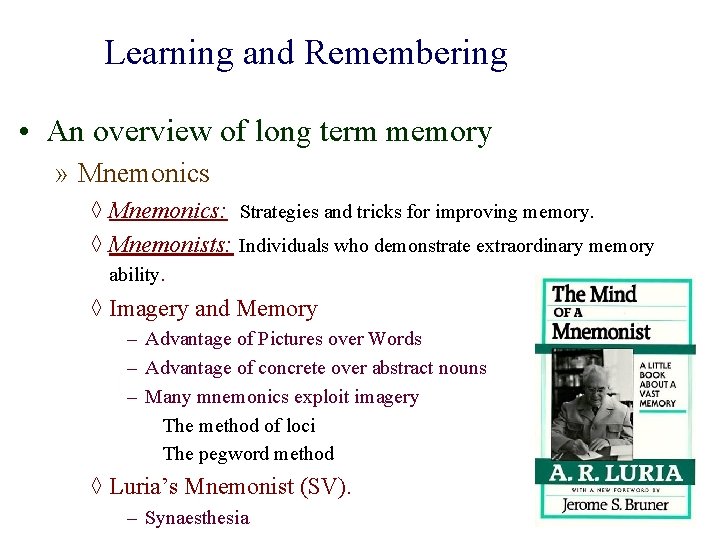
Learning and Remembering • An overview of long term memory » Mnemonics ◊ Mnemonics: Strategies and tricks for improving memory. ◊ Mnemonists: Individuals who demonstrate extraordinary memory ability. ◊ Imagery and Memory – Advantage of Pictures over Words – Advantage of concrete over abstract nouns – Many mnemonics exploit imagery The method of loci The pegword method ◊ Luria’s Mnemonist (SV). – Synaesthesia
Learning and Remembering • An overview of long term memory » Three mnemonic principles 1. Structure for learning – Encoding (rehearsal) 2. Use of images/rhymes/acronyms – Deep, durable memories 3. Storage or retention (depth of processing) – Retrieval Cues – Retrieval (encoding specificity)
Learning and Remembering • An overview of long term memory » The Ebbinghaus tradition Hermann von Ebbinghause ◊ Uber das Gedachtnis (1885) ◊ Method – Used nonsense syllables (GAH, SIF, etc. ) – The relearning task Savings score: the reduction in the number of trials necessary for relearning as compared with original learning. – Mac. Leod (1988) Relearning savings are a result of improved recall.
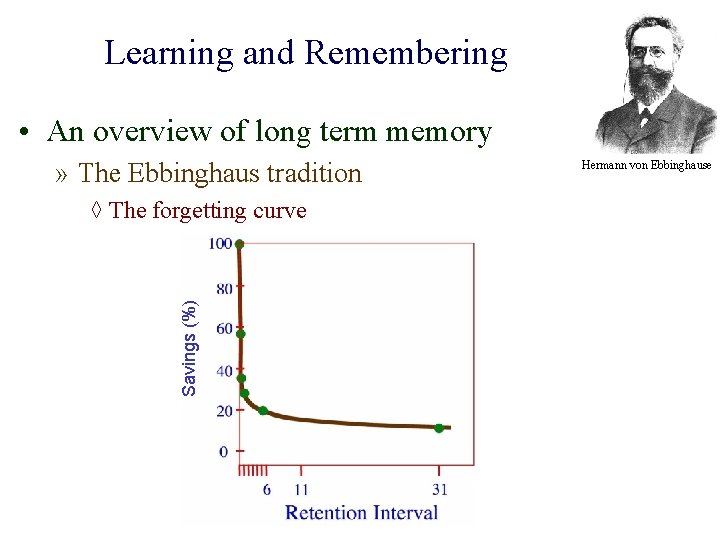
Learning and Remembering • An overview of long term memory » The Ebbinghaus tradition Savings (%) ◊ The forgetting curve Hermann von Ebbinghause
Learning and Remembering • An overview of long term memory » The Ebbinghaus tradition Hermann von Ebbinghause ◊ Evaluation – Problems with the (exclusive) use of nonsense syllables AUP, DWN, LEF, RGT, BAK, FOW – Real life memory ◊ The current position – Meaning is central to the study of LTM – Participants in studies use mnemonics – Ecological validity is important
Learning and Remembering • Storing information in LTM » Frequency ◊ We are very sensitive to the frequency of events » Distinctiveness ◊ The von Restorff effect: improved memory for information that is made distinct from surrounding information. » Rehearsal, organization, and imagery
Learning and Remembering • Storing information in LTM » Rehearsal ◊ Atkinson & Shiffrin’s definition – A deliberate practicing (recycling) of the contents of STM. ◊ Two effects 1. Maintains information in STM 2. Increases the likelihood that the item will be transferred to LTM ◊ Hellyer (1962) – Had participants rehearse out loud and perform a Brown. Peteson task (arithmetic).
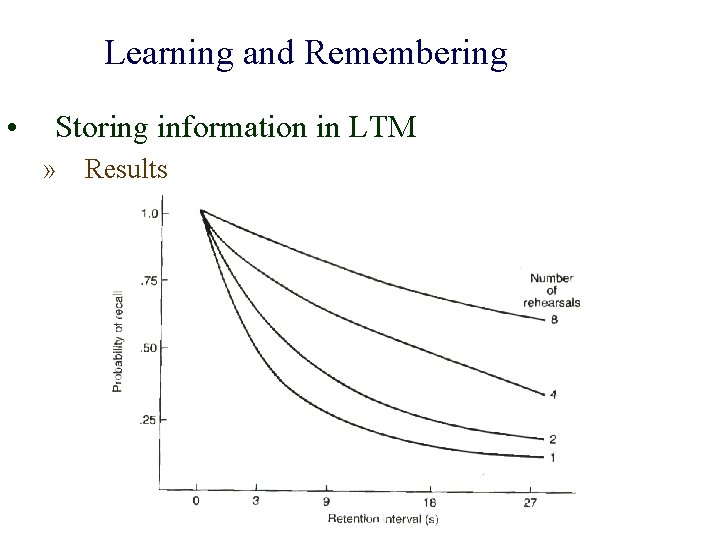
Learning and Remembering • Storing information in LTM » Results
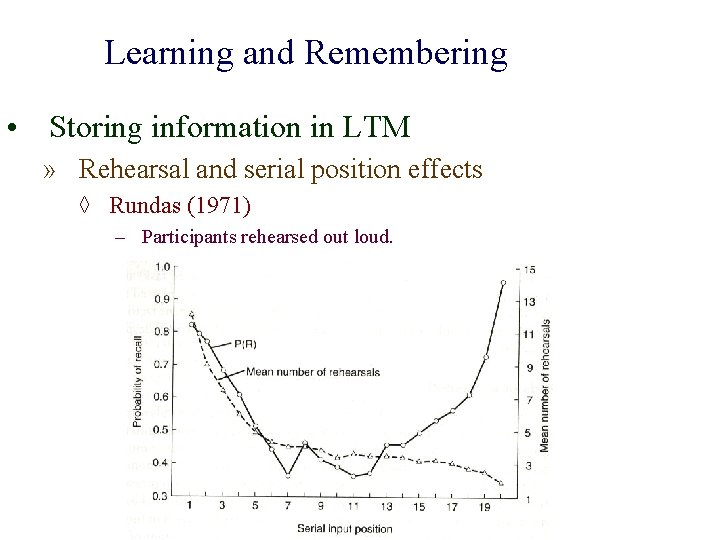
Learning and Remembering • Storing information in LTM » Rehearsal and serial position effects ◊ Rundas (1971) – Participants rehearsed out loud.
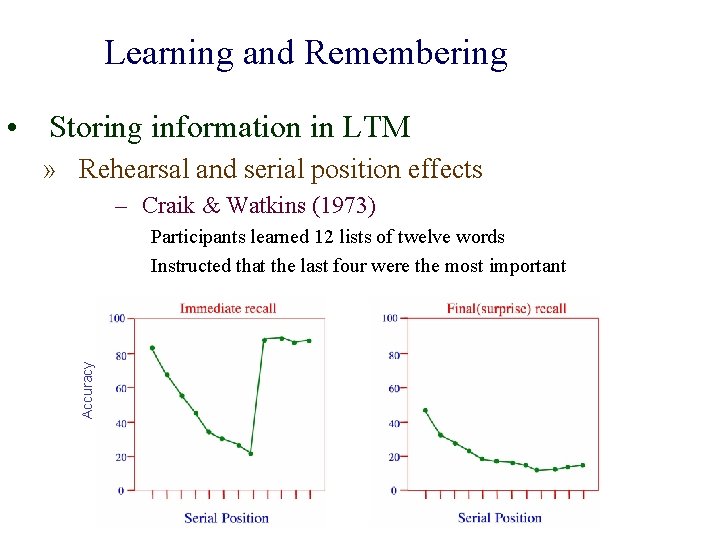
Learning and Remembering • Storing information in LTM » Rehearsal and serial position effects – Craik & Watkins (1973) Accuracy Participants learned 12 lists of twelve words Instructed that the last four were the most important
Learning and Remembering • Storing information in LTM » Levels of Processing ◊ Two postulates of the levels of processing approach 1. Physical properties --> shallow processing Semantic properties --> deep processing 2. The deeper the processing, the more durable the memory. ◊ Two forms of rehearsal 1. Maintenance rehearsal: Rote repetition of information. 2. Elaborative rehearsal: The processing of information on a meaningful level.
Learning and Remembering • Storing information in LTM » Empirical support for levels of processing ◊ Hyde & Jenkins (1973) – Intentional vs Incidental learning – Three incidental learning conditions 1. Pleasantness (semantic/deep) 2. Letter ‘E’ present? (Physical/shallow) 3. Number of letters (Physical/shallow)
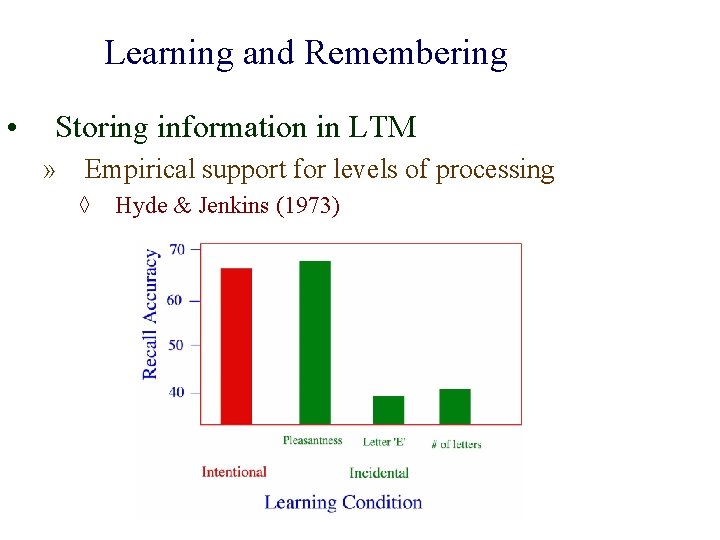
Learning and Remembering • Storing information in LTM » Empirical support for levels of processing ◊ Hyde & Jenkins (1973)
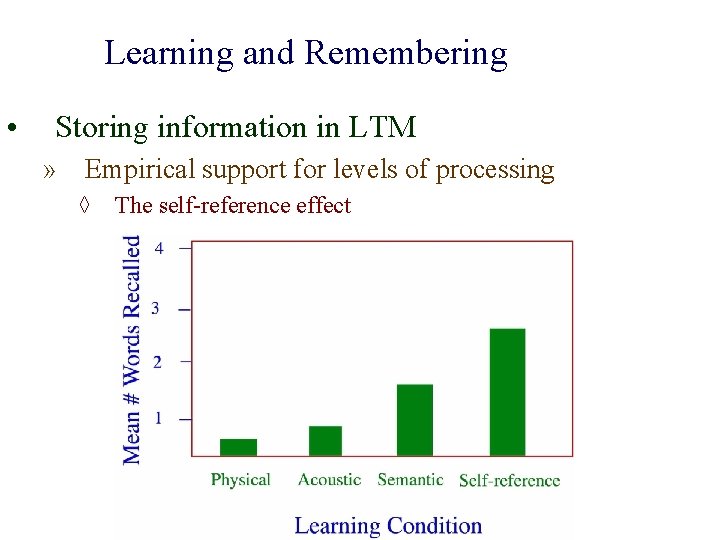
Learning and Remembering • Storing information in LTM » Empirical support for levels of processing ◊ The self-reference effect
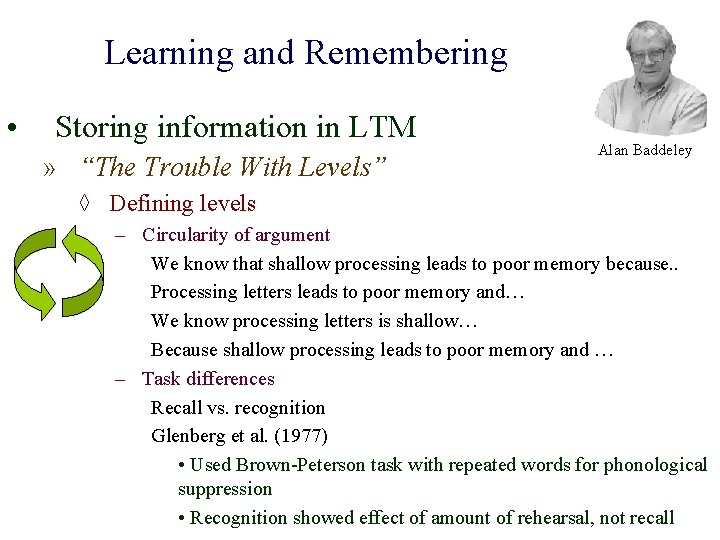
Learning and Remembering • Storing information in LTM » “The Trouble With Levels” Alan Baddeley ◊ Defining levels – Circularity of argument We know that shallow processing leads to poor memory because. . Processing letters leads to poor memory and… We know processing letters is shallow… Because shallow processing leads to poor memory and … – Task differences Recall vs. recognition Glenberg et al. (1977) • Used Brown-Peterson task with repeated words for phonological suppression • Recognition showed effect of amount of rehearsal, not recall
10/2/2020
Learning and Remembering • Storing information in LTM » Organization ◊ List as many “things that you can eat” as you can. – Are your answers organized? Category clustering – Organization in semantic memory (next week) – Tulving’s subjective organization Organization generated by the rememberer for structuring a list where no organization is supplied by the experimenter » Imagery ◊ Paivio’s dual coding hypothesis – Memory can be coded visually and verbally Words that can imaged can be stored twice
Learning and Remembering • Retrieving information from LTM » Decay ◊ Thorndyke’s law of disuse (use it or lose it) ◊ Bartlett and the reconstructive nature of memory – We remember only the gist, not details. » Interference in memory recall ◊ Proactive Interference : Previously learned material interferes with the learning of new material ◊ Retroactive Interference : New material interferes with previously learned material.
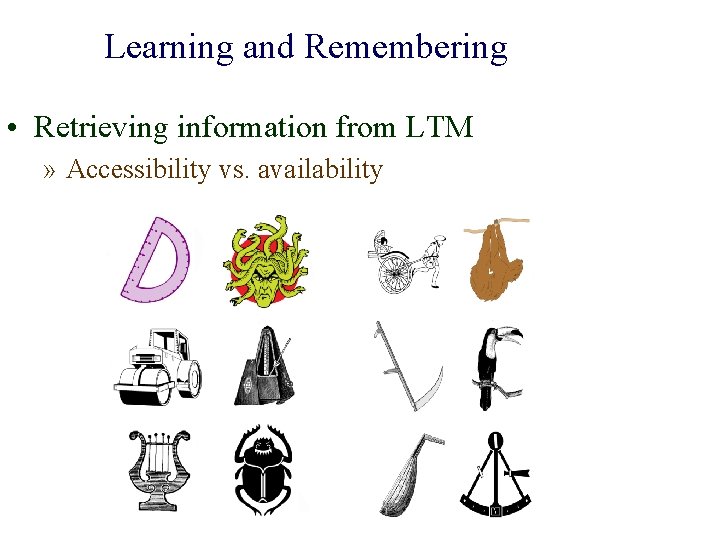
Learning and Remembering • Retrieving information from LTM » Accessibility vs. availability
Learning and Remembering • Retrieving information from LTM » Accessibility vs. availability ◊ Tip-of-the-tongue (Brown & Mac. Neil) – 49 low-frequency words (e. g. , apse, nepotism, sampan), prompted by brief definitions. 8. 5% of trials -> TOT – Total of 360 TOT states: 224 similar-sound TOTs (e. g. , Saipan for sampan) 48% had the same number of syllables as the target 95 similar-meaning TOTs (e. g. , houseboat for sampan). – > 50% can guess the first letter
Learning and Remembering • Retrieving information from LTM » Encoding specificity ◊ When is recall better than recognition? – Tulving’s recognition failure experiment – Step 1: Study list head LIGHT bath NEED pretty BLUE etc. – Step 2: Free association and recognition Endel Tulving
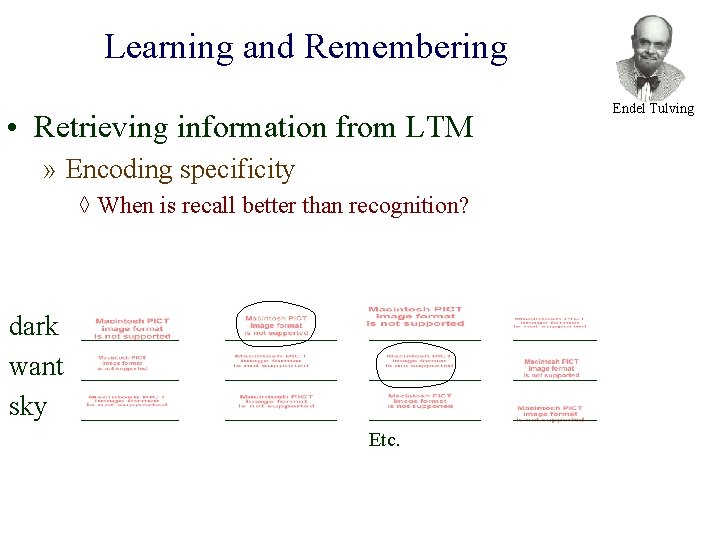
Learning and Remembering Endel Tulving • Retrieving information from LTM » Encoding specificity ◊ When is recall better than recognition? dark _______ want _______ sky ________ ________ Etc. ______
Learning and Remembering • Retrieving information from LTM Endel Tulving » Encoding specificity ◊ When is recall better than recognition? – When recall is cued. ◊ What makes a good cue? – Encoding Specificity Hypothesis. A cue will be an effective aid to retrieval if it is stored as part of the original memory. ◊ An empirical example (Goddan & Baddeley, 1975). – Participants are assigned to one of four conditions and were presented with a list of words. Encoding: Underwater or on land Retrieval: Underwater or on land
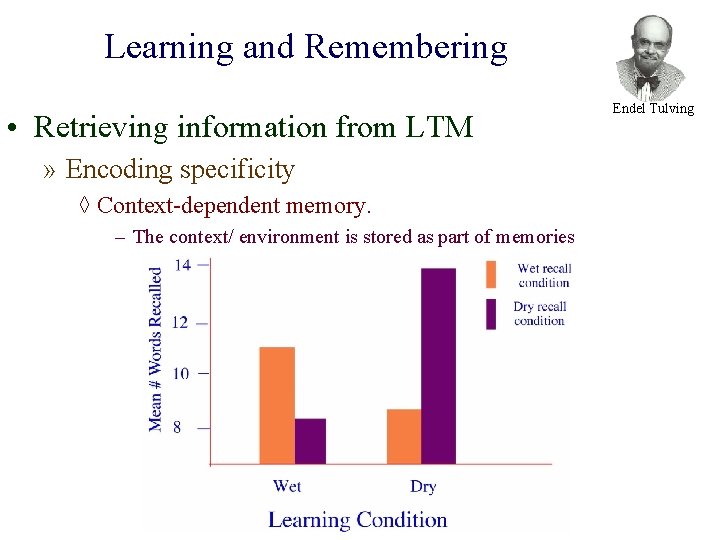
Learning and Remembering • Retrieving information from LTM » Encoding specificity ◊ Context-dependent memory. – The context/ environment is stored as part of memories Endel Tulving
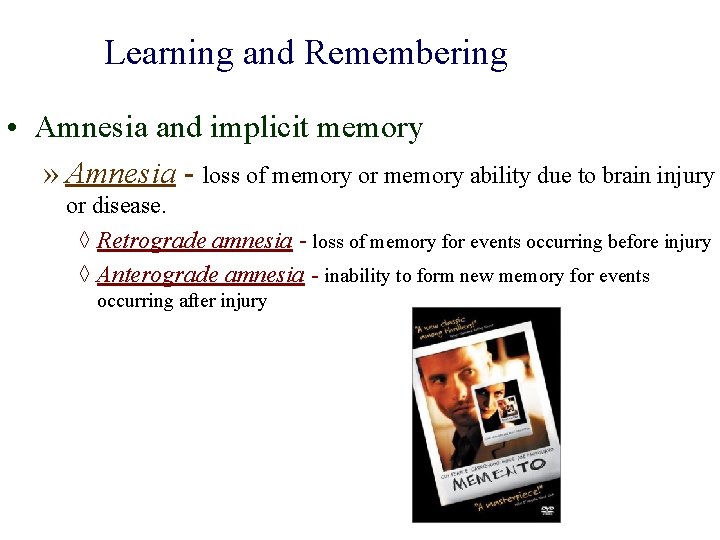
Learning and Remembering • Amnesia and implicit memory » Amnesia - loss of memory or memory ability due to brain injury or disease. ◊ Retrograde amnesia - loss of memory for events occurring before injury ◊ Anterograde amnesia - inability to form new memory for events occurring after injury
Learning and Remembering • Amnesia and implicit memory » Anterograde amnesia Video clip: The man with a 30 sec memory http: //www. youtube. com/watch? v=Wmz. U 47 i 2 xgw&feature=related
Learning and Remembering • Amnesia and implicit memory » Anterograde amnesia ◊ H. M. » Tools and objects, revisited » Role of the hippocampus » Dissociation of declarative and procedural memory ◊ Korsakoff’s syndrome
Learning and Remembering • Amnesia and implicit memory » Warrington & Weiskrantz (1970) ◊ Amnesic patients and institutionalized controls study a list of words. ◊ Three memory tests 1. Free Recall 2. Yes/No recognition 3. Word stem completion: tab____? gar____?
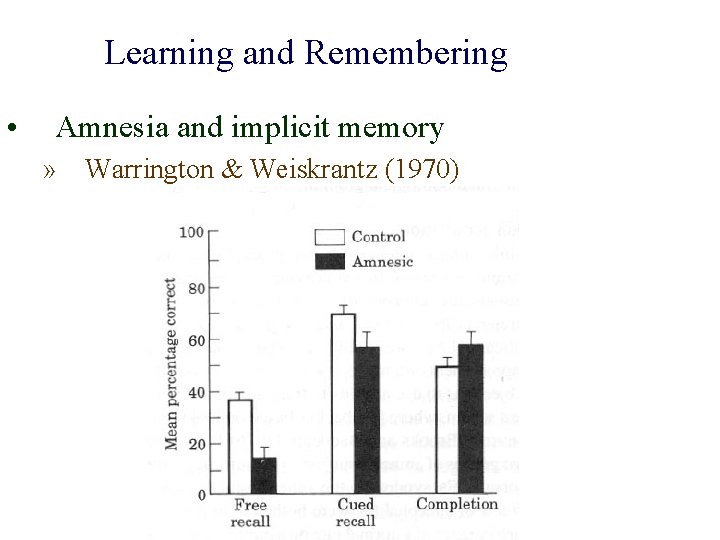
Learning and Remembering • Amnesia and implicit memory » Warrington & Weiskrantz (1970)
Learning and Remembering • Amnesia and implicit memory » Repitition priming - a previous encounter with information facilitated later performance on the same information. ◊ Does not require conscious recognition ◊ Is independent of level of processing ◊ Jacoby & Dallas (1981) – Three orienting tasks 1. Physical (e. g. , contains an ‘L’ ? ) 2. Rhyme (e. g. , rhymes with train? ) 3. Semantic (e. g. , is it the center of the nervous system? ) – Two memory tests 1. Yes/No recognition 2. (Masked) perceptual identification
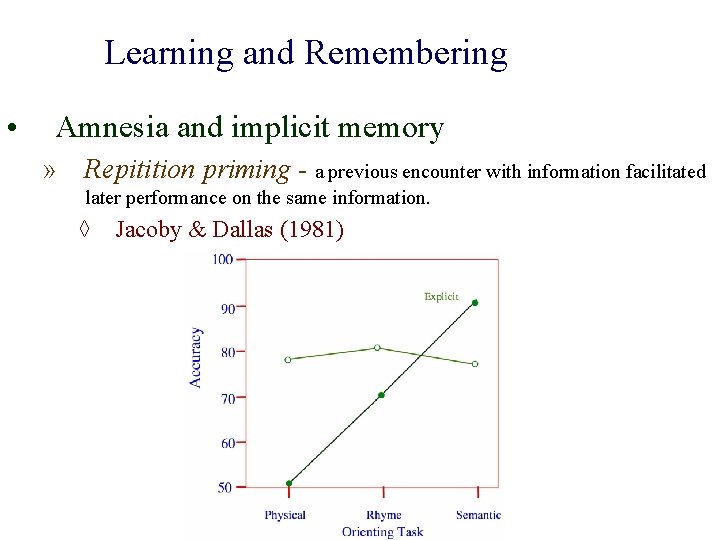
Learning and Remembering • Amnesia and implicit memory » Repitition priming - a previous encounter with information facilitated later performance on the same information. ◊ Jacoby & Dallas (1981)
- Slides: 40