
101 Update Moderator Mark Flanagan Wilmer Hale Peter



- Slides: 59
§ 101 Update Moderator: Mark Flanagan, Wilmer. Hale Peter Menell Bhanu Sadasivan Koret Professor of Law Mc. Dermott Will & Emery Director, BCLT Michael Schallop Van Pelt, Yi & James
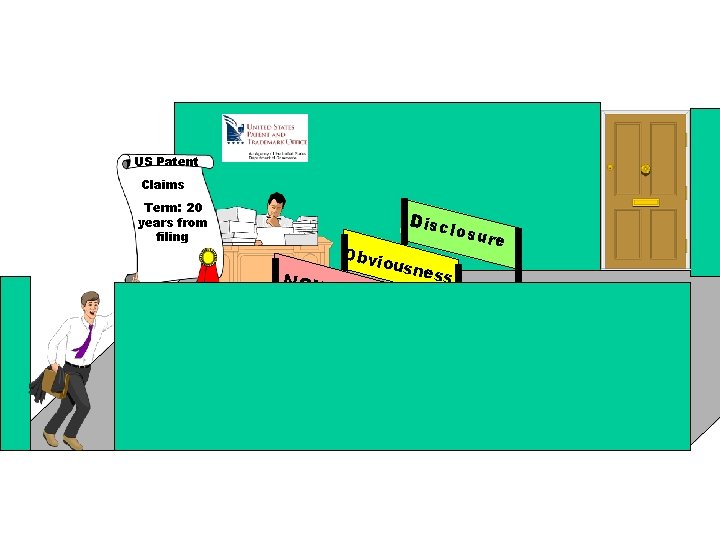
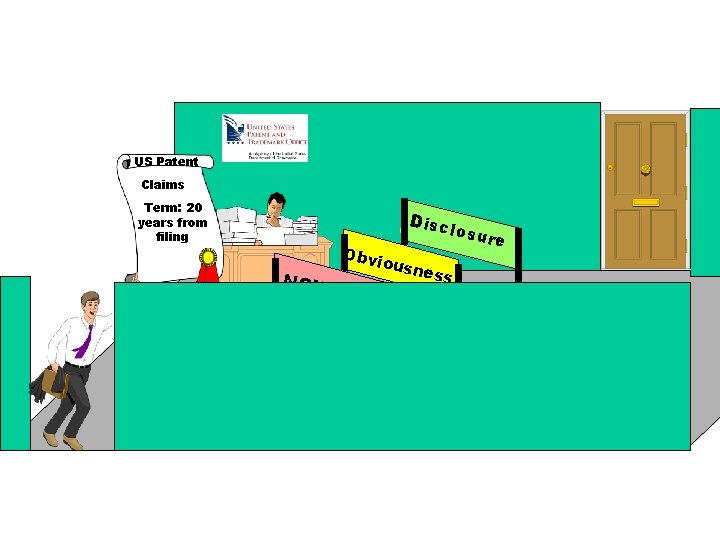
US Patent Claims Term: 20 years from filing Disc NOV Obvi ELTY Subj ec Matt t er UTIL ITY losu ousn ess re
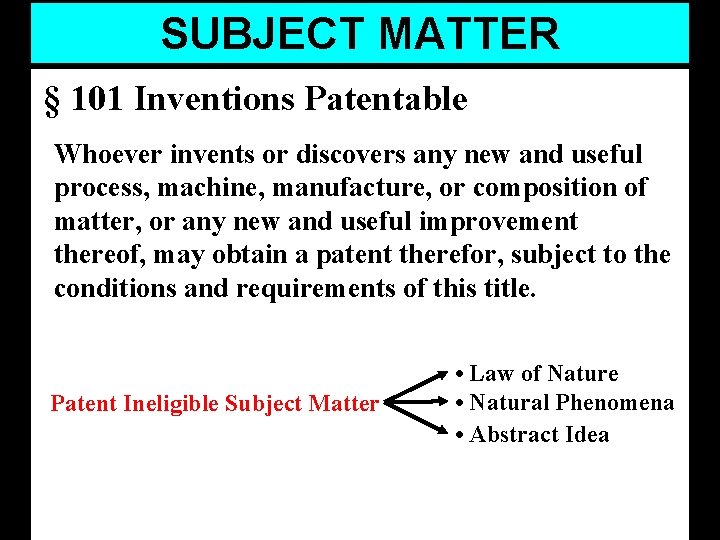
SUBJECT MATTER § 101 Inventions Patentable Whoever invents or discovers any new and useful process, machine, manufacture, or composition of matter, or any new and useful improvement thereof, may obtain a patent therefor, subject to the conditions and requirements of this title. Patent Ineligible Subject Matter • Law of Nature • Natural Phenomena • Abstract Idea
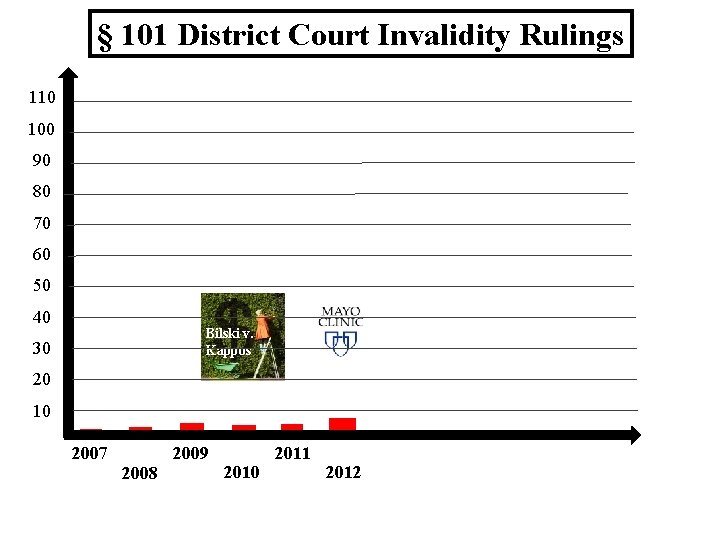
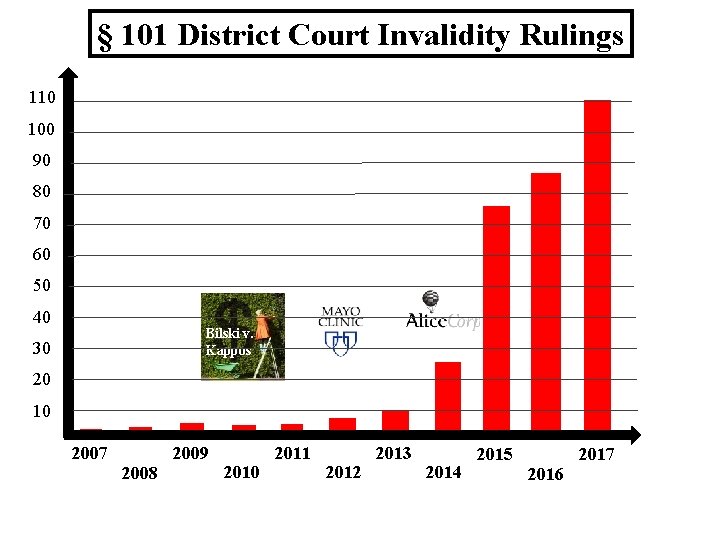
§ 101 District Court Invalidity Rulings 110 100 90 80 70 60 50 40 Bilski v. Kappos 30 20 10 2007 2008 2009 2010 2011 2012
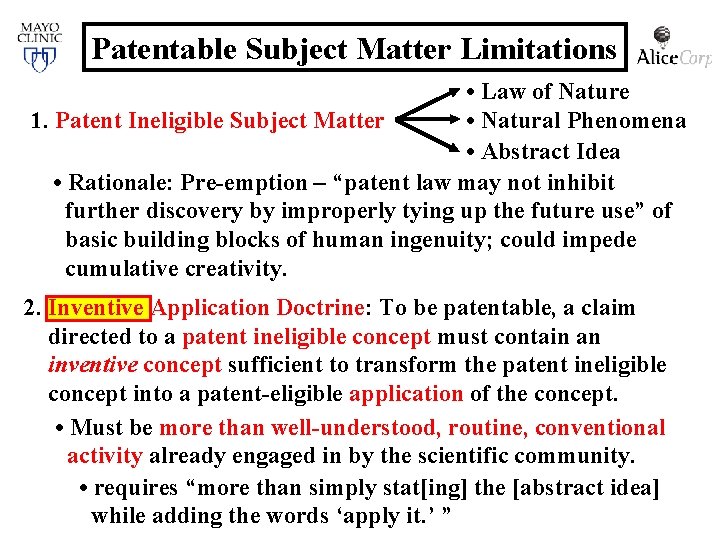
Patentable Subject Matter Limitations • Law of Nature • Natural Phenomena 1. Patent Ineligible Subject Matter • Abstract Idea • Rationale: Pre-emption – “patent law may not inhibit further discovery by improperly tying up the future use” of basic building blocks of human ingenuity; could impede cumulative creativity. 2. Inventive Application Doctrine: To be patentable, a claim directed to a patent ineligible concept must contain an inventive concept sufficient to transform the patent ineligible concept into a patent-eligible application of the concept. • Must be more than well-understood, routine, conventional activity already engaged in by the scientific community. • requires “more than simply stat[ing] the [abstract idea] while adding the words ‘apply it. ’ ”
§ 101 District Court Invalidity Rulings 110 100 90 80 70 60 50 40 Bilski v. Kappos 30 20 10 2007 2008 2009 2010 2011 2012 2013 2014 2015 2016 2017
US Patent Claims Term: 20 years from filing Disc NOV Obvi ELTY Subj ec Matt t er UTIL ITY losu ousn ess re
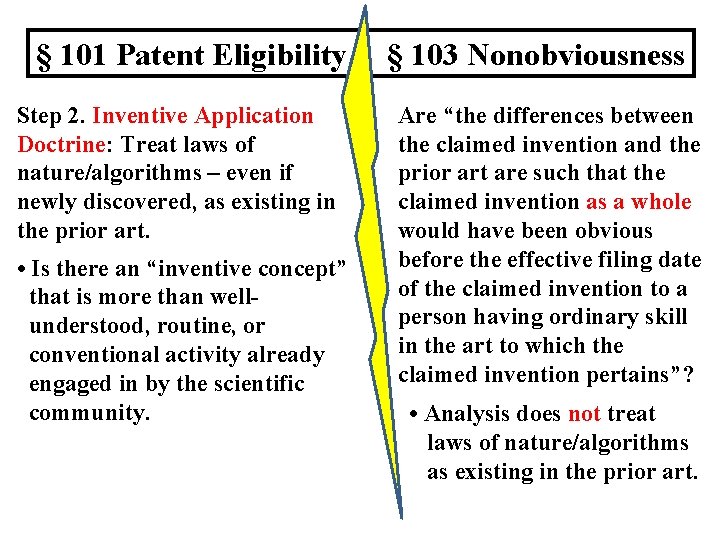
§ 101 Patent Eligibility § 103 Nonobviousness Step 2. Inventive Application Doctrine: Treat laws of nature/algorithms – even if newly discovered, as existing in the prior art. • Is there an “inventive concept” that is more than well understood, routine, or conventional activity already engaged in by the scientific community. Are “the differences between the claimed invention and the prior art are such that the claimed invention as a whole would have been obvious before the effective filing date of the claimed invention to a person having ordinary skill in the art to which the claimed invention pertains”? • Analysis does not treat laws of nature/algorithms as existing in the prior art.
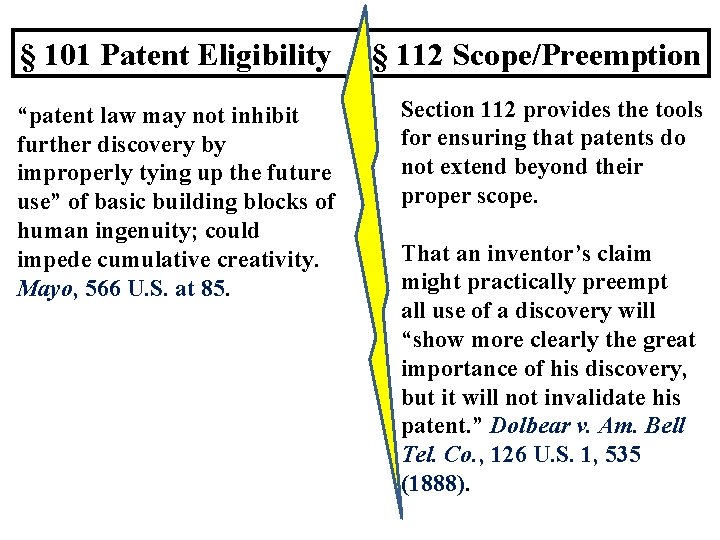
§ 101 Patent Eligibility § 112 Scope/Preemption “patent law may not inhibit further discovery by improperly tying up the future use” of basic building blocks of human ingenuity; could impede cumulative creativity. Mayo, 566 U. S. at 85. Section 112 provides the tools for ensuring that patents do not extend beyond their proper scope. That an inventor’s claim might practically preempt all use of a discovery will “show more clearly the great importance of his discovery, but it will not invalidate his patent. ” Dolbear v. Am. Bell Tel. Co. , 126 U. S. 1, 535 (1888).
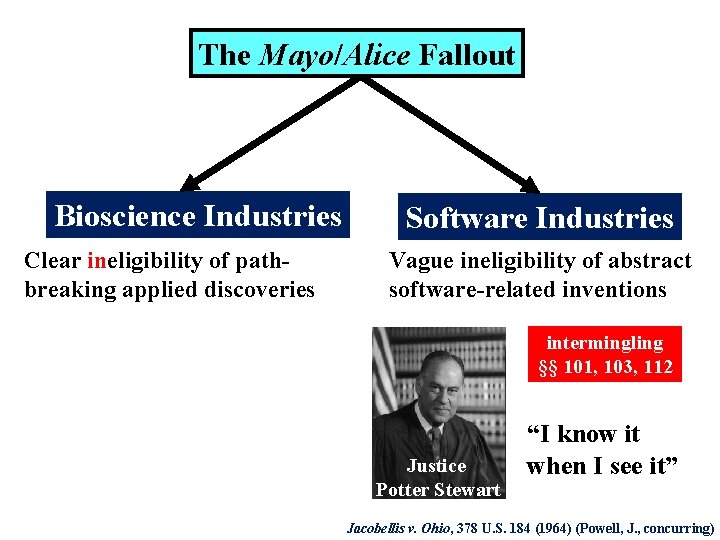
The Mayo/Alice Fallout Bioscience Industries Clear ineligibility of pathbreaking applied discoveries Software Industries Vague ineligibility of abstract software-related inventions intermingling §§ 101, 103, 112 Justice Potter Stewart “I know it when I see it” Jacobellis v. Ohio, 378 U. S. 184 (1964) (Powell, J. , concurring)
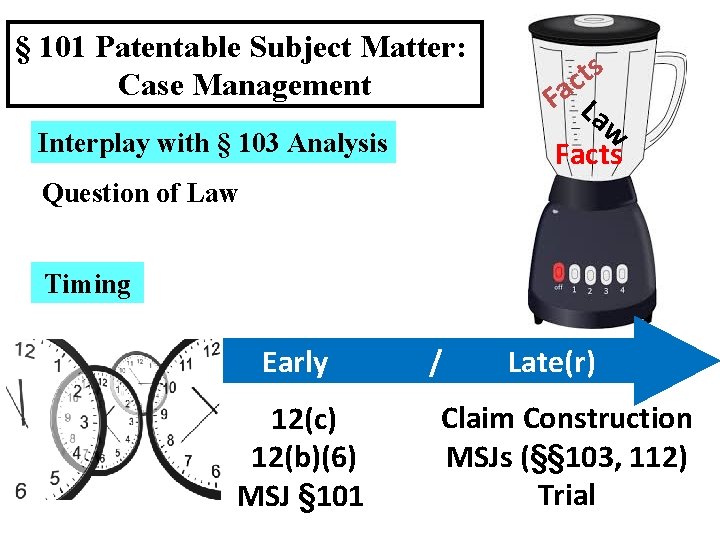
§ 101 Patentable Subject Matter: Case Management Interplay with § 103 Analysis ts c Fa La w Facts Question of Law Timing Early 12(c) 12(b)(6) MSJ § 101 / Late(r) Claim Construction MSJs (§§ 103, 112) Trial
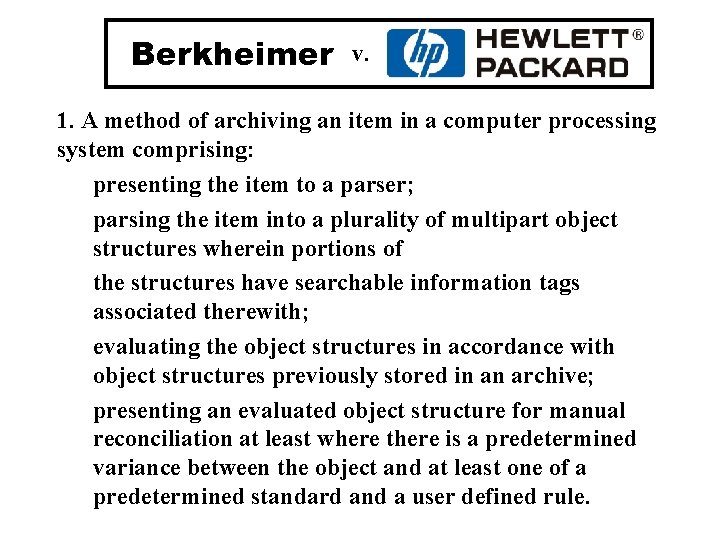
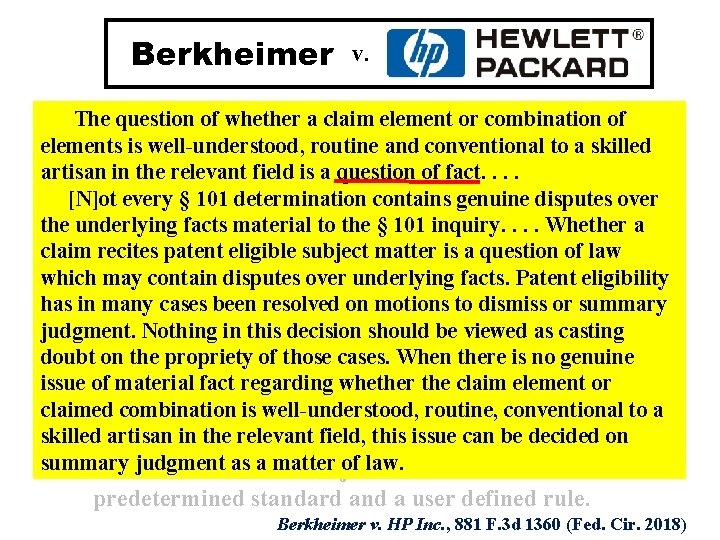
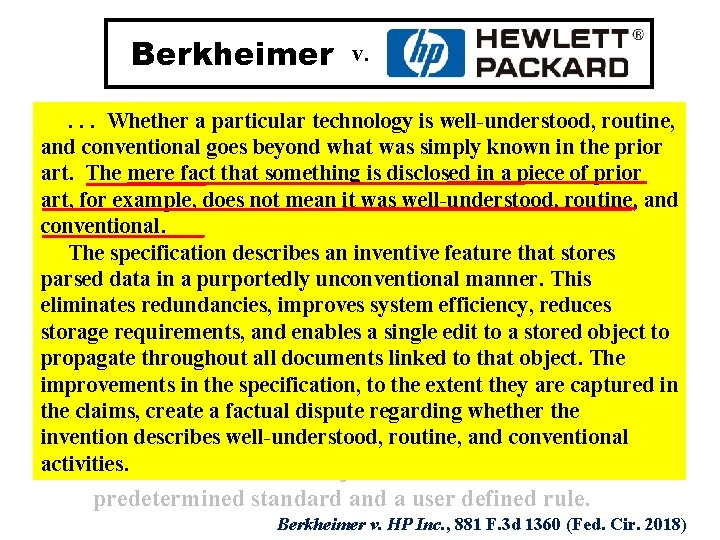
Berkheimer v. 1. A method of archiving an item in a computer processing system comprising: presenting the item to a parser; parsing the item into a plurality of multipart object structures wherein portions of the structures have searchable information tags associated therewith; evaluating the object structures in accordance with object structures previously stored in an archive; presenting an evaluated object structure for manual reconciliation at least where there is a predetermined variance between the object and at least one of a predetermined standard and a user defined rule.
Berkheimer v. The question of whether a claim element or combination of 1. A method of archiving an item in a computer processing elements is well-understood, routine and conventional to a skilled system comprising: artisan in the relevant field is a question of fact. . presenting the item to a parser; [N]ot every § 101 determination contains genuine disputes over parsing the item into a plurality of multipart object the underlying facts material to the § 101 inquiry. . Whether a structures wherein portions of claim recites patent eligible subject matter is a question of law which may contain disputes over underlying facts. Patent eligibility the structures have searchable information tags has in many cases been resolved on motions to dismiss or summary associated therewith; judgment. Nothing in this decision should be viewed as casting evaluating the object structures in accordance with doubt on the propriety of those cases. When there is no genuine object structures previously stored in an archive; issue of material fact regarding whether the claim element or claimed combination is well-understood, routine, conventional to a presenting an evaluated object structure for manual skilled artisan in the relevant field, this issue can be decided on reconciliation at least where there is a predetermined summary judgment as a matter of law. variance between the object and at least one of a predetermined standard and a user defined rule. Berkheimer v. HP Inc. , 881 F. 3 d 1360 (Fed. Cir. 2018)
Berkheimer v. . . . Whether a particular technology is well-understood, routine, 1. A method of archiving an item in a computer processing and conventional goes beyond what was simply known in the prior system comprising: art. The mere fact that something is disclosed in a piece of prior presenting the item to a parser; art, for example, does not mean it was well-understood, routine, and parsing the item into a plurality of multipart object conventional. structures wherein portions of The specification describes an inventive feature that stores parsed data in a purportedly unconventional manner. This the structures have searchable information tags eliminates redundancies, improves system efficiency, reduces associated therewith; storage requirements, and enables a single edit to a stored object to evaluating the object structures in accordance with propagate throughout all documents linked to that object. The object structures previously stored in an archive; improvements in the specification, to the extent they are captured in the claims, create a factual dispute regarding whether the presenting an evaluated object structure for manual invention describes well-understood, routine, and conventional reconciliation at least where there is a predetermined activities. variance between the object and at least one of a predetermined standard and a user defined rule. Berkheimer v. HP Inc. , 881 F. 3 d 1360 (Fed. Cir. 2018)
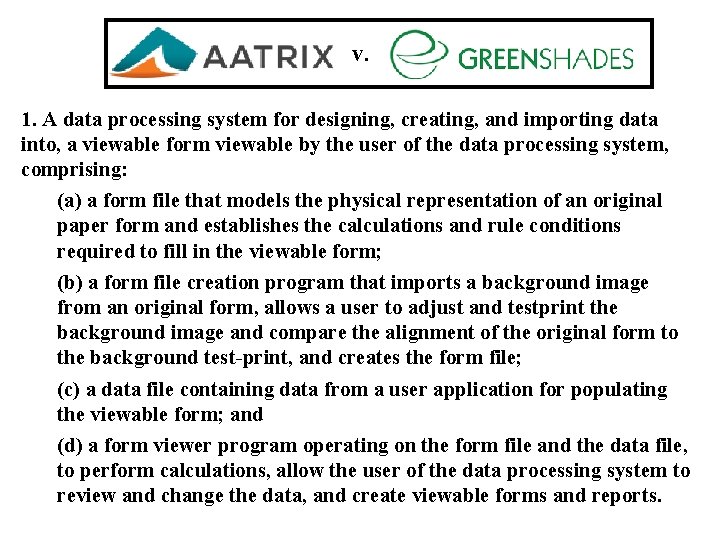
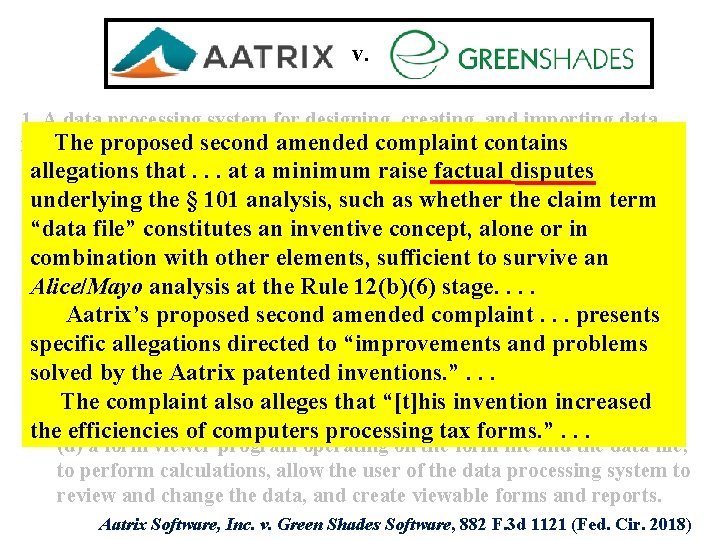
v. 1. A data processing system for designing, creating, and importing data into, a viewable form viewable by the user of the data processing system, comprising: (a) a form file that models the physical representation of an original paper form and establishes the calculations and rule conditions required to fill in the viewable form; (b) a form file creation program that imports a background image from an original form, allows a user to adjust and testprint the background image and compare the alignment of the original form to the background test-print, and creates the form file; (c) a data file containing data from a user application for populating the viewable form; and (d) a form viewer program operating on the form file and the data file, to perform calculations, allow the user of the data processing system to review and change the data, and create viewable forms and reports.
v. 1. A data processing system for designing, creating, and importing data The proposed second amended complaint contains into, a viewable form viewable by the user of the data processing system, comprising: allegations that. . . at a minimum raise factual disputes (a) a form file that models the physical representation of an original underlying the § 101 analysis, such as whether the claim term paper form and establishes the calculations and rule conditions “data file” constitutes an inventive concept, alone or in required to fill in the viewable form; combination with other elements, sufficient to survive an (b) a form file creation program that imports a background image Alice/Mayo analysis at the Rule 12(b)(6) stage. . from an original form, allows a user to adjust and testprint the Aatrix’s proposed second amended complaint. . . presents background image and compare the alignment of the original form to specific allegations directed to “improvements and problems the background test-print, and creates the form file; solved by the Aatrix patented inventions. ”. . . (c) a data file containing data from a user application for populating The complaint also alleges that “[t]his invention increased the viewable form; and the efficiencies of computers processing tax forms. ”. . . (d) a form viewer program operating on the form file and the data file, to perform calculations, allow the user of the data processing system to review and change the data, and create viewable forms and reports. Aatrix Software, Inc. v. Green Shades Software, 882 F. 3 d 1121 (Fed. Cir. 2018)
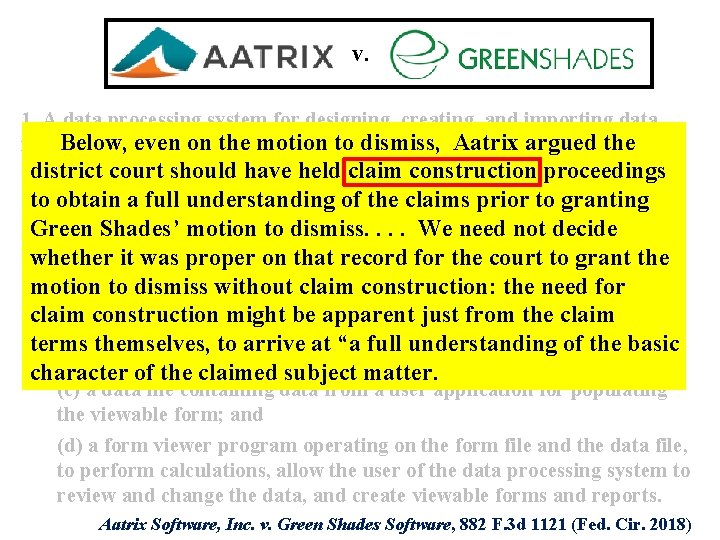
v. 1. A data processing system for designing, creating, and importing data Below, even on the motion to dismiss, Aatrix argued the into, a viewable form viewable by the user of the data processing system, comprising: district court should have held claim construction proceedings (a) a form file that models the physical representation of an original to obtain a full understanding of the claims prior to granting paper form and establishes the calculations and rule conditions Green Shades’ motion to dismiss. . We need not decide required to fill in the viewable form; whether it was proper on that record for the court to grant the (b) a form file creation program that imports a background image motion to dismiss without claim construction: the need for from an original form, allows a user to adjust and testprint the claim construction might be apparent just from the claim background image and compare the alignment of the original form to terms themselves, to arrive at “a full understanding of the basic the background test-print, and creates the form file; character of the claimed subject matter. (c) a data file containing data from a user application for populating the viewable form; and (d) a form viewer program operating on the form file and the data file, to perform calculations, allow the user of the data processing system to review and change the data, and create viewable forms and reports. Aatrix Software, Inc. v. Green Shades Software, 882 F. 3 d 1121 (Fed. Cir. 2018)
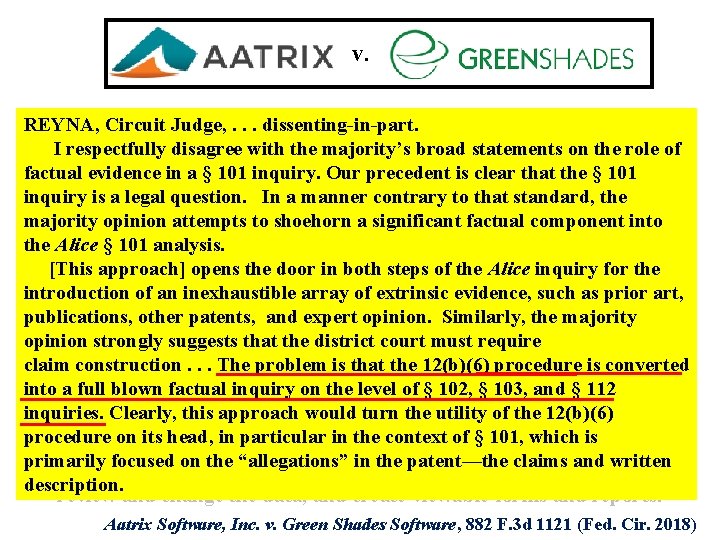
v. 1. A data processing system for designing, creating, and importing data REYNA, Circuit Judge, . . . dissenting-in-part. into, a viewable form viewable by the user of the data processing system, I respectfully disagree with the majority’s broad statements on the role of comprising: factual evidence in a § 101 inquiry. Our precedent is clear that the § 101 inquiry is a legal question. In a manner contrary to that standard, the (a) a form file that models the physical representation of an original majority opinion attempts to shoehorn a significant factual component into paper form and establishes the calculations and rule conditions the Alice § 101 analysis. required to fill in the viewable form; [This approach] opens the door in both steps of the Alice inquiry for the (b) a form file creation program that imports a background image introduction of an inexhaustible array of extrinsic evidence, such as prior art, from an original form, allows a user to adjust and testprint the publications, other patents, and expert opinion. Similarly, the majority background image and compare the alignment of the original form to opinion strongly suggests that the district court must require the background test-print, and creates the form file; claim construction. . . The problem is that the 12(b)(6) procedure is converted into a full blown factual inquiry on the level of § 102, § 103, and § 112 (c) a data file containing data from a user application for populating inquiries. Clearly, this approach would turn the utility of the 12(b)(6) the viewable form; and procedure on its head, in particular in the context of § 101, which is (d) a form viewer program operating on the form file and the data file, primarily focused on the “allegations” in the patent—the claims and written to perform calculations, allow the user of the data processing system to description. review and change the data, and create viewable forms and reports. Aatrix Software, Inc. v. Green Shades Software, 882 F. 3 d 1121 (Fed. Cir. 2018)
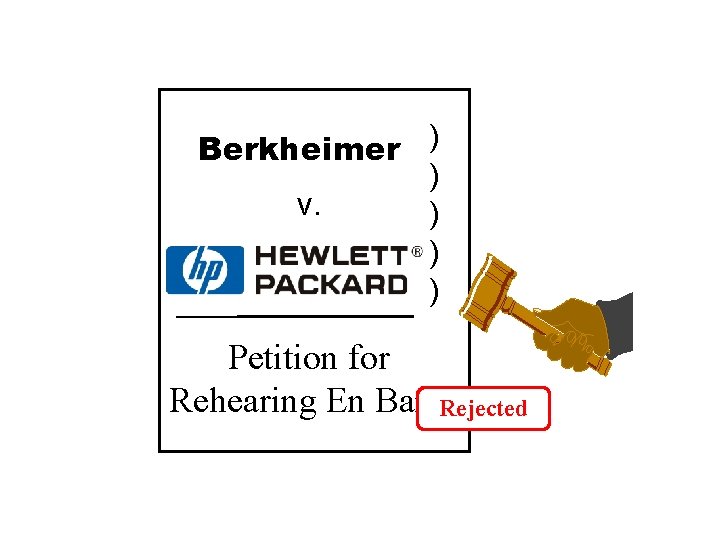
Berkheimer ) ) v. ) ) ) Petition for Rehearing En Banc. Rejected
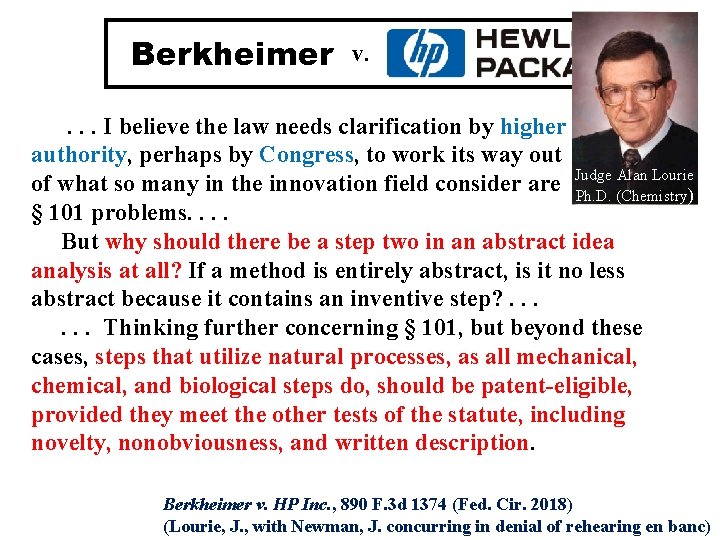
Berkheimer v. . . . I believe the law needs clarification by higher authority, perhaps by Congress, to work its way out Alan Lourie of what so many in the innovation field consider are Judge Ph. D. (Chemistry) § 101 problems. . But why should there be a step two in an abstract idea analysis at all? If a method is entirely abstract, is it no less abstract because it contains an inventive step? . . . Thinking further concerning § 101, but beyond these cases, steps that utilize natural processes, as all mechanical, chemical, and biological steps do, should be patent-eligible, provided they meet the other tests of the statute, including novelty, nonobviousness, and written description. Berkheimer v. HP Inc. , 890 F. 3 d 1374 (Fed. Cir. 2018) (Lourie, J. , with Newman, J. concurring in denial of rehearing en banc)
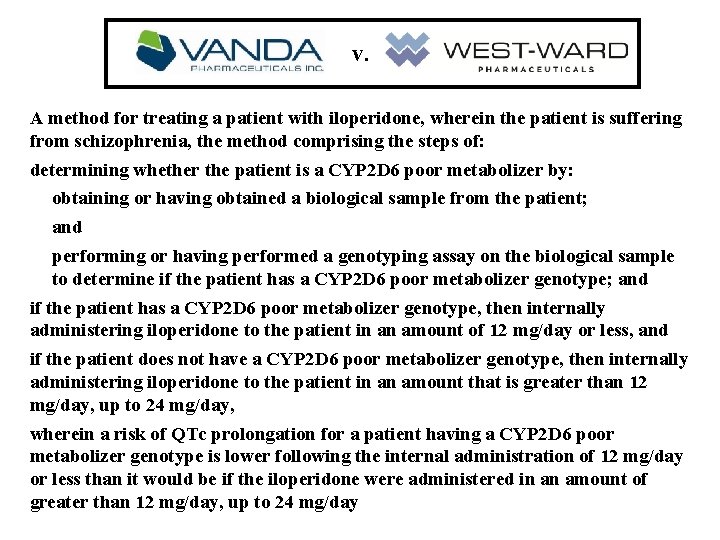
v. A method for treating a patient with iloperidone, wherein the patient is suffering from schizophrenia, the method comprising the steps of: determining whether the patient is a CYP 2 D 6 poor metabolizer by: obtaining or having obtained a biological sample from the patient; and performing or having performed a genotyping assay on the biological sample to determine if the patient has a CYP 2 D 6 poor metabolizer genotype; and if the patient has a CYP 2 D 6 poor metabolizer genotype, then internally administering iloperidone to the patient in an amount of 12 mg/day or less, and if the patient does not have a CYP 2 D 6 poor metabolizer genotype, then internally administering iloperidone to the patient in an amount that is greater than 12 mg/day, up to 24 mg/day, wherein a risk of QTc prolongation for a patient having a CYP 2 D 6 poor metabolizer genotype is lower following the internal administration of 12 mg/day or less than it would be if the iloperidone were administered in an amount of greater than 12 mg/day, up to 24 mg/day
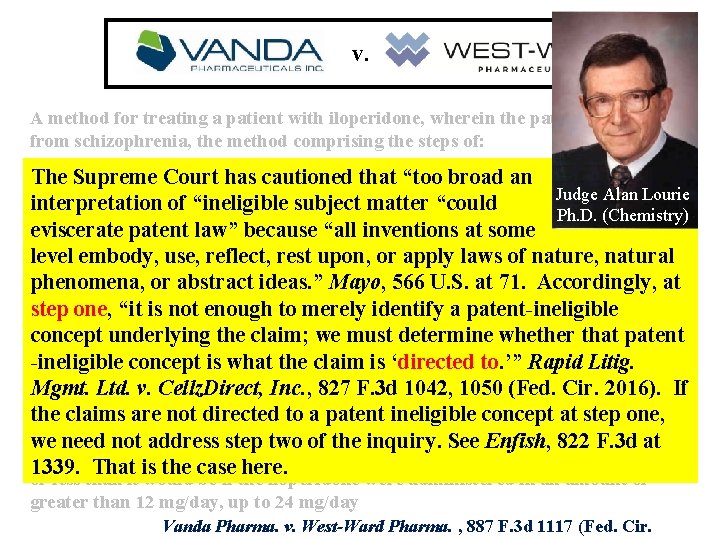
v. A method for treating a patient with iloperidone, wherein the patient is suffering from schizophrenia, the method comprising the steps of: determining whether the patient is a CYP 2 D 6 poor metabolizer by: The Supreme Court has cautioned that “too broad an Judge Alan Lourie obtaining or having obtained a biological sample from the patient; interpretation of “ineligible subject matter “could Ph. D. (Chemistry) and eviscerate patent law” because “all inventions at some performing or having performed a genotyping assay on the biological sample level embody, use, reflect, rest upon, or apply laws of nature, natural to determine if the patient has a CYP 2 D 6 poor metabolizer genotype; and phenomena, or abstract ideas. ” Mayo, 566 U. S. at 71. Accordingly, at if the patient has a CYP 2 D 6 poor metabolizer genotype, then internally step one, “it is not enough to merely identify a patent-ineligible administering iloperidone to the patient in an amount of 12 mg/day or less, and concept underlying the claim; we must determine whether that patent if the patient does not have a CYP 2 D 6 poor metabolizer genotype, then internally -ineligible concept is what the claim is ‘directed to. ’” Rapid Litig. administering iloperidone to the patient in an amount that is greater than 12 Mgmt. Ltd. v. Cellz. Direct, Inc. , 827 F. 3 d 1042, 1050 (Fed. Cir. 2016). If mg/day, up to 24 mg/day, the claims are not directed to a patent ineligible concept at step one, wherein a risk of QTc prolongation for a patient having a CYP 2 D 6 poor we need not address step two of the inquiry. See Enfish, 822 F. 3 d at metabolizer genotype is lower following the internal administration of 12 mg/day 1339. That is the case here. or less than it would be if the iloperidone were administered in an amount of greater than 12 mg/day, up to 24 mg/day Vanda Pharma. v. West-Ward Pharma. , 887 F. 3 d 1117 (Fed. Cir.
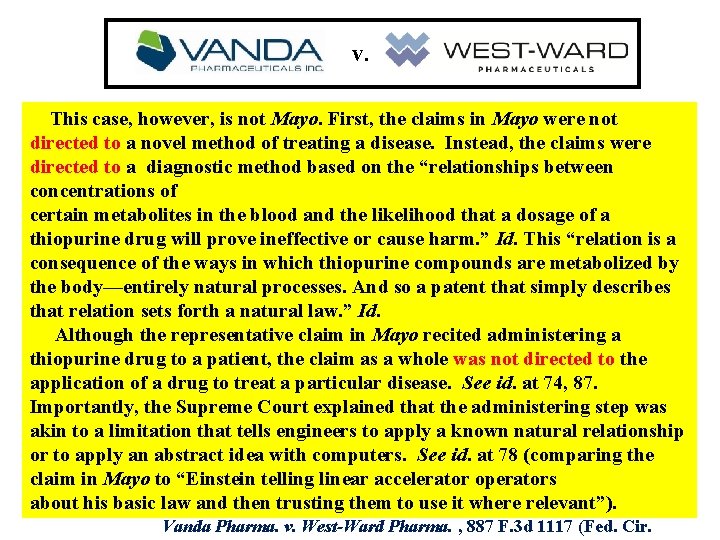
v. A method for treating a patient with iloperidone, wherein the patient is suffering This case, however, is not Mayo. First, the claims in Mayo were not from schizophrenia, the method comprising the steps of: directed to a novel method of treating a disease. Instead, the claims were directed to a diagnostic method based on the “relationships between determining whether the patient is a CYP 2 D 6 poor metabolizer by: concentrations of obtaining or having obtained a biological sample from the patient; certain metabolites in the blood and the likelihood that a dosage of a and thiopurine drug will prove ineffective or cause harm. ” Id. This “relation is a performing or having performed a genotyping assay on the biological sample consequence of the ways in which thiopurine compounds are metabolized by to determine if the patient has a CYP 2 D 6 poor metabolizer genotype; and the body—entirely natural processes. And so a patent that simply describes if the patient has a CYP 2 D 6 poor metabolizer genotype, then internally that relation sets forth a natural law. ” Id. administering iloperidone to the patient in an amount of 12 mg/day or less, and Although the representative claim in Mayo recited administering a thiopurine drug to a patient, the claim as a whole was not directed to the if the patient does not have a CYP 2 D 6 poor metabolizer genotype, then internally administering iloperidone to the patient in an amount that is greater than 12 application of a drug to treat a particular disease. See id. at 74, 87. mg/day, up to 24 mg/day, Importantly, the Supreme Court explained that the administering step was akin to a limitation that tells engineers to apply a known natural relationship wherein a risk of QTc prolongation for a patient having a CYP 2 D 6 poor or to apply an abstract idea with computers. See id. at 78 (comparing the metabolizer genotype is lower following the internal administration of 12 mg/day claim in Mayo to “Einstein telling linear accelerator operators or less than it would be if the iloperidone were administered in an amount of greater than 12 mg/day, up to 24 mg/day about his basic law and then trusting them to use it where relevant”). Vanda Pharma. v. West-Ward Pharma. , 887 F. 3 d 1117 (Fed. Cir.
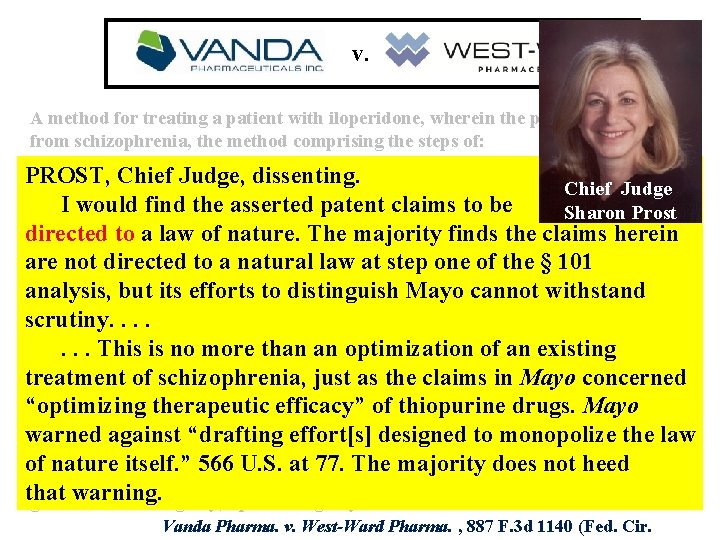
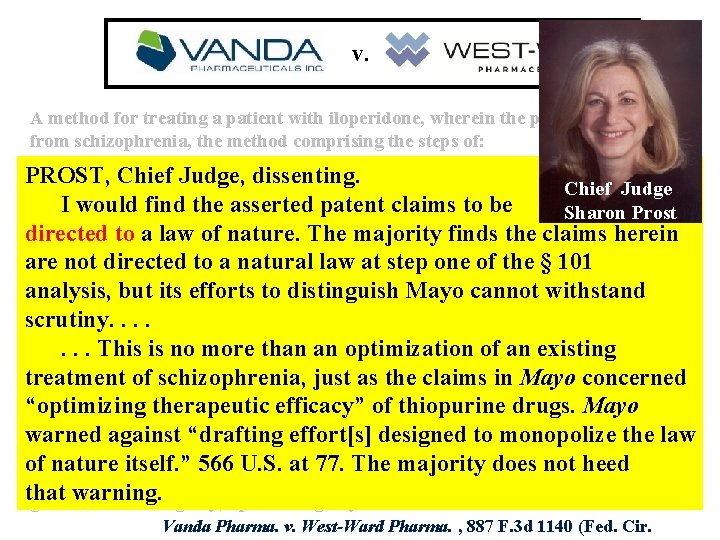
v. A method for treating a patient with iloperidone, wherein the patient is suffering from schizophrenia, the method comprising the steps of: determining whether the patient is a CYP 2 D 6 poor metabolizer by: PROST, Chief Judge, dissenting. Chief Judge obtaining or having obtained a biological sample from the patient; I would find the asserted patent claims to be Sharon Prost and directed to a law of nature. The majority finds the claims herein performing or having performed a genotyping assay on the biological sample are not directed to a natural law at step one of the § 101 to determine if the patient has a CYP 2 D 6 poor metabolizer genotype; and analysis, but its efforts to distinguish Mayo cannot withstand if the patient has a CYP 2 D 6 poor metabolizer genotype, then internally scrutiny. . administering iloperidone to the patient in an amount of 12 mg/day or less, and . . . This is no more than an optimization of an existing if the patient does not have a CYP 2 D 6 poor metabolizer genotype, then internally treatment of schizophrenia, just as the claims in Mayo concerned administering iloperidone to the patient in an amount that is greater than 12 mg/day, up to 24 mg/day, “optimizing therapeutic efficacy” of thiopurine drugs. Mayo wherein a risk of QTc prolongation for a patient having a CYP 2 D 6 poor warned against “drafting effort[s] designed to monopolize the law metabolizer genotype is lower following the internal administration of 12 mg/day of nature itself. ” 566 U. S. at 77. The majority does not heed or less than it would be if the iloperidone were administered in an amount of that warning. greater than 12 mg/day, up to 24 mg/day Vanda Pharma. v. West-Ward Pharma. , 887 F. 3 d 1140 (Fed. Cir.
v. A method for treating a patient with iloperidone, wherein the patient is suffering from schizophrenia, the method comprising the steps of: determining whether the patient is a CYP 2 D 6 poor metabolizer by: PROST, Chief Judge, dissenting. Chief Judge obtaining or having obtained a biological sample from the patient; I would find the asserted patent claims to be Sharon Prost and directed to a law of nature. The majority finds the claims herein performing or having performed a genotyping assay on the biological sample are not directed to a natural law at step one of the § 101 to determine if the patient has a CYP 2 D 6 poor metabolizer genotype; and analysis, but its efforts to distinguish Mayo cannot withstand if the patient has a CYP 2 D 6 poor metabolizer genotype, then internally scrutiny. . administering iloperidone to the patient in an amount of 12 mg/day or less, and . . . This is no more than an optimization of an existing if the patient does not have a CYP 2 D 6 poor metabolizer genotype, then internally treatment of schizophrenia, just as the claims in Mayo concerned administering iloperidone to the patient in an amount that is greater than 12 mg/day, up to 24 mg/day, “optimizing therapeutic efficacy” of thiopurine drugs. Mayo wherein a risk of QTc prolongation for a patient having a CYP 2 D 6 poor warned against “drafting effort[s] designed to monopolize the law metabolizer genotype is lower following the internal administration of 12 mg/day of nature itself. ” 566 U. S. at 77. The majority does not heed or less than it would be if the iloperidone were administered in an amount of that warning. greater than 12 mg/day, up to 24 mg/day Vanda Pharma. v. West-Ward Pharma. , 887 F. 3 d 1140 (Fed. Cir.
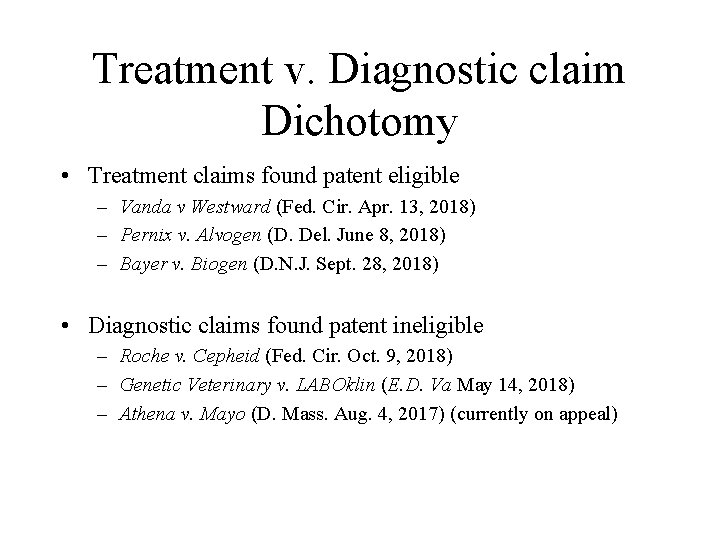
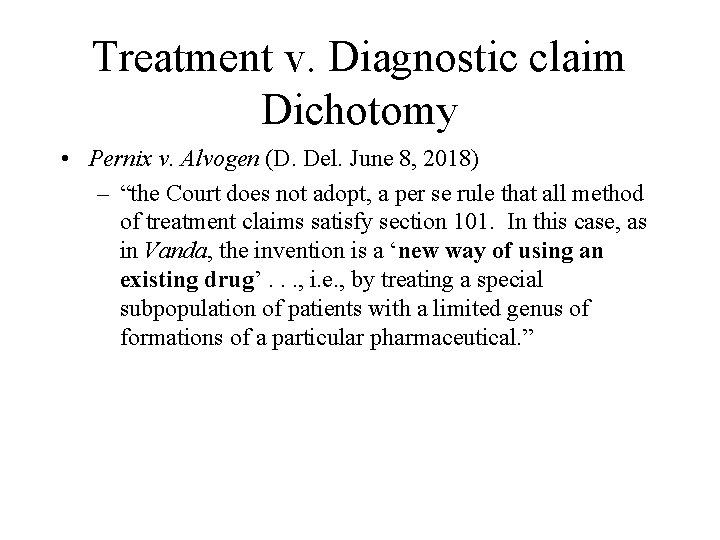
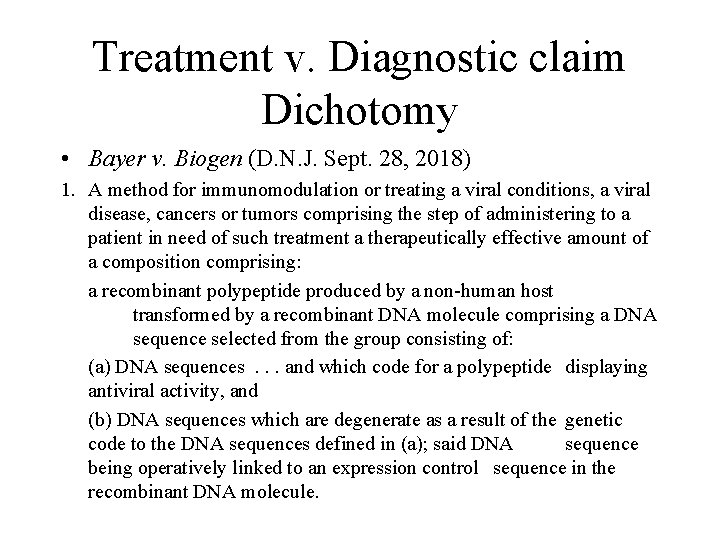
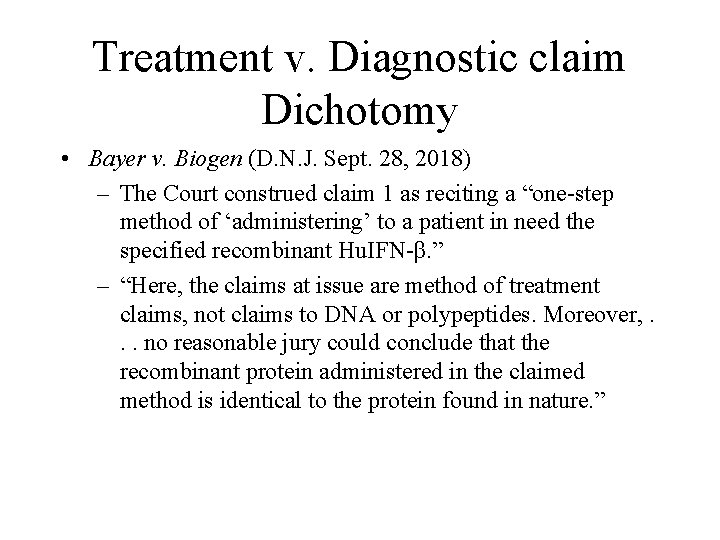
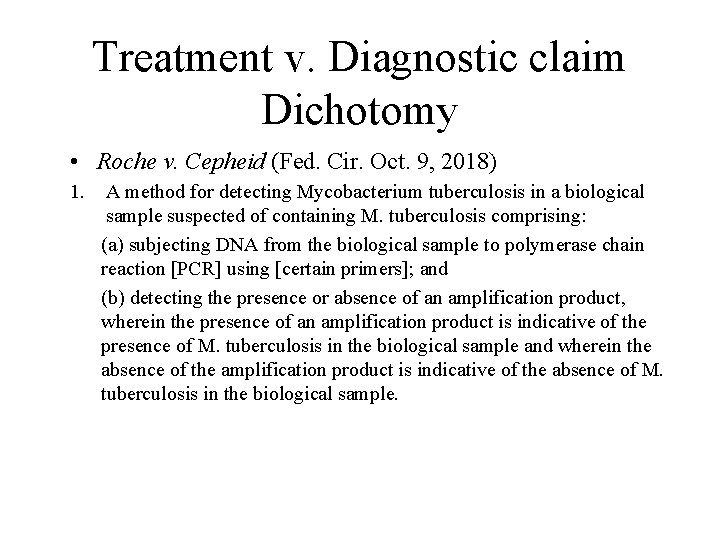
Treatment v. Diagnostic claim Dichotomy • Treatment claims found patent eligible – Vanda v Westward (Fed. Cir. Apr. 13, 2018) – Pernix v. Alvogen (D. Del. June 8, 2018) – Bayer v. Biogen (D. N. J. Sept. 28, 2018) • Diagnostic claims found patent ineligible – Roche v. Cepheid (Fed. Cir. Oct. 9, 2018) – Genetic Veterinary v. LABOklin (E. D. Va May 14, 2018) – Athena v. Mayo (D. Mass. Aug. 4, 2017) (currently on appeal)
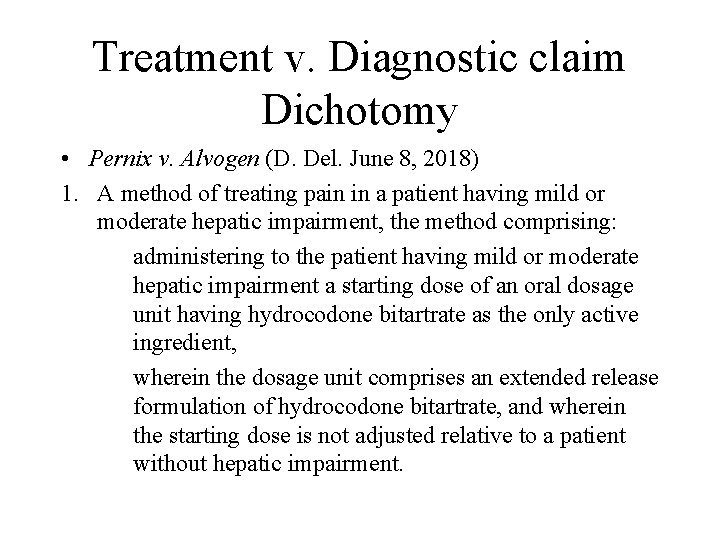
Treatment v. Diagnostic claim Dichotomy • Pernix v. Alvogen (D. Del. June 8, 2018) 1. A method of treating pain in a patient having mild or moderate hepatic impairment, the method comprising: administering to the patient having mild or moderate hepatic impairment a starting dose of an oral dosage unit having hydrocodone bitartrate as the only active ingredient, wherein the dosage unit comprises an extended release formulation of hydrocodone bitartrate, and wherein the starting dose is not adjusted relative to a patient without hepatic impairment.
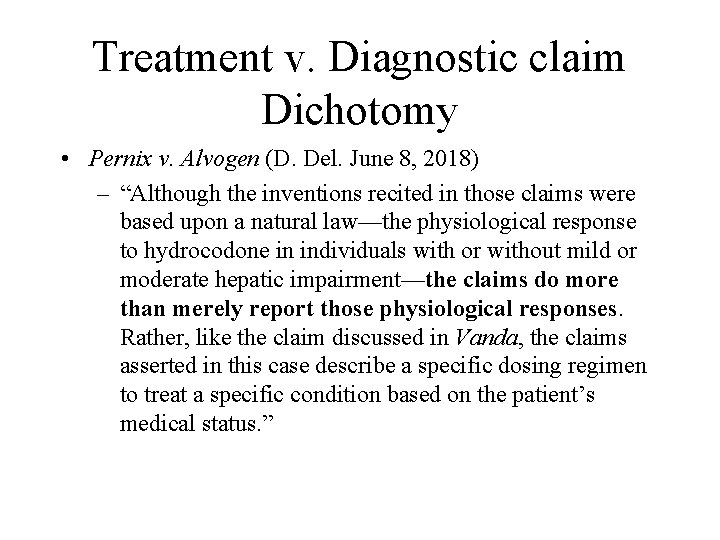
Treatment v. Diagnostic claim Dichotomy • Pernix v. Alvogen (D. Del. June 8, 2018) – “Although the inventions recited in those claims were based upon a natural law—the physiological response to hydrocodone in individuals with or without mild or moderate hepatic impairment—the claims do more than merely report those physiological responses. Rather, like the claim discussed in Vanda, the claims asserted in this case describe a specific dosing regimen to treat a specific condition based on the patient’s medical status. ”
Treatment v. Diagnostic claim Dichotomy • Pernix v. Alvogen (D. Del. June 8, 2018) – “the Court does not adopt, a per se rule that all method of treatment claims satisfy section 101. In this case, as in Vanda, the invention is a ‘new way of using an existing drug’. . . , i. e. , by treating a special subpopulation of patients with a limited genus of formations of a particular pharmaceutical. ”
Treatment v. Diagnostic claim Dichotomy • Bayer v. Biogen (D. N. J. Sept. 28, 2018) 1. A method for immunomodulation or treating a viral conditions, a viral disease, cancers or tumors comprising the step of administering to a patient in need of such treatment a therapeutically effective amount of a composition comprising: a recombinant polypeptide produced by a non-human host transformed by a recombinant DNA molecule comprising a DNA sequence selected from the group consisting of: (a) DNA sequences. . . and which code for a polypeptide displaying antiviral activity, and (b) DNA sequences which are degenerate as a result of the genetic code to the DNA sequences defined in (a); said DNA sequence being operatively linked to an expression control sequence in the recombinant DNA molecule.
Treatment v. Diagnostic claim Dichotomy • Bayer v. Biogen (D. N. J. Sept. 28, 2018) – The Court construed claim 1 as reciting a “one-step method of ‘administering’ to a patient in need the specified recombinant Hu. IFN-β. ” – “Here, the claims at issue are method of treatment claims, not claims to DNA or polypeptides. Moreover, . . . no reasonable jury could conclude that the recombinant protein administered in the claimed method is identical to the protein found in nature. ”
Treatment v. Diagnostic claim Dichotomy • Roche v. Cepheid (Fed. Cir. Oct. 9, 2018) 1. A method for detecting Mycobacterium tuberculosis in a biological sample suspected of containing M. tuberculosis comprising: (a) subjecting DNA from the biological sample to polymerase chain reaction [PCR] using [certain primers]; and (b) detecting the presence or absence of an amplification product, wherein the presence of an amplification product is indicative of the presence of M. tuberculosis in the biological sample and wherein the absence of the amplification product is indicative of the absence of M. tuberculosis in the biological sample.
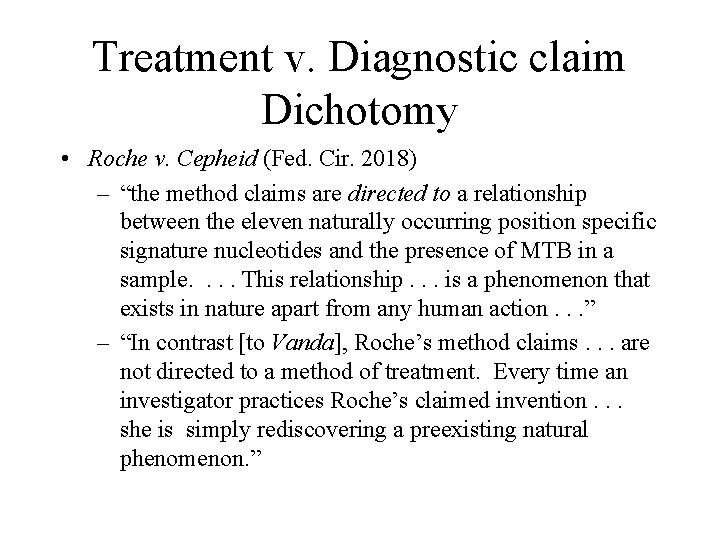
Treatment v. Diagnostic claim Dichotomy • Roche v. Cepheid (Fed. Cir. 2018) – “the method claims are directed to a relationship between the eleven naturally occurring position specific signature nucleotides and the presence of MTB in a sample. . This relationship. . . is a phenomenon that exists in nature apart from any human action. . . ” – “In contrast [to Vanda], Roche’s method claims. . . are not directed to a method of treatment. Every time an investigator practices Roche’s claimed invention. . . she is simply rediscovering a preexisting natural phenomenon. ”
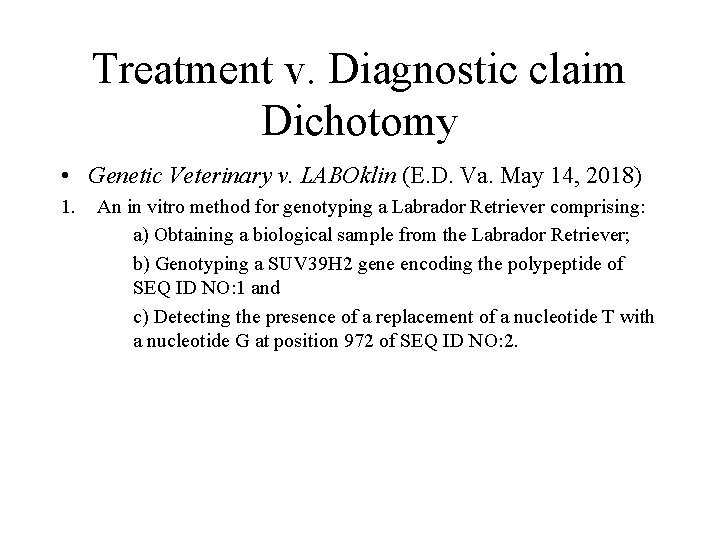
Treatment v. Diagnostic claim Dichotomy • Genetic Veterinary v. LABOklin (E. D. Va. May 14, 2018) 1. An in vitro method for genotyping a Labrador Retriever comprising: a) Obtaining a biological sample from the Labrador Retriever; b) Genotyping a SUV 39 H 2 gene encoding the polypeptide of SEQ ID NO: 1 and c) Detecting the presence of a replacement of a nucleotide T with a nucleotide G at position 972 of SEQ ID NO: 2.
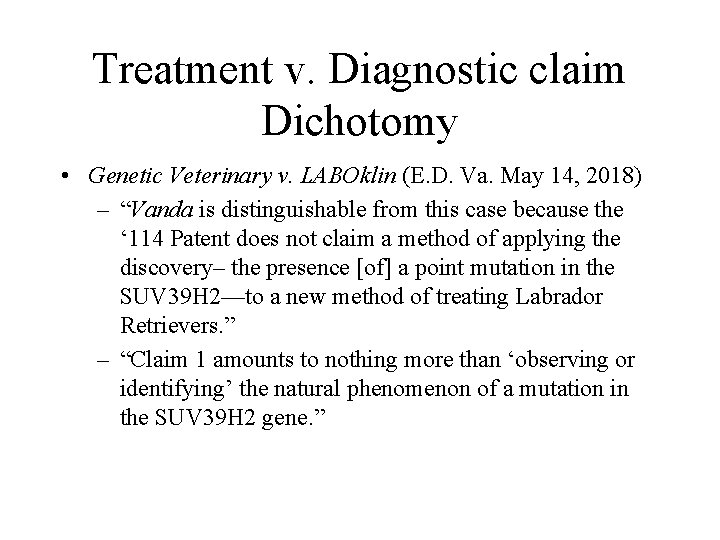
Treatment v. Diagnostic claim Dichotomy • Genetic Veterinary v. LABOklin (E. D. Va. May 14, 2018) – “Vanda is distinguishable from this case because the ‘ 114 Patent does not claim a method of applying the discovery– the presence [of] a point mutation in the SUV 39 H 2—to a new method of treating Labrador Retrievers. ” – “Claim 1 amounts to nothing more than ‘observing or identifying’ the natural phenomenon of a mutation in the SUV 39 H 2 gene. ”
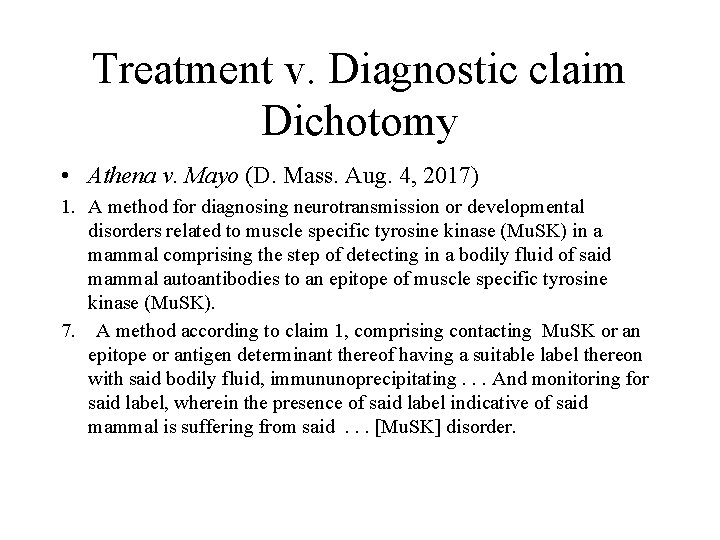
Treatment v. Diagnostic claim Dichotomy • Athena v. Mayo (D. Mass. Aug. 4, 2017) 1. A method for diagnosing neurotransmission or developmental disorders related to muscle specific tyrosine kinase (Mu. SK) in a mammal comprising the step of detecting in a bodily fluid of said mammal autoantibodies to an epitope of muscle specific tyrosine kinase (Mu. SK). 7. A method according to claim 1, comprising contacting Mu. SK or an epitope or antigen determinant thereof having a suitable label thereon with said bodily fluid, immununoprecipitating. . . And monitoring for said label, wherein the presence of said label indicative of said mammal is suffering from said. . . [Mu. SK] disorder.
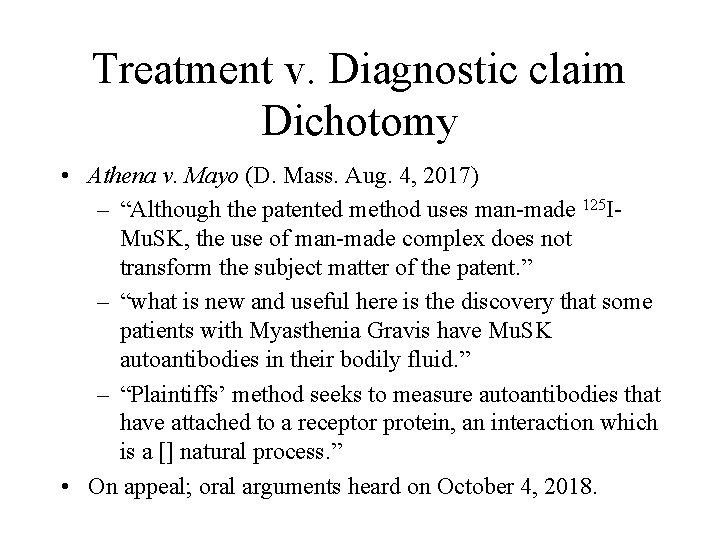
Treatment v. Diagnostic claim Dichotomy • Athena v. Mayo (D. Mass. Aug. 4, 2017) – “Although the patented method uses man-made 125 IMu. SK, the use of man-made complex does not transform the subject matter of the patent. ” – “what is new and useful here is the discovery that some patients with Myasthenia Gravis have Mu. SK autoantibodies in their bodily fluid. ” – “Plaintiffs’ method seeks to measure autoantibodies that have attached to a receptor protein, an interaction which is a [] natural process. ” • On appeal; oral arguments heard on October 4, 2018.
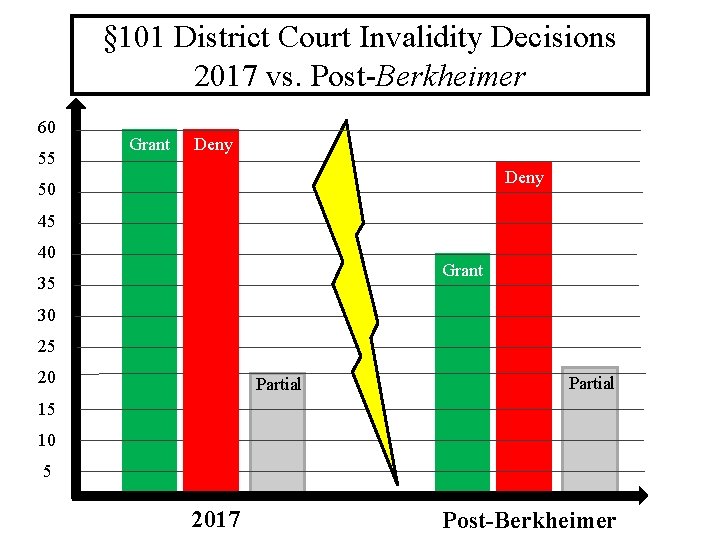
§ 101 District Court Invalidity Decisions 2017 vs. Post-Berkheimer 60 55 Grant Deny 50 45 40 Grant 35 30 25 20 Partial 15 10 5 2017 Post-Berkheimer
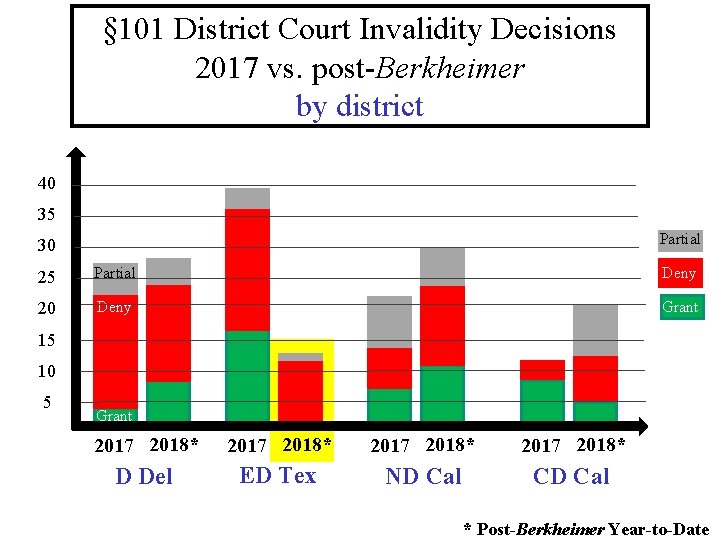
§ 101 District Court Invalidity Decisions 2017 vs. post-Berkheimer by district 40 35 Partial 30 25 Partial Deny 20 Deny Grant 15 10 5 Grant 2017 2018* D Del ED Tex ND Cal CD Cal * Post-Berkheimer Year-to-Date
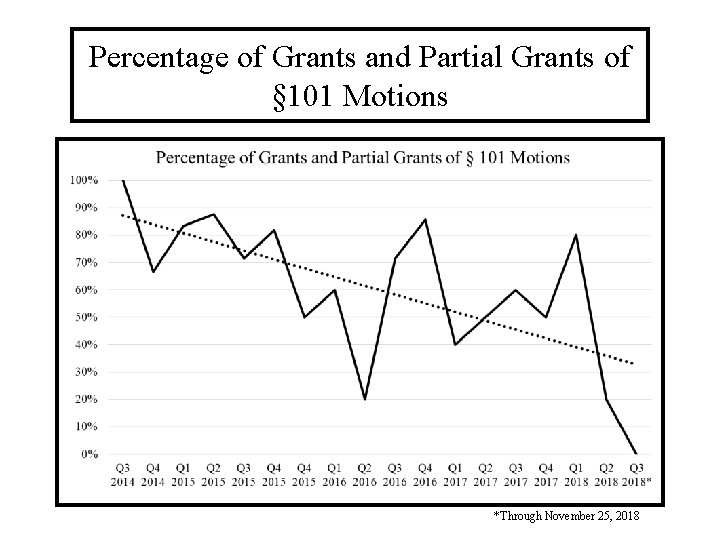
Percentage of Grants and Partial Grants of § 101 Motions *Through November 25, 2018
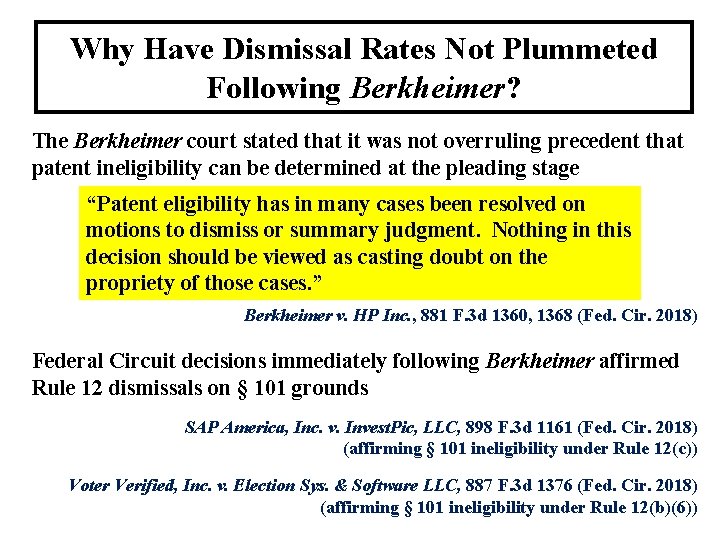
Why Have Dismissal Rates Not Plummeted Following Berkheimer? The Berkheimer court stated that it was not overruling precedent that patent ineligibility can be determined at the pleading stage “Patent eligibility has in many cases been resolved on motions to dismiss or summary judgment. Nothing in this decision should be viewed as casting doubt on the propriety of those cases. ” Berkheimer v. HP Inc. , 881 F. 3 d 1360, 1368 (Fed. Cir. 2018) Federal Circuit decisions immediately following Berkheimer affirmed Rule 12 dismissals on § 101 grounds SAP America, Inc. v. Invest. Pic, LLC, 898 F. 3 d 1161 (Fed. Cir. 2018) (affirming § 101 ineligibility under Rule 12(c)) Voter Verified, Inc. v. Election Sys. & Software LLC, 887 F. 3 d 1376 (Fed. Cir. 2018) (affirming § 101 ineligibility under Rule 12(b)(6))
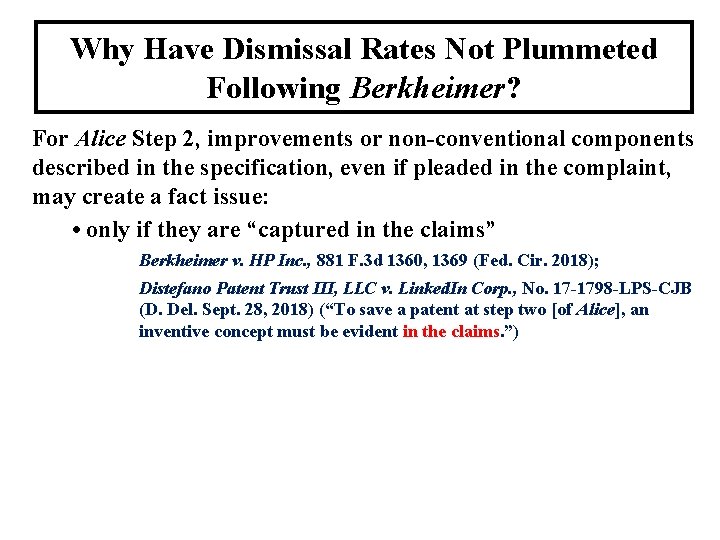
Why Have Dismissal Rates Not Plummeted Following Berkheimer? For Alice Step 2, improvements or non-conventional components described in the specification, even if pleaded in the complaint, may create a fact issue: • only if they are “captured in the claims” Berkheimer v. HP Inc. , 881 F. 3 d 1360, 1369 (Fed. Cir. 2018); Distefano Patent Trust III, LLC v. Linked. In Corp. , No. 17 -1798 -LPS-CJB (D. Del. Sept. 28, 2018) (“To save a patent at step two [of Alice], an inventive concept must be evident in the claims. ”)
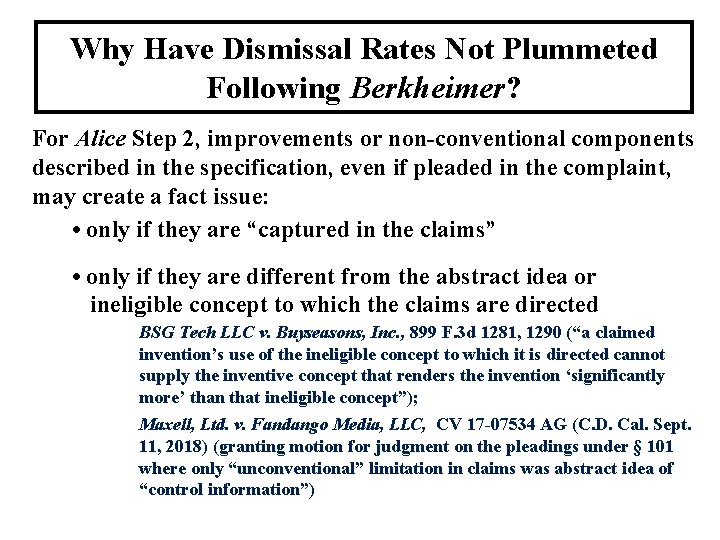
Why Have Dismissal Rates Not Plummeted Following Berkheimer? For Alice Step 2, improvements or non-conventional components described in the specification, even if pleaded in the complaint, may create a fact issue: • only if they are “captured in the claims” • only if they are different from the abstract idea or ineligible concept to which the claims are directed BSG Tech LLC v. Buyseasons, Inc. , 899 F. 3 d 1281, 1290 (“a claimed invention’s use of the ineligible concept to which it is directed cannot supply the inventive concept that renders the invention ‘significantly more’ than that ineligible concept”); Maxell, Ltd. v. Fandango Media, LLC, CV 17 -07534 AG (C. D. Cal. Sept. 11, 2018) (granting motion for judgment on the pleadings under § 101 where only “unconventional” limitation in claims was abstract idea of “control information”)
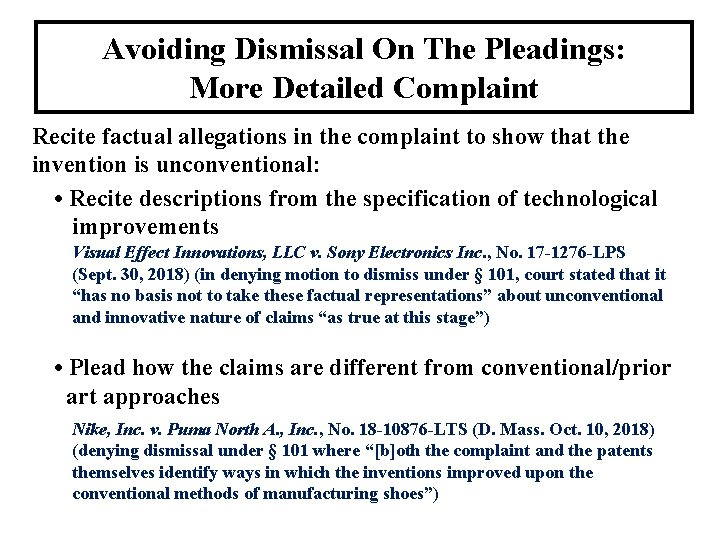
Avoiding Dismissal On The Pleadings: More Detailed Complaint Recite factual allegations in the complaint to show that the invention is unconventional: • Recite descriptions from the specification of technological improvements Visual Effect Innovations, LLC v. Sony Electronics Inc. , No. 17 -1276 -LPS (Sept. 30, 2018) (in denying motion to dismiss under § 101, court stated that it “has no basis not to take these factual representations” about unconventional and innovative nature of claims “as true at this stage”) • Plead how the claims are different from conventional/prior art approaches Nike, Inc. v. Puma North A. , Inc. , No. 18 -10876 -LTS (D. Mass. Oct. 10, 2018) (denying dismissal under § 101 where “[b]oth the complaint and the patents themselves identify ways in which the inventions improved upon the conventional methods of manufacturing shoes”)
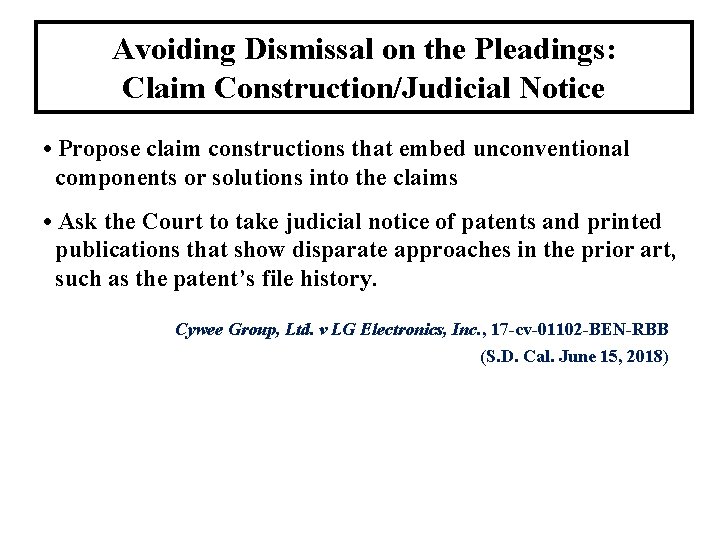
Avoiding Dismissal on the Pleadings: Claim Construction/Judicial Notice • Propose claim constructions that embed unconventional components or solutions into the claims • Ask the Court to take judicial notice of patents and printed publications that show disparate approaches in the prior art, such as the patent’s file history. Cywee Group, Ltd. v LG Electronics, Inc. , 17 -cv-01102 -BEN-RBB (S. D. Cal. June 15, 2018)
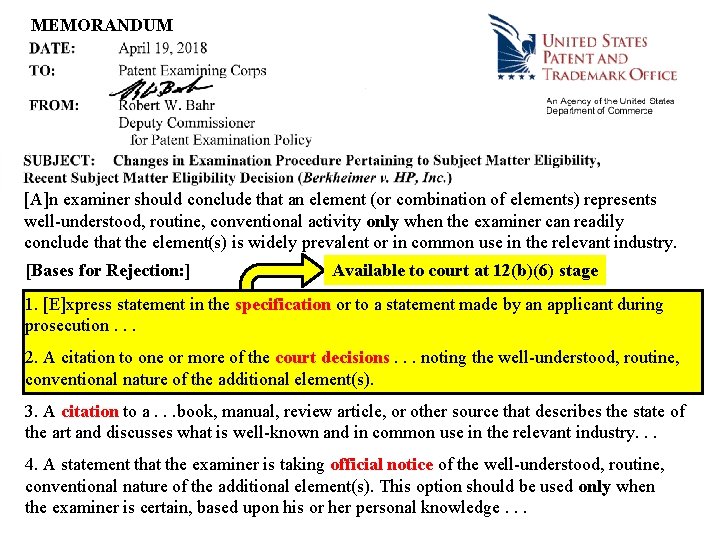
MEMORANDUM [A]n examiner should conclude that an element (or combination of elements) represents well-understood, routine, conventional activity only when the examiner can readily conclude that the element(s) is widely prevalent or in common use in the relevant industry. [Bases for Rejection: ] Available to court at 12(b)(6) stage 1. [E]xpress statement in the specification or to a statement made by an applicant during prosecution. . . 2. A citation to one or more of the court decisions. . . noting the well-understood, routine, conventional nature of the additional element(s). 3. A citation to a. . . book, manual, review article, or other source that describes the state of the art and discusses what is well-known and in common use in the relevant industry. . . 4. A statement that the examiner is taking official notice of the well-understood, routine, conventional nature of the additional element(s). This option should be used only when the examiner is certain, based upon his or her personal knowledge. . .
PTO § 101 Trends Source: http: //www. ipwatchdog. com/2018/05/24/eligibility-rejections-greater-frequency-uspto/id=97615/
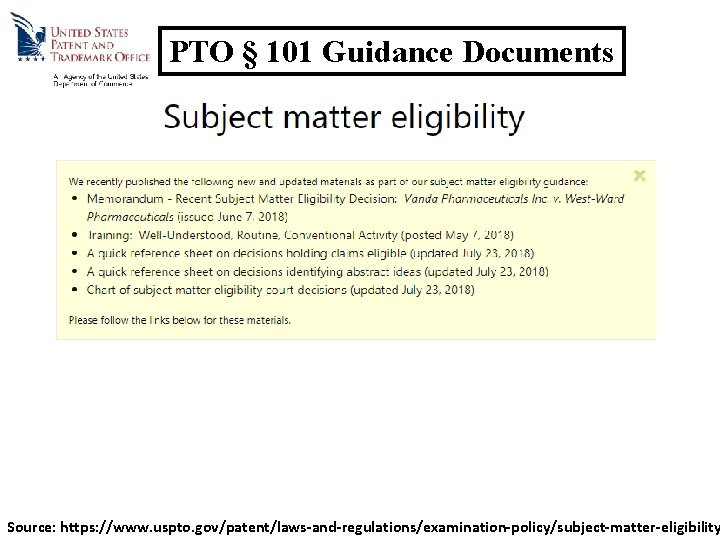
PTO § 101 Guidance Documents Source: https: //www. uspto. gov/patent/laws-and-regulations/examination-policy/subject-matter-eligibility
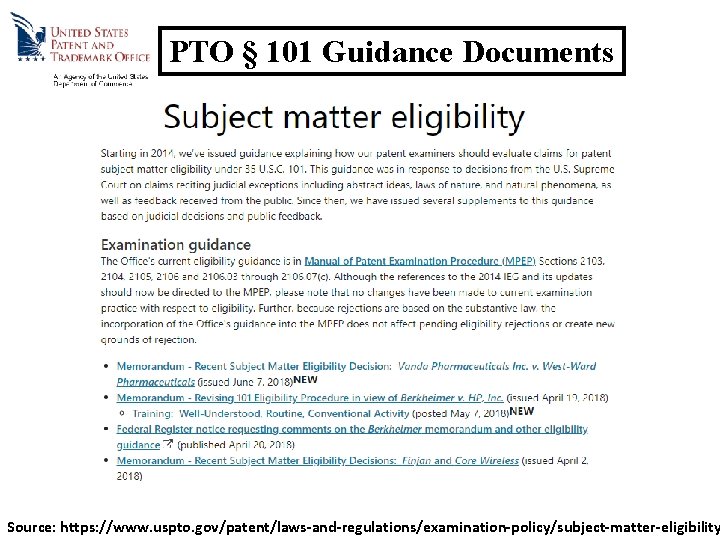
PTO § 101 Guidance Documents Source: https: //www. uspto. gov/patent/laws-and-regulations/examination-policy/subject-matter-eligibility
PTO § 101 Guidance Documents Source: https: //www. uspto. gov/patent/laws-and-regulations/examination-policy/subject-matter-eligibility
PTO § 101 Guidance Documents Source: https: //www. uspto. gov/about-us/news-updates/remarks-director-iancu-10 th-annual-patent-law-policy-conference
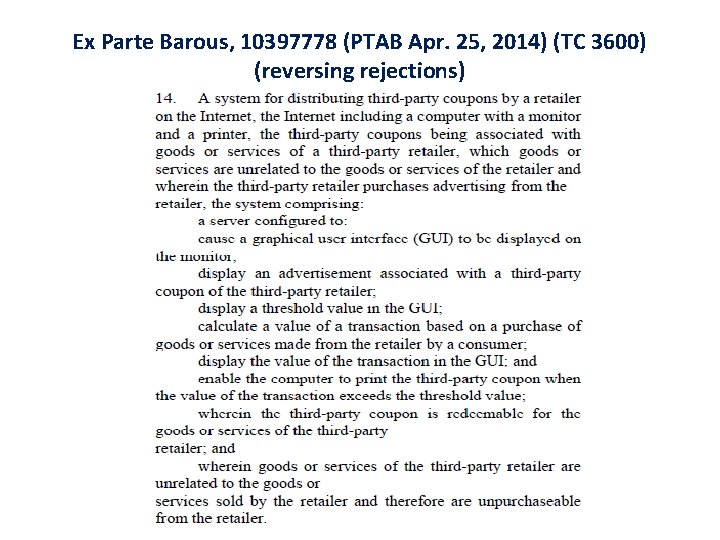
Ex Parte Barous, 10397778 (PTAB Apr. 25, 2014) (TC 3600) (reversing rejections)
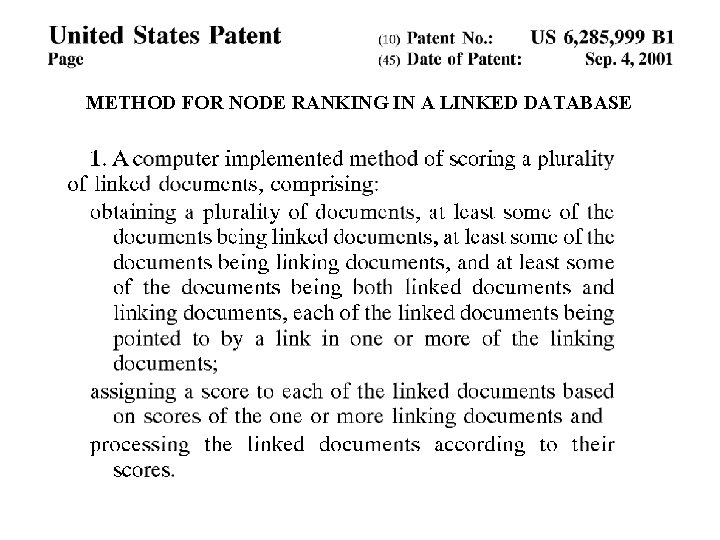
METHOD FOR NODE RANKING IN A LINKED DATABASE
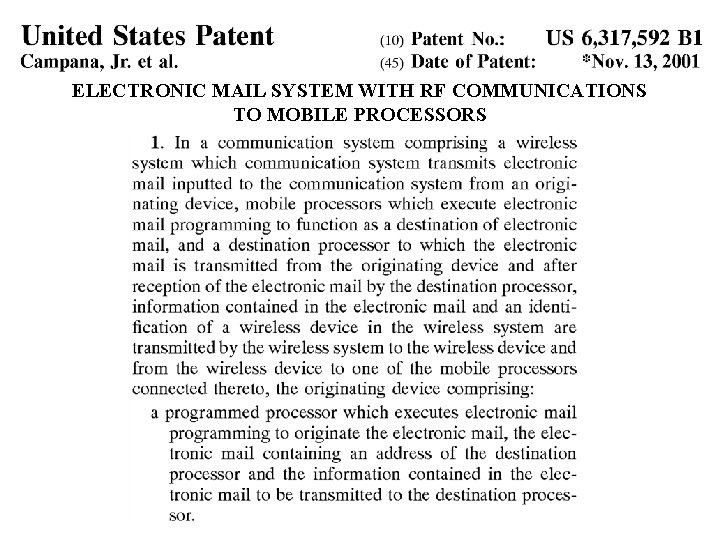
ELECTRONIC MAIL SYSTEM WITH RF COMMUNICATIONS TO MOBILE PROCESSORS
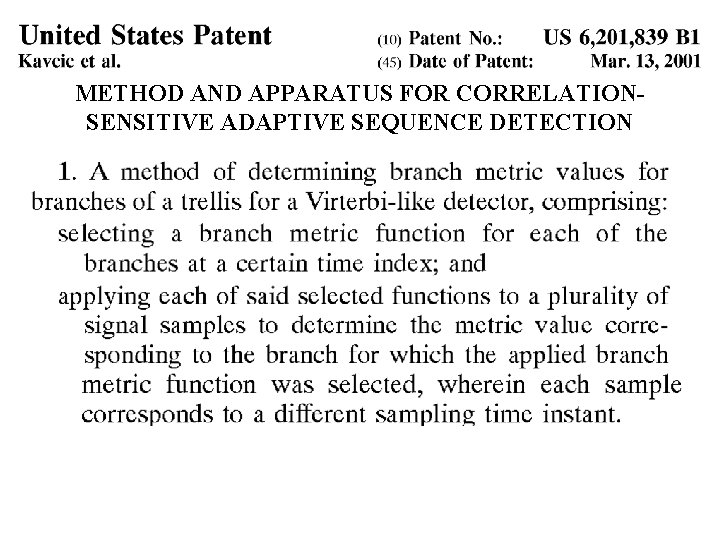
METHOD AND APPARATUS FOR CORRELATIONSENSITIVE ADAPTIVE SEQUENCE DETECTION
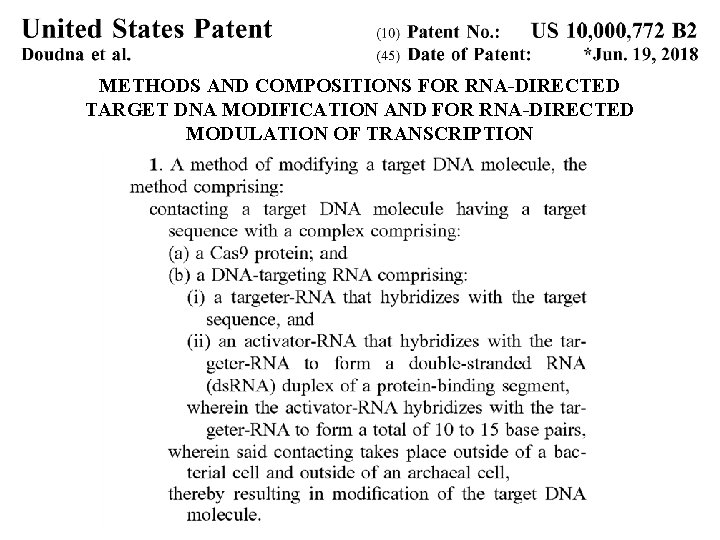
METHODS AND COMPOSITIONS FOR RNA-DIRECTED TARGET DNA MODIFICATION AND FOR RNA-DIRECTED MODULATION OF TRANSCRIPTION
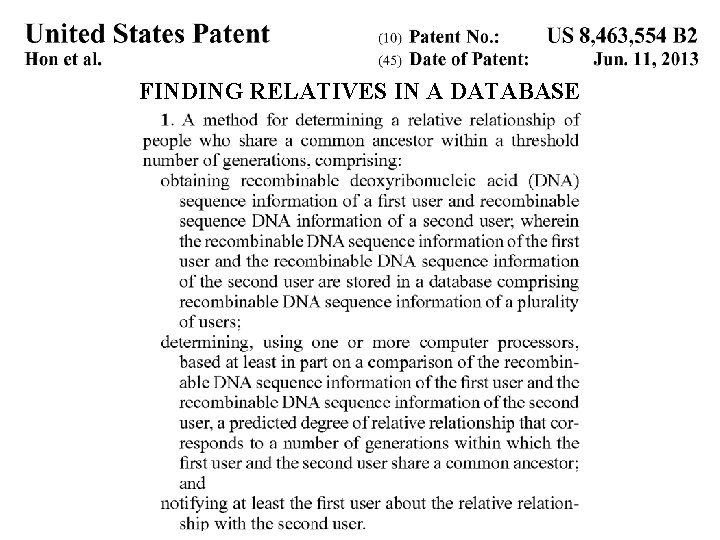
FINDING RELATIVES IN A DATABASE
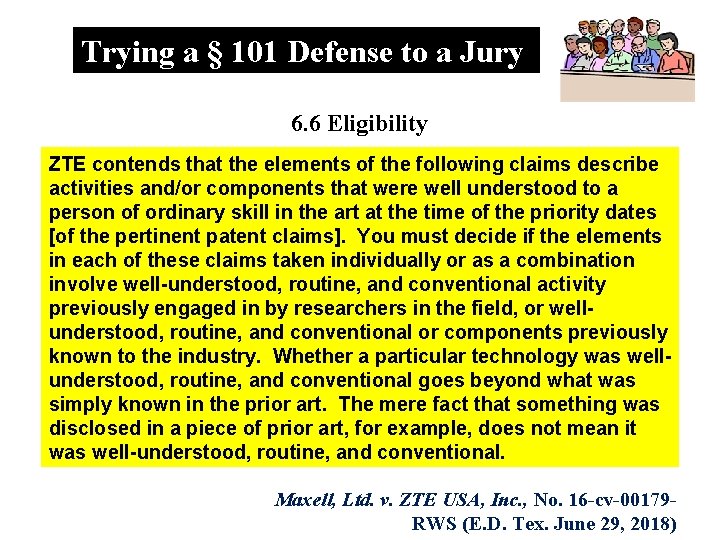
Trying a § 101 Defense to a Jury 6. 6 Eligibility ZTE contends that the elements of the following claims describe activities and/or components that were well understood to a person of ordinary skill in the art at the time of the priority dates [of the pertinent patent claims]. You must decide if the elements in each of these claims taken individually or as a combination involve well-understood, routine, and conventional activity previously engaged in by researchers in the field, or wellunderstood, routine, and conventional or components previously known to the industry. Whether a particular technology was wellunderstood, routine, and conventional goes beyond what was simply known in the prior art. The mere fact that something was disclosed in a piece of prior art, for example, does not mean it was well-understood, routine, and conventional. Maxell, Ltd. v. ZTE USA, Inc. , No. 16 -cv-00179 RWS (E. D. Tex. June 29, 2018)
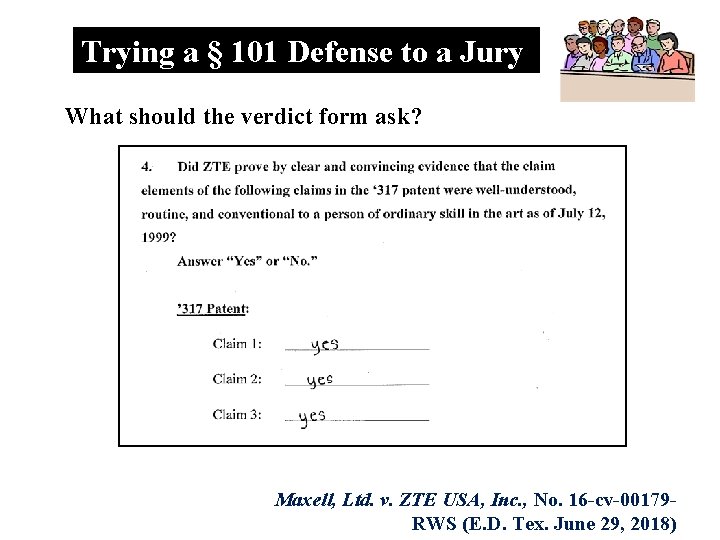
Trying a § 101 Defense to a Jury What should the verdict form ask? Maxell, Ltd. v. ZTE USA, Inc. , No. 16 -cv-00179 RWS (E. D. Tex. June 29, 2018)