
100 Question from Cell Organelles Storage areas of



- Slides: 30
$100 Question from Cell Organelles Storage areas of the cell – stores food water and wastes.
$200 Question from Cell Organelles The control center of the cell – contains chromosomes made of DNA.
$300 Question from Cell Organelles The powerhouse of the Cell – where respiration Takes place.
$400 Question from Cell Organelles Provides support and protection for a plant cell.
$500 Question from Cell Organelles Has ribosomes that produce necessary proteins for the cell.
$100 Question from Cell Basics This is used to view a cell.
$200 Question from Cell Basics The gel-like material that all other cell parts move around in – mostly water.
$300 Question from Cell Basics Separates the cell from its environment – controls what enters and exits the cell.
$400 Question from Cell Basics The general term for the specialized parts of the cell.
$500 Question from Cell Basics The two cell parts that plant cells have and animal cells do not.
$100 Question from Organization of Life Your stomach is one of these.
$200 Question from Organization of Life There are many kinds of these – nerve is an example.
$200 Question from Cell Extras The total magnification of a microscope with an eyepiece marked 20 X and an objective lens marked 30 X.
Passive Transport 100 Name one of the kinds of passive transport you learned about. S 2 C 06 Jeopardy Review
Passive Transport 200 True or False Passive transport does NOT REQUIRE any energy. S 2 C 06 Jeopardy Review
Passive Transport 300 TRUE OR FALSE In passive transport, molecules always move from a region of lower concentration to a region of higher concentration. S 2 C 06 Jeopardy Review
Passive Transport 400 Diffusion continues until the concentration of molecules is equal throughout the space. This is called __________. S 2 C 06 Jeopardy Review
Passive Transport 500 Name a molecule that moves by a kind of passive transport across membranes in cells and tell which kind of transport it uses. S 2 C 06 Jeopardy Review
Active Transport 100 Name one of the kinds of Active transport you learned about. S 2 C 06 Jeopardy Review
Active Transport 200 The type of endocytosis in which large molecules or whole cells are taken into a cell is called ___________. S 2 C 06 Jeopardy Review
Active Transport 300 In endocytosis and exocytosis, substances are carried in small membrane bound sacs called _______ S 2 C 06 Jeopardy Review
Active Transport 400 Molecule that provides the energy for the Na+-K+ pump to work. S 2 C 06 Jeopardy Review
Active Transport 500 Pinocytosis is a kind of ______ Exocytosis S 2 C 06 Jeopardy Review Endocytosis
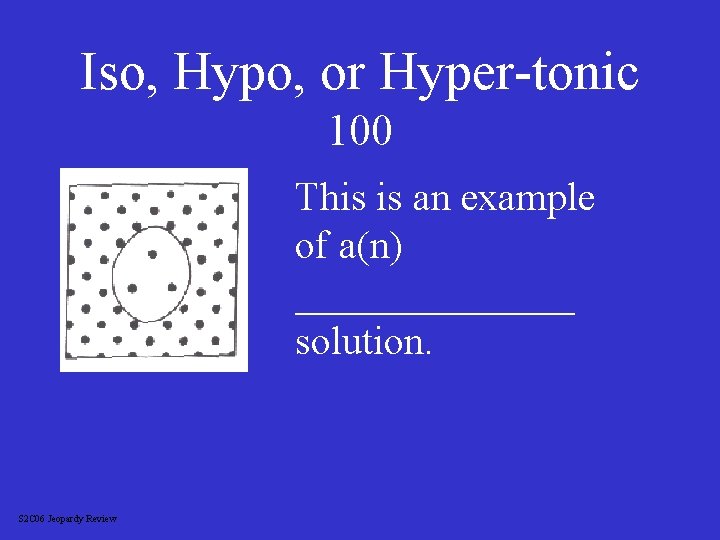
Iso, Hypo, or Hyper-tonic 100 This is an example of a(n) _______ solution. S 2 C 06 Jeopardy Review
Iso, Hypo, or Hyper-tonic 200 If placed in a ______ solution, water will enter an animal cell and it will get larger. S 2 C 06 Jeopardy Review
Iso, Hypo, or Hyper-tonic 300 If placed in a hypertonic solution plant cells will lose water and pull away from their cell wall. This is called __________. S 2 C 06 Jeopardy Review
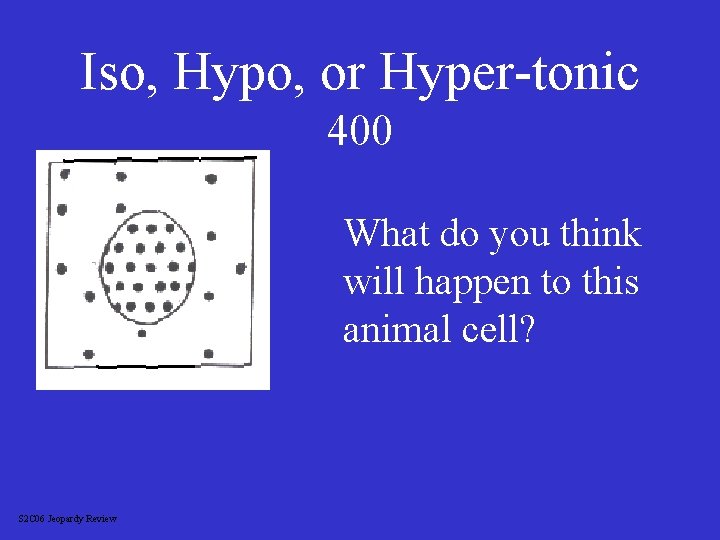
Iso, Hypo, or Hyper-tonic 400 What do you think will happen to this animal cell? S 2 C 06 Jeopardy Review
Iso, Hypo, or Hyper-tonic 500 The pressure exerted by water moving during osmosis is called _______ pressure. S 2 C 06 Jeopardy Review
Transport 100 Facilitated diffusion is a kind of ______ transport. Active S 2 C 06 Jeopardy Review Passive
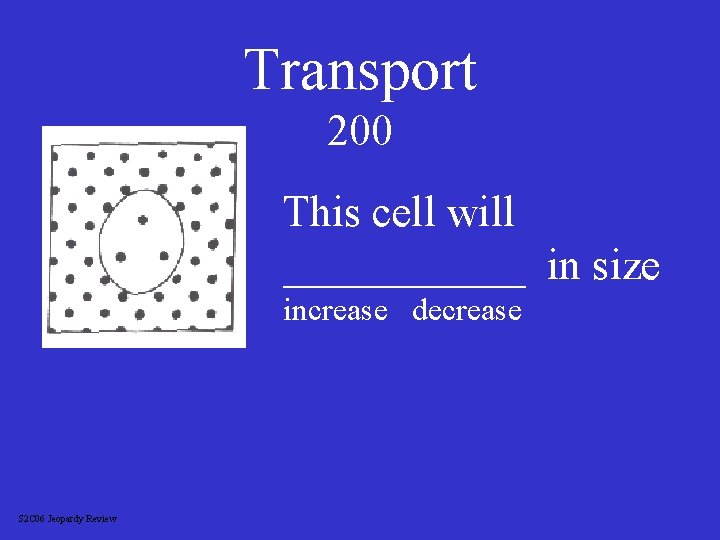
Transport 200 This cell will ______ in size increase decrease S 2 C 06 Jeopardy Review