
10 Z 3 Applications Enablers Challenges Directions Nikolaj
10 Z 3 : Applications Enablers Challenges Directions Nikolaj Bjørner Microsoft Research FSE &
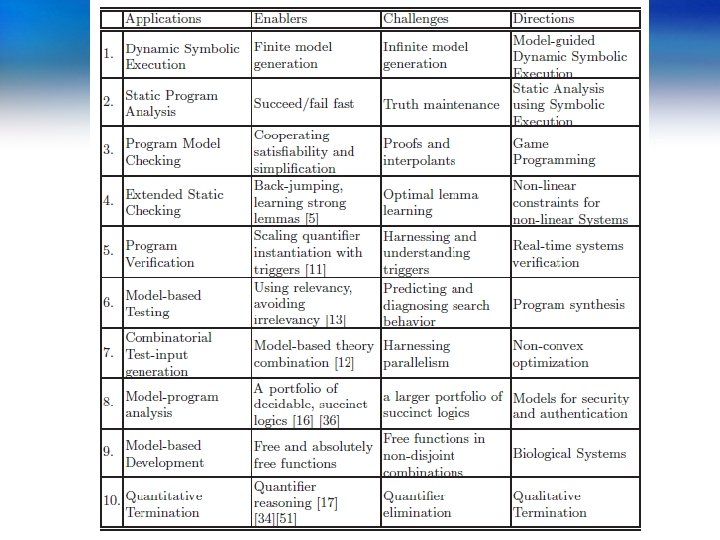
This Talk Z 3 – An Efficient SMT Solver 10 x Applications of Z 3 (at Microsoft) Enabling Technologies – what was important Challenges – what is compelling future work Directions – emerging applications

An update on Z 3
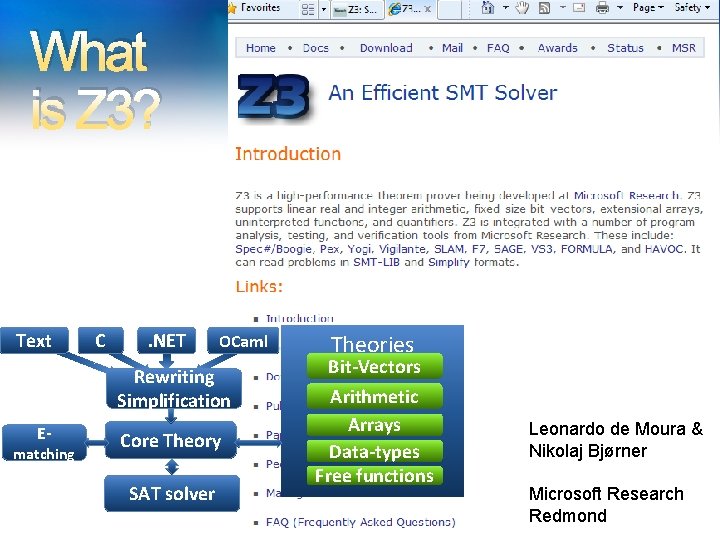
What is Z 3? Text C . NET OCaml Rewriting Simplification E- matching Core Theory SAT solver Theories Bit-Vectors Arithmetic Arrays Data-types Free functions Leonardo de Moura & Nikolaj Bjørner Microsoft Research Redmond

What is Z 3? Theories Simplify Bit-Vectors Lin-arithmetic SMT-LIB OCaml Arrays Tuples Uninterpreted functions Native Quantifiers: E-matching Arithmetic . NET C Model Generation: Finite Models Arrays Free Functions
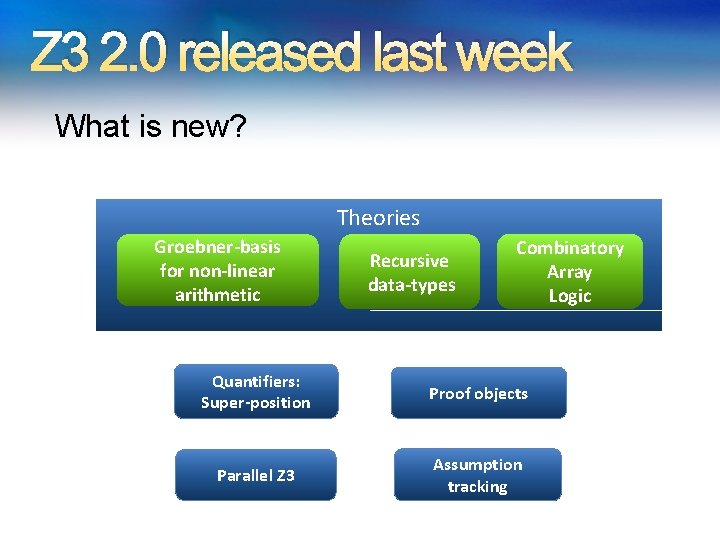
Z 3 2. 0 released last week What is new? Theories Groebner-basis for non-linear arithmetic Recursive data-types Combinatory Array Logic Quantifiers: Super-position Proof objects Parallel Z 3 Assumption tracking
Z 310: Applications Enablers Challenges Directions
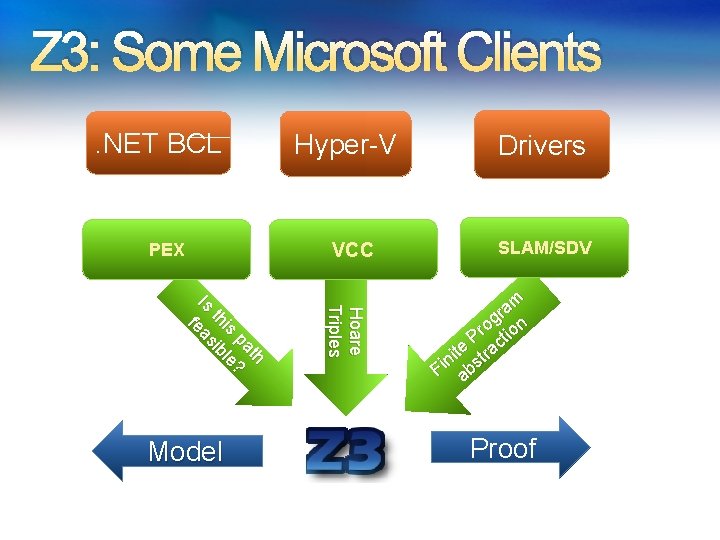
Z 3: Some Microsoft Clients. NET BCL PEX VCC Hoare Triples th pa ? is le th ib Is eas f Model Hyper-V Drivers SLAM/SDV am r og ion r P ct e a t ni str i F ab Proof
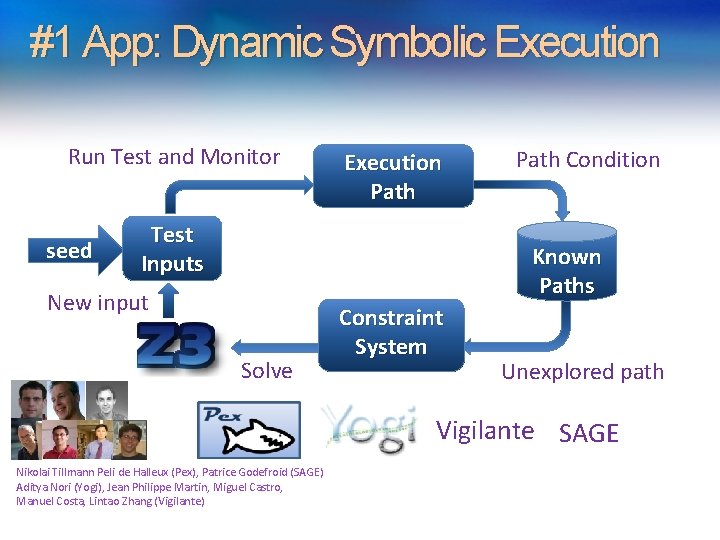
#1 App: Dynamic Symbolic Execution Run Test and Monitor seed Execution Path Test Inputs Path Condition Known Paths New input Solve Constraint System Unexplored path Vigilante SAGE Nikolai Tillmann Peli de Halleux (Pex), Patrice Godefroid (SAGE) Aditya Nori (Yogi), Jean Philippe Martin, Miguel Castro, Manuel Costa, Lintao Zhang (Vigilante)
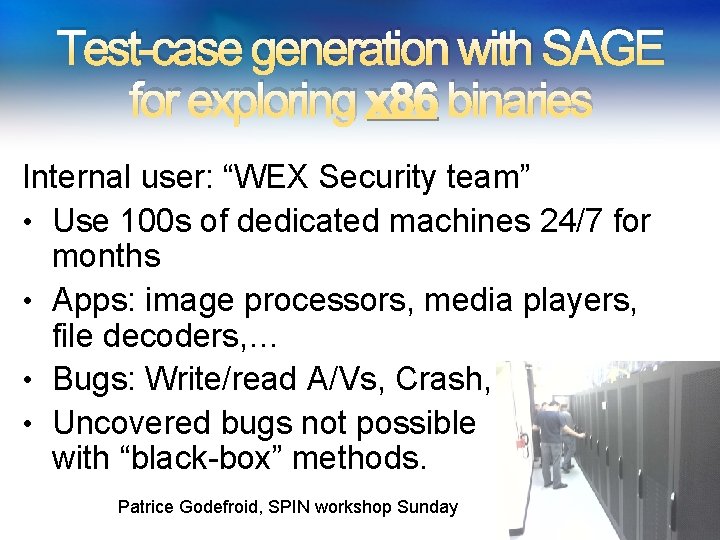
Test-case generation with SAGE for exploring x 86 binaries Internal user: “WEX Security team” • Use 100 s of dedicated machines 24/7 for months • Apps: image processors, media players, file decoders, … • Bugs: Write/read A/Vs, Crash, … • Uncovered bugs not possible with “black-box” methods. Patrice Godefroid, SPIN workshop Sunday
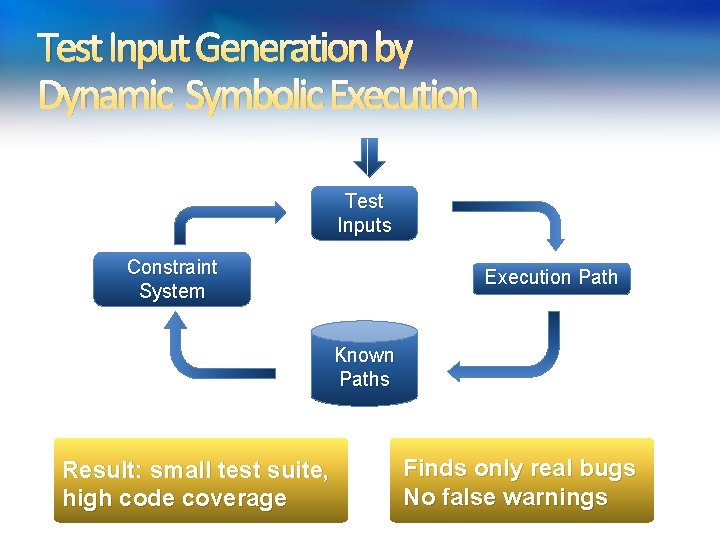
Test Input Generation by Dynamic Symbolic Execution Initially, choose Arbitrary Solve Test Inputs Constraint System Choose an Uncovered Path Result: small test suite, high code coverage Run Test and Monitor Execution Path Known Paths Record Path Condition Finds only real bugs No false warnings
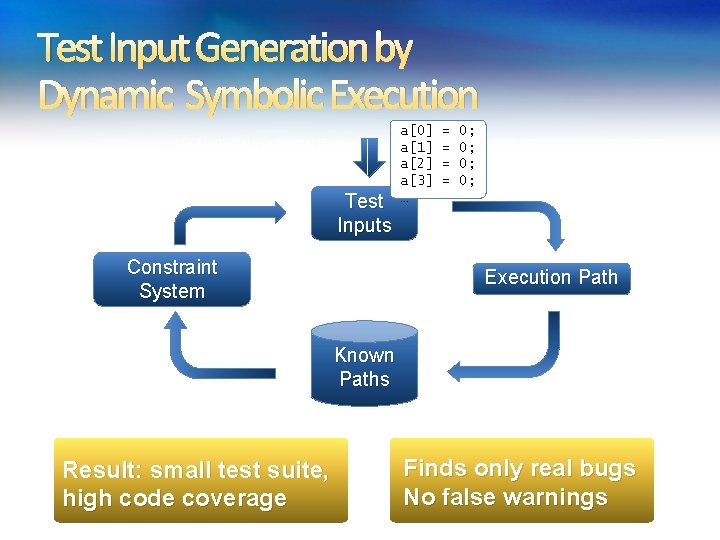
Test Input Generation by Dynamic Symbolic Execution Initially, choose Arbitrary Solve Test Inputs Constraint System Choose an Uncovered Path Result: small test suite, high code coverage a[0] a[1] a[2] a[3] … = = 0; 0; Run Test and Monitor Execution Path Known Paths Record Path Condition Finds only real bugs No false warnings
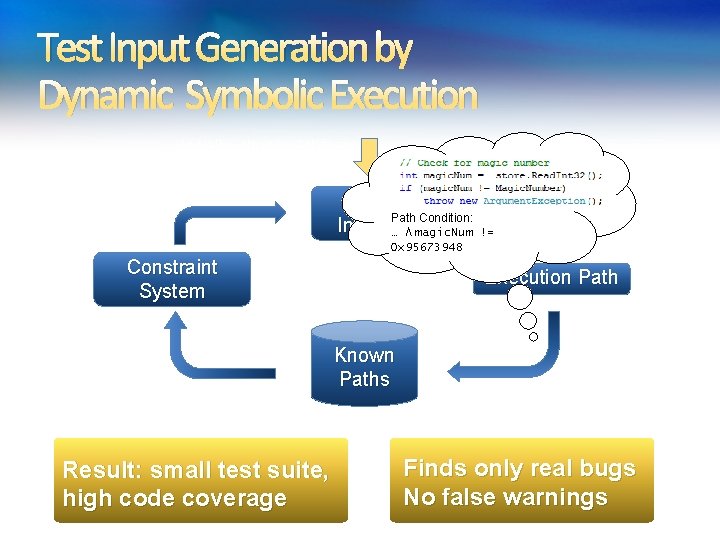
Test Input Generation by Dynamic Symbolic Execution Initially, choose Arbitrary Solve Test Condition: Inputs. Path … ⋀ magic. Num Run Test and Monitor != 0 x 95673948 Constraint System Choose an Uncovered Path Result: small test suite, high code coverage Execution Path Known Paths Record Path Condition Finds only real bugs No false warnings
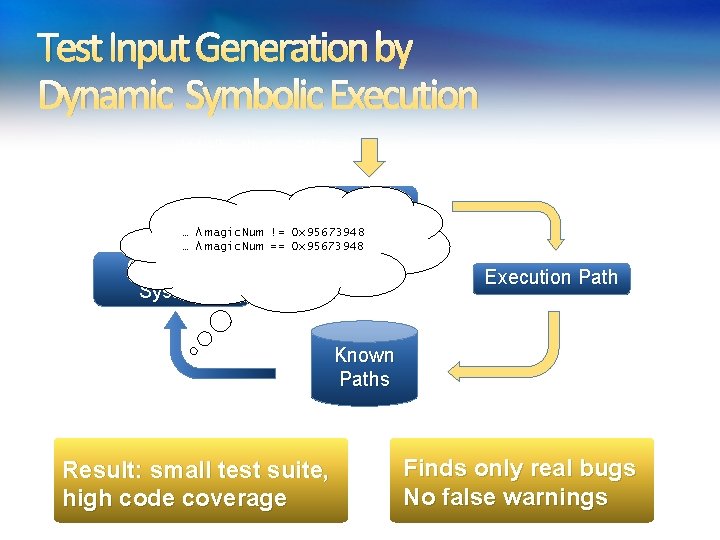
Test Input Generation by Dynamic Symbolic Execution Initially, choose Arbitrary Solve Test Inputs 0 x 95673948 Run Test and Monitor … ⋀ magic. Num != … ⋀ magic. Num == 0 x 95673948 Constraint System Choose an Uncovered Path Result: small test suite, high code coverage Execution Path Known Paths Record Path Condition Finds only real bugs No false warnings
![Test Input Generation by Dynamic Symbolic Execution a[0] a[1] a[2] a[3] = = 206;](http://slidetodoc.com/presentation_image_h2/5d645a9e90d83fe93ea2fce00396fee9/image-16.jpg "Test Input Generation by Dynamic Symbolic Execution a[0] a[1] a[2] a[3] = = 206;")
Test Input Generation by Dynamic Symbolic Execution a[0] a[1] a[2] a[3] = = 206; 202; 239; 190; Initially, choose Arbitrary Solve Test Inputs Constraint System Choose an Uncovered Path Result: small test suite, high code coverage Run Test and Monitor Execution Path Known Paths Record Path Condition Finds only real bugs No false warnings
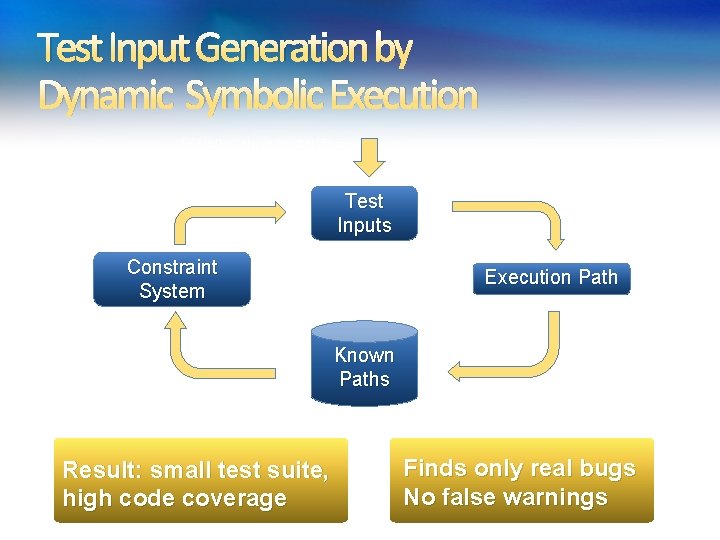
Test Input Generation by Dynamic Symbolic Execution Initially, choose Arbitrary Solve Test Inputs Constraint System Choose an Uncovered Path Result: small test suite, high code coverage Run Test and Monitor Execution Path Known Paths Record Path Condition Finds only real bugs No false warnings
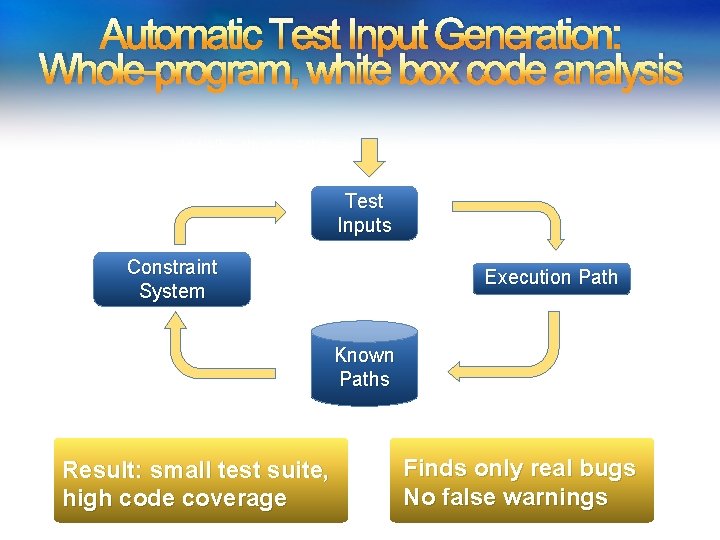
Automatic Test Input Generation: Whole-program, white box code analysis Initially, choose Arbitrary Solve Test Inputs Constraint System Choose an Uncovered Path Result: small test suite, high code coverage Run Test and Monitor Execution Path Known Paths Record Path Condition Finds only real bugs No false warnings
Array. List with Pex: The Spec Nikolai Tillmann, RV workshop, Saturday
![Array. List: Add. Item Test class Array. List. Test { [Pex. Method] void Add.](http://slidetodoc.com/presentation_image_h2/5d645a9e90d83fe93ea2fce00396fee9/image-20.jpg "Array. List: Add. Item Test class Array. List. Test { [Pex. Method] void Add.")
Array. List: Add. Item Test class Array. List. Test { [Pex. Method] void Add. Item(int c, object item) { var list = new Array. List(c); list. Add(item); Assert(list[0] == item); } } class Array. List { object[] items; int count; Array. List(int capacity) { if (capacity < 0) throw. . . ; items = new object[capacity]; } void Add(object item) { if (count == items. Length) Resize. Array(); items[this. count++] = item; }. . .
![Array. List: Starting Pex … class Array. List. Test { [Pex. Method] void Add.](http://slidetodoc.com/presentation_image_h2/5d645a9e90d83fe93ea2fce00396fee9/image-21.jpg "Array. List: Starting Pex … class Array. List. Test { [Pex. Method] void Add.")
Array. List: Starting Pex … class Array. List. Test { [Pex. Method] void Add. Item(int c, object item) { var list = new Array. List(c); list. Add(item); Assert(list[0] == item); } } class Array. List { object[] items; int count; Array. List(int capacity) { if (capacity < 0) throw. . . ; items = new object[capacity]; } void Add(object item) { if (count == items. Length) Resize. Array(); items[this. count++] = item; }. . . Inputs
![Array. List: Run 1, (0, null) class Array. List. Test { [Pex. Method] void](http://slidetodoc.com/presentation_image_h2/5d645a9e90d83fe93ea2fce00396fee9/image-22.jpg "Array. List: Run 1, (0, null) class Array. List. Test { [Pex. Method] void")
Array. List: Run 1, (0, null) class Array. List. Test { [Pex. Method] void Add. Item(int c, object item) { var list = new Array. List(c); list. Add(item); Assert(list[0] == item); } } class Array. List { object[] items; int count; Array. List(int capacity) { if (capacity < 0) throw. . . ; items = new object[capacity]; } void Add(object item) { if (count == items. Length) Resize. Array(); items[this. count++] = item; }. . . Inputs (0, null)
![Array. List: Run 1, (0, null) class Array. List. Test { [Pex. Method] void](http://slidetodoc.com/presentation_image_h2/5d645a9e90d83fe93ea2fce00396fee9/image-23.jpg "Array. List: Run 1, (0, null) class Array. List. Test { [Pex. Method] void")
Array. List: Run 1, (0, null) class Array. List. Test { [Pex. Method] void Add. Item(int c, object item) { var list = new Array. List(c); list. Add(item); Assert(list[0] == item); } } class Array. List { object[] items; int count; Array. List(int capacity) { if (capacity < 0) throw. . . ; items = new object[capacity]; } void Add(object item) { if (count == items. Length) Resize. Array(); items[this. count++] = item; }. . . c < 0 false Inputs Observed Constraints (0, null) !(c<0)
![Array. List: Run 1, (0, null) class Array. List. Test { [Pex. Method] void](http://slidetodoc.com/presentation_image_h2/5d645a9e90d83fe93ea2fce00396fee9/image-24.jpg "Array. List: Run 1, (0, null) class Array. List. Test { [Pex. Method] void")
Array. List: Run 1, (0, null) class Array. List. Test { [Pex. Method] void Add. Item(int c, object item) { var list = new Array. List(c); list. Add(item); Assert(list[0] == item); } } class Array. List { object[] items; int count; Array. List(int capacity) { if (capacity < 0) throw. . . ; items = new object[capacity]; } void Add(object item) { if (count == items. Length) 0 == c Resize. Array(); items[this. count++] = item; }. . . true Inputs Observed Constraints (0, null) !(c<0) && 0==c
![Array. List: Run 1, (0, null) class Array. List. Test { [Pex. Method] void](http://slidetodoc.com/presentation_image_h2/5d645a9e90d83fe93ea2fce00396fee9/image-25.jpg "Array. List: Run 1, (0, null) class Array. List. Test { [Pex. Method] void")
Array. List: Run 1, (0, null) class Array. List. Test { [Pex. Method] void Add. Item(int c, object item) { var list = new Array. List(c); list. Add(item); Assert(list[0] == item); } item == item } class Array. List { object[] items; int count; Array. List(int capacity) { if (capacity < 0) throw. . . ; items = new object[capacity]; } void Add(object item) { if (count == items. Length) Resize. Array(); items[this. count++] = item; }. . . Inputs Observed Constraints (0, null) !(c<0) && 0==c true This is a tautology, i. e. a constraint that is always true, regardless of the chosen values. We can ignore such constraints.
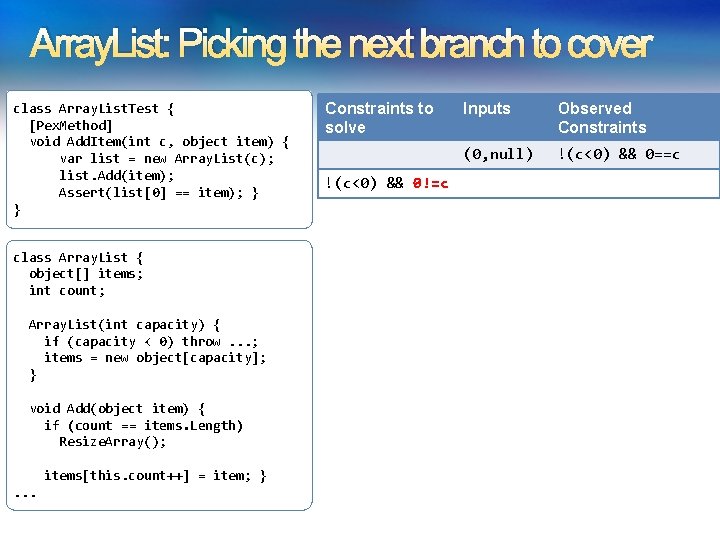
Array. List: Picking the next branch to cover class Array. List. Test { [Pex. Method] void Add. Item(int c, object item) { var list = new Array. List(c); list. Add(item); Assert(list[0] == item); } } class Array. List { object[] items; int count; Array. List(int capacity) { if (capacity < 0) throw. . . ; items = new object[capacity]; } void Add(object item) { if (count == items. Length) Resize. Array(); items[this. count++] = item; }. . . Constraints to solve !(c<0) && 0!=c Inputs Observed Constraints (0, null) !(c<0) && 0==c
![Array. List: Solve constraints using SMT solver class Array. List. Test { [Pex. Method]](http://slidetodoc.com/presentation_image_h2/5d645a9e90d83fe93ea2fce00396fee9/image-27.jpg "Array. List: Solve constraints using SMT solver class Array. List. Test { [Pex. Method]")
Array. List: Solve constraints using SMT solver class Array. List. Test { [Pex. Method] void Add. Item(int c, object item) { var list = new Array. List(c); list. Add(item); Assert(list[0] == item); } } class Array. List { object[] items; int count; Array. List(int capacity) { if (capacity < 0) throw. . . ; items = new object[capacity]; } void Add(object item) { if (count == items. Length) Resize. Array(); items[this. count++] = item; }. . . Constraints to solve Inputs Observed Constraints (0, null) !(c<0) && 0==c !(c<0) && 0!=c (1, null) Z 3 Constraint solver Z 3 has decision procedures for - Arrays - Linear integer arithmetic - Bitvector arithmetic -… - (Everything but floating-point numbers)
![Array. List: Run 2, (1, null) class Array. List. Test { [Pex. Method] void](http://slidetodoc.com/presentation_image_h2/5d645a9e90d83fe93ea2fce00396fee9/image-28.jpg "Array. List: Run 2, (1, null) class Array. List. Test { [Pex. Method] void")
Array. List: Run 2, (1, null) class Array. List. Test { [Pex. Method] void Add. Item(int c, object item) { var list = new Array. List(c); list. Add(item); Assert(list[0] == item); } } Constraints to solve Inputs Observed Constraints (0, null) !(c<0) && 0==c !(c<0) && 0!=c (1, null) !(c<0) && 0!=c class Array. List { object[] items; int count; Array. List(int capacity) { if (capacity < 0) throw. . . ; items = new object[capacity]; } void Add(object item) { if (count == items. Length) 0 == c Resize. Array(); items[this. count++] = item; }. . . false
![Array. List: Pick new branch class Array. List. Test { [Pex. Method] void Add.](http://slidetodoc.com/presentation_image_h2/5d645a9e90d83fe93ea2fce00396fee9/image-29.jpg "Array. List: Pick new branch class Array. List. Test { [Pex. Method] void Add.")
Array. List: Pick new branch class Array. List. Test { [Pex. Method] void Add. Item(int c, object item) { var list = new Array. List(c); list. Add(item); Assert(list[0] == item); } } class Array. List { object[] items; int count; Array. List(int capacity) { if (capacity < 0) throw. . . ; items = new object[capacity]; } void Add(object item) { if (count == items. Length) Resize. Array(); items[this. count++] = item; }. . . Constraints to solve Inputs Observed Constraints (0, null) !(c<0) && 0==c !(c<0) && 0!=c (1, null) !(c<0) && 0!=c c<0
![Array. List: Run 3, (-1, null) class Array. List. Test { [Pex. Method] void](http://slidetodoc.com/presentation_image_h2/5d645a9e90d83fe93ea2fce00396fee9/image-30.jpg "Array. List: Run 3, (-1, null) class Array. List. Test { [Pex. Method] void")
Array. List: Run 3, (-1, null) class Array. List. Test { [Pex. Method] void Add. Item(int c, object item) { var list = new Array. List(c); list. Add(item); Assert(list[0] == item); } } class Array. List { object[] items; int count; Array. List(int capacity) { if (capacity < 0) throw. . . ; items = new object[capacity]; } void Add(object item) { if (count == items. Length) Resize. Array(); items[this. count++] = item; }. . . Constraints to solve Inputs Observed Constraints (0, null) !(c<0) && 0==c !(c<0) && 0!=c (1, null) !(c<0) && 0!=c c<0 (-1, null)
![Array. List: Run 3, (-1, null) class Array. List. Test { [Pex. Method] void](http://slidetodoc.com/presentation_image_h2/5d645a9e90d83fe93ea2fce00396fee9/image-31.jpg "Array. List: Run 3, (-1, null) class Array. List. Test { [Pex. Method] void")
Array. List: Run 3, (-1, null) class Array. List. Test { [Pex. Method] void Add. Item(int c, object item) { var list = new Array. List(c); list. Add(item); Assert(list[0] == item); } } Constraints to solve Inputs Observed Constraints (0, null) !(c<0) && 0==c !(c<0) && 0!=c (1, null) !(c<0) && 0!=c c<0 (-1, null) c<0 class Array. List { object[] items; int count; Array. List(int capacity) { if (capacity < 0) throw. . . ; items = new object[capacity]; } void Add(object item) { if (count == items. Length) Resize. Array(); items[this. count++] = item; }. . . c < 0 true
![Array. List: Run 3, (-1, null) class Array. List. Test { [Pex. Method] void](http://slidetodoc.com/presentation_image_h2/5d645a9e90d83fe93ea2fce00396fee9/image-32.jpg "Array. List: Run 3, (-1, null) class Array. List. Test { [Pex. Method] void")
Array. List: Run 3, (-1, null) class Array. List. Test { [Pex. Method] void Add. Item(int c, object item) { var list = new Array. List(c); list. Add(item); Assert(list[0] == item); } } class Array. List { object[] items; int count; Array. List(int capacity) { if (capacity < 0) throw. . . ; items = new object[capacity]; } void Add(object item) { if (count == items. Length) Resize. Array(); items[this. count++] = item; }. . . Constraints to solve Inputs Observed Constraints (0, null) !(c<0) && 0==c !(c<0) && 0!=c (1, null) !(c<0) && 0!=c c<0 (-1, null) c<0
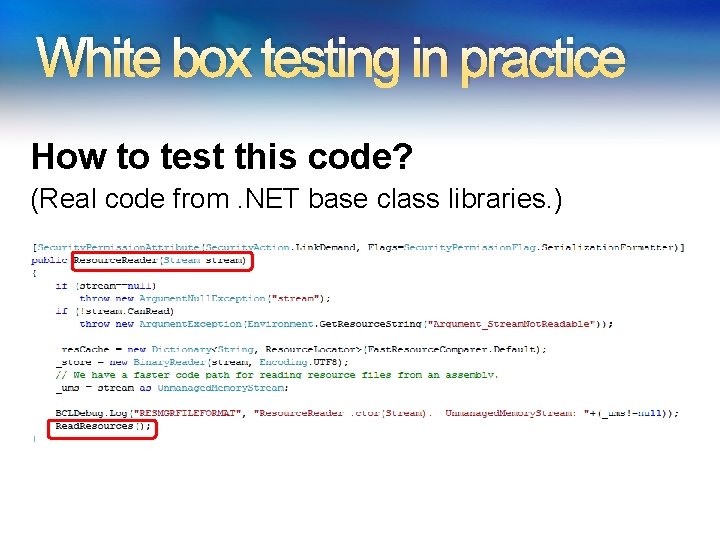
White box testing in practice How to test this code? (Real code from. NET base class libraries. ) 33
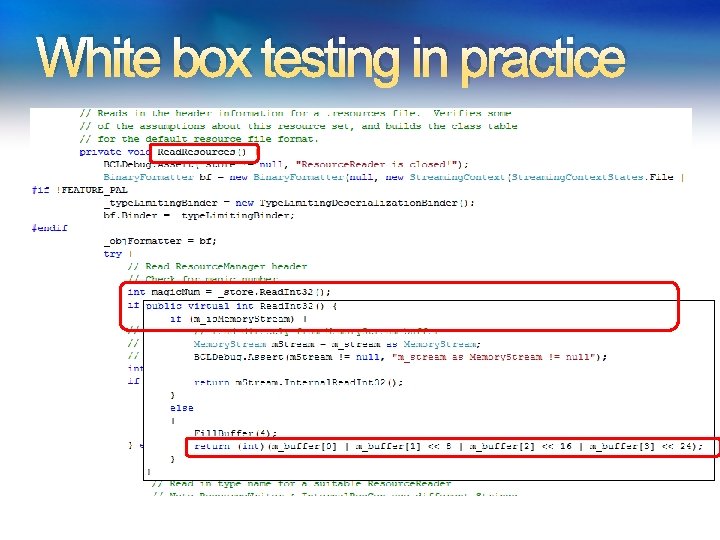
White box testing in practice 34
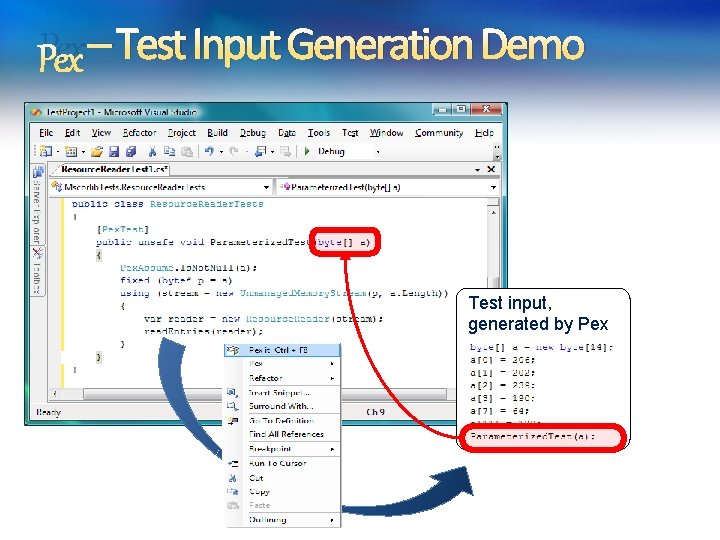
Pex – Test Input Generation Demo Test input, generated by Pex 35
#1 Enabler: finite model-finding Model generation Models used as test inputs Incremental solving Given a formula F, find a model M, that minimizes the value of the variables x 0 … xn Push / Pop of contexts for model minimization Demo: Example Z 3 model #1 Challenge: non-finite model-finding #1 Direction: Model-driven Dynamic Symbolic Execution
![#2 Static Program Analysis Application: 3(INT_MAX+1)/4 PREfix Static Analysis + int binary_search(int[] arr, int](http://slidetodoc.com/presentation_image_h2/5d645a9e90d83fe93ea2fce00396fee9/image-37.jpg "#2 Static Program Analysis Application: 3(INT_MAX+1)/4 PREfix Static Analysis + int binary_search(int[] arr, int")
#2 Static Program Analysis Application: 3(INT_MAX+1)/4 PREfix Static Analysis + int binary_search(int[] arr, int low, (INT_MAX+1)/4 int high, int key) = INT_MIN while (low <= high) { // Find middle value int mid = (low + high) / 2; int val = arr[mid]; // Refine range. . . string itoa(int n)-INT_MIN= { INT_MIN string s = “”; if (n < 0) { s += “-”; n = -n; } // Add digits to s …. Enabler: Bit-precise support Challenge: Speed More about PREfix & Z 3 by Yannick Moy
#3 Program Model Checking Z 3 is part of SDV 2. 0 (Windows 7) and Yogi Z 3 is used for: Predicate abstraction (c 2 bp) Counter-example refinement (newton) Maintaining symbolic state summaries An enabling feature: Term Simplification. Ella Bounimova, Vlad Levin, Jakob Lichtenberg, Tom Ball, Sriram Rajamani, Byron Cook, and team
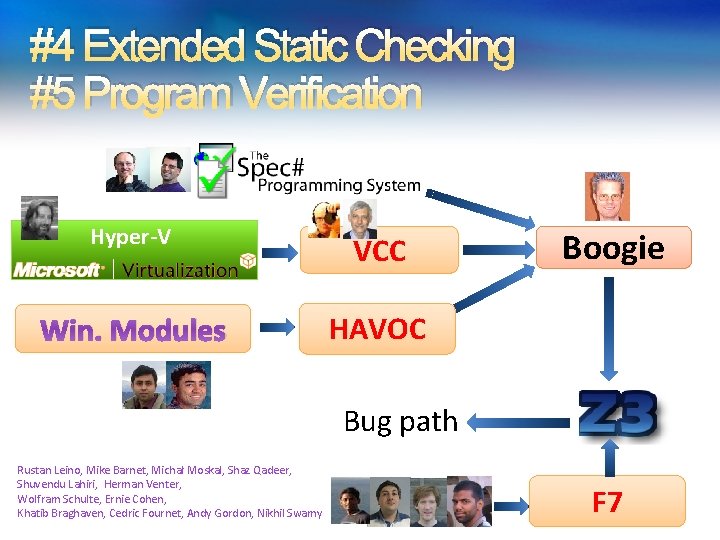
#4 Extended Static Checking #5 Program Verification Hyper-V VCC Win. Modules HAVOC Boogie Verification condition Bug path Rustan Leino, Mike Barnet, Michał Moskal, Shaz Qadeer, Shuvendu Lahiri, Herman Venter, Wolfram Schulte, Ernie Cohen, Khatib Braghaven, Cedric Fournet, Andy Gordon, Nikhil Swamy F 7
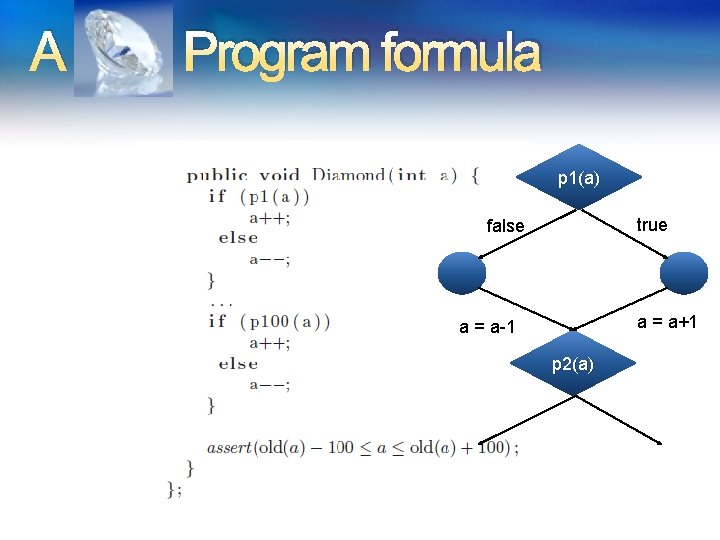
A Program formula p 1(a) true false a = a+1 a = a-1 p 2(a)
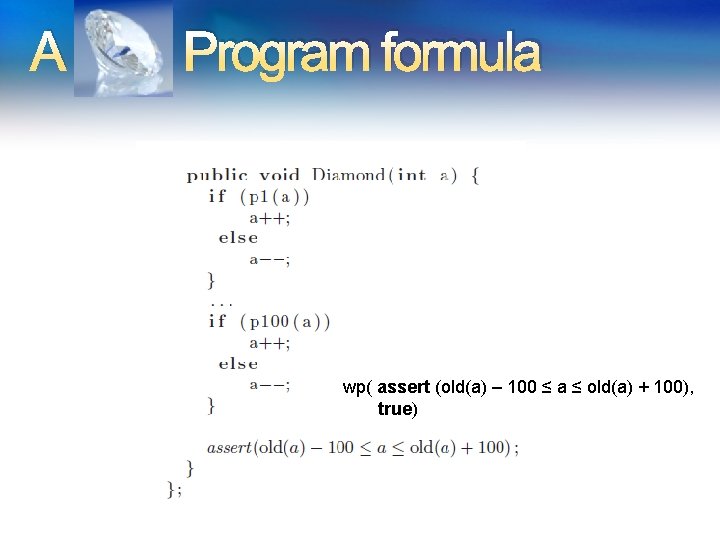
A Program formula wp( assert (old(a) – 100 ≤ a ≤ old(a) + 100), true)
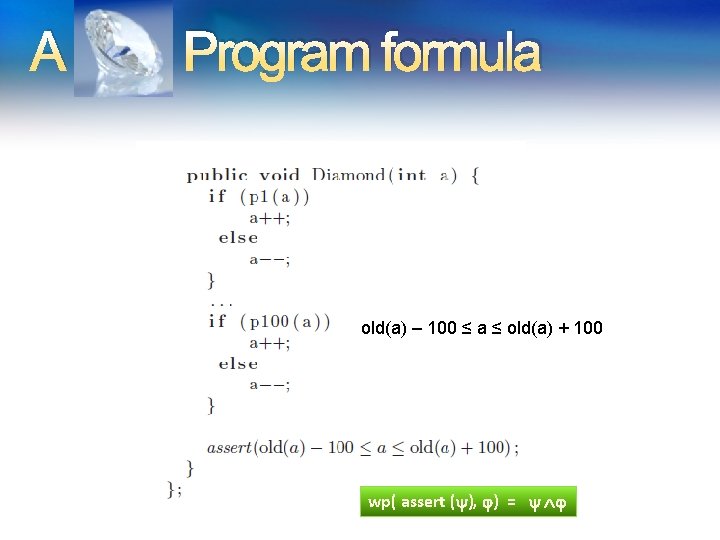
A Program formula old(a) – 100 ≤ a ≤ old(a) + 100 wp( assert ( ), ) =
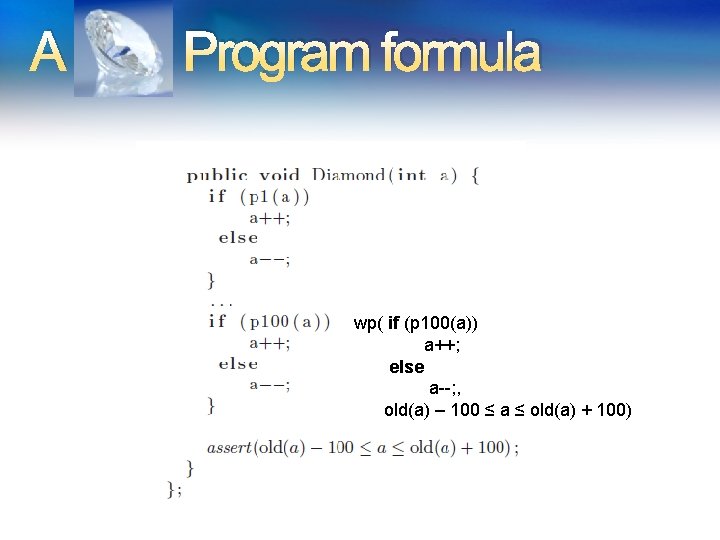
A Program formula wp( if (p 100(a)) a++; else a--; , old(a) – 100 ≤ a ≤ old(a) + 100)
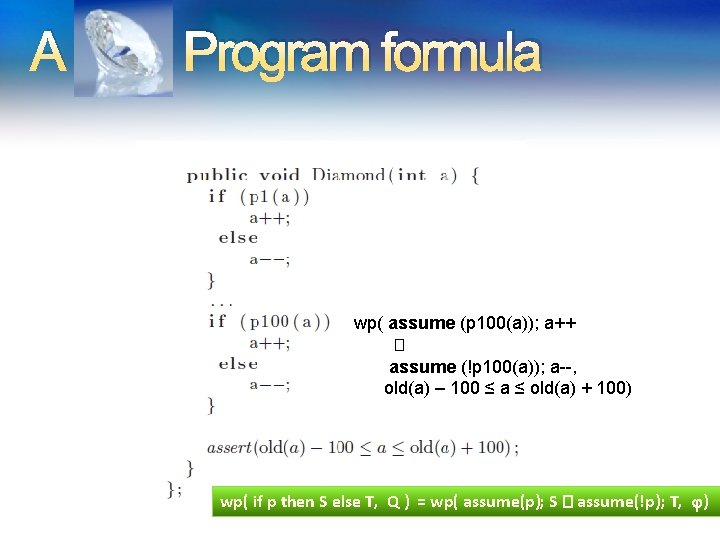
A Program formula wp( assume (p 100(a)); a++ � assume (!p 100(a)); a--, old(a) – 100 ≤ a ≤ old(a) + 100) wp( if p then S else T, Q ) = wp( assume(p); S � assume(!p); T, )
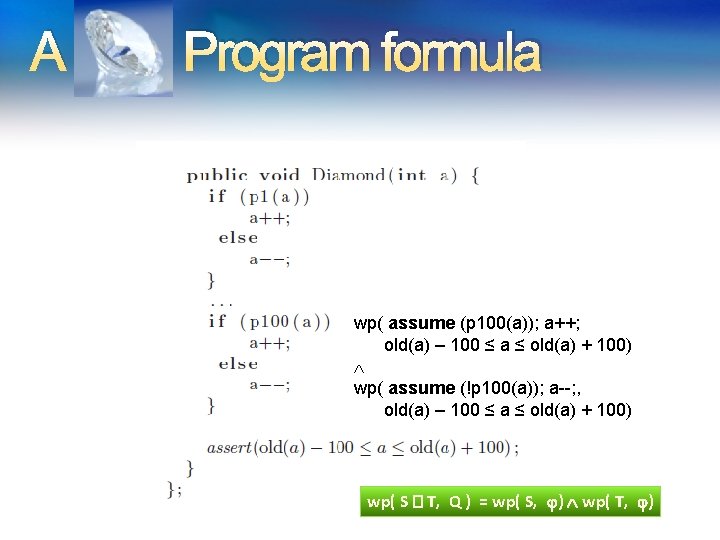
A Program formula wp( assume (p 100(a)); a++; old(a) – 100 ≤ a ≤ old(a) + 100) wp( assume (!p 100(a)); a--; , old(a) – 100 ≤ a ≤ old(a) + 100) wp( S � T, Q ) = wp( S, ) wp( T, )
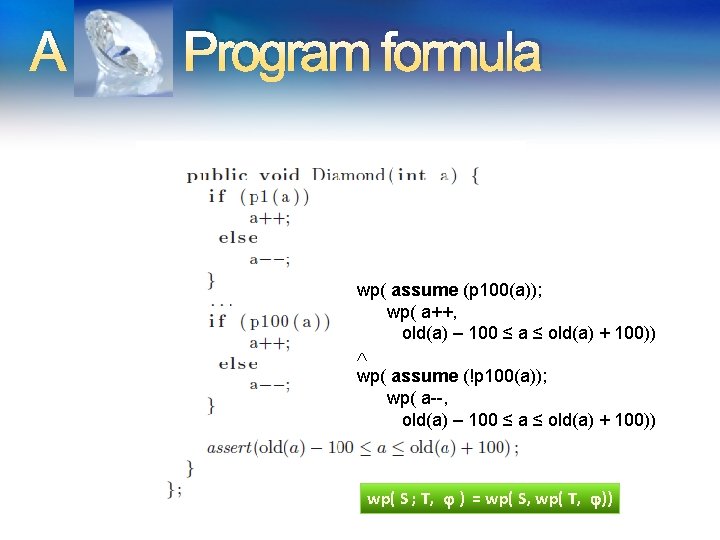
A Program formula wp( assume (p 100(a)); wp( a++, old(a) – 100 ≤ a ≤ old(a) + 100)) wp( assume (!p 100(a)); wp( a--, old(a) – 100 ≤ a ≤ old(a) + 100)) wp( S ; T, ) = wp( S, wp( T, ))
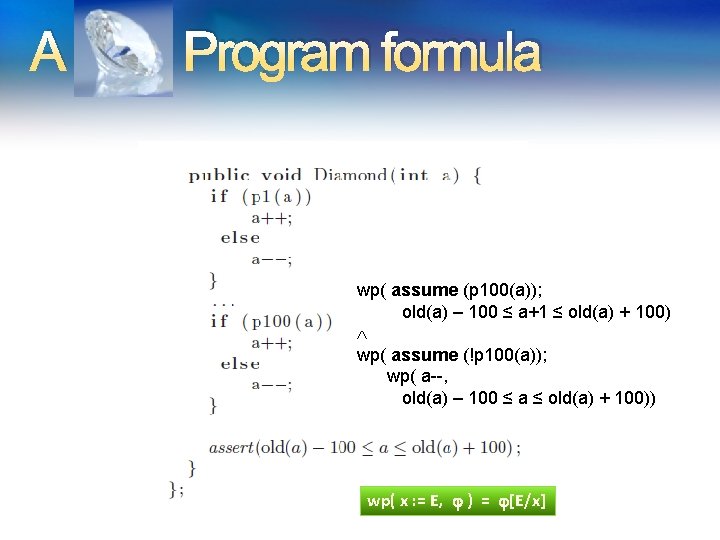
A Program formula wp( assume (p 100(a)); old(a) – 100 ≤ a+1 ≤ old(a) + 100) wp( assume (!p 100(a)); wp( a--, old(a) – 100 ≤ a ≤ old(a) + 100)) wp( x : = E, ) = [E/x]
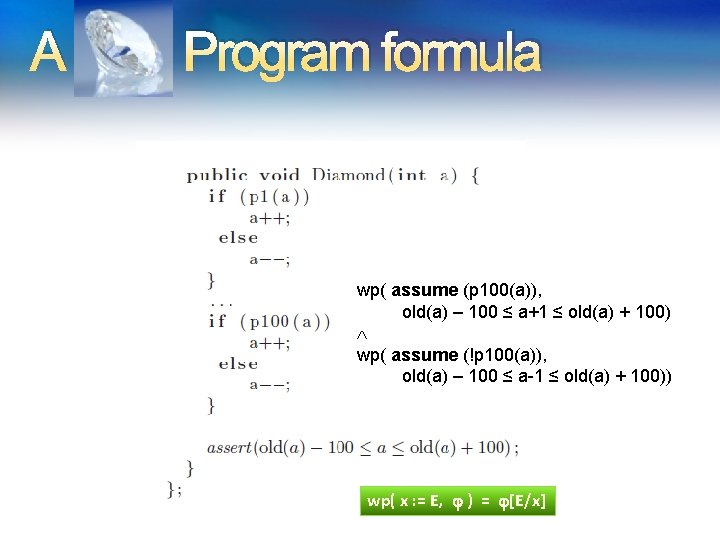
A Program formula wp( assume (p 100(a)), old(a) – 100 ≤ a+1 ≤ old(a) + 100) wp( assume (!p 100(a)), old(a) – 100 ≤ a-1 ≤ old(a) + 100)) wp( x : = E, ) = [E/x]
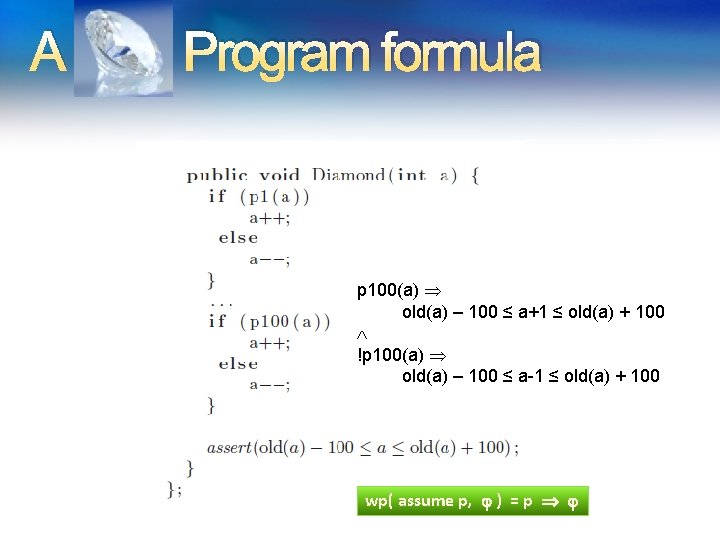
A Program formula p 100(a) old(a) – 100 ≤ a+1 ≤ old(a) + 100 !p 100(a) old(a) – 100 ≤ a-1 ≤ old(a) + 100 wp( assume p, ) = p
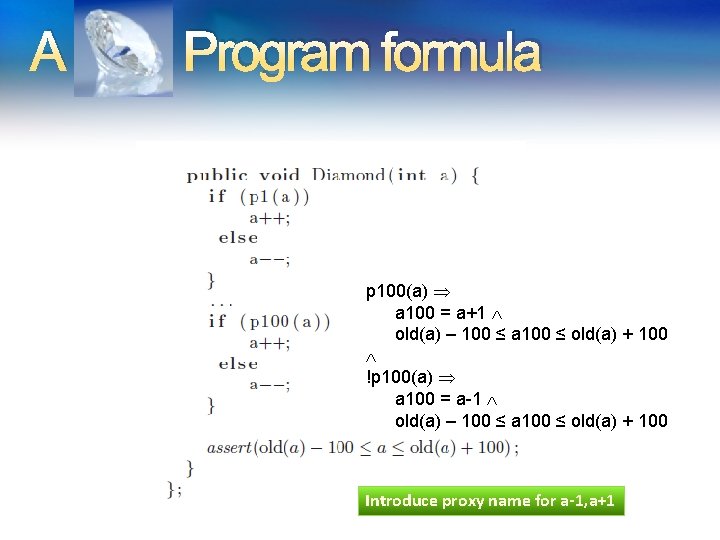
A Program formula p 100(a) a 100 = a+1 old(a) – 100 ≤ a 100 ≤ old(a) + 100 !p 100(a) a 100 = a-1 old(a) – 100 ≤ a 100 ≤ old(a) + 100 Introduce proxy name for a-1, a+1
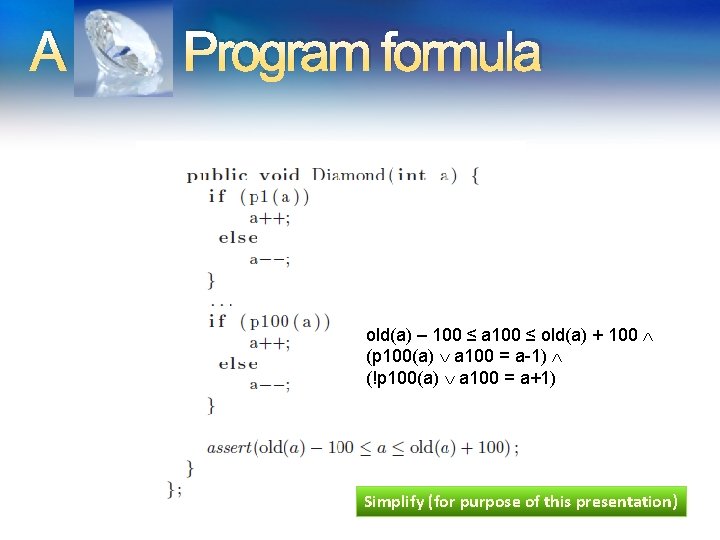
A Program formula old(a) – 100 ≤ a 100 ≤ old(a) + 100 (p 100(a) a 100 = a-1) (!p 100(a) a 100 = a+1) Simplify (for purpose of this presentation)
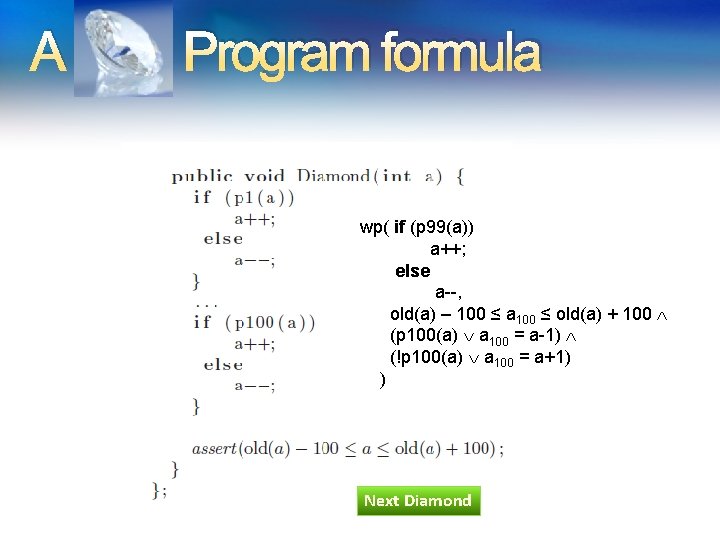
A Program formula wp( if (p 99(a)) a++; else a--, old(a) – 100 ≤ a 100 ≤ old(a) + 100 (p 100(a) a 100 = a-1) (!p 100(a) a 100 = a+1) ) Next Diamond
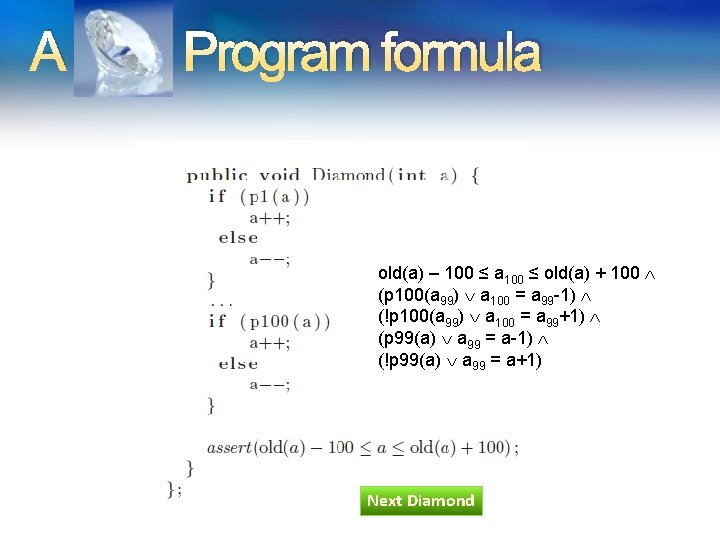
A Program formula old(a) – 100 ≤ a 100 ≤ old(a) + 100 (p 100(a 99) a 100 = a 99 -1) (!p 100(a 99) a 100 = a 99+1) (p 99(a) a 99 = a-1) (!p 99(a) a 99 = a+1) Next Diamond
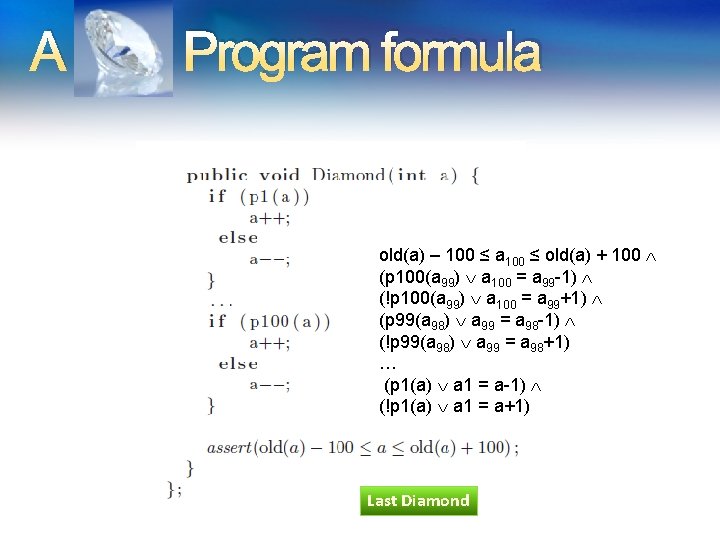
A Program formula old(a) – 100 ≤ a 100 ≤ old(a) + 100 (p 100(a 99) a 100 = a 99 -1) (!p 100(a 99) a 100 = a 99+1) (p 99(a 98) a 99 = a 98 -1) (!p 99(a 98) a 99 = a 98+1) … (p 1(a) a 1 = a-1) (!p 1(a) a 1 = a+1) Last Diamond
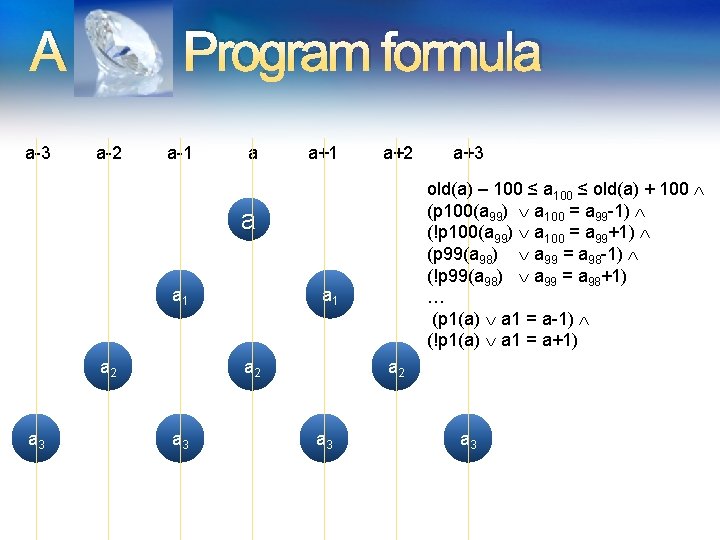
A a-3 Program formula a-2 a-1 a a+1 a+2 old(a) – 100 ≤ a 100 ≤ old(a) + 100 (p 100(a 99) a 100 = a 99 -1) (!p 100(a 99) a 100 = a 99+1) (p 99(a 98) a 99 = a 98 -1) (!p 99(a 98) a 99 = a 98+1) … (p 1(a) a 1 = a-1) (!p 1(a) a 1 = a+1) a a 1 a 2 a 3 a+3 a 2 a 3
DPLL(T) is brittle on diamond formulas The Diamond program formula is easy (for Z 3). But, similar problems are hard
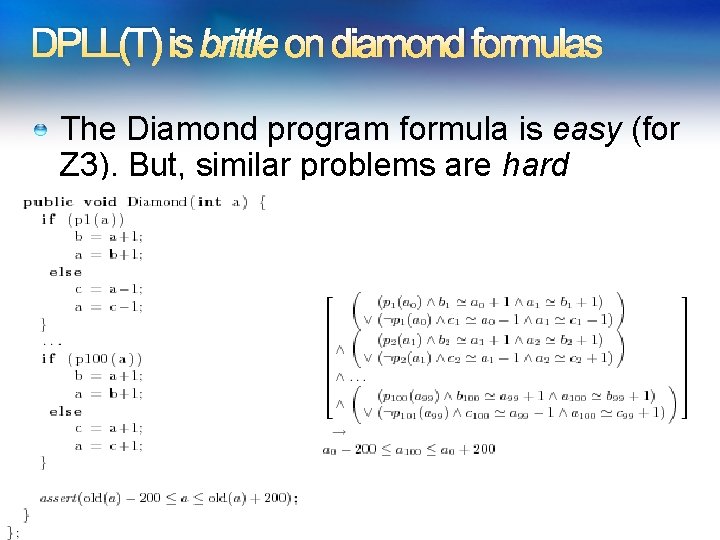
DPLL(T) is brittle on diamond formulas The Diamond program formula is easy (for Z 3). But, similar problems are hard
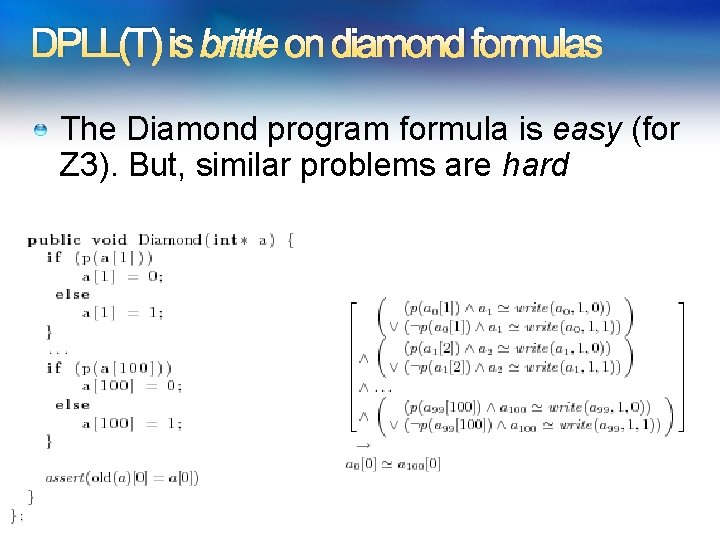
DPLL(T) is brittle on diamond formulas The Diamond program formula is easy (for Z 3). But, similar problems are hard
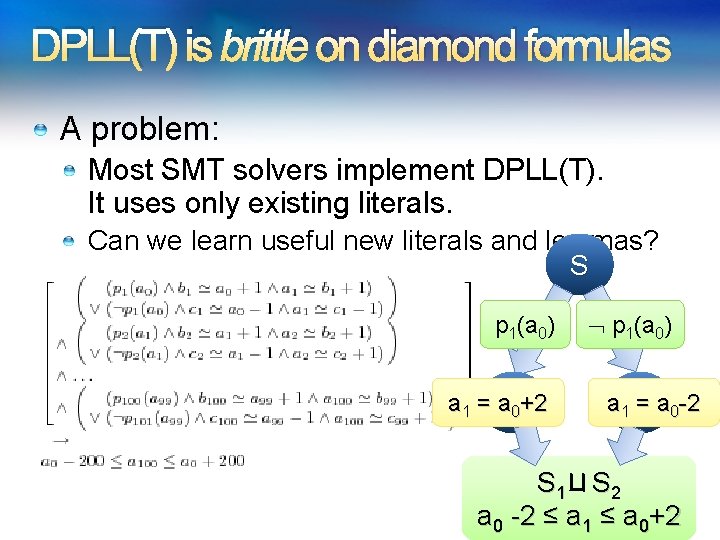
DPLL(T) is brittle on diamond formulas A problem: Most SMT solvers implement DPLL(T). It uses only existing literals. Can we learn useful new literals and lemmas? S p 1(a 0) a 1 = a S 01+2 p 1(a 0) a 1 S=2 a 0 -2 S 1 S 2 a 0 -2 ≤ a 1 ≤ a 0+2
Some recent approaches Difference logic: new literals based on activity [Wang, Gupta, Ganai, DAC 2006] DPLL(� ) [Bjorner, Dutertre, de Moura, LPAR 2008] 1 -consistent resolution [Cotton, Thesis, Verimag, Yesterday 2009] Abstract DPLL/Generalizing DPLL to Richer Logics [Kuehlmann, Mc. Millan, Sagiv, CAV 2009]
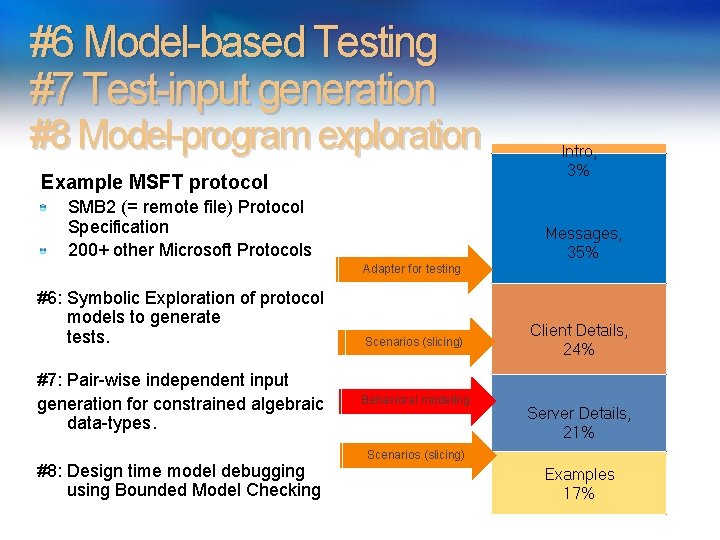
#6 Model-based Testing #7 Test-input generation #8 Model-program exploration Example MSFT protocol SMB 2 (= remote file) Protocol Specification 200+ other Microsoft Protocols Intro, 3% Messages, 35% Adapter for testing #6: Symbolic Exploration of protocol models to generate tests. #7: Pair-wise independent input generation for constrained algebraic data-types. #8: Design time model debugging using Bounded Model Checking Scenarios (slicing) Behavioral modeling Client Details, 24% Server Details, 21% Scenarios (slicing) Examples 17%
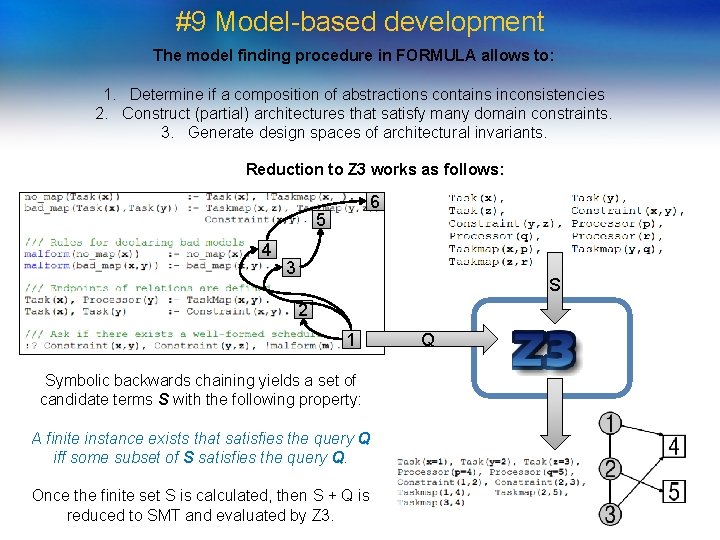
#9 Model-based development The model finding procedure in FORMULA allows to: 1. Determine if a composition of abstractions contains inconsistencies 2. Construct (partial) architectures that satisfy many domain constraints. 3. Generate design spaces of architectural invariants. Reduction to Z 3 works as follows: 6 5 4 S = 3 S 2 1 Symbolic backwards chaining yields a set of candidate terms S with the following property: A finite instance exists that satisfies the query Q iff some subset of S satisfies the query Q. Once the finite set S is calculated, then S + Q is reduced to SMT and evaluated by Z 3. Q
![#10 Quantitative Termination http: //www. foment. net/byron/fsharp. shtml Runtime & Invariants [PLDI, CAV 2009]](http://slidetodoc.com/presentation_image_h2/5d645a9e90d83fe93ea2fce00396fee9/image-63.jpg "#10 Quantitative Termination http: //www. foment. net/byron/fsharp. shtml Runtime & Invariants [PLDI, CAV 2009]")
#10 Quantitative Termination http: //www. foment. net/byron/fsharp. shtml Runtime & Invariants [PLDI, CAV 2009]
Conclusions SMT solvers are a great fit for software tools Current main applications: Test-case generation. Verifying compilers. Model Checking & Predicate Abstraction. Model-based testing and development Future opportunities in SMT research and applications abound


Extra slides
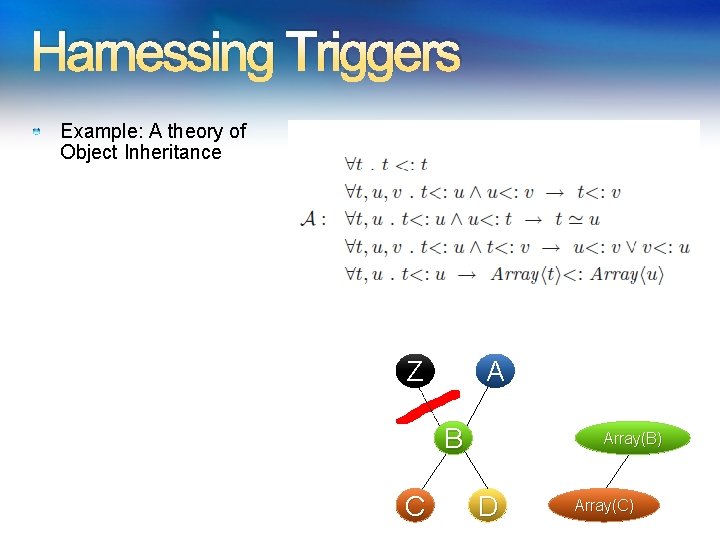
Harnessing Triggers Example: A theory of Object Inheritance Z A B C Array(B) D Array(C)
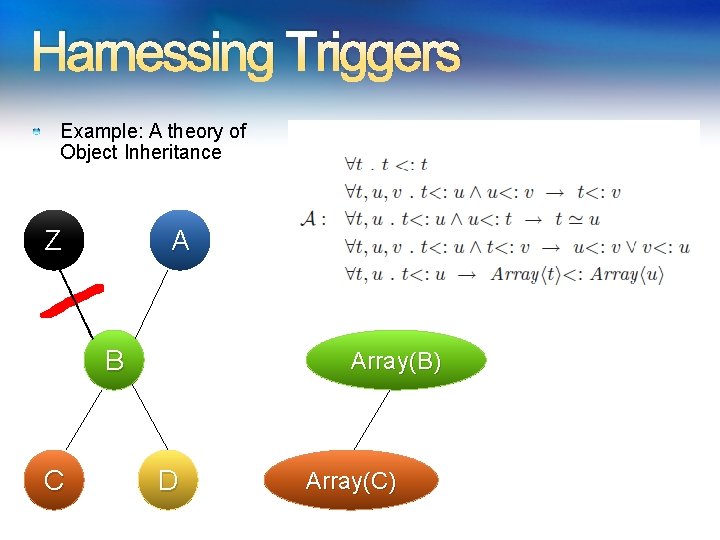
Harnessing Triggers Example: A theory of Object Inheritance Z A B C Array(B) D Array(C)
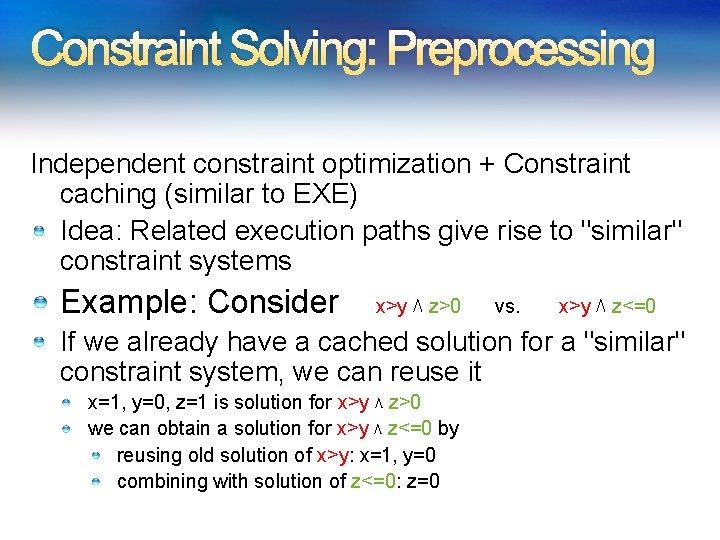
Constraint Solving: Preprocessing Independent constraint optimization + Constraint caching (similar to EXE) Idea: Related execution paths give rise to "similar" constraint systems Example: Consider x>y ⋀ z>0 vs. x>y ⋀ z<=0 If we already have a cached solution for a "similar" constraint system, we can reuse it x=1, y=0, z=1 is solution for x>y ⋀ z>0 we can obtain a solution for x>y ⋀ z<=0 by reusing old solution of x>y: x=1, y=0 combining with solution of z<=0: z=0
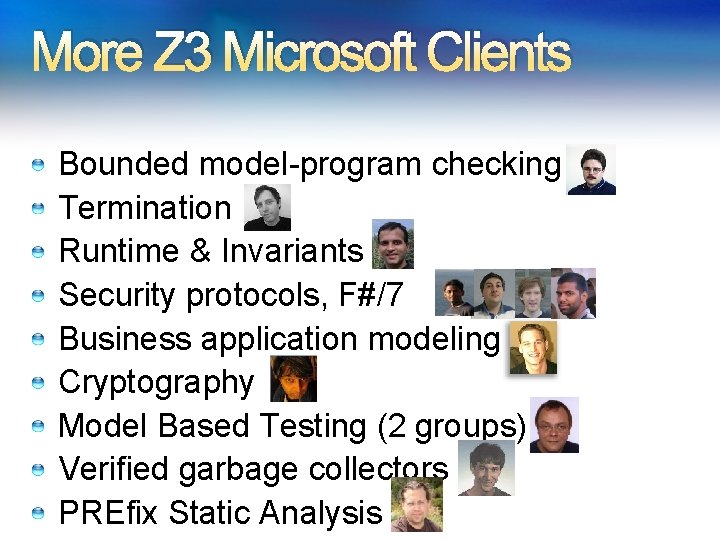
More Z 3 Microsoft Clients Bounded model-program checking Termination Runtime & Invariants Security protocols, F#/7 Business application modeling Cryptography Model Based Testing (2 groups) Verified garbage collectors PREfix Static Analysis
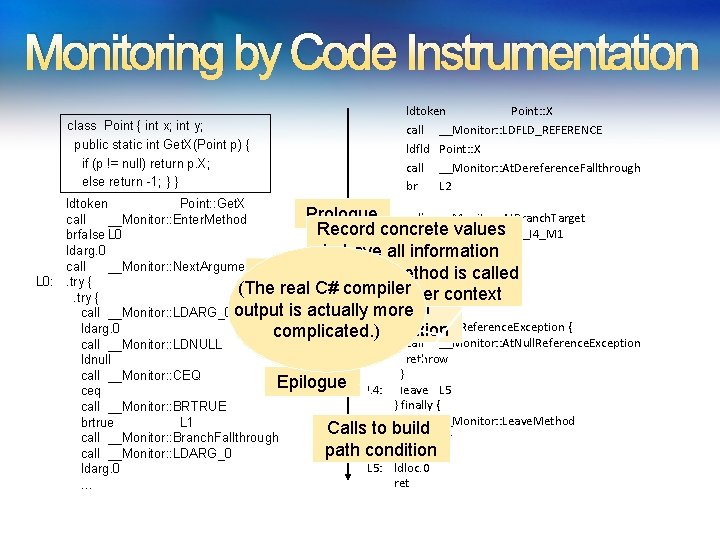
Monitoring by Code Instrumentation class Point { int x; int y; public static int Get. X(Point p) { if (p != null) return p. X; else return -1; } } ldtoken Point: : X call __Monitor: : LDFLD_REFERENCE ldfld Point: : X call __Monitor: : At. Dereference. Fallthrough br L 2 L 1: ldtoken Point: : Get. X Prologue call __Monitor: : At. Branch. Target call __Monitor: : Enter. Method Record concrete values call __Monitor: : LDC_I 4_M 1 brfalse L 0 ldarg. 0 to have allldc. i 4. m 1 information L 2: call __Monitor: : Next. Argument<Point> Calls to buildthis method when is called call __Monitor: : RET L 0: . try { (The real C# compiler path condition with no proper stloc. 0 context. try { Calls will perform output is actually more leave L 4 call __Monitor: : LDARG_0 } catch Null. Reference. Exception { ldarg. 0 symbolic computation complicated. ) ‘ call __Monitor: : At. Null. Reference. Exception call __Monitor: : LDNULL rethrow ldnull } call __Monitor: : CEQ Epilogue L 4: leave L 5 ceq } finally { call __Monitor: : BRTRUE call __Monitor: : Leave. Method brtrue L 1 Calls to build endfinally call __Monitor: : Branch. Fallthrough path condition } call __Monitor: : LDARG_0 L 5: ldloc. 0 ldarg. 0 ret … 71
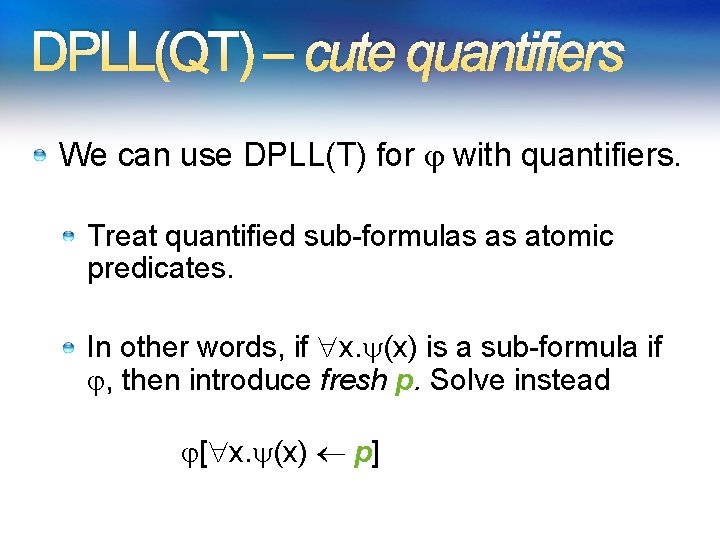
DPLL(QT) – cute quantifiers We can use DPLL(T) for with quantifiers. Treat quantified sub-formulas as atomic predicates. In other words, if x. (x) is a sub-formula if , then introduce fresh p. Solve instead [ x. (x) p]
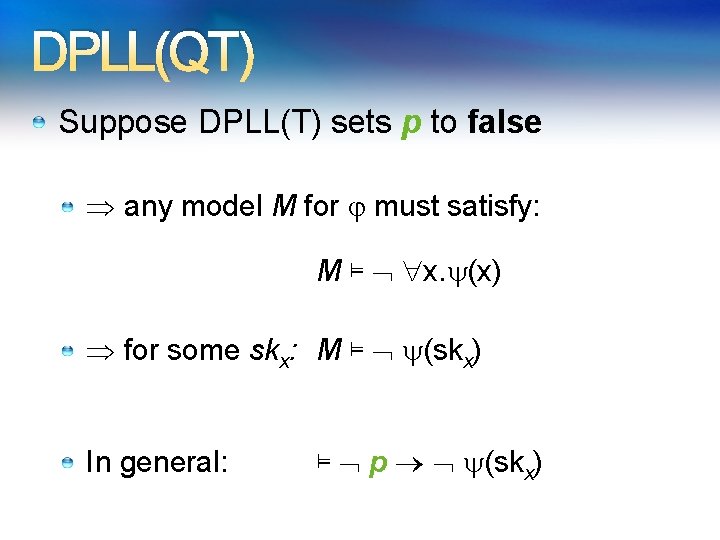
DPLL(QT) Suppose DPLL(T) sets p to false any model M for must satisfy: M ⊨ x. (x) for some skx: M ⊨ (skx) In general: ⊨ p (skx)
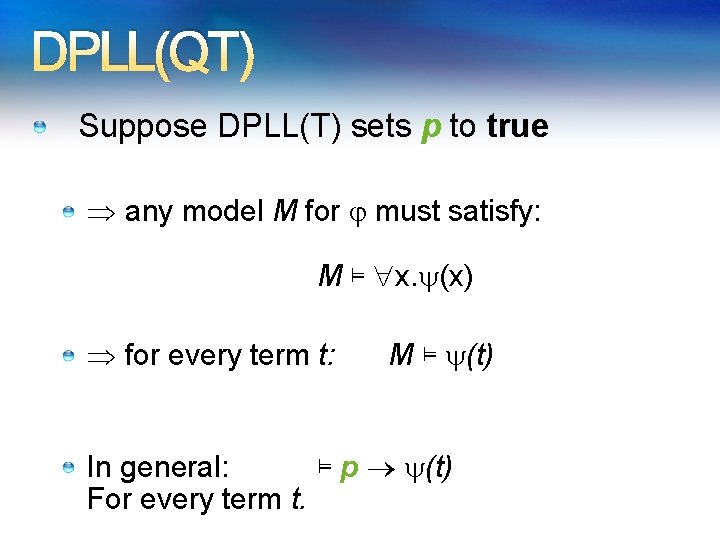
DPLL(QT) Suppose DPLL(T) sets p to true any model M for must satisfy: M ⊨ x. (x) for every term t: M ⊨ (t) In general: ⊨ p (t) For every term t.
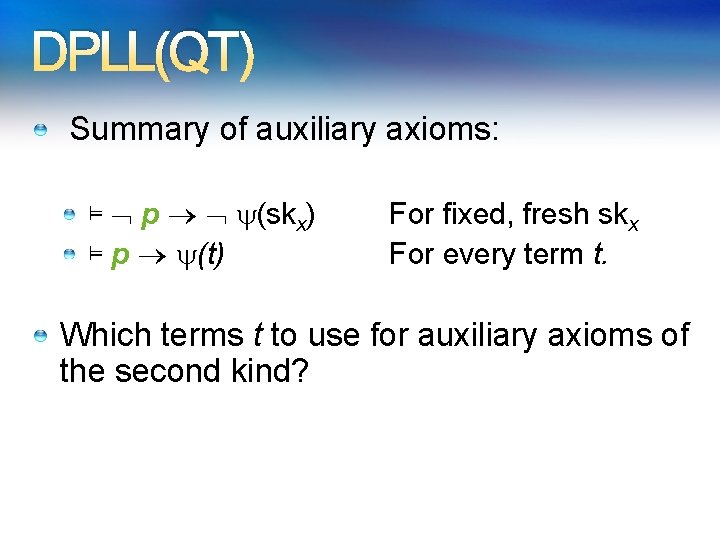
DPLL(QT) Summary of auxiliary axioms: ⊨ p (skx) ⊨ p (t) For fixed, fresh skx For every term t. Which terms t to use for auxiliary axioms of the second kind?
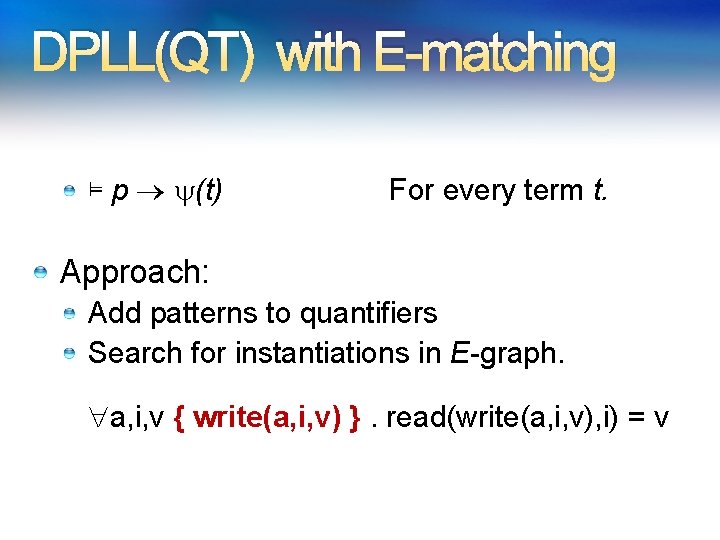
DPLL(QT) with E-matching ⊨ p (t) For every term t. Approach: Add patterns to quantifiers Search for instantiations in E-graph. a, i, v { write(a, i, v) }. read(write(a, i, v), i) = v
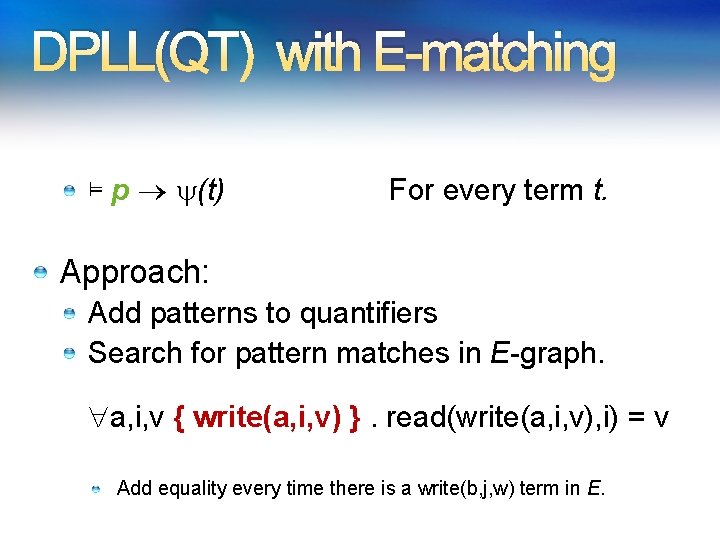
DPLL(QT) with E-matching ⊨ p (t) For every term t. Approach: Add patterns to quantifiers Search for pattern matches in E-graph. a, i, v { write(a, i, v) }. read(write(a, i, v), i) = v Add equality every time there is a write(b, j, w) term in E.
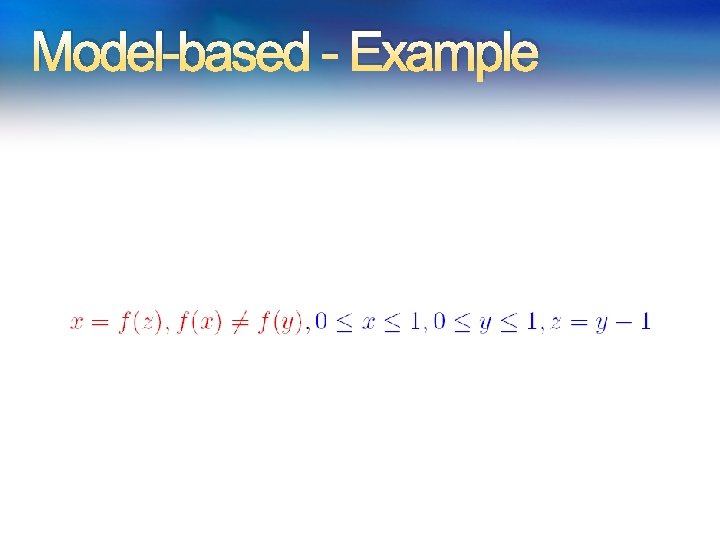
Model-based - Example
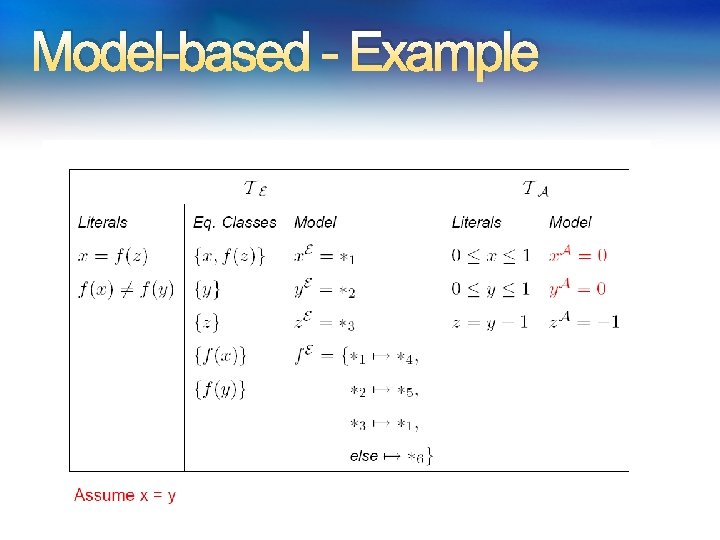
Model-based - Example
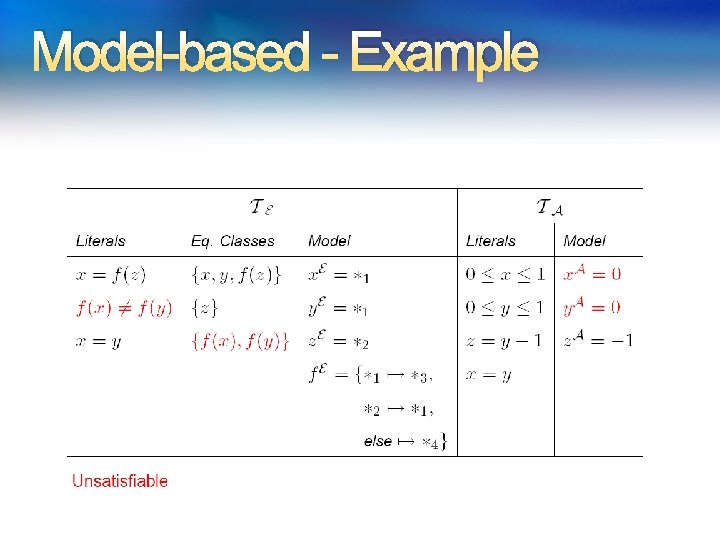
Model-based - Example
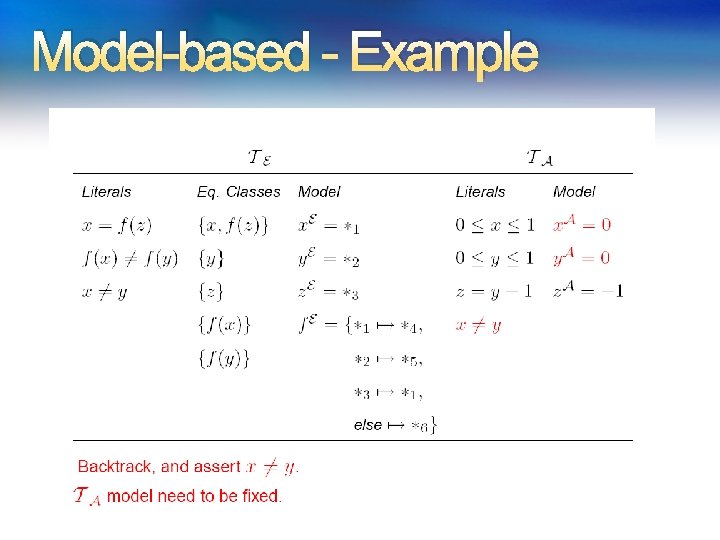
Model-based - Example
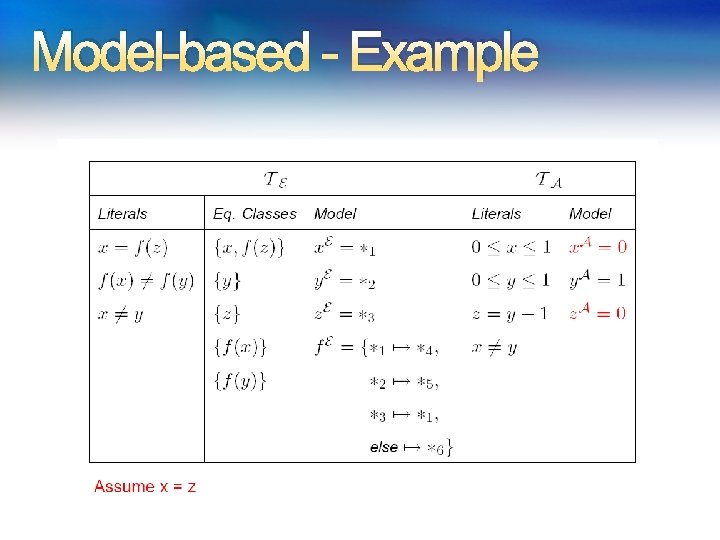
Model-based - Example
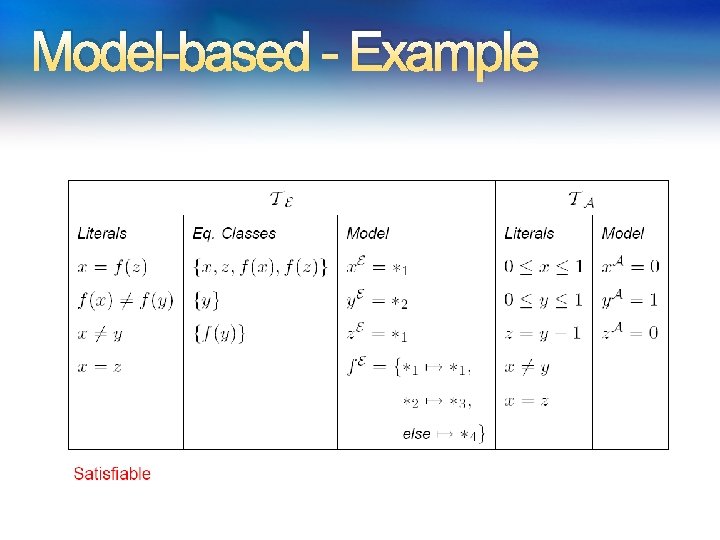
Model-based - Example
- Slides: 83