
10 THE TAX ASSESSMENT AND TAX ASSESSMENT METHODS
- Slides: 6
10. THE TAX ASSESSMENT AND TAX ASSESSMENT METHODS
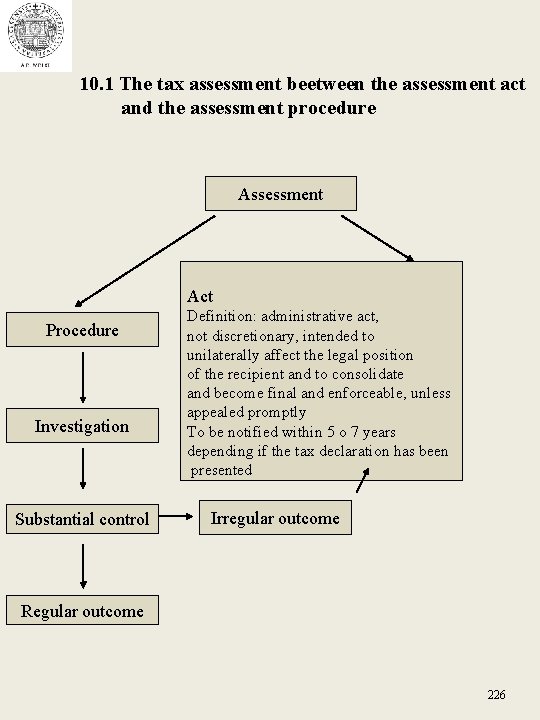
10. 1 The tax assessment beetween the assessment act and the assessment procedure Assessment Act Procedure Investigation Substantial control Definition: administrative act, not discretionary, intended to unilaterally affect the legal position of the recipient and to consolidate and become final and enforceable, unless appealed promptly To be notified within 5 o 7 years depending if the tax declaration has been presented Irregular outcome Regular outcome 226
10. 2 The reasons of the tax assessment The motivation a) Function: put the taxpayer in a position to exercise its right of defense (Art. 24 of the Constitution. ), allow the evaluation of the dell'A. F. (Art. 97 of the Constitution. ), Delimit the subject-matter in any subsequent litigation phase; b) Contents: assumptions of fact and legal reasons based the claim (Art. 7 l. 212/2000). additional content requested by the individual tax law c) Difference on the motivation of discretional administrative acts: protection of the pubblic interest without the need to ponder and mediate between conflicting interests (no discretion) d) The motivation for relationem; conditions and limitations. The investigation motivated by reference to another act must e) Motivation and proof 227
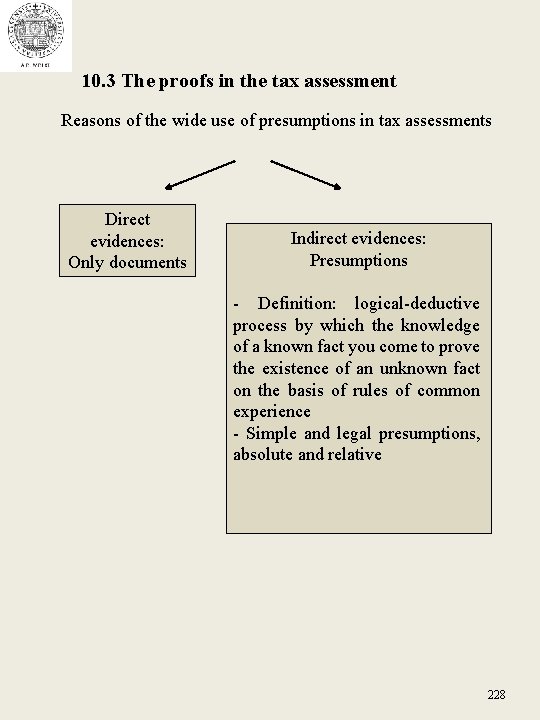
10. 3 The proofs in the tax assessment Reasons of the wide use of presumptions in tax assessments Direct evidences: Only documents Indirect evidences: Presumptions - Definition: logical-deductive process by which the knowledge of a known fact you come to prove the existence of an unknown fact on the basis of rules of common experience - Simple and legal presumptions, absolute and relative 228
10. 4 The tax assessments methods A) Sintetic method Subjects: individuals not engaged in business activities, arts and profession Procedure: on the basis of expenses of any kind incurred during the tax period with evidence to the contrary that its funding was the case with income already taxed or exempt or non-taxable income, with reference to indicative elements of investment ability, mainly costs for capital increases The total income synthetically ascertainable must be different for at least one-fifth from taxable income declared Compulsory contradictory 229
B) The inductive method Requirements: serious illegal conduct that prevent or make difficult the preliminary investigation and assessment of the office Accounting irregularities and violation 230