
10 The Mathematics of Money 10 1 Percentages


- Slides: 22
10 The Mathematics of Money 10. 1 Percentages 10. 2 Simple Interest 10. 3 Compound Interest 10. 4 Geometric Sequences 10. 5 Deferred Annuities: Planned Savings for the Future 10. 6 Installment Loans: The Cost of Financing the Present Copyright © 2010 Pearson Education, Inc. Excursions in Modern Mathematics, 7 e: 10. 5 - 2
Fixed Annuity A fixed annuity is a sequence of equal payments made or received over regular (monthly, quarterly, annually) time intervals. Annuities (often disguised under different names) are so common in today’s financial world that there is a good chance you may be currently involved in one or more annuities and not even realize it. You may be making regular deposits to save for a vacation, a wedding, or college, or you may be making regular payments on a car loan or a home mortgage. Copyright © 2010 Pearson Education, Inc. Excursions in Modern Mathematics, 7 e: 10. 5 - 3
Deferred Annuity - Installment Loan You could also be at the receiving end of an annuity, getting regular payments from an inheritance, a college trust fund set up on your behalf, or a lottery jackpot. When payments are made so as to produce a lump-sum payout at a later date (e. g. , making regular payments into a college trust fund), we call the annuity a deferred annuity; when a lump sum is paid to generate a series of regular payments later (e. g. , a car loan), we call the annuity an installment loan. Copyright © 2010 Pearson Education, Inc. Excursions in Modern Mathematics, 7 e: 10. 5 - 4
Deferred Annuity - Installment Loan Simply stated, in a deferred annuity the pain (in the form of payments) comes first and the reward (a lump-sum payout) comes in the future, whereas in an installment loan the reward (car, boat, house) comes in the present and the pain (payments again) is stretched out into the future. In this section we will discuss deferred annuities. In the next section we will take a look at installment loans. Copyright © 2010 Pearson Education, Inc. Excursions in Modern Mathematics, 7 e: 10. 5 - 5
Example 10. 21 Setting Up a College Trust Fund Given the cost of college, parents often set up college trust funds for their children by setting aside a little money each month over the years. A college trust fund is a form of forced savings toward a specific goal, and it is generally agreed to be a very good use of a parent’s money–it spreads out the pain of college costs over time, generates significant interest income, and has valuable tax benefits. Copyright © 2010 Pearson Education, Inc. Excursions in Modern Mathematics, 7 e: 10. 5 - 6
Example 10. 21 Setting Up a College Trust Fund Let’s imagine a mother decides to set up a college trust fund for her new-born child. Her plan is to have $100 withdrawn from her paycheck each month for the next 18 years and deposited in a savings account that pays 6% annual interest compounded monthly. What is the future value of this trust fund in 18 years? Copyright © 2010 Pearson Education, Inc. Excursions in Modern Mathematics, 7 e: 10. 5 - 7
Example 10. 21 Setting Up a College Trust Fund What makes this example different from Uncle Nick’s trust fund example (Example 10. 10) is that money is being added to the account in regular installments of $100 per month. Each $100 monthly installment has a different “lifespan”: The first $100 compounds for 216 months (12 times a year for 18 years), the second $100 compounds for only 215 months, the third $100 compounds for only 214 months, and so on. Copyright © 2010 Pearson Education, Inc. Excursions in Modern Mathematics, 7 e: 10. 5 - 8
Example 10. 21 Setting Up a College Trust Fund Thus, the future value of each $100 installment is different. To compute the future value of the trust fund we will have to compute the future value of each of the 216 installments separately and add. Sounds like a tall order, but the geometric sum formula will help us out. Copyright © 2010 Pearson Education, Inc. Excursions in Modern Mathematics, 7 e: 10. 5 - 9
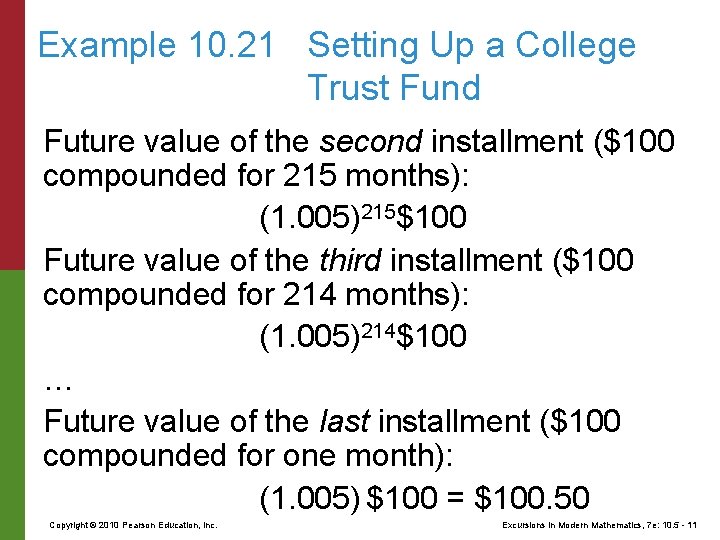
Example 10. 21 Setting Up a College Trust Fund Critical to our calculations are that each installment is for a fixed amount ($100) and that the periodic interest rate p is always the same (6% ÷ 12 = 0. 5% = 0. 005). Thus, when we use the general compounding formula, each future value looks the same except for the compounding exponent: Future value of the first installment ($100 compounded for 216 months): (1. 005)216$100 Copyright © 2010 Pearson Education, Inc. Excursions in Modern Mathematics, 7 e: 10. 5 - 10
Example 10. 21 Setting Up a College Trust Fund Future value of the second installment ($100 compounded for 215 months): (1. 005)215$100 Future value of the third installment ($100 compounded for 214 months): (1. 005)214$100 … Future value of the last installment ($100 compounded for one month): (1. 005) $100 = $100. 50 Copyright © 2010 Pearson Education, Inc. Excursions in Modern Mathematics, 7 e: 10. 5 - 11
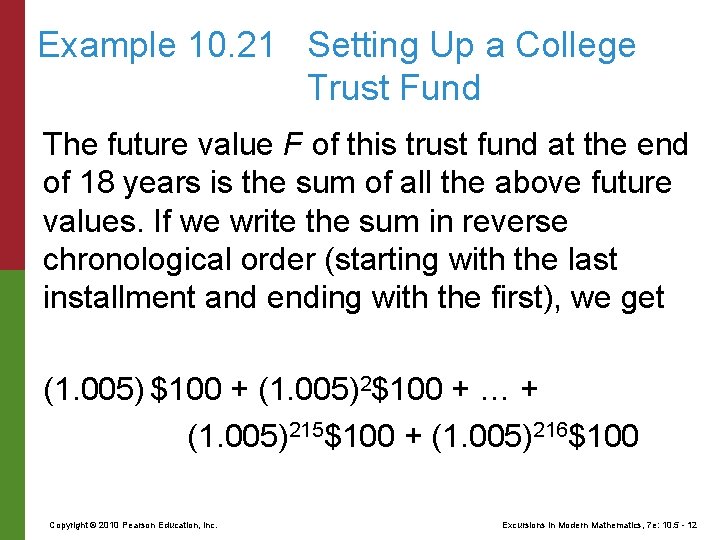
Example 10. 21 Setting Up a College Trust Fund The future value F of this trust fund at the end of 18 years is the sum of all the above future values. If we write the sum in reverse chronological order (starting with the last installment and ending with the first), we get (1. 005) $100 + (1. 005)2$100 + … + (1. 005)215$100 + (1. 005)216$100 Copyright © 2010 Pearson Education, Inc. Excursions in Modern Mathematics, 7 e: 10. 5 - 12
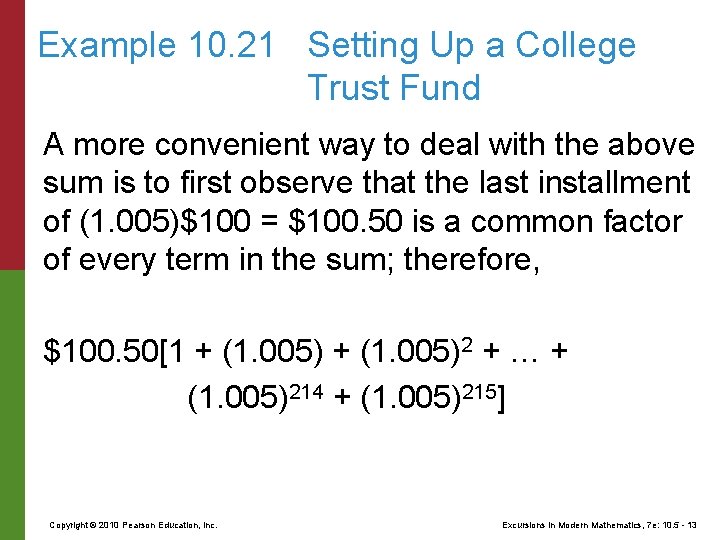
Example 10. 21 Setting Up a College Trust Fund A more convenient way to deal with the above sum is to first observe that the last installment of (1. 005)$100 = $100. 50 is a common factor of every term in the sum; therefore, $100. 50[1 + (1. 005)2 + … + (1. 005)214 + (1. 005)215] Copyright © 2010 Pearson Education, Inc. Excursions in Modern Mathematics, 7 e: 10. 5 - 13
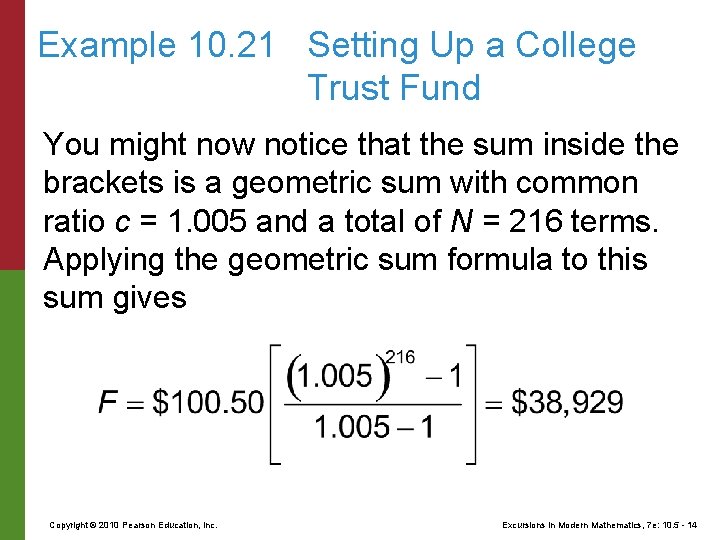
Example 10. 21 Setting Up a College Trust Fund You might now notice that the sum inside the brackets is a geometric sum with common ratio c = 1. 005 and a total of N = 216 terms. Applying the geometric sum formula to this sum gives Copyright © 2010 Pearson Education, Inc. Excursions in Modern Mathematics, 7 e: 10. 5 - 14
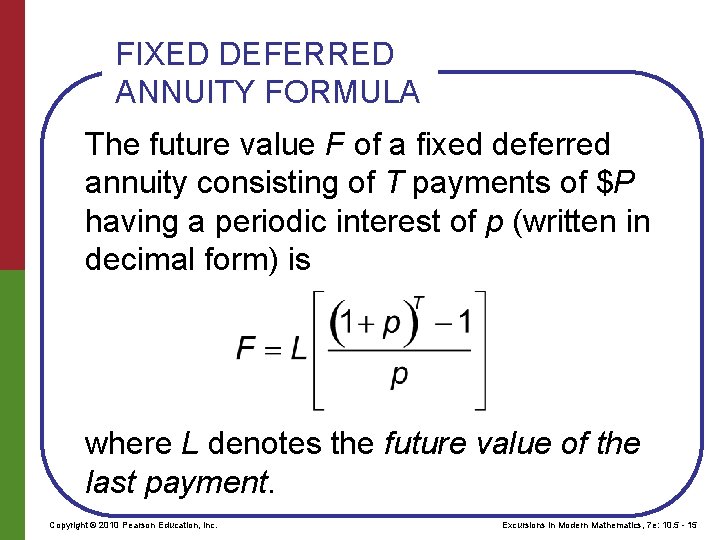
FIXED DEFERRED ANNUITY FORMULA The future value F of a fixed deferred annuity consisting of T payments of $P having a periodic interest of p (written in decimal form) is where L denotes the future value of the last payment. Copyright © 2010 Pearson Education, Inc. Excursions in Modern Mathematics, 7 e: 10. 5 - 15
Example 10. 22 Setting Up a College Trust Fund: Part 2 In Example 10. 21 we saw that an 18 -year annuity of $100 monthly payments at an APR of 6% compounded monthly is $38, 929. For the same APR and the same number of years, how much should the monthly payments be if our goal is an annuity with a future value of $50, 000? Copyright © 2010 Pearson Education, Inc. Excursions in Modern Mathematics, 7 e: 10. 5 - 16
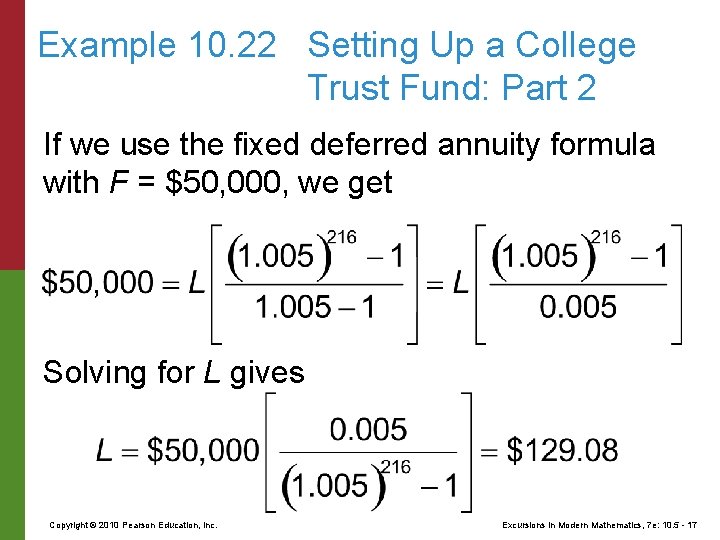
Example 10. 22 Setting Up a College Trust Fund: Part 2 If we use the fixed deferred annuity formula with F = $50, 000, we get Solving for L gives Copyright © 2010 Pearson Education, Inc. Excursions in Modern Mathematics, 7 e: 10. 5 - 17
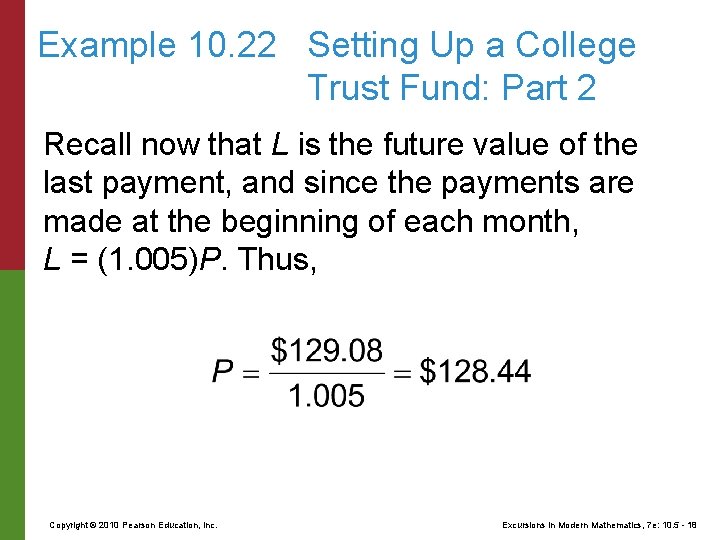
Example 10. 22 Setting Up a College Trust Fund: Part 2 Recall now that L is the future value of the last payment, and since the payments are made at the beginning of each month, L = (1. 005)P. Thus, Copyright © 2010 Pearson Education, Inc. Excursions in Modern Mathematics, 7 e: 10. 5 - 18
Relationship Between F and P The main point of Example 10. 22 is to illustrate that the fixed deferred annuity formula establishes a relationship between the future value F of the annuity and the fixed payment P required to achieve that future value. If we know one, we can solve for the other (assuming, of course, a specified number of payments T and a specified periodic interest rate p). Copyright © 2010 Pearson Education, Inc. Excursions in Modern Mathematics, 7 e: 10. 5 - 19
Example 10. 23 Saving for a Cruise: Part 5 We saw (Example 10. 12) that if you invest the $875 at a 6. 75% APR compounded monthly, the future value of your investment is $1449. 62–for simplicity, let’s call it $1450. This is $550 short of the $2000 you will need. Imagine you want to come up with the additional $550 by making regular monthly deposits into the savings account, essentially creating a small annuity. How much would you have to deposit each month to generate the $550 that you will need? Copyright © 2010 Pearson Education, Inc. Excursions in Modern Mathematics, 7 e: 10. 5 - 20
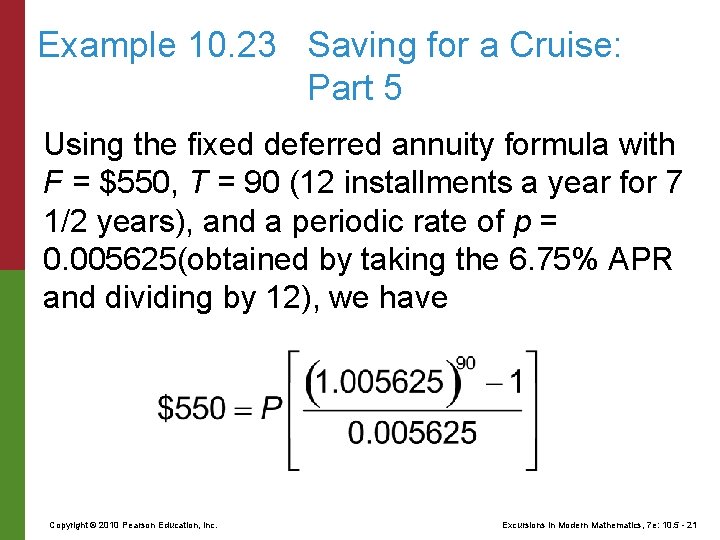
Example 10. 23 Saving for a Cruise: Part 5 Using the fixed deferred annuity formula with F = $550, T = 90 (12 installments a year for 7 1/2 years), and a periodic rate of p = 0. 005625(obtained by taking the 6. 75% APR and dividing by 12), we have Copyright © 2010 Pearson Education, Inc. Excursions in Modern Mathematics, 7 e: 10. 5 - 21
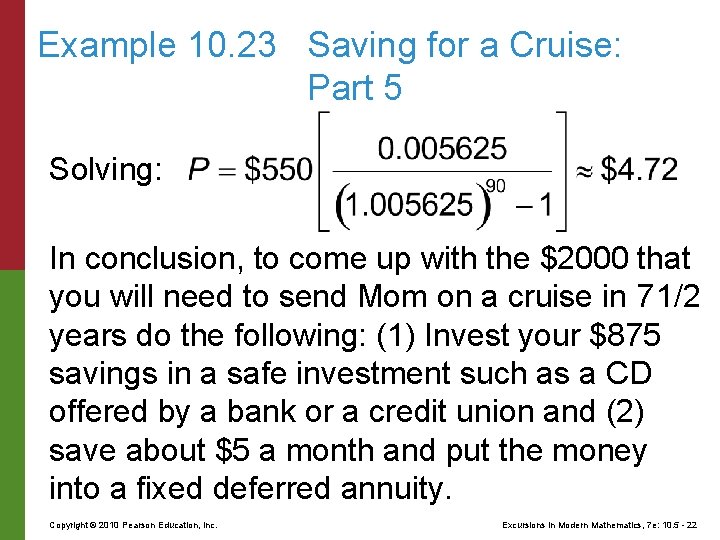
Example 10. 23 Saving for a Cruise: Part 5 Solving: In conclusion, to come up with the $2000 that you will need to send Mom on a cruise in 7 1/2 years do the following: (1) Invest your $875 savings in a safe investment such as a CD offered by a bank or a credit union and (2) save about $5 a month and put the money into a fixed deferred annuity. Copyright © 2010 Pearson Education, Inc. Excursions in Modern Mathematics, 7 e: 10. 5 - 22