
10 The Blood Lesson 10 1 The Function
10 The Blood Lesson 10. 1: The Function and Composition of the Blood Lesson 10. 2: Blood Types Lesson 10. 3: Blood Disorders and Diseases

Chapter 10: The Blood Lesson 10. 1 The Function and Composition of Blood
The Function and Composition of Blood • • the function of blood the formed elements physical properties of blood plasma © Goodheart-Willcox Co. , Inc. Permission granted to reproduce for educational use only.
The Function and Composition of Blood • • manufacturing blood cells red blood cells white blood cells platelets © Goodheart-Willcox Co. , Inc. Permission granted to reproduce for educational use only.
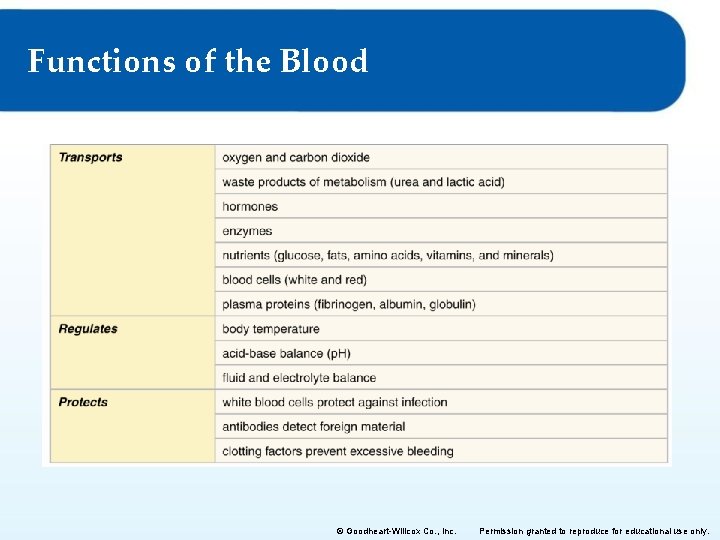
Functions of the Blood © Goodheart-Willcox Co. , Inc. Permission granted to reproduce for educational use only.
The Formed Elements • solid portion of blood • red blood cells – carry oxygen • white blood cells – immune response • platelets – clot © Goodheart-Willcox Co. , Inc. Permission granted to reproduce for educational use only.
Physical Properties of Blood • blood volume – 4– 5 liters of blood • taste – salty • color – bright red from artery – dull red from vein © Goodheart-Willcox Co. , Inc. Permission granted to reproduce for educational use only.
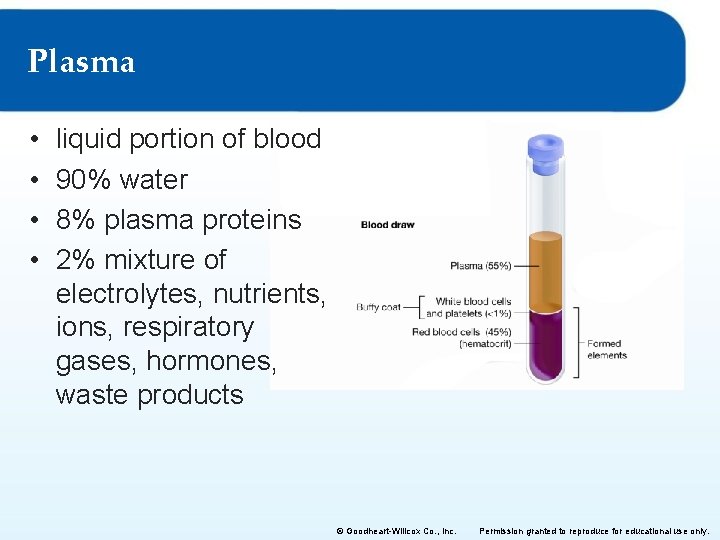
Plasma • • liquid portion of blood 90% water 8% plasma proteins 2% mixture of electrolytes, nutrients, ions, respiratory gases, hormones, waste products © Goodheart-Willcox Co. , Inc. Permission granted to reproduce for educational use only.
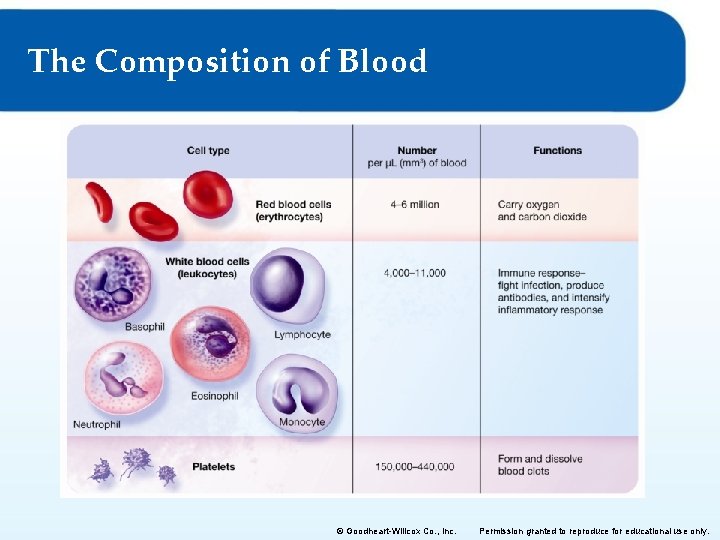
The Composition of Blood © Goodheart-Willcox Co. , Inc. Permission granted to reproduce for educational use only.
Review and Assessment Match these words with 1– 4 below: plasma, platelets, bright red, red blood cell. 1. liquid portion of blood 2. carry oxygen 3. clot 4. arterial blood © Goodheart-Willcox Co. , Inc. Permission granted to reproduce for educational use only.
Manufacturing Blood Cells • hematopoiesis – making new blood cells – stem cells make blood cells in • red bone marrow • lymphatic tissue © Goodheart-Willcox Co. , Inc. Permission granted to reproduce for educational use only.
Red Blood Cells (Erythrocytes) • shape and size – disk-shaped – 7– 8 micrometers in diameter • hemoglobin – binds with oxygen © Goodheart-Willcox Co. , Inc. Permission granted to reproduce for educational use only.
Red Blood Cells (Erythrocytes) • erythropoiesis – the process of making red blood cells • recycling – red blood cells live 120 days – phagocytosis–RBCs recycled – hemolysis–RBCs broken open © Goodheart-Willcox Co. , Inc. Permission granted to reproduce for educational use only.
White Blood Cells (Leukocytes) • neutrophils – first responders • eosinophils – allergic reactions • basophils – produce histamine © Goodheart-Willcox Co. , Inc. Permission granted to reproduce for educational use only.

White Blood Cells (Leukocytes) • lymphocytes – T cells – B cells – form antibodies • monocytes – become macrophages © Goodheart-Willcox Co. , Inc. Permission granted to reproduce for educational use only.
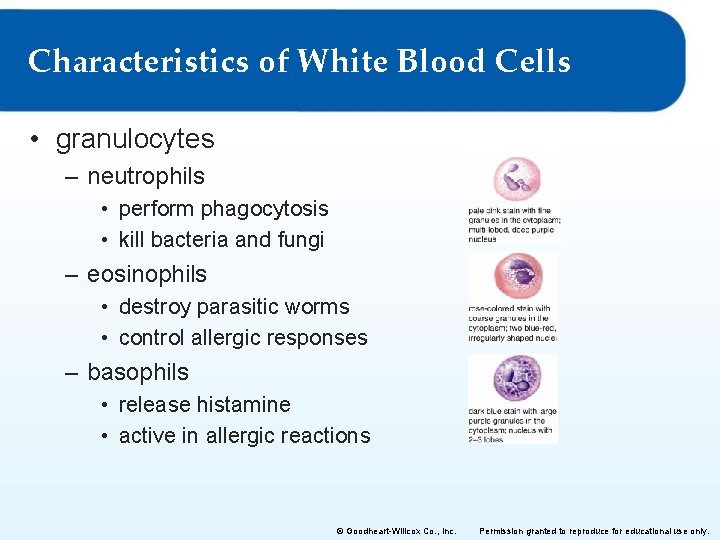
Characteristics of White Blood Cells • granulocytes – neutrophils • perform phagocytosis • kill bacteria and fungi – eosinophils • destroy parasitic worms • control allergic responses – basophils • release histamine • active in allergic reactions © Goodheart-Willcox Co. , Inc. Permission granted to reproduce for educational use only.
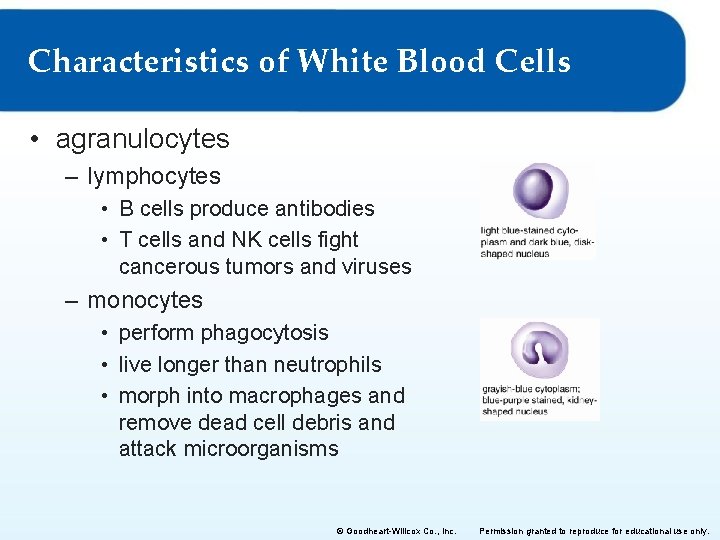
Characteristics of White Blood Cells • agranulocytes – lymphocytes • B cells produce antibodies • T cells and NK cells fight cancerous tumors and viruses – monocytes • perform phagocytosis • live longer than neutrophils • morph into macrophages and remove dead cell debris and attack microorganisms © Goodheart-Willcox Co. , Inc. Permission granted to reproduce for educational use only.
Platelets (Thrombocytes) • hemostasis – stops bleeding • steps of hemostasis – – vessel wall injury and constriction platelet aggregation platelet plug formation and coagulation blood clot formation and retraction © Goodheart-Willcox Co. , Inc. Permission granted to reproduce for educational use only.
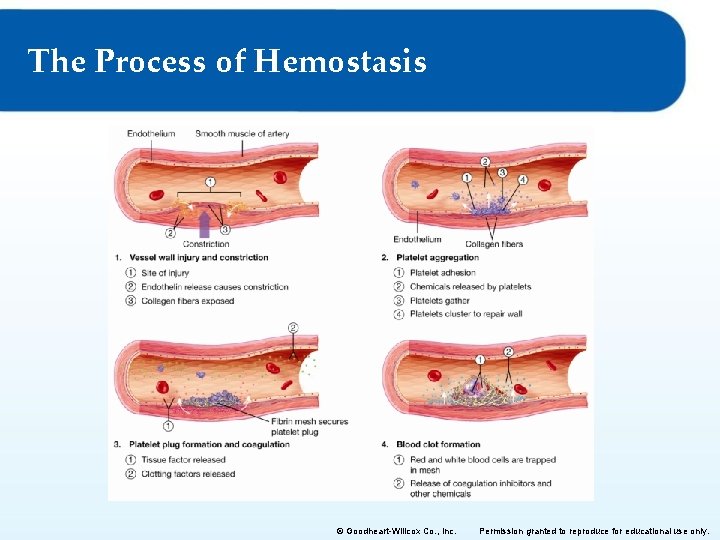
The Process of Hemostasis © Goodheart-Willcox Co. , Inc. Permission granted to reproduce for educational use only.

Review and Assessment Fill in the blanks with: basophils, hemostasis, hemoglobin, or T cell. 1. ________ is a type of lymphocyte. 2. ________ produce histamine. 3. ________ binds with oxygen. 4. ________ stops bleeding. © Goodheart-Willcox Co. , Inc. Permission granted to reproduce for educational use only.
Chapter 10: The Blood Lesson 10. 2 Blood Types
Blood Types • blood types • the Rh classification system • complete blood count © Goodheart-Willcox Co. , Inc. Permission granted to reproduce for educational use only.
Blood Types • A, B, AB, and O • antigens and antibodies – antigen • on surface of RBC, identify self and non-self – antibody • in blood plasma, mark foreign cells © Goodheart-Willcox Co. , Inc. Permission granted to reproduce for educational use only.
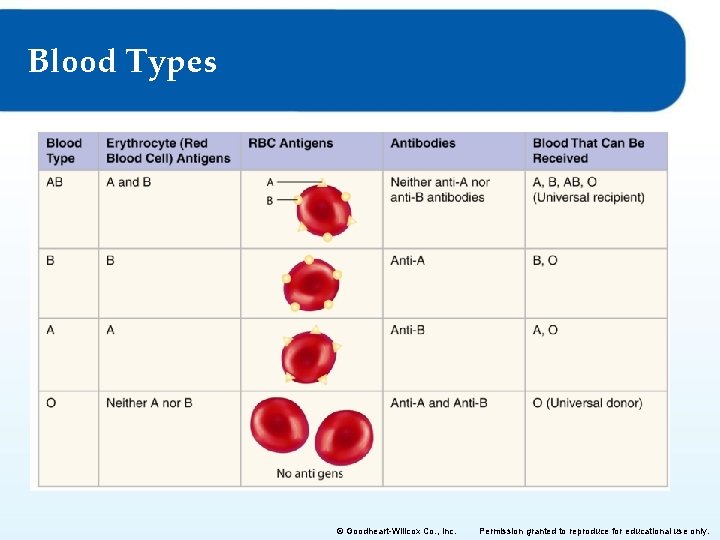
Blood Types © Goodheart-Willcox Co. , Inc. Permission granted to reproduce for educational use only.
Blood Transfusions • agglutination – clumping of RBCs • universal recipient – blood type AB • universal donor – blood type O © Goodheart-Willcox Co. , Inc. Permission granted to reproduce for educational use only.
The Rh Classification System • Rh-positive individuals – have Rh factor antigen on RBCs • Rh-negative individuals – do not have Rh factor antigen on RBCs • Rh factor complications – erythroblastosis fetalis – Rho. GAM © Goodheart-Willcox Co. , Inc. Permission granted to reproduce for educational use only.
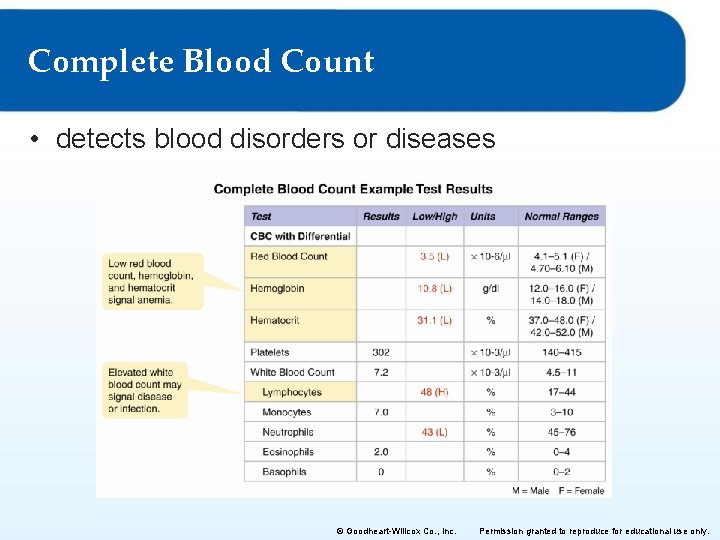
Complete Blood Count • detects blood disorders or diseases © Goodheart-Willcox Co. , Inc. Permission granted to reproduce for educational use only.
Review and Assessment True or False? 1. Blood type O is the universal donor. 2. Agglutination is the clumping of RBCs. 3. Antigens are in blood plasma. 4. Antibodies are on the surface of RBCs. 5. Rh factor is positive or negative. © Goodheart-Willcox Co. , Inc. Permission granted to reproduce for educational use only.
Chapter 10: The Blood Lesson 10. 3 Blood Disorders and Diseases
Blood Disorders and Diseases • • • anemia jaundice hemophilia polycythemia leukemia multiple myeloma © Goodheart-Willcox Co. , Inc. Permission granted to reproduce for educational use only.
Anemia • decrease in number of RBCs • insufficient amount of hemoglobin • acquired anemia – deficient diet, parasitic worms, disease • inherited anemia – genetic makeup © Goodheart-Willcox Co. , Inc. Permission granted to reproduce for educational use only.
Acquired Anemias • iron-deficient anemia – insufficient dietary intake of iron – bleeding from intestinal worms – pregnancy © Goodheart-Willcox Co. , Inc. Permission granted to reproduce for educational use only.
Acquired Anemias • aplastic anemia – damage to stem cells in bone marrow – causes • • toxins radiation therapy or chemotherapy infectious disease heredity © Goodheart-Willcox Co. , Inc. Permission granted to reproduce for educational use only.
Acquired Anemias • pernicious anemia – intestines can not absorb vitamin B 12 • anemias caused by chronic disease – – rheumatoid arthritis kidney disease chronic infections cancer © Goodheart-Willcox Co. , Inc. Permission granted to reproduce for educational use only.
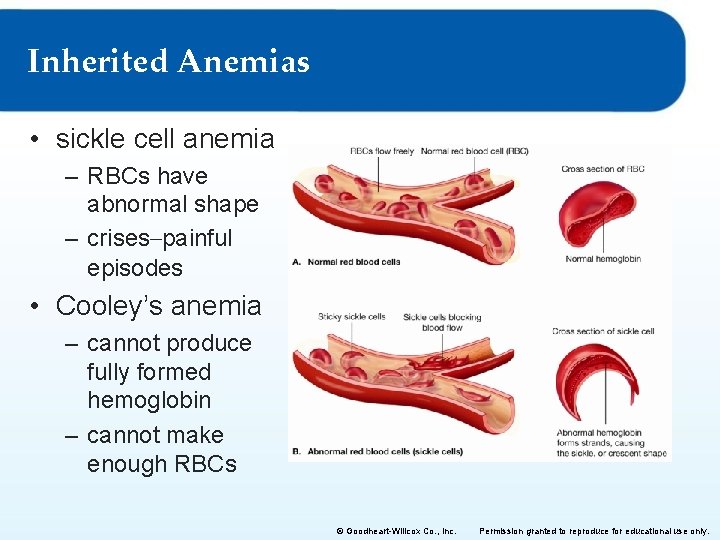
Inherited Anemias • sickle cell anemia – RBCs have abnormal shape – crises–painful episodes • Cooley’s anemia – cannot produce fully formed hemoglobin – cannot make enough RBCs © Goodheart-Willcox Co. , Inc. Permission granted to reproduce for educational use only.
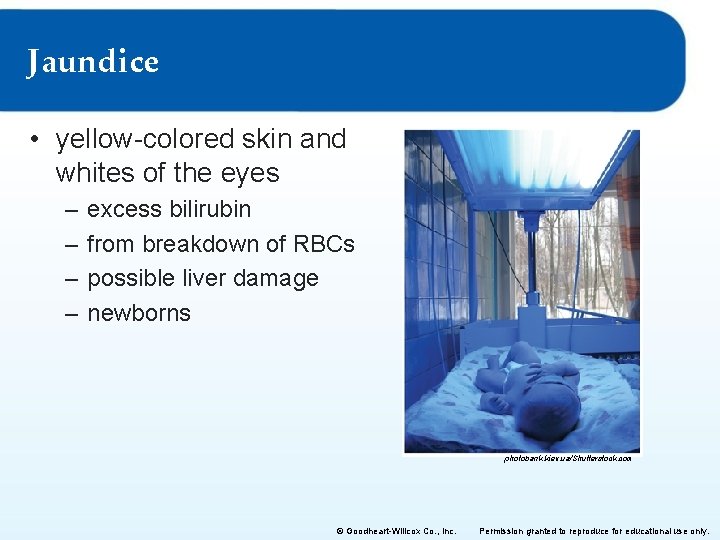
Jaundice • yellow-colored skin and whites of the eyes – – excess bilirubin from breakdown of RBCs possible liver damage newborns photobank. kiev. ua/Shutterstock. com © Goodheart-Willcox Co. , Inc. Permission granted to reproduce for educational use only.
Blood Disorders • hemophilia – inherited – blood does not clot • polycythemia – overproduction of RBCs – causes thick blood © Goodheart-Willcox Co. , Inc. Permission granted to reproduce for educational use only.
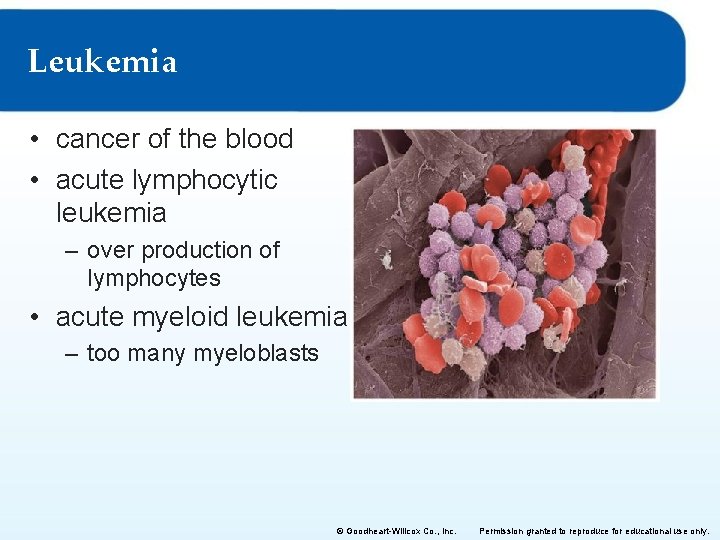
Leukemia • cancer of the blood • acute lymphocytic leukemia – over production of lymphocytes • acute myeloid leukemia – too many myeloblasts © Goodheart-Willcox Co. , Inc. Permission granted to reproduce for educational use only.
Leukemia • chronic lymphocytic leukemia – high level of lymphocytes • chronic myeloid leukemia – too many granulocytes © Goodheart-Willcox Co. , Inc. Permission granted to reproduce for educational use only.
Multiple Myeloma • • plasma cell cancer in bone marrow may damage bone treatable incurable © Goodheart-Willcox Co. , Inc. Permission granted to reproduce for educational use only.
Review and Assessment Match these words with 1– 4 below: jaundice, leukemia, anemia, hemophilia. 1. cancer of the blood 2. blood does not clot 3. yellow colored skin 4. decrease in number of RBCs © Goodheart-Willcox Co. , Inc. Permission granted to reproduce for educational use only.
- Slides: 41