
10 TH EDITION COLLEGE ALGEBRA LIAL HORNSBY SCHNEIDER
10 TH EDITION COLLEGE ALGEBRA LIAL HORNSBY SCHNEIDER 5. 8 - 1
5. 8 Matrix Inverses Identity Matrices Multiplicative Inverses Solving Systems Using Inverse Matrices 5. 8 - 2
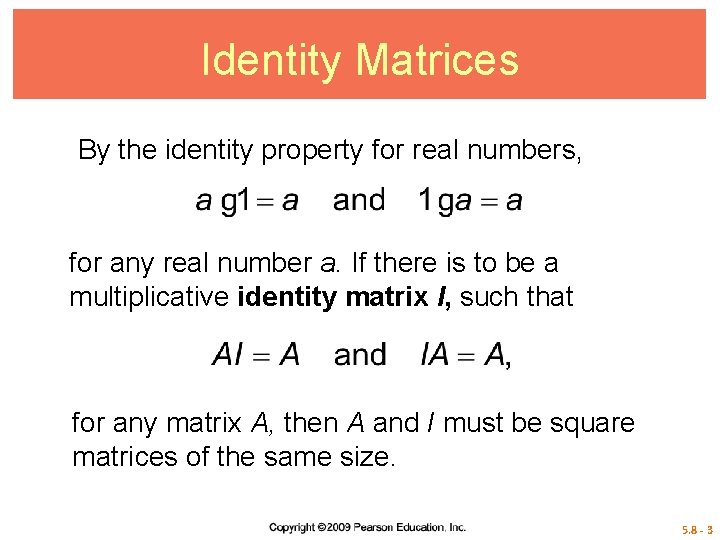
Identity Matrices By the identity property for real numbers, for any real number a. If there is to be a multiplicative identity matrix I, such that for any matrix A, then A and I must be square matrices of the same size. 5. 8 - 3
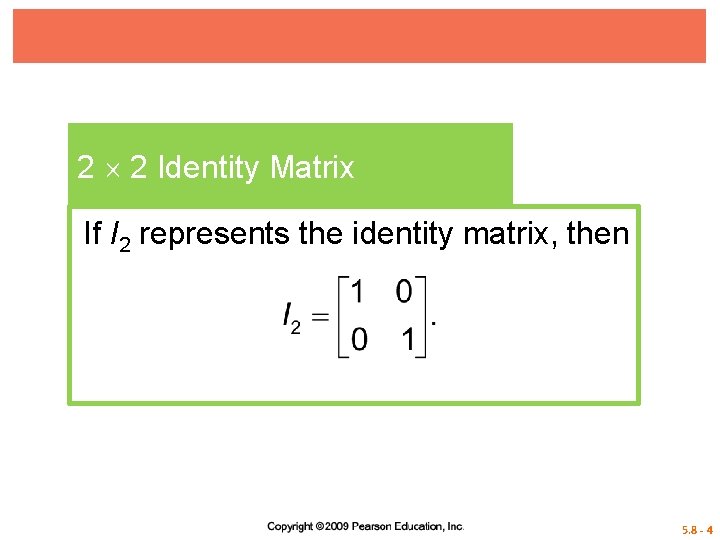
2 2 Identity Matrix If I 2 represents the identity matrix, then 5. 8 - 4
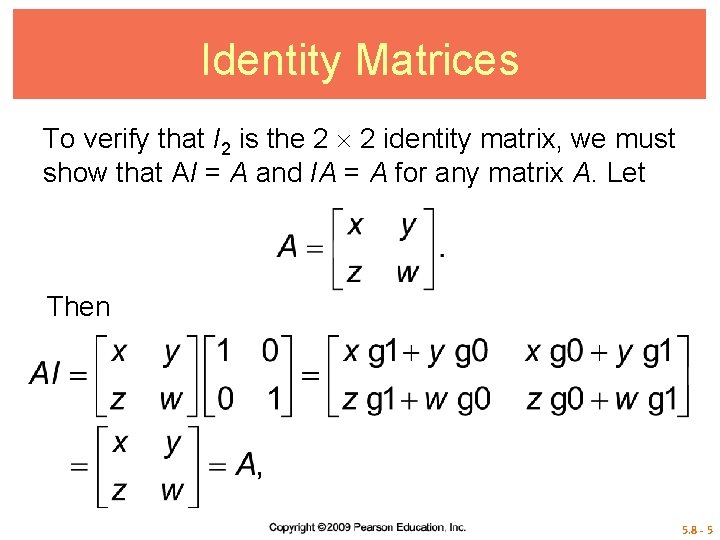
Identity Matrices To verify that I 2 is the 2 2 identity matrix, we must show that AI = A and IA = A for any matrix A. Let Then 5. 8 - 5

Identity Matrices and 5. 8 - 6
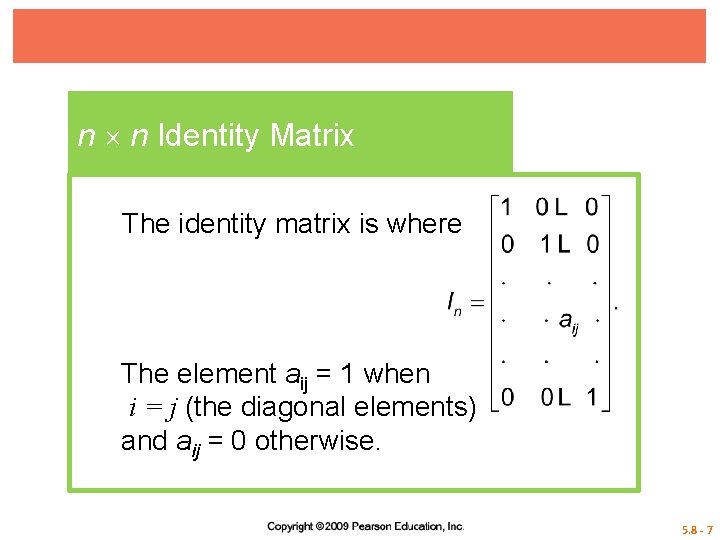
n n Identity Matrix The identity matrix is where The element aij = 1 when i = j (the diagonal elements) and aij = 0 otherwise. 5. 8 - 7
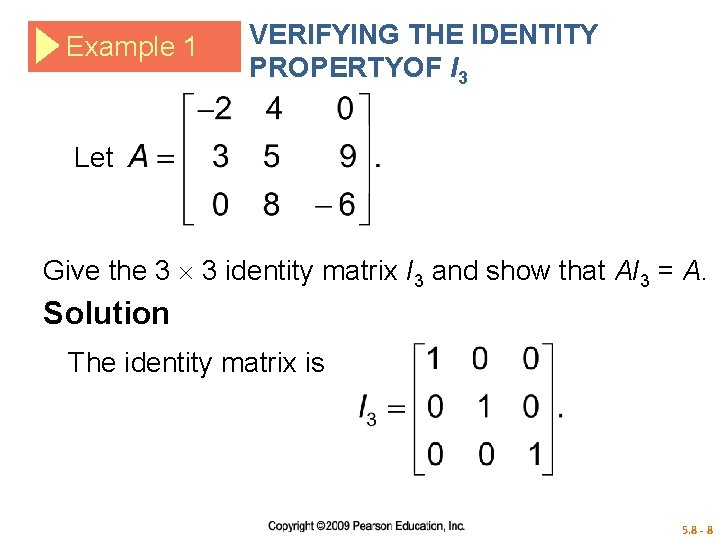
Example 1 VERIFYING THE IDENTITY PROPERTYOF I 3 Let Give the 3 3 identity matrix I 3 and show that AI 3 = A. Solution The identity matrix is 5. 8 - 8
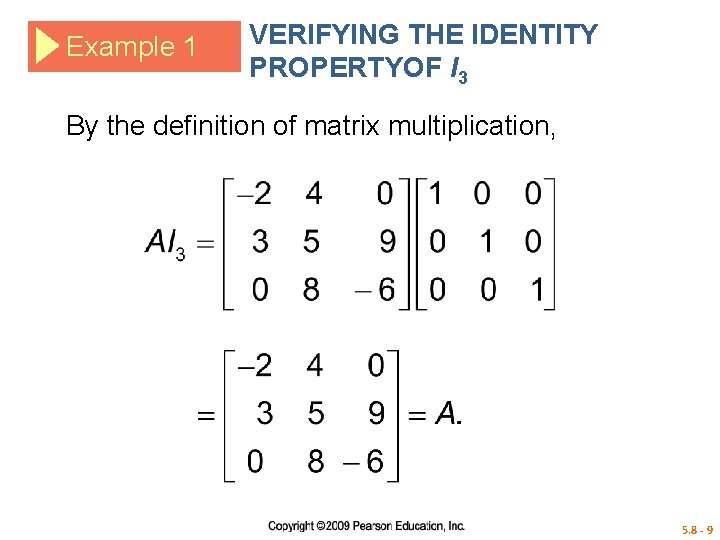
Example 1 VERIFYING THE IDENTITY PROPERTYOF I 3 By the definition of matrix multiplication, 5. 8 - 9
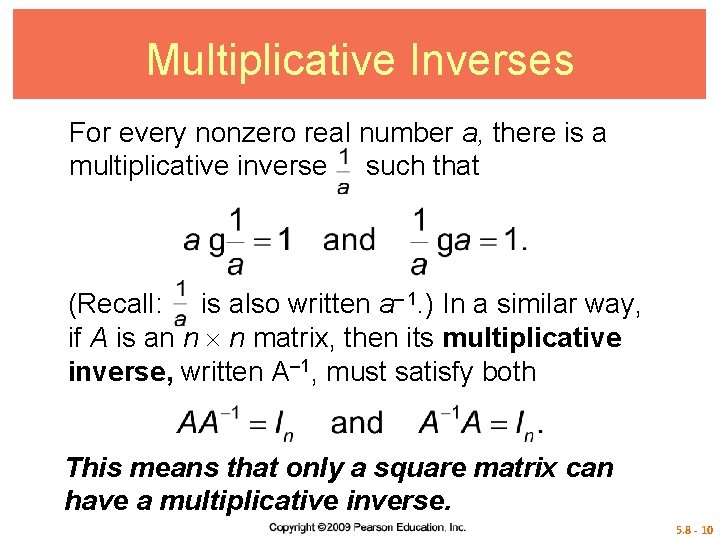
Multiplicative Inverses For every nonzero real number a, there is a multiplicative inverse such that (Recall: is also written a– 1. ) In a similar way, if A is an n n matrix, then its multiplicative inverse, written A– 1, must satisfy both This means that only a square matrix can have a multiplicative inverse. 5. 8 - 10
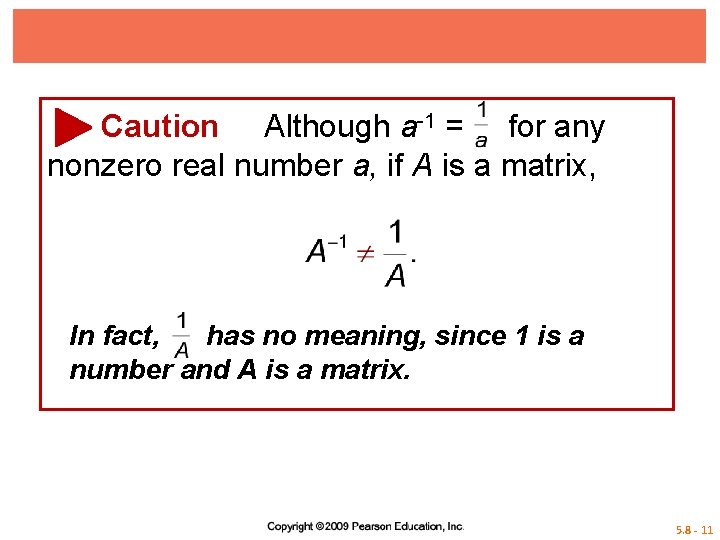
Caution Although a-1 = for any nonzero real number a, if A is a matrix, In fact, has no meaning, since 1 is a number and A is a matrix. 5. 8 - 11
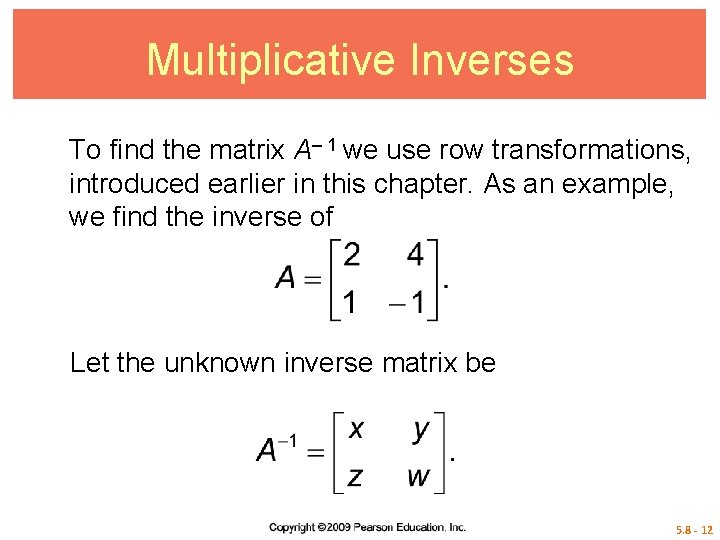
Multiplicative Inverses To find the matrix A– 1 we use row transformations, introduced earlier in this chapter. As an example, we find the inverse of Let the unknown inverse matrix be 5. 8 - 12
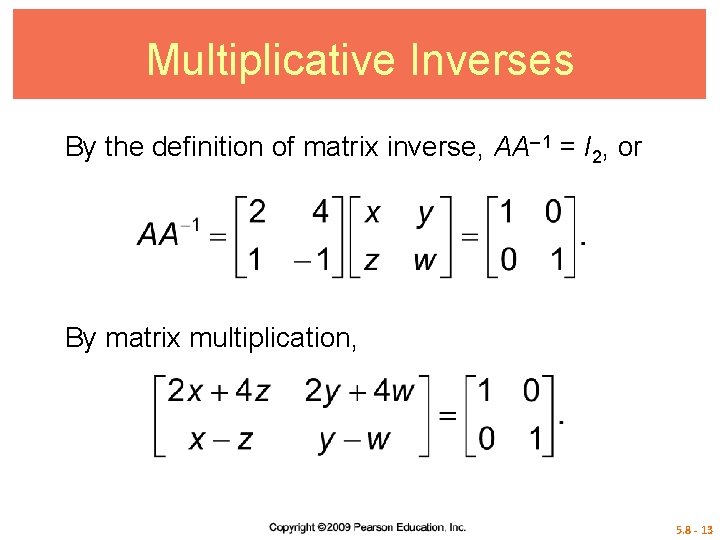
Multiplicative Inverses By the definition of matrix inverse, AA– 1 = I 2, or By matrix multiplication, 5. 8 - 13
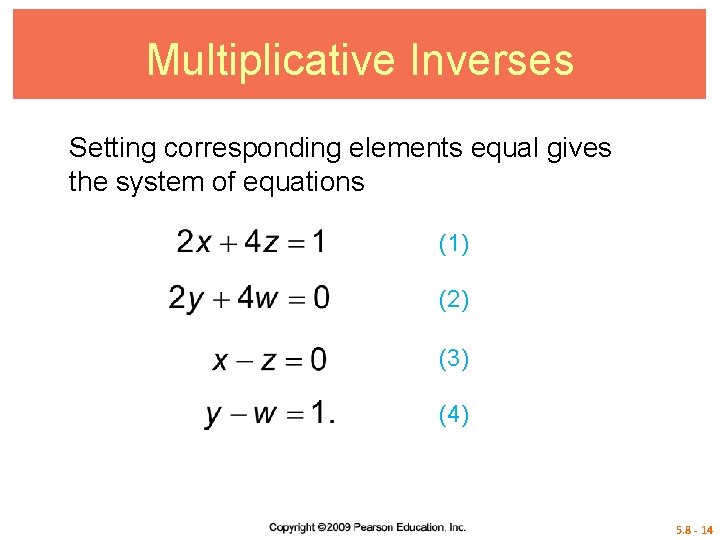
Multiplicative Inverses Setting corresponding elements equal gives the system of equations (1) (2) (3) (4) 5. 8 - 14
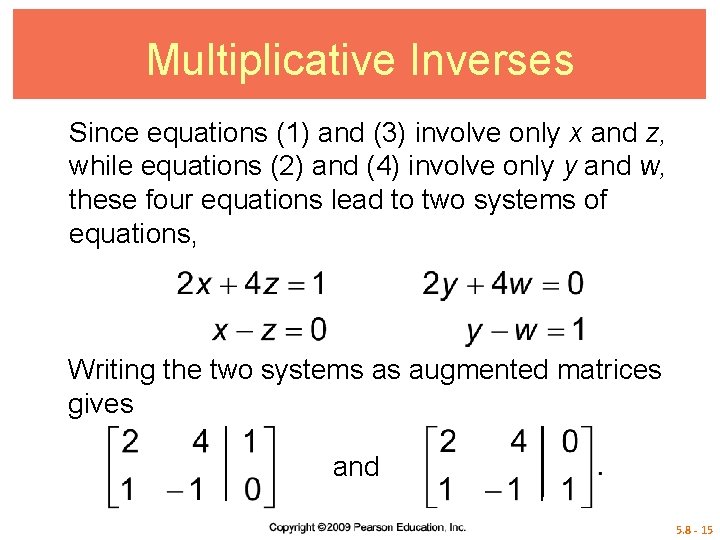
Multiplicative Inverses Since equations (1) and (3) involve only x and z, while equations (2) and (4) involve only y and w, these four equations lead to two systems of equations, Writing the two systems as augmented matrices gives and 5. 8 - 15
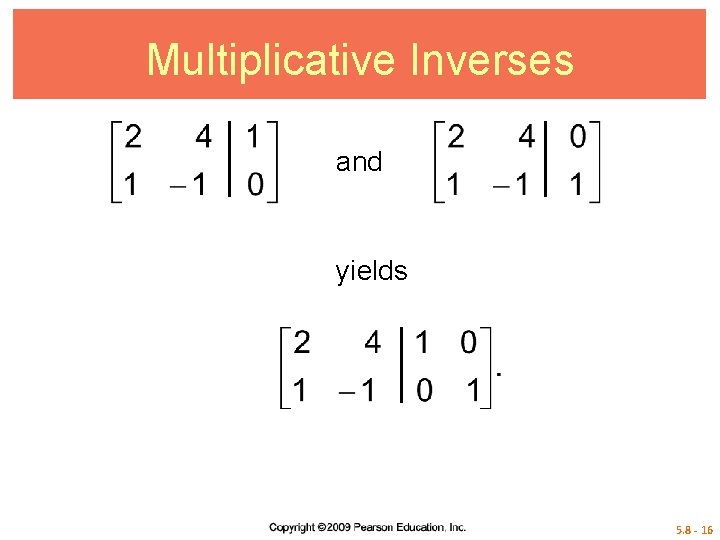
Multiplicative Inverses and yields 5. 8 - 16
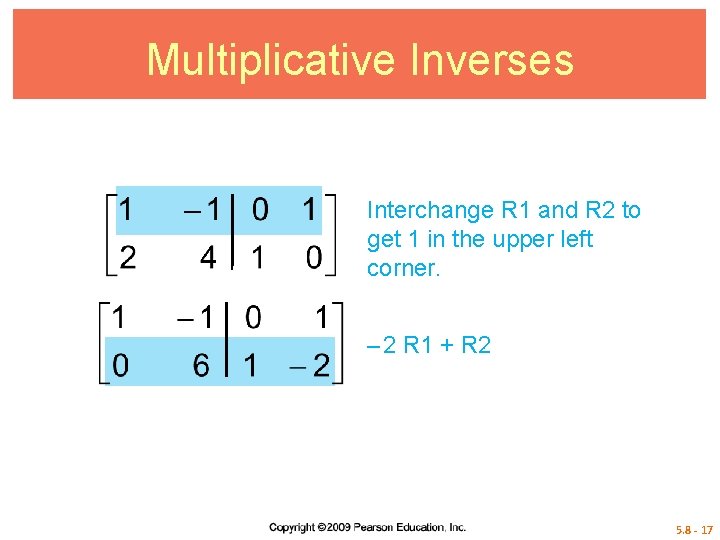
Multiplicative Inverses Interchange R 1 and R 2 to get 1 in the upper left corner. – 2 R 1 + R 2 5. 8 - 17
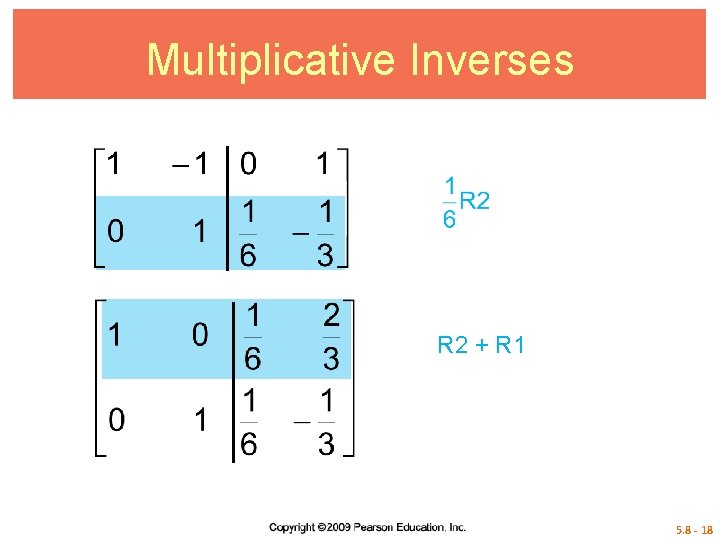
Multiplicative Inverses R 2 + R 1 5. 8 - 18
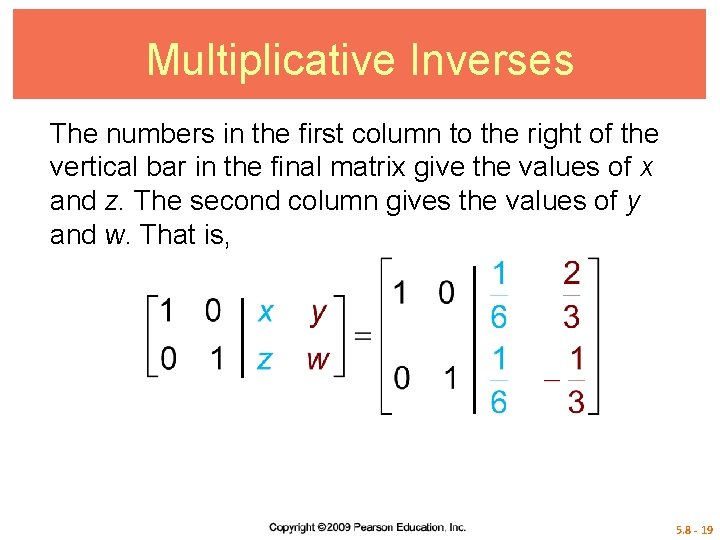
Multiplicative Inverses The numbers in the first column to the right of the vertical bar in the final matrix give the values of x and z. The second column gives the values of y and w. That is, 5. 8 - 19
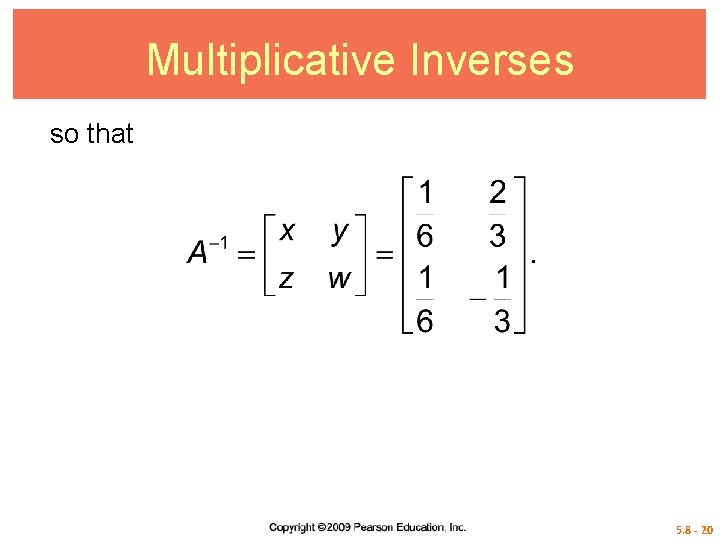
Multiplicative Inverses so that 5. 8 - 20
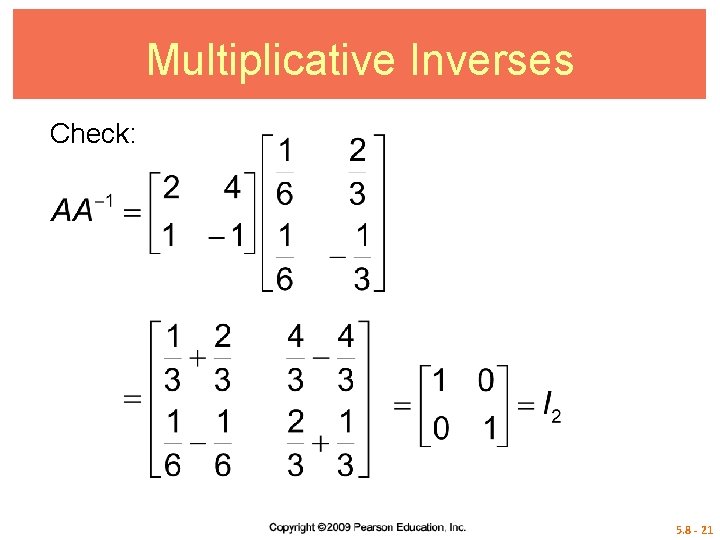
Multiplicative Inverses Check: 5. 8 - 21
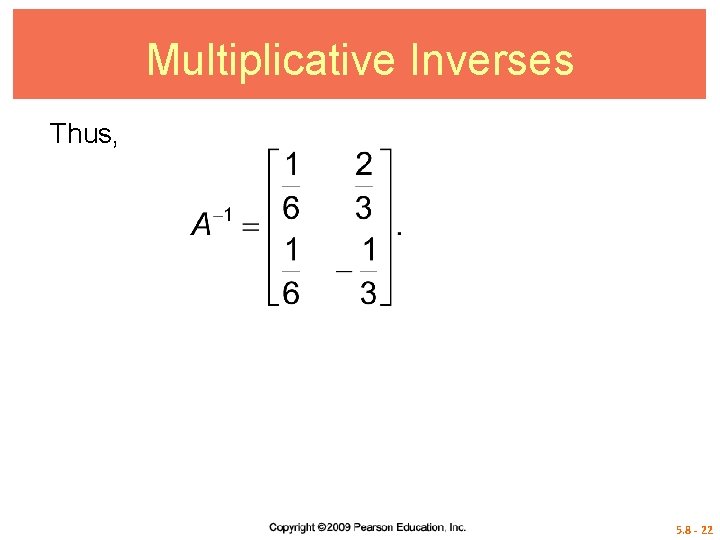
Multiplicative Inverses Thus, 5. 8 - 22
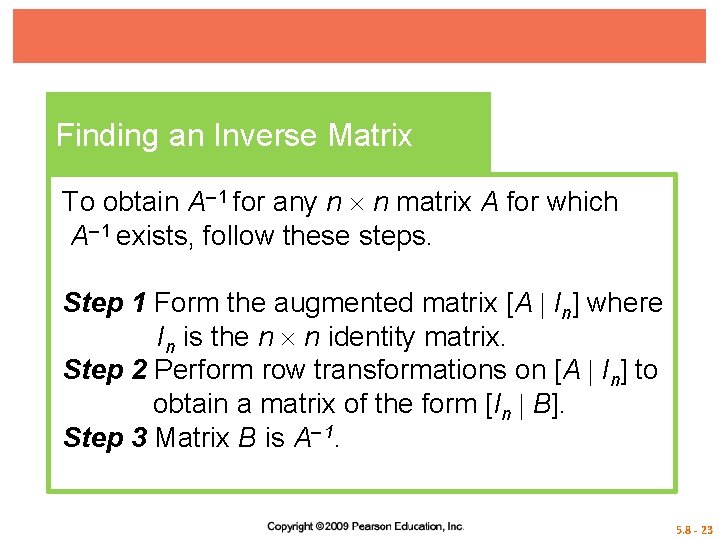
Finding an Inverse Matrix To obtain A– 1 for any n n matrix A for which A– 1 exists, follow these steps. Step 1 Form the augmented matrix [A In] where In is the n n identity matrix. Step 2 Perform row transformations on [A In] to obtain a matrix of the form [In B]. Step 3 Matrix B is A– 1. 5. 8 - 23
Note To confirm that two n n matrices A and B are inverses of each other, it is sufficient to show that AB = In. It is not necessary to show also that BA = In. 5. 8 - 24
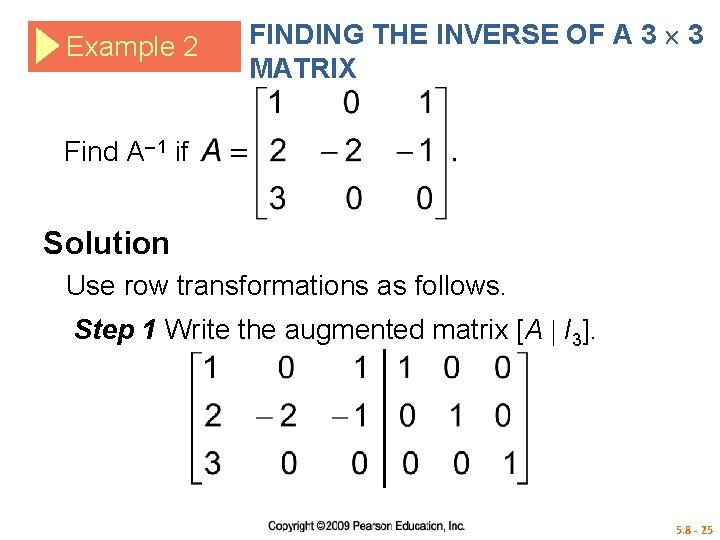
Example 2 FINDING THE INVERSE OF A 3 3 MATRIX Find A– 1 if Solution Use row transformations as follows. Step 1 Write the augmented matrix [A I 3]. 5. 8 - 25
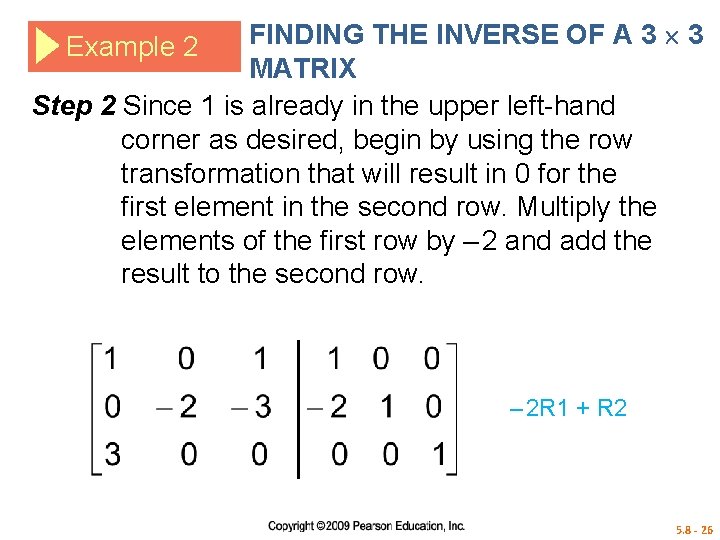
FINDING THE INVERSE OF A 3 3 MATRIX Step 2 Since 1 is already in the upper left-hand corner as desired, begin by using the row transformation that will result in 0 for the first element in the second row. Multiply the elements of the first row by – 2 and add the result to the second row. Example 2 – 2 R 1 + R 2 5. 8 - 26
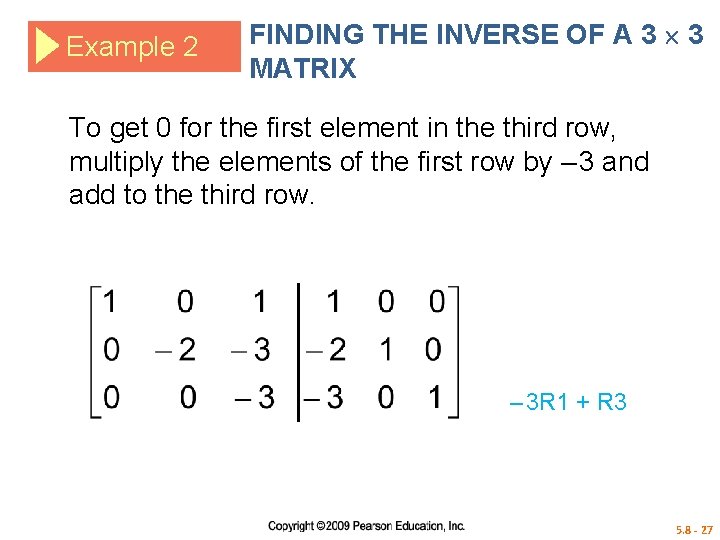
Example 2 FINDING THE INVERSE OF A 3 3 MATRIX To get 0 for the first element in the third row, multiply the elements of the first row by – 3 and add to the third row. – 3 R 1 + R 3 5. 8 - 27
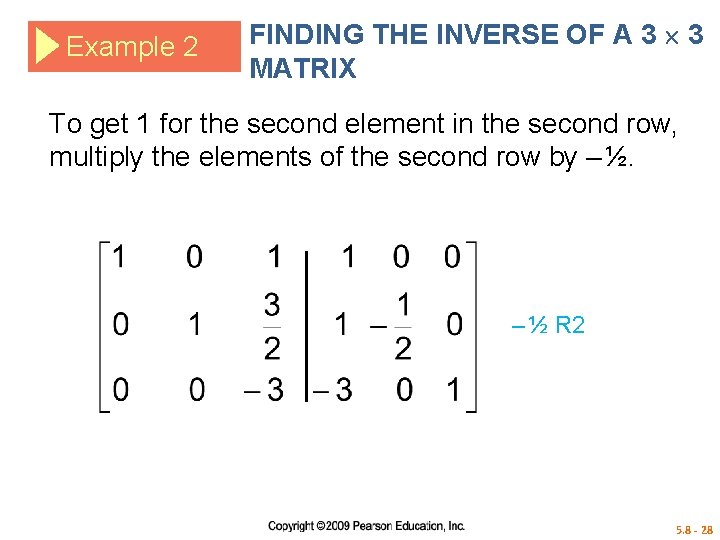
Example 2 FINDING THE INVERSE OF A 3 3 MATRIX To get 1 for the second element in the second row, multiply the elements of the second row by – ½ R 2 5. 8 - 28
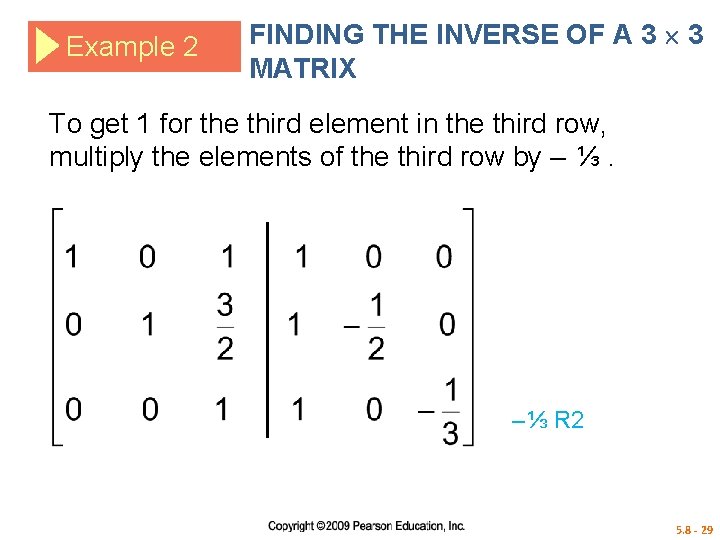
Example 2 FINDING THE INVERSE OF A 3 3 MATRIX To get 1 for the third element in the third row, multiply the elements of the third row by – ⅓ R 2 5. 8 - 29
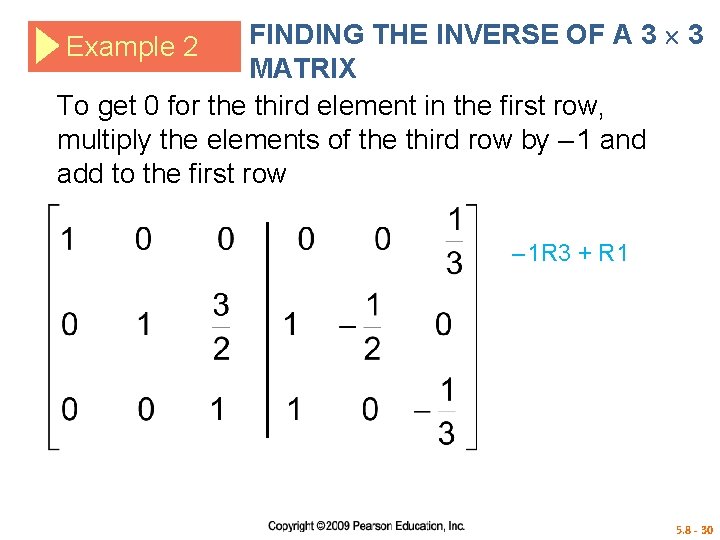
FINDING THE INVERSE OF A 3 3 MATRIX To get 0 for the third element in the first row, multiply the elements of the third row by – 1 and add to the first row Example 2 – 1 R 3 + R 1 5. 8 - 30
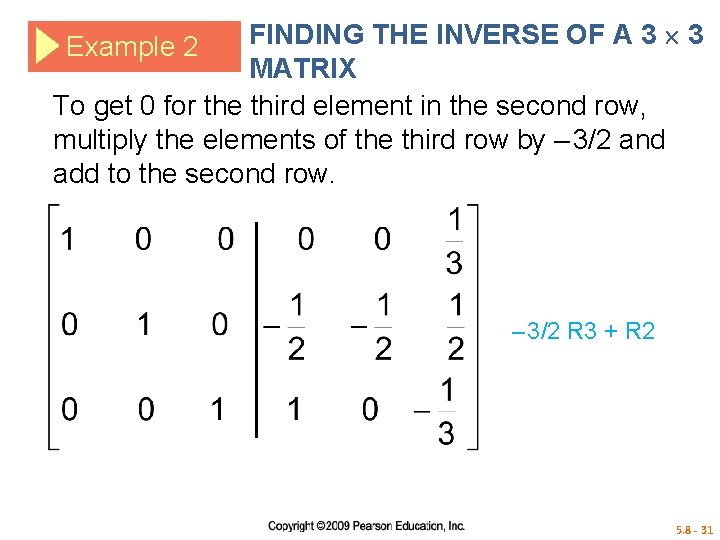
FINDING THE INVERSE OF A 3 3 MATRIX To get 0 for the third element in the second row, multiply the elements of the third row by – 3/2 and add to the second row. Example 2 – 3/2 R 3 + R 2 5. 8 - 31
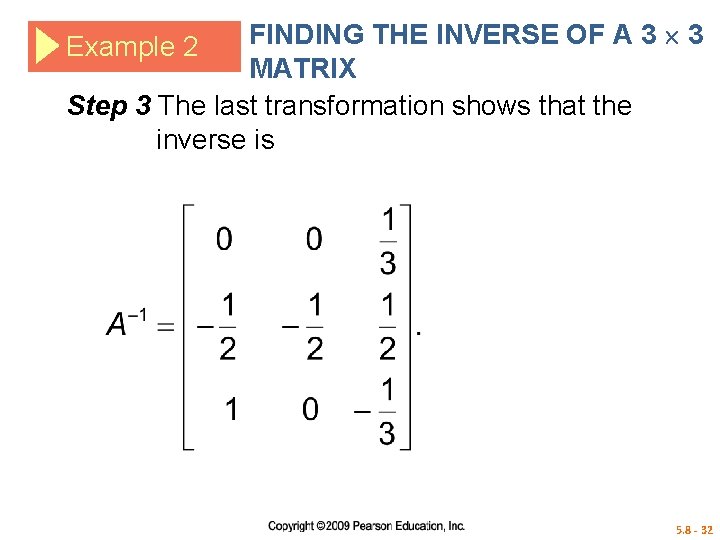
FINDING THE INVERSE OF A 3 3 MATRIX Step 3 The last transformation shows that the inverse is Example 2 5. 8 - 32
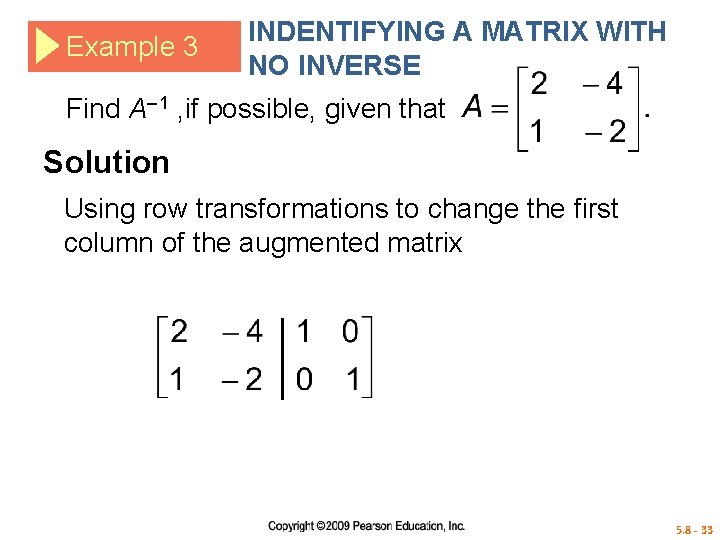
Example 3 INDENTIFYING A MATRIX WITH NO INVERSE Find A– 1 , if possible, given that Solution Using row transformations to change the first column of the augmented matrix 5. 8 - 33
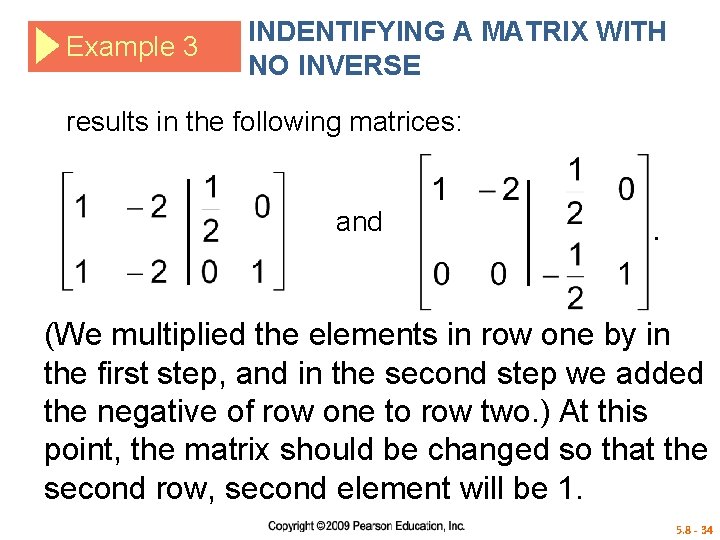
Example 3 INDENTIFYING A MATRIX WITH NO INVERSE results in the following matrices: and (We multiplied the elements in row one by in the first step, and in the second step we added the negative of row one to row two. ) At this point, the matrix should be changed so that the second row, second element will be 1. 5. 8 - 34
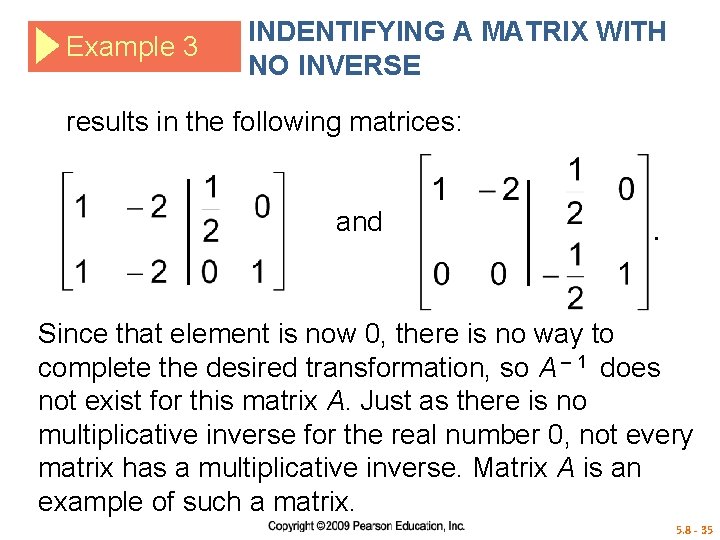
Example 3 INDENTIFYING A MATRIX WITH NO INVERSE results in the following matrices: and Since that element is now 0, there is no way to complete the desired transformation, so A – 1 does not exist for this matrix A. Just as there is no multiplicative inverse for the real number 0, not every matrix has a multiplicative inverse. Matrix A is an example of such a matrix. 5. 8 - 35
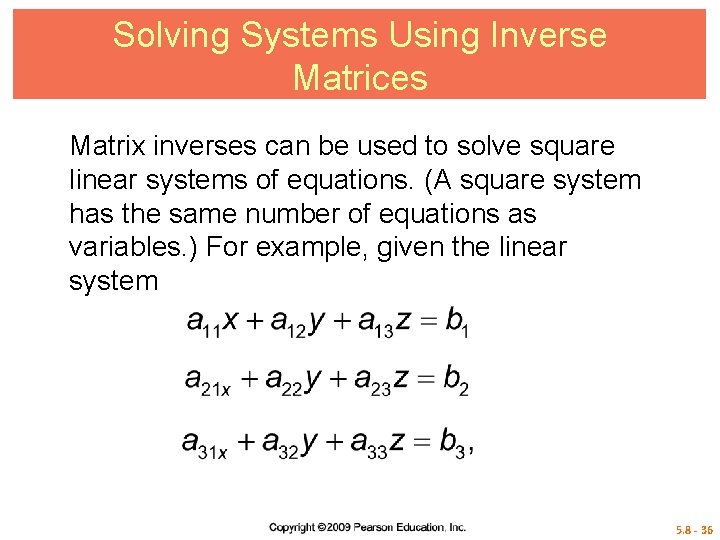
Solving Systems Using Inverse Matrices Matrix inverses can be used to solve square linear systems of equations. (A square system has the same number of equations as variables. ) For example, given the linear system 5. 8 - 36
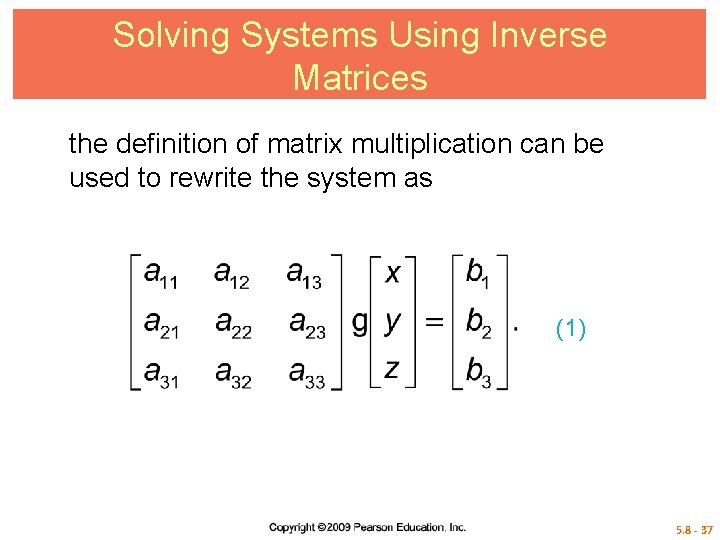
Solving Systems Using Inverse Matrices the definition of matrix multiplication can be used to rewrite the system as (1) 5. 8 - 37
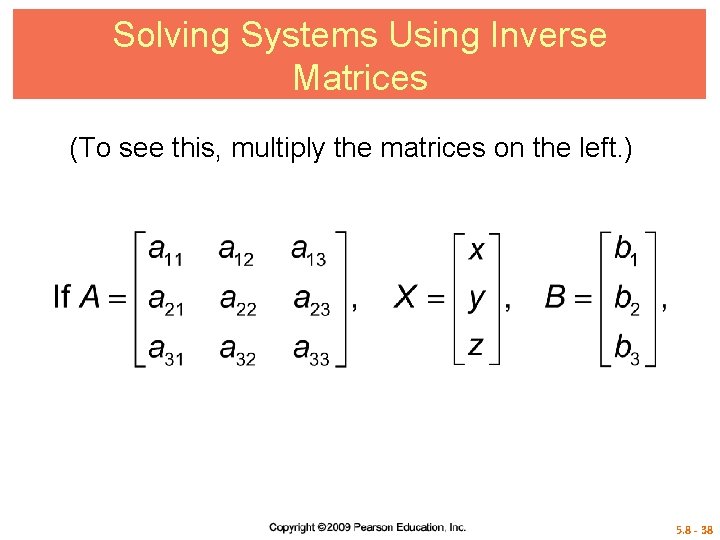
Solving Systems Using Inverse Matrices (To see this, multiply the matrices on the left. ) 5. 8 - 38
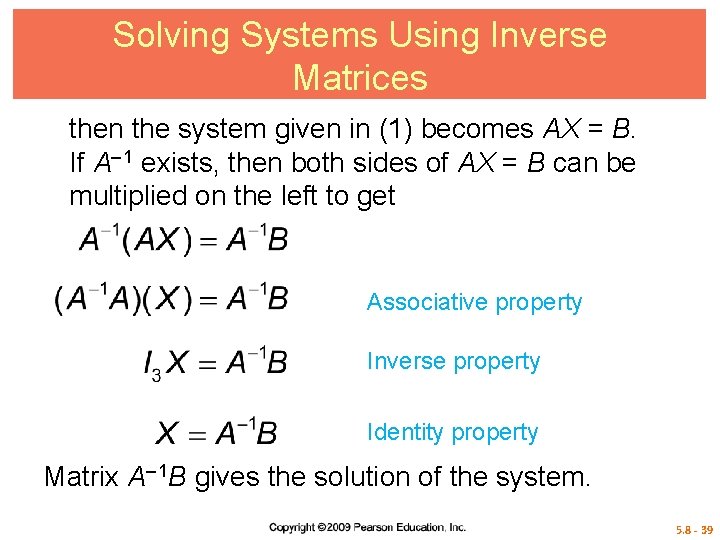
Solving Systems Using Inverse Matrices then the system given in (1) becomes AX = B. If A– 1 exists, then both sides of AX = B can be multiplied on the left to get Associative property Inverse property Identity property Matrix A– 1 B gives the solution of the system. 5. 8 - 39
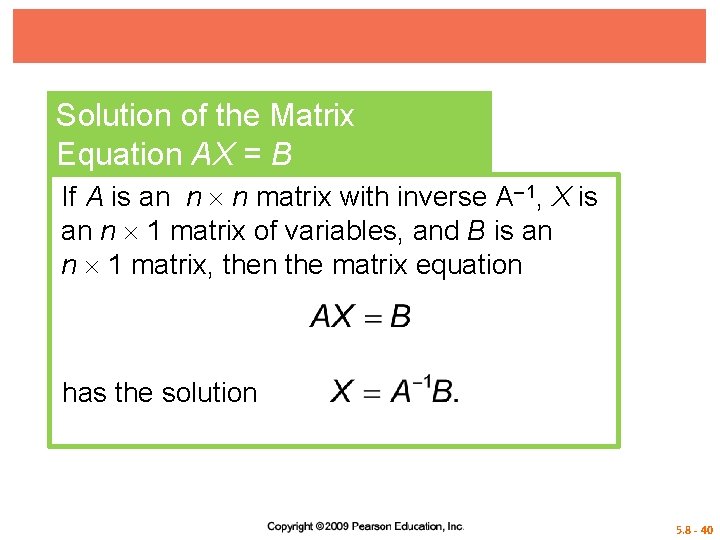
Solution of the Matrix Equation AX = B If A is an n n matrix with inverse A– 1, X is an n 1 matrix of variables, and B is an n 1 matrix, then the matrix equation has the solution 5. 8 - 40
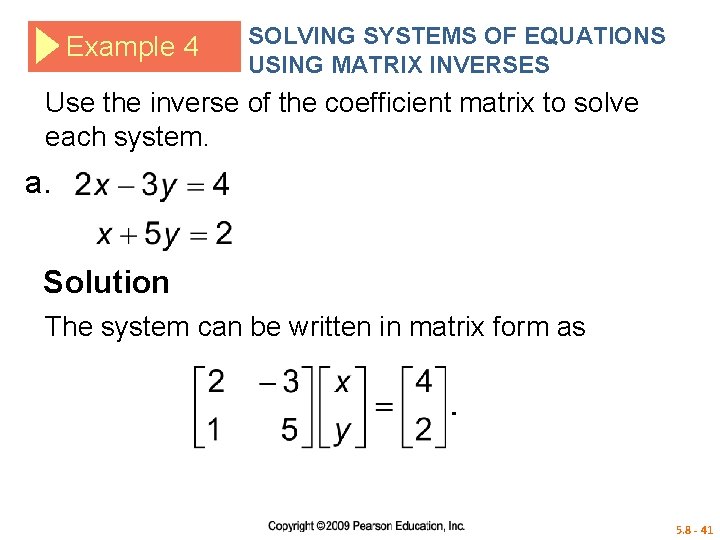
Example 4 SOLVING SYSTEMS OF EQUATIONS USING MATRIX INVERSES Use the inverse of the coefficient matrix to solve each system. a. Solution The system can be written in matrix form as 5. 8 - 41
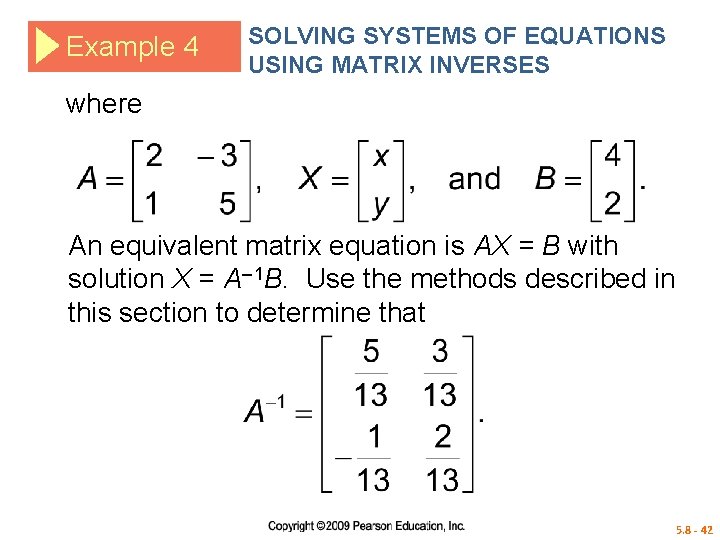
Example 4 SOLVING SYSTEMS OF EQUATIONS USING MATRIX INVERSES where An equivalent matrix equation is AX = B with solution X = A– 1 B. Use the methods described in this section to determine that 5. 8 - 42
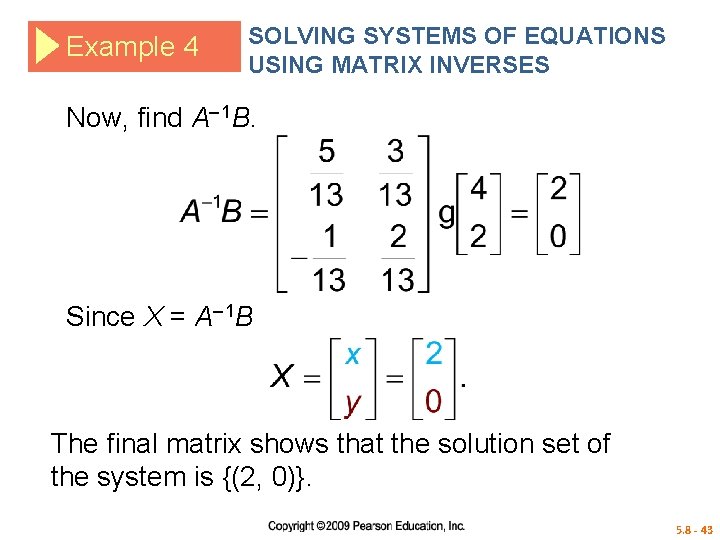
Example 4 SOLVING SYSTEMS OF EQUATIONS USING MATRIX INVERSES Now, find A– 1 B. Since X = A– 1 B The final matrix shows that the solution set of the system is {(2, 0)}. 5. 8 - 43
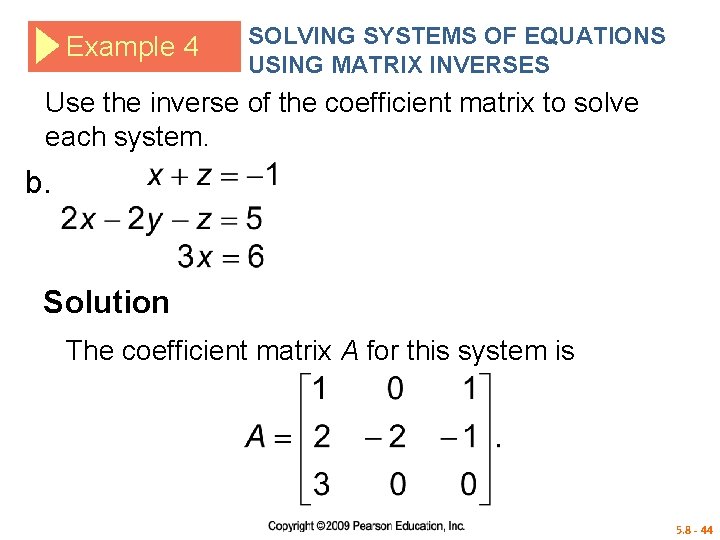
Example 4 SOLVING SYSTEMS OF EQUATIONS USING MATRIX INVERSES Use the inverse of the coefficient matrix to solve each system. b. Solution The coefficient matrix A for this system is 5. 8 - 44
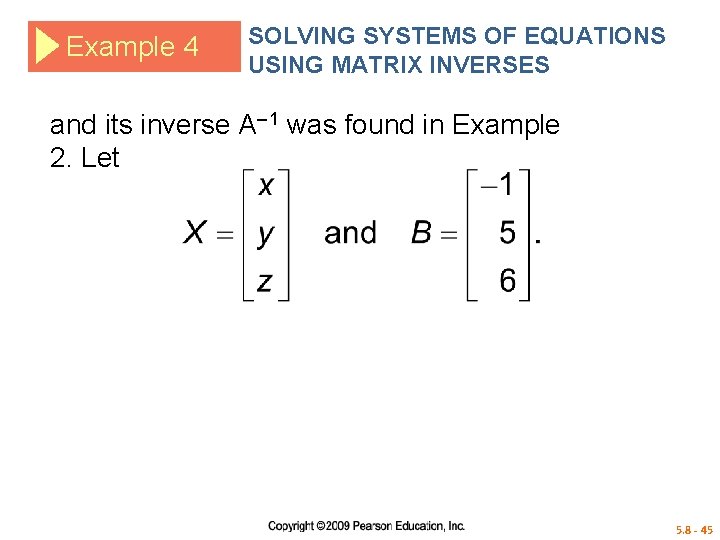
Example 4 SOLVING SYSTEMS OF EQUATIONS USING MATRIX INVERSES and its inverse A– 1 was found in Example 2. Let 5. 8 - 45
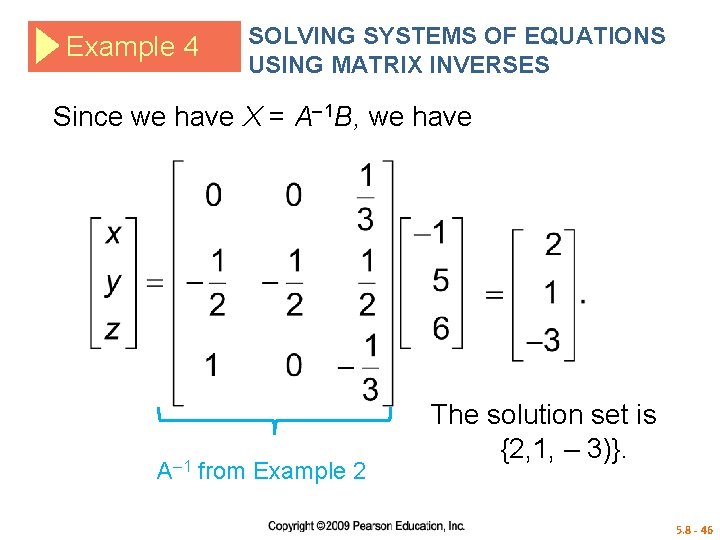
Example 4 SOLVING SYSTEMS OF EQUATIONS USING MATRIX INVERSES Since we have X = A– 1 B, we have A– 1 from Example 2 The solution set is {2, 1, – 3)}. 5. 8 - 46
- Slides: 46