
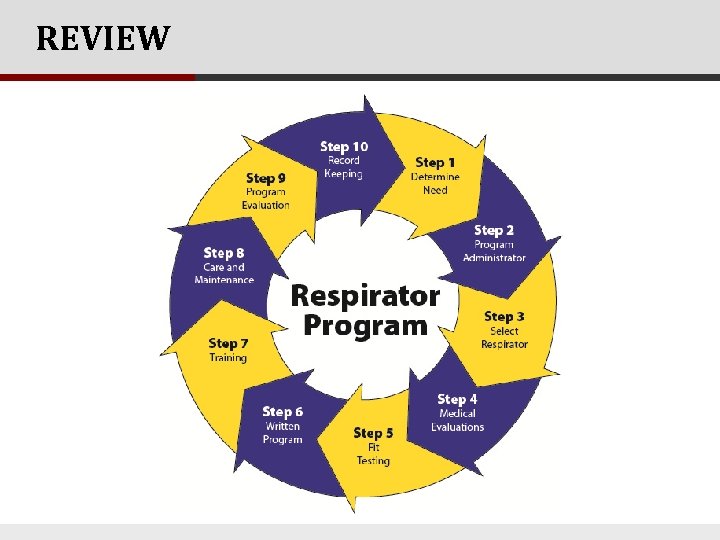
10 STEPS TO A RESPIRATORY PROTECTION PROGRAM 1910

- Slides: 26
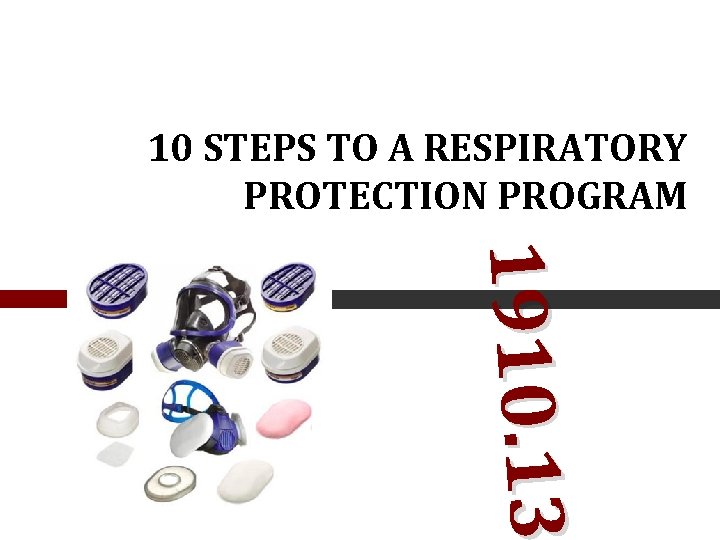
10 STEPS TO A RESPIRATORY PROTECTION PROGRAM 1910. 13
INTRODUCTION • Intended as a guide • Develop a program that meets your needs • Some of the materials covered are examples • Important to remember – Supplied Air Respirators and SCBA’s are included – Other Fit testing methods – we’re discussing Bitrex
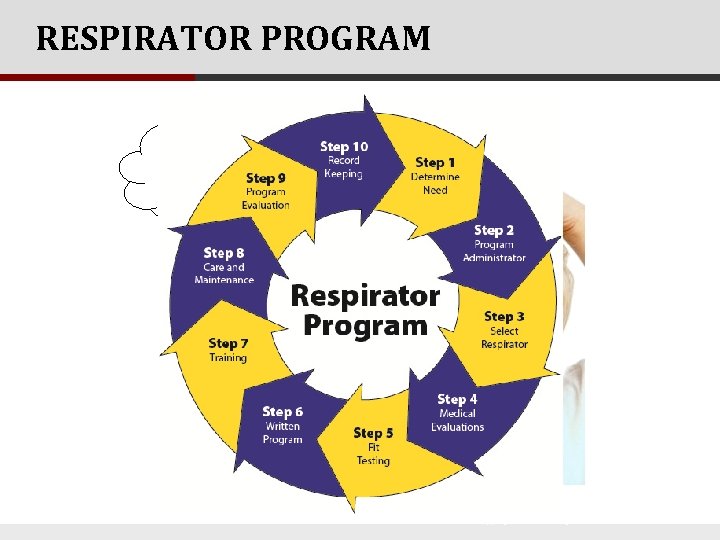
RESPIRATOR PROGRAM WHERE DO I START? Copyright ã 2006 Progressive Business Publications
RESPIRATOR PROGRAM Step 1: Determine Need - Is there a need? - Could we eliminate the need? - Ongoing costs » Equipment » Medical » Training/Fit testing » Can hinder employee comfort and productivity l Engineering controls » Ventilation l Administrative/work practice controls » Substituting less hazardous products » Rotating employees to reduce exposure time » Limiting the time someone can work in an area » Changing the way the work process is conducted. l Personal protective equipment (PPE) - Used when unable to eliminate or reduce the hazard sufficiently
RESPIRATOR PROGRAM Step 2: Program Administrator - Responsible for administering or overseeing program - Must be qualified by training or experience - Be familiar with hazards in the workplace and if engineering or administrative controls can be applied - Will identify types of respirators to be used - Will conduct required evaluations of program effectiveness
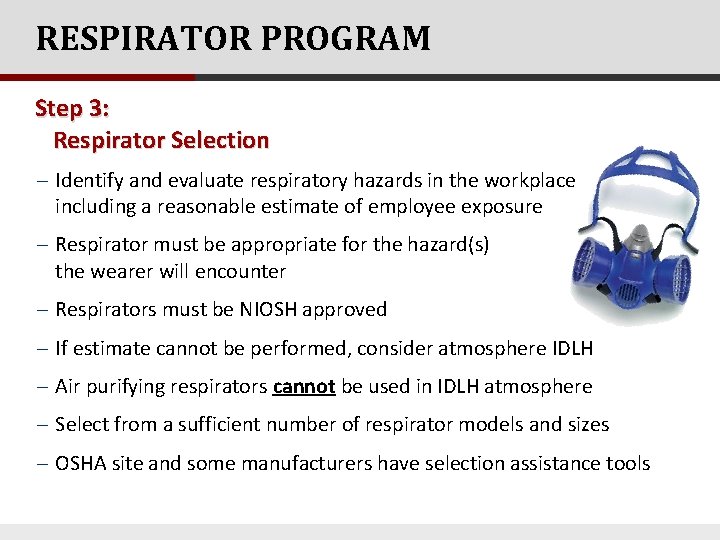
RESPIRATOR PROGRAM Step 3: Respirator Selection - Identify and evaluate respiratory hazards in the workplace including a reasonable estimate of employee exposure - Respirator must be appropriate for the hazard(s) the wearer will encounter - Respirators must be NIOSH approved - If estimate cannot be performed, consider atmosphere IDLH - Air purifying respirators cannot be used in IDLH atmosphere - Select from a sufficient number of respirator models and sizes - OSHA site and some manufacturers have selection assistance tools
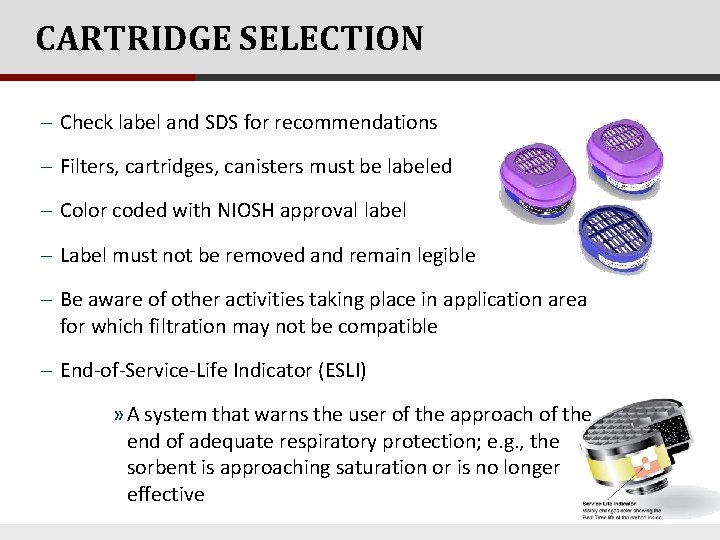
CARTRIDGE SELECTION - Check label and SDS for recommendations - Filters, cartridges, canisters must be labeled - Color coded with NIOSH approval label - Label must not be removed and remain legible - Be aware of other activities taking place in application area for which filtration may not be compatible - End-of-Service-Life Indicator (ESLI) » A system that warns the user of the approach of the end of adequate respiratory protection; e. g. , the sorbent is approaching saturation or is no longer effective
RESPIRATOR PROGRAM Step 4: Medical Evaluation - A medical evaluation is required for employees who wear respirators - Intended to assure that employees are physically able to wear a respirator - Must be done before fit testing - Performed by a PLHCP (physician or other licensed health care provider) using: » Medical questionnaire (Appendix C) § Administered confidentially § Completed on work time » Medical examination which obtains information
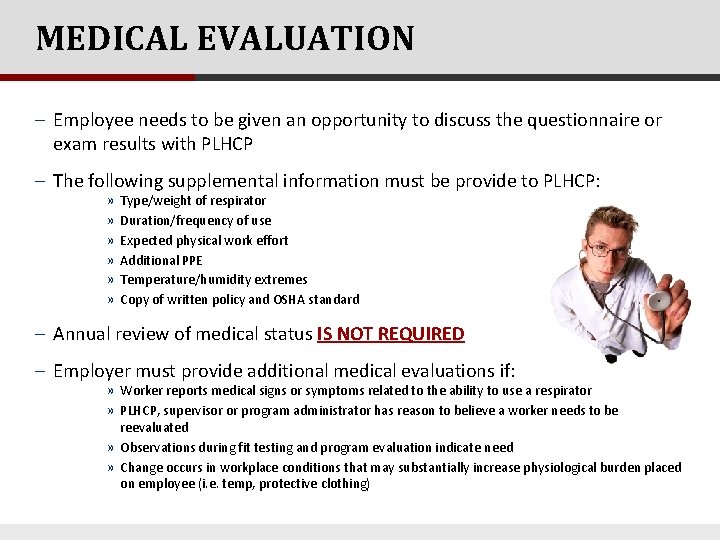
MEDICAL EVALUATION - Employee needs to be given an opportunity to discuss the questionnaire or exam results with PLHCP - The following supplemental information must be provide to PLHCP: » » » Type/weight of respirator Duration/frequency of use Expected physical work effort Additional PPE Temperature/humidity extremes Copy of written policy and OSHA standard - Annual review of medical status IS NOT REQUIRED - Employer must provide additional medical evaluations if: » Worker reports medical signs or symptoms related to the ability to use a respirator » PLHCP, supervisor or program administrator has reason to believe a worker needs to be reevaluated » Observations during fit testing and program evaluation indicate need » Change occurs in workplace conditions that may substantially increase physiological burden placed on employee (i. e. temp, protective clothing)
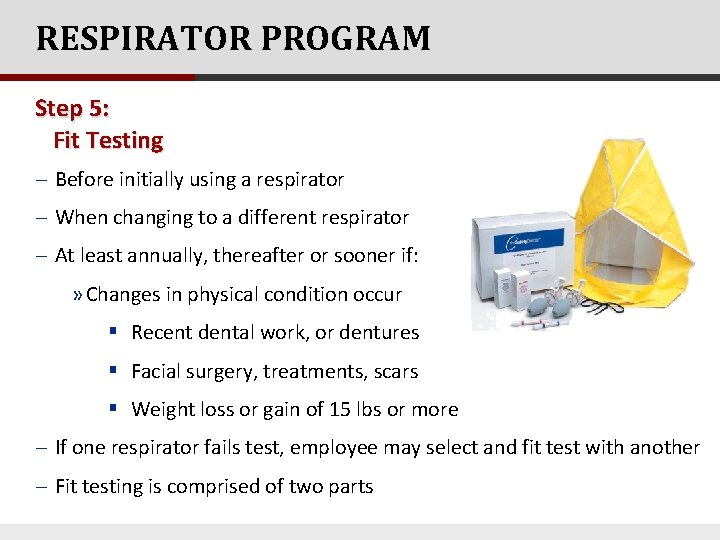
RESPIRATOR PROGRAM Step 5: Fit Testing - Before initially using a respirator - When changing to a different respirator - At least annually, thereafter or sooner if: » Changes in physical condition occur § Recent dental work, or dentures § Facial surgery, treatments, scars § Weight loss or gain of 15 lbs or more - If one respirator fails test, employee may select and fit test with another - Fit testing is comprised of two parts
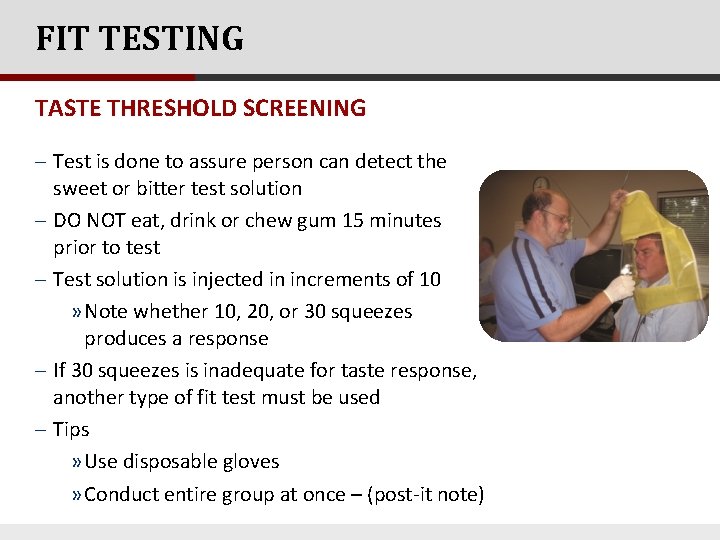
FIT TESTING TASTE THRESHOLD SCREENING - Test is done to assure person can detect the sweet or bitter test solution - DO NOT eat, drink or chew gum 15 minutes prior to test - Test solution is injected in increments of 10 » Note whether 10, 20, or 30 squeezes produces a response - If 30 squeezes is inadequate for taste response, another type of fit test must be used - Tips » Use disposable gloves » Conduct entire group at once – (post-it note)
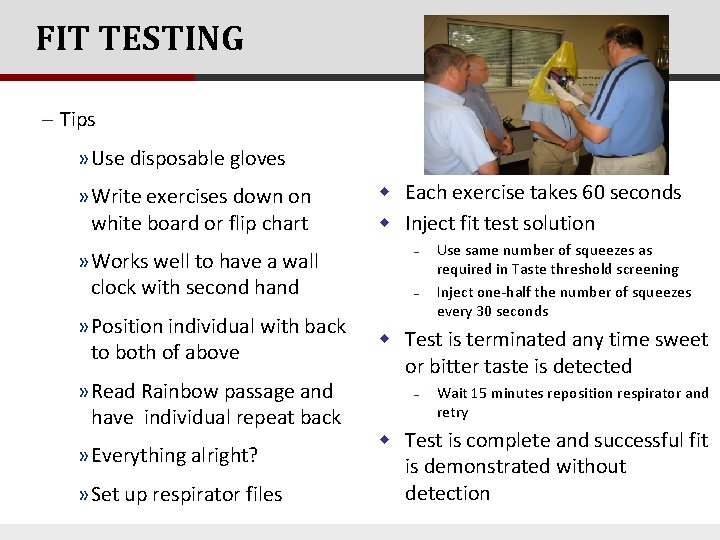
FIT TESTING TEST EXERCISES - Tips » Usebreathing disposable gloves w Normal while standing w Deep breathing while down standing » Write exercises on w Turning head side or to side while white board flip chart standing » Works to have wall w Moving headwell up and downawhile clock with second hand standing w Bending over individual (jogging in with placeback » Position can be to used) both of above w Talking (Rainbow Passage) » Read Rainbow passage and w Normal breathing while standing have individual repeat back » Everything alright? » Set up respirator files w Each exercise takes 60 seconds w Inject fit test solution – – Use same number of squeezes as required in Taste threshold screening Inject one-half the number of squeezes every 30 seconds w Test is terminated any time sweet or bitter taste is detected – Wait 15 minutes reposition respirator and retry w Test is complete and successful fit is demonstrated without detection
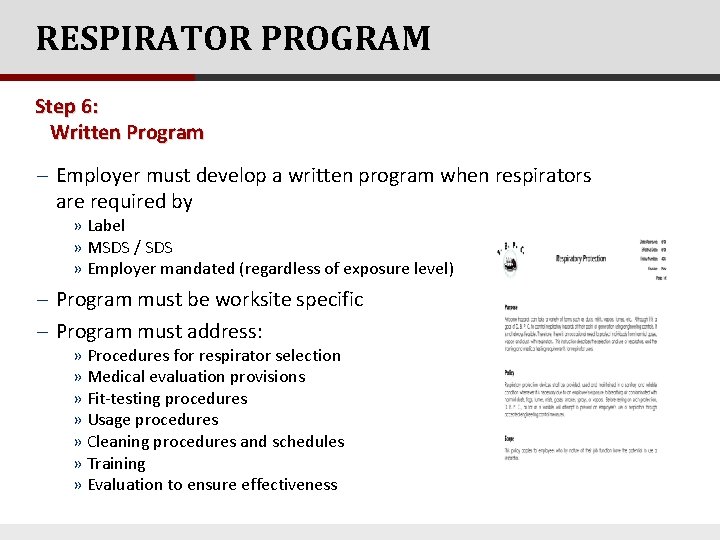
RESPIRATOR PROGRAM Step 6: Written Program - Employer must develop a written program when respirators are required by » Label » MSDS / SDS » Employer mandated (regardless of exposure level) - Program must be worksite specific - Program must address: » Procedures for respirator selection » Medical evaluation provisions » Fit-testing procedures » Usage procedures » Cleaning procedures and schedules » Training » Evaluation to ensure effectiveness
WRITTEN PROGRAM - Program must be administered by a suitably trained program administrator - Must update program as necessary to reflect changes in workplace conditions - Must address Voluntary Use - If respirators not required by label or policy: § Employer can provide respirator at employee’s request § Permit employee to use their own § Employer must implement limited written program » Medical evaluation Exception: » Maintenance, cleaning and storage Employers are not required to » Copy of Appendix D include in a written respiratory - Employee precautions » READ and HEED all instruction » Use NIOSH certified respirators only » Keep track of respirator protection program those employees whose only use of respirators involves the voluntary use of filtering face pieces (dust masks).
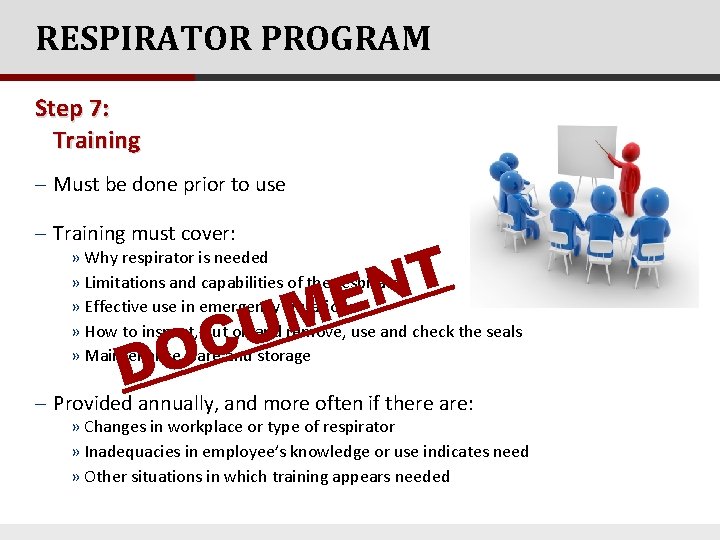
RESPIRATOR PROGRAM Step 7: Training - Must be done prior to use - Training must cover: T N E M U C » Why respirator is needed » Limitations and capabilities of the respirator » Effective use in emergency situations » How to inspect, put on and remove, use and check the seals » Maintenance, care and storage O D - Provided annually, and more often if there are: » Changes in workplace or type of respirator » Inadequacies in employee’s knowledge or use indicates need » Other situations in which training appears needed
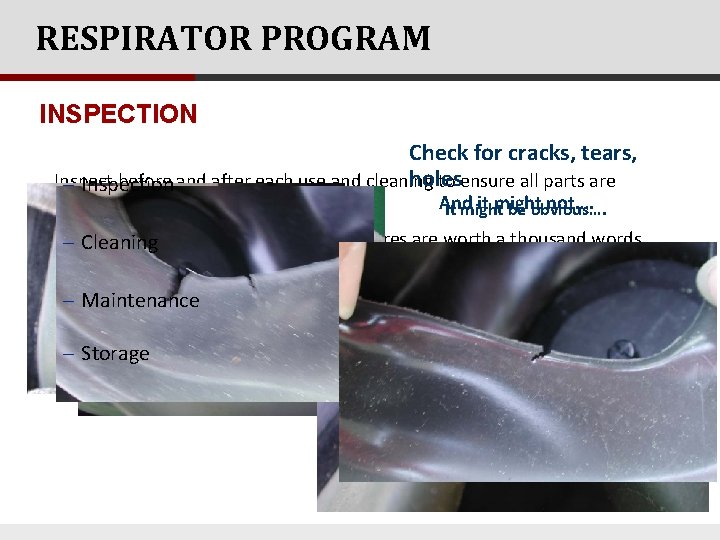
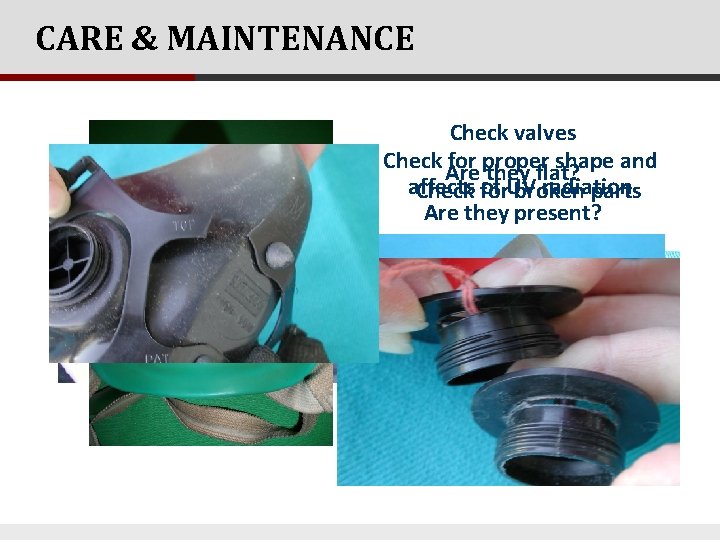
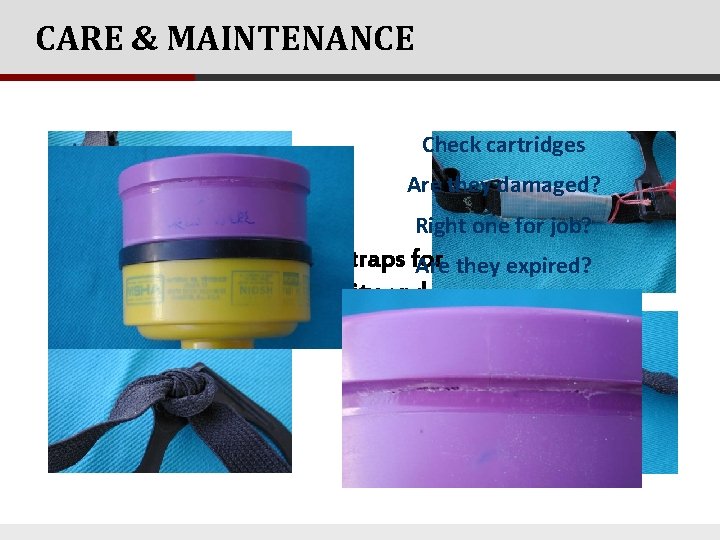
RESPIRATOR PROGRAM Step 8: INSPECTION Care & Maintenance Check for cracks, tears, holes Inspect before and after each use and cleaning to ensure all parts are - Inspection present and operating And it might not…. It might be obvious…. When it comes to what to look for, pictures are worth a thousand words - Cleaning - Maintenance - Storage Check for dirt, oil, soap, or chemical residue
CARE & MAINTENANCE Check valves Check for proper shape and Are they flat? affects of UV radiation Check for broken parts Are they present?
CARE & MAINTENANCE Check cartridges Are they damaged? Right one for job? Check straps for Are they expired? elasticity and modifications
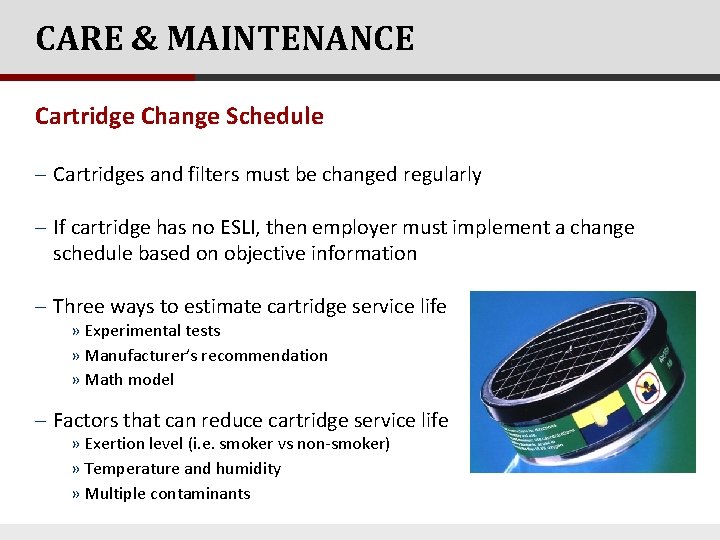
CARE & MAINTENANCE Cartridge Change Schedule - Cartridges and filters must be changed regularly - If cartridge has no ESLI, then employer must implement a change schedule based on objective information - Three ways to estimate cartridge service life » Experimental tests » Manufacturer’s recommendation » Math model - Factors that can reduce cartridge service life » Exertion level (i. e. smoker vs non-smoker) » Temperature and humidity » Multiple contaminants
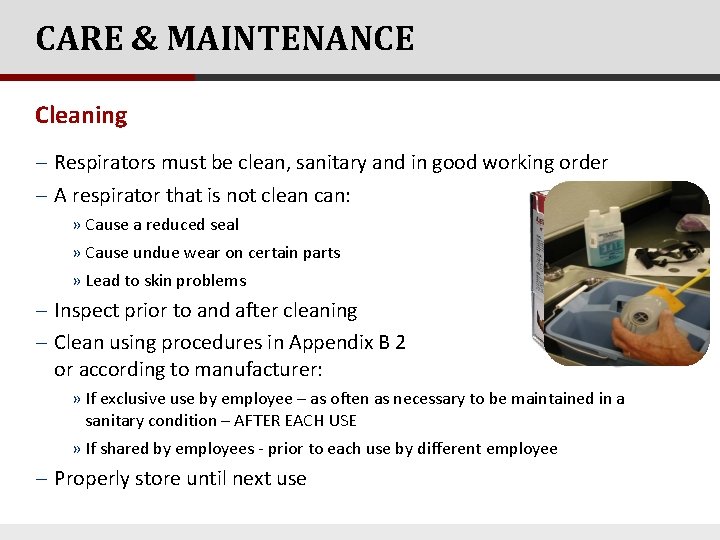
CARE & MAINTENANCE Cleaning - Respirators must be clean, sanitary and in good working order - A respirator that is not clean can: » Cause a reduced seal » Cause undue wear on certain parts » Lead to skin problems - Inspect prior to and after cleaning - Clean using procedures in Appendix B 2 or according to manufacturer: » If exclusive use by employee – as often as necessary to be maintained in a sanitary condition – AFTER EACH USE » If shared by employees - prior to each use by different employee - Properly store until next use
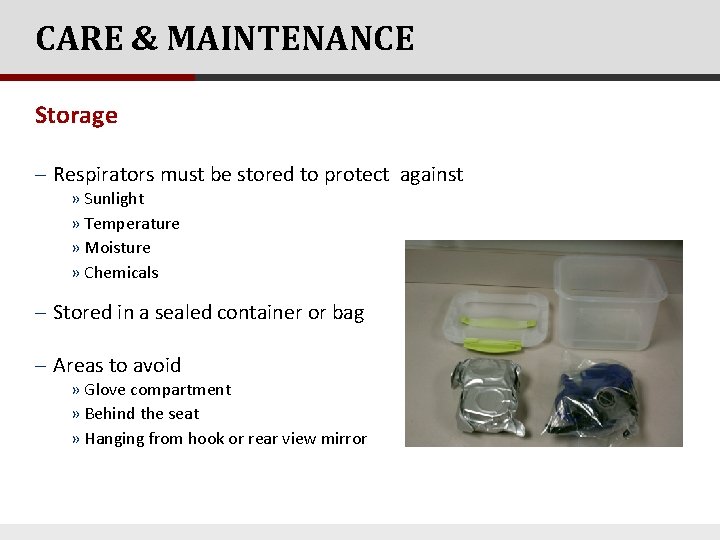
CARE & MAINTENANCE Storage - Respirators must be stored to protect against » Sunlight » Temperature » Moisture » Chemicals - Stored in a sealed container or bag - Areas to avoid » Glove compartment » Behind the seat » Hanging from hook or rear view mirror
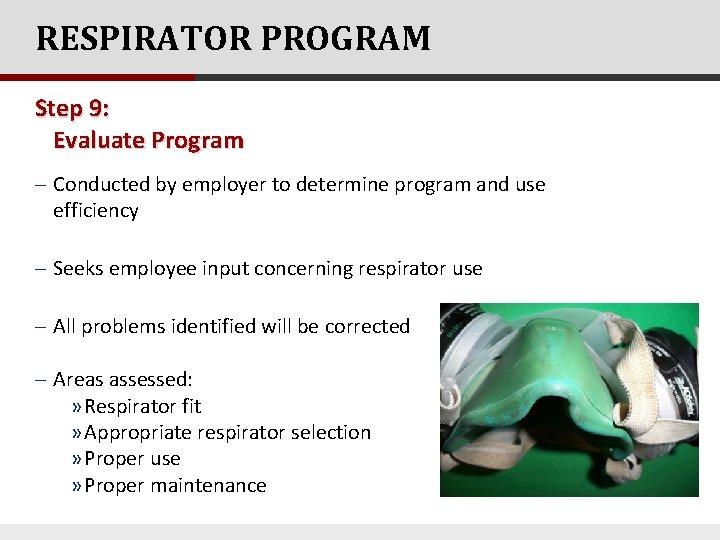
RESPIRATOR PROGRAM Step 9: Evaluate Program - Conducted by employer to determine program and use efficiency - Seeks employee input concerning respirator use - All problems identified will be corrected - Areas assessed: » Respirator fit » Appropriate respirator selection » Proper use » Proper maintenance
RESPIRATOR PROGRAM Step 10: Recordkeeping - Written Program - Medical Certifications - Fit Test Records - Training Records - Air monitoring records
ADDITIONAL POINTS - No facial hair may come in contact with respirator seal » If in doubt use a little flour - Always put respirator on in clean air environment - User seal check must be performed each time respirator is worn - Respirators are only effective when the seal around your nose and mouth is tight - Leave the contaminated atmosphere if any of the following occurs: » Smell or taste something out of the ordinary » Eyes or throat become irritated » Difficulty breathing, shortness of breath, chest pain » Dizziness, nausea, headache » Face piece is leaking or other parts break - What to do » Inspect respirator and cartridges » Inform management
REVIEW l Respirators should not be the first choice l Use engineering and/or administrative controls before using respirators l All users must have a medical evaluation and fit testing before use l Written Program » Must be worksite specific » Ties all the essential parts together l Have available sufficient number of respirator models and sizes l Establish cartridge change schedule l Train employees l Assistance » OSHA (e. Tool, Compliance Assistance Specialist, Consultation Service) » Pest. Sure (Linda) » Draeger Representative (Mike Allen)