
10 REPORTING AND ANALYZING LIABILITIES 10 1 Accounting
10 REPORTING AND ANALYZING LIABILITIES 10 -1 Accounting, Fifth Edition
Learning Objectives After studying this chapter, you should be able to: 1. Explain a current liability and identify the major types of current liabilities. * 2. Describe the accounting for notes payable. * 3. Explain the accounting for other current liabilities. 4. Identify the types of bonds. 5. Prepare the entries for the issuance of bonds and interest expense. 6. Describe the entries when bonds are redeemed. 7. Identify the requirements for the financial statement presentation and analysis of liabilities. * *Self-study topics 10 -2

Current Liabilities What is a Current Liability? Two key features: 1. Company expects to pay the debt from existing current assets or through the creation of other current liabilities. 2. Company will pay the debt within one year or the operating cycle, whichever is longer. Current liabilities include notes payable, accounts payable, unearned revenues, and accrued liabilities such as taxes, salaries and wages, and interest. 10 -3 LO 1 Explain a current liability and identify the major types of current liabilities.

Current Liabilities Question To be classified as a current liability, a debt must be expected to be paid: a. out of existing current assets. b. by creating other current liabilities. c. within 2 years. d. both (a) and (b). 10 -4 LO 1 Explain a current liability and identify the major types of current liabilities.
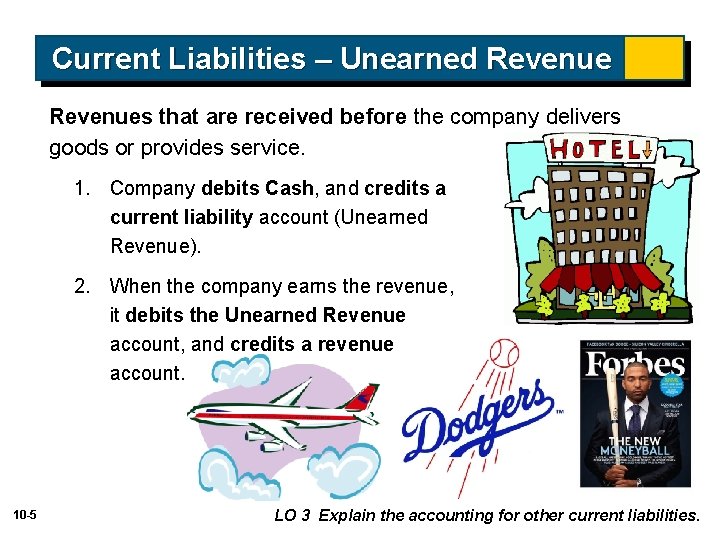
Current Liabilities – Unearned Revenues that are received before the company delivers goods or provides service. 1. Company debits Cash, and credits a current liability account (Unearned Revenue). 2. When the company earns the revenue, it debits the Unearned Revenue account, and credits a revenue account. 10 -5 LO 3 Explain the accounting for other current liabilities.
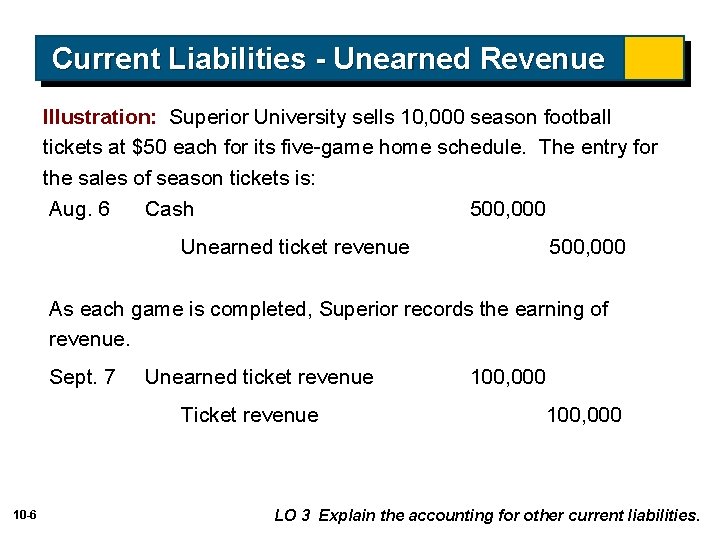
Current Liabilities - Unearned Revenue Illustration: Superior University sells 10, 000 season football tickets at $50 each for its five-game home schedule. The entry for the sales of season tickets is: Aug. 6 Cash 500, 000 Unearned ticket revenue 500, 000 As each game is completed, Superior records the earning of revenue. Sept. 7 Unearned ticket revenue Ticket revenue 10 -6 100, 000 LO 3 Explain the accounting for other current liabilities.
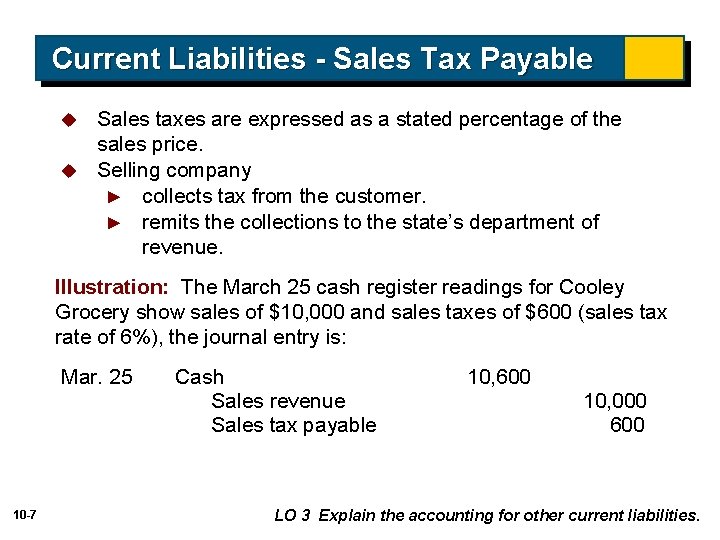
Current Liabilities - Sales Tax Payable Sales taxes are expressed as a stated percentage of the sales price. u Selling company ► collects tax from the customer. ► remits the collections to the state’s department of revenue. u Illustration: The March 25 cash register readings for Cooley Grocery show sales of $10, 000 and sales taxes of $600 (sales tax rate of 6%), the journal entry is: Mar. 25 10 -7 Cash Sales revenue Sales tax payable 10, 600 10, 000 600 LO 3 Explain the accounting for other current liabilities.
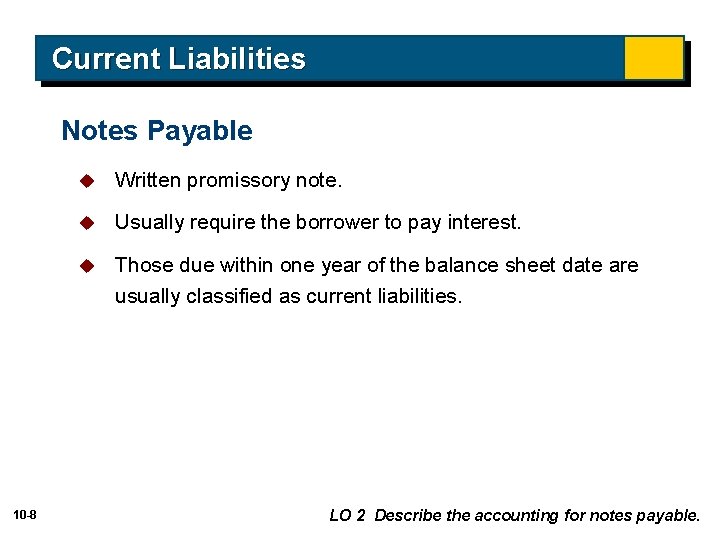
Current Liabilities Notes Payable 10 -8 u Written promissory note. u Usually require the borrower to pay interest. u Those due within one year of the balance sheet date are usually classified as current liabilities. LO 2 Describe the accounting for notes payable.
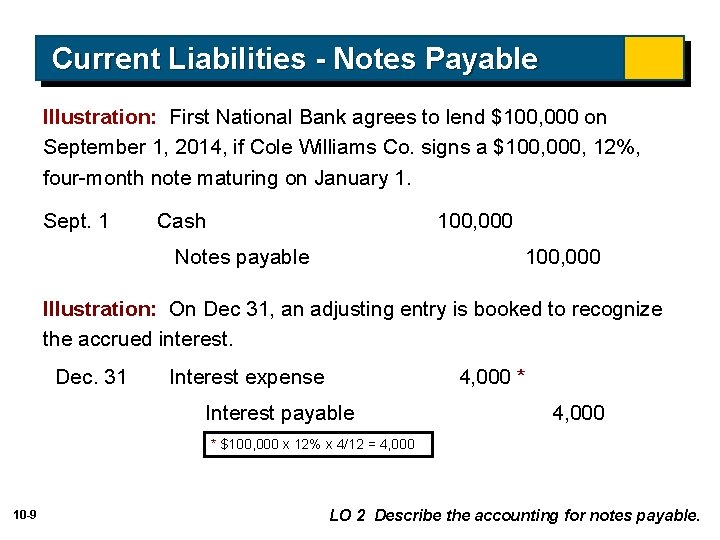
Current Liabilities - Notes Payable Illustration: First National Bank agrees to lend $100, 000 on September 1, 2014, if Cole Williams Co. signs a $100, 000, 12%, four-month note maturing on January 1. Sept. 1 Cash 100, 000 Notes payable 100, 000 Illustration: On Dec 31, an adjusting entry is booked to recognize the accrued interest. Dec. 31 Interest expense 4, 000 * Interest payable 4, 000 * $100, 000 x 12% x 4/12 = 4, 000 10 -9 LO 2 Describe the accounting for notes payable.
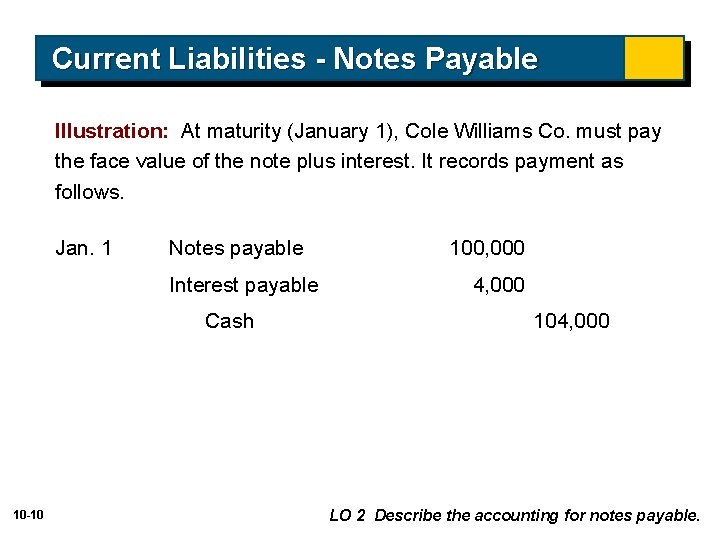
Current Liabilities - Notes Payable Illustration: At maturity (January 1), Cole Williams Co. must pay the face value of the note plus interest. It records payment as follows. Jan. 1 Notes payable Interest payable Cash 10 -10 100, 000 4, 000 104, 000 LO 2 Describe the accounting for notes payable.
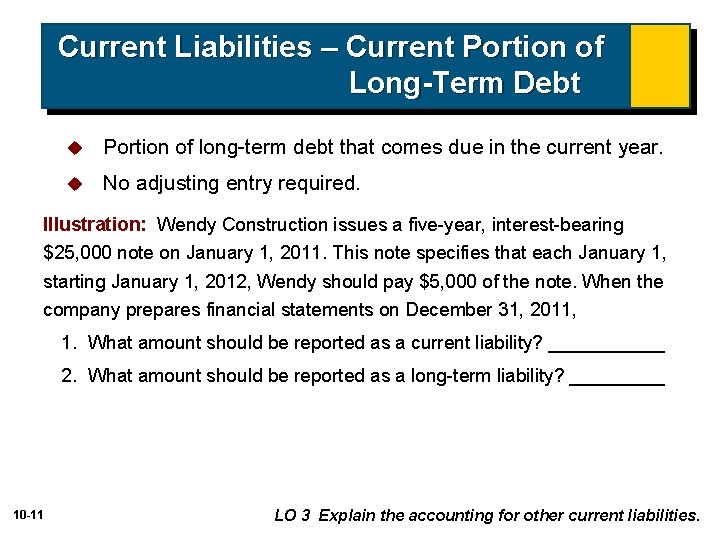
Current Liabilities – Current Portion of Long-Term Debt u Portion of long-term debt that comes due in the current year. u No adjusting entry required. Illustration: Wendy Construction issues a five-year, interest-bearing $25, 000 note on January 1, 2011. This note specifies that each January 1, starting January 1, 2012, Wendy should pay $5, 000 of the note. When the company prepares financial statements on December 31, 2011, 1. What amount should be reported as a current liability? ______ 2. What amount should be reported as a long-term liability? _____ 10 -11 LO 3 Explain the accounting for other current liabilities.
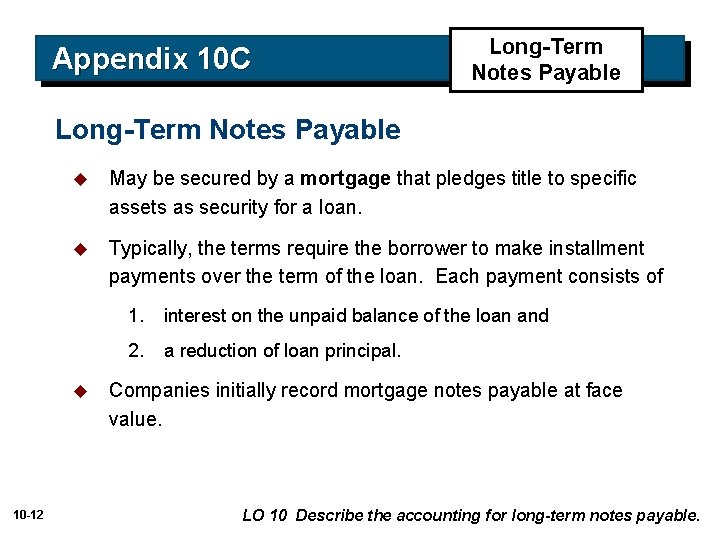
Appendix 10 C Long-Term Notes Payable u May be secured by a mortgage that pledges title to specific assets as security for a loan. u Typically, the terms require the borrower to make installment payments over the term of the loan. Each payment consists of u 10 -12 1. interest on the unpaid balance of the loan and 2. a reduction of loan principal. Companies initially record mortgage notes payable at face value. LO 10 Describe the accounting for long-term notes payable.
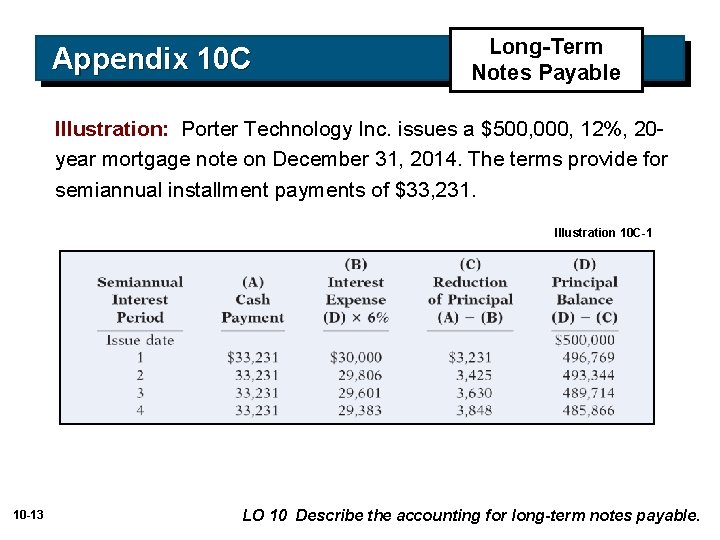
Appendix 10 C Long-Term Notes Payable Illustration: Porter Technology Inc. issues a $500, 000, 12%, 20 year mortgage note on December 31, 2014. The terms provide for semiannual installment payments of $33, 231. Illustration 10 C-1 10 -13 LO 10 Describe the accounting for long-term notes payable.
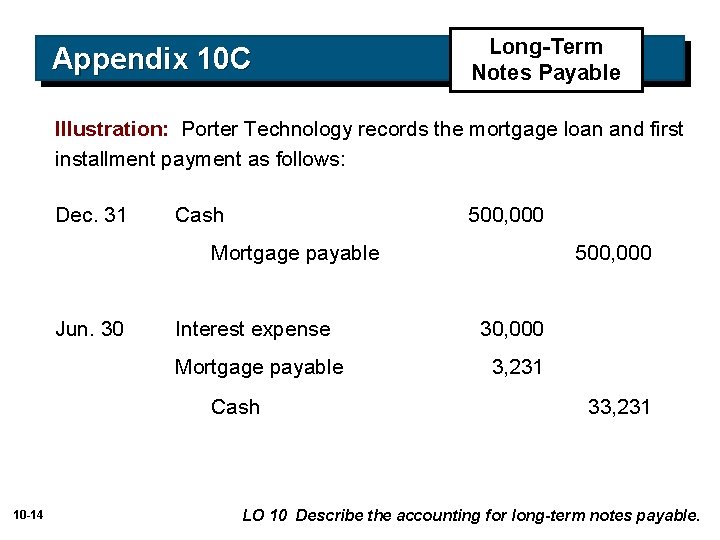
Appendix 10 C Long-Term Notes Payable Illustration: Porter Technology records the mortgage loan and first installment payment as follows: Dec. 31 Cash 500, 000 Mortgage payable Jun. 30 Interest expense Mortgage payable Cash 10 -14 500, 000 3, 231 33, 231 LO 10 Describe the accounting for long-term notes payable.
BE 10 -2, 3 & 4, p 542 10 -15
Current Liabilities – Payroll & Payroll Taxes Payable The term “payroll” pertains to both: Salaries - managerial, administrative, and sales personnel (monthly or yearly rate). Wages - store clerks, factory employees, and manual laborers (rate per hour). Determining the payroll involves computing three amounts: (1) gross earnings, (2) payroll deductions, and (3) net pay. 10 -16 LO 3 Explain the accounting for other current liabilities.
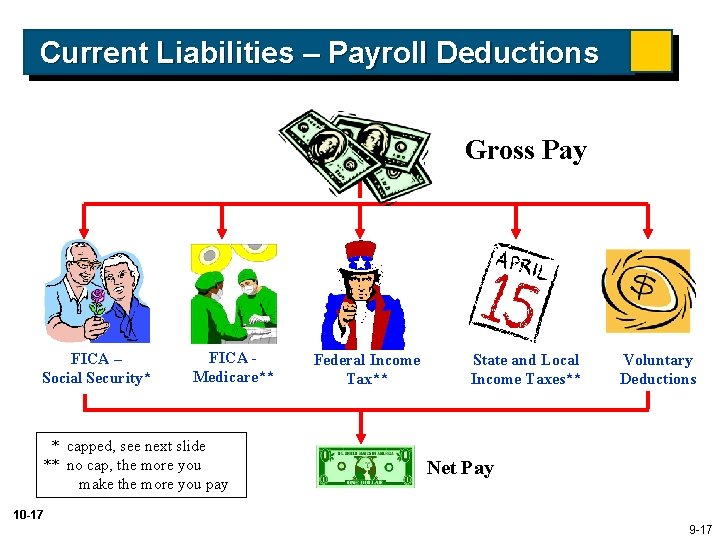
Current Liabilities – Payroll Deductions Gross Pay FICA – Social Security* FICA Medicare** * capped, see next slide ** no cap, the more you make the more you pay Federal Income Tax** State and Local Income Taxes** Voluntary Deductions Net Pay 10 -17 9 -17
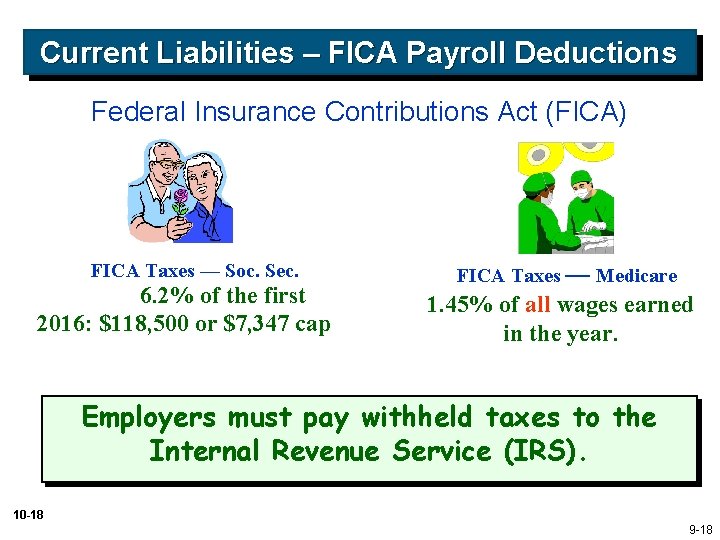
Current Liabilities – FICA Payroll Deductions Federal Insurance Contributions Act (FICA) FICA Taxes — Soc. Sec. 6. 2% of the first 2016: $118, 500 or $7, 347 cap FICA Taxes — Medicare 1. 45% of all wages earned in the year. Employers must pay withheld taxes to the Internal Revenue Service (IRS). 10 -18 9 -18
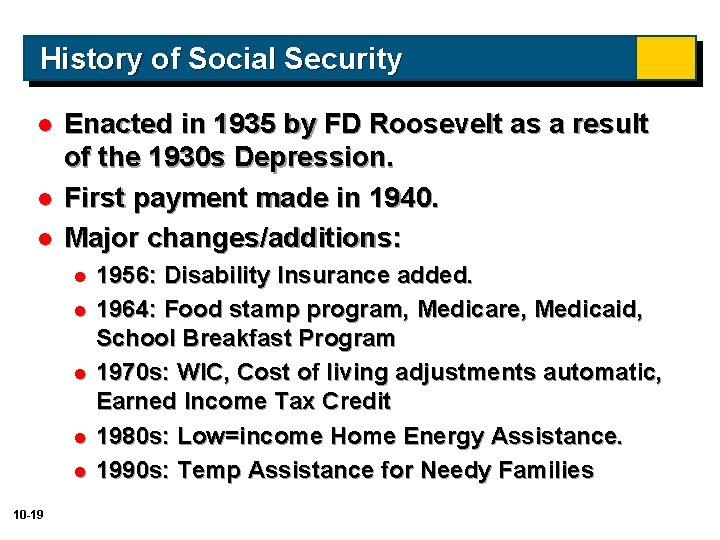
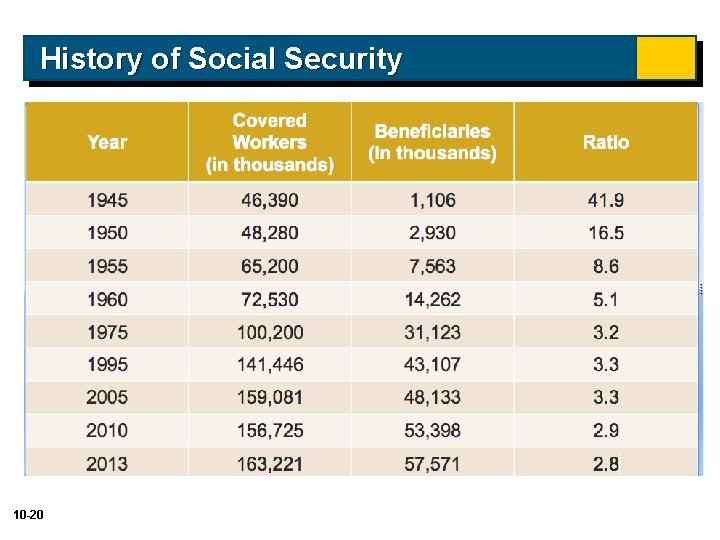
History of Social Security l l l Enacted in 1935 by FD Roosevelt as a result of the 1930 s Depression. First payment made in 1940. Major changes/additions: l l l 10 -19 1956: Disability Insurance added. 1964: Food stamp program, Medicare, Medicaid, School Breakfast Program 1970 s: WIC, Cost of living adjustments automatic, Earned Income Tax Credit 1980 s: Low=income Home Energy Assistance. 1990 s: Temp Assistance for Needy Families
History of Social Security 10 -20
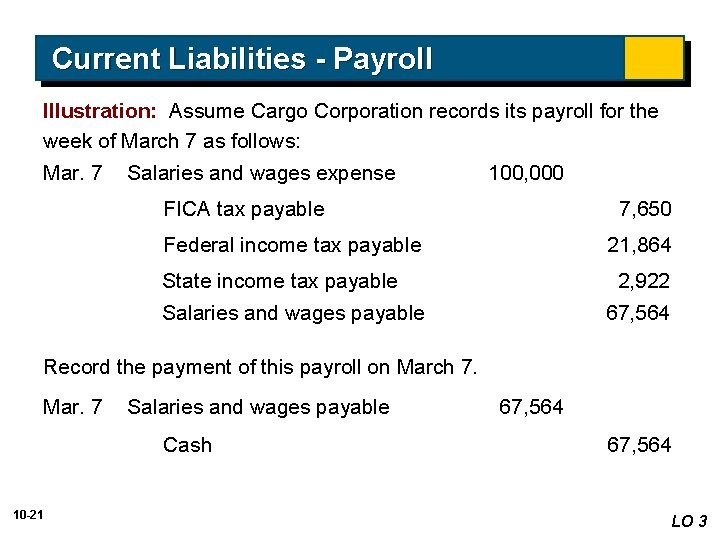
Current Liabilities - Payroll Illustration: Assume Cargo Corporation records its payroll for the week of March 7 as follows: Mar. 7 Salaries and wages expense 100, 000 FICA tax payable 7, 650 Federal income tax payable 21, 864 State income tax payable 2, 922 Salaries and wages payable 67, 564 Record the payment of this payroll on March 7. Mar. 7 Salaries and wages payable Cash 10 -21 67, 564 LO 3
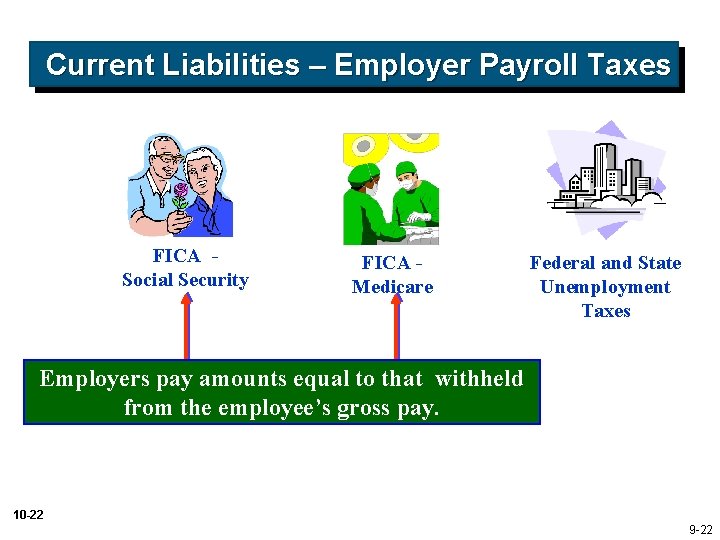
Current Liabilities – Employer Payroll Taxes FICA Social Security FICA Medicare Federal and State Unemployment Taxes Employers pay amounts equal to that withheld from the employee’s gross pay. 10 -22 9 -22

Current Liabilities – Payroll Taxes Payroll tax expense results from three taxes that governmental agencies levy on employers. These taxes are: FICA tax u Federal unemployment tax u State unemployment tax u Illustration: Based on Cargo Corp. ’s $100, 000 payroll, the company would record the employer’s expense and liability for these payroll taxes as follows. Payroll tax expense 13, 850 FICA tax payable State unemployment taxes payable Federal unemployment taxes payable 10 -23 7, 650 800 5, 400 LO 3 Explain the accounting for other current liabilities.
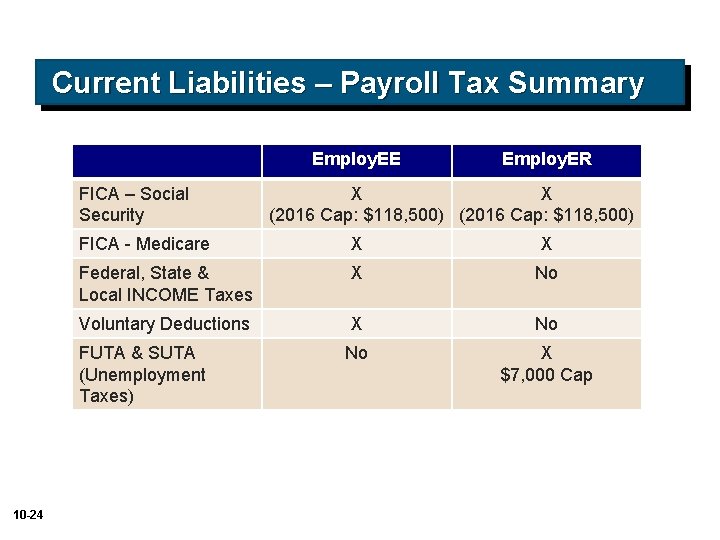
Current Liabilities – Payroll Tax Summary Employ. EE FICA – Social Security X X (2016 Cap: $118, 500) FICA - Medicare X X Federal, State & Local INCOME Taxes X No Voluntary Deductions X No No X $7, 000 Cap FUTA & SUTA (Unemployment Taxes) 10 -24 Employ. ER
BE 10 -5, 6 & 7, p 542 10 -25
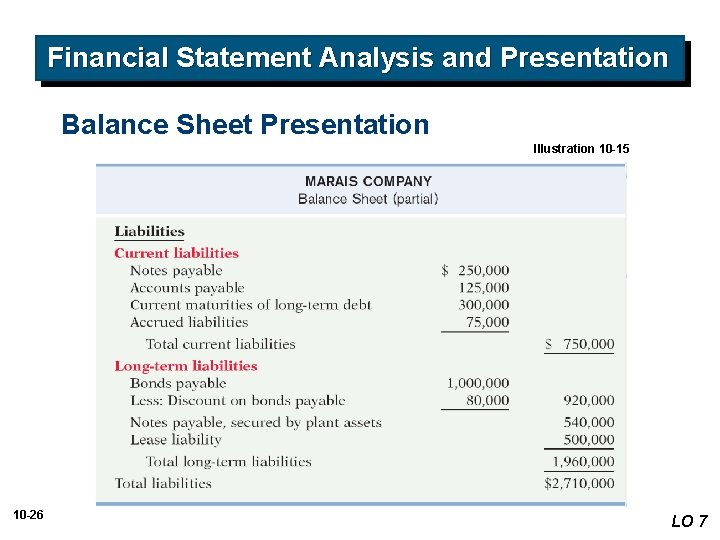
Financial Statement Analysis and Presentation Balance Sheet Presentation Illustration 10 -15 10 -26 LO 7
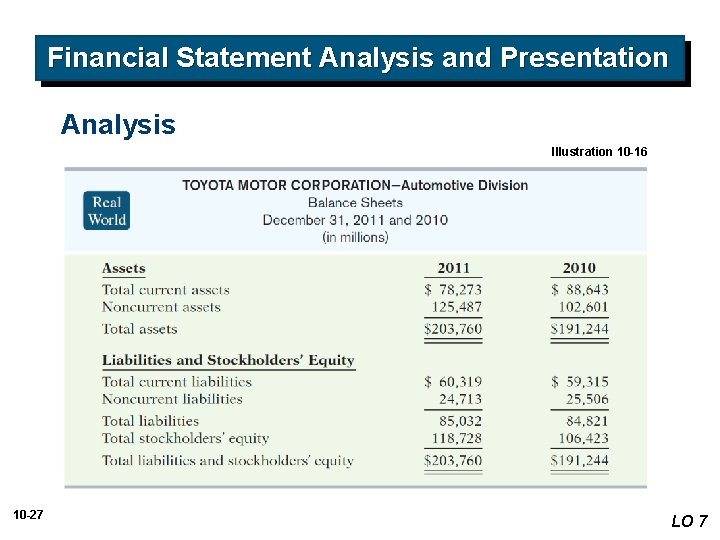
Financial Statement Analysis and Presentation Analysis Illustration 10 -16 10 -27 LO 7
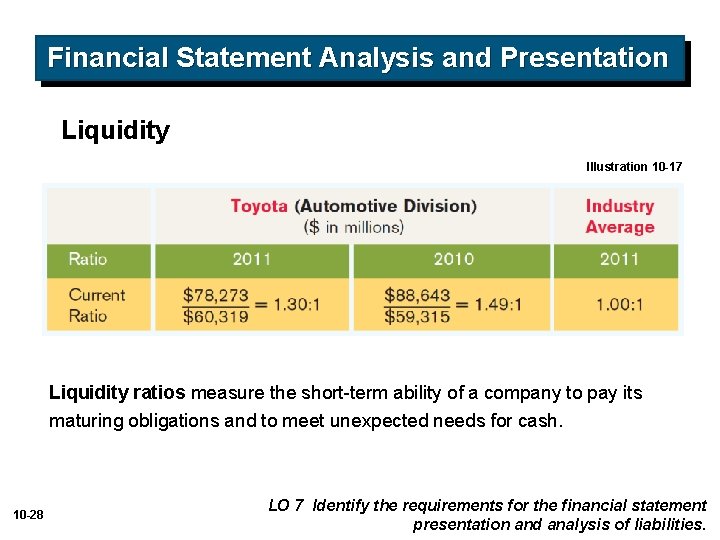
Financial Statement Analysis and Presentation Liquidity Illustration 10 -17 Liquidity ratios measure the short-term ability of a company to pay its maturing obligations and to meet unexpected needs for cash. 10 -28 LO 7 Identify the requirements for the financial statement presentation and analysis of liabilities.
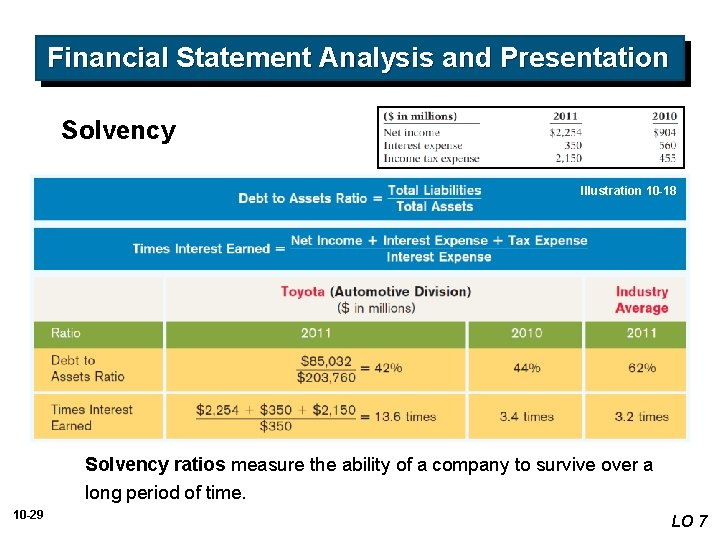
Financial Statement Analysis and Presentation Solvency Illustration 10 -18 Solvency ratios measure the ability of a company to survive over a long period of time. 10 -29 LO 7
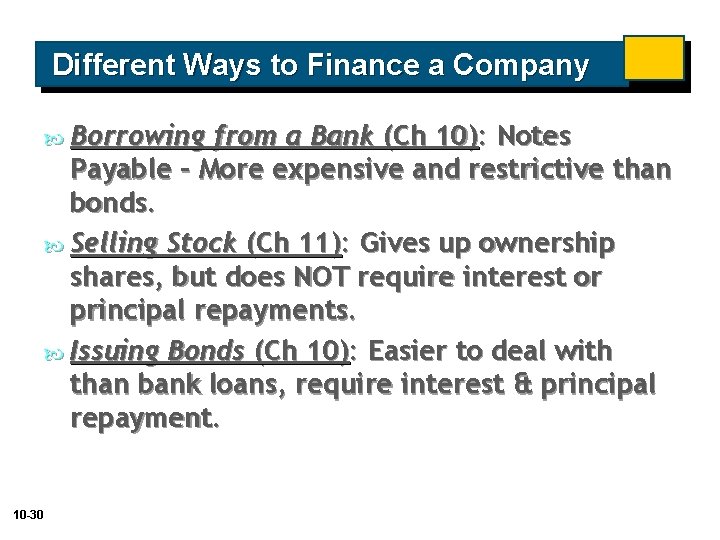
Different Ways to Finance a Company Borrowing from a Bank (Ch 10): Notes Payable – More expensive and restrictive than bonds. Selling Stock (Ch 11): Gives up ownership shares, but does NOT require interest or principal repayments. Issuing Bonds (Ch 10): Easier to deal with than bank loans, require interest & principal repayment. 10 -30
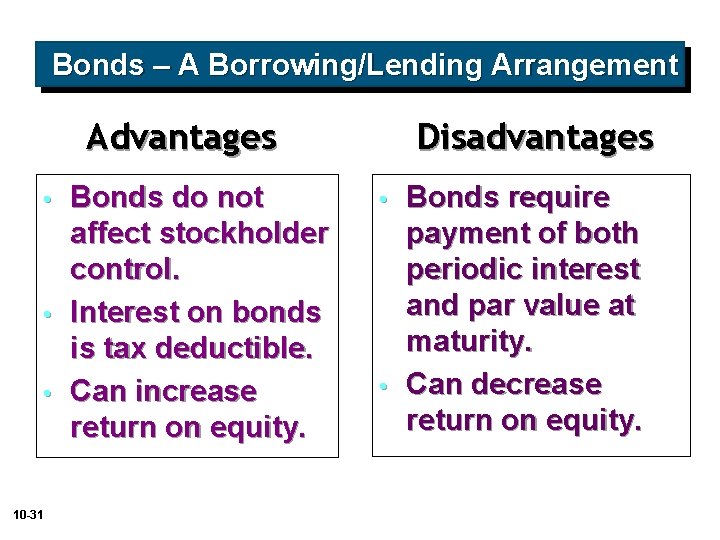
Bonds – A Borrowing/Lending Arrangement Advantages • • • 10 -31 Bonds do not affect stockholder control. Interest on bonds is tax deductible. Can increase return on equity. Disadvantages • • Bonds require payment of both periodic interest and par value at maturity. Can decrease return on equity.
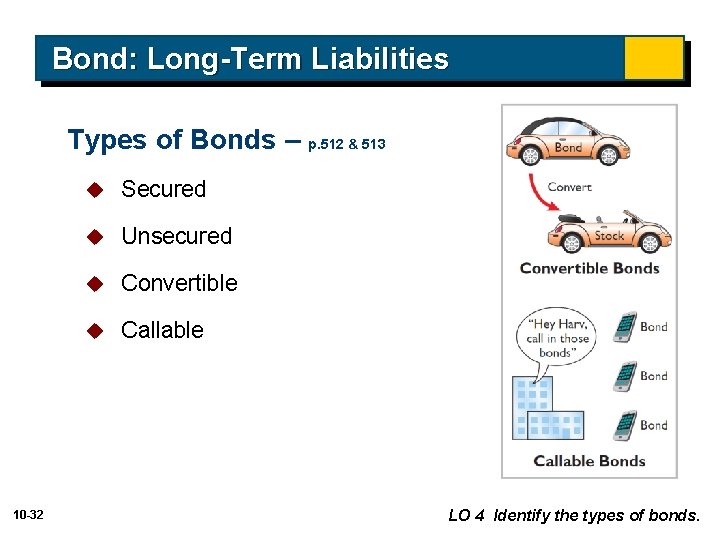
Bond: Long-Term Liabilities Types of Bonds – p. 512 & 513 10 -32 u Secured u Unsecured u Convertible u Callable LO 4 Identify the types of bonds.
Bond: Long-Term Liabilities Issuing Procedures u 10 -33 Bond certificate Alternative Terminology The contractual rate is often referred to as the stated rate. ► Issued to the investor. ► Provides name of the company issuing bonds, face value, maturity date, and contractual (stated) interest rate. u Face value - principal due at the maturity. u Maturity date - date final payment is due. u Contractual interest rate – rate to determine cash interest paid, generally semiannually. LO 4 Identify the types of bonds.
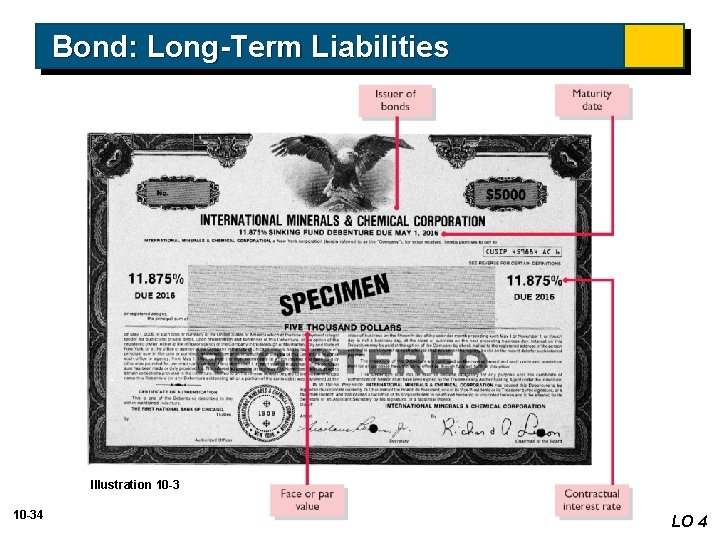
Bond: Long-Term Liabilities Illustration 10 -34 LO 4
Accounting for Bond Issues A corporation records bond transactions when it u issues or retires (buys back) bonds and u when bondholders convert bonds into common stock. Bonds may be issued at u face value, u below face value (discount), or u above face value (premium). Bond prices are quoted as a percentage of face value. 10 -35 LO 5 Prepare the entries for the issuance of bonds and interest expense.
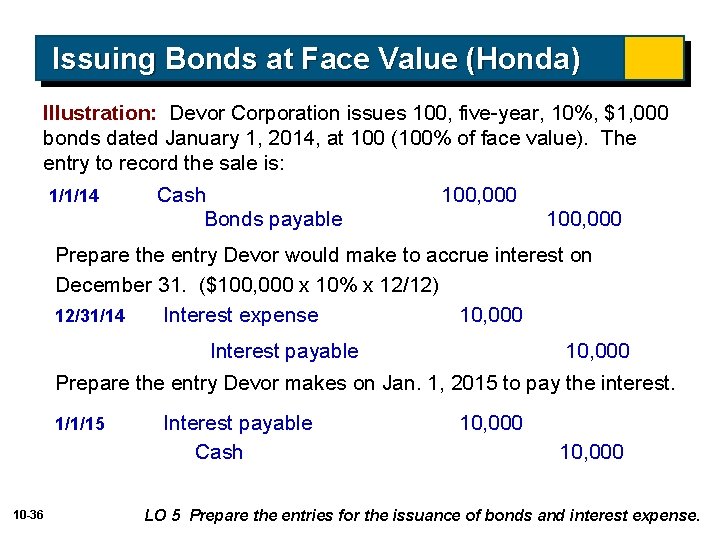
Issuing Bonds at Face Value (Honda) Illustration: Devor Corporation issues 100, five-year, 10%, $1, 000 bonds dated January 1, 2014, at 100 (100% of face value). The entry to record the sale is: 1/1/14 Cash Bonds payable 100, 000 Prepare the entry Devor would make to accrue interest on December 31. ($100, 000 x 10% x 12/12) 12/31/14 Interest expense 10, 000 Interest payable 10, 000 Prepare the entry Devor makes on Jan. 1, 2015 to pay the interest. 1/1/15 10 -36 Interest payable Cash 10, 000 LO 5 Prepare the entries for the issuance of bonds and interest expense.
Bond: Long-Term Liabilities Determining the Market Value of Bonds The current market price (present value) of a bond is a function of three factors: 1. the dollar amounts to be received, 2. the length of time until the amounts are received, and 3. the market rate of interest. The process of finding the present value is referred to as discounting the future amounts. 10 -37 LO 4 Identify the types of bonds.
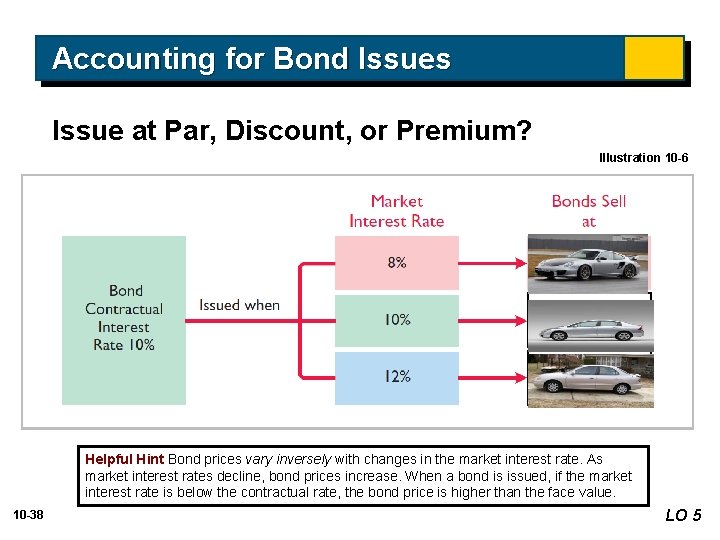
Accounting for Bond Issues Issue at Par, Discount, or Premium? Illustration 10 -6 Helpful Hint Bond prices vary inversely with changes in the market interest rate. As market interest rates decline, bond prices increase. When a bond is issued, if the market interest rate is below the contractual rate, the bond price is higher than the face value. 10 -38 LO 5
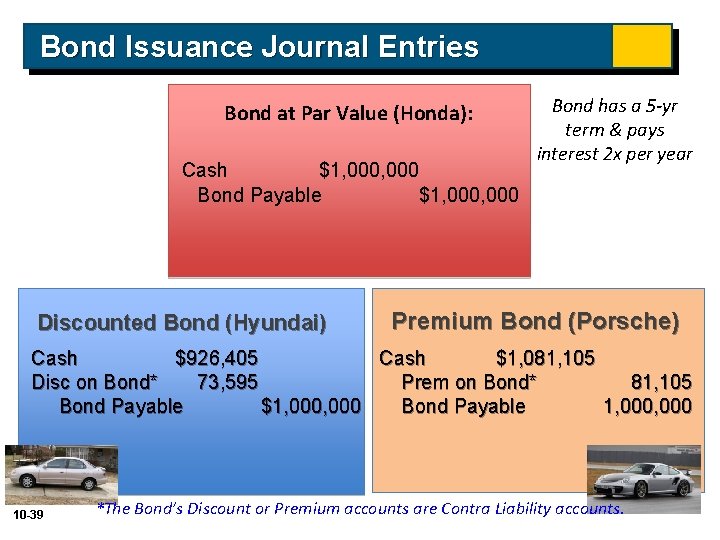
Bond Issuance Journal Entries Bond at Par Value (Honda): Cash $1, 000 Bond Payable $1, 000 Discounted Bond (Hyundai) Bond has a 5 -yr term & pays interest 2 x per year Premium Bond (Porsche) Cash $926, 405 Cash $1, 081, 105 Disc on Bond* 73, 595 Prem on Bond* 81, 105 Bond Payable $1, 000 Bond Payable 1, 000 10 -39 *The Bond’s Discount or Premium accounts are Contra Liability accounts.
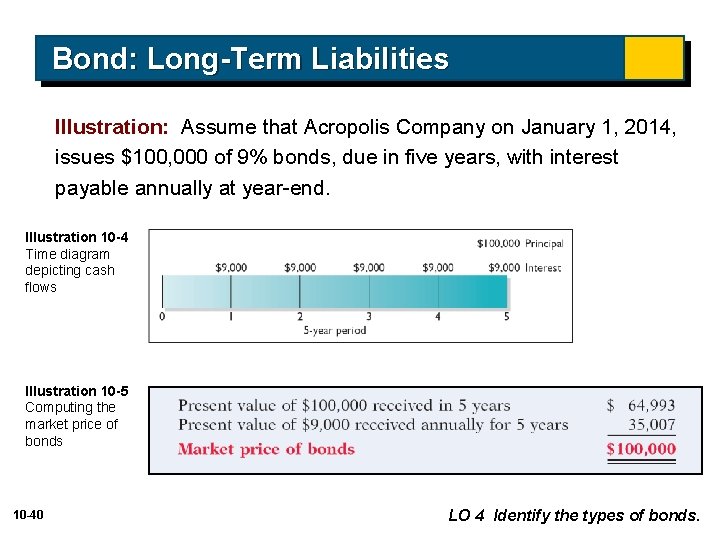
Bond: Long-Term Liabilities Illustration: Assume that Acropolis Company on January 1, 2014, issues $100, 000 of 9% bonds, due in five years, with interest payable annually at year-end. Illustration 10 -4 Time diagram depicting cash flows Illustration 10 -5 Computing the market price of bonds 10 -40 LO 4 Identify the types of bonds.
of Bond Basics of. Basics Bond Valuation The value of a bond investment is based on the SUM of ① Stream of interest payments made/received over the life of the bond Use the market rate interest and Table B 3. PLUS ② Single lump sum payment (par value) made at the bond’s maturity. Use the market rate interest and Table B 1. 10 -41
Components of Time Value Calculations PV – Present Value, what is it worth today? ② FV – Future Value, what is it worth in the future? ③ n – number of periods (i. e. months, quarter, year) ④ i – interest rate % earned for each n ① Must have 3 components to calculate the 4 th. 10 -42
Calculating the Present Value of a Bond Calculate the issue price of Rose Inc. bonds. • • Par Value = $1, 000 Issue Price = ? Stated Interest Rate = 10% (to determine interest payment) Market Interest Rate = 12% (to determine selling price) Interest Dates = 6/30 and 12/31 Bond Date = Jan. 1, 2015 Maturity Date = Dec. 31, 2019 (5 years) 10 -43
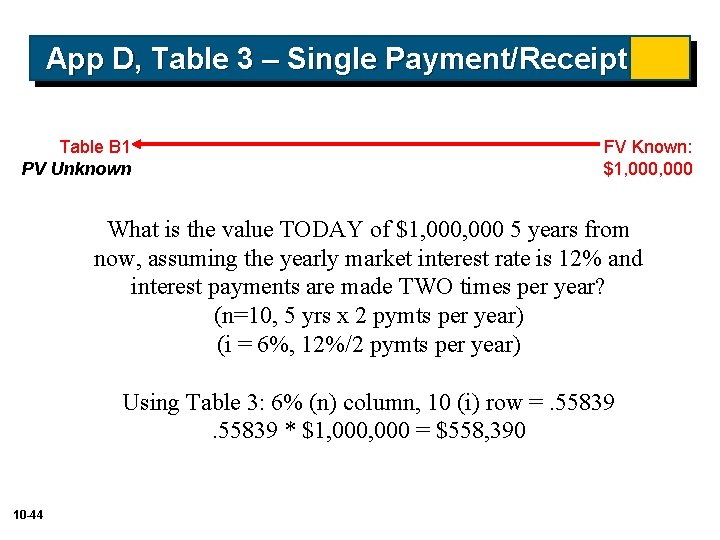
App D, Table 3 – Single Payment/Receipt Table B 1 PV Unknown FV Known: $1, 000 What is the value TODAY of $1, 000 5 years from now, assuming the yearly market interest rate is 12% and interest payments are made TWO times per year? (n=10, 5 yrs x 2 pymts per year) (i = 6%, 12%/2 pymts per year) Using Table 3: 6% (n) column, 10 (i) row =. 55839 * $1, 000 = $558, 390 10 -44
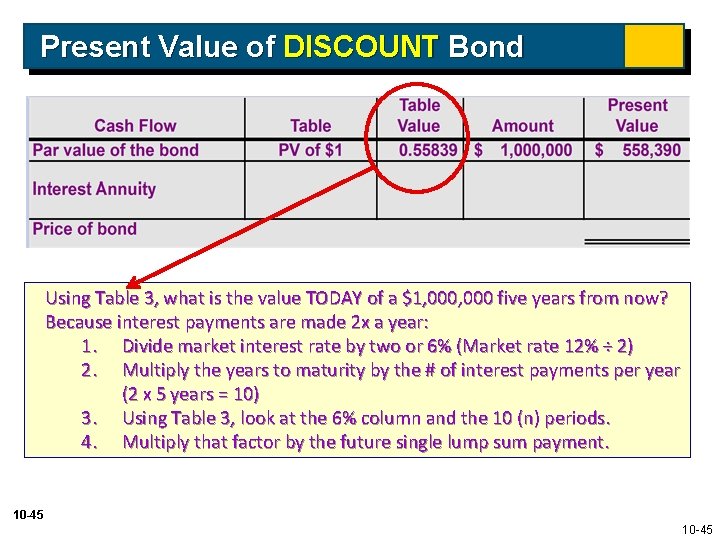
Present Value of DISCOUNT Bond Using Table 3, what is the value TODAY of a $1, 000 five years from now? Because interest payments are made 2 x a year: 1. Divide market interest rate by two or 6% (Market rate 12% ÷ 2) 2. Multiply the years to maturity by the # of interest payments per year (2 x 5 years = 10) 3. Using Table 3, look at the 6% column and the 10 (n) periods. 4. Multiply that factor by the future single lump sum payment. 10 -45
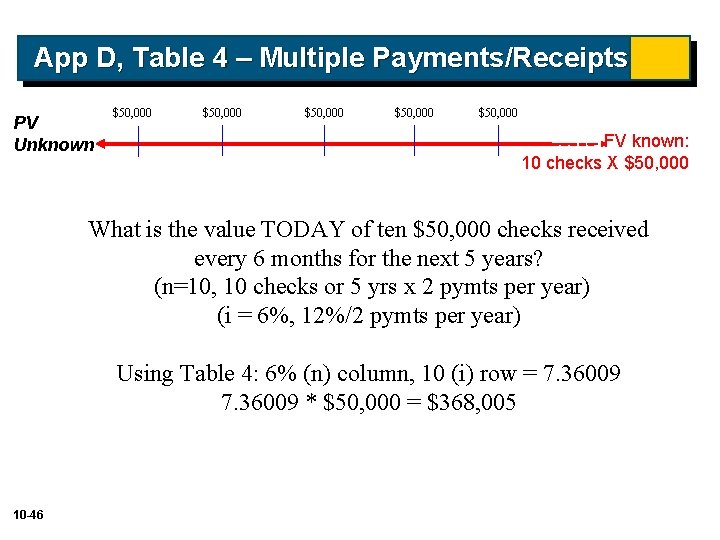
App D, Table 4 – Multiple Payments/Receipts PV Unknown $50, 000 $50, 000 FV known: 10 checks X $50, 000 What is the value TODAY of ten $50, 000 checks received every 6 months for the next 5 years? (n=10, 10 checks or 5 yrs x 2 pymts per year) (i = 6%, 12%/2 pymts per year) Using Table 4: 6% (n) column, 10 (i) row = 7. 36009 * $50, 000 = $368, 005 10 -46
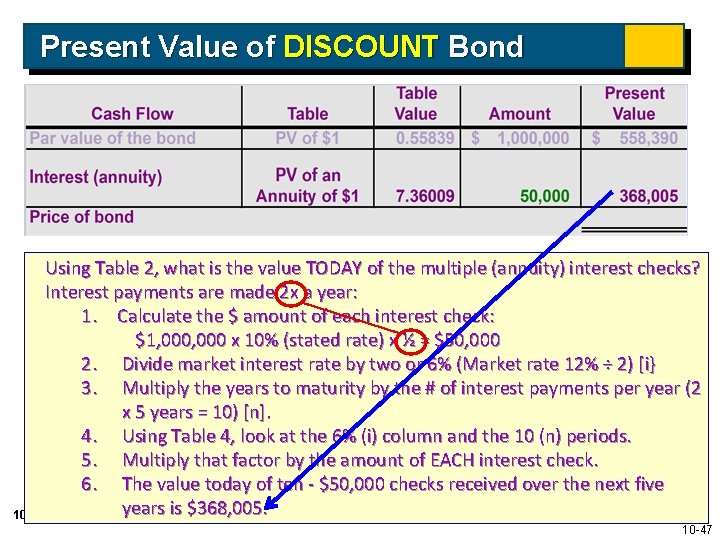
Present Value of DISCOUNT Bond Using Table 2, what is the value TODAY of the multiple (annuity) interest checks? Interest payments are made 2 x a year: 1. Calculate the $ amount of each interest check: $1, 000 x 10% (stated rate) x ½ = $50, 000 2. Divide market interest rate by two or 6% (Market rate 12% ÷ 2) [i} 3. Multiply the years to maturity by the # of interest payments per year (2 x 5 years = 10) [n]. 4. Using Table 4, look at the 6% (i) column and the 10 (n) periods. 5. Multiply that factor by the amount of EACH interest check. 6. The value today of ten - $50, 000 checks received over the next five years is $368, 005. 10 -47
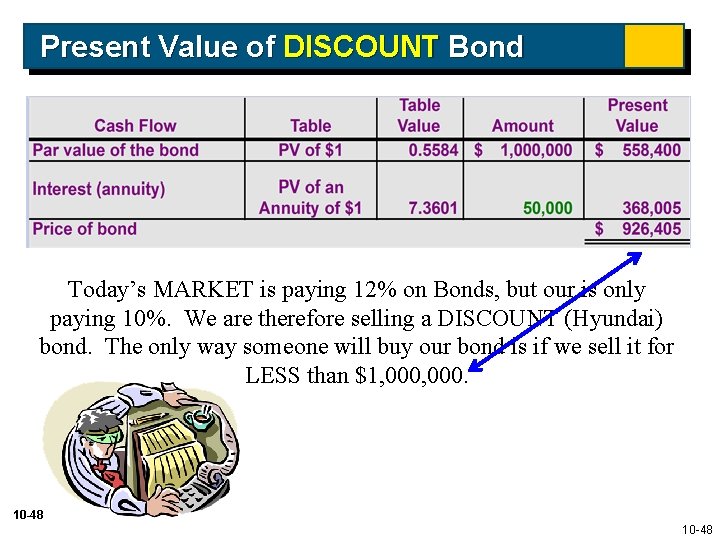
Present Value of DISCOUNT Bond Today’s MARKET is paying 12% on Bonds, but our is only paying 10%. We are therefore selling a DISCOUNT (Hyundai) bond. The only way someone will buy our bond is if we sell it for LESS than $1, 000. 10 -48
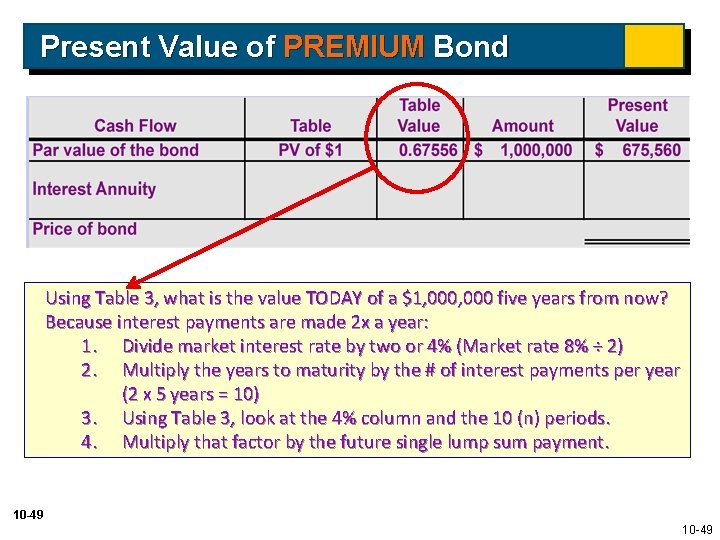
Present Value of PREMIUM Bond Using Table 3, what is the value TODAY of a $1, 000 five years from now? Because interest payments are made 2 x a year: 1. Divide market interest rate by two or 4% (Market rate 8% ÷ 2) 2. Multiply the years to maturity by the # of interest payments per year (2 x 5 years = 10) 3. Using Table 3, look at the 4% column and the 10 (n) periods. 4. Multiply that factor by the future single lump sum payment. 10 -49
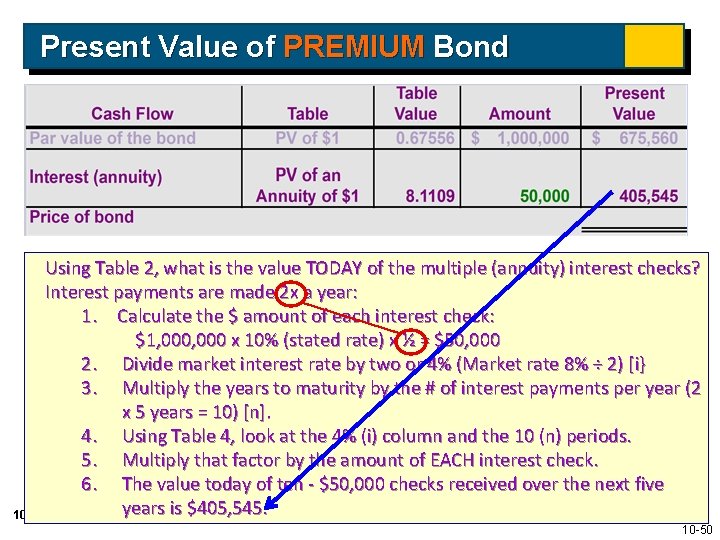
Present Value of PREMIUM Bond Using Table 2, what is the value TODAY of the multiple (annuity) interest checks? Interest payments are made 2 x a year: 1. Calculate the $ amount of each interest check: $1, 000 x 10% (stated rate) x ½ = $50, 000 2. Divide market interest rate by two or 4% (Market rate 8% ÷ 2) [i} 3. Multiply the years to maturity by the # of interest payments per year (2 x 5 years = 10) [n]. 4. Using Table 4, look at the 4% (i) column and the 10 (n) periods. 5. Multiply that factor by the amount of EACH interest check. 6. The value today of ten - $50, 000 checks received over the next five years is $405, 545. 10 -50
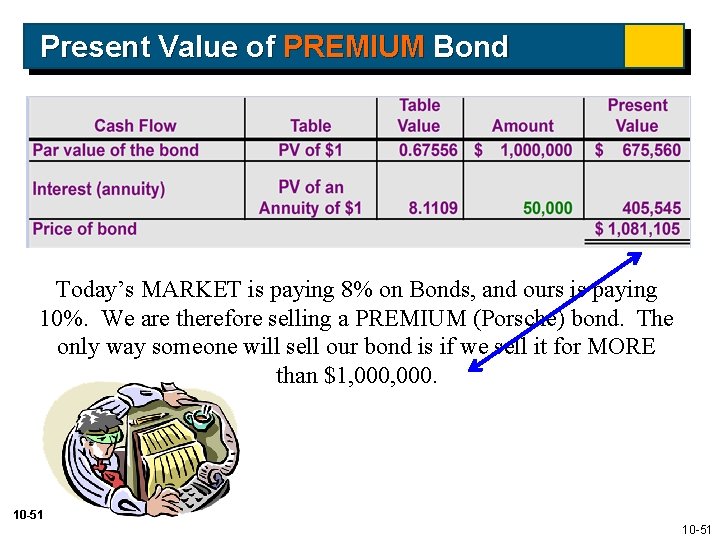
Present Value of PREMIUM Bond Today’s MARKET is paying 8% on Bonds, and ours is paying 10%. We are therefore selling a PREMIUM (Porsche) bond. The only way someone will sell our bond is if we sell it for MORE than $1, 000. 10 -51
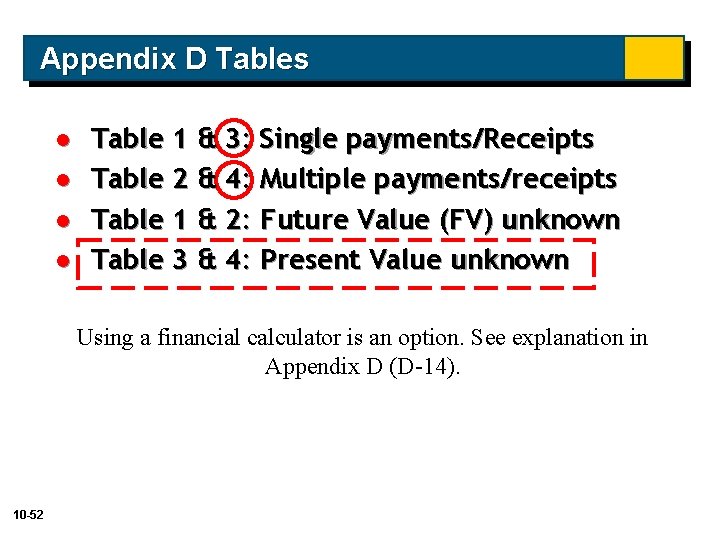
Appendix D Tables Appendix l l D Tables Table 1 & 3: Single payments/Receipts Table 2 & 4: Multiple payments/receipts Table 1 & 2: Future Value (FV) unknown Table 3 & 4: Present Value unknown Using a financial calculator is an option. See explanation in Appendix D (D-14). 10 -52
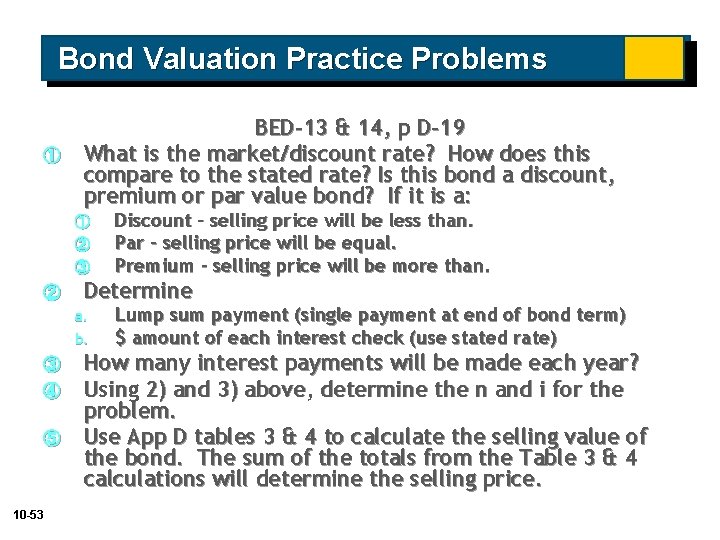
Bond Valuation Practice Problems ① BED-13 & 14, p D-19 What is the market/discount rate? How does this compare to the stated rate? Is this bond a discount, premium or par value bond? If it is a: ① ② ③ ② Determine a. b. ③ ④ ⑤ 10 -53 Discount – selling price will be less than. Par – selling price will be equal. Premium – selling price will be more than. Lump sum payment (single payment at end of bond term) $ amount of each interest check (use stated rate) How many interest payments will be made each year? Using 2) and 3) above, determine the n and i for the problem. Use App D tables 3 & 4 to calculate the selling value of the bond. The sum of the totals from the Table 3 & 4 calculations will determine the selling price.
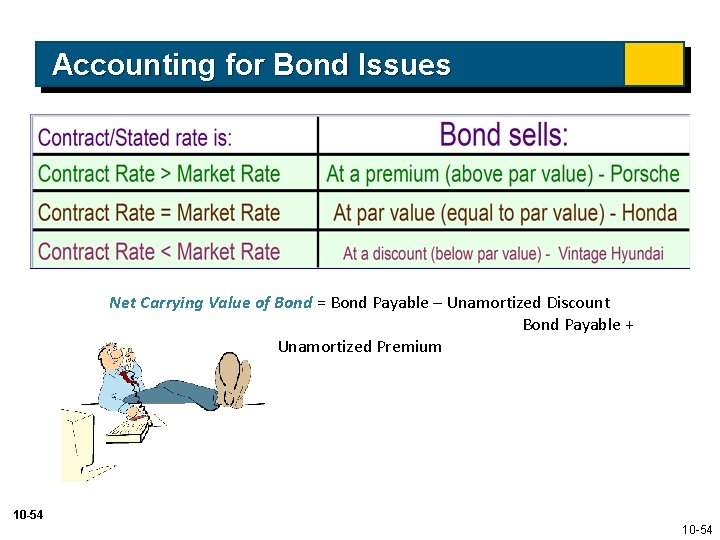
Accounting for Bond Issues Net Carrying Value of Bond = Bond Payable – Unamortized Discount Bond Payable + Unamortized Premium 10 -54
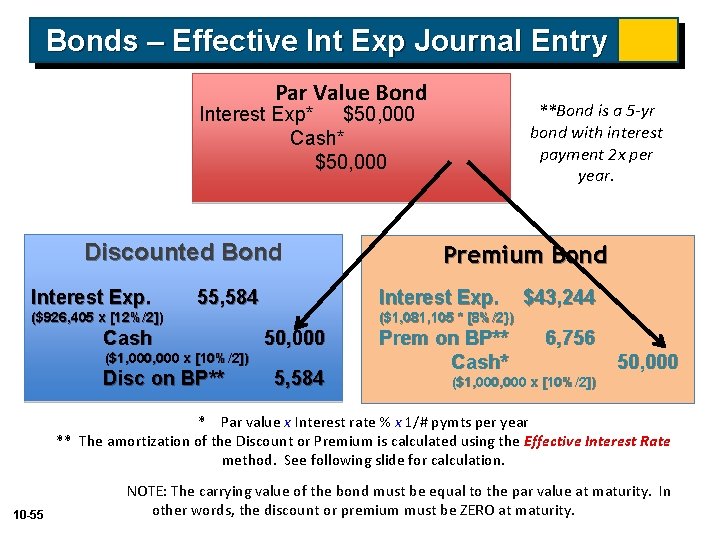
Bonds – Effective Int Exp Journal Entry Par Value Bond **Bond is a 5 -yr bond with interest payment 2 x per year. Interest Exp* $50, 000 Cash* $50, 000 Discounted Bond Interest Exp. 55, 584 Interest Exp. ($926, 405 x [12%/2]) Cash $43, 244 ($1, 081, 105 * [8%/2}) 50, 000 ($1, 000 x [10%/2]) Disc on BP** Premium Bond 5, 584 Prem on BP** Cash* 6, 756 50, 000 ($1, 000 x [10%/2]) * Par value x Interest rate % x 1/# pymts per year ** The amortization of the Discount or Premium is calculated using the Effective Interest Rate method. See following slide for calculation. 10 -55 NOTE: The carrying value of the bond must be equal to the par value at maturity. In other words, the discount or premium must be ZERO at maturity.
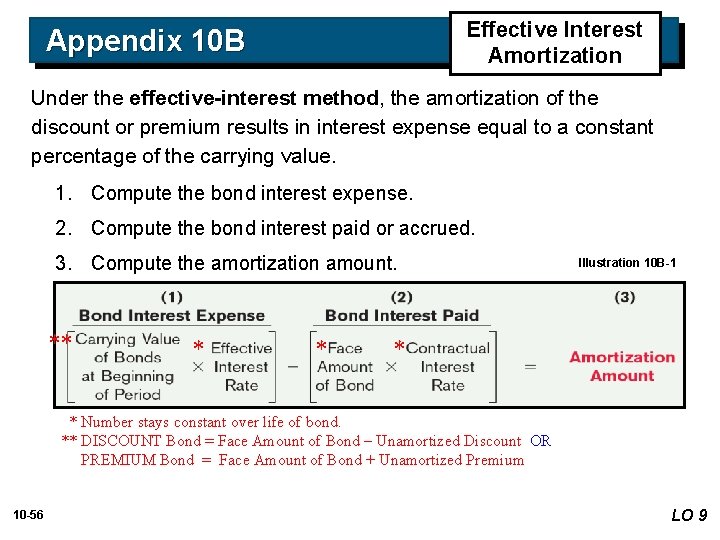
Effective Interest Amortization Appendix 10 B Under the effective-interest method, the amortization of the discount or premium results in interest expense equal to a constant percentage of the carrying value. 1. Compute the bond interest expense. 2. Compute the bond interest paid or accrued. 3. Compute the amortization amount. ** * * Illustration 10 B-1 * * Number stays constant over life of bond. ** DISCOUNT Bond = Face Amount of Bond – Unamortized Discount OR PREMIUM Bond = Face Amount of Bond + Unamortized Premium 10 -56 LO 9
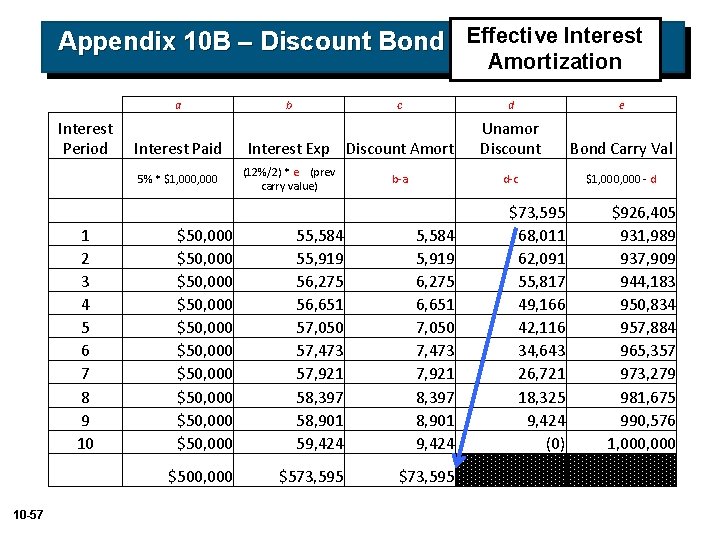
Appendix 10 B – Discount Bond Effective Interest Amortization a Interest Period Interest Paid 5% * $1, 000 1 2 3 4 5 6 7 8 9 10 10 -57 b c Interest Exp Discount Amort (12%/2) * e (prev carry value) b-a $50, 000 $50, 000 $50, 000 55, 584 55, 919 56, 275 56, 651 57, 050 57, 473 57, 921 58, 397 58, 901 59, 424 5, 584 5, 919 6, 275 6, 651 7, 050 7, 473 7, 921 8, 397 8, 901 9, 424 $500, 000 $573, 595 $73, 595 d e Unamor Discount Bond Carry Val d-c $1, 000 - d $73, 595 68, 011 62, 091 55, 817 49, 166 42, 116 34, 643 26, 721 18, 325 9, 424 (0) $926, 405 931, 989 937, 909 944, 183 950, 834 957, 884 965, 357 973, 279 981, 675 990, 576 1, 000
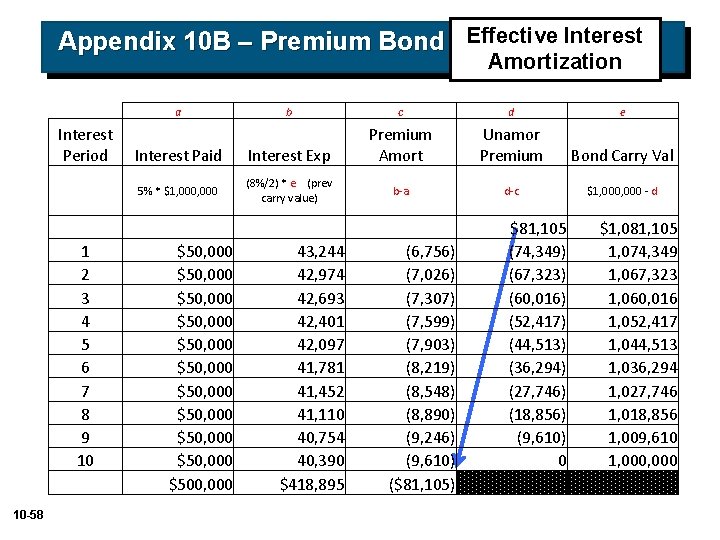
Appendix 10 B – Premium Bond Effective Interest Amortization a Interest Period 1 2 3 4 5 6 7 8 9 10 10 -58 b c d e Interest Paid Interest Exp Premium Amort Unamor Premium Bond Carry Val 5% * $1, 000 (8%/2) * e (prev carry value) b-a d-c $1, 000 - d $50, 000 $50, 000 $50, 000 $500, 000 43, 244 42, 974 42, 693 42, 401 42, 097 41, 781 41, 452 41, 110 40, 754 40, 390 $418, 895 (6, 756) (7, 026) (7, 307) (7, 599) (7, 903) (8, 219) (8, 548) (8, 890) (9, 246) (9, 610) ($81, 105) $81, 105 (74, 349) (67, 323) (60, 016) (52, 417) (44, 513) (36, 294) (27, 746) (18, 856) (9, 610) 0 $1, 081, 105 1, 074, 349 1, 067, 323 1, 060, 016 1, 052, 417 1, 044, 513 1, 036, 294 1, 027, 746 1, 018, 856 1, 009, 610 1, 000
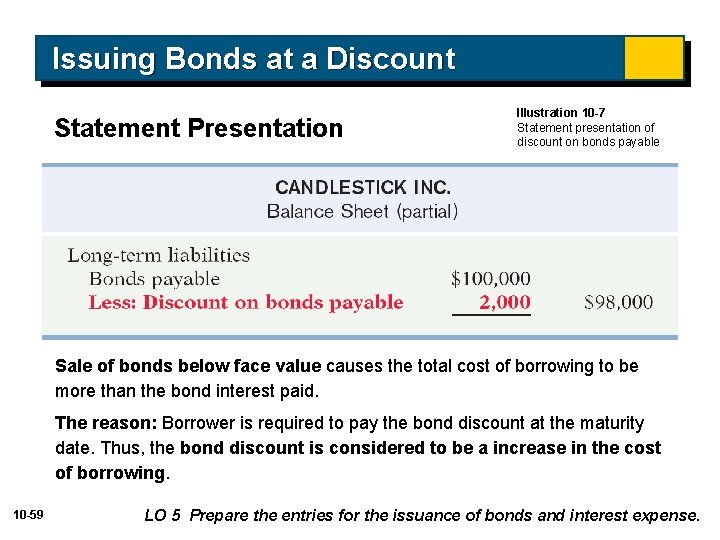
Issuing Bonds at a Discount Statement Presentation Illustration 10 -7 Statement presentation of discount on bonds payable Sale of bonds below face value causes the total cost of borrowing to be more than the bond interest paid. The reason: Borrower is required to pay the bond discount at the maturity date. Thus, the bond discount is considered to be a increase in the cost of borrowing. 10 -59 LO 5 Prepare the entries for the issuance of bonds and interest expense.
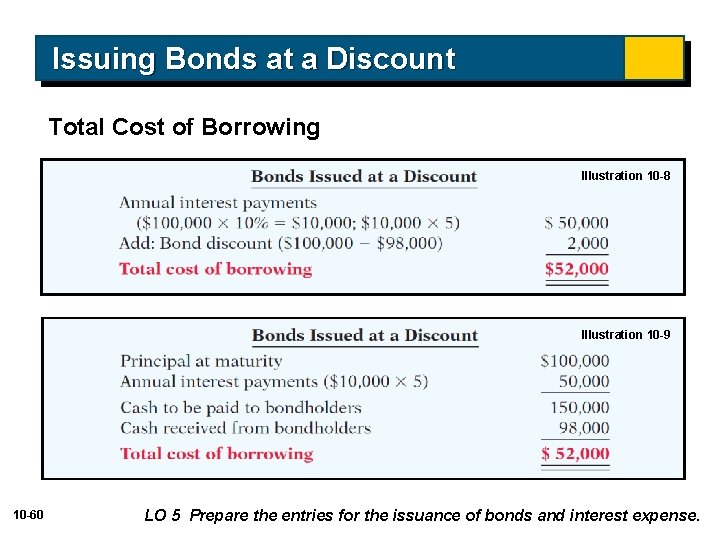
Issuing Bonds at a Discount Total Cost of Borrowing Illustration 10 -8 Illustration 10 -9 10 -60 LO 5 Prepare the entries for the issuance of bonds and interest expense.
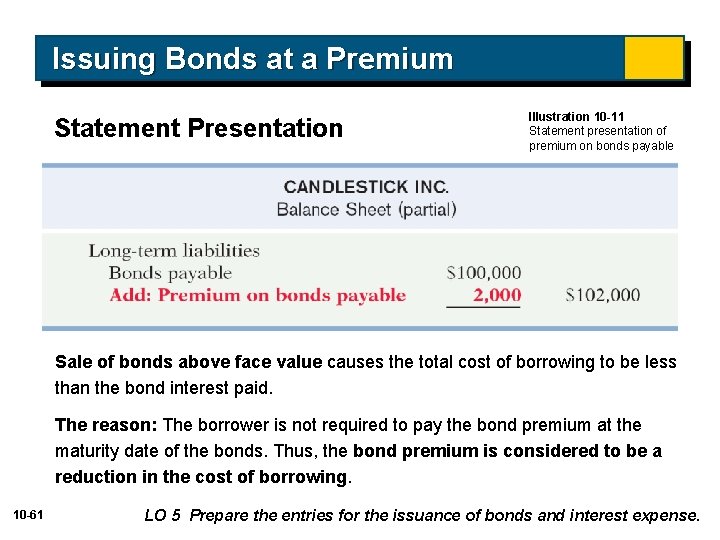
Issuing Bonds at a Premium Statement Presentation Illustration 10 -11 Statement presentation of premium on bonds payable Sale of bonds above face value causes the total cost of borrowing to be less than the bond interest paid. The reason: The borrower is not required to pay the bond premium at the maturity date of the bonds. Thus, the bond premium is considered to be a reduction in the cost of borrowing. 10 -61 LO 5 Prepare the entries for the issuance of bonds and interest expense.
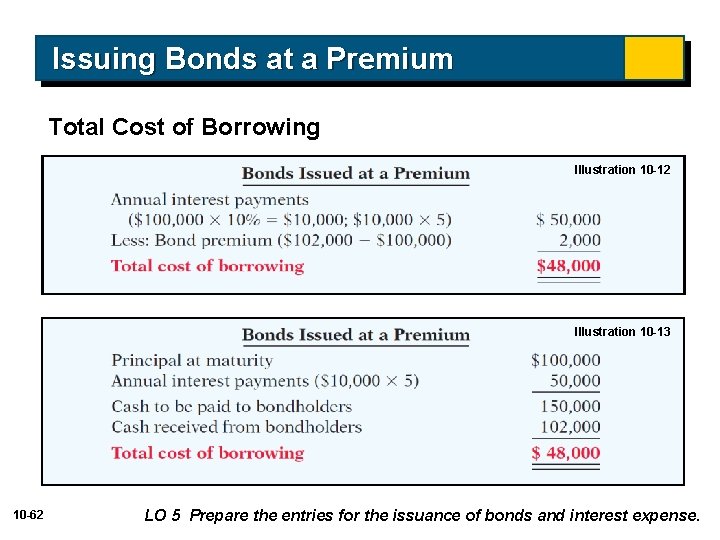
Issuing Bonds at a Premium Total Cost of Borrowing Illustration 10 -12 Illustration 10 -13 10 -62 LO 5 Prepare the entries for the issuance of bonds and interest expense.
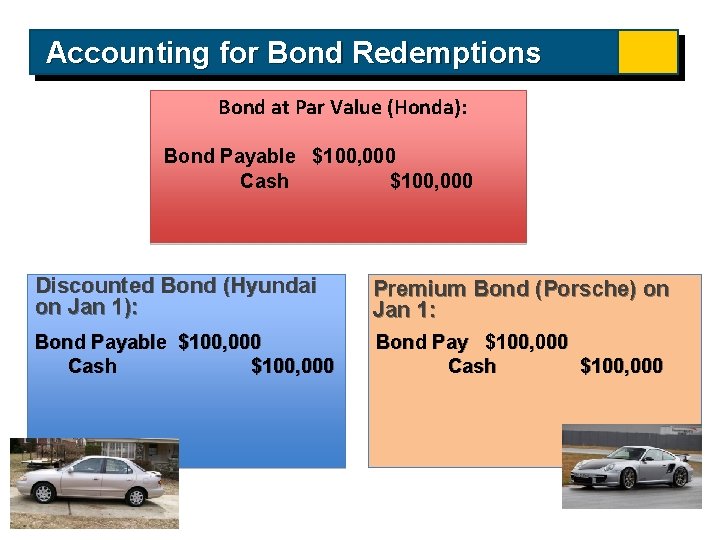
Accounting for Bond Redemptions Bond at Par Value (Honda): Bond Payable $100, 000 Cash $100, 000 Discounted Bond (Hyundai on Jan 1): Premium Bond (Porsche) on Jan 1: Bond Payable $100, 000 Cash $100, 000 Bond Pay $100, 000 Cash $100, 000 10 -63
- Slides: 63