
10 Middle Childhood Social and Emotional Development Copyright
- Slides: 24
10 Middle Childhood: Social and Emotional Development Copyright © 2016 Cengage Learning. All Rights Reserved. May not be scanned, copied or duplicated, or posted to a publicly accessible website, in whole or in part.
Theories of Social and Emotional Development in Middle Childhood Copyright © 2016 Cengage Learning. All Rights Reserved. May not be scanned, copied or duplicated, or posted to a publicly accessible website, in whole or in part. HDEV 4 | CH 10 2
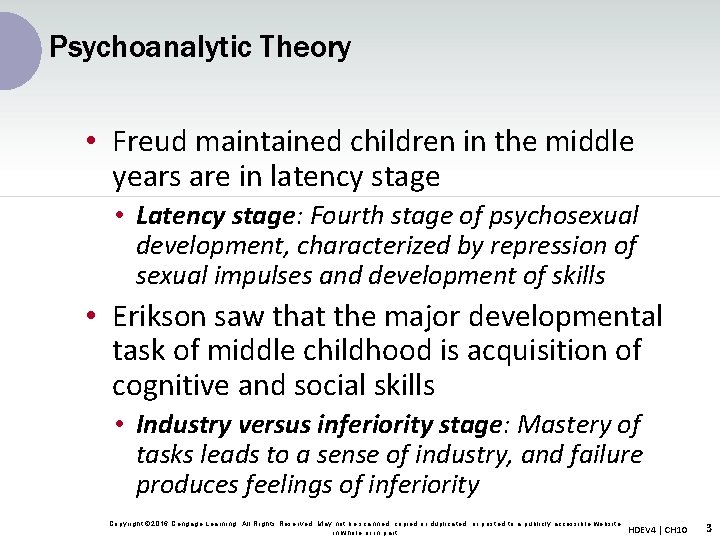
Psychoanalytic Theory • Freud maintained children in the middle years are in latency stage • Latency stage: Fourth stage of psychosexual development, characterized by repression of sexual impulses and development of skills • Erikson saw that the major developmental task of middle childhood is acquisition of cognitive and social skills • Industry versus inferiority stage: Mastery of tasks leads to a sense of industry, and failure produces feelings of inferiority Copyright © 2016 Cengage Learning. All Rights Reserved. May not be scanned, copied or duplicated, or posted to a publicly accessible website, in whole or in part. HDEV 4 | CH 10 3
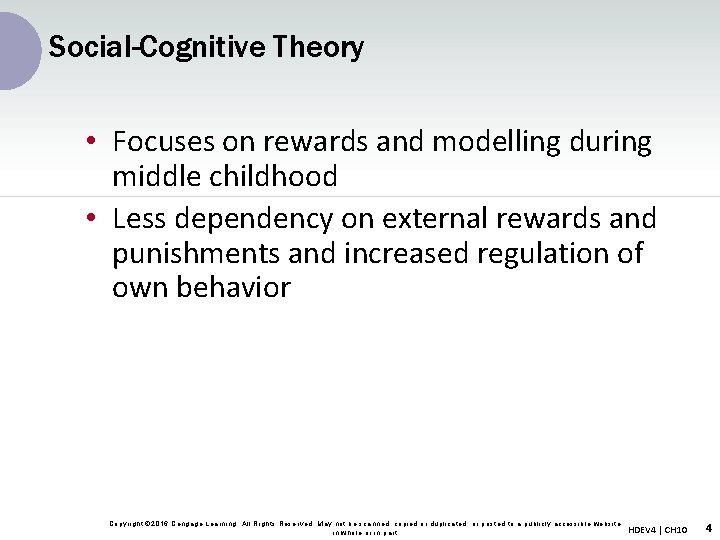
Social-Cognitive Theory • Focuses on rewards and modelling during middle childhood • Less dependency on external rewards and punishments and increased regulation of own behavior Copyright © 2016 Cengage Learning. All Rights Reserved. May not be scanned, copied or duplicated, or posted to a publicly accessible website, in whole or in part. HDEV 4 | CH 10 4
Cognitive-Developmental Theory and Social Cognition • According to Piaget, middle childhood coincides with the stage of concrete operations • Cognitive advance affects the child’s social relationships • Social cognition: Development of children’s understanding of the relationship between the self and others • Children with better perspective-taking skills have better peer relationships Copyright © 2016 Cengage Learning. All Rights Reserved. May not be scanned, copied or duplicated, or posted to a publicly accessible website, in whole or in part. HDEV 4 | CH 10 5
Development of the Self-Concept in Middle Childhood • Children’s self-concepts focus more on abstract internal or personality traits • Nine year-olds focus on physical traits, such as eye color, in self-definition • 11 -year-olds try to build their self-esteem by focusing on their talents - Show concern for psychological traits and social relationships Copyright © 2016 Cengage Learning. All Rights Reserved. May not be scanned, copied or duplicated, or posted to a publicly accessible website, in whole or in part. HDEV 4 | CH 10 6
Self-Esteem • Evaluation of self-worth in multiple areas as children age • Declines through childhood and increases again in adolescence • Children with an ideal self-image tend to have parents who are restrictive, involved, and loving • Social acceptance by peers is related to selfperceived competence of the child in academics, social, and athletic fields Copyright © 2016 Cengage Learning. All Rights Reserved. May not be scanned, copied or duplicated, or posted to a publicly accessible website, in whole or in part. HDEV 4 | CH 10 7
Learned Helplessness • Acquired belief that one is unable to control one’s environment • Helpless children believe that success is due more to ability than effort • They have little ability in a particular area Copyright © 2016 Cengage Learning. All Rights Reserved. May not be scanned, copied or duplicated, or posted to a publicly accessible website, in whole or in part. HDEV 4 | CH 10 8
The Family Copyright © 2016 Cengage Learning. All Rights Reserved. May not be scanned, copied or duplicated, or posted to a publicly accessible website, in whole or in part. HDEV 4 | CH 10 9
Parent-Child Relationships • Coregulation: Gradual transfer of control from parent to child beginning in middle childhood • Children and parents spend less time together in middle childhood than in the preschool years • Mothers’ interactions - Caregiving • Father’s interactions - Recreation Copyright © 2016 Cengage Learning. All Rights Reserved. May not be scanned, copied or duplicated, or posted to a publicly accessible website, in whole or in part. HDEV 4 | CH 10 10
Lesbian and Gay Parents • Psychological adjustment of children growing up with gay parents is similar to that of heterosexual parents • Have sustainable positive relationships • Sexual orientation of children not influenced by those of lesbian or gay parents Copyright © 2016 Cengage Learning. All Rights Reserved. May not be scanned, copied or duplicated, or posted to a publicly accessible website, in whole or in part. HDEV 4 | CH 10 11
Children Whose Parents Get Divorced • Unable to enjoy or do daily activities, such as eating with both the parents • Most live with their mothers • Less paternal attention may affect children’s self-esteem level • Children may have behavior problems Copyright © 2016 Cengage Learning. All Rights Reserved. May not be scanned, copied or duplicated, or posted to a publicly accessible website, in whole or in part. HDEV 4 | CH 10 12
Life in Stepfamilies • The Good, the Bad, and the Ugly Copyright © 2016 Cengage Learning. All Rights Reserved. May not be scanned, copied or duplicated, or posted to a publicly accessible website, in whole or in part. HDEV 4 | CH 10 13
Continuity of Marriages for the Sake of Children • Effects of severe parental bickering are same as when parents are divorced or separated • Children exposed to adult or marital conflict display alarm reaction • Heart rate, blood pressure, and sweating rise sharply • Divorce may be a positive alternative to family conflict Copyright © 2016 Cengage Learning. All Rights Reserved. May not be scanned, copied or duplicated, or posted to a publicly accessible website, in whole or in part. HDEV 4 | CH 10 14
The Effects of Maternal Employment on Children • Nearly 3 out of 4 married mothers of children under 18 are employed • Benefits of maternal employment • Daughters of employed women are more achievement oriented and set higher career goals for themselves • Children of working mothers tend to be more prosocial, less anxious, and flexible in their gender role stereotypes Copyright © 2016 Cengage Learning. All Rights Reserved. May not be scanned, copied or duplicated, or posted to a publicly accessible website, in whole or in part. HDEV 4 | CH 10 15
Peer Relationships Copyright © 2016 Cengage Learning. All Rights Reserved. May not be scanned, copied or duplicated, or posted to a publicly accessible website, in whole or in part. HDEV 4 | CH 10 16
Peers as Socialization Influences • Peers are more important during middle childhood • Share similar interests and skills that reflect the child’s generation • Help in cooperating, relating to leaders, and coping with aggressive impulses • Important confidants • Instil a feeling that they are normal and not alone Copyright © 2016 Cengage Learning. All Rights Reserved. May not be scanned, copied or duplicated, or posted to a publicly accessible website, in whole or in part. HDEV 4 | CH 10 17
Peer Acceptance and Rejection • Popular children tend to be attractive, good at academics or sports, mature for their age • Friendly, nurturant, skilful, and have high selfesteem • Children who are aggressive are rejected by their peers • Rejected children tend to remain on the fringes of the group instead of conforming Copyright © 2016 Cengage Learning. All Rights Reserved. May not be scanned, copied or duplicated, or posted to a publicly accessible website, in whole or in part. HDEV 4 | CH 10 18
Development of Friendships • Friendship based on geographical proximity in pre-school • Between 8 and 11 years of age, children focus on meeting each other’s needs and share interests • Friends behave differently with each other than with acquaintances • Middle childhood • Children’s friendships are almost exclusively with others of the same gender Copyright © 2016 Cengage Learning. All Rights Reserved. May not be scanned, copied or duplicated, or posted to a publicly accessible website, in whole or in part. HDEV 4 | CH 10 19
Sexism • Discrimination or bias against people based on their gender • Girls • Often treated unequally by their teachers, male peers, and the school curriculum • Often are overlooked for careers in STEM • May be subject to sexual harassment from male classmates • Boys often dominate classroom communication Copyright © 2016 Cengage Learning. All Rights Reserved. May not be scanned, copied or duplicated, or posted to a publicly accessible website, in whole or in part. HDEV 4 | CH 10 20
Social and Emotional Problems Copyright © 2016 Cengage Learning. All Rights Reserved. May not be scanned, copied or duplicated, or posted to a publicly accessible website, in whole or in part. HDEV 4 | CH 10 21
Childhood depression q Depressed children underutilize serotonin Serotonin: Neurotransmitter involved in mood disorders • Child feels sad, may show poor appetite, insomnia, lack of energy, and inactivity • Feeling of hopelessness and suicide • Often not recognized until the age of seven Copyright © 2016 Cengage Learning. All Rights Reserved. May not be scanned, copied or duplicated, or posted to a publicly accessible website, in whole or in part. HDEV 4 | CH 10 22
Childhood Depression (continued 1) • Often Perceived low levels of competence • Often problems in academics, socializing, physical appearance, and sports • Attributional styles may add to the feeling of hopelessness • Attributional style: Blaming oneself or others for outcomes Copyright © 2016 Cengage Learning. All Rights Reserved. May not be scanned, copied or duplicated, or posted to a publicly accessible website, in whole or in part. HDEV 4 | CH 10 23
Childhood Anxiety • Anxiety disorders and depression are often combined in children • Generalized anxiety disorder (GAD) • Anxiety appears to be present continuously and is unrelated to the situation • Separation anxiety disorder (SAD) • Show anxiety when separated from loved ones • Diagnosed when it is persistent and inappropriate for the child’s growth Copyright © 2016 Cengage Learning. All Rights Reserved. May not be scanned, copied or duplicated, or posted to a publicly accessible website, in whole or in part. HDEV 4 | CH 10 24