
10 Keys to a Productive Special Education Partnership
- Slides: 24
10 Keys to a Productive Special Education Partnership Insert parent and district trainer names, degrees, district/organization affiliations here
Ground Rules � Our focus is on general concepts that apply to all participants � We encourage questions & examples that can help clarify the concepts for all parents � We encourage you to contact us if you have personalized questions about your child’s needs and program Insert parent and district trainer contact information here
Who Are We? �Parent Trainer: Add name and photo �District Trainer: Add name and photo
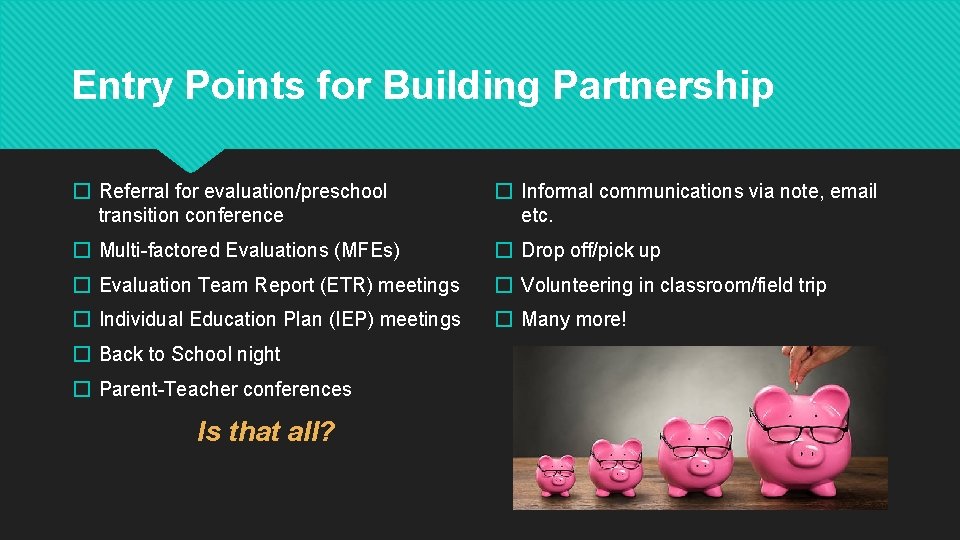
Entry Points for Building Partnership � Referral for evaluation/preschool transition conference � Informal communications via note, email etc. � Multi-factored Evaluations (MFEs) � Drop off/pick up � Evaluation Team Report (ETR) meetings � Volunteering in classroom/field trip � Individual Education Plan (IEP) meetings � Many more! � Back to School night � Parent-Teacher conferences Is that all?
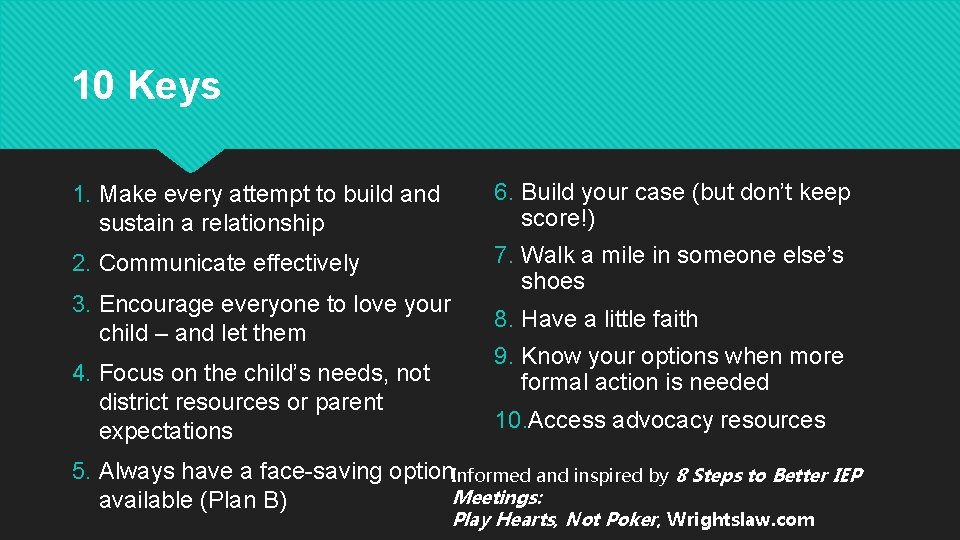
10 Keys 1. Make every attempt to build and sustain a relationship 6. Build your case (but don’t keep score!) 2. Communicate effectively 7. Walk a mile in someone else’s shoes 3. Encourage everyone to love your child – and let them 4. Focus on the child’s needs, not district resources or parent expectations 8. Have a little faith 9. Know your options when more formal action is needed 10. Access advocacy resources 5. Always have a face-saving option. Informed and inspired by 8 Steps to Better IEP Meetings: available (Plan B) Play Hearts, Not Poker, Wrightslaw. com
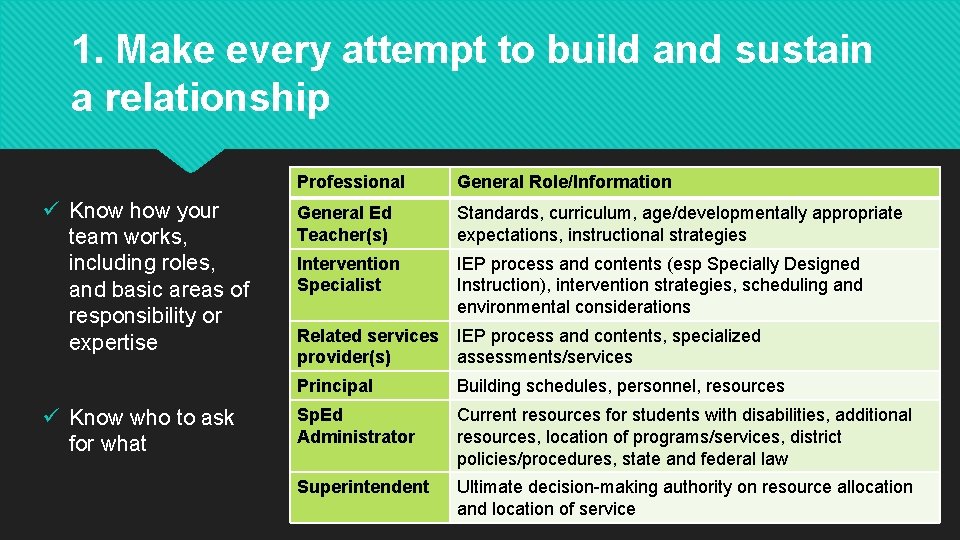
1. Make every attempt to build and sustain a relationship ü Know how your team works, including roles, and basic areas of responsibility or expertise ü Know who to ask for what Professional General Role/Information General Ed Teacher(s) Standards, curriculum, age/developmentally appropriate expectations, instructional strategies Intervention Specialist IEP process and contents (esp Specially Designed Instruction), intervention strategies, scheduling and environmental considerations Related services IEP process and contents, specialized provider(s) assessments/services Principal Building schedules, personnel, resources Sp. Ed Administrator Current resources for students with disabilities, additional resources, location of programs/services, district policies/procedures, state and federal law Superintendent Ultimate decision-making authority on resource allocation and location of service
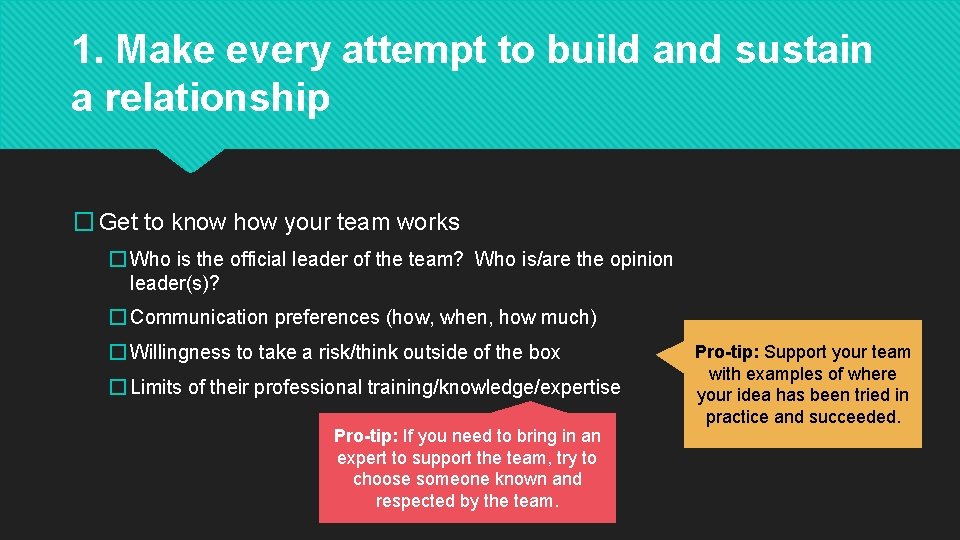
1. Make every attempt to build and sustain a relationship � Get to know how your team works � Who is the official leader of the team? Who is/are the opinion leader(s)? � Communication preferences (how, when, how much) � Willingness to take a risk/think outside of the box � Limits of their professional training/knowledge/expertise Pro-tip: If you need to bring in an expert to support the team, try to choose someone known and respected by the team. Pro-tip: Support your team with examples of where your idea has been tried in practice and succeeded.
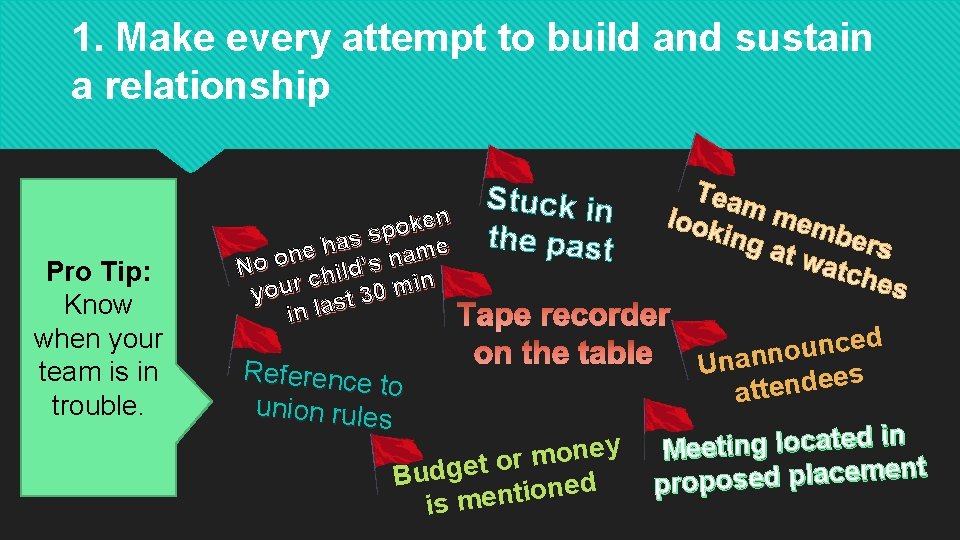
1. Make every attempt to build and sustain a relationship Pro Tip: Know when your team is in trouble. en k o p s s a h e e m n a o n No ld’s in i h c your st 30 m in la Reference to union rules Stuck in the past y e n o m or t e g d u B ed n o i t n e is m d e c n u Unanno es attende in Meeting located ent m e c a l p d e s o pr
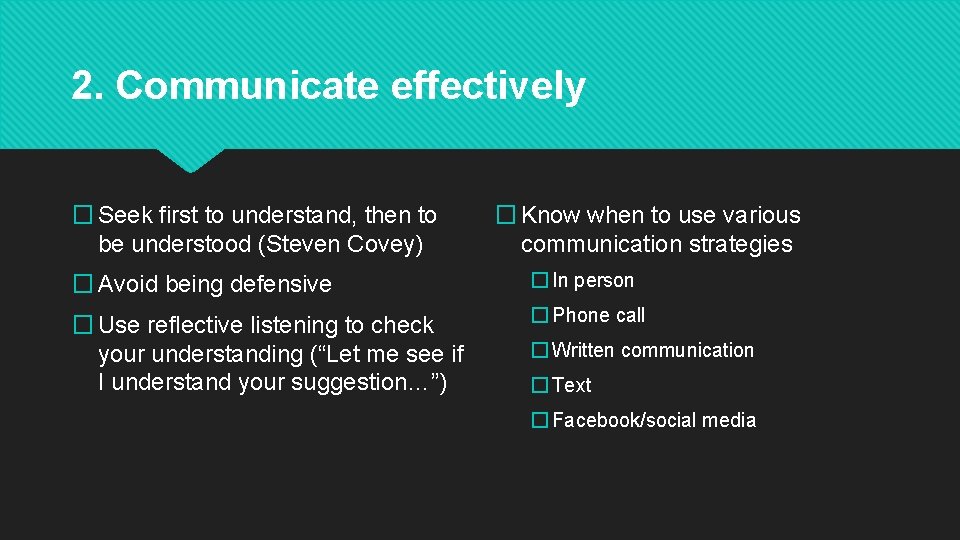
2. Communicate effectively � Seek first to understand, then to be understood (Steven Covey) � Know when to use various communication strategies � Avoid being defensive � In person � Use reflective listening to check your understanding (“Let me see if I understand your suggestion…”) � Phone call � Written communication � Text � Facebook/social media
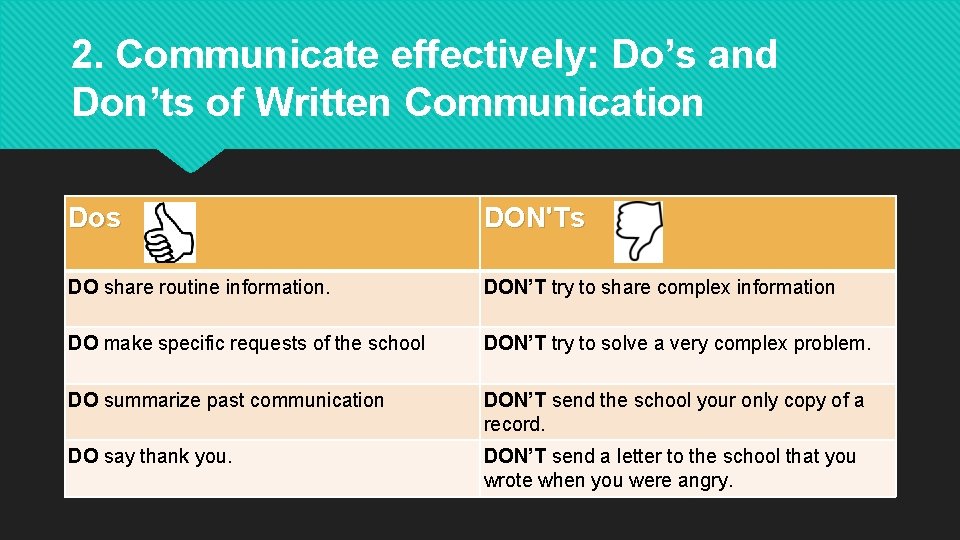
2. Communicate effectively: Do’s and Don’ts of Written Communication Dos DON'Ts DO share routine information. DON’T try to share complex information DO make specific requests of the school DON’T try to solve a very complex problem. DO summarize past communication DON’T send the school your only copy of a record. DO say thank you. DON’T send a letter to the school that you wrote when you were angry.
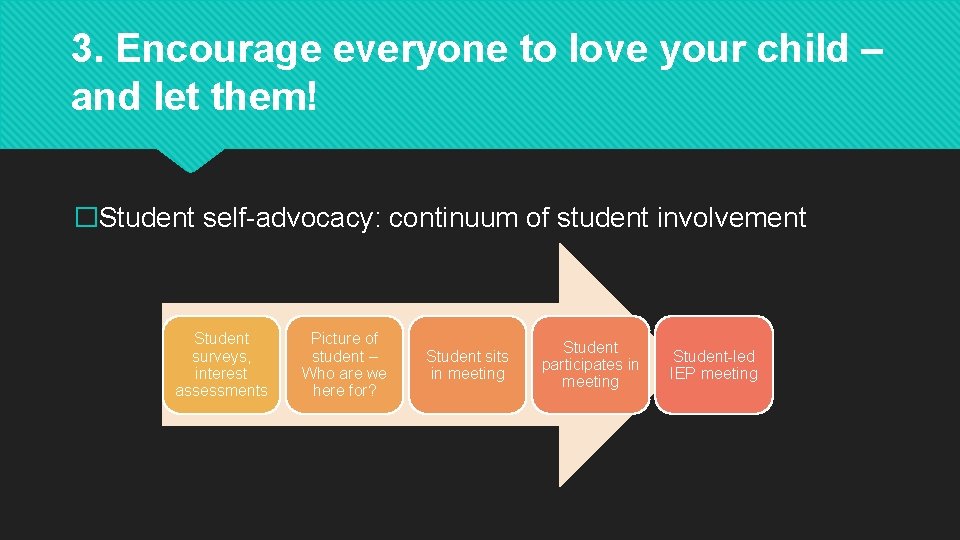
3. Encourage everyone to love your child – and let them! �Student self-advocacy: continuum of student involvement Student surveys, interest assessments Picture of student – Who are we here for? Student sits in meeting Student participates in meeting Student-led IEP meeting
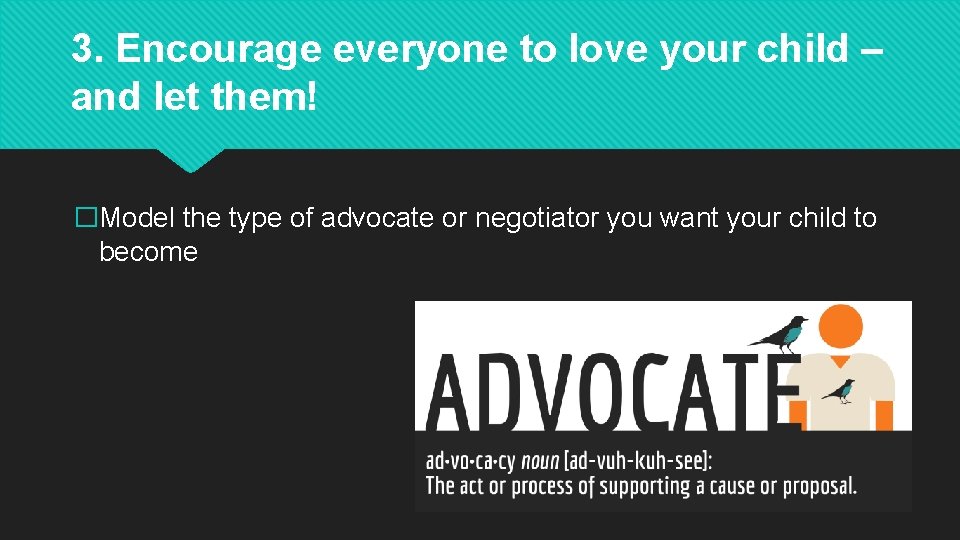
3. Encourage everyone to love your child – and let them! �Model the type of advocate or negotiator you want your child to become
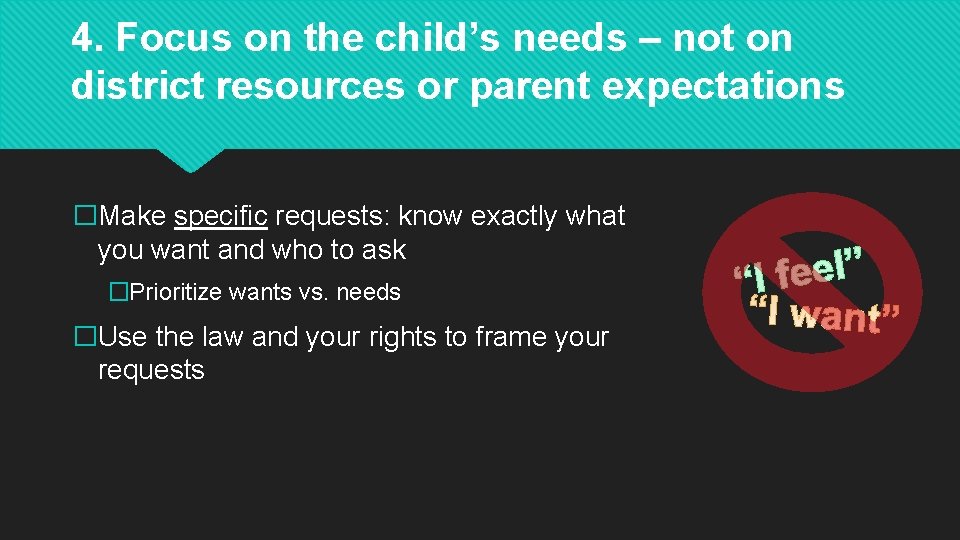
4. Focus on the child’s needs – not on district resources or parent expectations �Make specific requests: know exactly what you want and who to ask �Prioritize wants vs. needs �Use the law and your rights to frame your requests ” l e e f “I
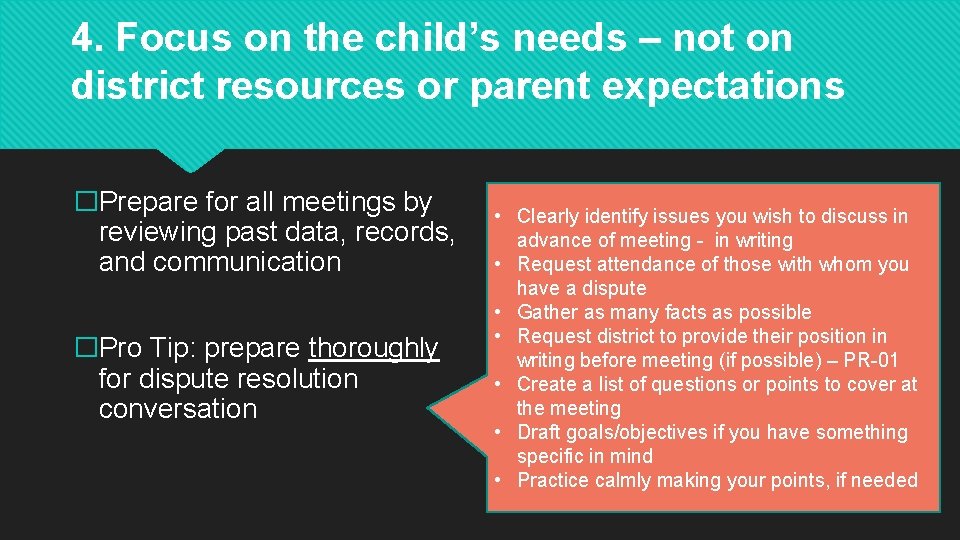
4. Focus on the child’s needs – not on district resources or parent expectations �Prepare for all meetings by reviewing past data, records, and communication �Pro Tip: prepare thoroughly for dispute resolution conversation • Clearly identify issues you wish to discuss in advance of meeting - in writing • Request attendance of those with whom you have a dispute • Gather as many facts as possible • Request district to provide their position in writing before meeting (if possible) – PR-01 • Create a list of questions or points to cover at the meeting • Draft goals/objectives if you have something specific in mind • Practice calmly making your points, if needed
5. Always have a face-saving option available (Plan B) � A good negotiator walks into a meeting knowing what they want and what they will settle for � Have several satisfactory outcomes in mind � Offer “trial” implementation of proposed action (yours or theirs) with data collection, but first clarify: � Who will collect data? � When will we reconvene? � What will be our decision rule(s)?
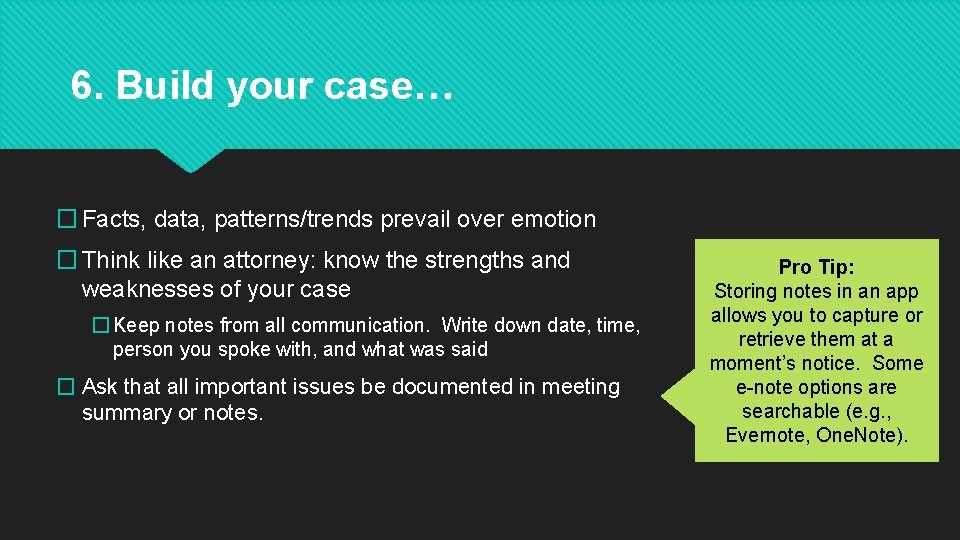
6. Build your case… � Facts, data, patterns/trends prevail over emotion � Think like an attorney: know the strengths and weaknesses of your case � Keep notes from all communication. Write down date, time, person you spoke with, and what was said � Ask that all important issues be documented in meeting summary or notes. Pro Tip: Storing notes in an app allows you to capture or retrieve them at a moment’s notice. Some e-note options are searchable (e. g. , Evernote, One. Note).
6. (cont’d) …But don’t keep score �Resist the urge to bring up past grievances unless they are directly relevant to the current discussion �Use mindfulness strategies to remain present and engaged in the moment Pro Tip: Consider developing a mantra to help you focus on the desired outcome or feeling of empowerment
7. Walk a mile in someone else’s shoes � Presume positive intent � Empathy is key to building productive relationships �Genuinely consider the perspective/stresses/goals/fears of �A building or special education administrator �A classroom teacher or service provider �A parent of a child with a disability How would you want to be approached if you were on the other side of the table?
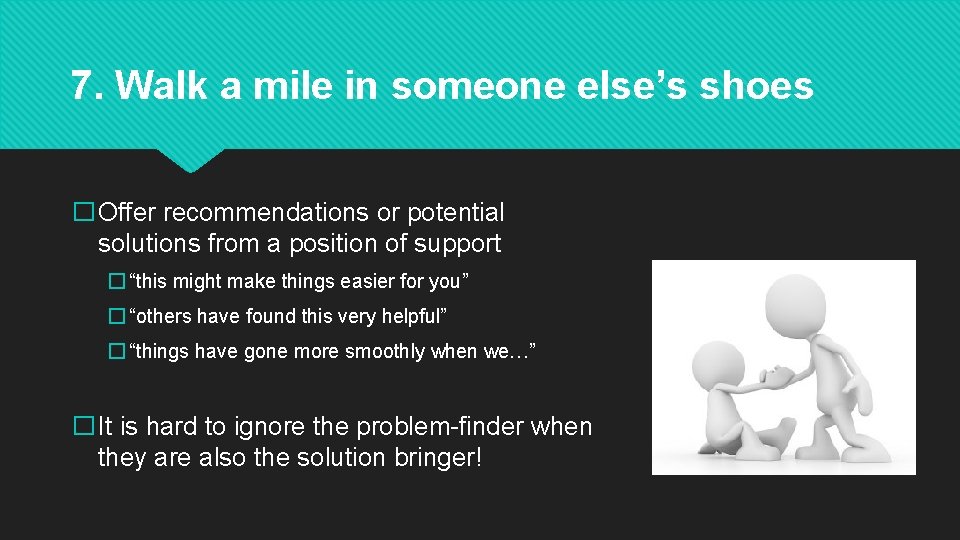
7. Walk a mile in someone else’s shoes �Offer recommendations or potential solutions from a position of support � “this might make things easier for you” � “others have found this very helpful” � “things have gone more smoothly when we…” �It is hard to ignore the problem-finder when they are also the solution bringer!
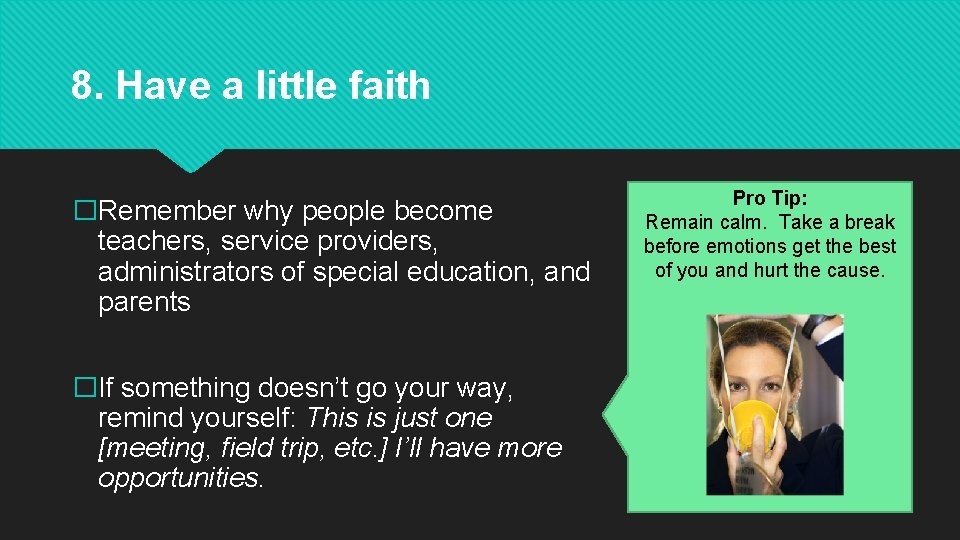
8. Have a little faith �Remember why people become teachers, service providers, administrators of special education, and parents �If something doesn’t go your way, remind yourself: This is just one [meeting, field trip, etc. ] I’ll have more opportunities. Pro Tip: Remain calm. Take a break before emotions get the best of you and hurt the cause.
9. Know your options when more formal action is needed �Local options �External options �Peer/parent mentor �SST-8 (330/929 -6634) �Principal or Special Ed Administrator �Advocate: OCECD, ARC, other organizations �Administrative Review (Superintendent) �Independent Educational Evaluation or outside evaluation
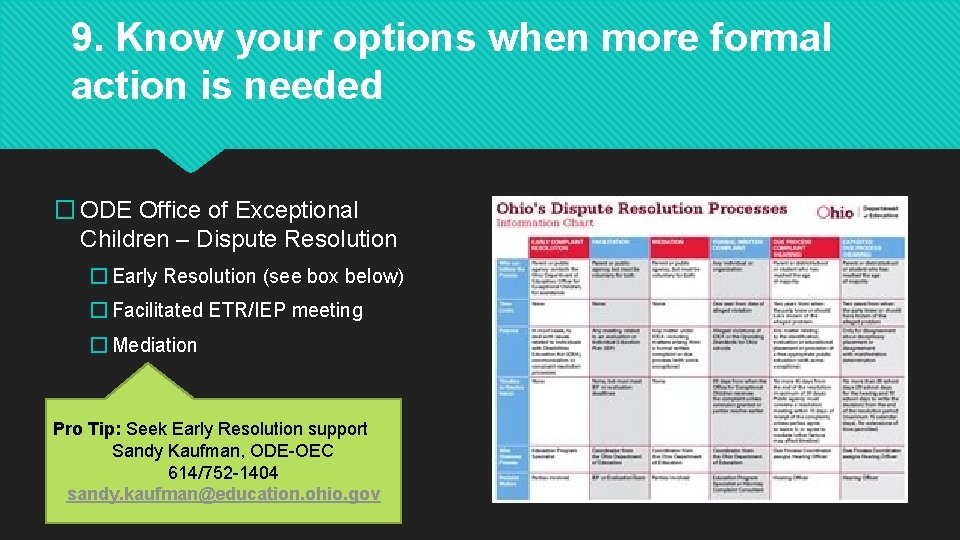
9. Know your options when more formal action is needed � ODE Office of Exceptional Children – Dispute Resolution � Early Resolution (see box below) � Facilitated ETR/IEP meeting � Mediation Pro Tip: Seek Early Resolution support Sandy Kaufman, ODE-OEC 614/752 -1404 sandy. kaufman@education. ohio. gov
10. Access helpful resources � Wrightslaw: 8 Steps to Better IEP Meetings: Play Hearts, Not Poker � Ohio Department of Education – OEC Dispute Resolution � Disability Rights Ohio: Negotiation Skills for Parents � ODE’s Guide to Parent’s Rights in Special Education � Partnering with Schools: A Guide for Parents � No more Whose IDEA � SST-8 Parent Mentor list
Questions? Developed by This document/product/software was supported in whole or in part by the U. S. Department of Education, Office of Special Education Programs, (Award #H 027 A 130158, CFDA 84. 027 A, awarded to the Ohio Department of Education). The opinions expressed herein do not necessarily reflect the policy or position of the U. S. Department of Education, Office of Special Education Programs, and no official endorsement by the Department should be inferred.