
10 Ideas to Simplify Your Retention Schedule William
- Slides: 16
10 Ideas to Simplify Your Retention Schedule William Saffady wsaffady@saffady. com The Gateway to Information Governance Annual Spring Conference | ARMA Metro NYC Chapter | March 5, 2019
Overview • Record periods are based on information lifecycle concept • Essential characteristics • Must be systematically developed in regular course of business • Must comply with applicable laws and regulations • Must be reasonable • Retention criteria • Legal requirements • Operational need • Scholarly value 2
Problems with Retention Schedules • Difficult and time-consuming to create • Too long and overly complicated • Incomplete; some unscheduled records • Inconsistent retention periods for similar records • Difficult to understand apply • Weak user acceptance; not consistently implemented • Time-consuming to review and update 3
#1 Determine the objective • Elimination of obsolete records • The historical basis for professional records management • Will favor shortest possible retention periods for non-permanent records • Addresses storage costs; secondarily discovery costs, privacy issues • Preservation of relevant records • Compatible with view of information as an asset • Will err on the side of keeping records longer for operational reasons or uncertainties about compliance requirements • May be favored by departmental custodians • Impact of electronic recordkeeping 4
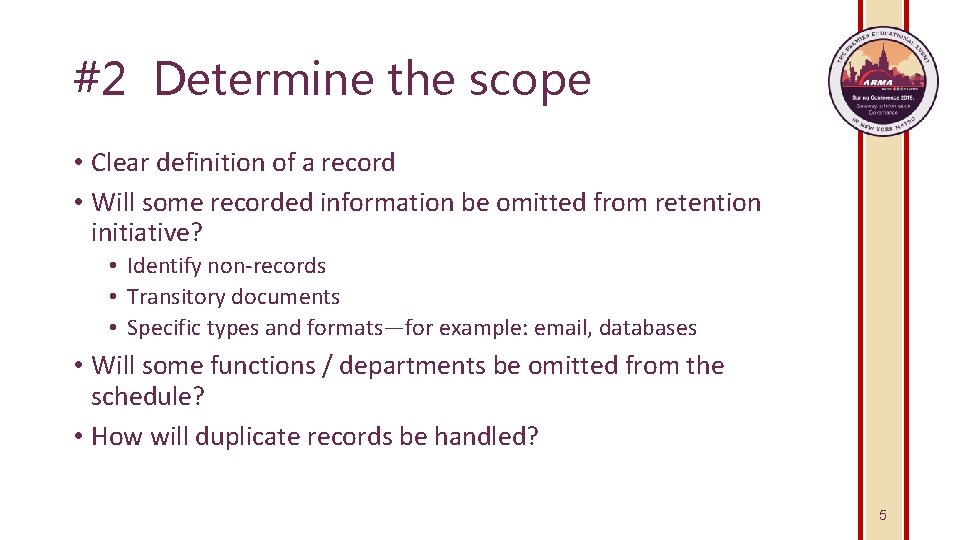
#2 Determine the scope • Clear definition of a record • Will some recorded information be omitted from retention initiative? • Identify non-records • Transitory documents • Specific types and formats—for example: email, databases • Will some functions / departments be omitted from the schedule? • How will duplicate records be handled? 5
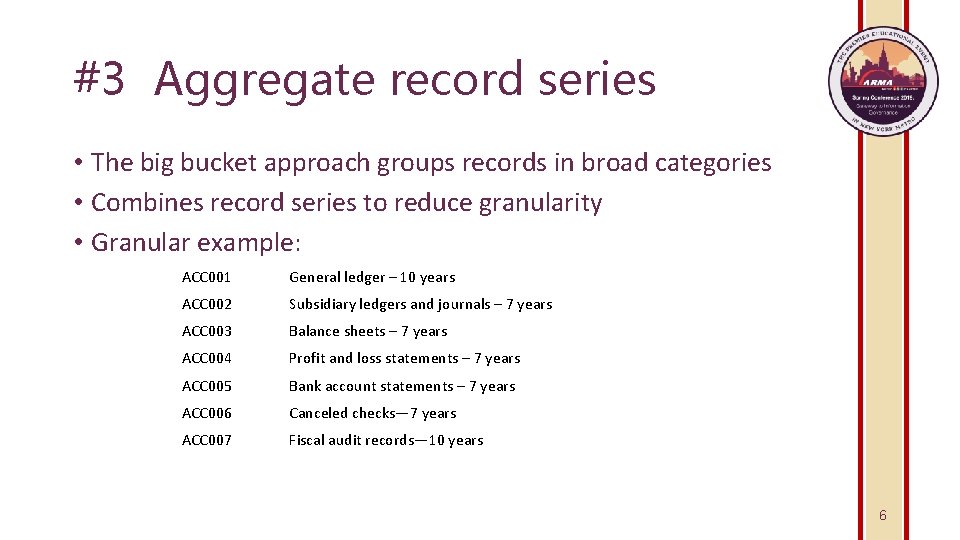
#3 Aggregate record series • The big bucket approach groups records in broad categories • Combines record series to reduce granularity • Granular example: ACC 001 General ledger – 10 years ACC 002 Subsidiary ledgers and journals – 7 years ACC 003 Balance sheets – 7 years ACC 004 Profit and loss statements – 7 years ACC 005 Bank account statements – 7 years ACC 006 Canceled checks— 7 years ACC 007 Fiscal audit records— 10 years 6
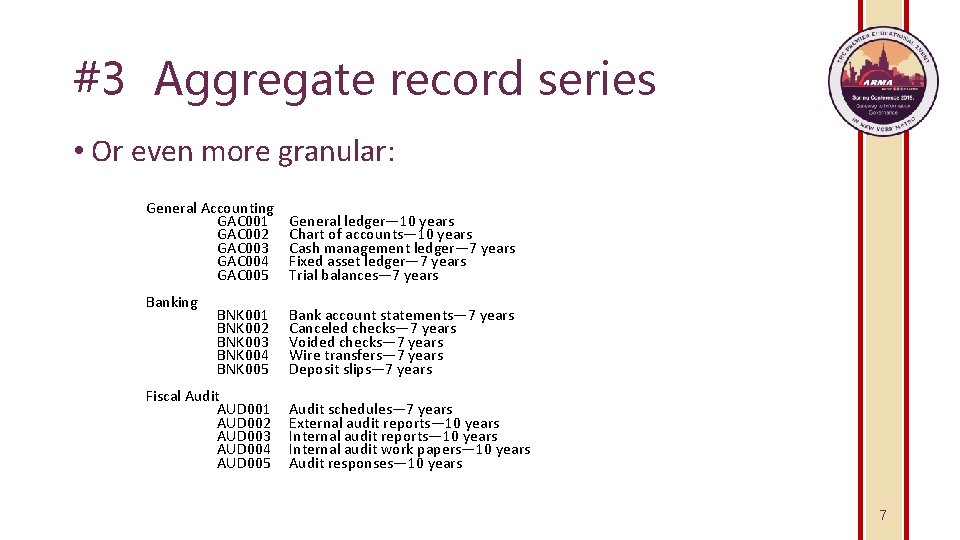
#3 Aggregate record series • Or even more granular: General Accounting GAC 001 GAC 002 GAC 003 GAC 004 GAC 005 Banking BNK 001 BNK 002 BNK 003 BNK 004 BNK 005 Fiscal Audit AUD 001 AUD 002 AUD 003 AUD 004 AUD 005 General ledger— 10 years Chart of accounts— 10 years Cash management ledger— 7 years Fixed asset ledger— 7 years Trial balances— 7 years Bank account statements— 7 years Canceled checks— 7 years Voided checks— 7 years Wire transfers— 7 years Deposit slips— 7 years Audit schedules— 7 years External audit reports— 10 years Internal audit work papers— 10 years Audit responses— 10 years 7
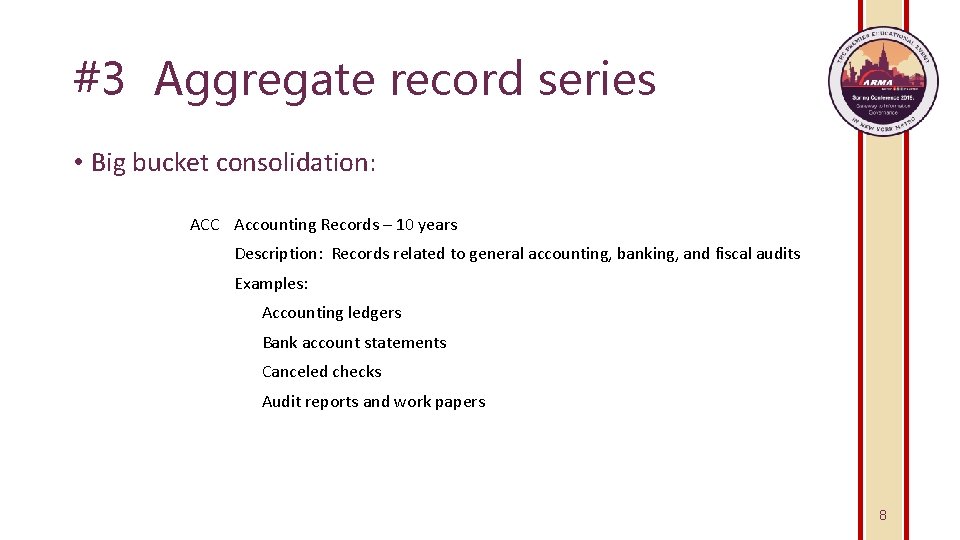
#3 Aggregate record series • Big bucket consolidation: ACC Accounting Records – 10 years Description: Records related to general accounting, banking, and fiscal audits Examples: Accounting ledgers Bank account statements Canceled checks Audit reports and work papers 8
#3 Aggregate record series • Not a simple pruning of obsolete and redundant series • Systematic consolidation based on analysis of business operations and activities • Does not eliminate record series concept, just fewer of them • Advantage: Shorter schedule with fewer choices is easier to understand apply • Concerns: Possible over-retention, crosswalk needed from old schedule, what about older records in storage? 9
#4 Fewer retention periods • Standardize on a few retention choices to simplify schedule development and implementation • 3 years – for records of short-term value • 10 years (or possibly 7 years) – for records with medium-term operational value or legal retention requirement • Indefinite retention for records that need to be kept longer with re-evaluation after specified period of time–but may need another choice between 10 and 30 years • Permanent designation reserved for records with scholarly value 10
#5 Flexible retention periods • Also described as “retention bands” • Specifies range of acceptable retention periods for a given record series -- for example: 7 to 10 years • Retention period expressed as minimum and maximum • Record custodians select a retention period within the specified range • May encourage but not mandate the minimum period • Advantage: Adaptable to variety of situations; giving departments some discretion may encourage compliance 11
#6 Minimize event-driven retention • Definition • Retention trigger is an event beyond the current year • Retention period begins at undetermined future time • Examples: case files, project files, personnel files, student files, patient files • Issues • Trigger event may occur in distant future or not at all • Difficult to implement with big bucket schedules • Incompatible with automated record retention • Alternative may involve very long retention period that transcends future event for entire record series 12
#7 Handling Duplicate Records • Information copies and not backup copies • Duplicate records often outnumber official copies • Identifying official copies • In departmental schedules: limited to official copies • More complicated in functional schedules • Retention options for duplicate records • Enumerate and specify retention periods for all copies • Discard at any time but do not keep longer than official copy • Maximum retention period for all duplicate records 13
#8 Use Policies for Some Records • Schedule is a listing of record series • Certain records are associated with multiple categories • Certain records require more detailed explanation and instructions than a schedule can provide • Examples • • • Duplicate records Documents of transitory value: notes, outlines, etc. Email File shares Older unscheduled records Information that should never be kept 14
#9 Consider Uniform Time Periods • Default retention period for records that cannot be individually examined • Examples • • Email File shares Records associated with defunct operations Records obtained from acquired entities Unscheduled records in offsite storage and elsewhere Duplicate records Documents of transitory value • Exceptions limited to unusual circumstances 15
#10 Create a General Schedule • For records associated with multiple departments or business functions • Examples • • • Policies and procedures Periodic and ad hoc reports about specific matters Committee records Project records Budget preparation records (departmental) Subject files Appointment calendars Travel records Lists, logs, databases created for administrative convenience 16