
10 From DNA to Protein Gene Expression Chapter

- Slides: 61
10 From DNA to Protein: Gene Expression
Chapter 10 From DNA to Protein: Gene Expression Key Concepts • 10. 1 Genetics Shows That Genes Code for Proteins • 10. 2 DNA Expression Begins with Its Transcription to RNA • 10. 3 The Genetic Code in RNA Is Translated into the Amino Acid Sequences of Proteins
Chapter 10 From DNA to Protein: Gene Expression • 10. 4 Translation of the Genetic Code is Mediated by t. RNA and Ribosomes • 10. 5 Proteins Are Modified after Translation
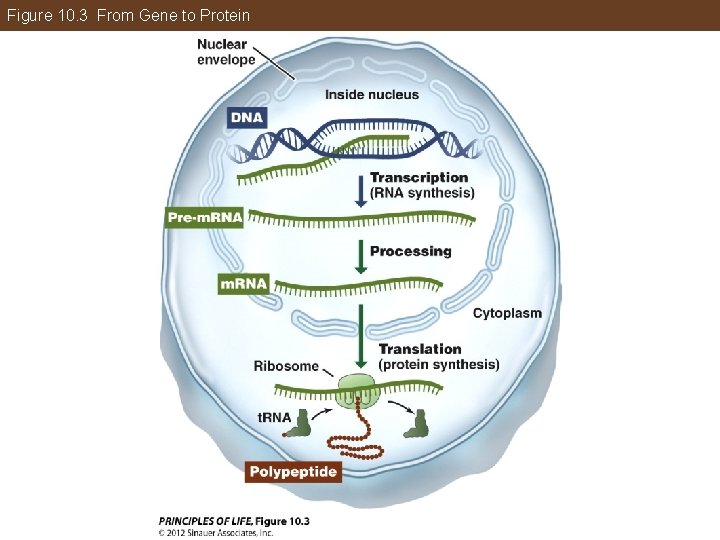
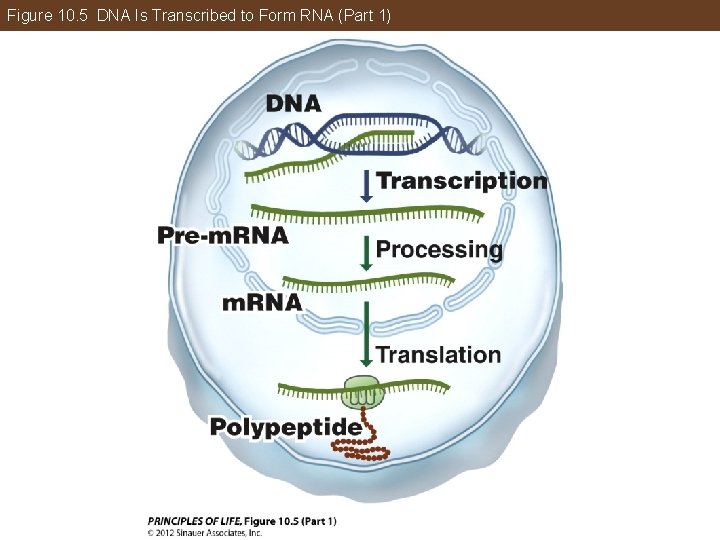
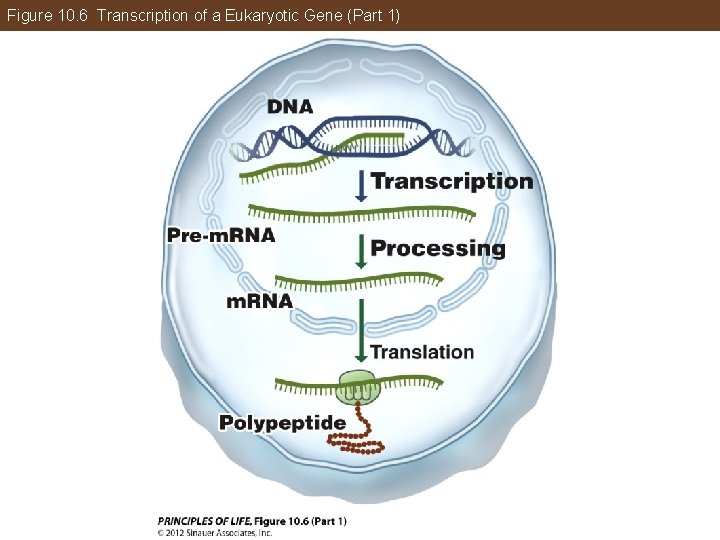
Concept 10. 1 Genetics Shows That Genes Code for Proteins Molecular biology is the study of nucleic acids and proteins, and often focuses on gene expression. Gene expression to form a specific polypeptide occurs in two steps: • Transcription—copies information from a DNA sequence (a gene) to a complementary RNA sequence • Translation—converts RNA sequence to amino acid sequence of a polypeptide
Concept 10. 1 Genetics Shows That Genes Code for Proteins Roles of three kinds of RNA in protein synthesis: • Messenger RNA (m. RNA) and transcription—carries copy of a DNA sequence to the site of protein synthesis at the ribosome • Ribosomal RNA (r. RNA) and translation— catalyzes peptide bonds between amino acids • Transfer RNA (t. RNA) mediates between m. RNA and protein—carries amino acids for polypeptide assembly
Figure 10. 3 From Gene to Protein
Concept 10. 2 DNA Expression Begins with Its Transcription to RNA Transcription—the formation of a specific RNA sequence from a specific DNA sequence—requires some components: • A DNA template for base pairings—one of the two strands of DNA • Nucleoside triphosphates (ATP, GTP, CTP, UTP) as substrates • An RNA polymerase enzyme
Concept 10. 2 DNA Expression Begins with Its Transcription to RNA Besides m. RNAs, other types of RNA are produced by transcription: • t. RNA • r. RNA • Small nuclear RNAs • micro. RNAs may have other functions in the cell besides protein synthesis.
Concept 10. 2 DNA Expression Begins with Its Transcription to RNA polymerases catalyze synthesis of RNA from the DNA template. RNA polymerases are processive—a single enzyme-template binding results in polymerization of hundreds of RNA bases. Unlike DNA polymerases, RNA polymerases do not need primers.
Concept 10. 2 DNA Expression Begins with Its Transcription to RNA Transcription occurs in three phases: • Initiation • Elongation • Termination
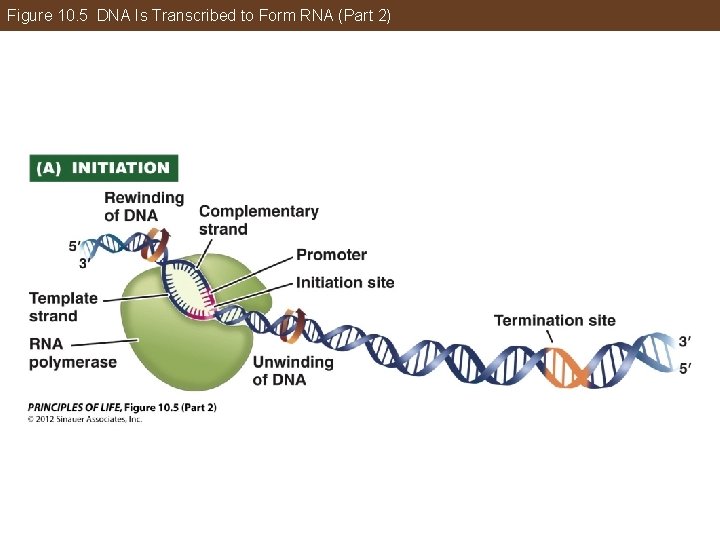
Concept 10. 2 DNA Expression Begins with Its Transcription to RNA Initiation requires a promoter—a special sequence of DNA. RNA polymerase binds to the promoter. Promoter tells RNA polymerase two things: • Where to start transcription • Which strand of DNA to transcribe Part of each promoter is the transcription initiation site.
Figure 10. 5 DNA Is Transcribed to Form RNA (Part 1)
Figure 10. 5 DNA Is Transcribed to Form RNA (Part 2)
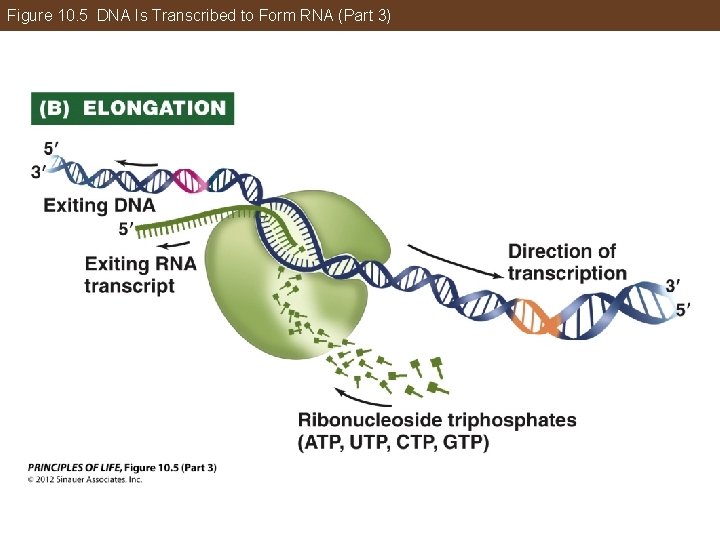
Concept 10. 2 DNA Expression Begins with Its Transcription to RNA Elongation: RNA polymerase unwinds DNA about 13 base pairs at a time; reads template in 3′-to-5′ direction. RNA polymerase adds nucleotides to the 3′ end of the new strand. The first nucleotide in the new RNA forms its 5′ end and the RNA transcript is antiparallel to the DNA template strand. RNA polymerases can proofread, but allow more mistakes.
Figure 10. 5 DNA Is Transcribed to Form RNA (Part 3)
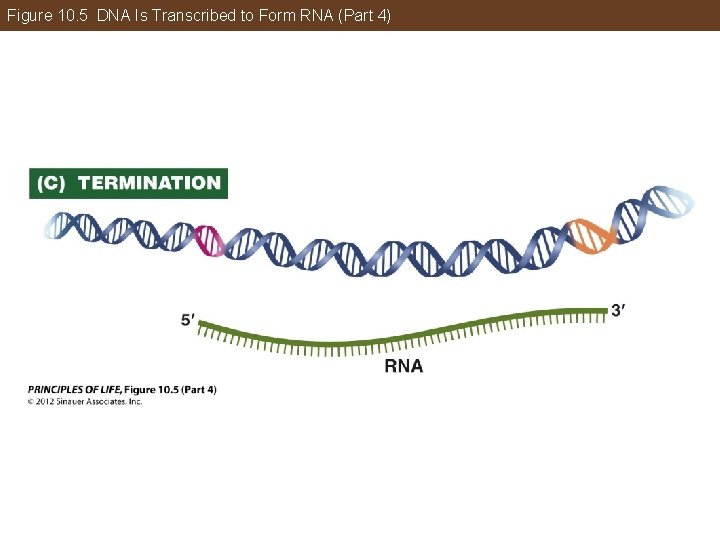
Concept 10. 2 DNA Expression Begins with Its Transcription to RNA Termination is specified by a specific DNA base sequence. Mechanisms of termination are complex and varied. For some genes, the transcript falls away from the DNA template and RNA polymerase—for others a helper protein pulls it away.
Figure 10. 5 DNA Is Transcribed to Form RNA (Part 4)
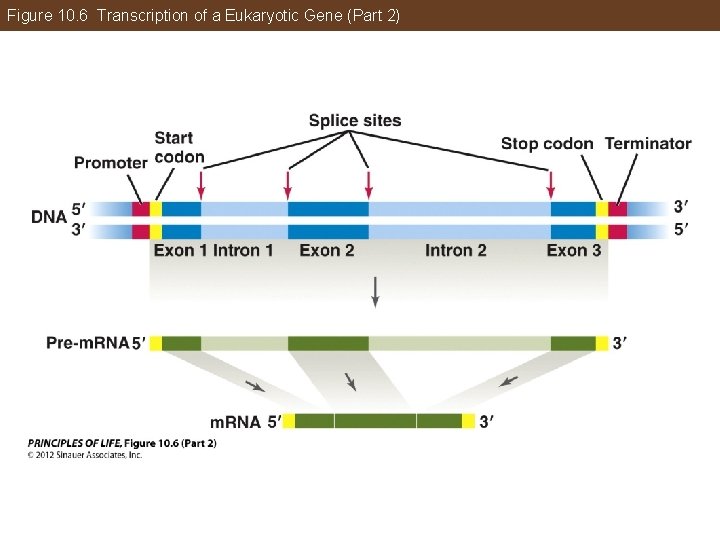
Concept 10. 2 DNA Expression Begins with Its Transcription to RNA Coding regions are sequences of a DNA molecule that are expressed as proteins. Eukaryotic genes may have noncoding sequences—introns (intervening regions). The coding sequences are exons (expressed regions). Introns and exons appear in the primary m. RNA transcript—pre-m. RNA; introns are removed from the final m. RNA.
Figure 10. 6 Transcription of a Eukaryotic Gene (Part 1)
Figure 10. 6 Transcription of a Eukaryotic Gene (Part 2)
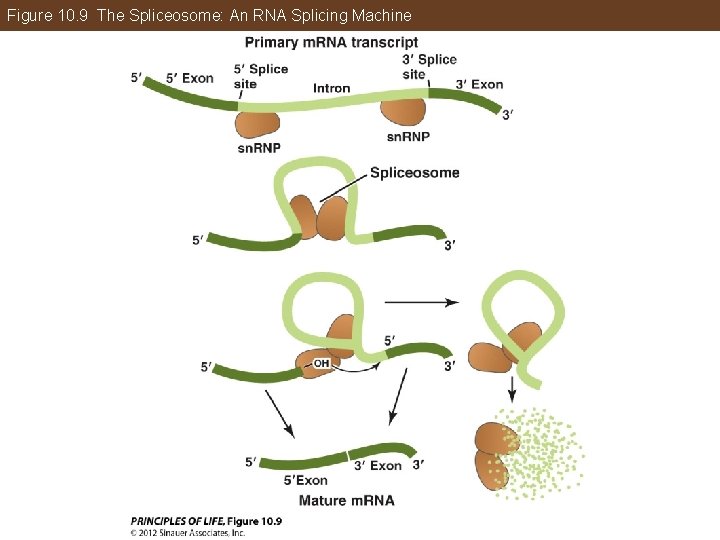
Concept 10. 2 DNA Expression Begins with Its Transcription to RNA splicing removes introns and splices exons together. Newly transcribed pre-m. RNA is bound at ends by sn. RNPs—small nuclear ribonucleoprotein particles. Consensus sequences are short sequences between exons and introns, bound by sn. RNPs.
Concept 10. 2 DNA Expression Begins with Its Transcription to RNA Besides the sn. RNPs, other proteins are added to form an RNA–protein complex, the spliceosome. The complex cuts pre-m. RNA, releases introns, and splices exons together to produce mature m. RNA.
Figure 10. 9 The Spliceosome: An RNA Splicing Machine
Concept 10. 2 DNA Expression Begins with Its Transcription to RNA While the pre-m. RNA is in the nucleus it undergoes two processing steps: A 5′ cap (or G cap) is added to the 5′ end as it is transcribed and facilitates binding and prevents breakdown by enzymes. A poly A tail is added to the 3′ end at the end of transcription and assists in export from the nucleus and aids stability.
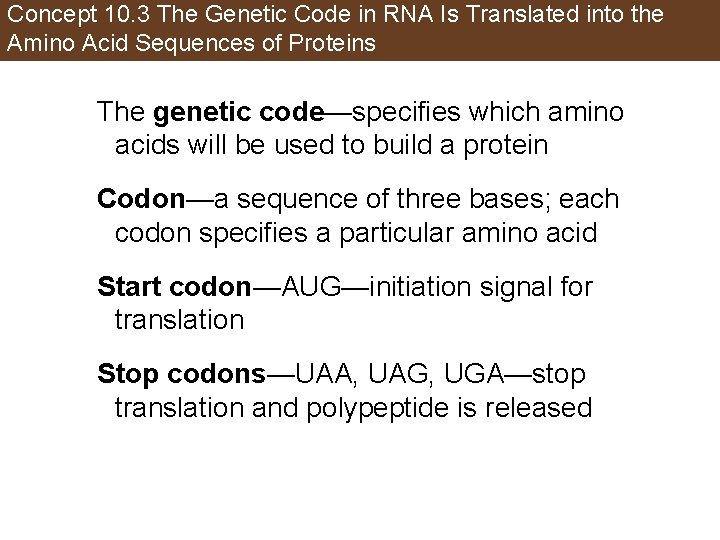
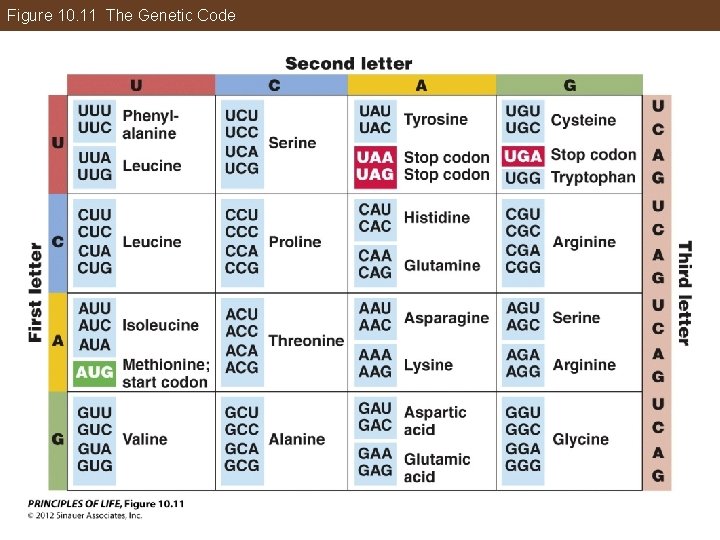
Concept 10. 3 The Genetic Code in RNA Is Translated into the Amino Acid Sequences of Proteins The genetic code—specifies which amino acids will be used to build a protein Codon—a sequence of three bases; each codon specifies a particular amino acid Start codon—AUG—initiation signal for translation Stop codons—UAA, UAG, UGA—stop translation and polypeptide is released
Figure 10. 11 The Genetic Code
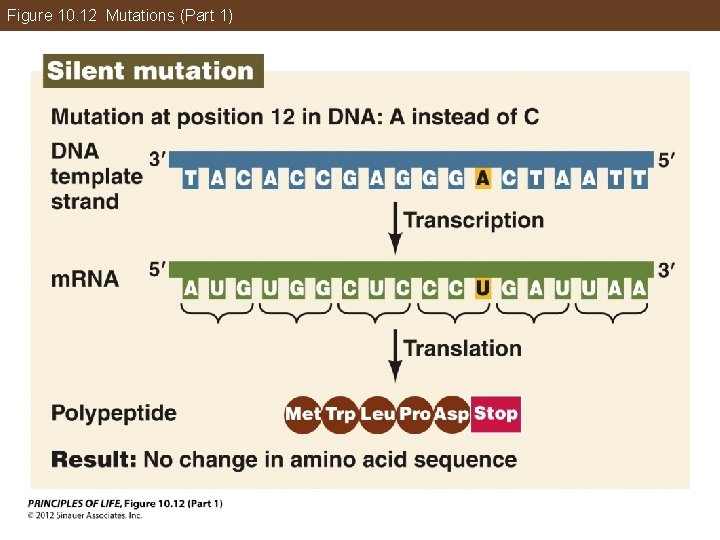
Figure 10. 12 Mutations (Part 1)
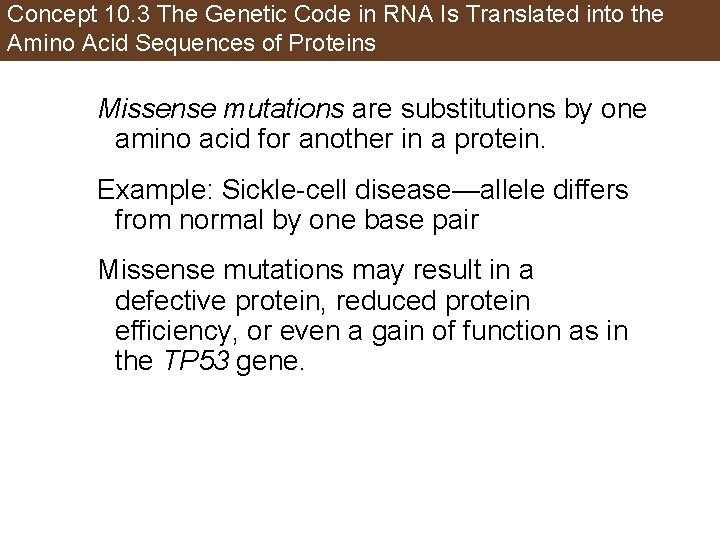
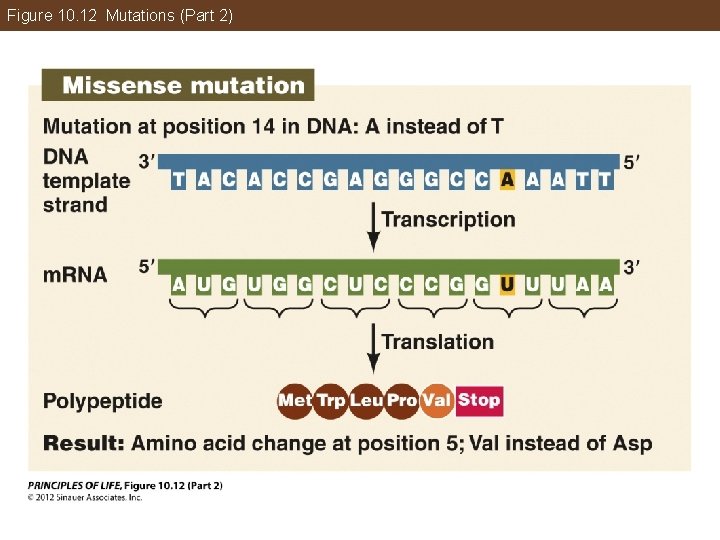
Concept 10. 3 The Genetic Code in RNA Is Translated into the Amino Acid Sequences of Proteins Missense mutations are substitutions by one amino acid for another in a protein. Example: Sickle-cell disease—allele differs from normal by one base pair Missense mutations may result in a defective protein, reduced protein efficiency, or even a gain of function as in the TP 53 gene.
Figure 10. 12 Mutations (Part 2)
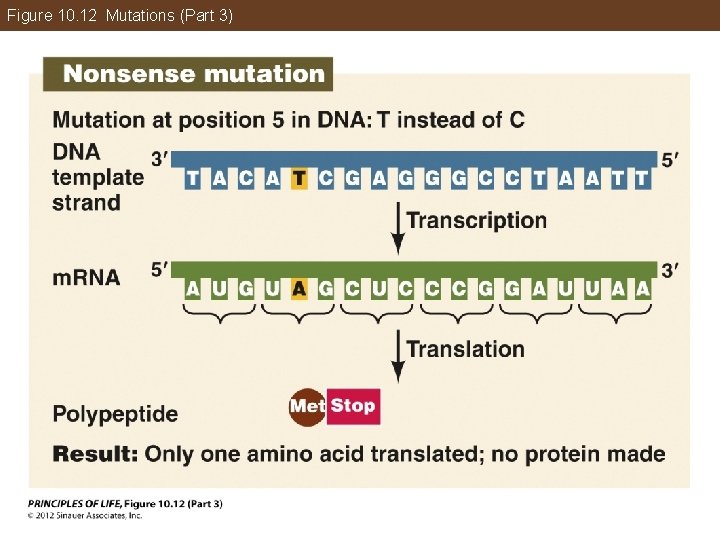
Concept 10. 3 The Genetic Code in RNA Is Translated into the Amino Acid Sequences of Proteins Nonsense mutations involve a base substitution that causes a stop codon to form somewhere in the m. RNA. This results in a shortened protein, which is usually not functional—if near the 3' end it may have no effect.
Figure 10. 12 Mutations (Part 3)
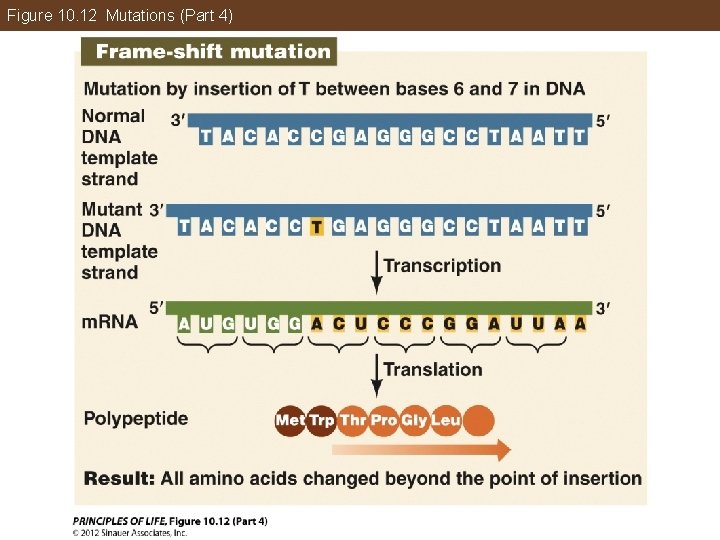
Concept 10. 3 The Genetic Code in RNA Is Translated into the Amino Acid Sequences of Proteins Frame-shift mutations are insertions or deletions of bases in DNA. These mutations interfere with translation and shift the “reading-frame. ” Nonfunctional proteins are produced.
Figure 10. 12 Mutations (Part 4)
Concept 10. 4 Translation of the Genetic Code Is Mediated by t. RNA and Ribosomes t. RNA links information in m. RNA codons with specific amino acids. For each amino acid, there is a specific type or “species” of t. RNA. Two key events to ensure that the protein made is the one specified by the m. RNA: • t. RNAs must read m. RNA codons correctly. • t. RNAs must deliver amino acids corresponding to each codon.
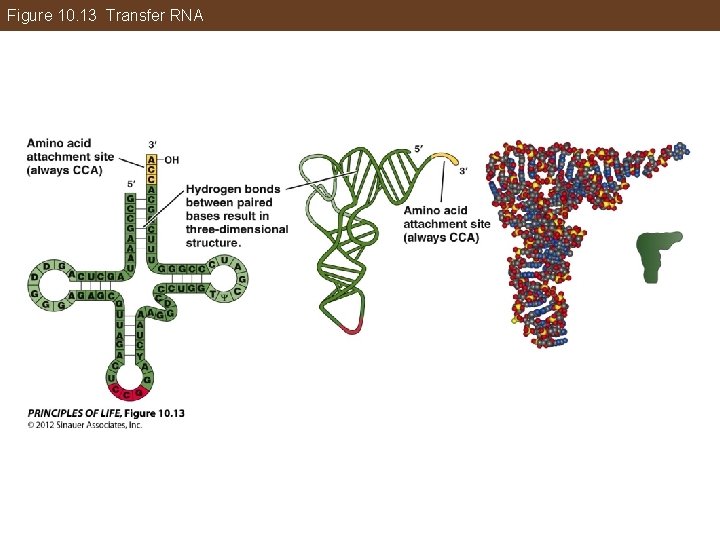
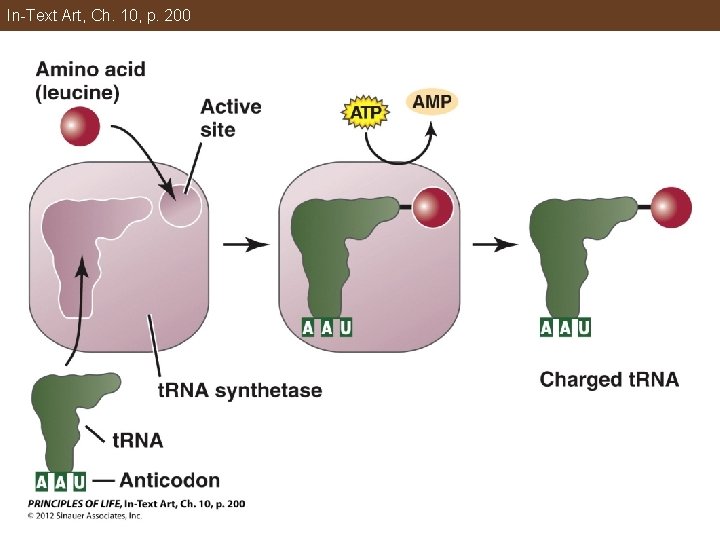
Concept 10. 4 Translation of the Genetic Code Is Mediated by t. RNA and Ribosomes Each t. RNA has three functions, made possible by its structure and base sequence: • t. RNAs bind to a particular amino acid, and become “charged. ” • t. RNAs bind at their midpoint—anticodon-to m. RNA molecules. • t. RNAs interacts with ribosomes.
Figure 10. 13 Transfer RNA
In-Text Art, Ch. 10, p. 200
Concept 10. 4 Translation of the Genetic Code Is Mediated by t. RNA and Ribosomes Activating enzymes—aminoacyl-t. RNA synthetases—charge t. RNA with the correct amino acids. Each enzyme is highly specific for one amino acid and its corresponding t. RNA. The enzymes have three-part active sites— they bind a specific amino acid, a specific t. RNA, and ATP.
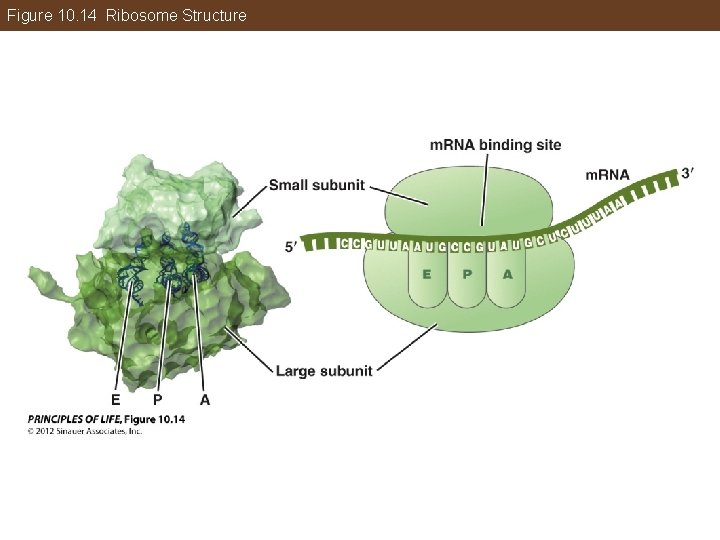
Concept 10. 4 Translation of the Genetic Code Is Mediated by t. RNA and Ribosomes The translation of m. RNA by t. RNA is accomplished at the ribosome—the workbench—and holds m. RNA and charged t. RNAs in the correct positions to allow assembly of polypeptide chain. Ribosomes are not specific; they can make any type of protein.
Concept 10. 4 Translation of the Genetic Code Is Mediated by t. RNA and Ribosomes have two subunits, large and small. In eukaryotes, the large subunit has three molecules of ribosomal RNA (r. RNA) and 49 different proteins in a precise pattern. The small subunit has one r. RNA and 33 proteins.
Figure 10. 14 Ribosome Structure
Concept 10. 4 Translation of the Genetic Code Is Mediated by t. RNA and Ribosomes Large subunit has three t. RNA binding sites: A (amino acid) site binds with anticodon of charged t. RNA. P (polypeptide) site is where t. RNA adds its amino acid to the growing chain. E (exit) site is where t. RNA sits before being released from the ribosome.
Concept 10. 4 Translation of the Genetic Code Is Mediated by t. RNA and Ribosomes Ribosome has a fidelity function: when proper binding occurs, hydrogen bonds form between the base pairs. Small subunit r. RNA validates the match—if hydrogen bonds have not formed between all three base pairs, the t. RNA must be an incorrect match for that codon and the t. RNA is rejected.
Concept 10. 4 Translation of the Genetic Code Is Mediated by t. RNA and Ribosomes Like transcription, translation also occurs in three steps: • Initiation • Elongation • Termination
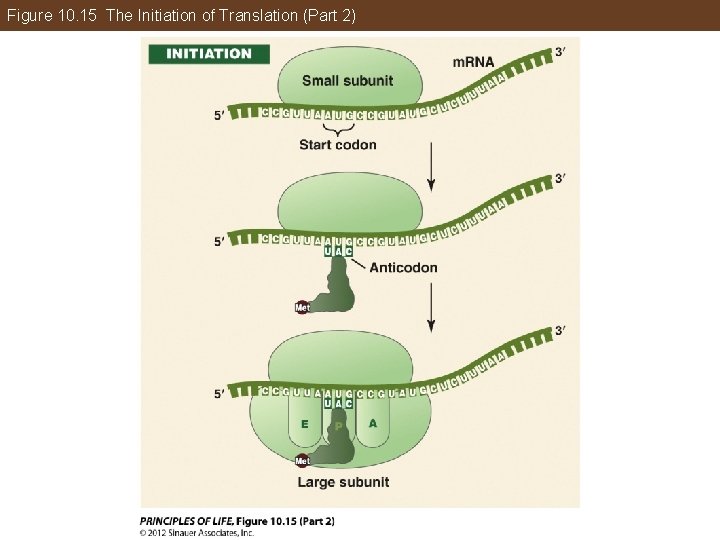
Concept 10. 4 Translation of the Genetic Code Is Mediated by t. RNA and Ribosomes Initiation: An initiation complex consists of a charged t. RNA and small ribosomal subunit, both bound to m. RNA. After binding, the small subunit moves along the m. RNA until it reaches the start codon, AUG. The first amino acid is always methionine, which may be removed after translation.
Concept 10. 4 Translation of the Genetic Code Is Mediated by t. RNA and Ribosomes The large subunit joins the complex; the charged t. RNA is now in the P site of the large subunit. Initiation factors are responsible for assembly of the initiation complex from m. RNA, two ribosomal subunits and charged t. RNA.
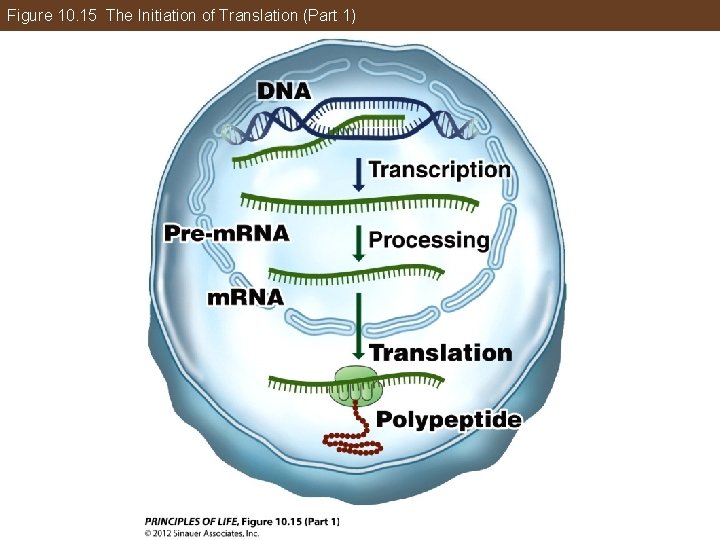
Figure 10. 15 The Initiation of Translation (Part 1)
Figure 10. 15 The Initiation of Translation (Part 2)
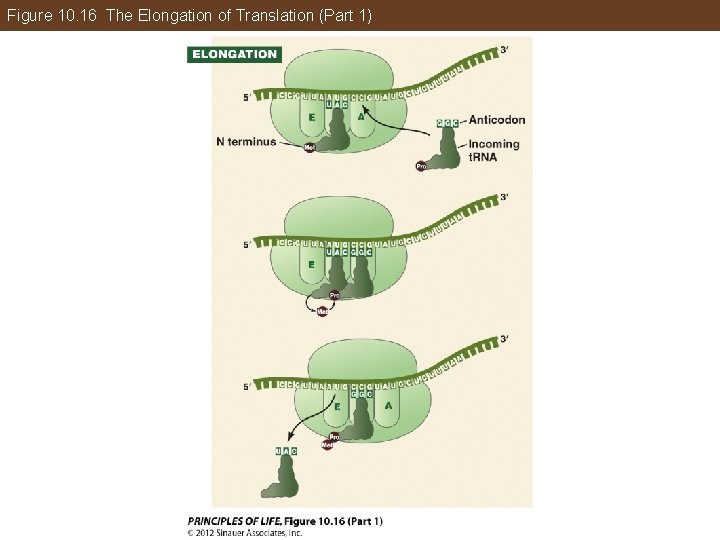
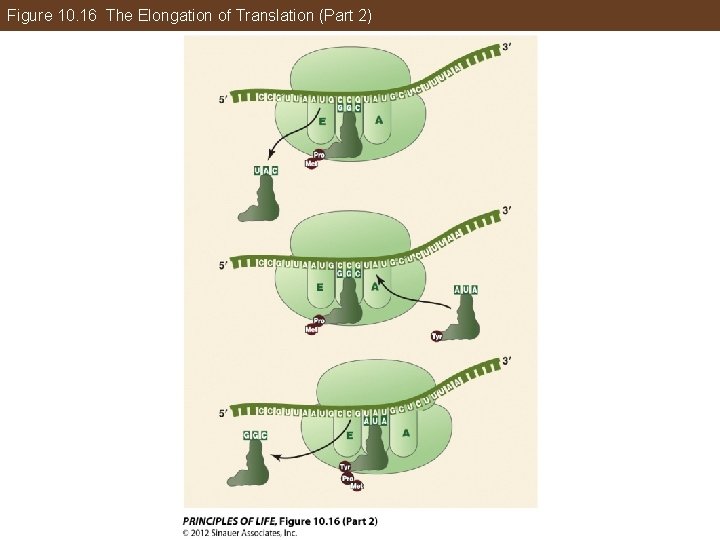
Concept 10. 4 Translation of the Genetic Code Is Mediated by t. RNA and Ribosomes Elongation: The second charged t. RNA enters the A site Large subunit catalyzes two reactions: It breaks bond between t. RNA in P site and its amino acid. A peptide bond forms between that amino acid and the amino acid on t. RNA in the A site.
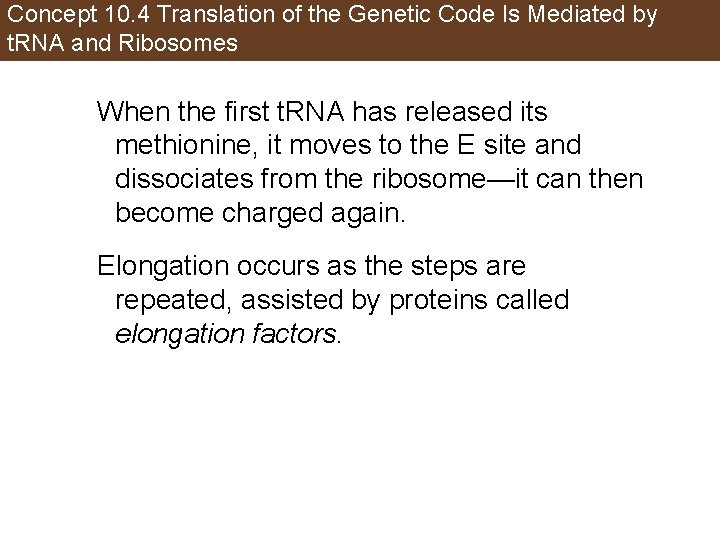
Concept 10. 4 Translation of the Genetic Code Is Mediated by t. RNA and Ribosomes When the first t. RNA has released its methionine, it moves to the E site and dissociates from the ribosome—it can then become charged again. Elongation occurs as the steps are repeated, assisted by proteins called elongation factors.
Concept 10. 4 Translation of the Genetic Code Is Mediated by t. RNA and Ribosomes The large subunit has peptidyl transferase activity—if r. RNA is destroyed, the activity stops. The component with this activity is an r. RNA in the ribosome. The catalyst is an example of a ribozyme (from ribonucleic acid and enzyme).
Figure 10. 16 The Elongation of Translation (Part 1)
Figure 10. 16 The Elongation of Translation (Part 2)
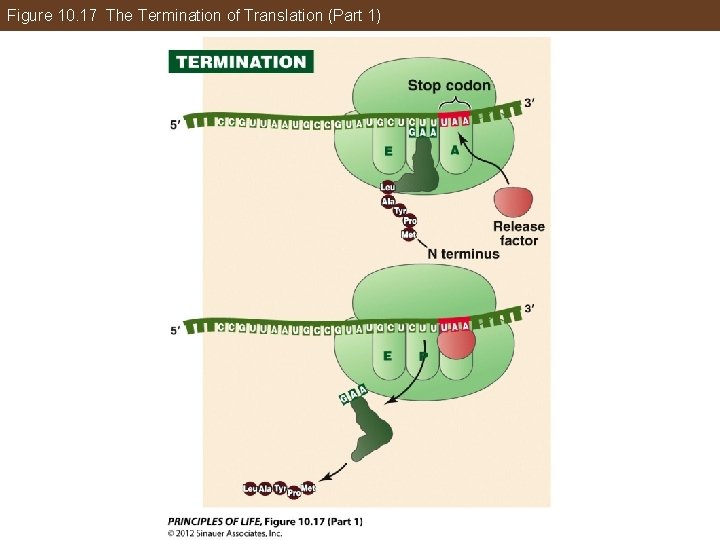
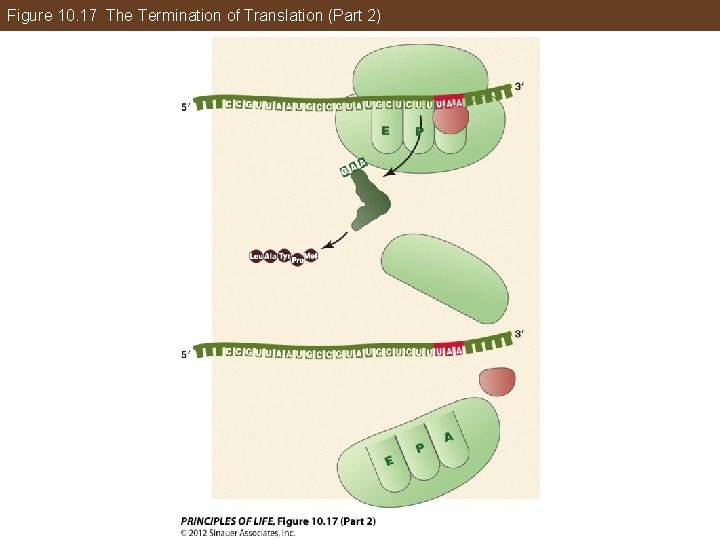
Concept 10. 4 Translation of the Genetic Code Is Mediated by t. RNA and Ribosomes Termination—translation ends when a stop codon enters the A site. Stop codon binds a protein release factor— allows hydrolysis of bond between polypeptide chain and t. RNA on the P site. Polypeptide chain separates from the ribosome—C terminus is the last amino acid added.
Figure 10. 17 The Termination of Translation (Part 1)
Figure 10. 17 The Termination of Translation (Part 2)
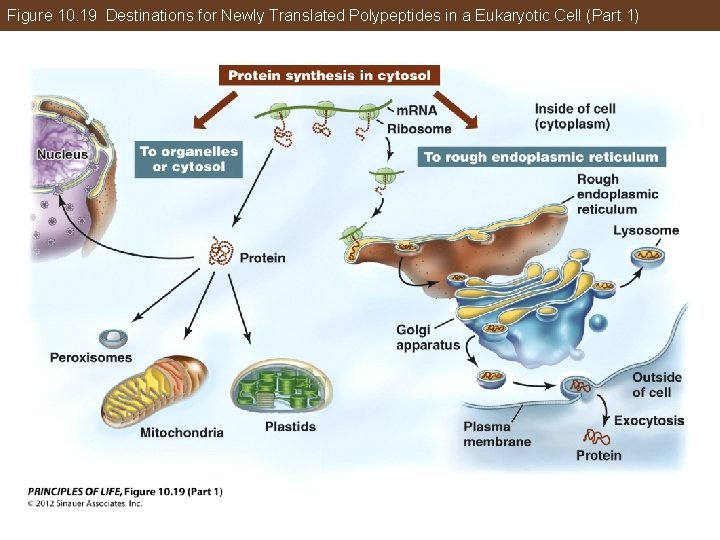
Concept 10. 5 Proteins Are Modified after Translation Posttranslational aspects of protein synthesis: Polypeptide emerges from the ribosome and folds into its 3 -D shape. Its conformation allows it to interact with other molecules—it may contain a signal sequence (or signal peptide) indicating where in the cell it belongs.
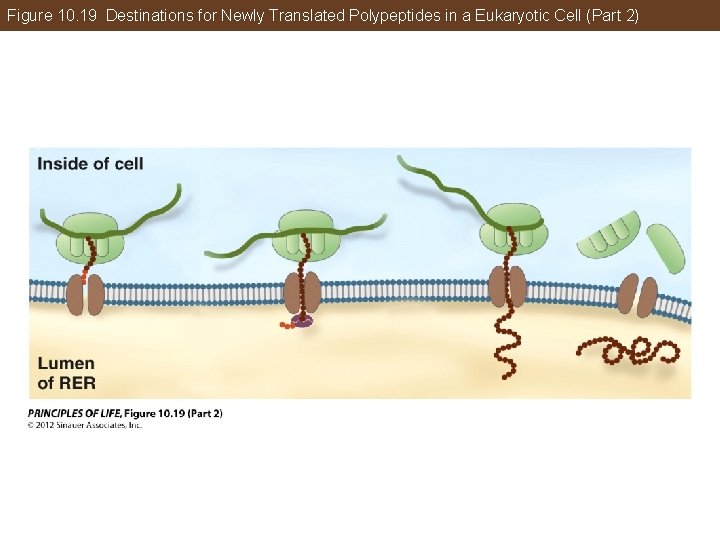
Concept 10. 5 Proteins Are Modified after Translation In the absence of a signal sequence, the protein will remain where it was made. Some proteins contain signal sequences that “target” them to the nucleus, mitochondria, or other places. Signal sequence binds to a receptor protein on the organelle surface—a channel forms and the protein moves into the organelle.
Figure 10. 19 Destinations for Newly Translated Polypeptides in a Eukaryotic Cell (Part 1)
Figure 10. 19 Destinations for Newly Translated Polypeptides in a Eukaryotic Cell (Part 2)
Concept 10. 5 Proteins Are Modified after Translation Protein modifications: Proteolysis—cutting of a long polypeptide chain, or polyprotein, into final products, by proteases Glycosylation—addition of carbohydrates to form glycoproteins Phosphorylation—addition of phosphate groups catalyzed by protein kinases— charged phosphate groups change the conformation of the protein