
10 Crafting the Brand Positioning Marketing Management 13
10 Crafting the Brand Positioning Marketing Management, 13 th ed
Chapter Questions • How can a firm choose and communicate an effective positioning in the market? • How are brands differentiated? • What marketing strategies are appropriate at each stage of the product life cycle? • What are the implications of market evolution for marketing strategies? Copyright © 2009 Pearson Education, Inc. Publishing as Prentice Hall 10 -2
What is Positioning? Positioning is the act of designing the company’s offering and image to occupy a distinctive place in the mind of the target market. Copyright © 2009 Pearson Education, Inc. Publishing as Prentice Hall 10 -3
Value Propositions • Perdue Chicken • More tender golden chicken at a moderate premium price • Domino’s • A good hot pizza, delivered to your door within 30 minutes of ordering, at a moderate price Copyright © 2009 Pearson Education, Inc. Publishing as Prentice Hall 10 -4
Defining Associations Points-of-parity Points-of-difference (PODs) (POPs) • Attributes or benefits • Associations that consumers strongly are not necessarily associate with a unique to the brand, positively but may be shared evaluate, and believe with other brands they could not find to the same extent with a competitive brand Copyright © 2009 Pearson Education, Inc. Publishing as Prentice Hall 10 -5
Conveying Category Membership • Announcing category benefits • Comparing to exemplars • Relying on the product descriptor Copyright © 2009 Pearson Education, Inc. Publishing as Prentice Hall 10 -6
Consumer Desirability Criteria for PODs • Relevance • Distinctiveness • Believability Copyright © 2009 Pearson Education, Inc. Publishing as Prentice Hall 10 -7
Deliverability Criteria for PODs • Feasibility • Communicability • Sustainability Copyright © 2009 Pearson Education, Inc. Publishing as Prentice Hall 10 -8
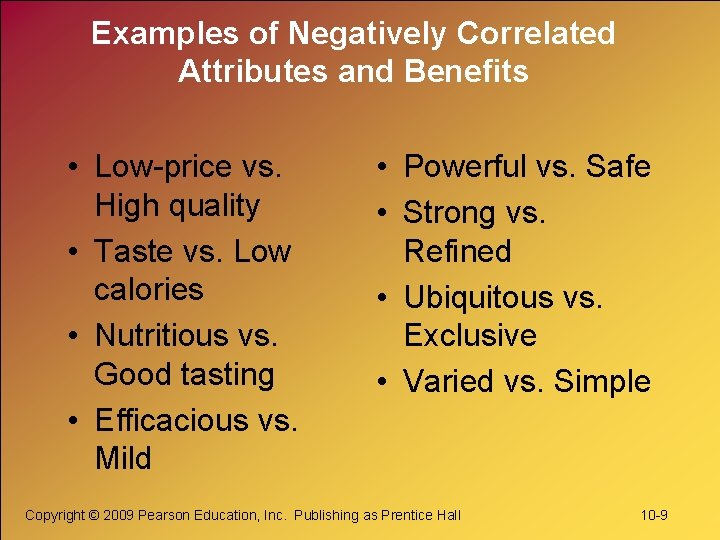
Examples of Negatively Correlated Attributes and Benefits • Low-price vs. High quality • Taste vs. Low calories • Nutritious vs. Good tasting • Efficacious vs. Mild • Powerful vs. Safe • Strong vs. Refined • Ubiquitous vs. Exclusive • Varied vs. Simple Copyright © 2009 Pearson Education, Inc. Publishing as Prentice Hall 10 -9
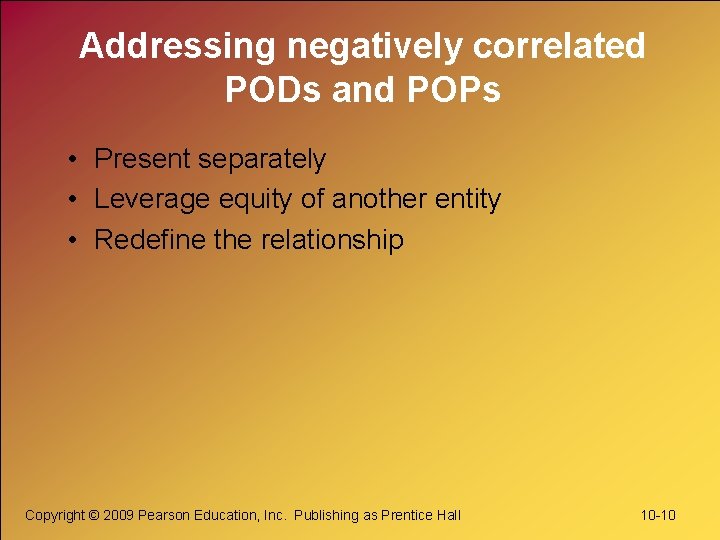
Addressing negatively correlated PODs and POPs • Present separately • Leverage equity of another entity • Redefine the relationship Copyright © 2009 Pearson Education, Inc. Publishing as Prentice Hall 10 -10
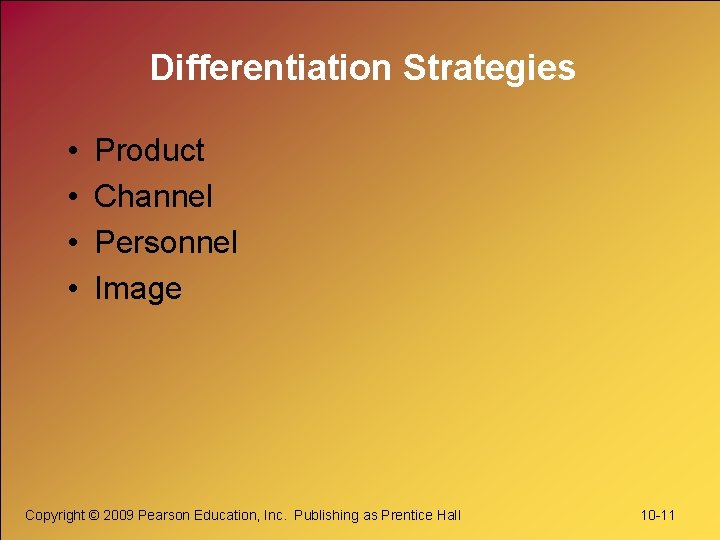
Differentiation Strategies • • Product Channel Personnel Image Copyright © 2009 Pearson Education, Inc. Publishing as Prentice Hall 10 -11
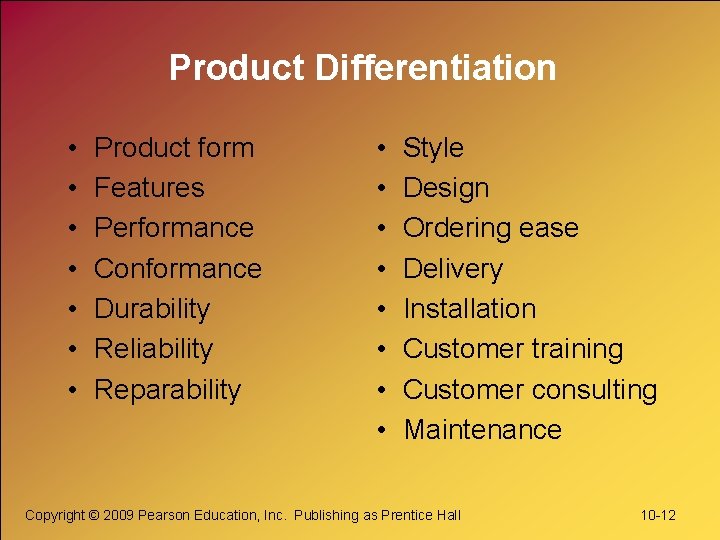
Product Differentiation • • Product form Features Performance Conformance Durability Reliability Reparability • • Style Design Ordering ease Delivery Installation Customer training Customer consulting Maintenance Copyright © 2009 Pearson Education, Inc. Publishing as Prentice Hall 10 -12
Claims of Product Life Cycles • Products have a limited life • Product sales pass through distinct stages each with different challenges and opportunities • Profits rise and fall at different stages • Products require different strategies in each life cycle stage Copyright © 2009 Pearson Education, Inc. Publishing as Prentice Hall 10 -13
Strategies for Sustaining Rapid Market Growth • Improve product quality, add new features, and improve styling • Add new models and flanker products • Enter new market segments • Increase distribution coverage • Shift from product-awareness advertising to product-preference advertising • Lower prices to attract the next layer of pricesensitive buyers Copyright © 2009 Pearson Education, Inc. Publishing as Prentice Hall 10 -14
Stages in the Maturity Stage • Growth • Stable • Decaying maturity Copyright © 2009 Pearson Education, Inc. Publishing as Prentice Hall 10 -15
Marketing Product Modifications • Quality improvements • Feature improvements • Style improvements Copyright © 2009 Pearson Education, Inc. Publishing as Prentice Hall 10 -16
Marketing Program Modifications • • • Prices Distribution Advertising Sales promotion Services Copyright © 2009 Pearson Education, Inc. Publishing as Prentice Hall 10 -17
Ways to Increase Sales Volume • • Convert nonusers Enter new market segments Attract competitors’ customers Have consumers use the product on more occasions • Have consumers use more of the product on each occasion • Have consumers use the product in new ways Copyright © 2009 Pearson Education, Inc. Publishing as Prentice Hall 10 -18
Market Evolution Stages • • Emergence Growth Maturity Decline Copyright © 2009 Pearson Education, Inc. Publishing as Prentice Hall 10 -19
Emerging Markets • • Latent Single-niche Multiple-niche Mass-market Copyright © 2009 Pearson Education, Inc. Publishing as Prentice Hall 10 -20
Maturity Strategies • Market fragmentation stage • Market consolidation stage Copyright © 2009 Pearson Education, Inc. Publishing as Prentice Hall 10 -21
- Slides: 21