
10 Corporate Strategy Diversification Acquisitions and Internal New

- Slides: 30
10 Corporate Strategy: Diversification, Acquisitions, and Internal New Ventures 1
Overview n Diversification ¨ The process of adding new businesses to the company that are distinct from its established operations n Vehicles for diversification ¨ Internal new venturing n Starting a new business from scratch ¨ Acquisitions ¨ Joint n ventures Restructuring ¨ Reducing the scope of diversified operations by exiting from business areas 2
Expanding Beyond a Single Industry n Advantages of staying in a single industry ¨ Focus resources and capabilities on competing successfully in one area ¨ Focus on what the company knows and does best n Disadvantages of being in a single industry ¨ Danger of the industry declining ¨ Missing the opportunity to leverage resources and capabilities to other activities ¨ Resting on laurels and not continually learning 3
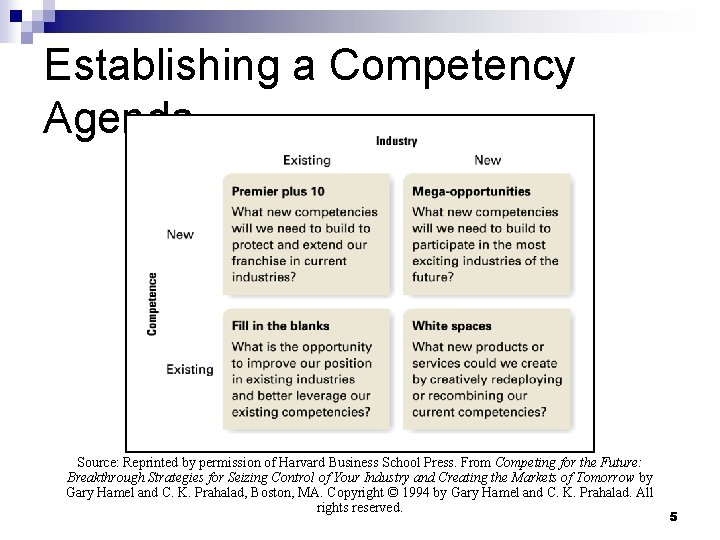
A Company as a Portfolio of Distinctive Competencies Reconceptualize the company as a portfolio of distinctive competencies rather than a portfolio of products n Consider how those competencies might be leveraged to create opportunities in new industries n Existing vs. competencies n Existing industries in which a company competes vs. new industries n 4
Establishing a Competency Agenda Source: Reprinted by permission of Harvard Business School Press. From Competing for the Future: Breakthrough Strategies for Seizing Control of Your Industry and Creating the Markets of Tomorrow by Gary Hamel and C. K. Prahalad, Boston, MA. Copyright © 1994 by Gary Hamel and C. K. Prahalad. All rights reserved. 5
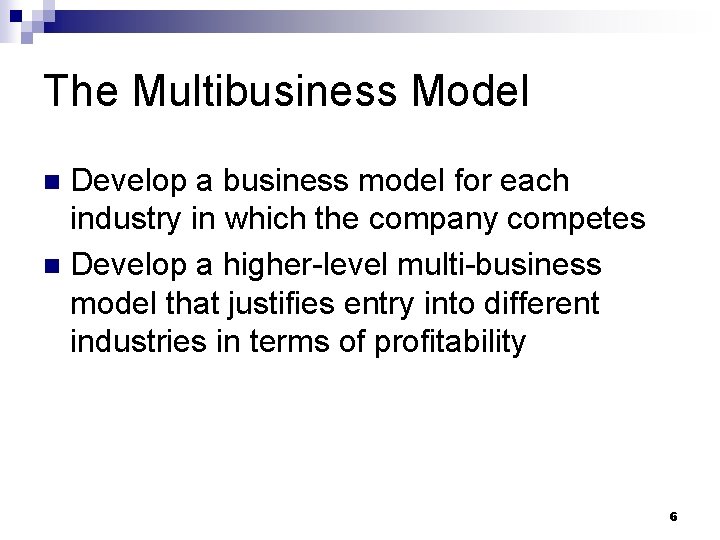
The Multibusiness Model Develop a business model for each industry in which the company competes n Develop a higher-level multi-business model that justifies entry into different industries in terms of profitability n 6
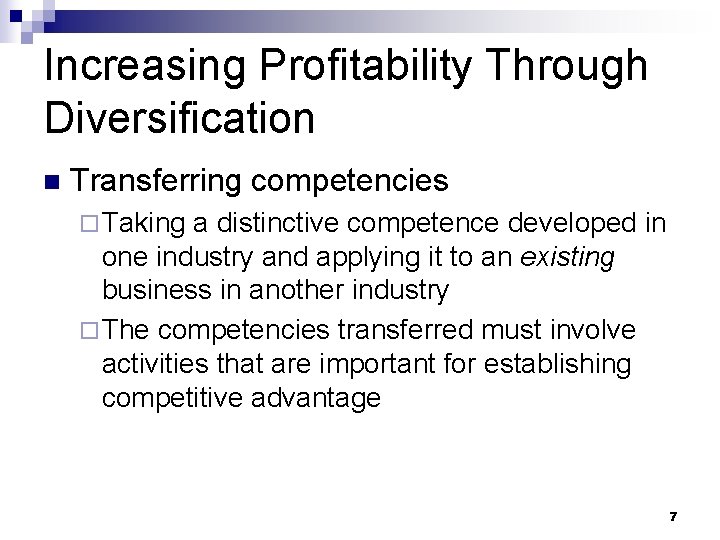
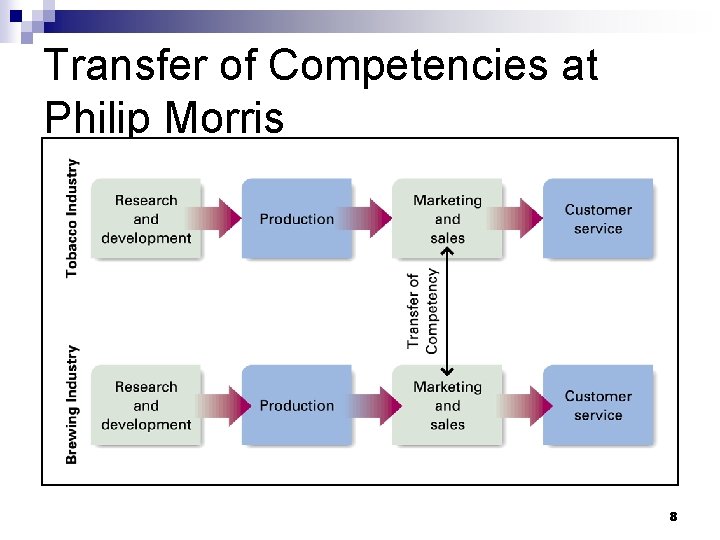
Increasing Profitability Through Diversification n Transferring competencies ¨ Taking a distinctive competence developed in one industry and applying it to an existing business in another industry ¨ The competencies transferred must involve activities that are important for establishing competitive advantage 7
Transfer of Competencies at Philip Morris 8
Increasing Profitability Through Diversification (cont’d) n Leveraging competencies ¨ Taking a distinctive competency developed by a business in one industry and using it to create a new business in a different industry n Sharing resources: economies of scope ¨ Cost reductions associated with sharing resources across businesses 9
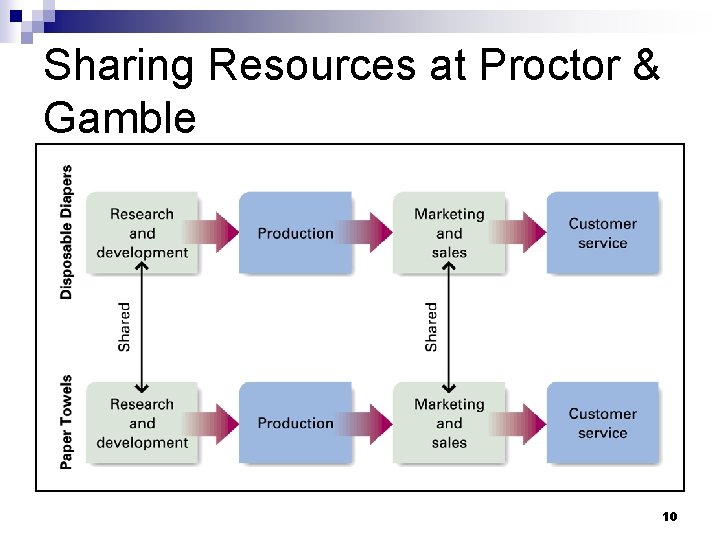
Sharing Resources at Proctor & Gamble 10
Increasing Profitability Through Diversification (cont’d) n Managing rivalry: multipoint competition ¨ Diversifying into an industry in order to hold a competitor in check that has either entered its industry or has the potential to do so ¨ Multipoint competition: companies competing against each other in different industries 11
Increasing Profitability Through Diversification (cont’d) n Exploiting general organizational competencies ¨ Competencies that transcend individual functions or businesses and reside at the corporate level in the multi-business enterprise ¨ Entrepreneurial capabilities ¨ Effective organization structure and controls ¨ Superior strategic capabilities 12
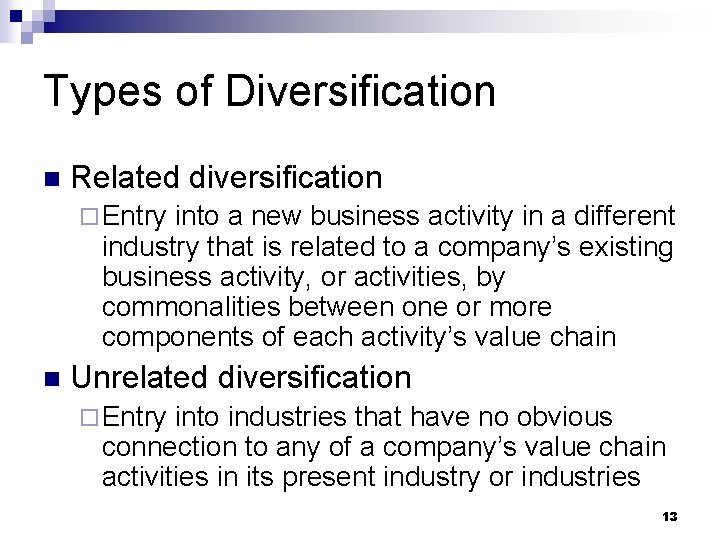
Types of Diversification n Related diversification ¨ Entry into a new business activity in a different industry that is related to a company’s existing business activity, or activities, by commonalities between one or more components of each activity’s value chain n Unrelated diversification ¨ Entry into industries that have no obvious connection to any of a company’s value chain activities in its present industry or industries 13
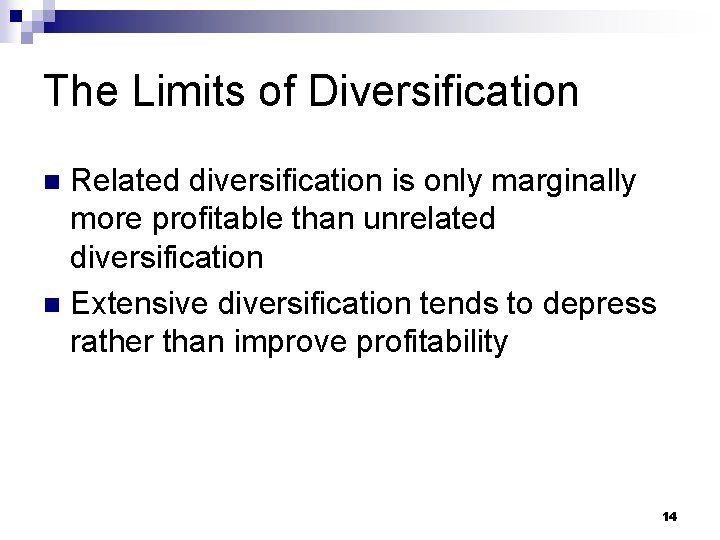
The Limits of Diversification Related diversification is only marginally more profitable than unrelated diversification n Extensive diversification tends to depress rather than improve profitability n 14
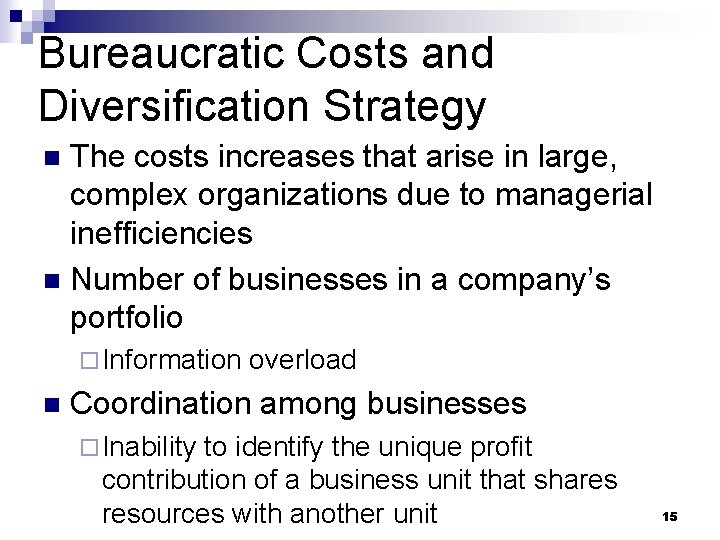
Bureaucratic Costs and Diversification Strategy The costs increases that arise in large, complex organizations due to managerial inefficiencies n Number of businesses in a company’s portfolio n ¨ Information n overload Coordination among businesses ¨ Inability to identify the unique profit contribution of a business unit that shares resources with another unit 15
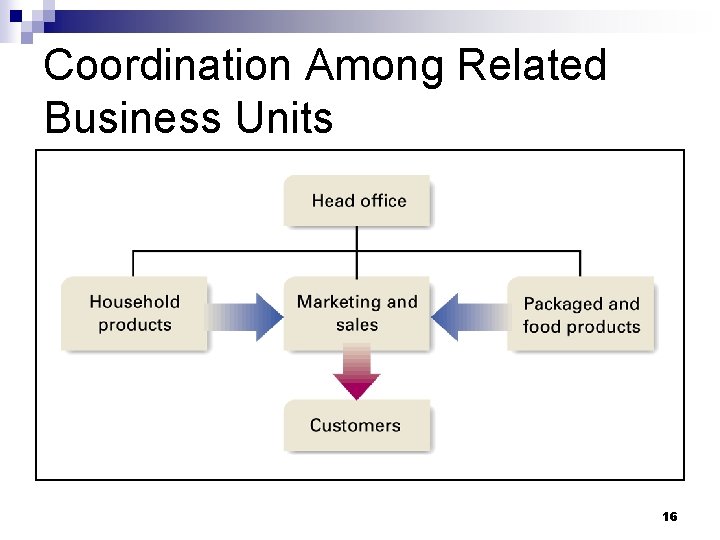
Coordination Among Related Business Units 16
Bureaucratic Costs and Diversification Strategy (cont’d) n Limits of diversification ¨ Bureaucratic costs place a limit on the amount of diversification that can profitably be pursued n Related or unrelated diversification? ¨ Related diversified companies can create value in more ways than unrelated companies, but they have to bear higher bureaucratic costs 17
Diversification That Dissipates Value n Diversifying to pool risks ¨ Stockholders can diversify their own portfolios at lower costs than the company can ¨ Research suggests that corporate diversification is not an effective way to pool risks n Diversifying to achieve greater growth ¨ Growth on its own does not create value 18
Entry Strategy: Internal New Ventures—Attractions To execute corporate-level strategies when a company has a set of valuable competencies in its existing businesses that can be leveraged to enter the new business area n When entering a newly emerging or embryonic industry n 19
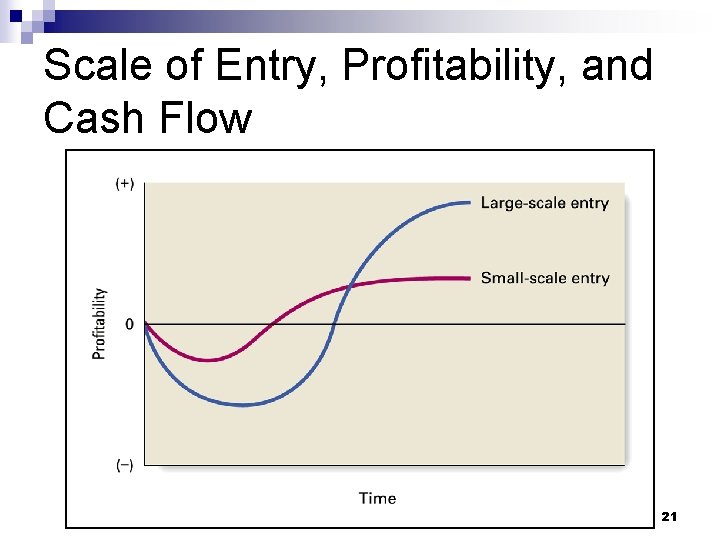
Entry Strategy: Internal New Ventures—Pitfalls n Scale of entry ¨ Large-scale entry is initially more expensive than small-scale entry, but it brings higher returns in the long run 20
Scale of Entry, Profitability, and Cash Flow 21
Entry Strategy: Internal New Ventures—Pitfalls (cont’d) n Commercialization ¨ Technological possibilities should not overshadow market needs and opportunities n Poor implementation ¨ Demands on cash flow ¨ Clear strategic objectives are needed ¨ Anticipating time and costs 22
Guidelines for Successful Internal New Venturing n Structured approach to managing internal new venturing ¨ Research research aimed at advancing basic science and technology ¨ Development research aimed at finding and refining commercial applications for the technology ¨ Foster close links between R&D and marketing; between R&D and manufacturing ¨ Selection process for choosing ventures ¨ Monitor progress 23
Entry Strategy: Acquisitions— Attractions To achieve horizontal integration n To achieve diversification when the company lacks important competencies n To move quickly n Perceived as less risky than internal new ventures n When the new industry is well established and enterprises enjoy protection from barriers to entry n 24
Entry Strategy: Acquisitions— Pitfalls Difficulty with post-acquisition integration n Overestimating economic benefits n The expense of acquisitions n Inadequate pre-acquisition screening n 25
Guidelines for Successful Acquisition Target identification and pre-acquisition screening n Bidding strategy n ¨ Hostile vs. friendly takeover Integration n Learning from experience n 26
Entry Strategy: Joint Ventures— Attractions Helps avoid the risks and costs of building a new operation up from the ground floor n Teaming with another company that has complementary skills and assets may increase the probability of success n 27
Entry Strategy: Joint Ventures— Pitfalls Requires the sharing of profits if the new business succeeds n Venture partners must share control; conflicts on how to run the joint venture can cause failure n Runs the risk of giving critical know-how away to joint venture partner n 28
Restructuring n n Reducing the scope of the company by exiting business areas Why restructure? ¨ Diversification discount: investors see highly diversified companies as less attractive n n Complexity and lack of transparency in financial statements Too much diversification or for the wrong reasons ¨ Response to failed acquisitions ¨ Innovations have diminished the advantages of vertical integration or diversification 29
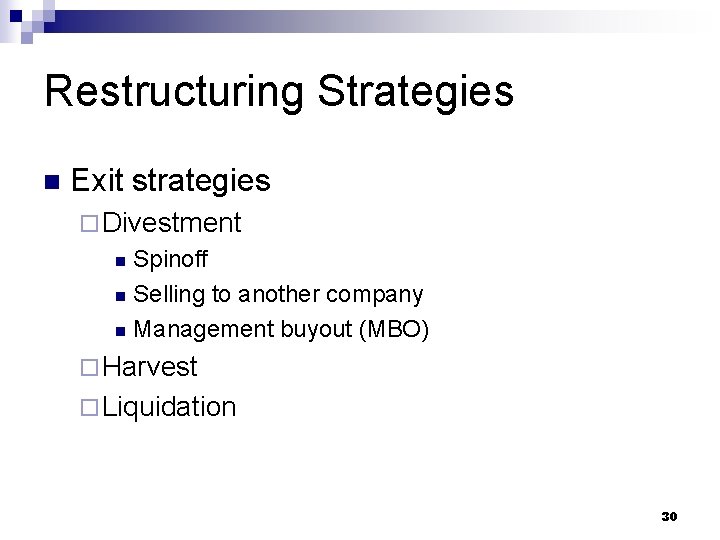
Restructuring Strategies n Exit strategies ¨ Divestment Spinoff n Selling to another company n Management buyout (MBO) n ¨ Harvest ¨ Liquidation 30