
10 CHAPTER Probation Parole and Intermediate Sanctions The
10 CHAPTER Probation, Parole, and Intermediate Sanctions
The Justifications for Community Corrections § Today about 4 million offenders are serving their sentences on probation rather than behind bars § 850, 000 offenders have been paroled and finish their sentences “on the outside” § Probation and parole are known as community corrections § Often considered less severe than prison
The Justification for Community Corrections § Reintegration § § Diversion § § Preparing offenders to return to the community unmarred by further criminal behavior Diverting those who qualify away from prison/jail and toward community-based and intermediate sanctions The Low-Cost Alternative § § Community corrections offer an enticing financial alternative to imprisonment Community-based criminals finance their own supervision
Probation: Doing Time in the Community § Probation is the most common form of punishment in the United States § Legal status of a convicted offender who serves his sentence in the community under the supervision of a probation officer for a designated period of time § § Is subject to certain conditions imposed by the court Theory is that the offender can be treated more economically and humanely
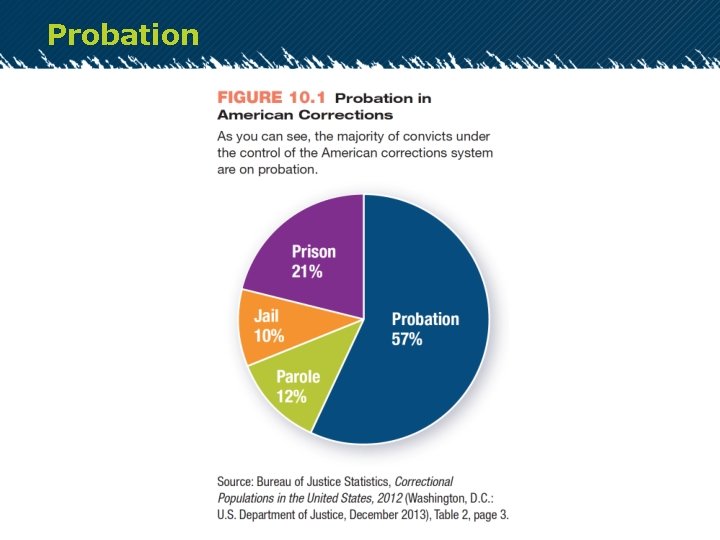
Probation
Discussion Question #1 § As discussed, the majority of offenders under the control of the corrections system are on probation. § People are sentenced to probation for violent, property, drug, and all other offenses. § Do you feel that there any specific offenders or offenses that should not be eligible for probation? § § Murderers, rapists, habitual offenders, etc… Explain your position.
Probation § In traditional probation, offender agrees to certain terms for a specified amount of time in return for serving the sentence in the community § Benefits § § Not serving sentence in a correctional facility Probationary sentence is usually shorter than the length of a prison term

Probation § Sentencing choices and probation § Suspended sentence § § Offender is sentenced after being convicted of a crime but is not required to being serving the sentence Alternative Sentencing Arrangements § § § Split sentence (shock probation) Shock incarceration Intermittent incarceration
Probation § Offenders are most likely to be denied probation if they: § § § Are convicted on multiple charges Were on probation or parole at the time of arrest Have two or more prior convictions Are addicted to narcotics Seriously injured the victim of the crime Used a weapon in the commission of the crime
Conditions of Probation § The probation officer and judge impose certain conditions as part of the probation sentence § These conditions represent a “contract” between the government and the offender § § If violated, probation may be revoked Principles of Probation § A judge’s personal philosophy is often reflected in the probation conditions that he or she creates for probationers
Probation § Types of Conditions: § Standard conditions § § § Punitive conditions § § § Imposed on all probationers Include reporting regularly to officer, notifying the agency of any change of address Designed to reflect the seriousness of the offense and increase punishment Include fines, community service, drug testing Treatment conditions § § Designed to help the offender with issues that may contribute to criminal activity Include counseling for drug and alcohol abuse and mental health issues
The Supervisory Role of the Probation Officer § The Probation officer has two basic roles: § Investigative § § § Supervisory (line officers) Size of agency § § § Conducting the Presentence Investigation (PS) In smaller probation agencies, individual officers perform both tasks In larger jurisdictions, the trend has been separating the responsibilities Role Conflict § § Guiding the probationer to a successful completion of the probationary term Protect the community from the probationer
Discussion Question #2: § Imagine you are a probation officer. § Reflect back on the role conflict of probation officers. § § Guiding the probationer to a successful completion of the probationary term Protect the community from the probationer § As a probation officer which role would you focus more on? § Why? § How would this role preference determine how you handle technical violations?
The Supervisory Role of the Probation Officer § The Use of Authority § § An ideal officer-offender relationship is based on trust (does not often exist) Most officers rely on their authority to guide an offender successfully through the sentence § § Often times the authority is based on the power to revoke probation Caseload Dilemma § § § Probation officer caseloads are excessive Ideal caseload size is difficult to determine With large caseloads it is difficult to enforce the conditions imposed on their clients
Probation § Probation can end in one of two ways § § § The offender successfully completes the sentence The offender misbehaves and probation is revoked Probation revocation can occur if the offender commits a § § New crime Technical violation § Not criminal but the offender breaks the terms of probation or parole as designated by the court § § § Failing to report a change of address Testing positive for drug use It is up to the probation officer to refer an offender’s violation to the courts
Discussion Question #3 § Imagine you are a probation officer supervising a violent felony caseload. § § How often do you think it is appropriate for each offender to visit you in your office? How often should you do a site visit with each offender at their home? What amount of offenders do you think qualifies as an appropriate caseload for you to properly supervise them? What else do you expect to do to be considered a quality probation officer who is properly supervising his/her caseload?

Probation § The Revocation Process § § § Offenders do not enjoy the same protections under the U. S. Constitution during a revocation hearing Alleged probation violators are entitled to an attorney during the revocation process A three stage procedure is appropriate § Preliminary Hearing § § Revocation Hearing § § Judge determines if probable cause for revoking probation exists In front of a judge; probation agency presents evidence to support its claim of violation; probationers can testify on their own behalf and present witnesses Revocation Sentencing § The judge must decide what the penalty will be if the offender has established that a violation has occurred

Does Probation Work? § Goals of Probation § § Probation and other forms of community corrections programs are evaluated by their success in preventing recidivism § The rearrest or return to incarceration of the probationer Effective supervisory probation strategies include behavior monitoring and behavior change Smaller caseloads decrease the rates of probationers being arrested for new crimes Risk Factors for Recidivism § § About 15% of all probationers are returned to prison or jail before the end of the probation term Risk factors include § Antisocial personality patterns § Procriminal attitudes § Social supports for crime § Unemployment and substance abuse
The Parole Picture § Approximately 850, 000 Americans are living in the community on parole § Parole is the conditional release of an inmate before his or her sentenced has expired § Parole is based on three concepts § § § Grace Contract of consent Custody
Comparing Probation and Parole § Both probation and parole operate under the assumption that the offender serves his or her time in the community rather than in a prison or jail § Circumstances are different § Probation is a sentence handed down by a judge following a conviction and does not usually include incarceration Parole occurs after an offender has already served some time in a correctional facility
Comparing Probation and Parole § Conditions of Parole § § Similar to probation supervision Required to follow certain conditions Many jurisdictions combine the duties of probation and parole officers because they are so similar Parolees have a control contract § Sets out the agreement between the state and the paroled offender § Parole Revocation § § § About 25% of parolees return to prison before the end of their parole period Property crimes are the most common reason for the revocation Parole revocation is similar to probation revocation § With a technical violation it is the parole authorities that have the discretion to initiate revocation proceedings
Discretionary Release § States with indeterminate sentencing have systems of discretionary release § Eligibility for Parole § § § Parole is not a right, but a privilege In most states a prisoner is eligible to be considered for parole after serving a legislatively determined percentage of the minimum sentence There are offenders serving life sentences who will never be eligible for parole
Discretionary Release § Parole Procedures § § Jurisdictions have their procedures for determining discretionary release dates Parole boards make the parole decision (usually 3 to 7 members) § § Usually the board is appointed by the governor (limited terms) Roles of the parole board § § To decide which offenders should be placed on parole To determine the conditions of parole and aid in the continuing supervision of the parolee To discharge the offender when the conditions of parole have not been met If a violation occurs, to determine whether parole privileges should be revoked
Discretionary Release § The Parole Decision § Criteria to determine discretionary release § § § The nature and circumstances of the underlying offense and the offender’s current attitude toward it The offender’s prior criminal record The offender’s attitude toward the victim and the victim’s family members The offender’s physical, mental, and emotional health The offender’s behavior behind bars, including his or her participation in programs for self-improvement Recently including the wants and needs of the victims
Discretionary Release § Parole Grant Hearing § § Parole Denial § § The entire parole board or subcommittee reviews information, meets the offender, and hears testimony from relevant witnesses to determine whether to grant parole Reasons for denial usually involve poor prison behavior and/or severity of the underlying crime Parole Guidelines § Many states have moved away from discretionary release and have mandatory release § Offender has served the full length of his or her sentence, minus any good time adjustments § § Offenders will usually know their presumptive parole date soon after entering prison Rely on parole guidelines § Standards that are used in the parole process to measure the risk that a potential parolee will recidivate and determine the release date
Intermediate Sanctions § Many feel that imprisonment and probation fail to reflect the immense diversity of crimes and criminals and propose intermediate sanctions § § More restrictive than probation and less restrictive than imprisonment Judicially Administered Sanctions § § § Fines Community service Restitution Forfeiture Pretrial diversion programs
Intermediate Sanctions § Pretrial Diversion Programs § An alternative to trial offered by a judge or prosecutor § Offender agrees to participate in a specified counseling or treatment program in return for withdrawal of charges § Problem-Solving Courts § Opportunity to divert low-level offenders § Address specific problems like drug addiction, mental § § illness, and domestic violence When offenders complete the program, the charges are dropped Forfeiture § Process by which the government seizes property gained or § § used in criminal activity Once property is forfeited, the government can sell the property or use the property in further crime fighting efforts or award it to a third party Billions of dollars worth of contraband property have been impounded
Intermediate Sanctions § Day Reporting Centers: § § Community based corrections center where offenders report daily for purposes of treatment, education, and incapacitation Intensive Probation Supervision: § § § A more restrictive alternative to regular probation Stricter and more frequent surveillance and control than conventional probation Goal is to provide prisonlike control of offenders while keeping them out of prison
Intermediate Sanctions § Shock Incarceration: § § § Home Confinement: § § Offenders spend a short period of time in an institution The boot camp is a variation on traditional shock incarceration and includes military training with strict discipline, manual labor, and physical training Offenders are required to spend extended periods of time confined to their homes, sometimes administered in conjunction with electronic monitoring Electronic Monitoring: § Offender’s whereabouts are kept under surveillance by an electronic device
Intermediate Sanctions § Levels of Home Monitoring: § § Curfew Home detention § § Home incarceration § § Offenders are required to remain home at all times with exceptions being made for education, counseling, employment or other specified activities Offenders are required to remain home at all times, except for medical emergencies Types of Electronic Monitoring § § Programmed contact Continuous signaling
Widening the Net § Net Widening: § § § A criticism of intermediate sanctions As more and more alternatives to incarceration are used, the criminal justice system can expand the number of people that come under its supervision Strengthen the Net: § § Increase the government’s power to intervene in the lives of citizens Technological advances accelerate this trend
Discussion Question #4 § Billions of dollars are spent each year incarcerating millions of offenders. § Many states are evaluating their discretionary release policies, especially for elderly offenders who have severe medical issues. § Should prisons release terminally ill offenders who are sentenced to life in prison? § What factors need to be considered?
- Slides: 32