
10 Chapter Measuring Exposure To Exchange Rate Fluctuations









- Slides: 38
10 Chapter Measuring Exposure To Exchange Rate Fluctuations See c 10. xls for spreadsheets to accompany this chapter. South-Western/Thomson Learning © 2003
Chapter Objectives • To discuss the relevance of an MNC’s exposure to exchange rate risk; • To explain how transaction exposure can be measured; • To explain how economic exposure can be measured; and • To explain how translation exposure can be measured. C 10 - 2
Is Exchange Rate Risk Relevant? Purchasing Power Parity Argument û Exchange rate movements will be matched by price movements. ü PPP does not necessarily hold. C 10 - 3
Is Exchange Rate Risk Relevant? The Investor Hedge Argument û MNC shareholders can hedge against exchange rate fluctuations on their own. ü The investors may not have complete information on corporate exposure. They may not have the capabilities to correctly insulate their individual exposure too. C 10 - 4
Is Exchange Rate Risk Relevant? Currency Diversification Argument û An MNC that is well diversified should not be affected by exchange rate movements because of offsetting effects. ü This is a naive presumption. C 10 - 5
Is Exchange Rate Risk Relevant? Stakeholder Diversification Argument û Well diversified stakeholders will be somewhat insulated against losses experienced by an MNC due to exchange rate risk. ü MNCs may be affected in the same way because of exchange rate risk. C 10 - 6
Is Exchange Rate Risk Relevant? Response from MNCs • Many MNCs have attempted to stabilize their earnings with hedging strategies, which confirms the view that exchange rate risk is relevant. C 10 - 7
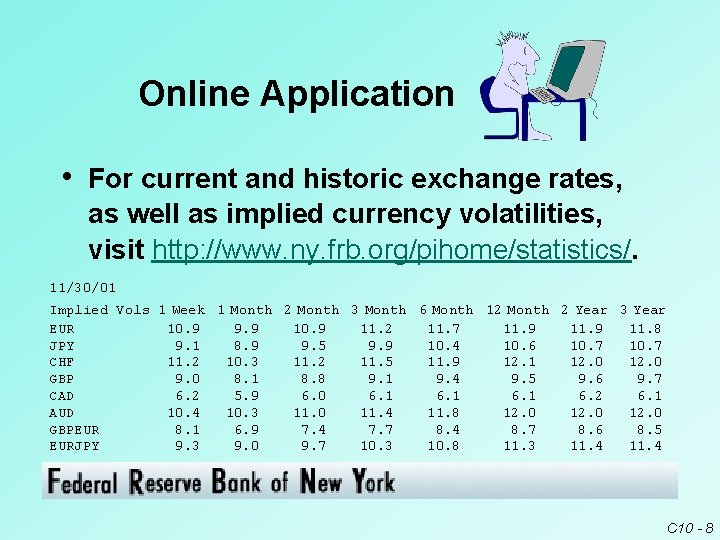
Online Application • For current and historic exchange rates, as well as implied currency volatilities, visit http: //www. ny. frb. org/pihome/statistics/. 11/30/01 Implied Vols 1 Week 1 Month 2 Month 3 Month 6 Month 12 Month 2 Year 3 Year EUR 10. 9 9. 9 10. 9 11. 2 11. 7 11. 9 11. 8 JPY 9. 1 8. 9 9. 5 9. 9 10. 4 10. 6 10. 7 CHF 11. 2 10. 3 11. 2 11. 5 11. 9 12. 1 12. 0 GBP 9. 0 8. 1 8. 8 9. 1 9. 4 9. 5 9. 6 9. 7 CAD 6. 2 5. 9 6. 0 6. 1 6. 2 6. 1 AUD 10. 4 10. 3 11. 0 11. 4 11. 8 12. 0 GBPEUR 8. 1 6. 9 7. 4 7. 7 8. 4 8. 7 8. 6 8. 5 EURJPY 9. 3 9. 0 9. 7 10. 3 10. 8 11. 3 11. 4 C 10 - 8
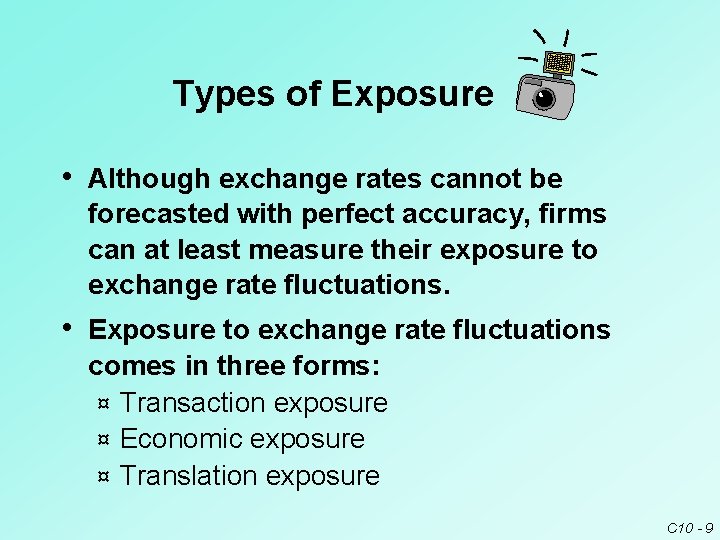
Types of Exposure • Although exchange rates cannot be forecasted with perfect accuracy, firms can at least measure their exposure to exchange rate fluctuations. • Exposure to exchange rate fluctuations comes in three forms: ¤ Transaction exposure ¤ Economic exposure ¤ Translation exposure C 10 - 9
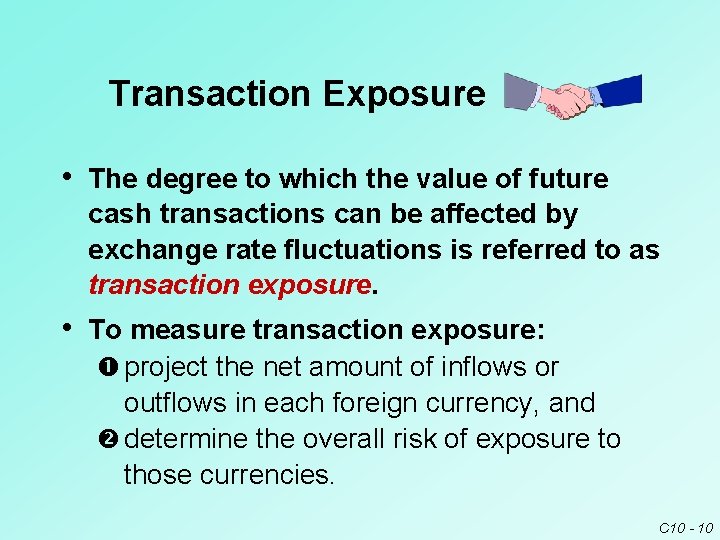
Transaction Exposure • The degree to which the value of future cash transactions can be affected by exchange rate fluctuations is referred to as transaction exposure. • To measure transaction exposure: project the net amount of inflows or outflows in each foreign currency, and determine the overall risk of exposure to those currencies. C 10 - 10
Transaction Exposure • MNCs can usually anticipate foreign cash flows for an upcoming short-term period with reasonable accuracy. • After the consolidated net currency flows for the entire MNC has been determined, each net flow is converted into either a point estimate or a range of a chosen currency, so as to standardize the exposure assessment for each currency. C 10 - 11
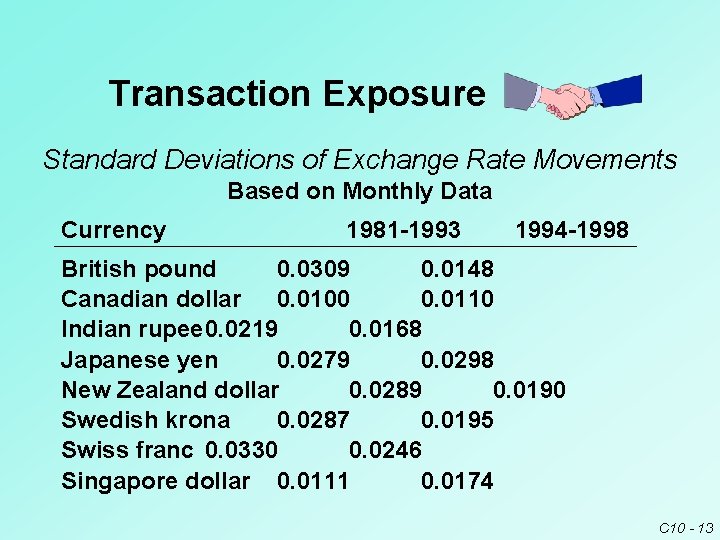
Transaction Exposure • An MNC’s overall exposure can be assessed by considering each currency position together with the currency’s variability and the correlations among the currencies. • The standard deviation statistic on historical data serves as one measure of currency variability. Note that currency variability levels may change over time. C 10 - 12
Transaction Exposure Standard Deviations of Exchange Rate Movements Based on Monthly Data Currency 1981 -1993 1994 -1998 British pound 0. 0309 0. 0148 Canadian dollar 0. 0100 0. 0110 Indian rupee 0. 0219 0. 0168 Japanese yen 0. 0279 0. 0298 New Zealand dollar 0. 0289 0. 0190 Swedish krona 0. 0287 0. 0195 Swiss franc 0. 0330 0. 0246 Singapore dollar 0. 0111 0. 0174 C 10 - 13
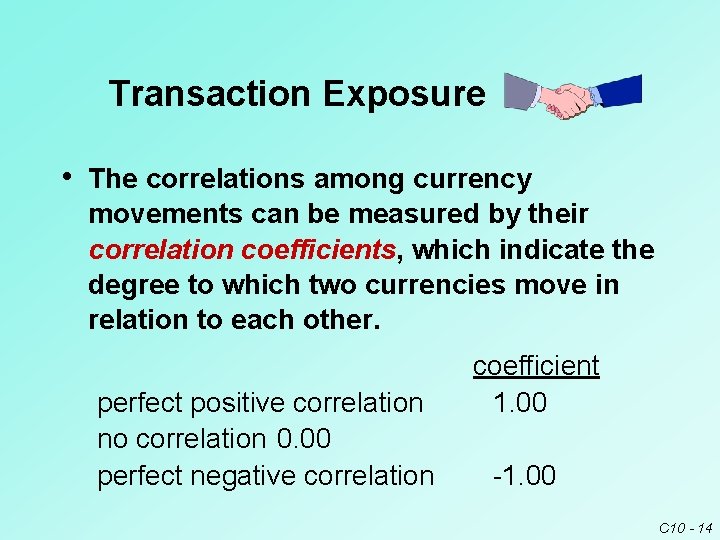
Transaction Exposure • The correlations among currency movements can be measured by their correlation coefficients, which indicate the degree to which two currencies move in relation to each other. perfect positive correlation no correlation 0. 00 perfect negative correlation coefficient 1. 00 C 10 - 14
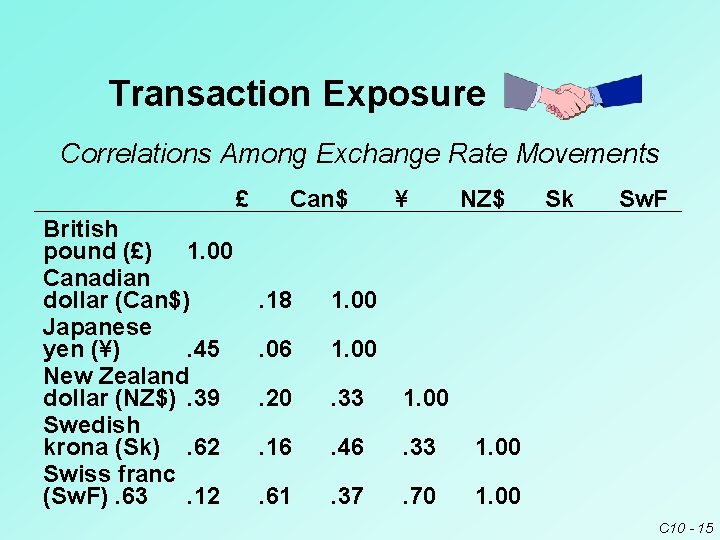
Transaction Exposure Correlations Among Exchange Rate Movements £ British pound (£) 1. 00 Canadian dollar (Can$) Japanese yen (¥). 45 New Zealand dollar (NZ$). 39 Swedish krona (Sk). 62 Swiss franc (Sw. F). 63. 12 Can$ ¥ NZ$ . 18 1. 00 . 06 1. 00 . 20 . 33 1. 00 . 16 . 46 . 33 1. 00 . 61 . 37 . 70 1. 00 Sk Sw. F C 10 - 15
Transaction Exposure • The point in considering correlations is to detect positions that could somewhat offset each other. • For example, if currencies X and Y are highly correlated, the exposures of a net X inflow and a net Y outflow will offset each other to a certain degree. • Note that the corrrelations among currencies may change over time. C 10 - 16
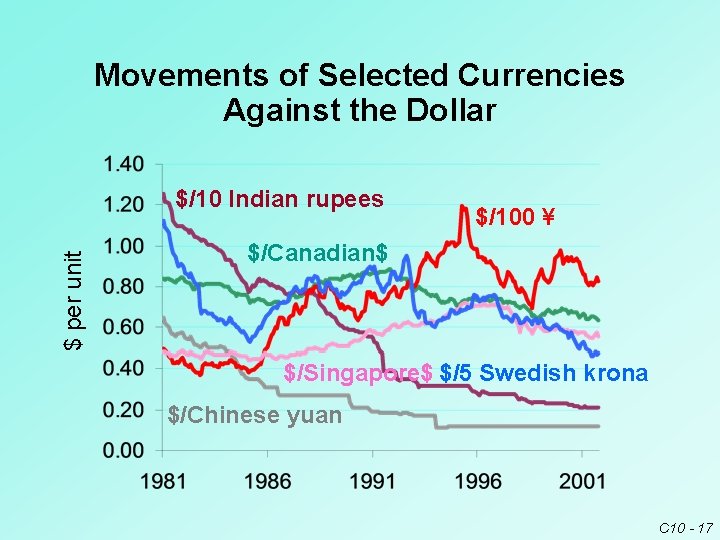
Movements of Selected Currencies Against the Dollar $ per unit $/10 Indian rupees $/100 ¥ $/Canadian$ $/Singapore$ $/5 Swedish krona $/Chinese yuan C 10 - 17
Transaction Exposure • A related method, the value-at-risk (VAR) method, incorporates currency volatility and correlations to determine the potential maximum one-day loss. • Historical data is used to determine the potential one-day decline in a particular currency. This decline is then applied to the net cash flows in that currency. C 10 - 18
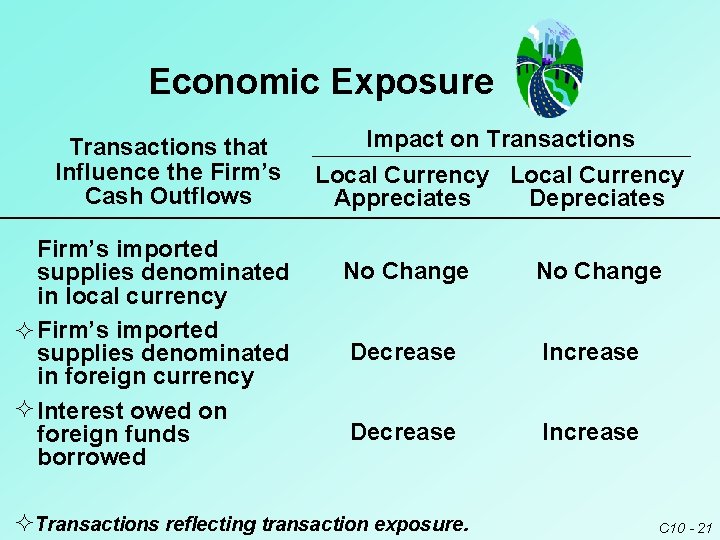
Economic Exposure • Economic exposure refers to the degree to which a firm’s present value of future cash flows can be influenced by exchange rate fluctuations. • Cash flows that do not require conversion of currencies do not reflect transaction exposure. Yet, these cash flows may also be influenced significantly by exchange rate movements. C 10 - 19
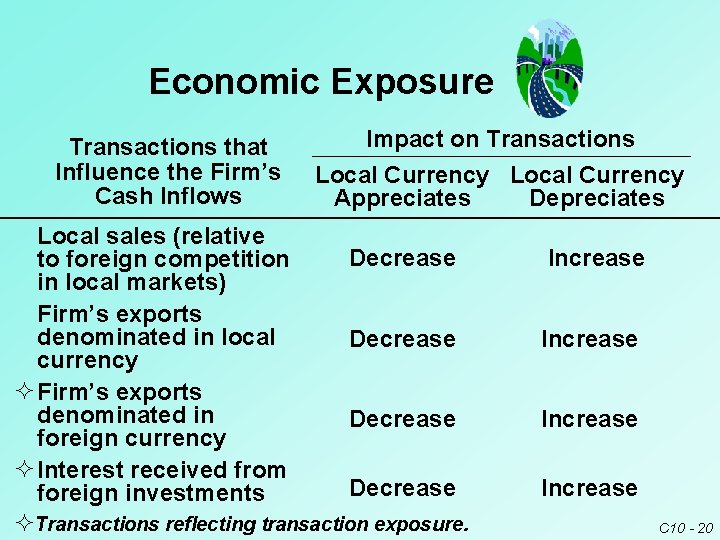
Economic Exposure Transactions that Influence the Firm’s Cash Inflows Impact on Transactions Local Currency Appreciates Depreciates Local sales (relative Decrease to foreign competition in local markets) Firm’s exports denominated in local Decrease currency Firm’s exports denominated in Decrease foreign currency Interest received from Decrease foreign investments Transactions reflecting transaction exposure. Increase C 10 - 20
Economic Exposure Transactions that Influence the Firm’s Cash Outflows Firm’s imported supplies denominated in local currency Firm’s imported supplies denominated in foreign currency Interest owed on foreign funds borrowed Impact on Transactions Local Currency Appreciates Depreciates No Change Decrease Increase Transactions reflecting transaction exposure. C 10 - 21
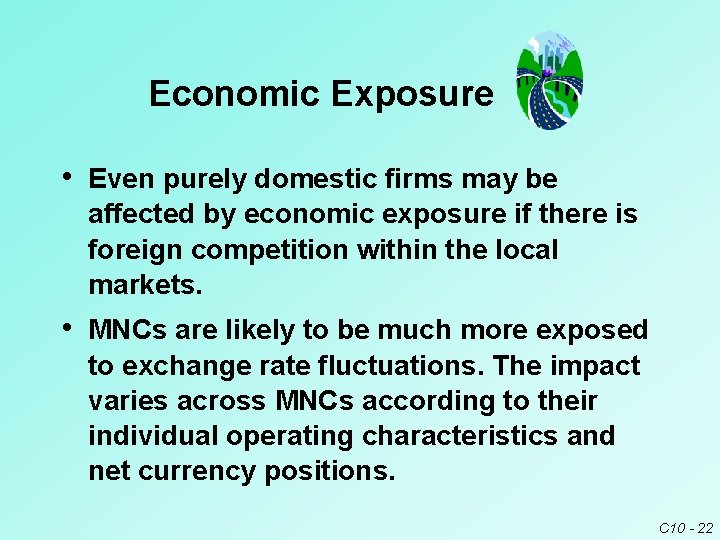
Economic Exposure • Even purely domestic firms may be affected by economic exposure if there is foreign competition within the local markets. • MNCs are likely to be much more exposed to exchange rate fluctuations. The impact varies across MNCs according to their individual operating characteristics and net currency positions. C 10 - 22
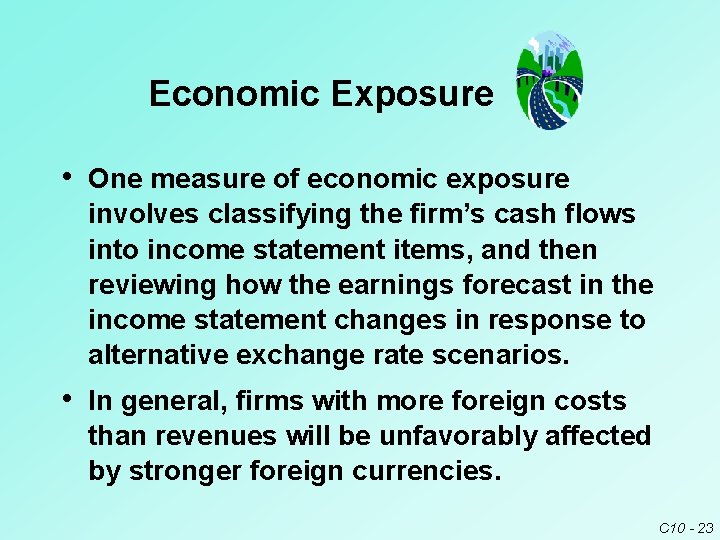
Economic Exposure • One measure of economic exposure involves classifying the firm’s cash flows into income statement items, and then reviewing how the earnings forecast in the income statement changes in response to alternative exchange rate scenarios. • In general, firms with more foreign costs than revenues will be unfavorably affected by stronger foreign currencies. C 10 - 23
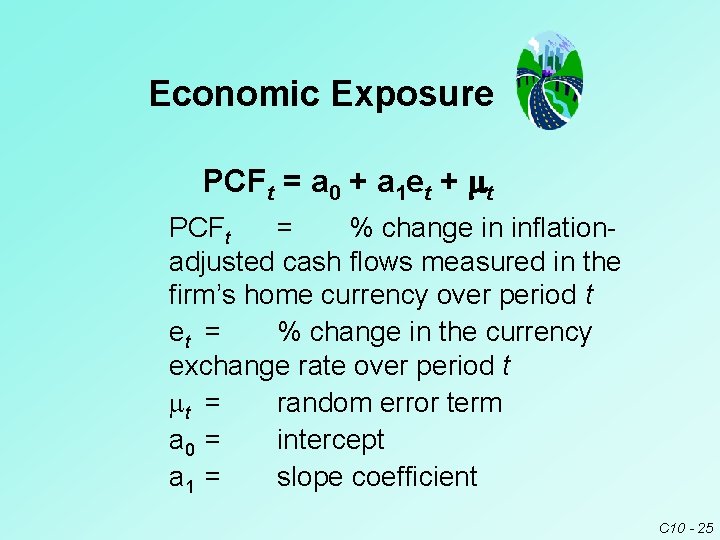
Economic Exposure • Another method of assessing a firm’s economic exposure involves applying regression analysis to historical cash flow and exchange rate data. C 10 - 24
Economic Exposure PCFt = a 0 + a 1 et + t PCFt = % change in inflation adjusted cash flows measured in the firm’s home currency over period t et = % change in the currency exchange rate over period t t = random error term a 0 = intercept a 1 = slope coefficient C 10 - 25
Economic Exposure • The regression model may be revised to handle multiple currencies by including them as additional independent variables, or by using a currency index (composite). • By changing the dependent variable, the impact of exchange rates on the firm’s value (as measured by its stock price), earnings, exports, sales, etc. may also be assessed. C 10 - 26
Translation Exposure • The exposure of the MNC’s consolidated financial statements to exchange rate fluctuations is known as translation exposure. • In particular, subsidiary earnings translated into the reporting currency on the consolidated income statement are subject to changing exchange rates. C 10 - 27
Translation Exposure Does Translation Exposure Matter? • Cash Flow Perspective - Translating financial statements for consolidated reporting purposes does not by itself affect an MNC’s cash flows. • However, a weak foreign currency today may result in a forecast of a weak exchange rate at the time subsidiary earnings are actually remitted. C 10 - 28
Translation Exposure Does Translation Exposure Matter? • Stock Price Perspective - Since an MNC’s translation exposure affects its consolidated earnings and many investors tend to use earnings when valuing firms, the MNC’s valuation may be affected. C 10 - 29
Translation Exposure • In general, translation exposure is relevant because some MNC subsidiaries may want to remit their earnings to their parents now, the prevailing exchange rates may be used to forecast the expected cash flows that will result from future remittances, and consolidated earnings are used by many investors to value MNCs. C 10 - 30
Translation Exposure • An MNC’s degree of translation exposure is dependent on: the proportion of its business conducted by its foreign subsidiaries, the locations of its foreign subsidiaries, and the accounting method that it uses. C 10 - 31
Translation Exposure • According to World Research Advisory estimates, the translated earnings of U. S. based MNCs in aggregate were reduced by $20 billion in the third quarter of 1998 alone simply because of the depreciation of Asian currencies against the dollar. • In 2000, the weakness of the euro also caused several U. S. -based MNCs to report lower earnings than expected. C 10 - 32
Online Application • The annual reports for many MNCs may be found at http: //www. reportgallery. com. Review some annual reports and see if you can find any comments that describe the MNCs’ transaction, economic, or translation exposures. C 10 - 33
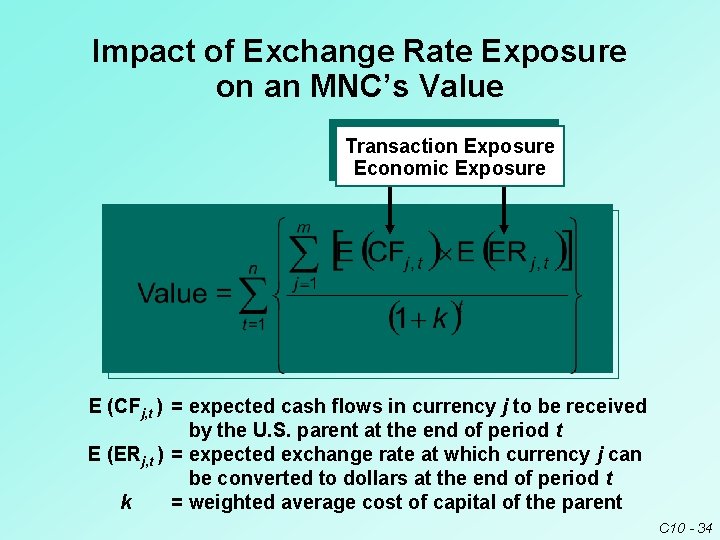
Impact of Exchange Rate Exposure on an MNC’s Value Transaction Exposure Economic Exposure E (CFj, t ) = expected cash flows in currency j to be received by the U. S. parent at the end of period t E (ERj, t ) = expected exchange rate at which currency j can be converted to dollars at the end of period t k = weighted average cost of capital of the parent C 10 - 34
Chapter Review • Is Exchange Rate Risk Relevant? ¤ ¤ ¤ Purchasing Power Parity Argument The Investor Hedge Argument Currency Diversification Argument Stakeholder Diversification Argument Response from MNCs • Types of Exposure ¤ Transaction, Economic, and Translation Exposures C 10 - 35
Chapter Review • Transaction Exposure to “Net” Cash Flows ¤ Transaction Exposure Based on Currency Variability ¤ Transaction Exposure Based on Currency Correlations ¤ Transaction Exposure Based on Value at Risk ¤ C 10 - 36
Chapter Review • Economic Exposure to Local Currency Appreciation & Depreciation ¤ Economic Exposure of Domestic Firms & MNCs ¤ Measuring Economic Exposure Sensitivity of Earnings & Cash Flows to Exchange Rates ¤ C 10 - 37
Chapter Review • Translation Exposure Does Translation Exposure Matter? Cash Flow Perspective Stock Price Perspective ¤ Determinants of Translation Exposure ¤ Examples of Translation Exposure ¤ • Impact of Exchange Rate Exposure on an MNC’s Value C 10 - 38