
10 CHAPTER 10 INTERCOMPANY FIXED ASSET TRANSFERS Slide





- Slides: 14
10 CHAPTER 10 INTERCOMPANY FIXED ASSET TRANSFERS Slide 10 -1
10 FOCUS OF CHAPTER 10 l Changing From The New Basis of Accounting to The Old Basis of Accounting in Consolidation l The Additional Complexities of Fixed Asset Transfers in Relation to Inventory Transfers Slide 10 -2
Summary of GAAP Requirements 10 for Preparing Consolidated Statements l ALL intercompany transactions must be eliminated in consolidation. l ALL unrealized intercompany profit or gain must be eliminated. l The gross profit (full gain) is eliminated. l Income taxes (benefit) on such profits or gains (or losses) must also be deferred. l Sharing the deferral with NCI shareholders is allowed. Slide 10 -3
10 The Consolidated Perspective l From a consolidated viewpoint, the reported amount for a fixed asset cannot change merely because the asset has been moved to a different location within the consolidated group. Saxco Paxco Saxco Consolidated Group Slide 10 -4
10 The Consolidated Perspective l What applies to intercompany fixed asset transfers applies equally as well to transfers of: n Inventory n Patents n Copyrights n Capitalized software n Other assets Slide 10 -5
Changing from the New Basis 10 to the Old Basis in Consolidation l The Objective of Changing to the Old Basis of Accounting in Consolidation: n To report amounts based on the SELLING ENTITY’S historical cost for the: #1 s Fixed asset’s cost. #2 s Related accumulated depreciation. #3 s Related depreciation expense. n To defer recognizing unrealized profit/gain. Slide 10 -6
Developing Fixed Asset Consolidation 10 Entries: The Classic Approach l Compare WWD with WWWHBD: n WHAT WAS DONE n WHAT WE WISH HAD BEEN DONE l Use the differences for the consolidation entry. This approach is the same as that used for preparing CORRECTING entries. Slide 10 -7
Developing Fixed Asset Consolidation 10 Entries: The Classic Approach l STEP #1: Obtain the balances that exist on the BUYING entity’s books at the balance sheet date. (WWD) l STEP #2: Perform a pro forma calculation of the balances that would have existed if the transfer had been made at the SELLING entity’s carrying value. (WWWHBD) l STEP #3: Use the differences between steps 1 and 2 for the consolidation entry. Slide 10 -8
Using the Right Depreciable Life: 10 What’s Relevant and What’s NOT l In performing the pro forma calculation in STEP #2, use the relevant life: n What’s NOT Relevant: s The OLD remaining life at the transfer date. n What’s Relevant: s Slide 10 -9 The NEW assigned remaining life (if different from the old remaining life).
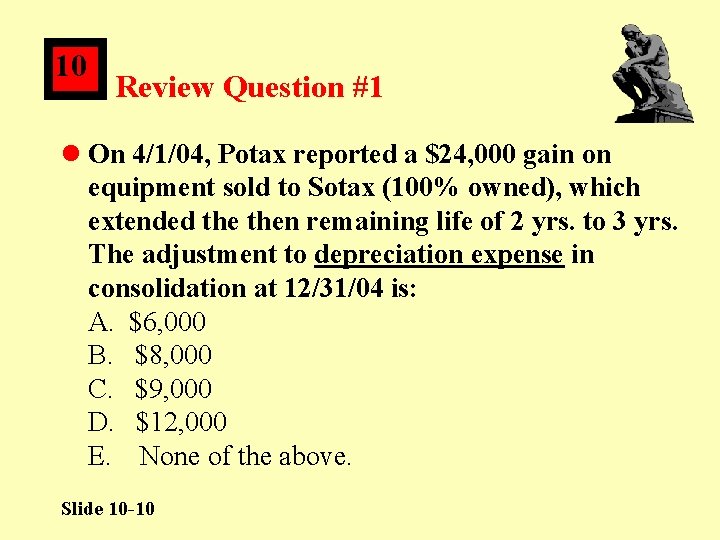
10 Review Question #1 l On 4/1/04, Potax reported a $24, 000 gain on equipment sold to Sotax (100% owned), which extended then remaining life of 2 yrs. to 3 yrs. The adjustment to depreciation expense in consolidation at 12/31/04 is: A. $6, 000 B. $8, 000 C. $9, 000 D. $12, 000 E. None of the above. Slide 10 -10
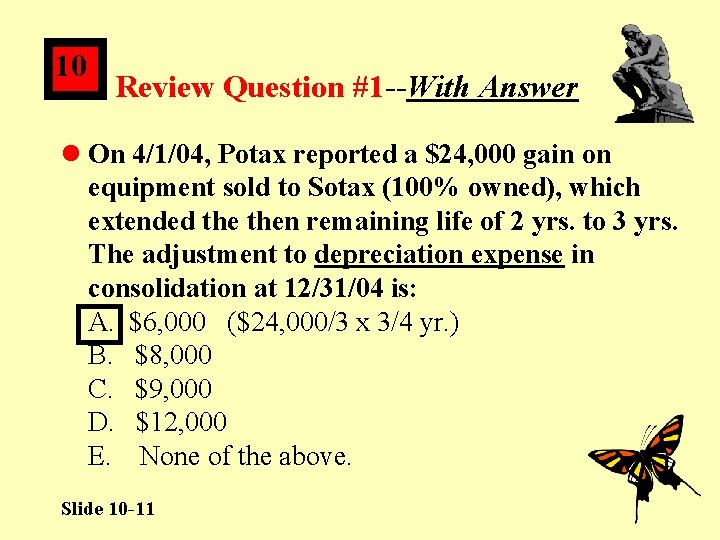
10 Review Question #1 --With Answer l On 4/1/04, Potax reported a $24, 000 gain on equipment sold to Sotax (100% owned), which extended then remaining life of 2 yrs. to 3 yrs. The adjustment to depreciation expense in consolidation at 12/31/04 is: A. $6, 000 ($24, 000/3 x 3/4 yr. ) B. $8, 000 C. $9, 000 D. $12, 000 E. None of the above. Slide 10 -11
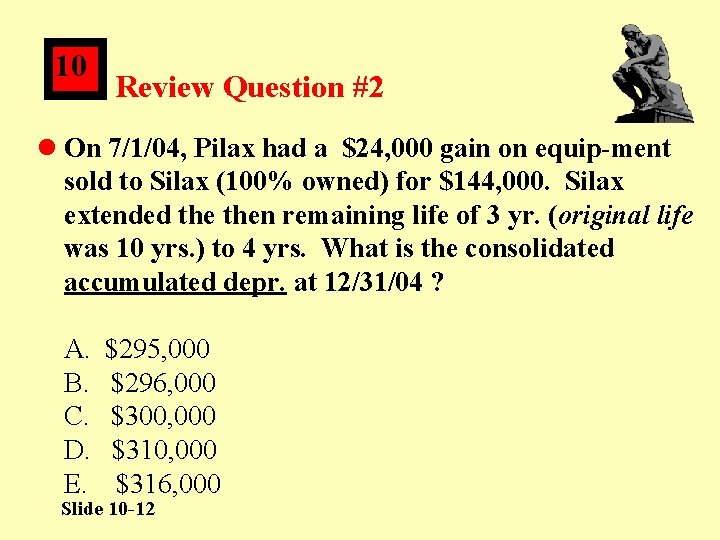
10 Review Question #2 l On 7/1/04, Pilax had a $24, 000 gain on equip-ment sold to Silax (100% owned) for $144, 000. Silax extended then remaining life of 3 yr. (original life was 10 yrs. ) to 4 yrs. What is the consolidated accumulated depr. at 12/31/04 ? A. B. C. D. E. $295, 000 $296, 000 $300, 000 $316, 000 Slide 10 -12
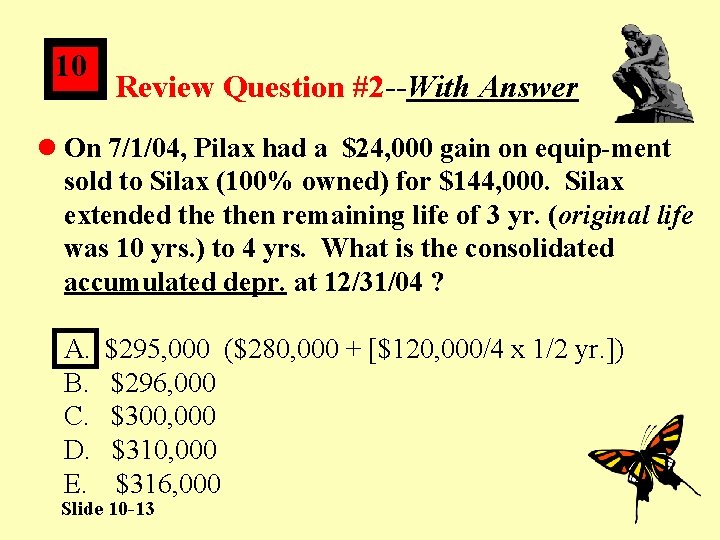
10 Review Question #2 --With Answer l On 7/1/04, Pilax had a $24, 000 gain on equip-ment sold to Silax (100% owned) for $144, 000. Silax extended then remaining life of 3 yr. (original life was 10 yrs. ) to 4 yrs. What is the consolidated accumulated depr. at 12/31/04 ? A. B. C. D. E. $295, 000 ($280, 000 + [$120, 000/4 x 1/2 yr. ]) $296, 000 $300, 000 $316, 000 Slide 10 -13
10 End of Chapter 10 l. Time to Clear Things Up-Any Questions? Slide 10 -14