
10 Capital Budgeting Decisions 2007 Pearson Education Canada
10 Capital Budgeting Decisions © 2007 Pearson Education Canada Slide 10 -1
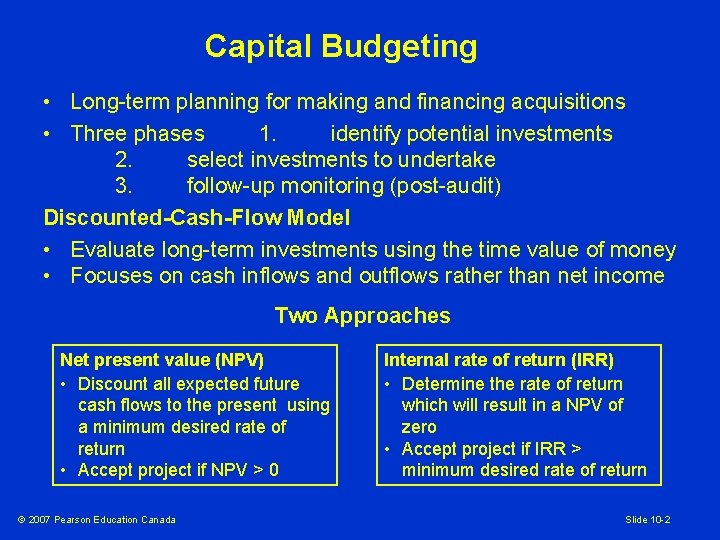
Capital Budgeting • Long-term planning for making and financing acquisitions • Three phases 1. identify potential investments 2. select investments to undertake 3. follow-up monitoring (post-audit) Discounted-Cash-Flow Model • Evaluate long-term investments using the time value of money • Focuses on cash inflows and outflows rather than net income Two Approaches Net present value (NPV) • Discount all expected future cash flows to the present using a minimum desired rate of return • Accept project if NPV > 0 © 2007 Pearson Education Canada Internal rate of return (IRR) • Determine the rate of return which will result in a NPV of zero • Accept project if IRR > minimum desired rate of return Slide 10 -2
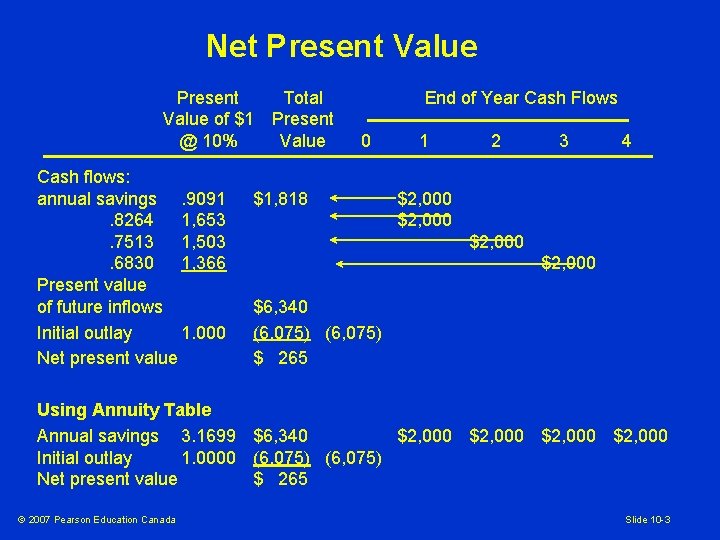
Net Present Value of $1 @ 10% Cash flows: annual savings. 9091. 8264 1, 653. 7513 1, 503. 6830 1, 366 Present value of future inflows Initial outlay 1. 000 Net present value Total Present Value End of Year Cash Flows 0 $1, 818 1 2 3 4 $2, 000 $6, 340 (6, 075) $ 265 Using Annuity Table Annual savings 3. 1699 $6, 340 $2, 000 Initial outlay 1. 0000 (6, 075) Net present value $ 265 © 2007 Pearson Education Canada Slide 10 -3
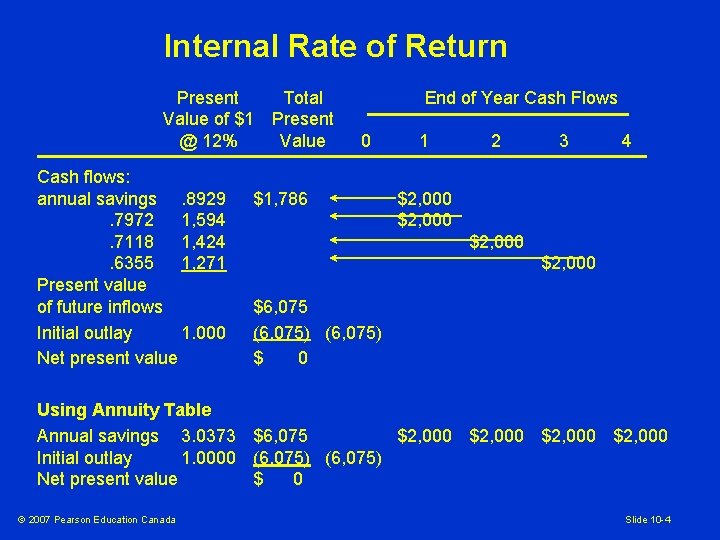
Internal Rate of Return Present Value of $1 @ 12% Cash flows: annual savings. 8929. 7972 1, 594. 7118 1, 424. 6355 1, 271 Present value of future inflows Initial outlay 1. 000 Net present value Total Present Value End of Year Cash Flows 0 $1, 786 1 2 3 4 $2, 000 $6, 075 (6, 075) $ 0 Using Annuity Table Annual savings 3. 0373 $6, 075 $2, 000 Initial outlay 1. 0000 (6, 075) Net present value $ 0 © 2007 Pearson Education Canada Slide 10 -4
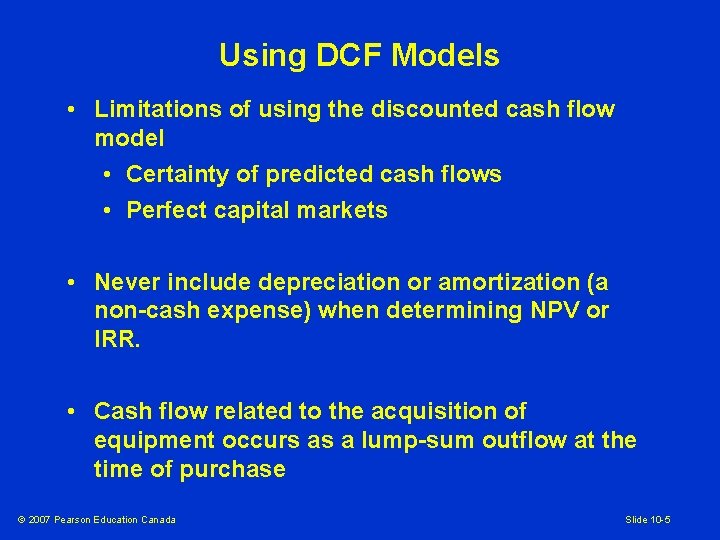
Using DCF Models • Limitations of using the discounted cash flow model • Certainty of predicted cash flows • Perfect capital markets • Never include depreciation or amortization (a non-cash expense) when determining NPV or IRR. • Cash flow related to the acquisition of equipment occurs as a lump-sum outflow at the time of purchase © 2007 Pearson Education Canada Slide 10 -5
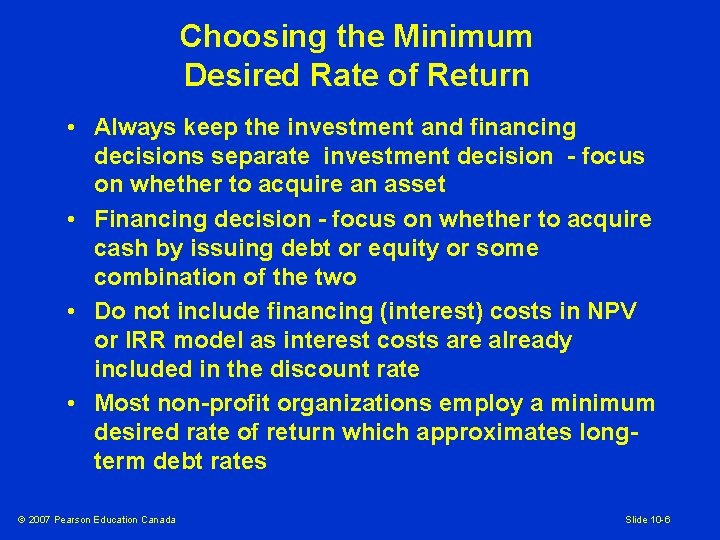
Choosing the Minimum Desired Rate of Return • Always keep the investment and financing decisions separate investment decision - focus on whether to acquire an asset • Financing decision - focus on whether to acquire cash by issuing debt or equity or some combination of the two • Do not include financing (interest) costs in NPV or IRR model as interest costs are already included in the discount rate • Most non-profit organizations employ a minimum desired rate of return which approximates longterm debt rates © 2007 Pearson Education Canada Slide 10 -6
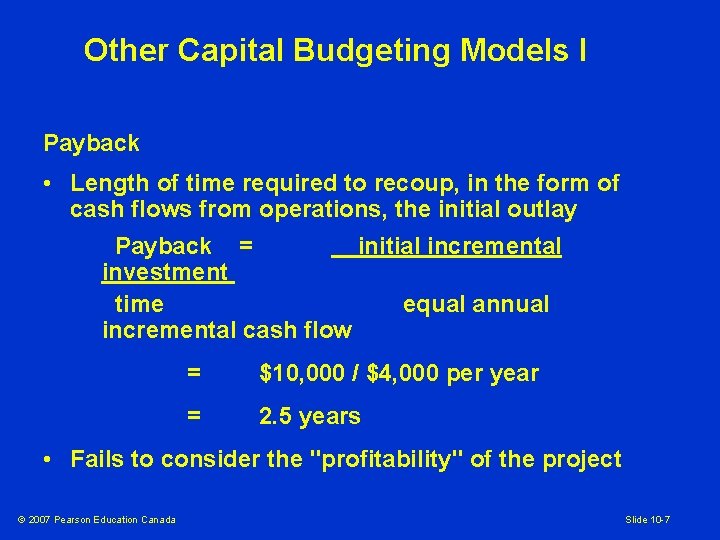
Other Capital Budgeting Models I Payback • Length of time required to recoup, in the form of cash flows from operations, the initial outlay Payback = initial incremental investment time equal annual incremental cash flow = $10, 000 / $4, 000 per year = 2. 5 years • Fails to consider the "profitability" of the project © 2007 Pearson Education Canada Slide 10 -7
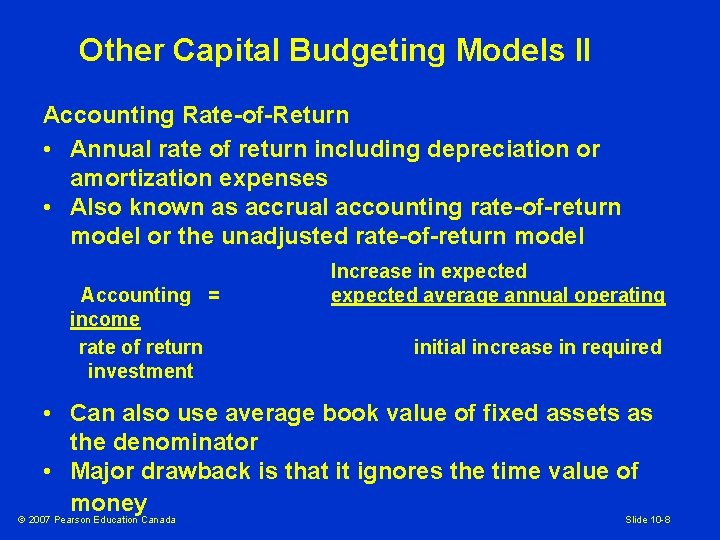
Other Capital Budgeting Models II Accounting Rate-of-Return • Annual rate of return including depreciation or amortization expenses • Also known as accrual accounting rate-of-return model or the unadjusted rate-of-return model Accounting = income rate of return investment Increase in expected average annual operating initial increase in required • Can also use average book value of fixed assets as the denominator • Major drawback is that it ignores the time value of money © 2007 Pearson Education Canada Slide 10 -8
Income Taxes and Capital Budgeting • Depreciation (or amortization) does not require an outlay of cash as cash was given up when the asset was purchased • Depreciation (or amortization) is the systematic allocation of the cost of the asset over its estimated (useful) life • Depreciation (or amortization) is a deductible expense in computing income; it reduces taxable income and the cash flow required to cover taxes payable • When performing capital budgeting analysis, always consider after-tax flows © 2007 Pearson Education Canada Slide 10 -9
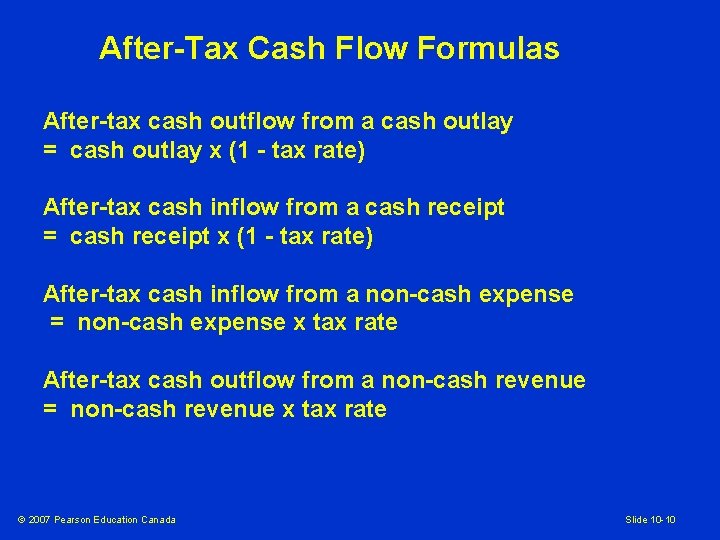
After-Tax Cash Flow Formulas After-tax cash outflow from a cash outlay = cash outlay x (1 - tax rate) After-tax cash inflow from a cash receipt = cash receipt x (1 - tax rate) After-tax cash inflow from a non-cash expense = non-cash expense x tax rate After-tax cash outflow from a non-cash revenue = non-cash revenue x tax rate © 2007 Pearson Education Canada Slide 10 -10
Capital Cost Allowance • Federal Income Tax Act (ITA) does not allow a company to deduct depreciation (or amortization) in determining taxable income • It does however allow for Capital Cost Allowance (CCA) which is the income tax counterpart to depreciation • ITA assigns all assets to specific CCA classes © 2007 Pearson Education Canada Slide 10 -11
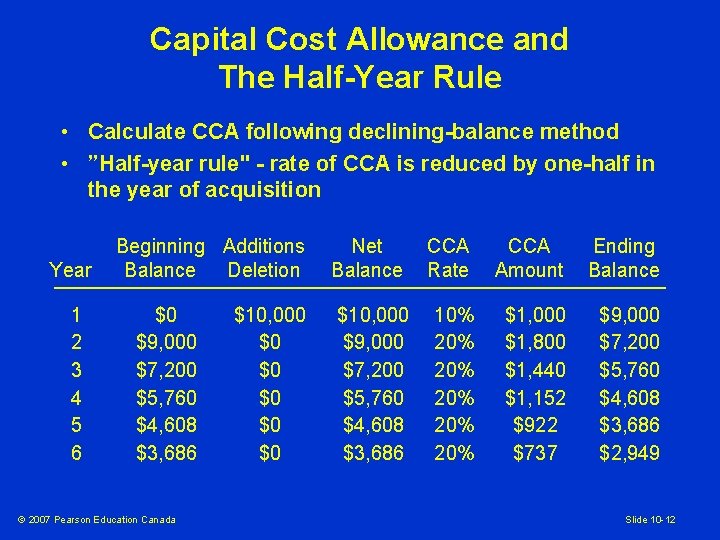
Capital Cost Allowance and The Half-Year Rule • Calculate CCA following declining-balance method • ”Half-year rule" - rate of CCA is reduced by one-half in the year of acquisition Year 1 2 3 4 5 6 Beginning Additions Balance Deletion $0 $9, 000 $7, 200 $5, 760 $4, 608 $3, 686 © 2007 Pearson Education Canada $10, 000 $0 $0 $0 Net Balance $10, 000 $9, 000 $7, 200 $5, 760 $4, 608 $3, 686 CCA Rate CCA Amount Ending Balance 10% 20% 20% 20% $1, 000 $1, 800 $1, 440 $1, 152 $922 $737 $9, 000 $7, 200 $5, 760 $4, 608 $3, 686 $2, 949 Slide 10 -12
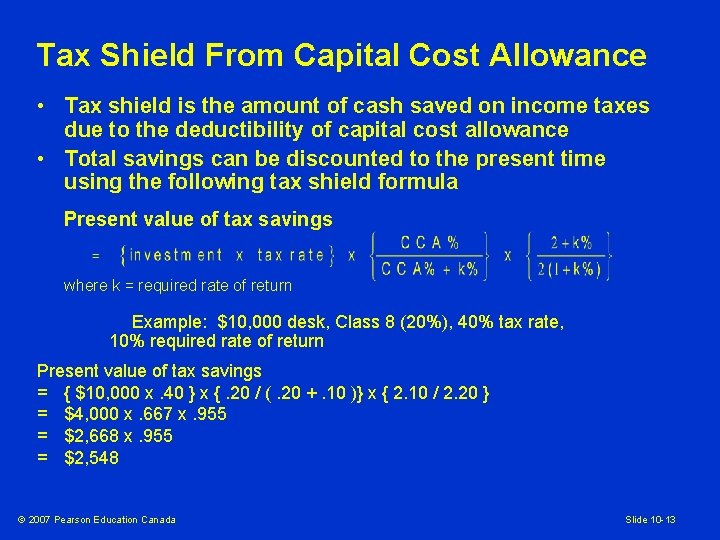
Tax Shield From Capital Cost Allowance • Tax shield is the amount of cash saved on income taxes due to the deductibility of capital cost allowance • Total savings can be discounted to the present time using the following tax shield formula Present value of tax savings where k = required rate of return Example: $10, 000 desk, Class 8 (20%), 40% tax rate, 10% required rate of return Present value of tax savings = { $10, 000 x. 40 } x {. 20 / (. 20 +. 10 )} x { 2. 10 / 2. 20 } = $4, 000 x. 667 x. 955 = $2, 668 x. 955 = $2, 548 © 2007 Pearson Education Canada Slide 10 -13
Trade-Ins and Disposals of Capital Assets • Undepreciated capital cost (UCC) • Net tax book value of an asset • Capital cost allowance calculations ignore the net UCC of the asset when a capital asset is traded-in on another asset or is sold • CCA works on a pool basis so that we do not have to be concerned with the UCC of the specific asset being disposed of • Note that the half-year rule does not apply to CCA calculations when assets are sold © 2007 Pearson Education Canada Slide 10 -14
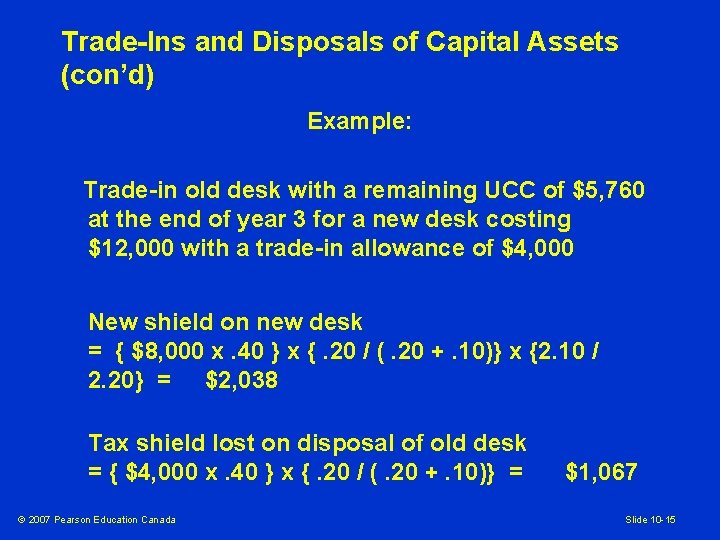
Trade-Ins and Disposals of Capital Assets (con’d) Example: Trade-in old desk with a remaining UCC of $5, 760 at the end of year 3 for a new desk costing $12, 000 with a trade-in allowance of $4, 000 New shield on new desk = { $8, 000 x. 40 } x {. 20 / (. 20 +. 10)} x {2. 10 / 2. 20} = $2, 038 Tax shield lost on disposal of old desk = { $4, 000 x. 40 } x {. 20 / (. 20 +. 10)} = © 2007 Pearson Education Canada $1, 067 Slide 10 -15
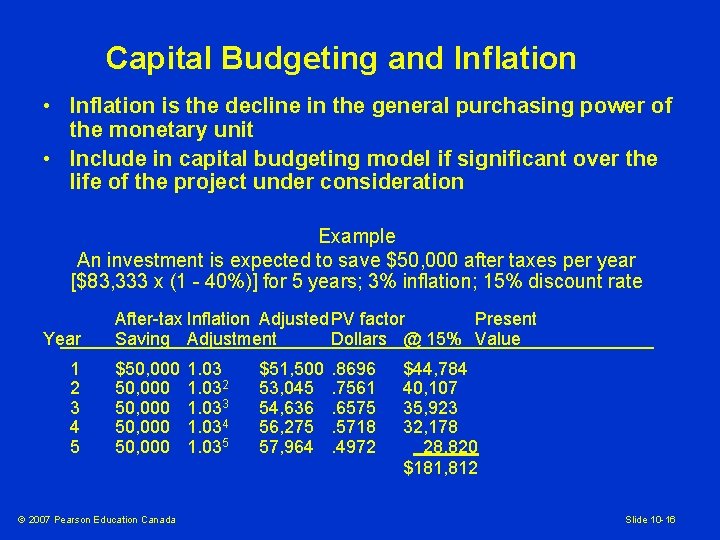
Capital Budgeting and Inflation • Inflation is the decline in the general purchasing power of the monetary unit • Include in capital budgeting model if significant over the life of the project under consideration Example An investment is expected to save $50, 000 after taxes per year [$83, 333 x (1 - 40%)] for 5 years; 3% inflation; 15% discount rate Year 1 2 3 4 5 After-tax Inflation Adjusted PV factor Present Saving Adjustment Dollars @ 15% Value $50, 000 50, 000 © 2007 Pearson Education Canada 1. 032 1. 033 1. 034 1. 035 $51, 500 53, 045 54, 636 56, 275 57, 964 . 8696. 7561. 6575. 5718. 4972 $44, 784 40, 107 35, 923 32, 178 28, 820 $181, 812 Slide 10 -16
Capital Investment and Risk • Risk occurs because the actual cash flows may differ from what is expected • With capital budgeting, need to first determine the riskiness of the investment • Next, the inputs t o the capital budgeting model should be adjusted to reflect the risk © 2007 Pearson Education Canada Slide 10 -17
Recognizing Risk • Three common ways: 1. Reduce individual expected cash inflows or increase expected cash outflows by an amount that depends on their riskiness 2. Reduce the expected life of riskier projects 3. Increase the minimum desired rate of return for riskier projects © 2007 Pearson Education Canada Slide 10 -18
Capital Investments and Sensitivity Analysis • Shows the financial consequences that would occur if actual cash inflows and outflows differed from those expected • Two types: 1. comparing the optimistic, pessimistic, and most likely predictions 2. determining the amount of deviation from expected values before a decision is changed © 2007 Pearson Education Canada Slide 10 -19
- Slides: 19