
10 Adolescence and Emerging Adulthood Physical and Cognitive




- Slides: 35
10 Adolescence and Emerging Adulthood Physical and Cognitive Development Chapter 10 Copyright © 2010 Pearson Education, Inc. All rights reserved.
Adolescence and Emerging Adulthood Physical and Cognitive Development • Adolescent Development in a Cultural and Historical Context • Physical Development and Adaptation • Gender Identity and Sexual Practices • Cognitive Changes in Adolescence Copyright © 2010 Pearson Education, Inc. All rights reserved.
Adolescent Development in Cultural and Historical Context • The adolescent period, between childhood and adulthood, is apparent in all cultures, often associated with a rite of passage Copyright © 2010 Pearson Education, Inc. All rights reserved.
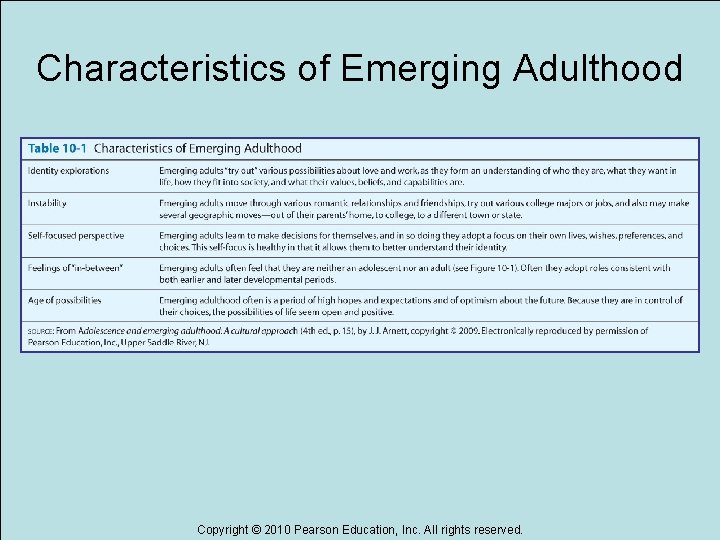
Adolescent Development in Cultural and Historical Context • The period between ages 18 -25 is often filled with activities aimed at preparing for adulthood and called emerging adulthood • Adolescence in the U. S. is characterized by: – age-segregation – economic dependence – mass media – instability, uncertainty, and challenge Copyright © 2010 Pearson Education, Inc. All rights reserved.
Characteristics of Emerging Adulthood Copyright © 2010 Pearson Education, Inc. All rights reserved.
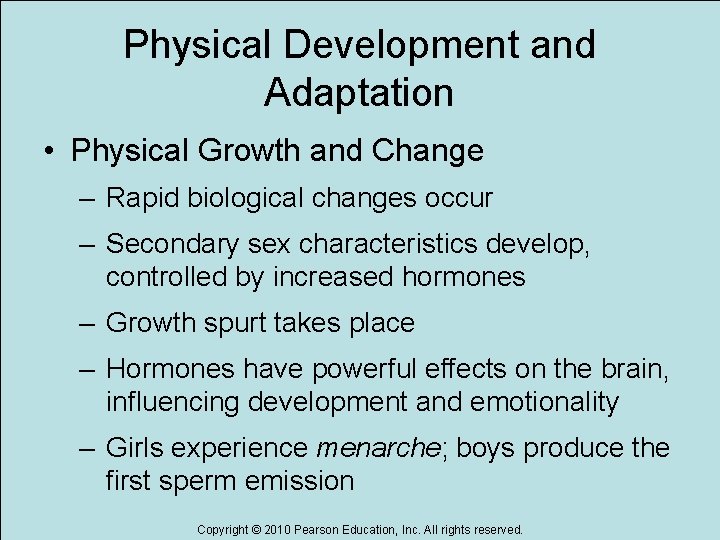
Physical Development and Adaptation • Physical Growth and Change – Rapid biological changes occur – Secondary sex characteristics develop, controlled by increased hormones – Growth spurt takes place – Hormones have powerful effects on the brain, influencing development and emotionality – Girls experience menarche; boys produce the first sperm emission Copyright © 2010 Pearson Education, Inc. All rights reserved.
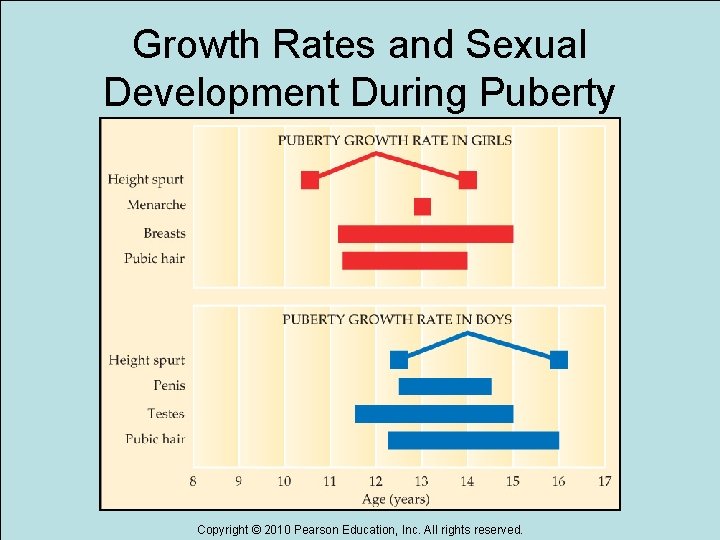
Growth Rates and Sexual Development During Puberty Copyright © 2010 Pearson Education, Inc. All rights reserved.
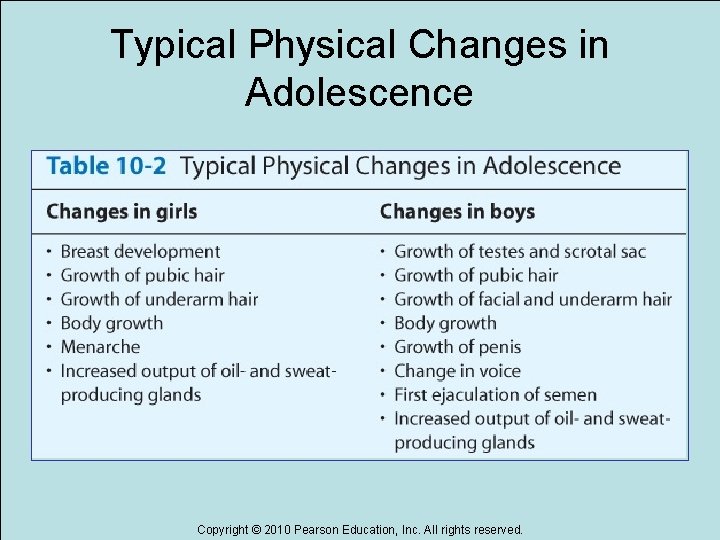
Typical Physical Changes in Adolescence Copyright © 2010 Pearson Education, Inc. All rights reserved.
Physical Changes and Adaptation • Secular Trend: In many industrialized countries, puberty occurs at younger ages than in the past • Adolescents below to a marginal group, on the fringe of dominant culture • Body image is of major concern – Girls worry about being too fat or too tall – Focus on obesity can lead eating disorders • anorexia nervosa • bulimia nervosa Copyright © 2010 Pearson Education, Inc. All rights reserved. to
Video Clip Tyra Banks visits an eating disorder clinic http: //www. youtube. com/watch? v=0 ct-q 1 FCe. Lc Copyright © 2010 Pearson Education, Inc. All rights reserved.
Video Clip Tyra Banks interviews a teenage girl about her struggle with anorexia: http: //www. youtube. com/watch? v=Jixb. THj 6 FKY Copyright © 2010 Pearson Education, Inc. All rights reserved.
Physical Development and Adaptation • Boys and girls mature at different ages • Girls mature 2 years earlier than boys, on average • Late maturation is a disadvantage for boys • Early maturation can be a problem for boys and girls, because childhood is cut short • Late maturation can be an advantage for girls, because then they are in more in sync with boys Copyright © 2010 Pearson Education, Inc. All rights reserved.
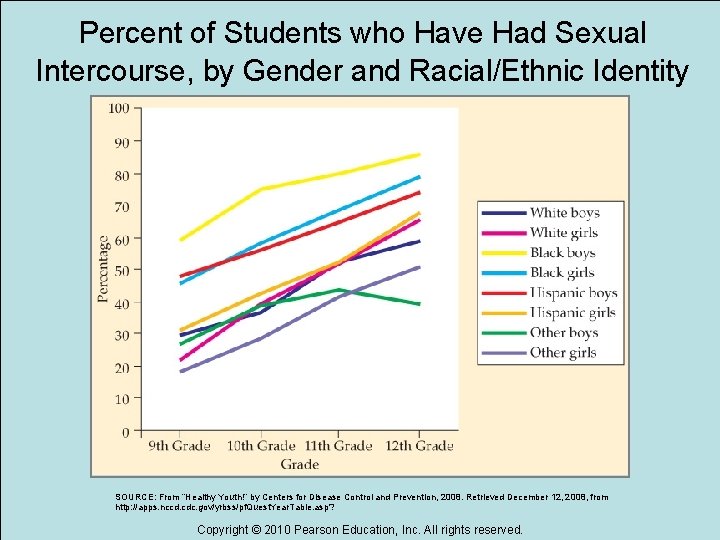
Gender Identity and Sexual Practices • Sexual attitudes have gone back-and-forth across the last several decades • Teenagers today are highly sexually active: by 12 th grade 66% of females and 63% of males report sexual activity • Early sexual activity is associated with gender, ethnicity, family situation, and age of sexual maturity Copyright © 2010 Pearson Education, Inc. All rights reserved.
Video Clip ABC News story on teen sex: Oral sex as the new goodnight kiss: http: //www. youtube. com/watch? v=g. F 7 Kn 3 a 37 p 4 Copyright © 2010 Pearson Education, Inc. All rights reserved.
Percent of Students who Have Had Sexual Intercourse, by Gender and Racial/Ethnic Identity SOURCE: From “Healthy Youth!” by Centers for Disease Control and Prevention, 2008. Retrieved December 12, 2008, from http: //apps. nccd. cdc. gov/yrbss/pf. Quest. Year. Table. asp? Copyright © 2010 Pearson Education, Inc. All rights reserved.
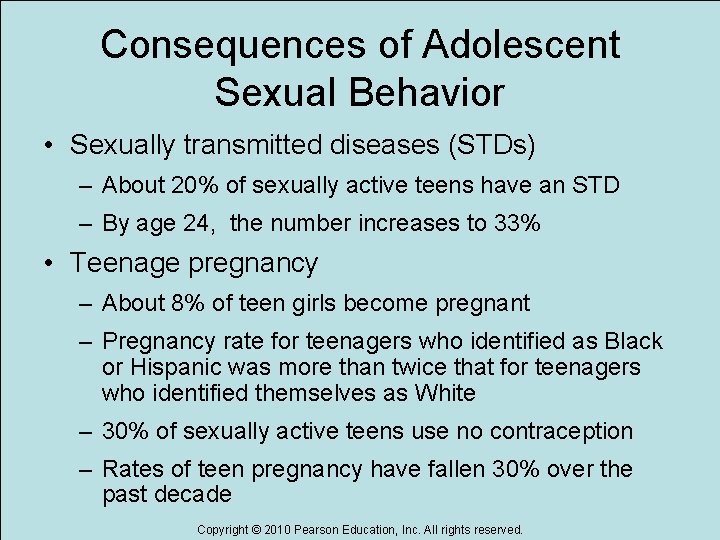
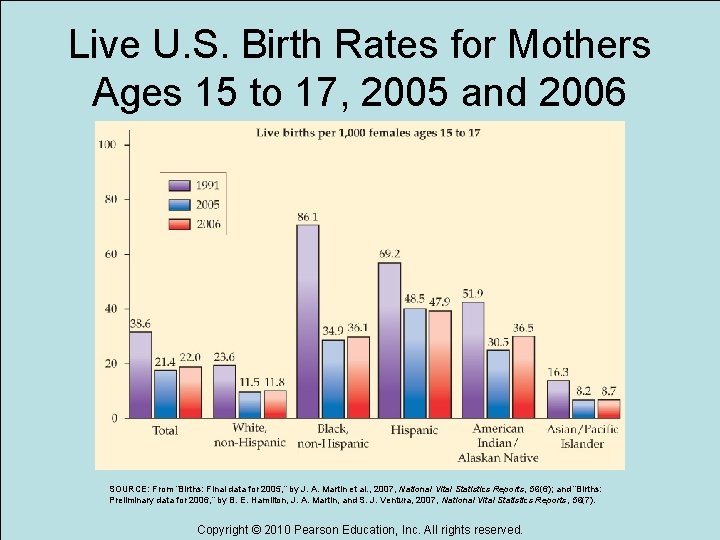
Consequences of Adolescent Sexual Behavior • Sexually transmitted diseases (STDs) – About 20% of sexually active teens have an STD – By age 24, the number increases to 33% • Teenage pregnancy – About 8% of teen girls become pregnant – Pregnancy rate for teenagers who identified as Black or Hispanic was more than twice that for teenagers who identified themselves as White – 30% of sexually active teens use no contraception – Rates of teen pregnancy have fallen 30% over the past decade Copyright © 2010 Pearson Education, Inc. All rights reserved.
Video Clip Scene from the documentary In My Room: girl describes her experience with and reasons for self-cutting: http: //www. youtube. com/watch? v=mki. ZZHm. W 9 f 8 Copyright © 2010 Pearson Education, Inc. All rights reserved.
Video Clip Associated Press news story describing a “pregnancy pact” between 17 teen girls in a town in Massachusetts: http: //www. youtube. com/watch? v=6 shs. Ee. Su. L 3 Copyright © 2010 Pearson Education, Inc. All rights reserved.
Video Clip CBS news interview with teenage mother from high school where a number of her classmates made a “pregnancy pact”: http: //www. youtube. com/watch? v=bn. HSnlh. Z 2 ZA Copyright © 2010 Pearson Education, Inc. All rights reserved.
Live U. S. Birth Rates for Mothers Ages 15 to 17, 2005 and 2006 SOURCE: From “Births: Final data for 2005, ” by J. A. Martin et al. , 2007, National Vital Statistics Reports, 56(6); and “Births: Preliminary data for 2006, ” by B. E. Hamilton, J. A. Martin, and S. J. Ventura, 2007, National Vital Statistics Reports, 56(7). Copyright © 2010 Pearson Education, Inc. All rights reserved.
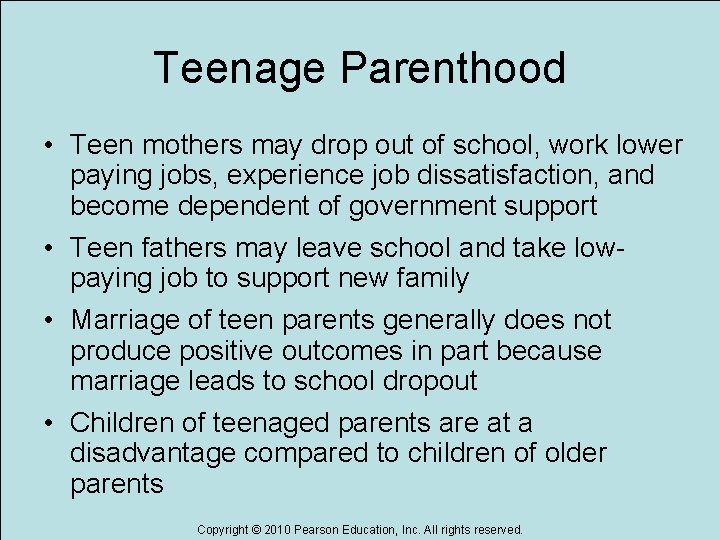
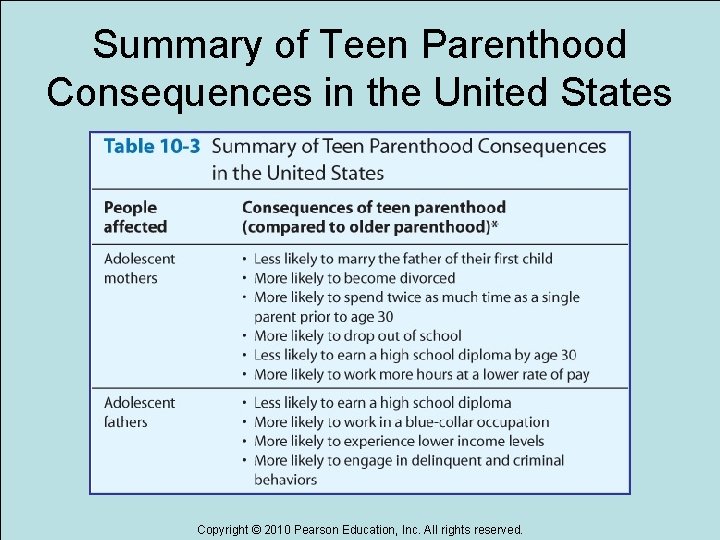
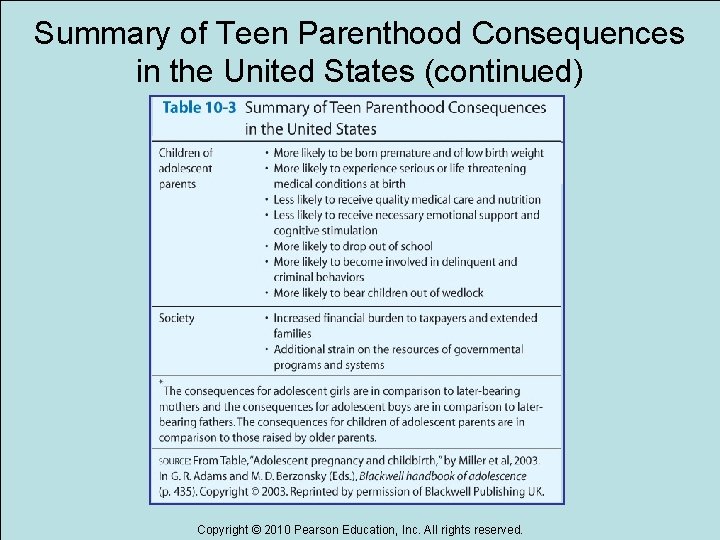
Teenage Parenthood • Teen mothers may drop out of school, work lower paying jobs, experience job dissatisfaction, and become dependent of government support • Teen fathers may leave school and take lowpaying job to support new family • Marriage of teen parents generally does not produce positive outcomes in part because marriage leads to school dropout • Children of teenaged parents are at a disadvantage compared to children of older parents Copyright © 2010 Pearson Education, Inc. All rights reserved.
Summary of Teen Parenthood Consequences in the United States Copyright © 2010 Pearson Education, Inc. All rights reserved.
Summary of Teen Parenthood Consequences in the United States (continued) Copyright © 2010 Pearson Education, Inc. All rights reserved.
Cognitive Changes in Adolescence • Used to be thought that brain was fully developed by adolescence • New research using brain imaging techniques shows otherwise – Synaptic pruning takes place – Gray matter (neural tissue) and white matter (myelin) increase until about the age of 40 – Last area of brain development in teens is in frontal lobes, where decision making, problem solving, and thinking occur – Judgment skills are the last to develop Copyright © 2010 Pearson Education, Inc. All rights reserved.
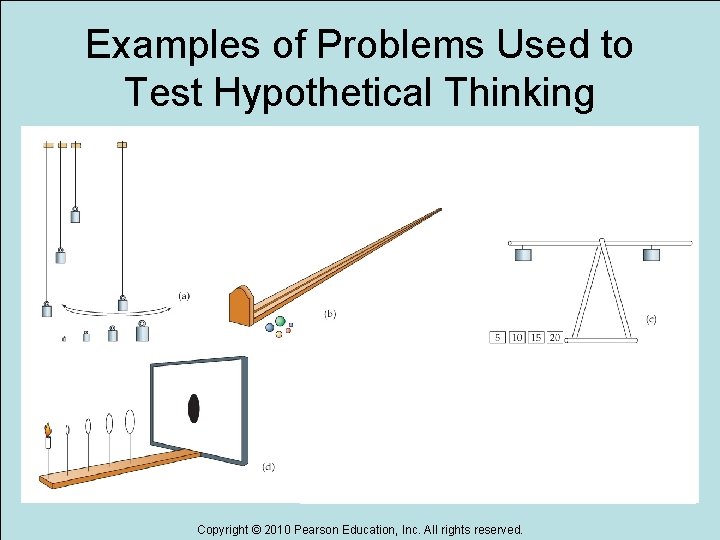
Cognitive Changes in Adolescence • Hormones affect brain development, especially in the amygdala, where emotions are regulated • Risky behaviors and emotionality may be the result of brain areas developing at different rates • Cognitive development in adolescence – acquiring more knowledge – using abstract thought – metacognition – Piaget’s formal operations stage associated with hypothetical (scientific) reasoning Copyright © 2010 Pearson Education, Inc. All rights reserved.
Video Clip Discussion of formal operational thought http: //www. youtube. com/watch? v=lw 36 Pp. YPPZM Copyright © 2010 Pearson Education, Inc. All rights reserved.
Examples of Problems Used to Test Hypothetical Thinking Copyright © 2010 Pearson Education, Inc. All rights reserved.
The Scope and Content of Adolescent Thought • More breadth and complexity in their thought content • Adolescents’ ability to understand contrary-tofact situations often affects parent-child relationships • Adolescents want to “negotiate” at this age • Teens show increasing concern with social, political, and moral issues Copyright © 2010 Pearson Education, Inc. All rights reserved.
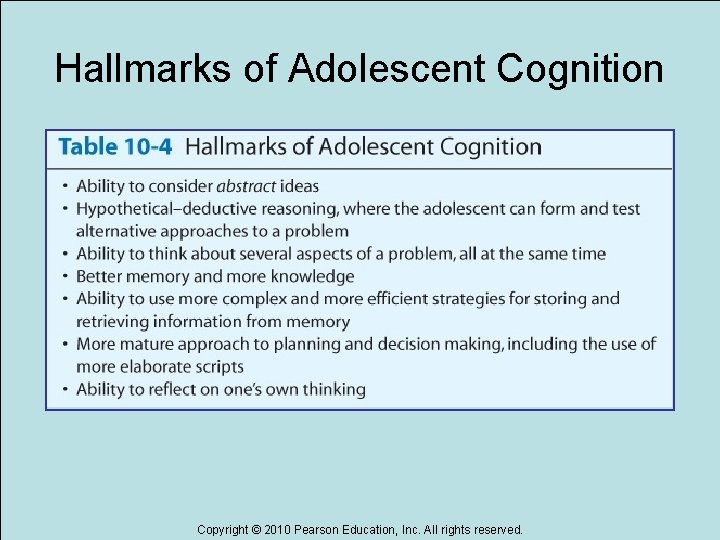
Hallmarks of Adolescent Cognition Copyright © 2010 Pearson Education, Inc. All rights reserved.
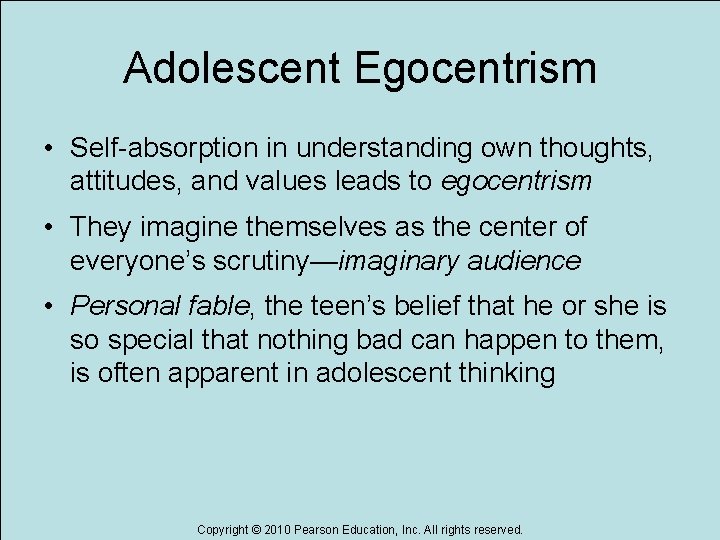
Adolescent Egocentrism • Self-absorption in understanding own thoughts, attitudes, and values leads to egocentrism • They imagine themselves as the center of everyone’s scrutiny—imaginary audience • Personal fable, the teen’s belief that he or she is so special that nothing bad can happen to them, is often apparent in adolescent thinking Copyright © 2010 Pearson Education, Inc. All rights reserved.
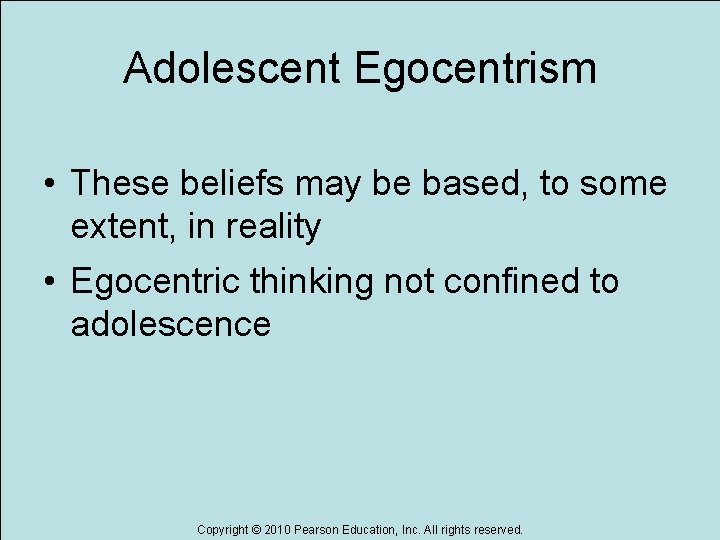
Adolescent Egocentrism • These beliefs may be based, to some extent, in reality • Egocentric thinking not confined to adolescence Copyright © 2010 Pearson Education, Inc. All rights reserved.
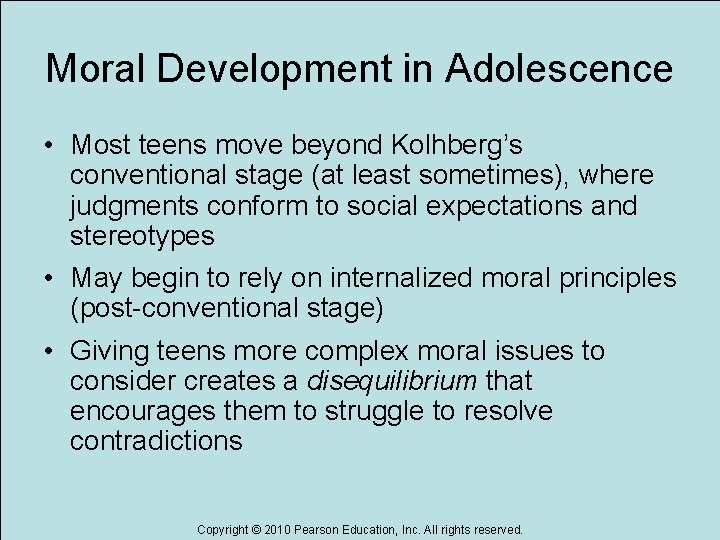
Moral Development in Adolescence • Most teens move beyond Kolhberg’s conventional stage (at least sometimes), where judgments conform to social expectations and stereotypes • May begin to rely on internalized moral principles (post-conventional stage) • Giving teens more complex moral issues to consider creates a disequilibrium that encourages them to struggle to resolve contradictions Copyright © 2010 Pearson Education, Inc. All rights reserved.
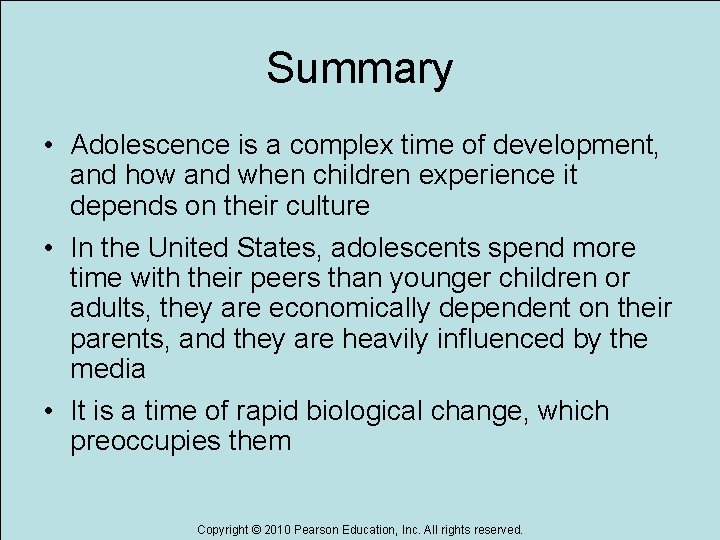
Summary • Adolescence is a complex time of development, and how and when children experience it depends on their culture • In the United States, adolescents spend more time with their peers than younger children or adults, they are economically dependent on their parents, and they are heavily influenced by the media • It is a time of rapid biological change, which preoccupies them Copyright © 2010 Pearson Education, Inc. All rights reserved.
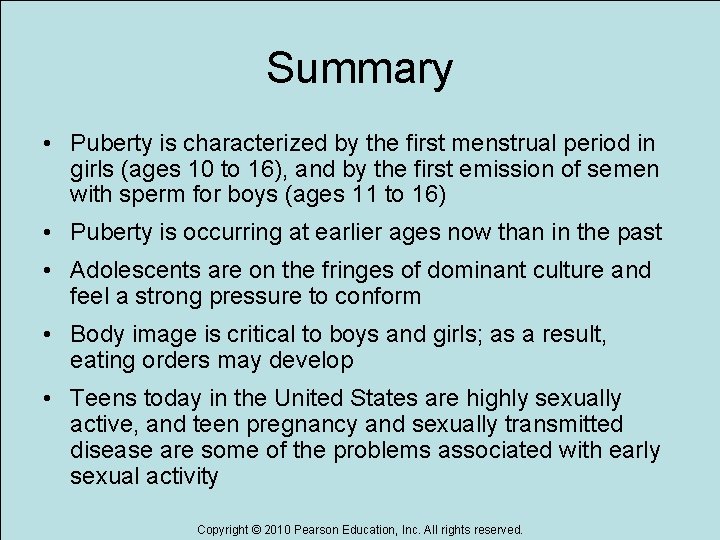
Summary • Puberty is characterized by the first menstrual period in girls (ages 10 to 16), and by the first emission of semen with sperm for boys (ages 11 to 16) • Puberty is occurring at earlier ages now than in the past • Adolescents are on the fringes of dominant culture and feel a strong pressure to conform • Body image is critical to boys and girls; as a result, eating orders may develop • Teens today in the United States are highly sexually active, and teen pregnancy and sexually transmitted disease are some of the problems associated with early sexual activity Copyright © 2010 Pearson Education, Inc. All rights reserved.
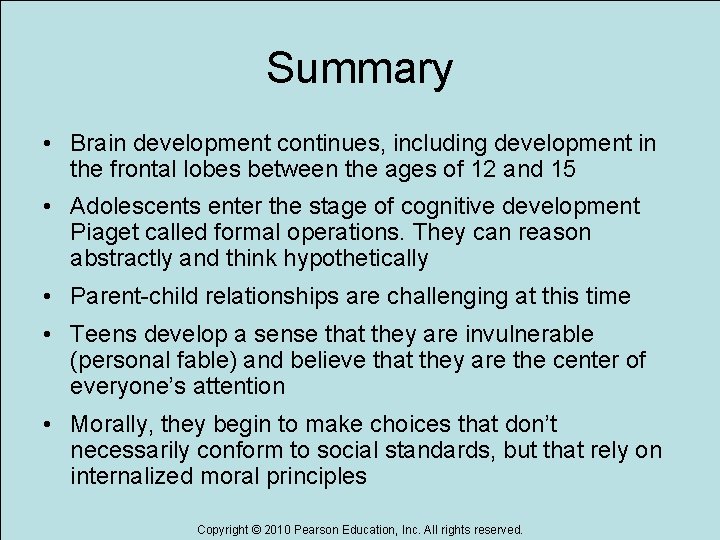
Summary • Brain development continues, including development in the frontal lobes between the ages of 12 and 15 • Adolescents enter the stage of cognitive development Piaget called formal operations. They can reason abstractly and think hypothetically • Parent-child relationships are challenging at this time • Teens develop a sense that they are invulnerable (personal fable) and believe that they are the center of everyone’s attention • Morally, they begin to make choices that don’t necessarily conform to social standards, but that rely on internalized moral principles Copyright © 2010 Pearson Education, Inc. All rights reserved.