
10 6 Theoretical Probability Warm Up An experiment
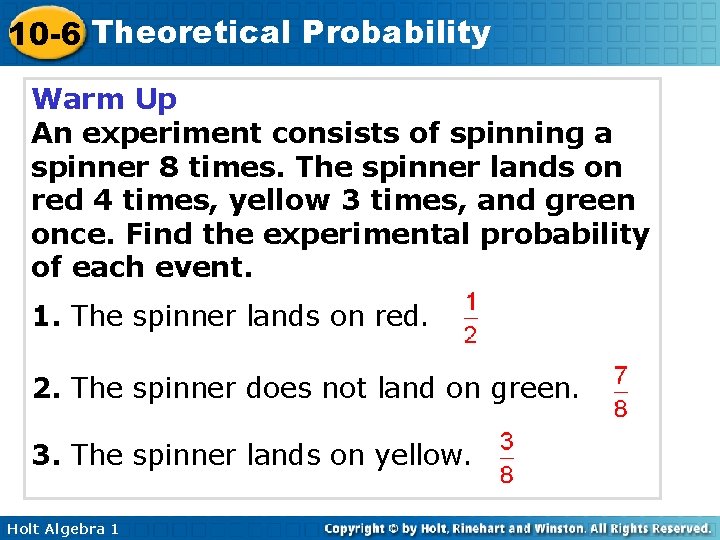
10 -6 Theoretical Probability Warm Up An experiment consists of spinning a spinner 8 times. The spinner lands on red 4 times, yellow 3 times, and green once. Find the experimental probability of each event. 1. The spinner lands on red. 2. The spinner does not land on green. 3. The spinner lands on yellow. Holt Algebra 1
10 -6 Theoretical Probability Holt Algebra 11
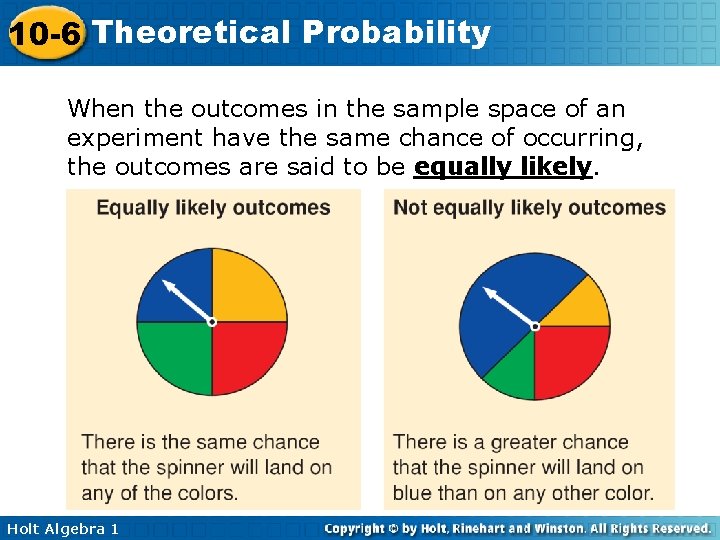
10 -6 Theoretical Probability When the outcomes in the sample space of an experiment have the same chance of occurring, the outcomes are said to be equally likely. Holt Algebra 1
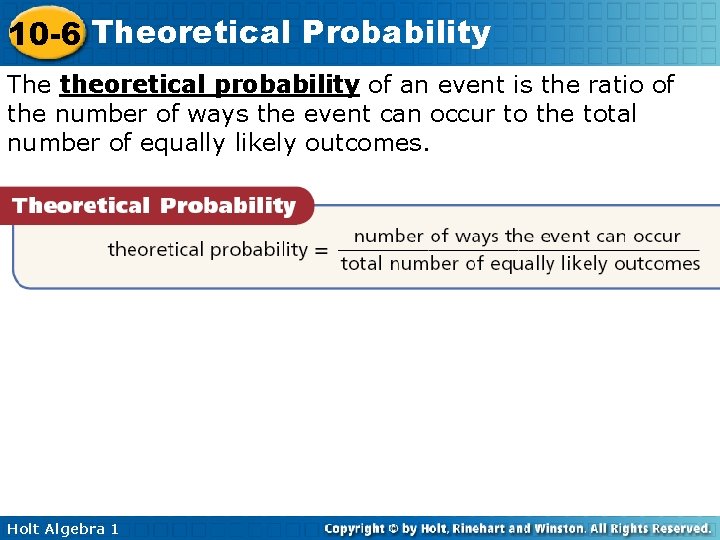
10 -6 Theoretical Probability The theoretical probability of an event is the ratio of the number of ways the event can occur to the total number of equally likely outcomes. Holt Algebra 1
10 -6 Theoretical Probability An experiment in which all outcomes are equally likely is said to be fair. You can usually assume that experiments involving coins and number cubes are fair. Holt Algebra 1
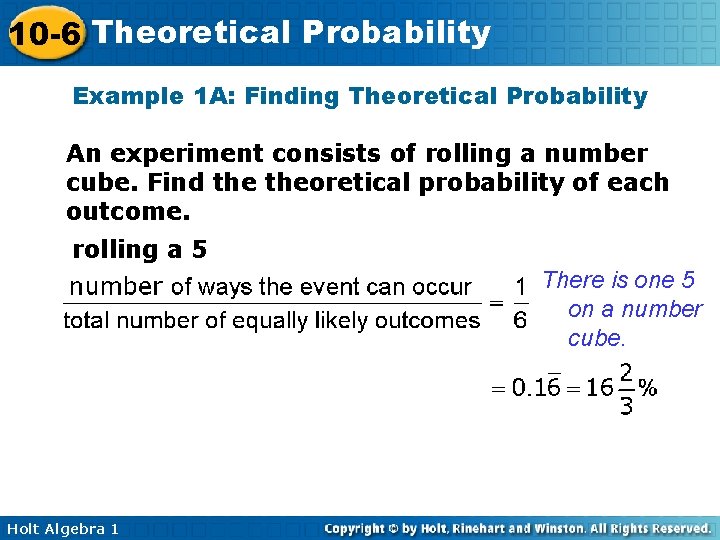
10 -6 Theoretical Probability Example 1 A: Finding Theoretical Probability An experiment consists of rolling a number cube. Find theoretical probability of each outcome. rolling a 5 There is one 5 on a number cube. Holt Algebra 1
10 -6 Theoretical Probability Reading Math The probability of an event can be written as P(event). P(heads) means “the probability that heads will be the outcome. ” Holt Algebra 1
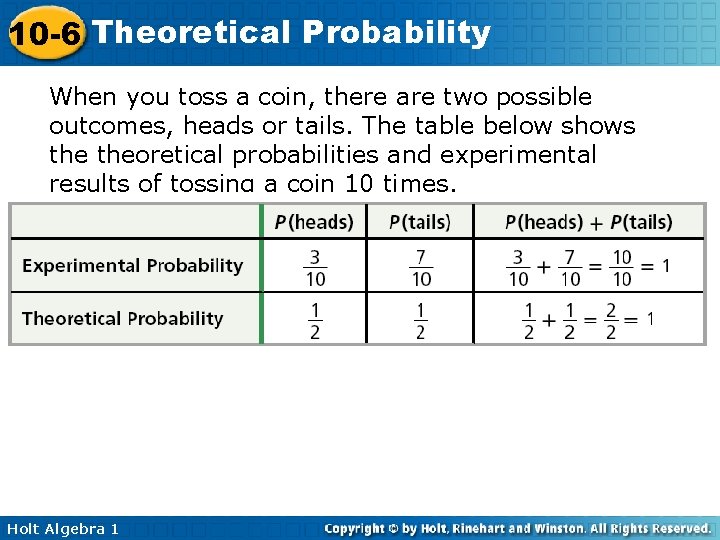
10 -6 Theoretical Probability When you toss a coin, there are two possible outcomes, heads or tails. The table below shows theoretical probabilities and experimental results of tossing a coin 10 times. Holt Algebra 1
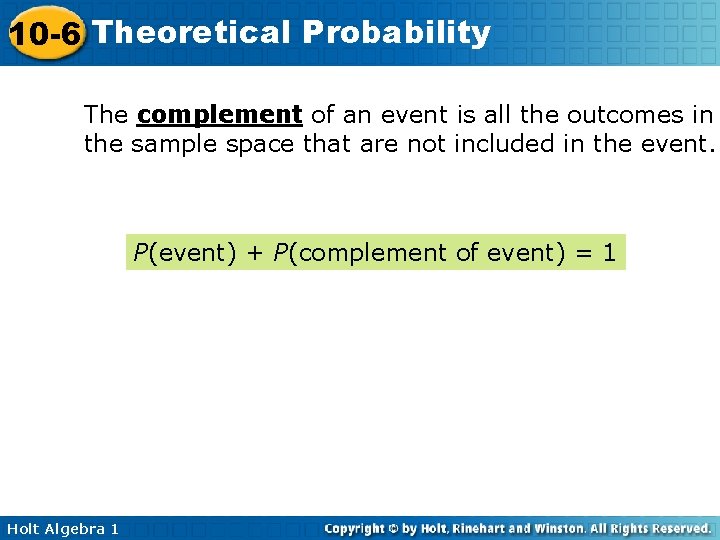
10 -6 Theoretical Probability The complement of an event is all the outcomes in the sample space that are not included in the event. P(event) + P(complement of event) = 1 Holt Algebra 1
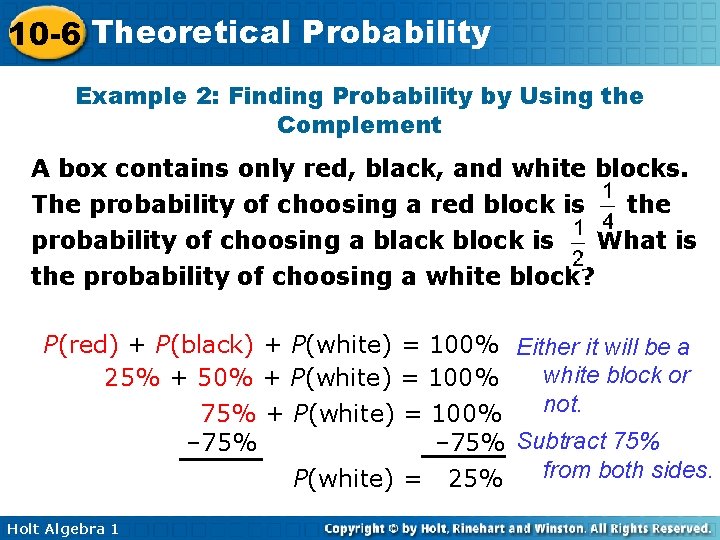
10 -6 Theoretical Probability Example 2: Finding Probability by Using the Complement A box contains only red, black, and white blocks. The probability of choosing a red block is , the probability of choosing a black block is. What is the probability of choosing a white block? P(red) + P(black) + P(white) = 100% Either it will be a white block or 25% + 50% + P(white) = 100% not. 75% + P(white) = 100% – 75% Subtract 75% from both sides. P(white) = 25% Holt Algebra 1
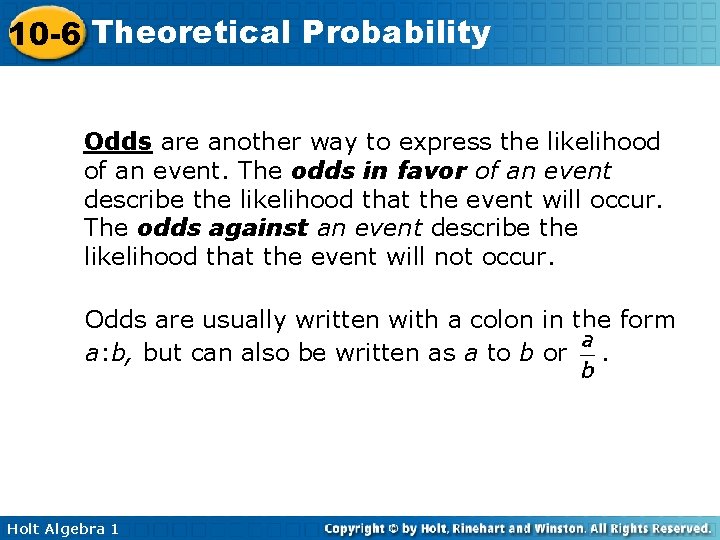
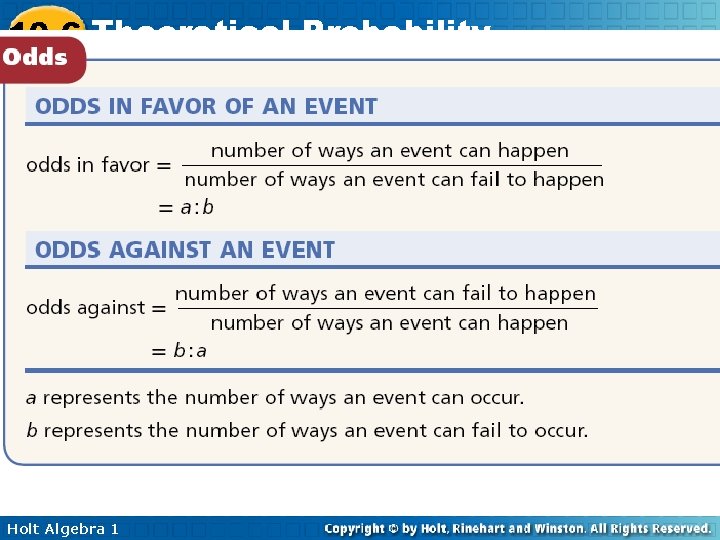
10 -6 Theoretical Probability Odds are another way to express the likelihood of an event. The odds in favor of an event describe the likelihood that the event will occur. The odds against an event describe the likelihood that the event will not occur. Odds are usually written with a colon in the form a: b, but can also be written as a to b or. Holt Algebra 1
10 -6 Theoretical Probability Holt Algebra 1
10 -6 Theoretical Probability Reading Math You may see an outcome called “favorable. ” This does not mean that the outcome is good or bad. A favorable outcome is the outcome you are looking for in a probability experiment. Holt Algebra 1
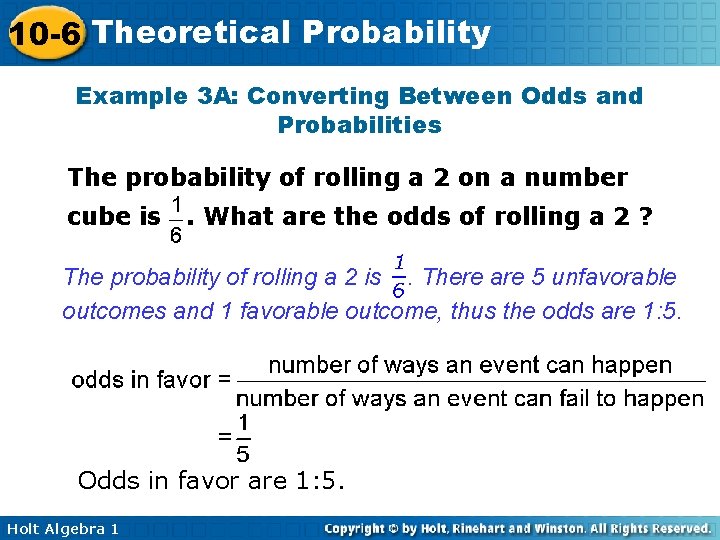
10 -6 Theoretical Probability Example 3 A: Converting Between Odds and Probabilities The probability of rolling a 2 on a number cube is . What are the odds of rolling a 2 ? The probability of rolling a 2 is. There are 5 unfavorable outcomes and 1 favorable outcome, thus the odds are 1: 5. Odds in favor are 1: 5. Holt Algebra 1
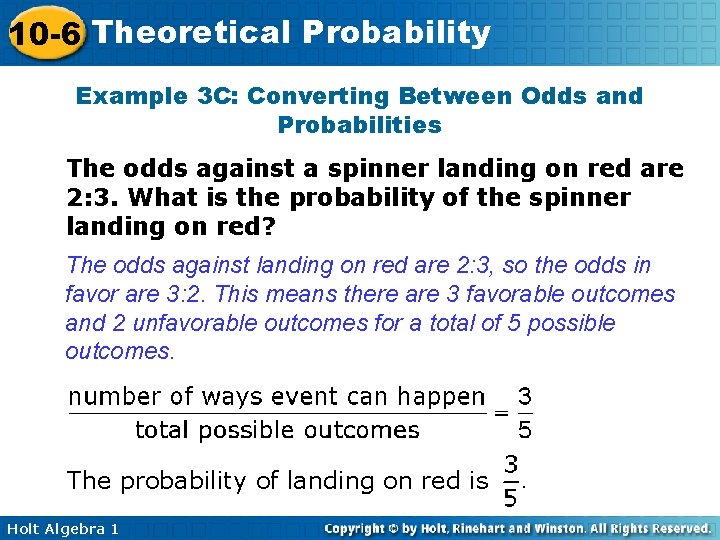
10 -6 Theoretical Probability Example 3 C: Converting Between Odds and Probabilities The odds against a spinner landing on red are 2: 3. What is the probability of the spinner landing on red? The odds against landing on red are 2: 3, so the odds in favor are 3: 2. This means there are 3 favorable outcomes and 2 unfavorable outcomes for a total of 5 possible outcomes. The probability of landing on red is Holt Algebra 1
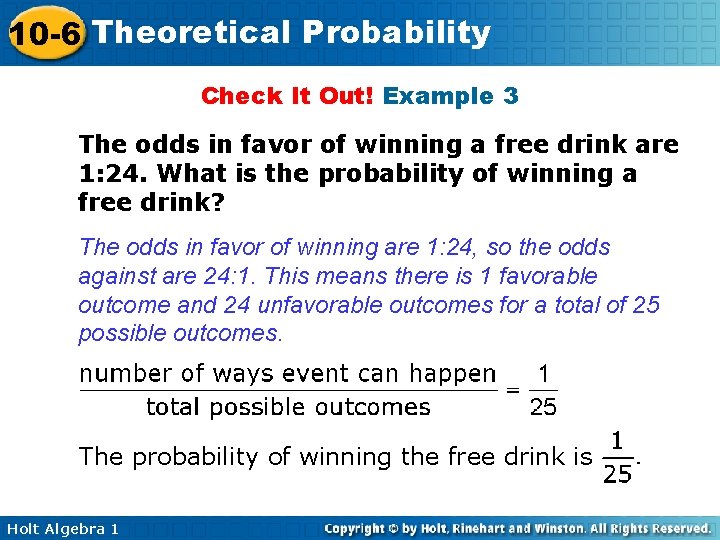
10 -6 Theoretical Probability Check It Out! Example 3 The odds in favor of winning a free drink are 1: 24. What is the probability of winning a free drink? The odds in favor of winning are 1: 24, so the odds against are 24: 1. This means there is 1 favorable outcome and 24 unfavorable outcomes for a total of 25 possible outcomes. The probability of winning the free drink is Holt Algebra 1
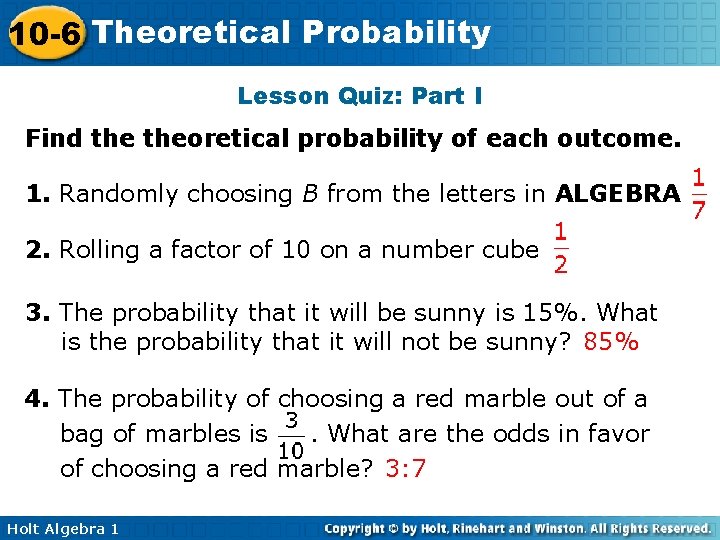
10 -6 Theoretical Probability Lesson Quiz: Part I Find theoretical probability of each outcome. 1. Randomly choosing B from the letters in ALGEBRA 2. Rolling a factor of 10 on a number cube 3. The probability that it will be sunny is 15%. What is the probability that it will not be sunny? 85% 4. The probability of choosing a red marble out of a bag of marbles is. What are the odds in favor of choosing a red marble? 3: 7 Holt Algebra 1
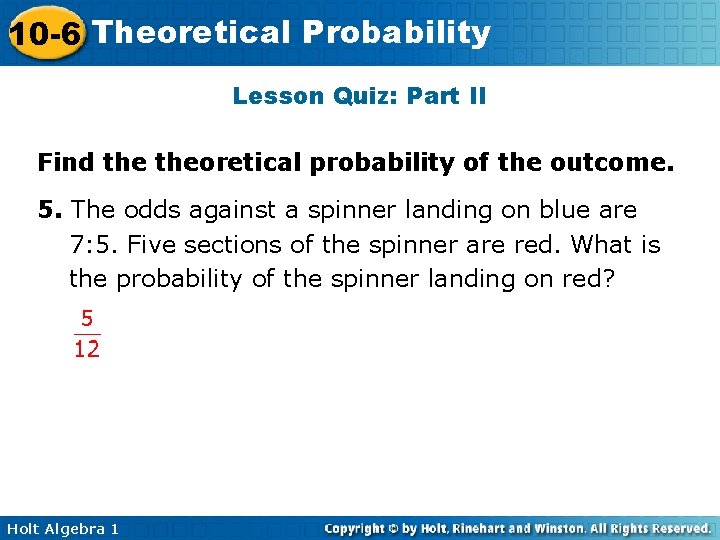
10 -6 Theoretical Probability Lesson Quiz: Part II Find theoretical probability of the outcome. 5. The odds against a spinner landing on blue are 7: 5. Five sections of the spinner are red. What is the probability of the spinner landing on red? Holt Algebra 1
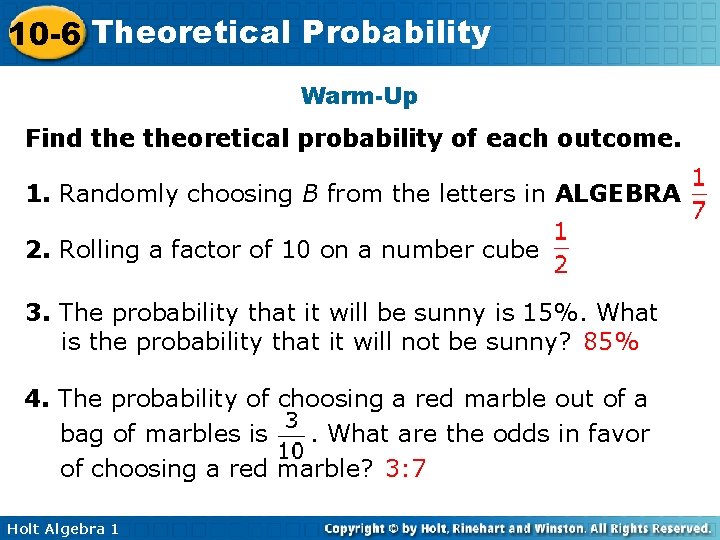
10 -6 Theoretical Probability Warm-Up Find theoretical probability of each outcome. 1. Randomly choosing B from the letters in ALGEBRA 2. Rolling a factor of 10 on a number cube 3. The probability that it will be sunny is 15%. What is the probability that it will not be sunny? 85% 4. The probability of choosing a red marble out of a bag of marbles is. What are the odds in favor of choosing a red marble? 3: 7 Holt Algebra 1
- Slides: 19