
10 6 Sliding Filament Mechanism Sliding Filament Mechanism
- Slides: 8
10. 6 Sliding Filament Mechanism
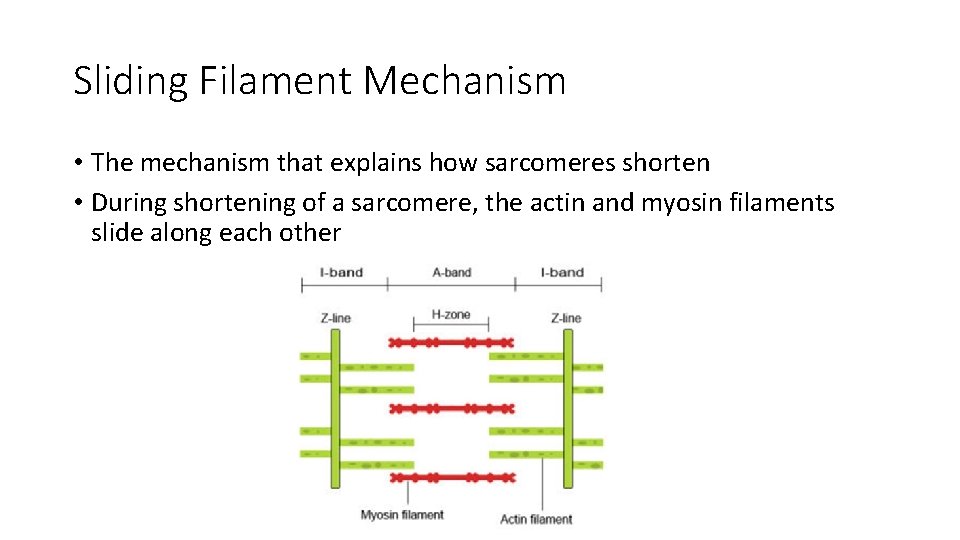
Sliding Filament Mechanism • The mechanism that explains how sarcomeres shorten • During shortening of a sarcomere, the actin and myosin filaments slide along each other
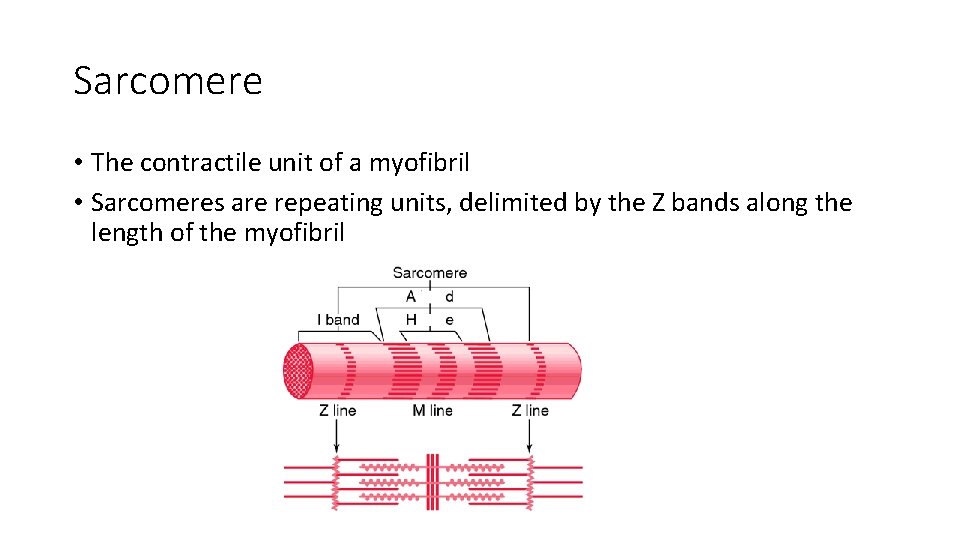
Sarcomere • The contractile unit of a myofibril • Sarcomeres are repeating units, delimited by the Z bands along the length of the myofibril
Steps: • 1. A message is sent from the nervous system that tells muscle fibers to contract • 2. This message causes the sarcoplasmic reticulum to release stored calcium into the sarcoplasm • 3. These calcium ions attach onto the actin filaments, exposing actin filament binding sites
Steps: (continued) • 4. Myosin heads attach onto these exposed binding sites of the actin filaments, creating cross-bridges between the myosin filament and the actin filaments • 5. Each myosin cross-bridge then bends, creating a pulling force that pulls the actin filament in toward the center of the sarcomere • 6. These cross-bridges then break, and the myosin heads reattach onto the next binding sites of the actin filaments, forming new cross bridges, which then bend, further pulling the actin filaments in toward the center of the sarcomere
Steps: continued • 7. This process occurs over and over again, as long as the message to contract is given to the muscle by the nervous system • 8. Because the actin filaments are attached to the z-lines of the sarcomere, the z-lines are pulled in toward the center of the sarcomere
Steps: continued • 9. When z-lines are pulled in toward the center of the sarcomere, the sarcomere shortens • 10. When enough muscle fibers of a muscle shorten, the muscle shortens, exerting a pulling force on its bony attachments
Study Questions: 1. The sliding filament mechanism explains how sarcomeres lengthen. True or False? 2. ____ is released by the sarcoplasmic reticulum into the sarcoplasm. a. Potassium b. Calcium c. ATP d. Oxygen 3. A cross-bridge is the connection between actin and _____. a. Myosin b. Calcium c. Sarcoplasm d. H-zone