
10 5 Catalytic reaction 2 1 catalysts and
![Using stationary-state approximation Michaelis constant Discussion: 1) When [S] >> k. M: is zeroth](https://slidetodoc.com/presentation_image_h2/9c0cf0c7c8c74ac676aca4d372f5a697/image-33.jpg "Using stationary-state approximation Michaelis constant Discussion: 1) When [S] >> k. M: is zeroth")
![When [S] = k. M: At r = ½ rm, [S] = k. M](https://slidetodoc.com/presentation_image_h2/9c0cf0c7c8c74ac676aca4d372f5a697/image-34.jpg "When [S] = k. M: At r = ½ rm, [S] = k. M")
![Periodic change of [Br-] and [Ce(IV)]/[Ce(III)] In 1910, Lotka showed that the system: G](https://slidetodoc.com/presentation_image_h2/9c0cf0c7c8c74ac676aca4d372f5a697/image-45.jpg "Periodic change of [Br-] and [Ce(IV)]/[Ce(III)] In 1910, Lotka showed that the system: G")
- Slides: 49
§ 10. 5 Catalytic reaction
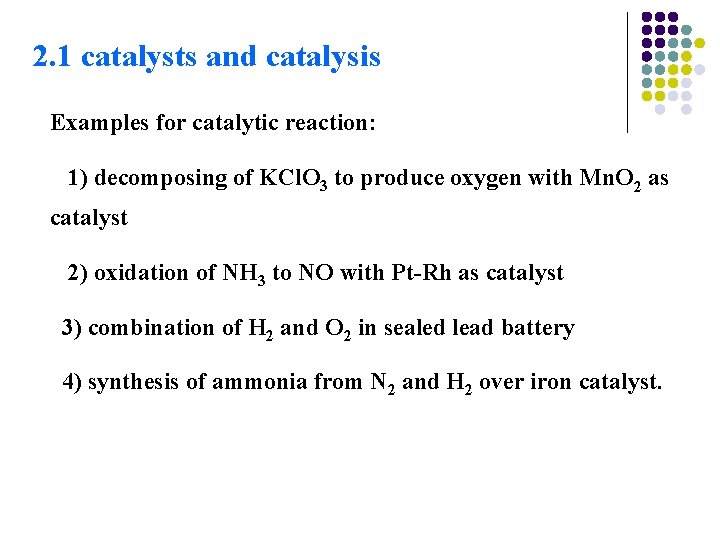
2. 1 catalysts and catalysis Examples for catalytic reaction: 1) decomposing of KCl. O 3 to produce oxygen with Mn. O 2 as catalyst 2) oxidation of NH 3 to NO with Pt-Rh as catalyst 3) combination of H 2 and O 2 in sealed lead battery 4) synthesis of ammonia from N 2 and H 2 over iron catalyst.
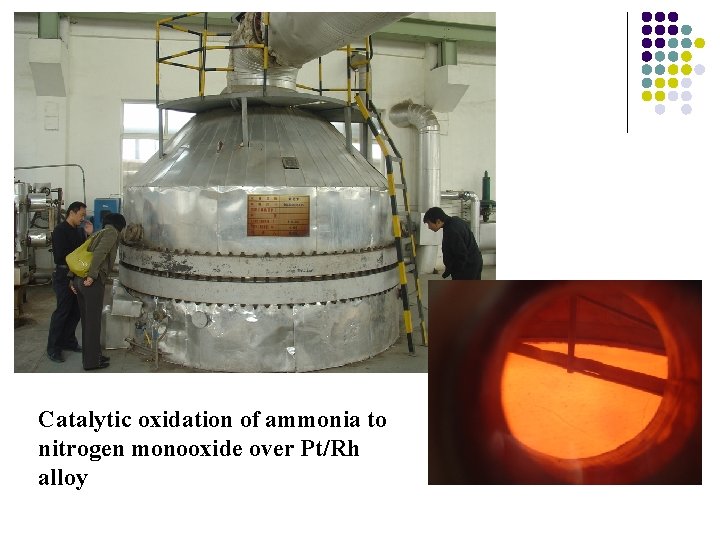
Catalytic oxidation of ammonia to nitrogen monooxide over Pt/Rh alloy
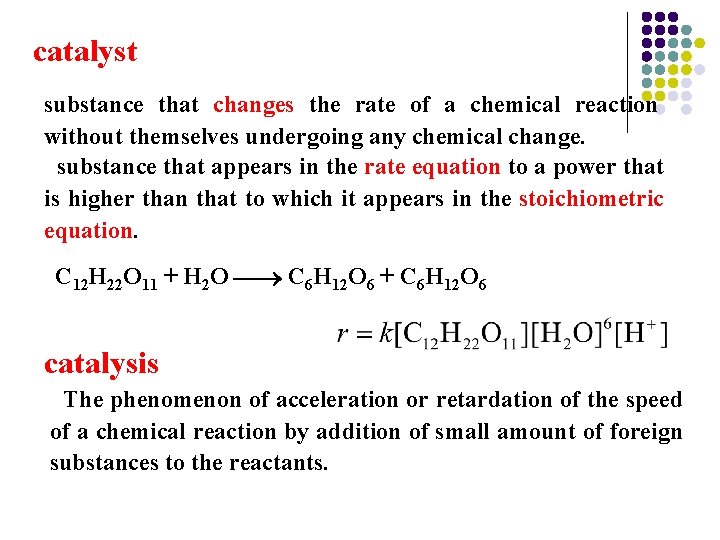
catalyst substance that changes the rate of a chemical reaction without themselves undergoing any chemical change. substance that appears in the rate equation to a power that is higher than that to which it appears in the stoichiometric equation. C 12 H 22 O 11 + H 2 O C 6 H 12 O 6 + C 6 H 12 O 6 catalysis The phenomenon of acceleration or retardation of the speed of a chemical reaction by addition of small amount of foreign substances to the reactants.
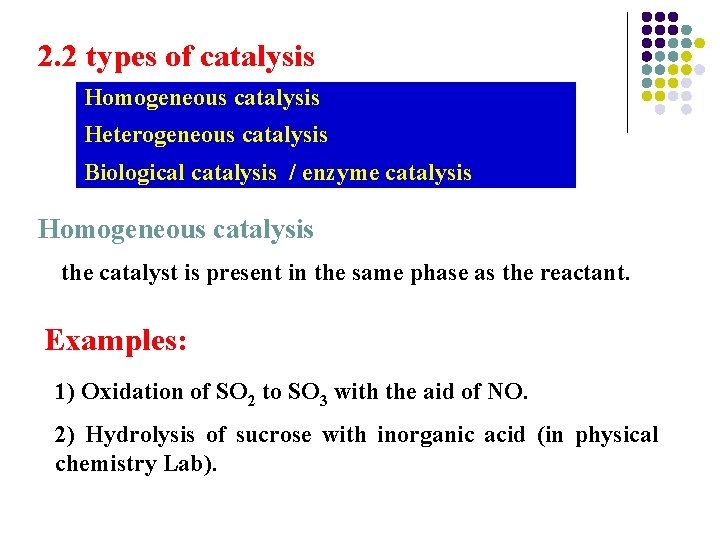
2. 2 types of catalysis Homogeneous catalysis Heterogeneous catalysis Biological catalysis / enzyme catalysis Homogeneous catalysis the catalyst is present in the same phase as the reactant. Examples: 1) Oxidation of SO 2 to SO 3 with the aid of NO. 2) Hydrolysis of sucrose with inorganic acid (in physical chemistry Lab).
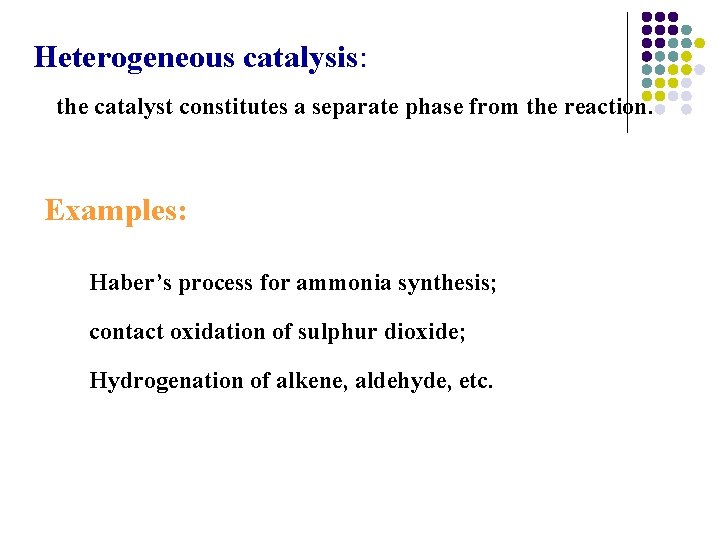
Heterogeneous catalysis: the catalyst constitutes a separate phase from the reaction. Examples: Haber’s process for ammonia synthesis; contact oxidation of sulphur dioxide; Hydrogenation of alkene, aldehyde, etc.
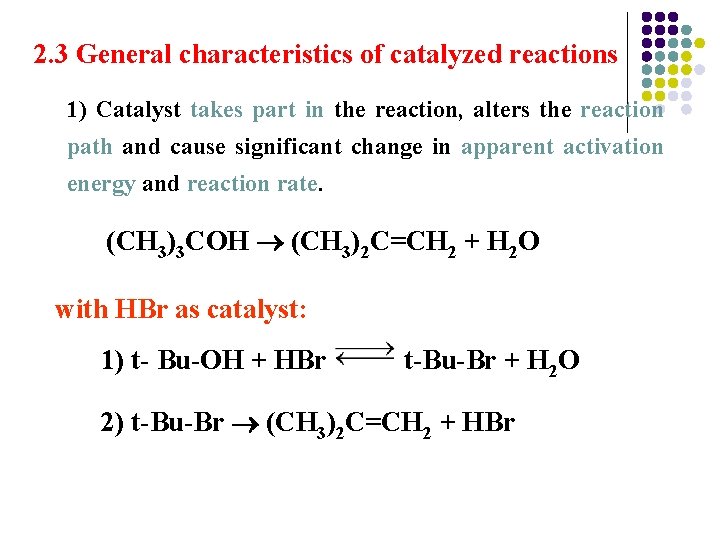
2. 3 General characteristics of catalyzed reactions 1) Catalyst takes part in the reaction, alters the reaction path and cause significant change in apparent activation energy and reaction rate. (CH 3)3 COH (CH 3)2 C=CH 2 + H 2 O with HBr as catalyst: 1) t- Bu-OH + HBr t-Bu-Br + H 2 O 2) t-Bu-Br (CH 3)2 C=CH 2 + HBr
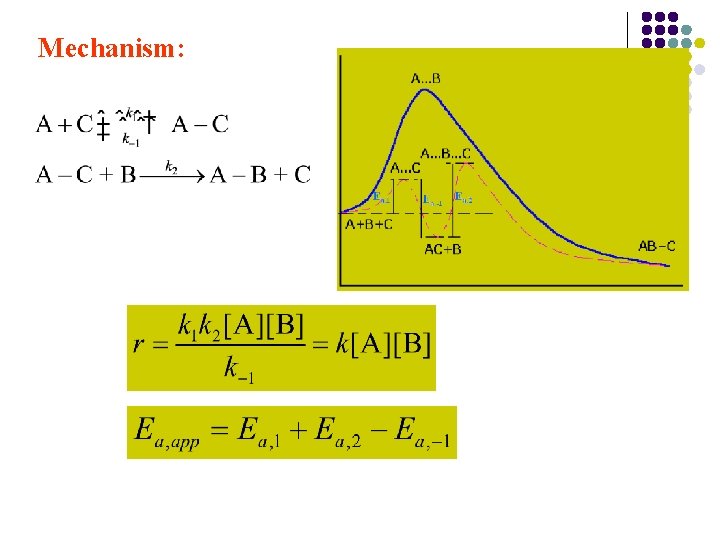
Mechanism:
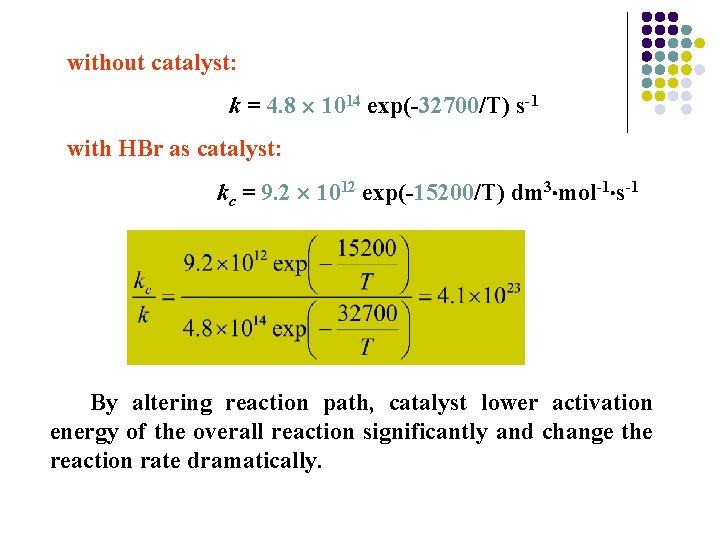
without catalyst: k = 4. 8 1014 exp(-32700/T) s-1 with HBr as catalyst: kc = 9. 2 1012 exp(-15200/T) dm 3 mol-1 s-1 By altering reaction path, catalyst lower activation energy of the overall reaction significantly and change the reaction rate dramatically.
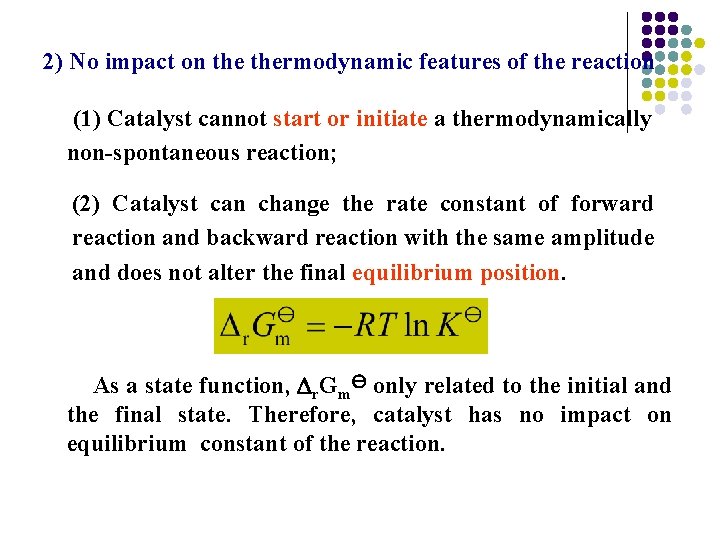
2) No impact on thermodynamic features of the reaction (1) Catalyst cannot start or initiate a thermodynamically non-spontaneous reaction; (2) Catalyst can change the rate constant of forward reaction and backward reaction with the same amplitude and does not alter the final equilibrium position. As a state function, r. Gm only related to the initial and the final state. Therefore, catalyst has no impact on equilibrium constant of the reaction.
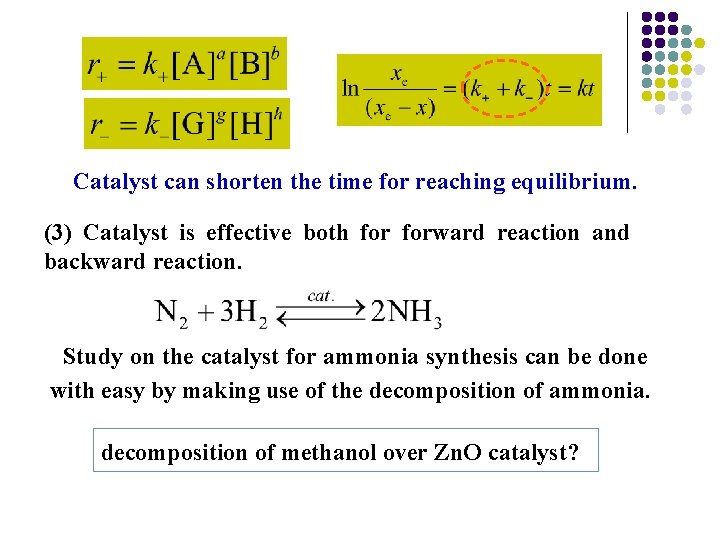
Catalyst can shorten the time for reaching equilibrium. (3) Catalyst is effective both forward reaction and backward reaction. Study on the catalyst for ammonia synthesis can be done with easy by making use of the decomposition of ammonia. decomposition of methanol over Zn. O catalyst?
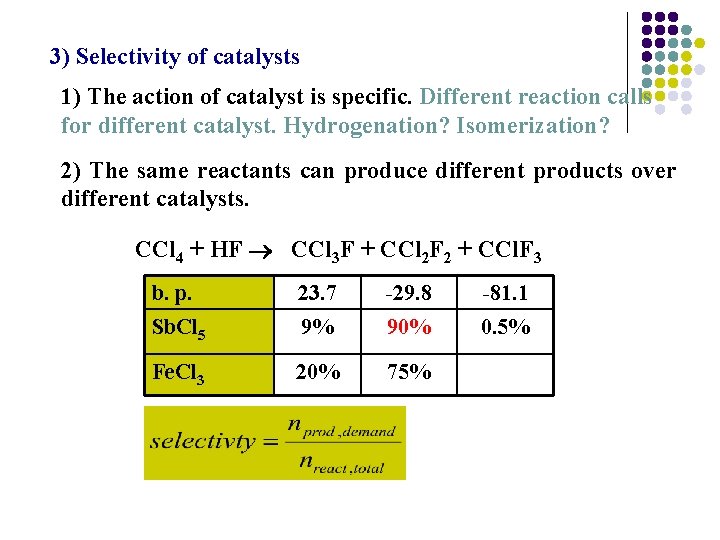
3) Selectivity of catalysts 1) The action of catalyst is specific. Different reaction calls for different catalyst. Hydrogenation? Isomerization? 2) The same reactants can produce different products over different catalysts. CCl 4 + HF CCl 3 F + CCl 2 F 2 + CCl. F 3 b. p. 23. 7 -29. 8 -81. 1 Sb. Cl 5 9% 90% 0. 5% Fe. Cl 3 20% 75%
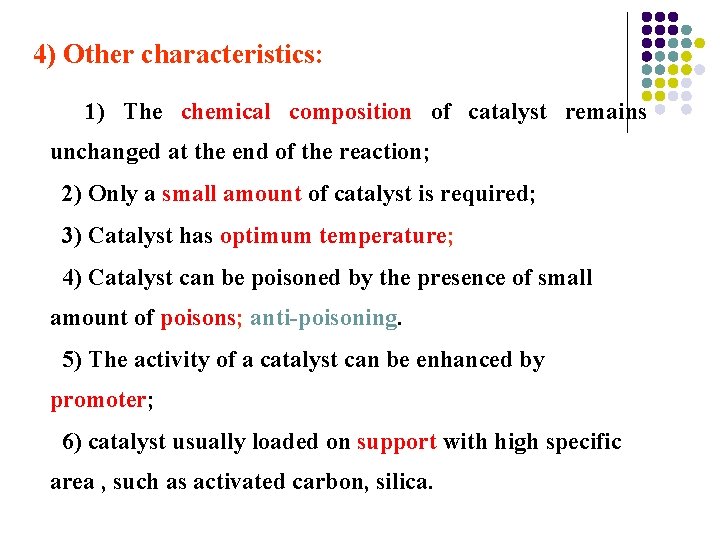
4) Other characteristics: 1) The chemical composition of catalyst remains unchanged at the end of the reaction; 2) Only a small amount of catalyst is required; 3) Catalyst has optimum temperature; 4) Catalyst can be poisoned by the presence of small amount of poisons; anti-poisoning. 5) The activity of a catalyst can be enhanced by promoter; 6) catalyst usually loaded on support with high specific area , such as activated carbon, silica.
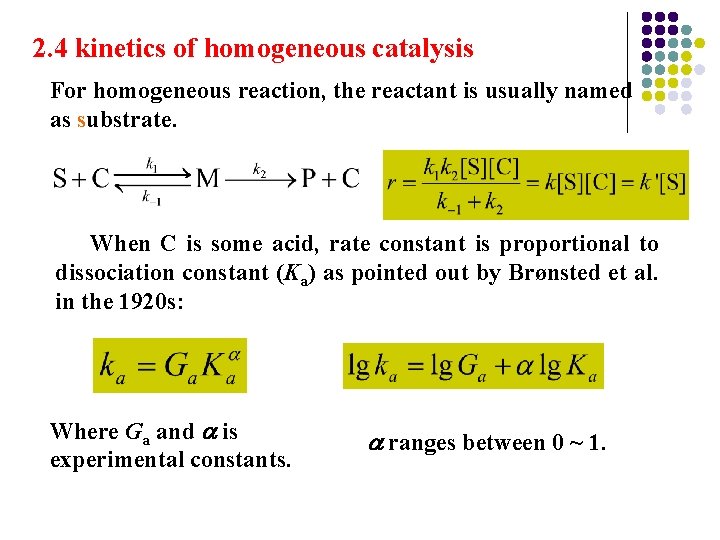
2. 4 kinetics of homogeneous catalysis For homogeneous reaction, the reactant is usually named as substrate. When C is some acid, rate constant is proportional to dissociation constant (Ka) as pointed out by Brønsted et al. in the 1920 s: Where Ga and is experimental constants. ranges between 0 ~ 1.
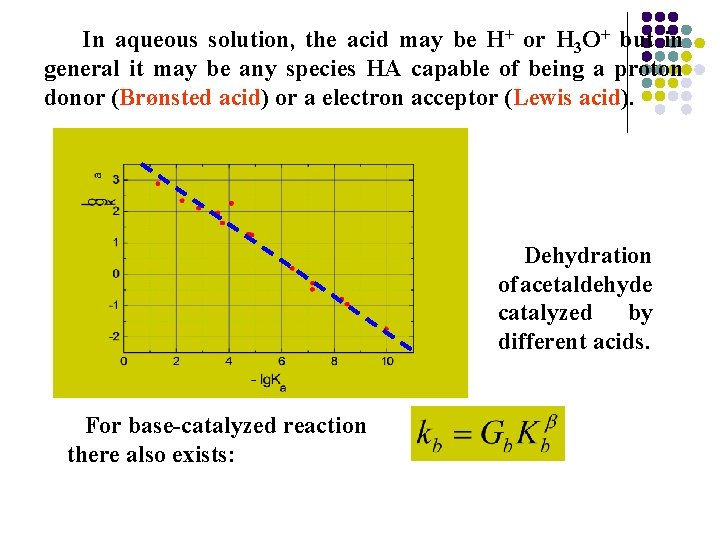
In aqueous solution, the acid may be H+ or H 3 O+ but in general it may be any species HA capable of being a proton donor (Brønsted acid) or a electron acceptor (Lewis acid). Dehydration of acetaldehyde catalyzed by different acids. For base-catalyzed reaction there also exists:
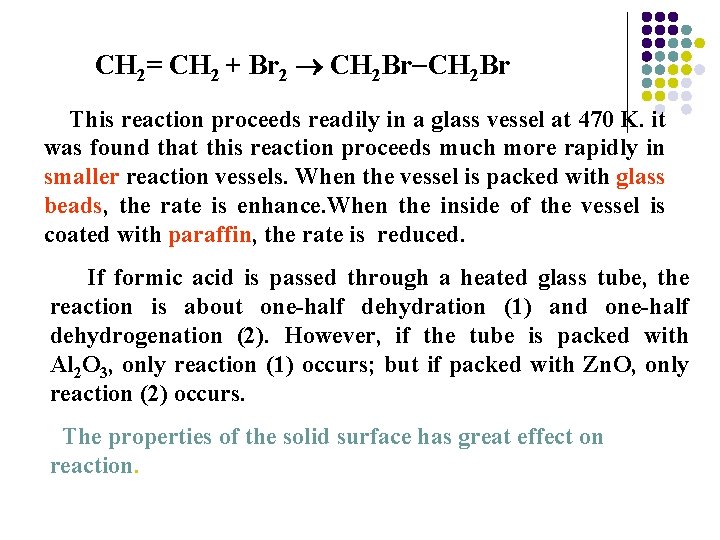
CH 2= CH 2 + Br 2 CH 2 Br This reaction proceeds readily in a glass vessel at 470 K. it was found that this reaction proceeds much more rapidly in smaller reaction vessels. When the vessel is packed with glass beads, the rate is enhance. When the inside of the vessel is coated with paraffin, the rate is reduced. If formic acid is passed through a heated glass tube, the reaction is about one-half dehydration (1) and one-half dehydrogenation (2). However, if the tube is packed with Al 2 O 3, only reaction (1) occurs; but if packed with Zn. O, only reaction (2) occurs. The properties of the solid surface has great effect on reaction.
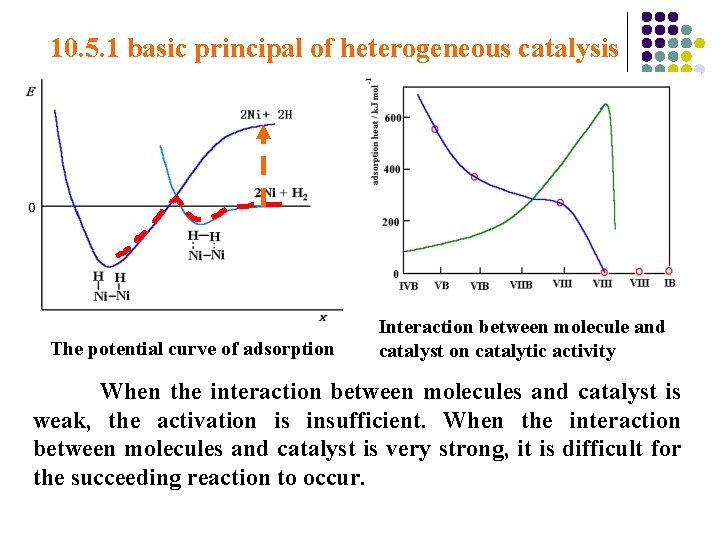
10. 5. 1 basic principal of heterogeneous catalysis The potential curve of adsorption Interaction between molecule and catalyst on catalytic activity When the interaction between molecules and catalyst is weak, the activation is insufficient. When the interaction between molecules and catalyst is very strong, it is difficult for the succeeding reaction to occur.
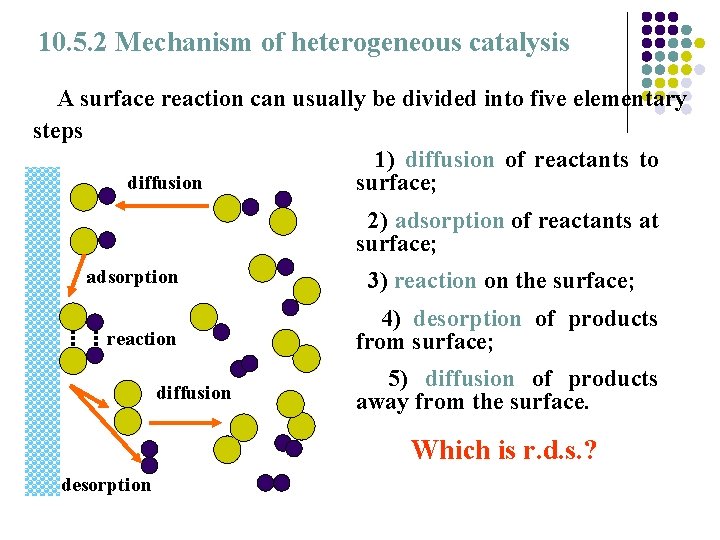
10. 5. 2 Mechanism of heterogeneous catalysis A surface reaction can usually be divided into five elementary steps 1) diffusion of reactants to diffusion surface; 2) adsorption of reactants at surface; adsorption reaction diffusion 3) reaction on the surface; 4) desorption of products from surface; 5) diffusion of products away from the surface. Which is r. d. s. ? desorption
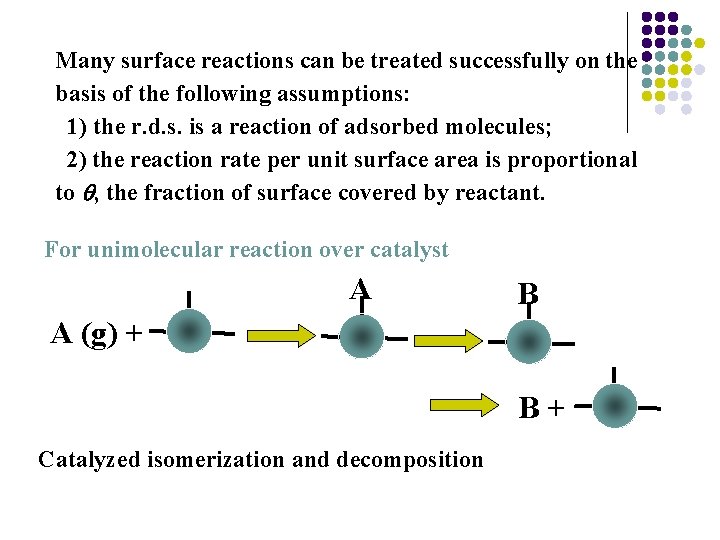
Many surface reactions can be treated successfully on the basis of the following assumptions: 1) the r. d. s. is a reaction of adsorbed molecules; 2) the reaction rate per unit surface area is proportional to , the fraction of surface covered by reactant. For unimolecular reaction over catalyst A B A (g) + B+ Catalyzed isomerization and decomposition
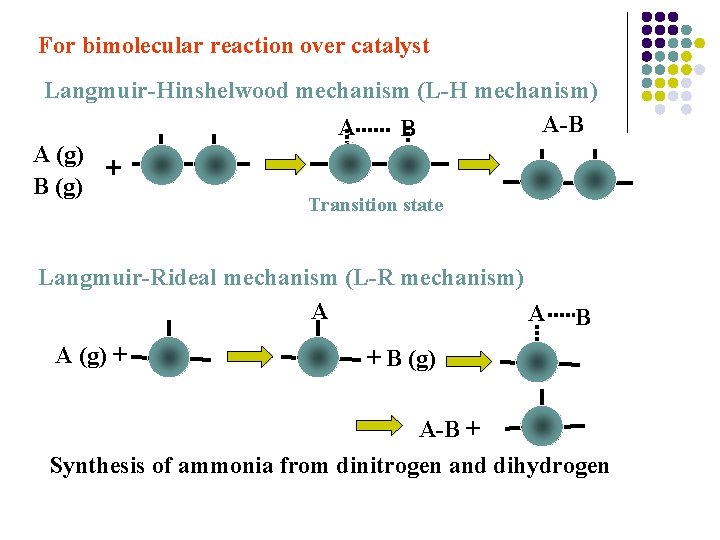
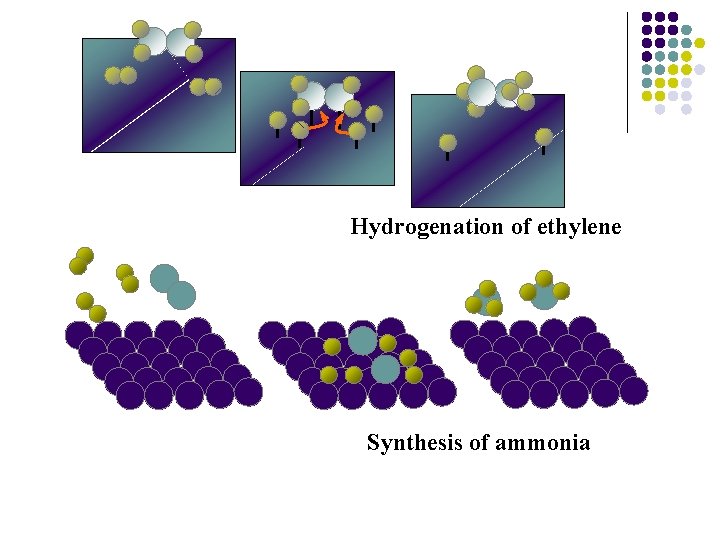
For bimolecular reaction over catalyst Langmuir-Hinshelwood mechanism (L-H mechanism) A-B A (g) + B (g) Transition state Langmuir-Rideal mechanism (L-R mechanism) A A A (g) + B (g) A-B + Synthesis of ammonia from dinitrogen and dihydrogen
Hydrogenation of ethylene Synthesis of ammonia
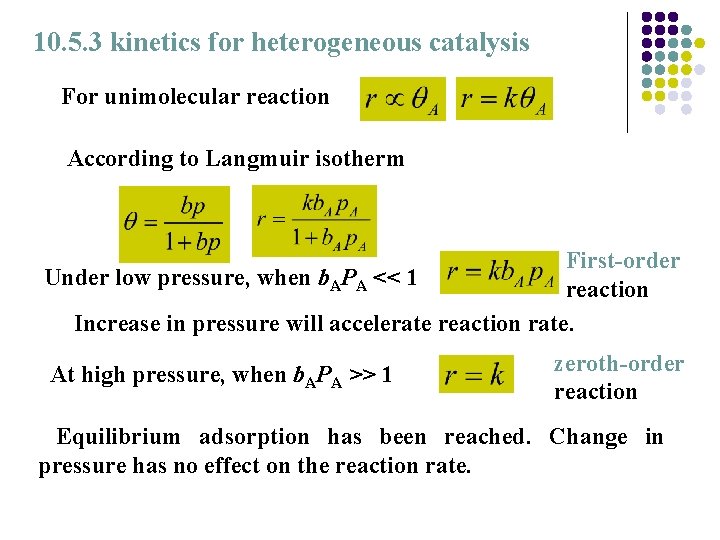
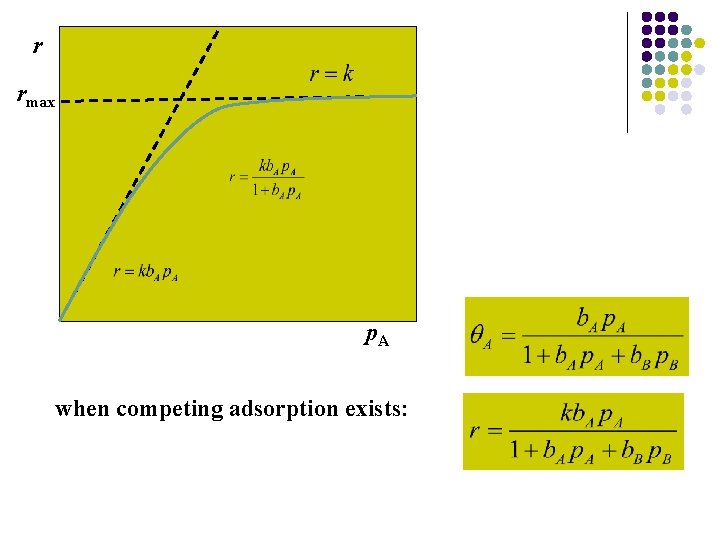
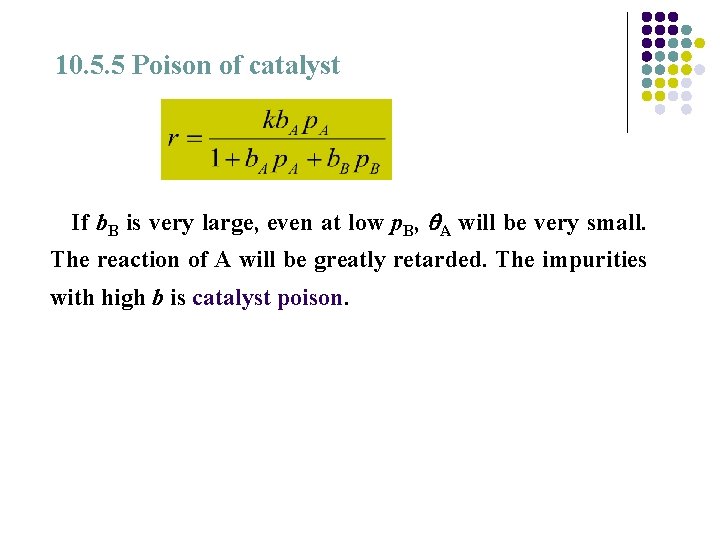
10. 5. 3 kinetics for heterogeneous catalysis For unimolecular reaction According to Langmuir isotherm First-order Under low pressure, when b. APA << 1 reaction Increase in pressure will accelerate reaction rate. At high pressure, when b. APA >> 1 zeroth-order reaction Equilibrium adsorption has been reached. Change in pressure has no effect on the reaction rate.
r rmax p. A when competing adsorption exists:
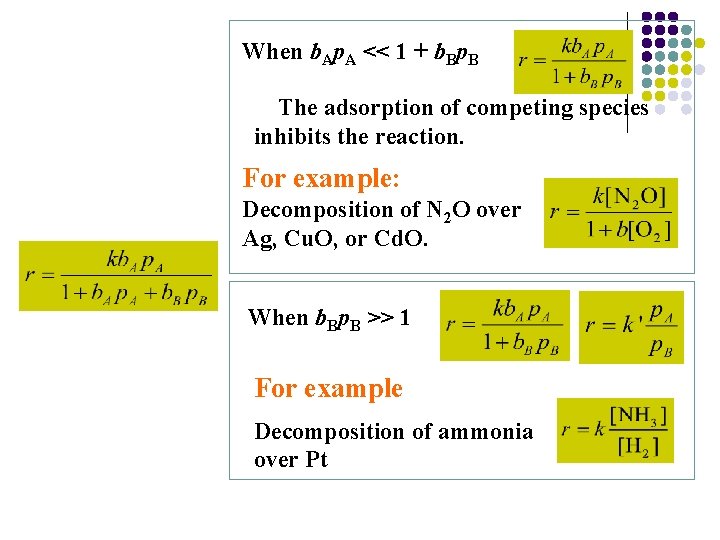
When b. Ap. A << 1 + b. Bp. B The adsorption of competing species inhibits the reaction. For example: Decomposition of N 2 O over Ag, Cu. O, or Cd. O. When b. Bp. B >> 1 For example Decomposition of ammonia over Pt
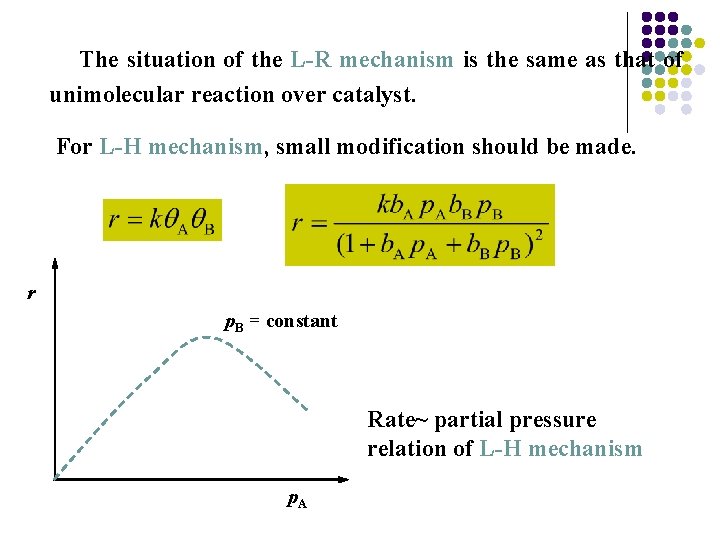
The situation of the L-R mechanism is the same as that of unimolecular reaction over catalyst. For L-H mechanism, small modification should be made. r p. B = constant Rate~ partial pressure relation of L-H mechanism p. A
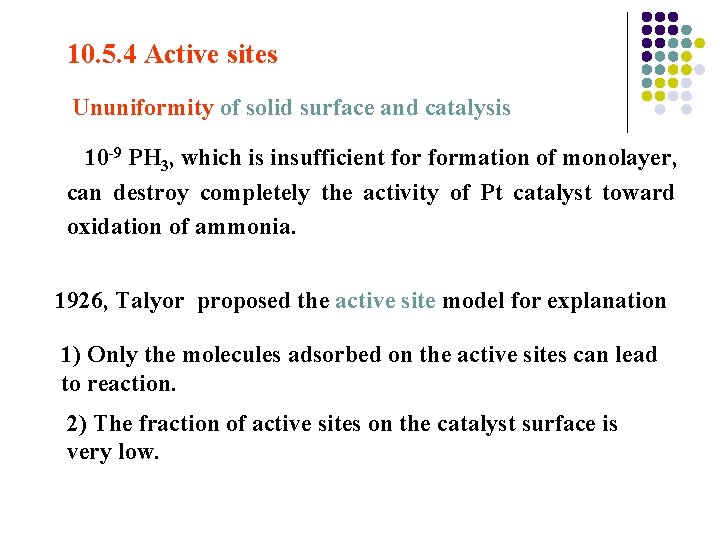
10. 5. 4 Active sites Ununiformity of solid surface and catalysis 10 -9 PH 3, which is insufficient formation of monolayer, can destroy completely the activity of Pt catalyst toward oxidation of ammonia. 1926, Talyor proposed the active site model for explanation 1) Only the molecules adsorbed on the active sites can lead to reaction. 2) The fraction of active sites on the catalyst surface is very low.
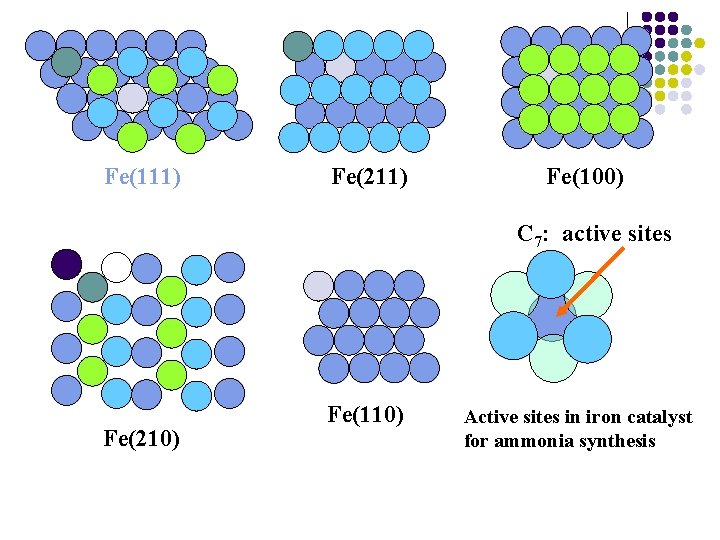
Fe(111) Fe(211) Fe(100) C 7: active sites Fe(210) Fe(110) Active sites in iron catalyst for ammonia synthesis
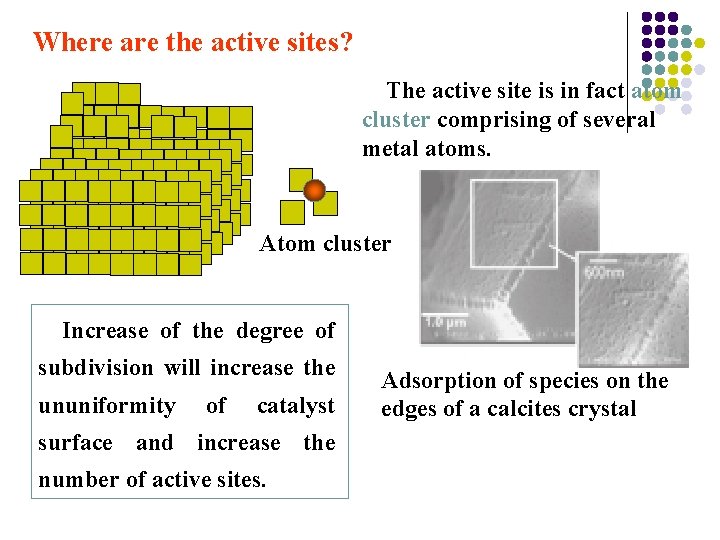
Where are the active sites? The active site is in fact atom cluster comprising of several metal atoms. Atom cluster Increase of the degree of subdivision will increase the ununiformity of catalyst surface and increase the number of active sites. Adsorption of species on the edges of a calcites crystal
10. 5. 5 Poison of catalyst If b. B is very large, even at low p. B, A will be very small. The reaction of A will be greatly retarded. The impurities with high b is catalyst poison.
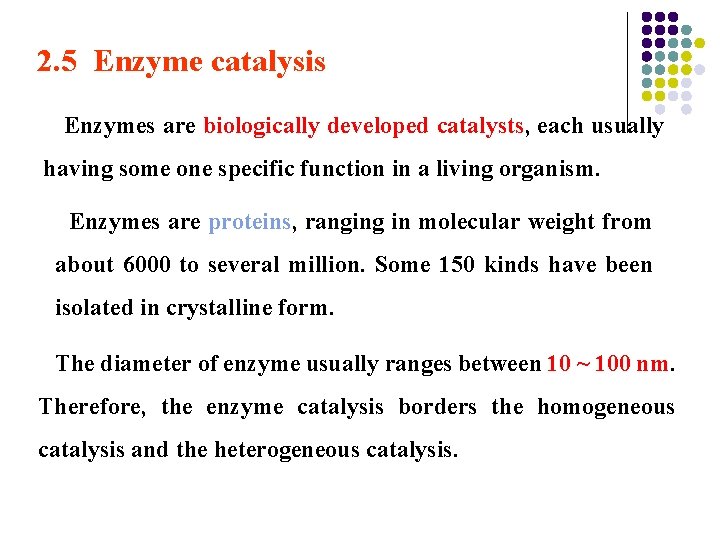
2. 5 Enzyme catalysis Enzymes are biologically developed catalysts, each usually having some one specific function in a living organism. Enzymes are proteins, ranging in molecular weight from about 6000 to several million. Some 150 kinds have been isolated in crystalline form. The diameter of enzyme usually ranges between 10 ~ 100 nm. Therefore, the enzyme catalysis borders the homogeneous catalysis and the heterogeneous catalysis.
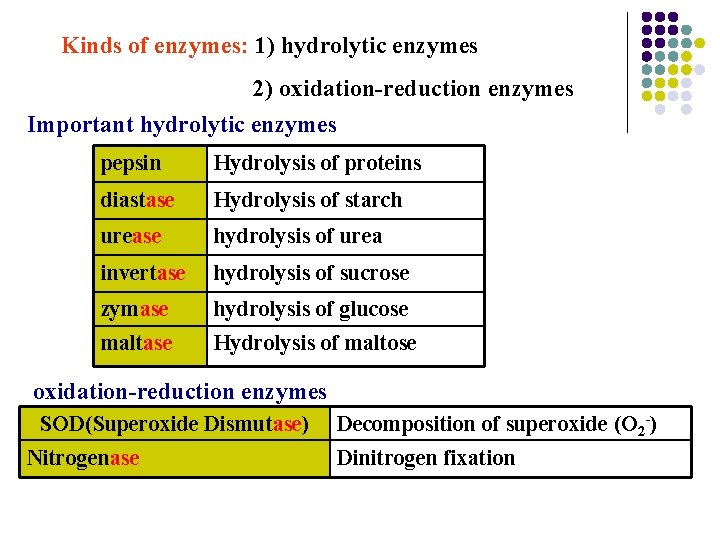
Kinds of enzymes: 1) hydrolytic enzymes 2) oxidation-reduction enzymes Important hydrolytic enzymes pepsin Hydrolysis of proteins diastase Hydrolysis of starch urease hydrolysis of urea invertase hydrolysis of sucrose zymase hydrolysis of glucose maltase Hydrolysis of maltose oxidation-reduction enzymes SOD(Superoxide Dismutase) Nitrogenase Decomposition of superoxide (O 2 -) Dinitrogen fixation
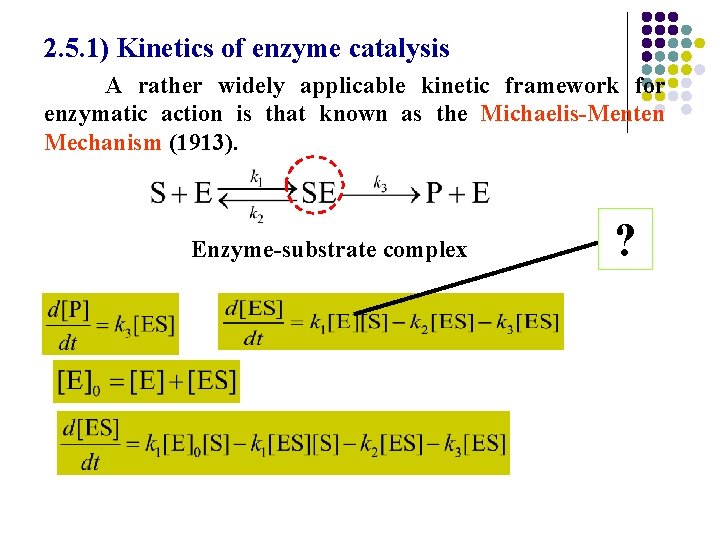
2. 5. 1) Kinetics of enzyme catalysis A rather widely applicable kinetic framework for enzymatic action is that known as the Michaelis-Menten Mechanism (1913). Enzyme-substrate complex ?
Using stationary-state approximation Michaelis constant Discussion: 1) When [S] >> k. M: is zeroth order with respect of [S]. 2) When [S] << k. M: is first order with respect of [S].
When [S] = k. M: At r = ½ rm, [S] = k. M
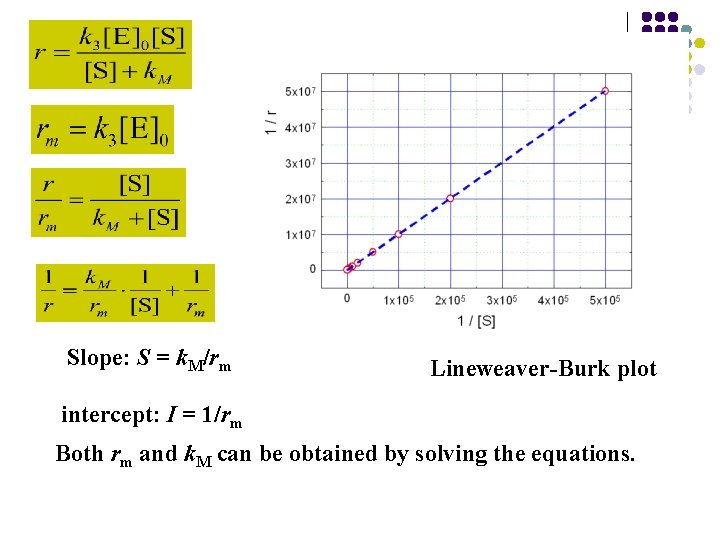
Slope: S = k. M/rm Lineweaver-Burk plot intercept: I = 1/rm Both rm and k. M can be obtained by solving the equations.
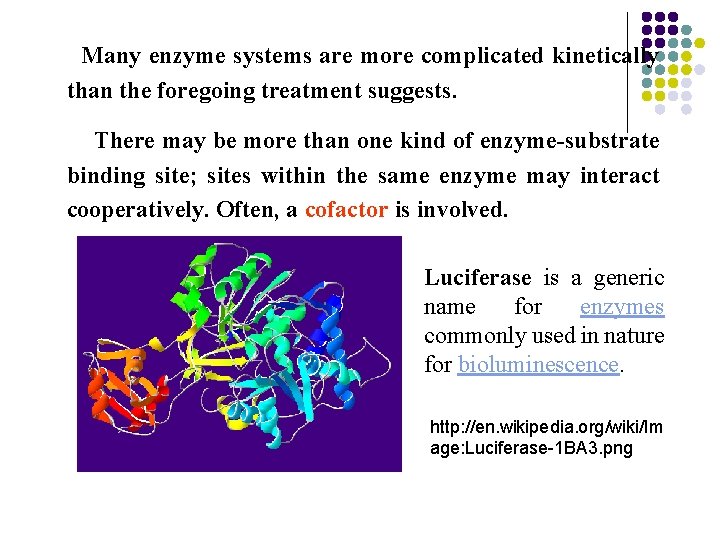
Many enzyme systems are more complicated kinetically than the foregoing treatment suggests. There may be more than one kind of enzyme-substrate binding site; sites within the same enzyme may interact cooperatively. Often, a cofactor is involved. Luciferase is a generic name for enzymes commonly used in nature for bioluminescence. http: //en. wikipedia. org/wiki/Im age: Luciferase-1 BA 3. png
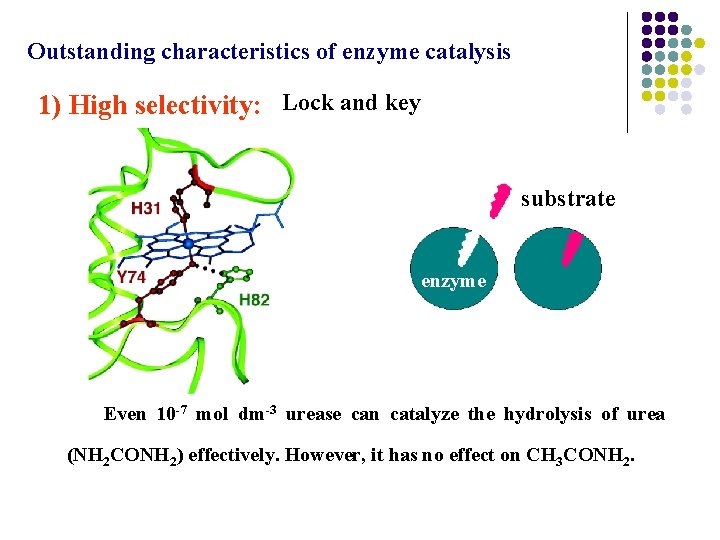
Outstanding characteristics of enzyme catalysis 1) High selectivity: Lock and key substrate enzyme Even 10 -7 mol dm-3 urease can catalyze the hydrolysis of urea (NH 2 CONH 2) effectively. However, it has no effect on CH 3 CONH 2.
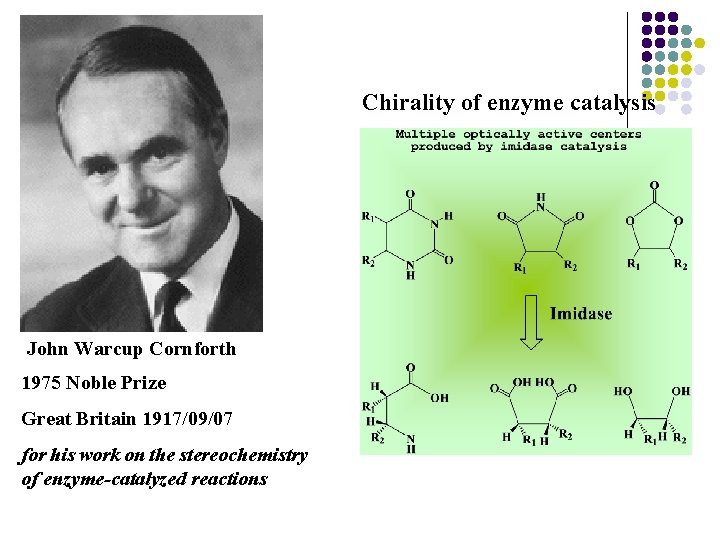
Chirality of enzyme catalysis John Warcup Cornforth 1975 Noble Prize Great Britain 1917/09/07 for his work on the stereochemistry of enzyme-catalyzed reactions
2) High efficiency Activation energy of hydrolysis of sucrose is 107 k. J mol-1 in presence of H+, while that is 36 k. J mol-1 in presence of a little amount of saccharase, corresponding to a rate change of 1022. A superoxide Dismutase can catalytically decompose 105 molecules of hydrogen peroxide in at ambient temperature in 1 s, while Al 2(Si. O 3)3, an industrial catalyst for cracking of petroleum, can only crack one alkane molecules at 773 K in 4 s. 3) Moderate conditions Nitrogenase in root-node can fix dinitrogen from dinitrogen and water at ambient pressure and atmospheric pressure with 100 % conversion. While in industry, the conversion of dinitrogen and dihydrogen to ammonia over promoted iron catalyst at 500 atm and 450 ~ 480 o. C for single cycle is only 10~15%.
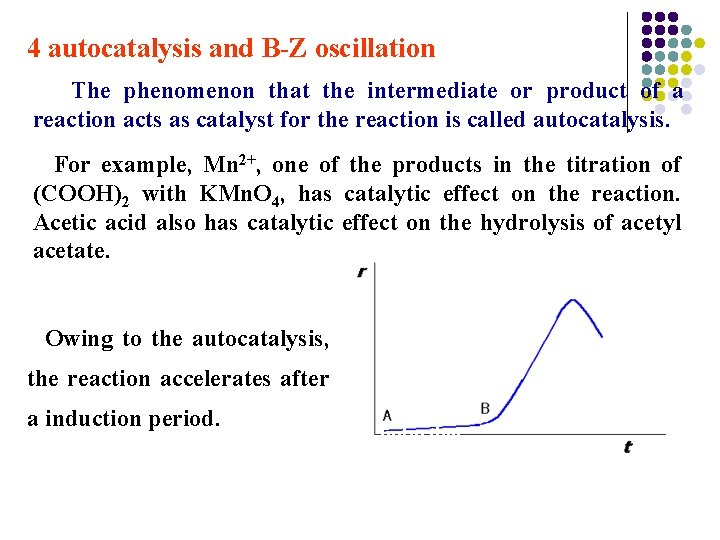
4 autocatalysis and B-Z oscillation The phenomenon that the intermediate or product of a reaction acts as catalyst for the reaction is called autocatalysis. For example, Mn 2+, one of the products in the titration of (COOH)2 with KMn. O 4, has catalytic effect on the reaction. Acetic acid also has catalytic effect on the hydrolysis of acetyl acetate. Owing to the autocatalysis, the reaction accelerates after a induction period. Induction period
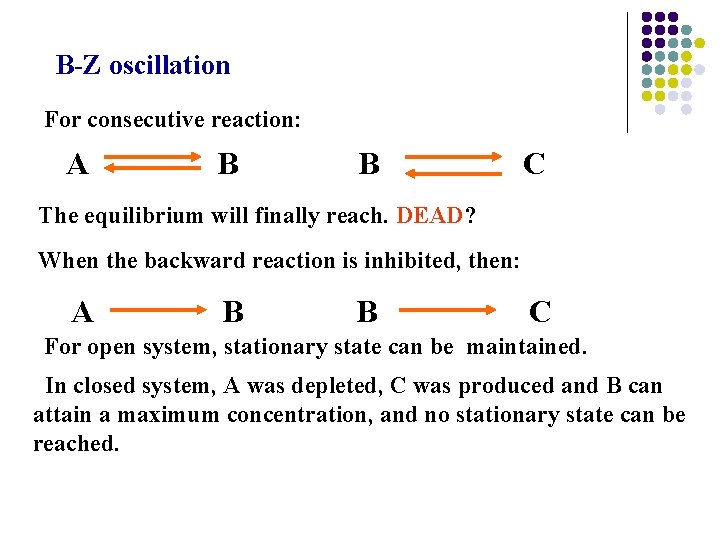
B-Z oscillation For consecutive reaction: A B B C The equilibrium will finally reach. DEAD? When the backward reaction is inhibited, then: A B B C For open system, stationary state can be maintained. In closed system, A was depleted, C was produced and B can attain a maximum concentration, and no stationary state can be reached.
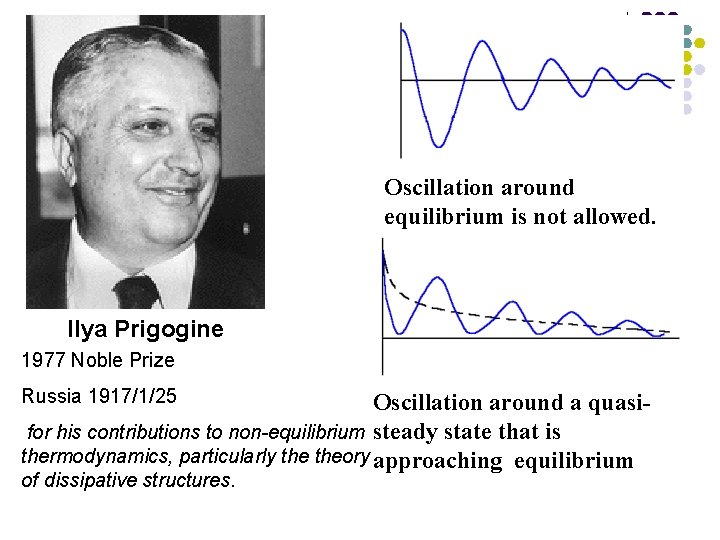
It was interesting that, for some open system far apart from equilibrium, the intermediate concentration oscillates with time. These reactions is called chemical oscillating reaction. The first oscillating reaction was observed by Belousov in 1958. Latterly, Zhabotinshii reported other systems that can generate chemical oscillation. We now call chemical oscillation Belousov-Zhabotinshii oscillation (B-Z oscillation). The first B-Z oscillation system is the cerium-ion-catalyzed oxidation of malonic acid by bromate.
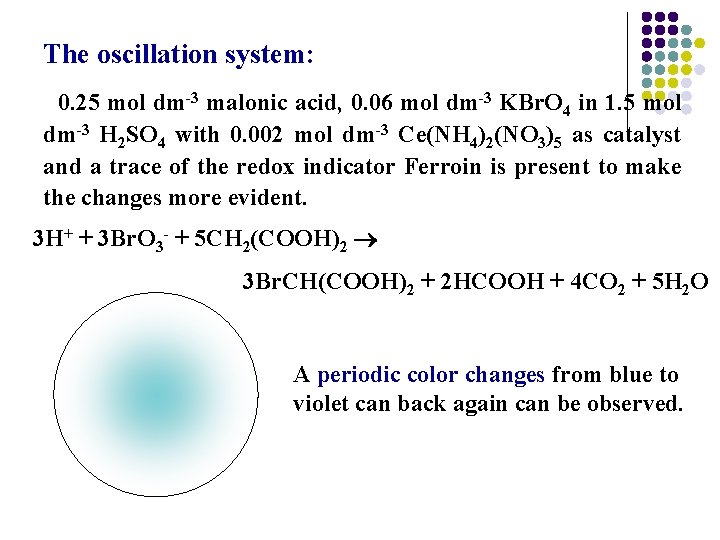
The oscillation system: 0. 25 mol dm-3 malonic acid, 0. 06 mol dm-3 KBr. O 4 in 1. 5 mol dm-3 H 2 SO 4 with 0. 002 mol dm-3 Ce(NH 4)2(NO 3)5 as catalyst and a trace of the redox indicator Ferroin is present to make the changes more evident. 3 H+ + 3 Br. O 3 - + 5 CH 2(COOH)2 3 Br. CH(COOH)2 + 2 HCOOH + 4 CO 2 + 5 H 2 O A periodic color changes from blue to violet can back again can be observed.
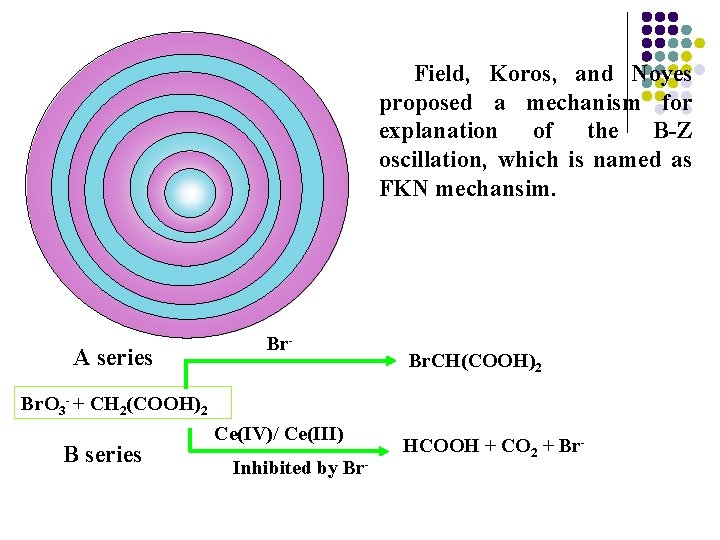
Field, Koros, and Noyes proposed a mechanism for explanation of the B-Z oscillation, which is named as FKN mechansim. A series Br- Br. CH(COOH)2 Br. O 3 - + CH 2(COOH)2 B series Ce(IV)/ Ce(III) Inhibited by Br- HCOOH + CO 2 + Br-
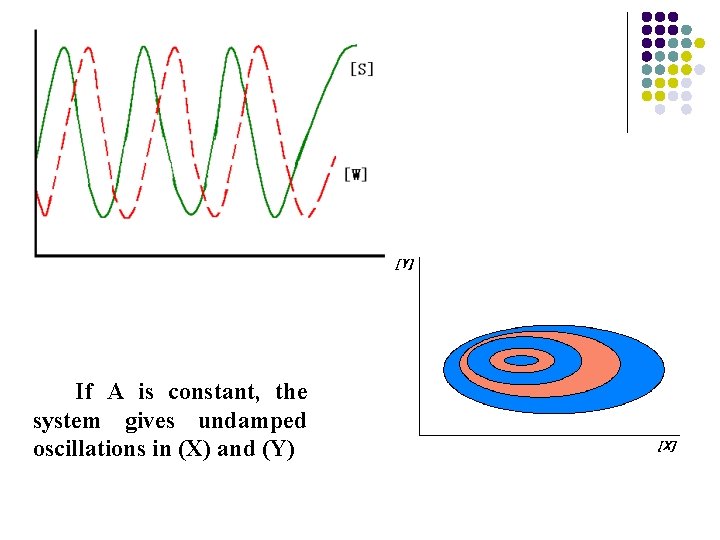
Periodic change of [Br-] and [Ce(IV)]/[Ce(III)] In 1910, Lotka showed that the system: G + S 2 S S + W 2 W W inert k 1 k 2 k 3 k 2[S] – k 3 ln[S] + k 2[W] + k 1[G]ln[W] = constant
If A is constant, the system gives undamped oscillations in (X) and (Y)
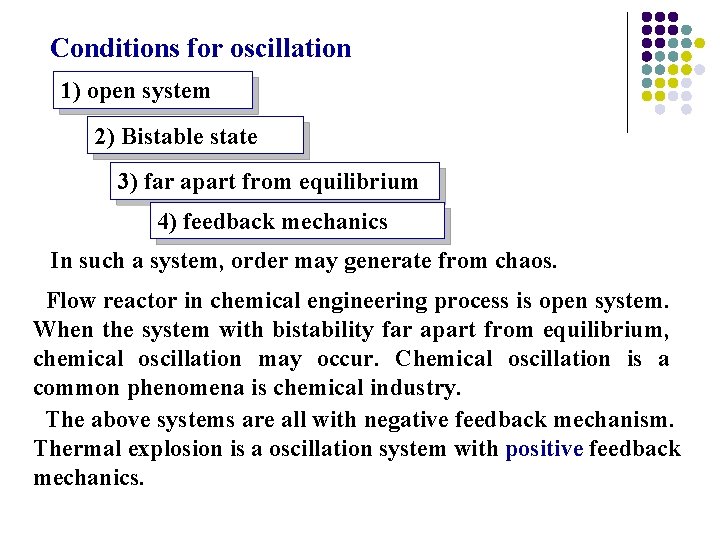
Conditions for oscillation 1) open system 2) Bistable state 3) far apart from equilibrium 4) feedback mechanics In such a system, order may generate from chaos. Flow reactor in chemical engineering process is open system. When the system with bistability far apart from equilibrium, chemical oscillation may occur. Chemical oscillation is a common phenomena is chemical industry. The above systems are all with negative feedback mechanism. Thermal explosion is a oscillation system with positive feedback mechanics.
Oscillation around equilibrium is not allowed. Ilya Prigogine 1977 Noble Prize Russia 1917/1/25 Oscillation around a quasifor his contributions to non-equilibrium steady state that is thermodynamics, particularly theory approaching equilibrium of dissipative structures.
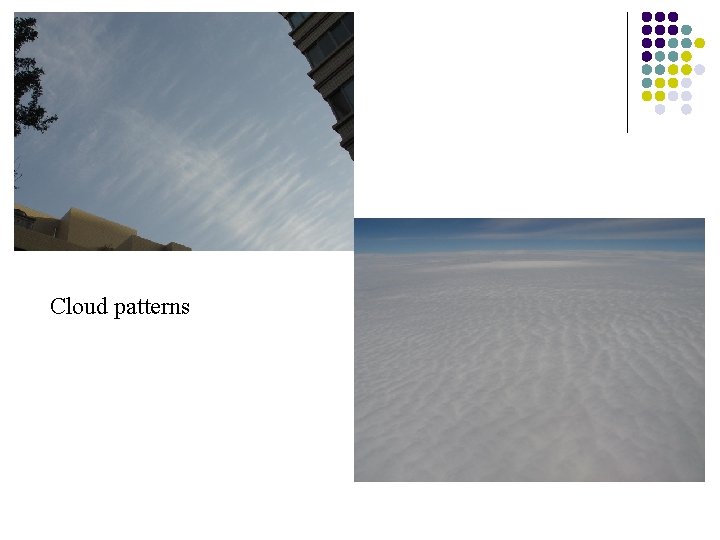
Cloud patterns