
10 4 Evidence of Evolution KEY CONCEPT Evidence
- Slides: 14
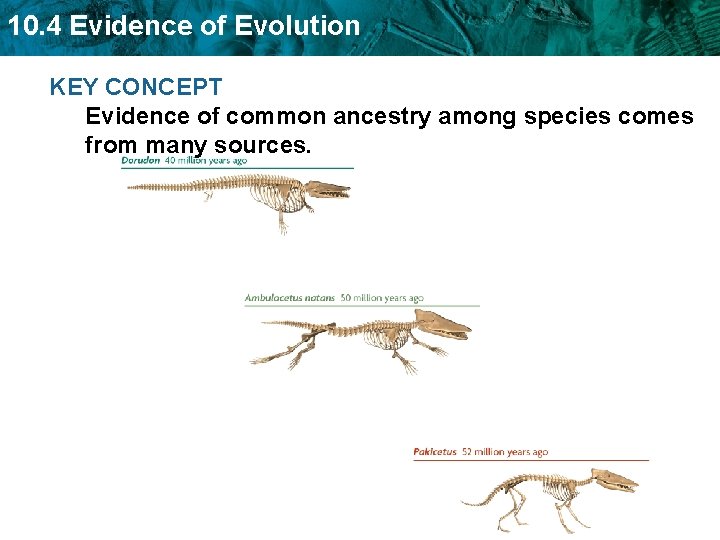
10. 4 Evidence of Evolution KEY CONCEPT Evidence of common ancestry among species comes from many sources.
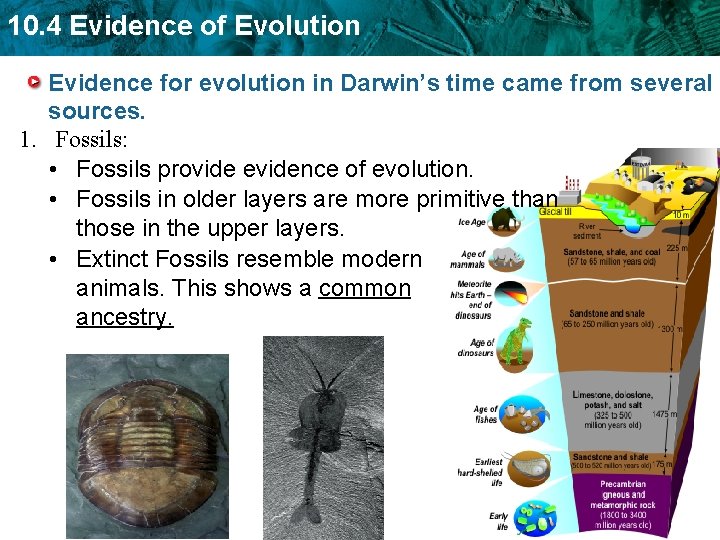
10. 4 Evidence of Evolution Evidence for evolution in Darwin’s time came from several sources. 1. Fossils: • Fossils provide evidence of evolution. • Fossils in older layers are more primitive than those in the upper layers. • Extinct Fossils resemble modern animals. This shows a common ancestry.
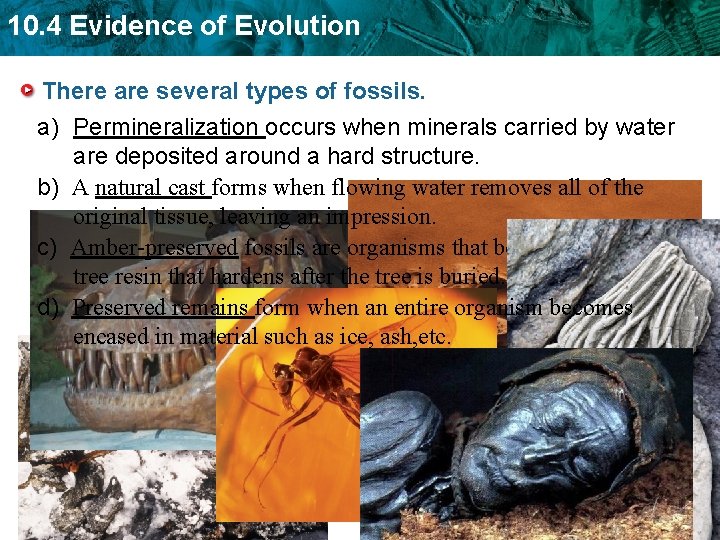
10. 4 Evidence of Evolution There are several types of fossils. a) Permineralization occurs when minerals carried by water are deposited around a hard structure. b) A natural cast forms when flowing water removes all of the original tissue, leaving an impression. c) Amber-preserved fossils are organisms that become trapped in tree resin that hardens after the tree is buried. d) Preserved remains form when an entire organism becomes encased in material such as ice, ash, etc.
10. 4 Evidence of Evolution • Dating Fossils
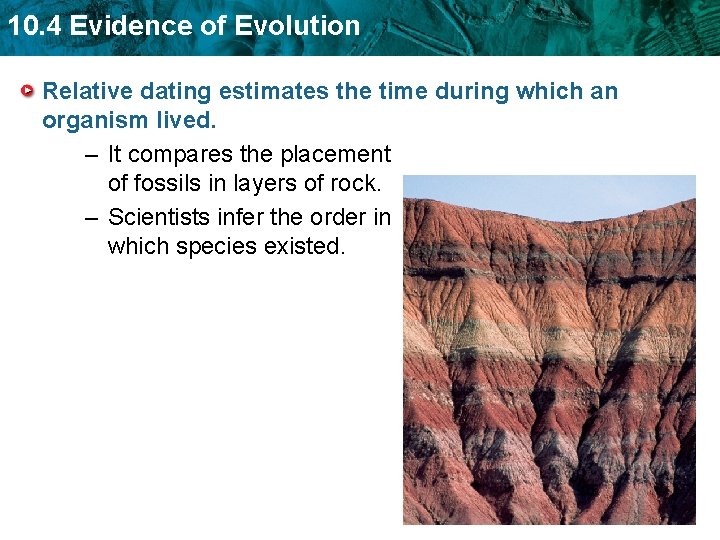
10. 4 Evidence of Evolution Relative dating estimates the time during which an organism lived. – It compares the placement of fossils in layers of rock. – Scientists infer the order in which species existed.
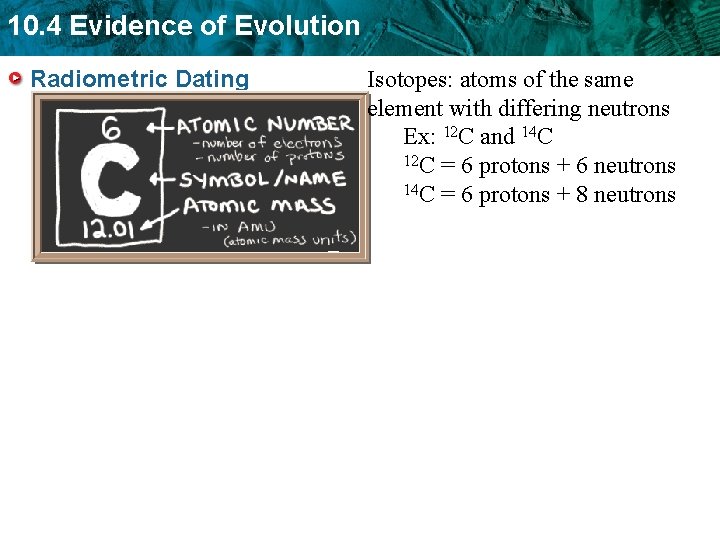
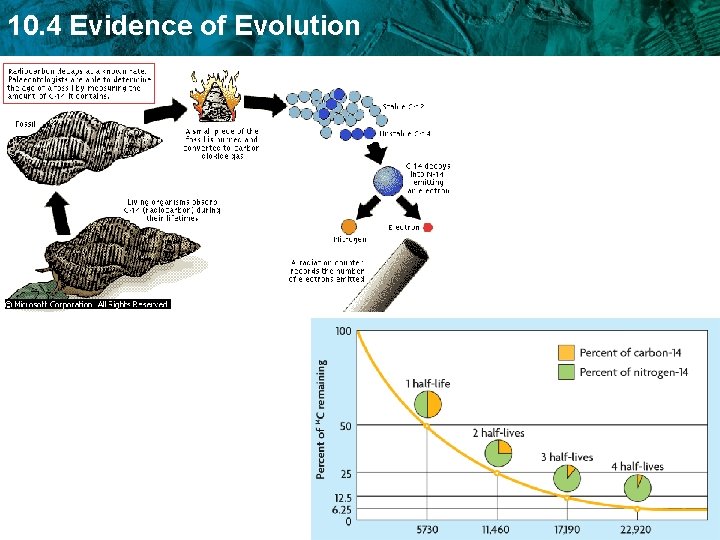
10. 4 Evidence of Evolution Radiometric Dating Isotopes: atoms of the same element with differing neutrons Ex: 12 C and 14 C 12 C = 6 protons + 6 neutrons 14 C = 6 protons + 8 neutrons • Isotopes are unstable in their nuclei, so they decay • Isotopes have a known half life (rates of decay are known). • Half life = number of years it takes for half of the isotopes to decay • 14 C has a half life of 5700 years, and 14 N is a decay product • Age determined by comparing ratio of 14 C to 14 N – Wider ratio = older samples
10. 4 Evidence of Evolution
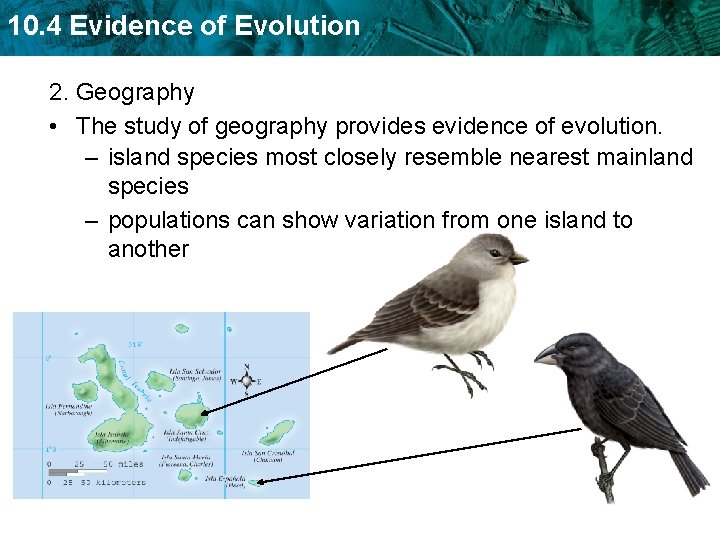
10. 4 Evidence of Evolution 2. Geography • The study of geography provides evidence of evolution. – island species most closely resemble nearest mainland species – populations can show variation from one island to another
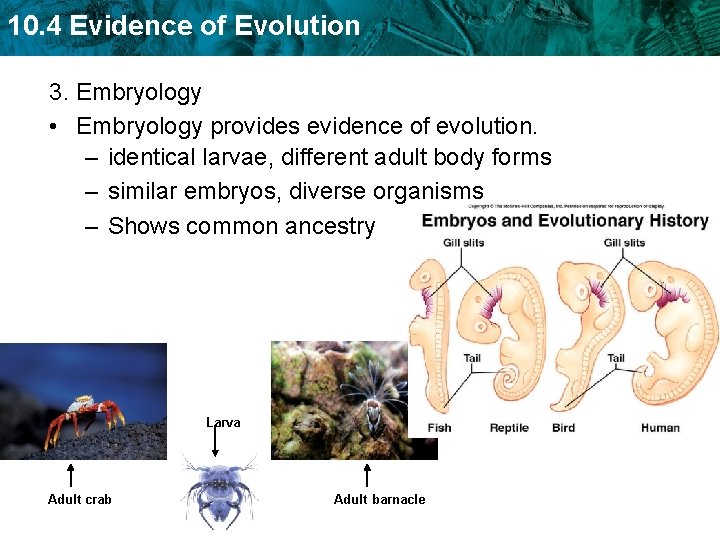
10. 4 Evidence of Evolution 3. Embryology • Embryology provides evidence of evolution. – identical larvae, different adult body forms – similar embryos, diverse organisms – Shows common ancestry Larva Adult crab Adult barnacle
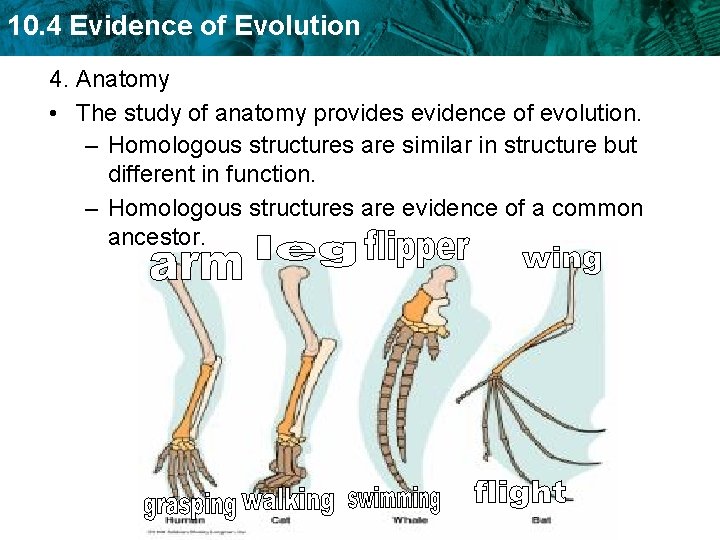
10. 4 Evidence of Evolution 4. Anatomy • The study of anatomy provides evidence of evolution. – Homologous structures are similar in structure but different in function. – Homologous structures are evidence of a common ancestor.
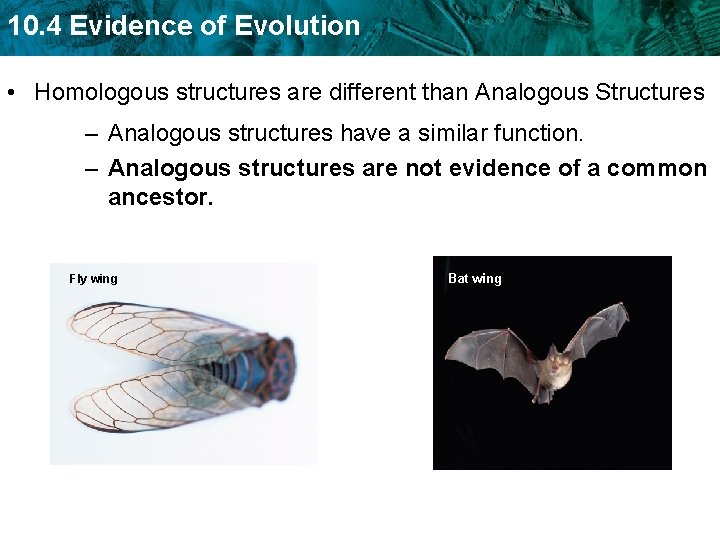
10. 4 Evidence of Evolution • Homologous structures are different than Analogous Structures – Analogous structures have a similar function. Human hand Mole foot – Analogous structures are not evidence of a common ancestor. Fly wing Bat wing
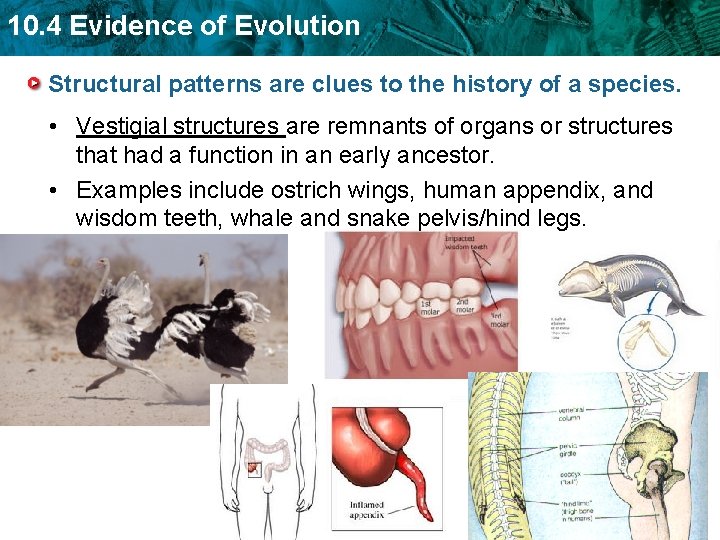
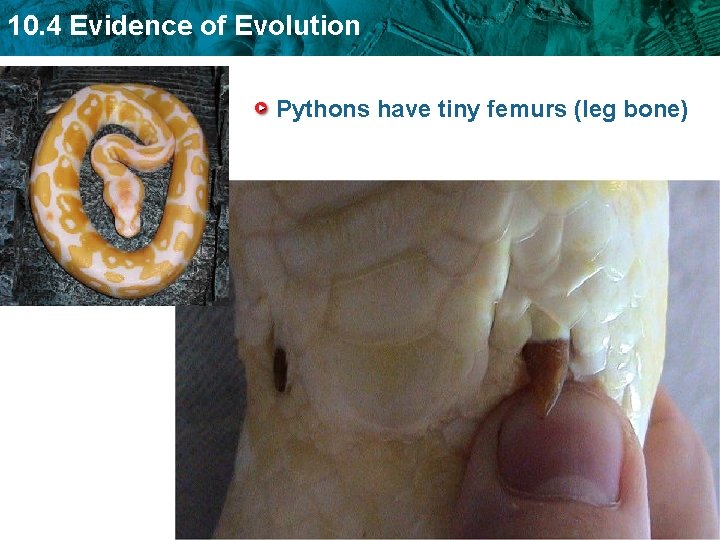
10. 4 Evidence of Evolution Structural patterns are clues to the history of a species. • Vestigial structures are remnants of organs or structures that had a function in an early ancestor. • Examples include ostrich wings, human appendix, and wisdom teeth, whale and snake pelvis/hind legs.
10. 4 Evidence of Evolution Pythons have tiny femurs (leg bone)
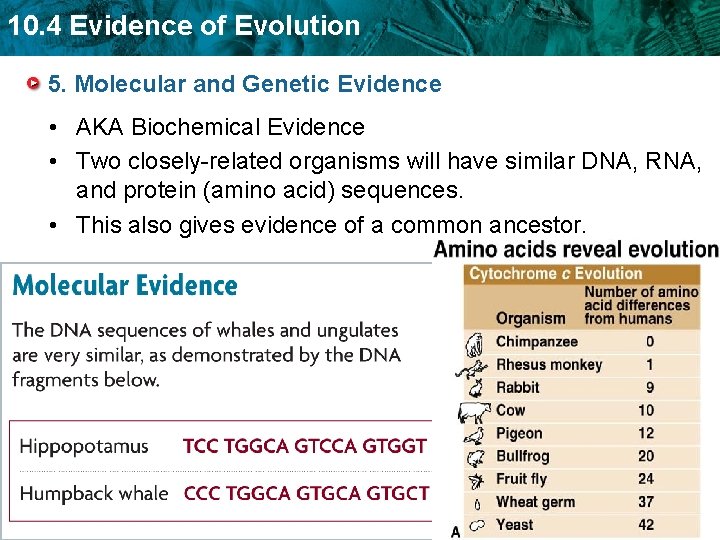
10. 4 Evidence of Evolution 5. Molecular and Genetic Evidence • AKA Biochemical Evidence • Two closely-related organisms will have similar DNA, RNA, and protein (amino acid) sequences. • This also gives evidence of a common ancestor.