
10 3 Displaying Data Part II Students will
- Slides: 14
10 -3 Displaying Data: Part II Students will be able to understand explain • Line graphs. • Scatter plots for two variables. • Relationship between a pair of variables using a scatterplot. • Trend lines. • Positive association, negative association, and no association. • How to choose a data display. ALWAYS LEARNING Copyright © 2020, 2016, 2012 Pearson Education, Inc. 1
Line Graphs A line graph typically shows trends in a variable over time. Time is usually marked on the horizontal axis, with the variable being considered marked on the vertical axis. Consecutive data points are connected by line segments. ALWAYS LEARNING Copyright © 2020, 2016, 2012 Pearson Education, Inc. 2
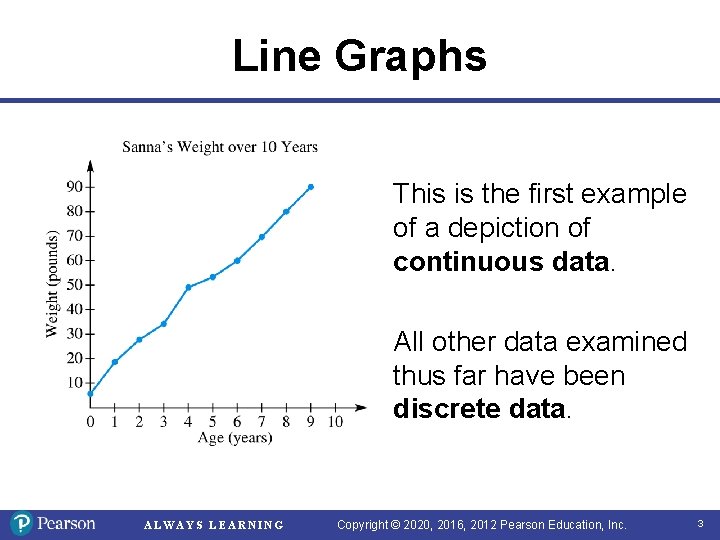
Line Graphs This is the first example of a depiction of continuous data. All other data examined thus far have been discrete data. ALWAYS LEARNING Copyright © 2020, 2016, 2012 Pearson Education, Inc. 3
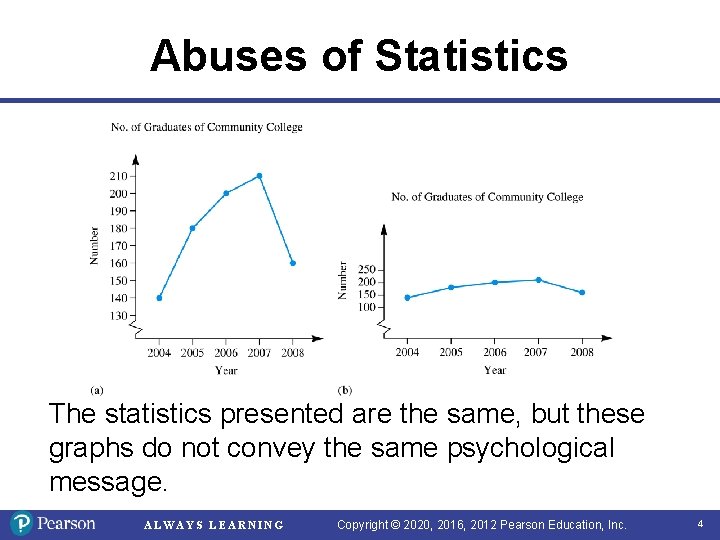
Abuses of Statistics The statistics presented are the same, but these graphs do not convey the same psychological message. ALWAYS LEARNING Copyright © 2020, 2016, 2012 Pearson Education, Inc. 4
Scatterplots Sometimes a relationship between variables cannot be easily depicted by even a broken line, so a scatterplot may be used. ALWAYS LEARNING Copyright © 2020, 2016, 2012 Pearson Education, Inc. 5
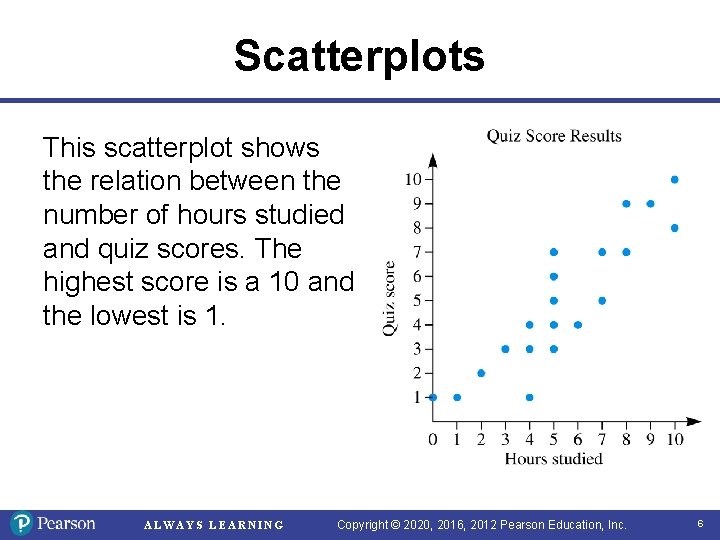
Scatterplots This scatterplot shows the relation between the number of hours studied and quiz scores. The highest score is a 10 and the lowest is 1. ALWAYS LEARNING Copyright © 2020, 2016, 2012 Pearson Education, Inc. 6
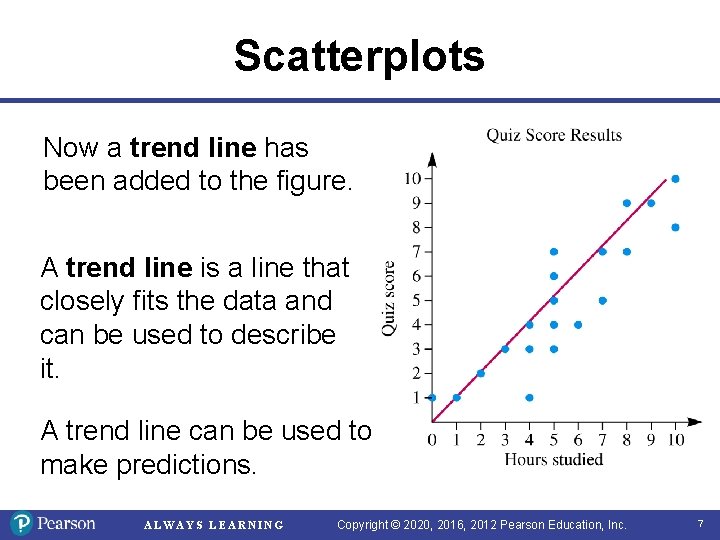
Scatterplots Now a trend line has been added to the figure. A trend line is a line that closely fits the data and can be used to describe it. A trend line can be used to make predictions. ALWAYS LEARNING Copyright © 2020, 2016, 2012 Pearson Education, Inc. 7
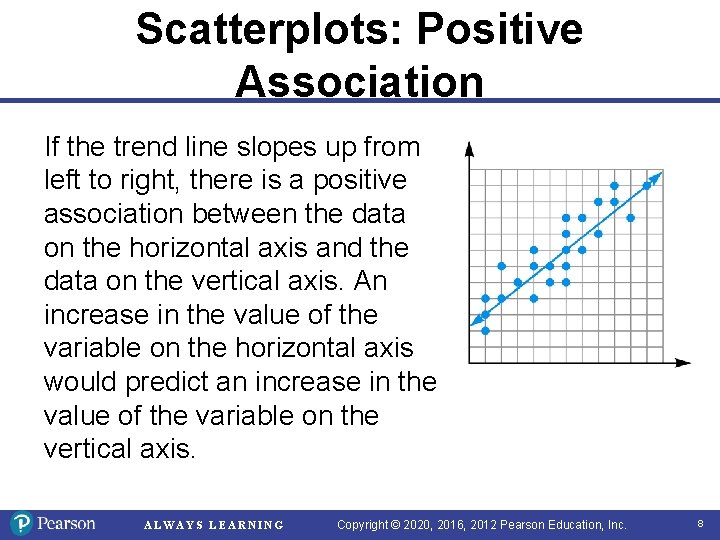
Scatterplots: Positive Association If the trend line slopes up from left to right, there is a positive association between the data on the horizontal axis and the data on the vertical axis. An increase in the value of the variable on the horizontal axis would predict an increase in the value of the variable on the vertical axis. ALWAYS LEARNING Copyright © 2020, 2016, 2012 Pearson Education, Inc. 8
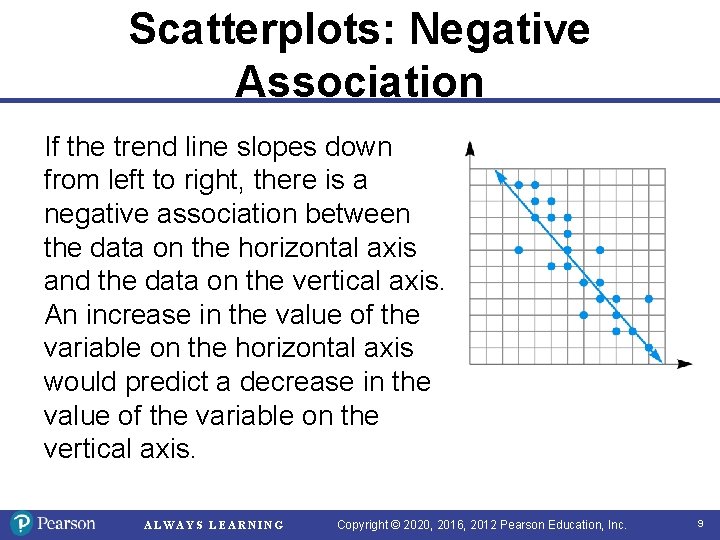
Scatterplots: Negative Association If the trend line slopes down from left to right, there is a negative association between the data on the horizontal axis and the data on the vertical axis. An increase in the value of the variable on the horizontal axis would predict a decrease in the value of the variable on the vertical axis. ALWAYS LEARNING Copyright © 2020, 2016, 2012 Pearson Education, Inc. 9
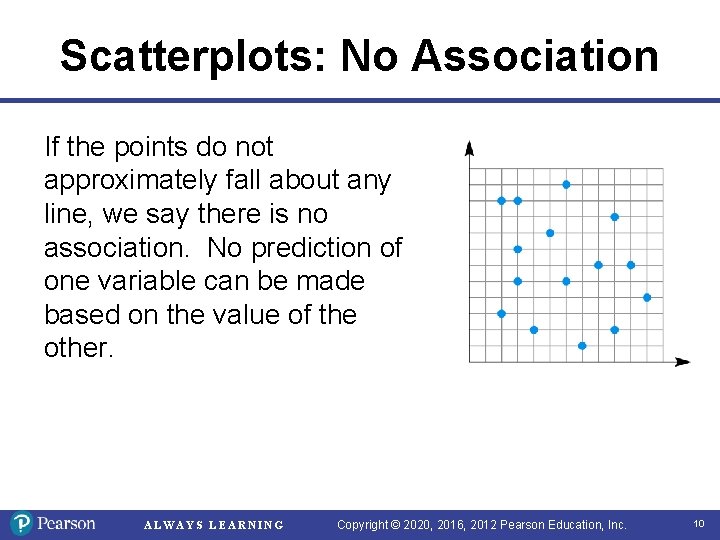
Scatterplots: No Association If the points do not approximately fall about any line, we say there is no association. No prediction of one variable can be made based on the value of the other. ALWAYS LEARNING Copyright © 2020, 2016, 2012 Pearson Education, Inc. 10
Multiple Line Graphs Multiple line graphs may be used together to demonstrate different sets of data where comparisons may be made. ALWAYS LEARNING Copyright © 2020, 2016, 2012 Pearson Education, Inc. 11
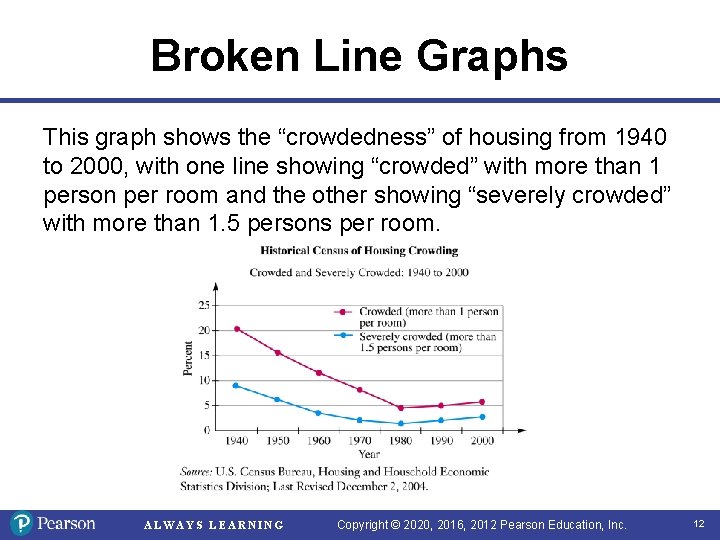
Broken Line Graphs This graph shows the “crowdedness” of housing from 1940 to 2000, with one line showing “crowded” with more than 1 person per room and the other showing “severely crowded” with more than 1. 5 persons per room. ALWAYS LEARNING Copyright © 2020, 2016, 2012 Pearson Education, Inc. 12
Choosing a Data Display Choosing the right display is not always easy, and there may be more than one appropriate choice. Pictograph—Used to show data with pictures or symbols. Dot plot—Used most often to show frequencies. Stem and leaf plot—Used to show each value in a data set and to group values into intervals. Bar graph—Used to compare numbers of data items in grouped categories. ALWAYS LEARNING Copyright © 2020, 2016, 2012 Pearson Education, Inc. 13
Choosing a Data Display Histogram—Used to compare numbers of data items typically grouped in numerical intervals; order matters in the data depicted. Circle graph—Used to show the division of a whole into parts. Percentage bar—Used to show the division of a whole into parts. Line graph—Used to show data values change over time; normally used for continuous data. Scatterplot—Used to show the relationship between two variables. ALWAYS LEARNING Copyright © 2020, 2016, 2012 Pearson Education, Inc. 14