
10 27 2017 Nationalism Germany Enduring Issues Power
- Slides: 12
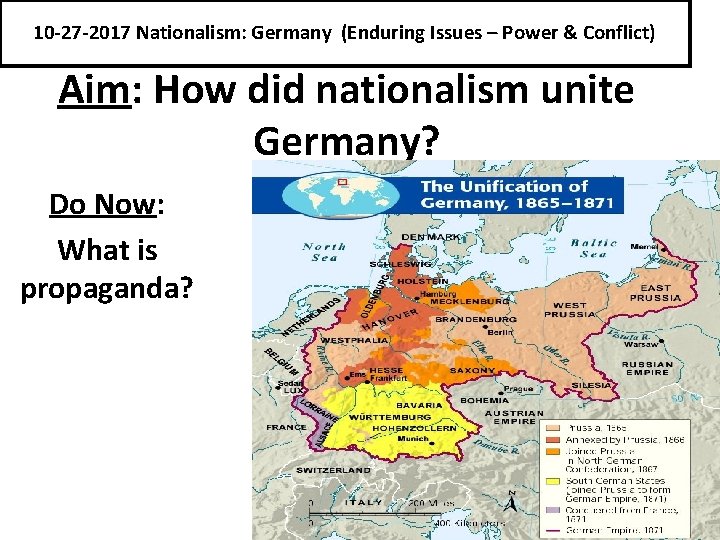
10 -27 -2017 Nationalism: Germany (Enduring Issues – Power & Conflict) Aim: How did nationalism unite Germany? Do Now: What is propaganda?
Activity Web Quest 1. Choose a partner to work with on this activity. 2. Take our your printed worksheet. 3. Bring up an ID card to get an Ipad. 4. Follow the instructions on the work sheet to complete the web quest.
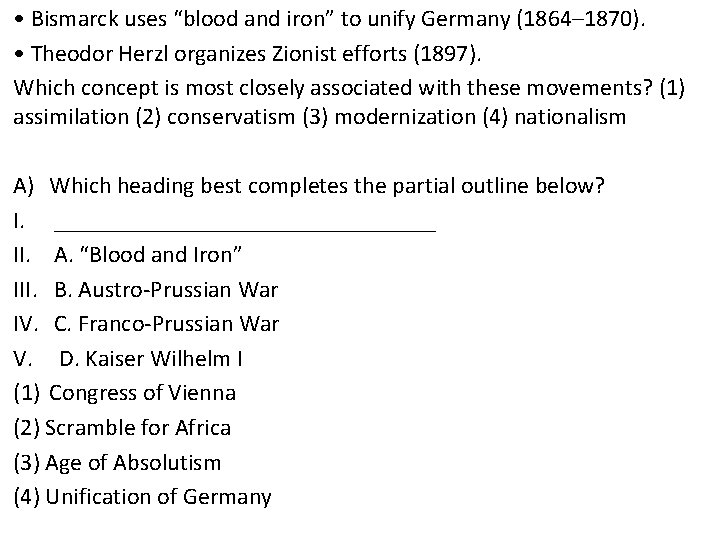
• Bismarck uses “blood and iron” to unify Germany (1864– 1870). • Theodor Herzl organizes Zionist efforts (1897). Which concept is most closely associated with these movements? (1) assimilation (2) conservatism (3) modernization (4) nationalism A) Which heading best completes the partial outline below? I. ________________ II. A. “Blood and Iron” III. B. Austro-Prussian War IV. C. Franco-Prussian War V. D. Kaiser Wilhelm I (1) Congress of Vienna (2) Scramble for Africa (3) Age of Absolutism (4) Unification of Germany
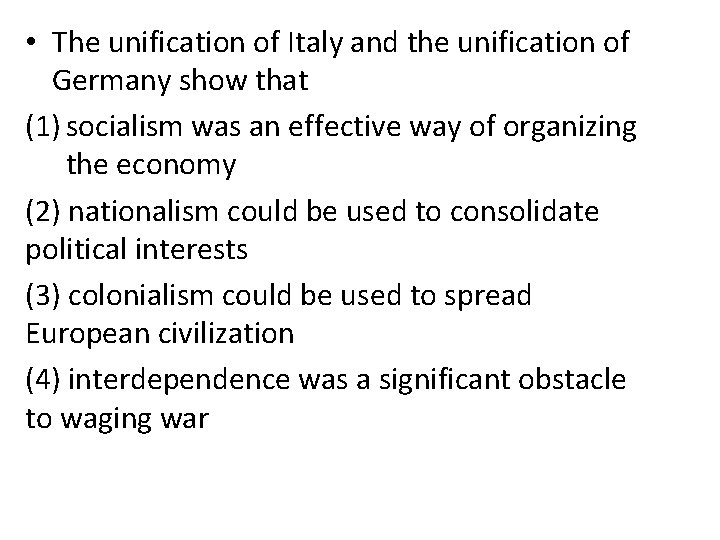
• The unification of Italy and the unification of Germany show that (1) socialism was an effective way of organizing the economy (2) nationalism could be used to consolidate political interests (3) colonialism could be used to spread European civilization (4) interdependence was a significant obstacle to waging war
Case Study: Germany • Bismarck Unites Germany – Beginning in 1815, thirty-nine German states form the German Confederation • Prussia Leads German Unification – Prussia has advantages that help it to unify Germany • mainly German population • powerful army • creation of liberal constitution
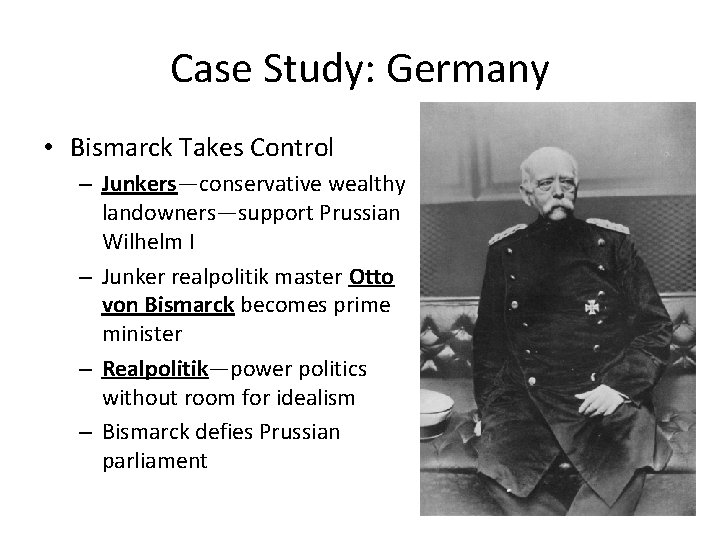
Case Study: Germany • Bismarck Takes Control – Junkers—conservative wealthy landowners—support Prussian Wilhelm I – Junker realpolitik master Otto von Bismarck becomes prime minister – Realpolitik—power politics without room for idealism – Bismarck defies Prussian parliament
Case Study: Germany • Prussia Expands – Prussia and Austria fight Denmark, gain two provinces – Quick victory makes other German nations respect Prussia
Case Study: Germany • Seven Weeks War – Bismarck creates a border dispute with Austria to provoke a war – Prussia seizes Austrian territory, northern Germany – Eastern and western parts of Prussian kingdom are joined for the first time.
Case Study: Germany • The Franco-Prussian War – Bismarck provokes war with France to unite all Germans – Wilhelm is crowned Kaiser—emperor of a united Germany—at Versailles – Bismarck creates a Germany united under Prussian dominance.
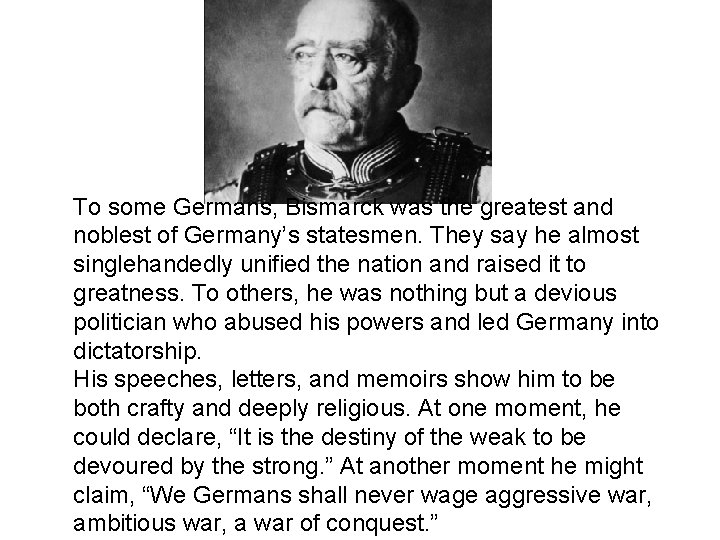
To some Germans, Bismarck was the greatest and noblest of Germany’s statesmen. They say he almost singlehandedly unified the nation and raised it to greatness. To others, he was nothing but a devious politician who abused his powers and led Germany into dictatorship. His speeches, letters, and memoirs show him to be both crafty and deeply religious. At one moment, he could declare, “It is the destiny of the weak to be devoured by the strong. ” At another moment he might claim, “We Germans shall never wage aggressive war, ambitious war, a war of conquest. ”
A Shift in Power • Balance Is Lost – In 1815 the Congress of Vienna established five powers in Europe: • • • Austria Prussia Britain France Russia – By 1871, Britain and Prussia (now Germany) have gained much power – Austria and Russia are weaker militarily and economically
Final Summary Answer the summary question: How did nationalism unite Germany? • Support your answer using at least 2 -3 pieces of evidence from any of your readings, class notes, and/ or homework.