
10 2 Inheritance Dihybrid Crosses Gene Linkage 10
10. 2 Inheritance Dihybrid Crosses & Gene Linkage 10. 2 Dihybrid Crosses & Gene Linkage 1
Mendel’s Law of Independent Assortment “Can you remember it? ” 10. 2 Dihybrid Crosses & Gene Linkage 2
Mendel’s Law of Independent Assortment “The presence of an allele of one of the genes in a gamete has no influence over which allele of another gene is present. ” This only holds true for unlinked genes (genes on different chromosomes). 10. 2 Dihybrid Crosses & Gene Linkage 3
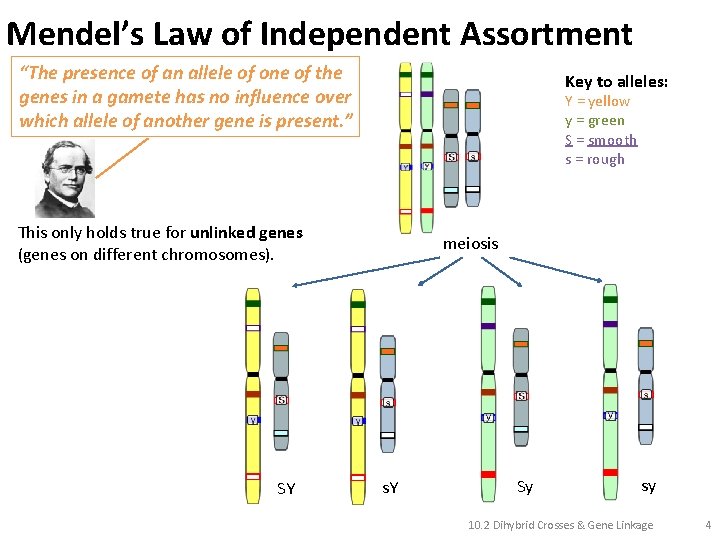
Mendel’s Law of Independent Assortment “The presence of an allele of one of the genes in a gamete has no influence over which allele of another gene is present. ” Key to alleles: Y = yellow y = green S = smooth s = rough This only holds true for unlinked genes (genes on different chromosomes). SY meiosis s. Y Sy sy 10. 2 Dihybrid Crosses & Gene Linkage 4

Dihybrid Crosses Consider two traits, each carried on separate chromsomes (the genes are unlinked). In this example of Lathyrus odoratus (sweet pea), we consider two traits: pea colour and pea surface. Key to alleles: What is the predicted phenotype ratio for a cross between two pea plants which are heterozygous at both loci? F 0 Y = yellow y = green S = smooth s = rough Phenotype: Genotype: Punnet Grid: Heterozygous at both loci gametes F 1 10. 2 Dihybrid Crosses & Gene Linkage 5
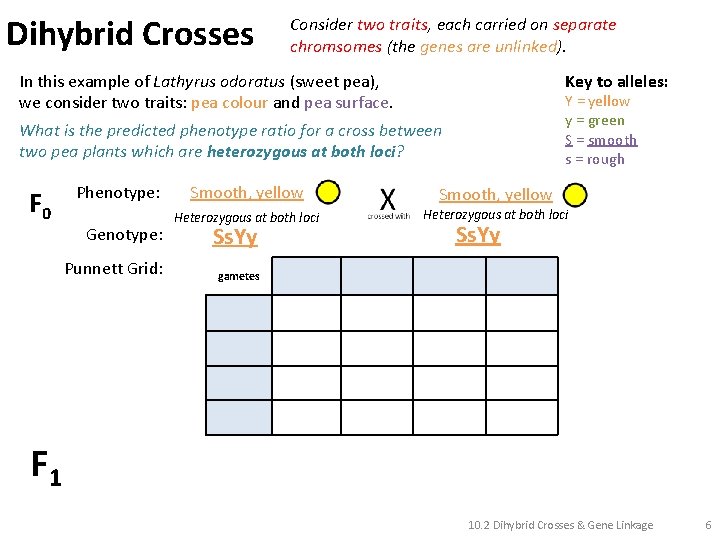
Dihybrid Crosses Consider two traits, each carried on separate chromsomes (the genes are unlinked). In this example of Lathyrus odoratus (sweet pea), we consider two traits: pea colour and pea surface. Key to alleles: Y = yellow y = green S = smooth s = rough What is the predicted phenotype ratio for a cross between two pea plants which are heterozygous at both loci? F 0 Phenotype: Genotype: Punnett Grid: Smooth, yellow Heterozygous at both loci Ss. Yy gametes F 1 10. 2 Dihybrid Crosses & Gene Linkage 6
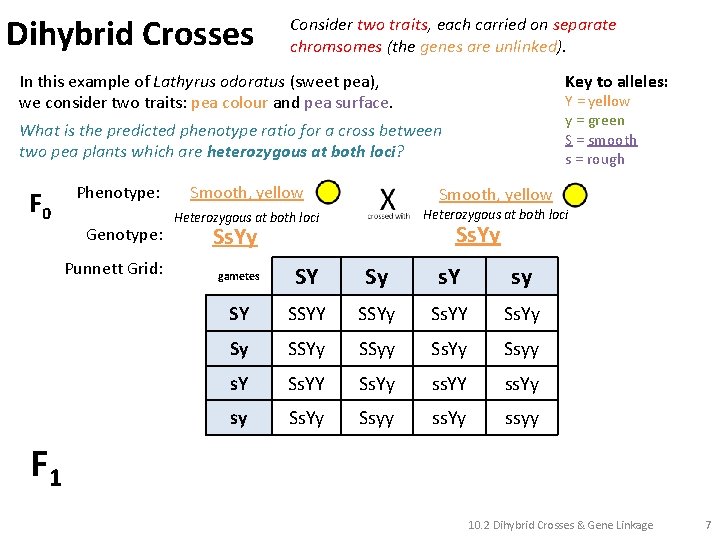
Dihybrid Crosses Consider two traits, each carried on separate chromsomes (the genes are unlinked). In this example of Lathyrus odoratus (sweet pea), we consider two traits: pea colour and pea surface. Key to alleles: Y = yellow y = green S = smooth s = rough What is the predicted phenotype ratio for a cross between two pea plants which are heterozygous at both loci? F 0 Phenotype: Genotype: Punnett Grid: Smooth, yellow Heterozygous at both loci Ss. Yy gametes SY Sy s. Y sy SY SSYy Ss. YY Ss. Yy Sy SSYy SSyy Ss. Yy Ssyy s. Y Ss. Yy ss. YY ss. Yy sy Ss. Yy Ssyy ss. Yy ssyy F 1 10. 2 Dihybrid Crosses & Gene Linkage 7
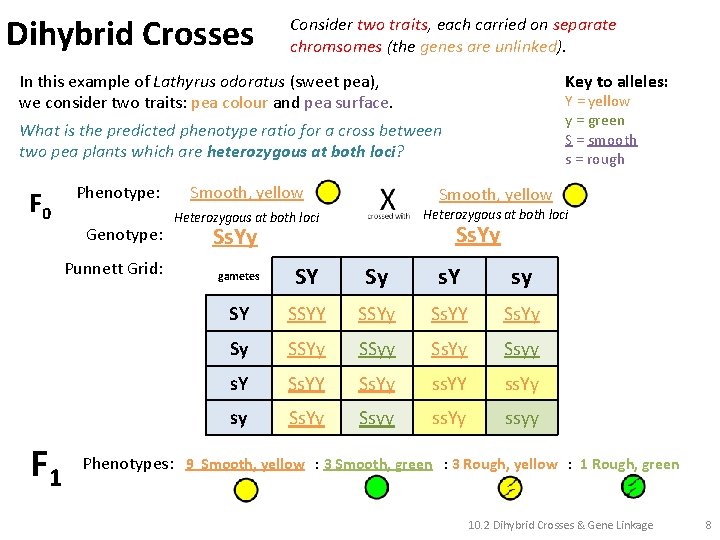
Dihybrid Crosses Consider two traits, each carried on separate chromsomes (the genes are unlinked). In this example of Lathyrus odoratus (sweet pea), we consider two traits: pea colour and pea surface. Key to alleles: Y = yellow y = green S = smooth s = rough What is the predicted phenotype ratio for a cross between two pea plants which are heterozygous at both loci? F 0 Phenotype: Genotype: Punnett Grid: F 1 Smooth, yellow Heterozygous at both loci Ss. Yy gametes SY Sy s. Y sy SY SSYy Ss. YY Ss. Yy Sy SSYy SSyy Ss. Yy Ssyy s. Y Ss. Yy ss. YY ss. Yy sy Ss. Yy Ssyy ss. Yy ssyy Phenotypes: 9 Smooth, yellow : 3 Smooth, green : 3 Rough, yellow : 1 Rough, green 10. 2 Dihybrid Crosses & Gene Linkage 8
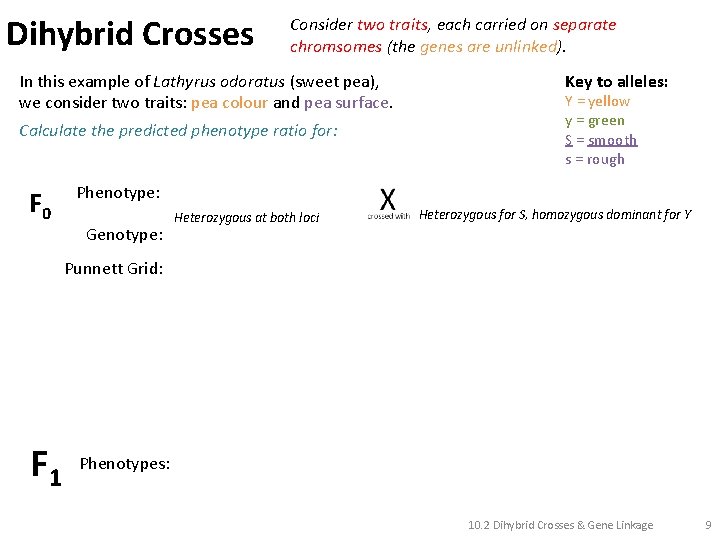
Dihybrid Crosses Consider two traits, each carried on separate chromsomes (the genes are unlinked). In this example of Lathyrus odoratus (sweet pea), we consider two traits: pea colour and pea surface. Calculate the predicted phenotype ratio for: F 0 Key to alleles: Y = yellow y = green S = smooth s = rough Phenotype: Genotype: Heterozygous at both loci Heterozygous for S, homozygous dominant for Y Punnett Grid: F 1 Phenotypes: 10. 2 Dihybrid Crosses & Gene Linkage 9
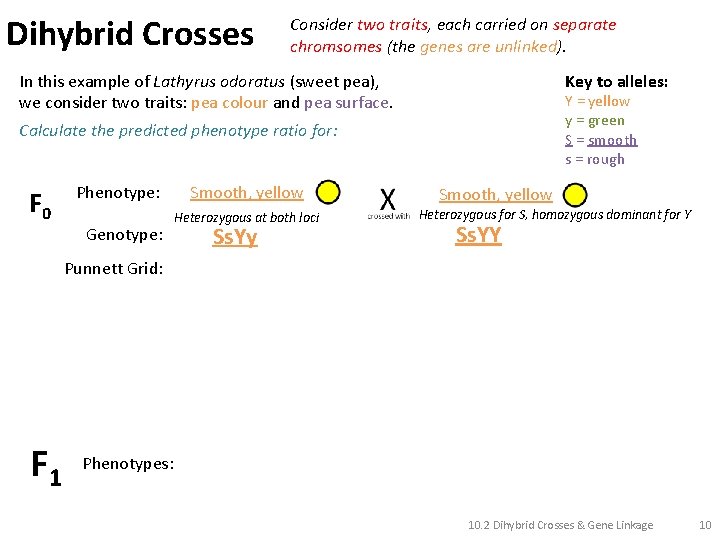
Dihybrid Crosses Consider two traits, each carried on separate chromsomes (the genes are unlinked). In this example of Lathyrus odoratus (sweet pea), we consider two traits: pea colour and pea surface. Key to alleles: Y = yellow y = green S = smooth s = rough Calculate the predicted phenotype ratio for: F 0 Phenotype: Genotype: Smooth, yellow Heterozygous at both loci Ss. Yy Smooth, yellow Heterozygous for S, homozygous dominant for Y Ss. YY Punnett Grid: F 1 Phenotypes: 10. 2 Dihybrid Crosses & Gene Linkage 10
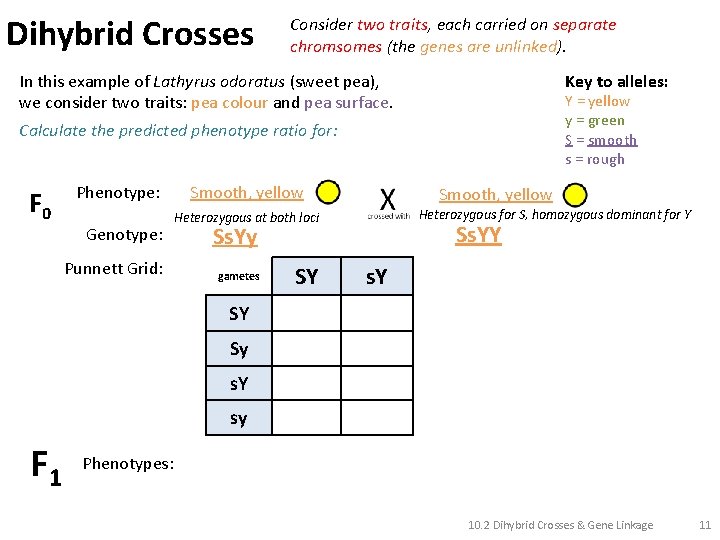
Dihybrid Crosses Consider two traits, each carried on separate chromsomes (the genes are unlinked). In this example of Lathyrus odoratus (sweet pea), we consider two traits: pea colour and pea surface. Key to alleles: Y = yellow y = green S = smooth s = rough Calculate the predicted phenotype ratio for: F 0 Phenotype: Genotype: Punnett Grid: Smooth, yellow Heterozygous for S, homozygous dominant for Y Heterozygous at both loci Ss. YY Ss. Yy gametes SY s. Y SY Sy s. Y sy F 1 Phenotypes: 10. 2 Dihybrid Crosses & Gene Linkage 11
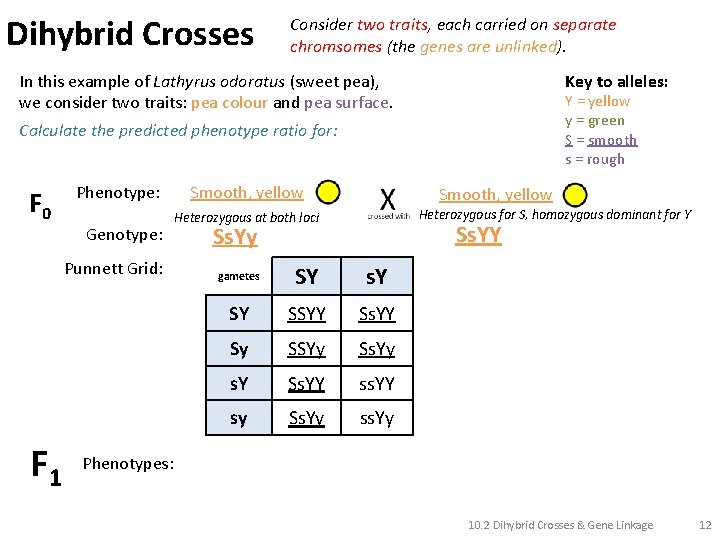
Dihybrid Crosses Consider two traits, each carried on separate chromsomes (the genes are unlinked). In this example of Lathyrus odoratus (sweet pea), we consider two traits: pea colour and pea surface. Key to alleles: Y = yellow y = green S = smooth s = rough Calculate the predicted phenotype ratio for: F 0 Phenotype: Genotype: Punnett Grid: F 1 Smooth, yellow Heterozygous for S, homozygous dominant for Y Heterozygous at both loci Ss. YY Ss. Yy gametes SY s. Y SY SSYY Ss. YY Sy SSYy Ss. Yy s. Y Ss. YY sy Ss. Yy ss. Yy Phenotypes: 10. 2 Dihybrid Crosses & Gene Linkage 12
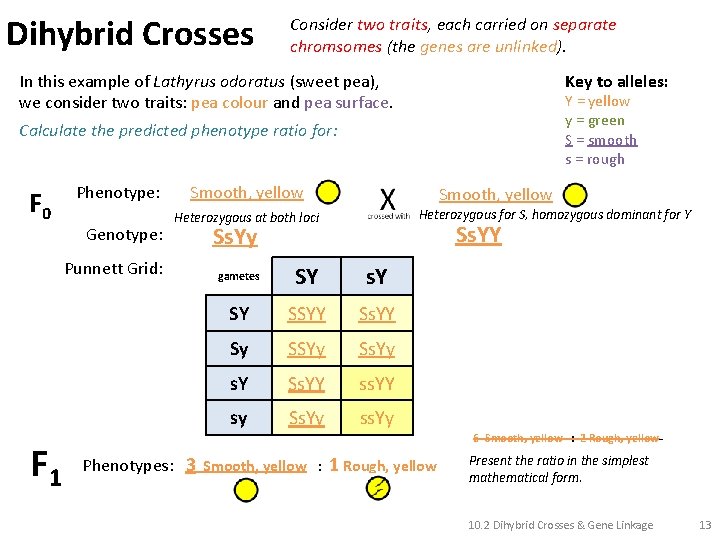
Dihybrid Crosses Consider two traits, each carried on separate chromsomes (the genes are unlinked). In this example of Lathyrus odoratus (sweet pea), we consider two traits: pea colour and pea surface. Key to alleles: Y = yellow y = green S = smooth s = rough Calculate the predicted phenotype ratio for: F 0 Phenotype: Genotype: Punnett Grid: F 1 Smooth, yellow Heterozygous for S, homozygous dominant for Y Heterozygous at both loci Ss. YY Ss. Yy gametes SY s. Y SY SSYY Ss. YY Sy SSYy Ss. Yy s. Y Ss. YY sy Ss. Yy ss. Yy 6 Smooth, yellow : 2 Rough, yellow Phenotypes: 3 Smooth, yellow : 1 Rough, yellow Present the ratio in the simplest mathematical form. 10. 2 Dihybrid Crosses & Gene Linkage 13
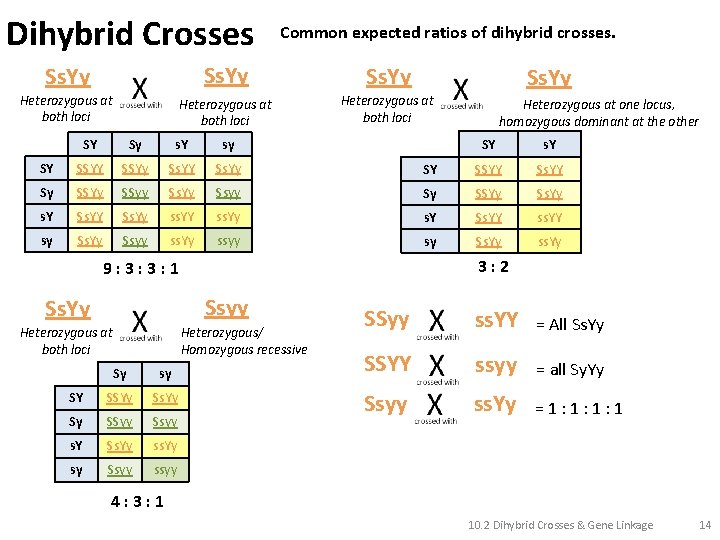
Dihybrid Crosses Common expected ratios of dihybrid crosses. Ss. Yy Heterozygous at both loci Ss. Yy Heterozygous at one locus, homozygous dominant at the other SY s. Y SY SSYY Ssyy Sy SSYy Ss. Yy ss. YY ss. Yy s. Y Ss. YY ss. Yy ssyy sy Ss. Yy ss. Yy SY Sy s. Y sy SY SSYy Ss. YY Ss. Yy Sy SSYy SSyy Ss. Yy s. Y Ss. Yy sy Ss. Yy Ssyy 3: 2 9: 3: 3: 1 Ssyy Ss. Yy Heterozygous at both loci Heterozygous/ Homozygous recessive Sy sy SY SSYy Ss. Yy Sy SSyy Ssyy s. Y Ss. Yy sy Ssyy ssyy SSyy ss. YY = All Ss. Yy SSYY ssyy = all Sy. Yy Ssyy ss. Yy =1: 1: 1: 1 4: 3: 1 10. 2 Dihybrid Crosses & Gene Linkage 14
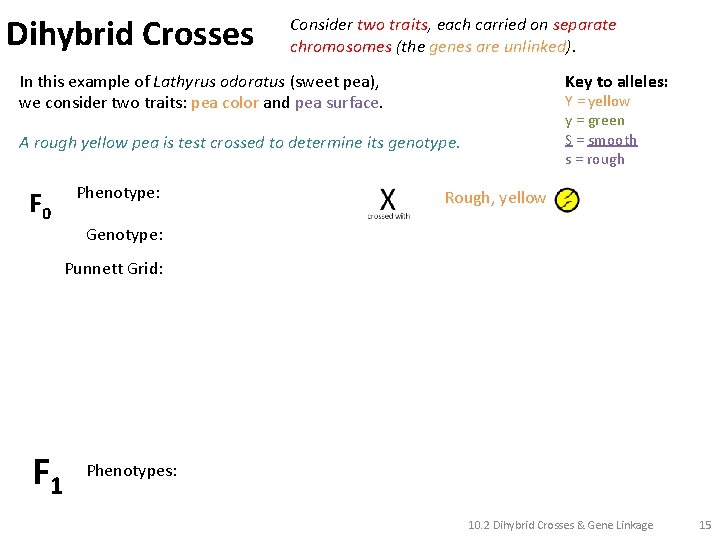
Dihybrid Crosses Consider two traits, each carried on separate chromosomes (the genes are unlinked). In this example of Lathyrus odoratus (sweet pea), we consider two traits: pea color and pea surface. Key to alleles: Y = yellow y = green S = smooth s = rough A rough yellow pea is test crossed to determine its genotype. F 0 Phenotype: Rough, yellow Genotype: Punnett Grid: F 1 Phenotypes: 10. 2 Dihybrid Crosses & Gene Linkage 15
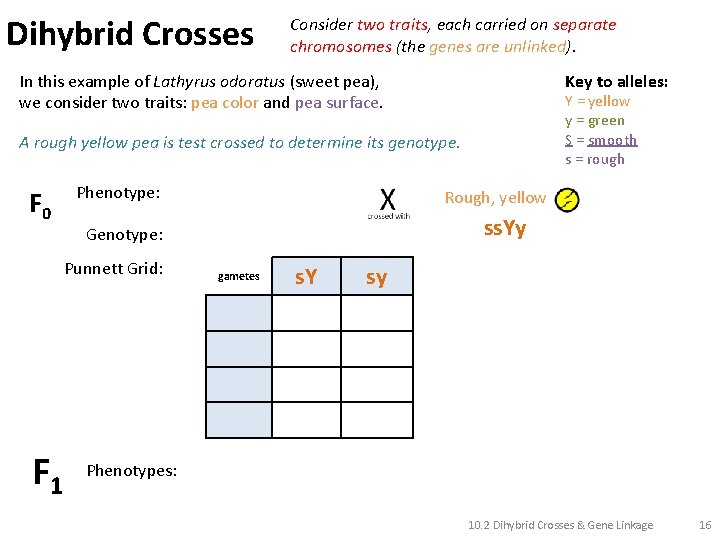
Dihybrid Crosses Consider two traits, each carried on separate chromosomes (the genes are unlinked). In this example of Lathyrus odoratus (sweet pea), we consider two traits: pea color and pea surface. Key to alleles: Y = yellow y = green S = smooth s = rough A rough yellow pea is test crossed to determine its genotype. F 0 Phenotype: ss. Yy Genotype: Punnett Grid: F 1 Rough, yellow gametes s. Y sy Phenotypes: 10. 2 Dihybrid Crosses & Gene Linkage 16
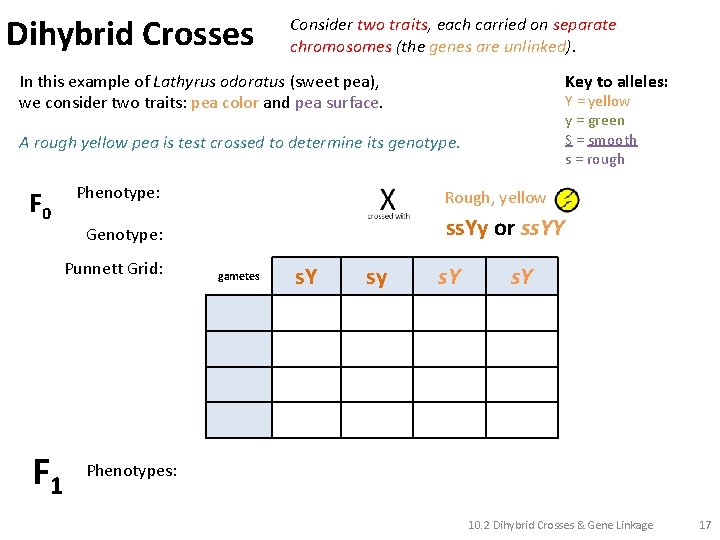
Dihybrid Crosses Consider two traits, each carried on separate chromosomes (the genes are unlinked). In this example of Lathyrus odoratus (sweet pea), we consider two traits: pea color and pea surface. Key to alleles: Y = yellow y = green S = smooth s = rough A rough yellow pea is test crossed to determine its genotype. F 0 Phenotype: ss. Yy or ss. YY Genotype: Punnett Grid: F 1 Rough, yellow gametes s. Y sy s. Y Phenotypes: 10. 2 Dihybrid Crosses & Gene Linkage 17
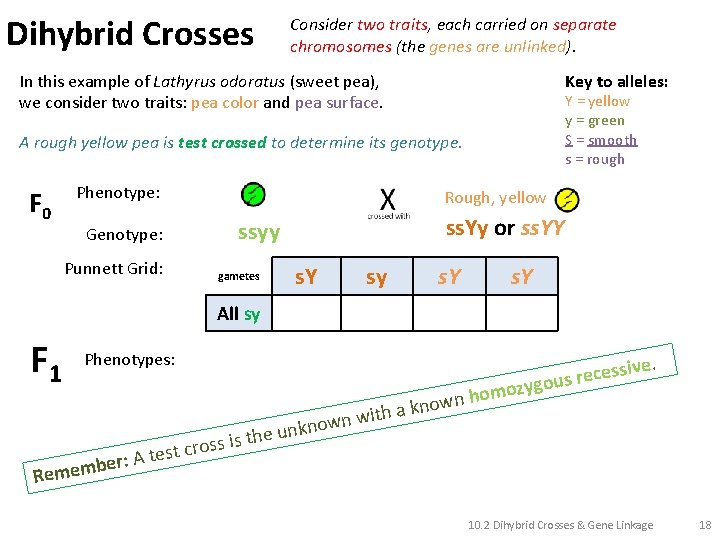
Dihybrid Crosses Consider two traits, each carried on separate chromosomes (the genes are unlinked). In this example of Lathyrus odoratus (sweet pea), we consider two traits: pea color and pea surface. Key to alleles: Y = yellow y = green S = smooth s = rough A rough yellow pea is test crossed to determine its genotype. F 0 Phenotype: Genotype: Punnett Grid: Rough, yellow ss. Yy or ss. YY ssyy s. Y gametes sy s. Y All sy F 1 Phenotypes: ith a w n w o e unkn e. essiv c e r s u ygo oz m o h n know is th s s o r c t r: A tes be Remem 10. 2 Dihybrid Crosses & Gene Linkage 18
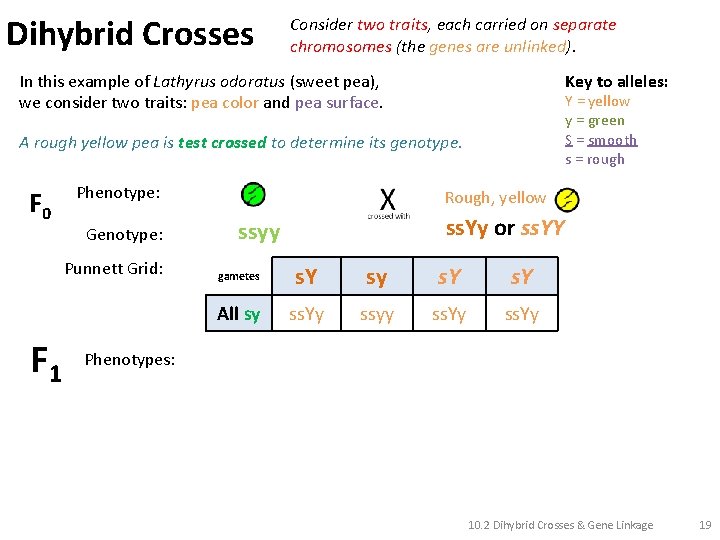
Dihybrid Crosses Consider two traits, each carried on separate chromosomes (the genes are unlinked). In this example of Lathyrus odoratus (sweet pea), we consider two traits: pea color and pea surface. Key to alleles: Y = yellow y = green S = smooth s = rough A rough yellow pea is test crossed to determine its genotype. F 0 Phenotype: Genotype: Punnett Grid: F 1 Rough, yellow ss. Yy or ss. YY ssyy gametes s. Y sy s. Y All sy ss. Yy ssyy ss. Yy Phenotypes: 10. 2 Dihybrid Crosses & Gene Linkage 19
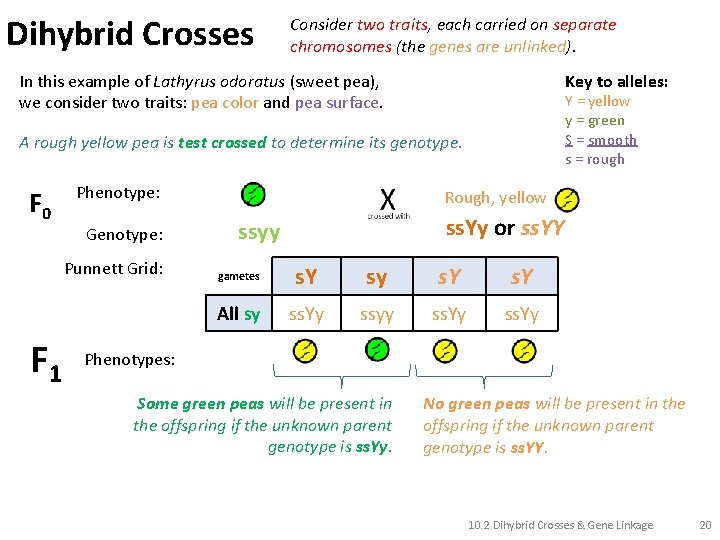
Dihybrid Crosses Consider two traits, each carried on separate chromosomes (the genes are unlinked). In this example of Lathyrus odoratus (sweet pea), we consider two traits: pea color and pea surface. Key to alleles: Y = yellow y = green S = smooth s = rough A rough yellow pea is test crossed to determine its genotype. F 0 Phenotype: Genotype: Punnett Grid: F 1 Rough, yellow ss. Yy or ss. YY ssyy gametes s. Y sy s. Y All sy ss. Yy ssyy ss. Yy Phenotypes: Some green peas will be present in the offspring if the unknown parent genotype is ss. Yy. No green peas will be present in the offspring if the unknown parent genotype is ss. YY. 10. 2 Dihybrid Crosses & Gene Linkage 20
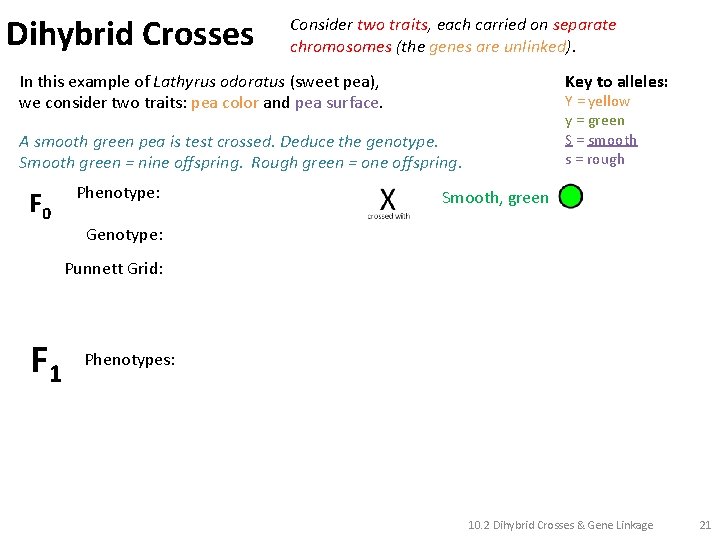
Dihybrid Crosses Consider two traits, each carried on separate chromosomes (the genes are unlinked). In this example of Lathyrus odoratus (sweet pea), we consider two traits: pea color and pea surface. Key to alleles: Y = yellow y = green S = smooth s = rough A smooth green pea is test crossed. Deduce the genotype. Smooth green = nine offspring. Rough green = one offspring. F 0 Phenotype: Smooth, green Genotype: Punnett Grid: F 1 Phenotypes: 10. 2 Dihybrid Crosses & Gene Linkage 21
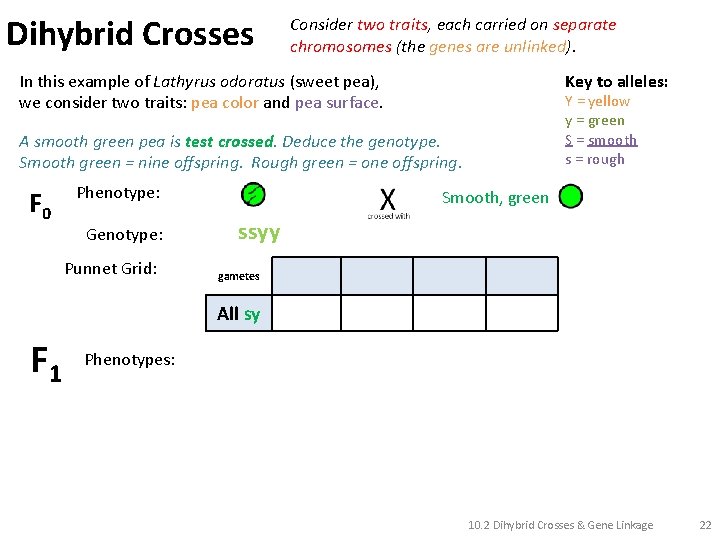
Dihybrid Crosses Consider two traits, each carried on separate chromosomes (the genes are unlinked). In this example of Lathyrus odoratus (sweet pea), we consider two traits: pea color and pea surface. Key to alleles: Y = yellow y = green S = smooth s = rough A smooth green pea is test crossed. Deduce the genotype. Smooth green = nine offspring. Rough green = one offspring. F 0 Phenotype: Genotype: Punnet Grid: Smooth, green ssyy gametes All sy F 1 Phenotypes: 10. 2 Dihybrid Crosses & Gene Linkage 22
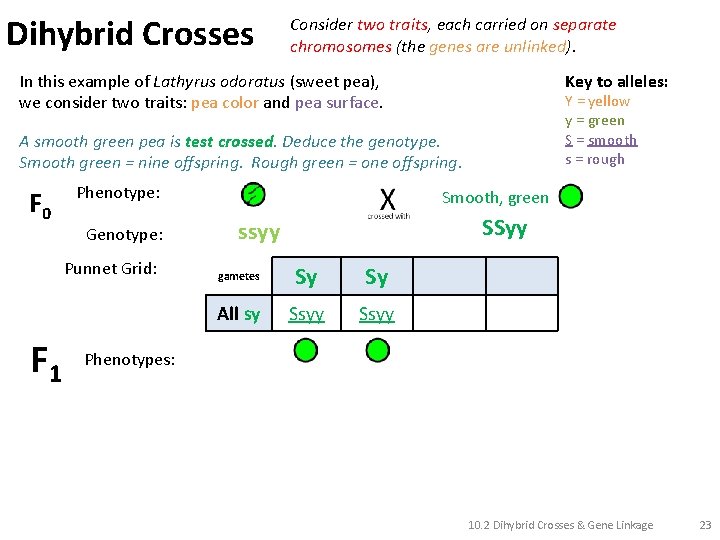
Dihybrid Crosses Consider two traits, each carried on separate chromosomes (the genes are unlinked). In this example of Lathyrus odoratus (sweet pea), we consider two traits: pea color and pea surface. Key to alleles: Y = yellow y = green S = smooth s = rough A smooth green pea is test crossed. Deduce the genotype. Smooth green = nine offspring. Rough green = one offspring. F 0 Phenotype: Genotype: Punnet Grid: F 1 Smooth, green SSyy ssyy gametes Sy Sy All sy Ssyy Phenotypes: 10. 2 Dihybrid Crosses & Gene Linkage 23
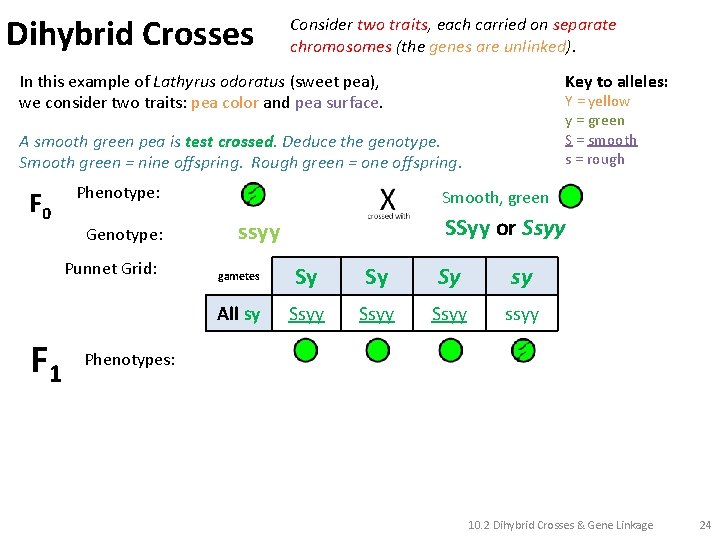
Dihybrid Crosses Consider two traits, each carried on separate chromosomes (the genes are unlinked). In this example of Lathyrus odoratus (sweet pea), we consider two traits: pea color and pea surface. Key to alleles: Y = yellow y = green S = smooth s = rough A smooth green pea is test crossed. Deduce the genotype. Smooth green = nine offspring. Rough green = one offspring. F 0 Phenotype: Genotype: Punnet Grid: F 1 Smooth, green SSyy or Ssyy ssyy gametes Sy Sy Sy sy All sy Ssyy ssyy Phenotypes: 10. 2 Dihybrid Crosses & Gene Linkage 24
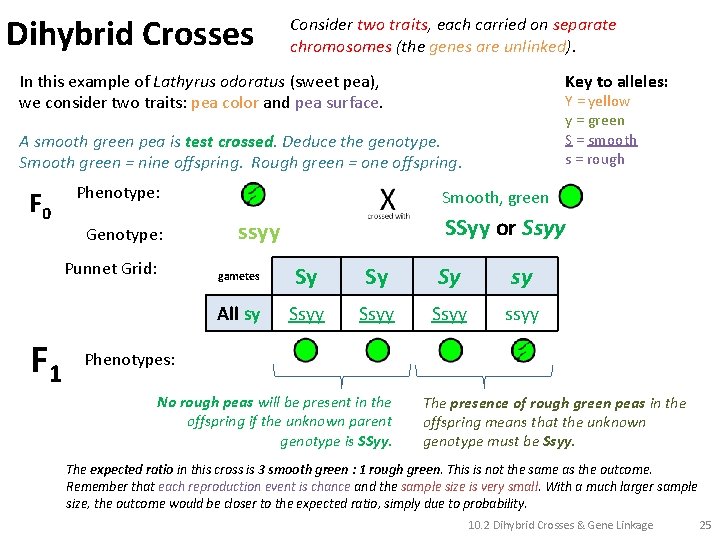
Dihybrid Crosses Consider two traits, each carried on separate chromosomes (the genes are unlinked). In this example of Lathyrus odoratus (sweet pea), we consider two traits: pea color and pea surface. Key to alleles: Y = yellow y = green S = smooth s = rough A smooth green pea is test crossed. Deduce the genotype. Smooth green = nine offspring. Rough green = one offspring. F 0 Phenotype: Genotype: Punnet Grid: F 1 Smooth, green SSyy or Ssyy ssyy gametes Sy Sy Sy sy All sy Ssyy ssyy Phenotypes: No rough peas will be present in the offspring if the unknown parent genotype is SSyy. The presence of rough green peas in the offspring means that the unknown genotype must be Ssyy. The expected ratio in this cross is 3 smooth green : 1 rough green. This is not the same as the outcome. Remember that each reproduction event is chance and the sample size is very small. With a much larger sample size, the outcome would be closer to the expected ratio, simply due to probability. 10. 2 Dihybrid Crosses & Gene Linkage 25
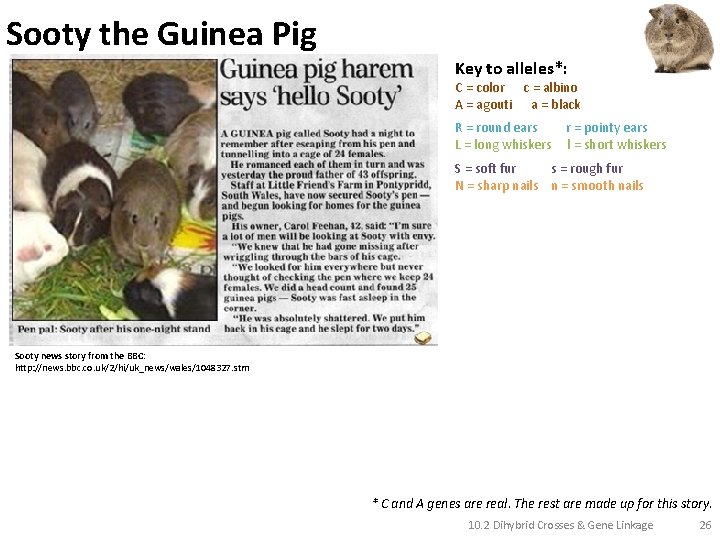
Sooty the Guinea Pig Key to alleles*: C = color c = albino A = agouti a = black R = round ears L = long whiskers r = pointy ears l = short whiskers S = soft fur s = rough fur N = sharp nails n = smooth nails Sooty news story from the BBC: http: //news. bbc. co. uk/2/hi/uk_news/wales/1048327. stm * C and A genes are real. The rest are made up for this story. 10. 2 Dihybrid Crosses & Gene Linkage 26
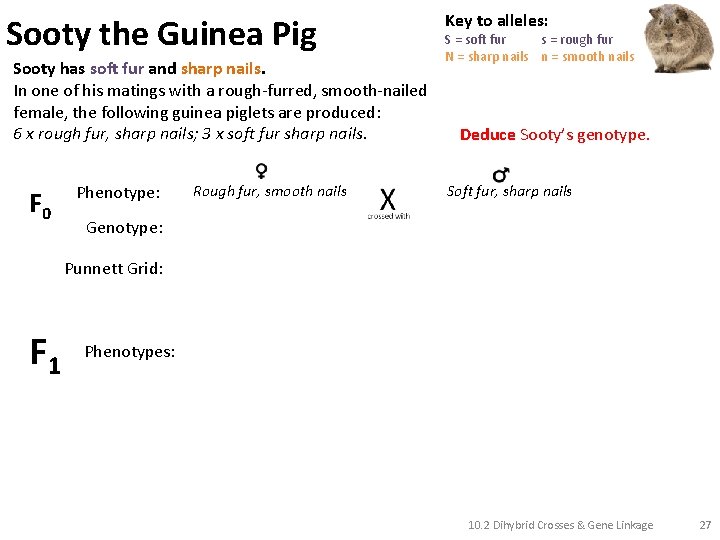
Sooty the Guinea Pig Sooty has soft fur and sharp nails. In one of his matings with a rough-furred, smooth-nailed female, the following guinea piglets are produced: 6 x rough fur, sharp nails; 3 x soft fur sharp nails. F 0 Phenotype: Rough fur, smooth nails Key to alleles: S = soft fur s = rough fur N = sharp nails n = smooth nails Deduce Sooty’s genotype. Soft fur, sharp nails Genotype: Punnett Grid: F 1 Phenotypes: 10. 2 Dihybrid Crosses & Gene Linkage 27
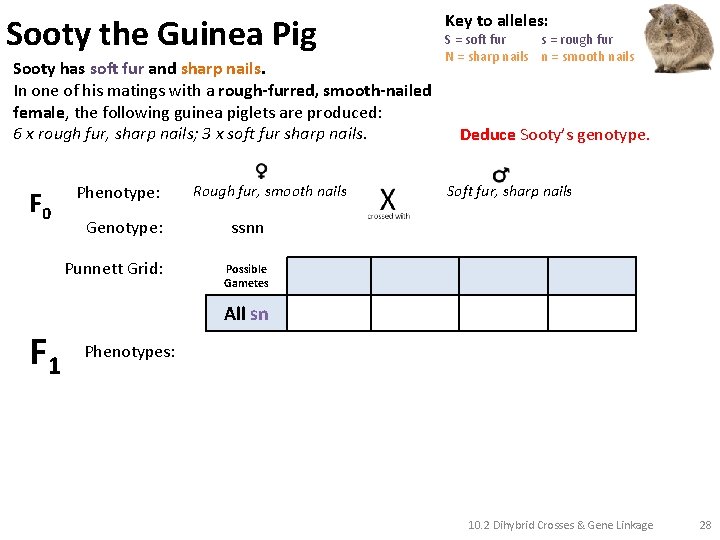
Sooty the Guinea Pig Sooty has soft fur and sharp nails. In one of his matings with a rough-furred, smooth-nailed female, the following guinea piglets are produced: 6 x rough fur, sharp nails; 3 x soft fur sharp nails. F 0 Phenotype: Genotype: Punnett Grid: Rough fur, smooth nails Key to alleles: S = soft fur s = rough fur N = sharp nails n = smooth nails Deduce Sooty’s genotype. Soft fur, sharp nails ssnn Possible Gametes All sn F 1 Phenotypes: 10. 2 Dihybrid Crosses & Gene Linkage 28
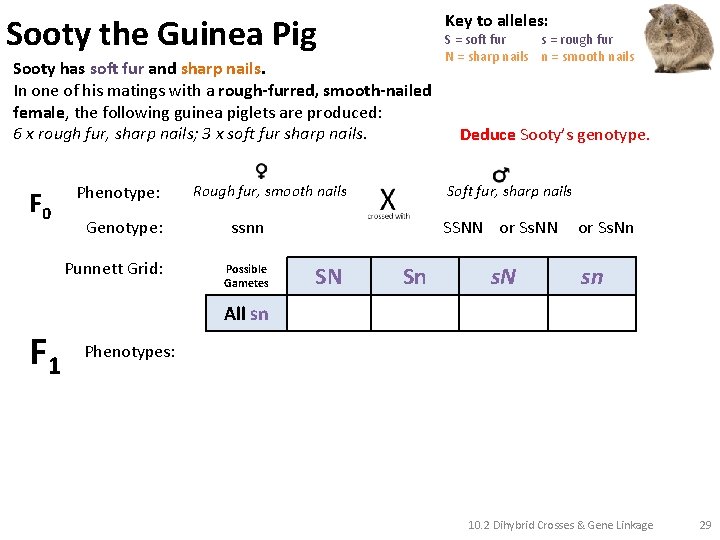
Key to alleles: Sooty the Guinea Pig Sooty has soft fur and sharp nails. In one of his matings with a rough-furred, smooth-nailed female, the following guinea piglets are produced: 6 x rough fur, sharp nails; 3 x soft fur sharp nails. F 0 Phenotype: Genotype: Punnett Grid: Rough fur, smooth nails Deduce Sooty’s genotype. Soft fur, sharp nails ssnn Possible Gametes S = soft fur s = rough fur N = sharp nails n = smooth nails SSNN or Ss. NN SN Sn s. N or Ss. Nn sn All sn F 1 Phenotypes: 10. 2 Dihybrid Crosses & Gene Linkage 29
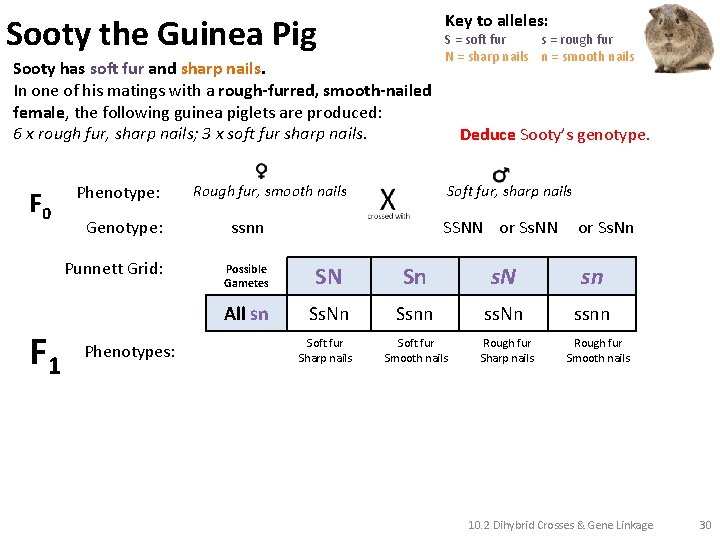
Key to alleles: Sooty the Guinea Pig Sooty has soft fur and sharp nails. In one of his matings with a rough-furred, smooth-nailed female, the following guinea piglets are produced: 6 x rough fur, sharp nails; 3 x soft fur sharp nails. F 0 Phenotype: Genotype: Punnett Grid: F 1 Phenotypes: Rough fur, smooth nails S = soft fur s = rough fur N = sharp nails n = smooth nails Deduce Sooty’s genotype. Soft fur, sharp nails ssnn SSNN or Ss. Nn Possible Gametes SN Sn s. N sn All sn Ss. Nn Ssnn ss. Nn ssnn Soft fur Sharp nails Soft fur Smooth nails Rough fur Sharp nails Rough fur Smooth nails 10. 2 Dihybrid Crosses & Gene Linkage 30
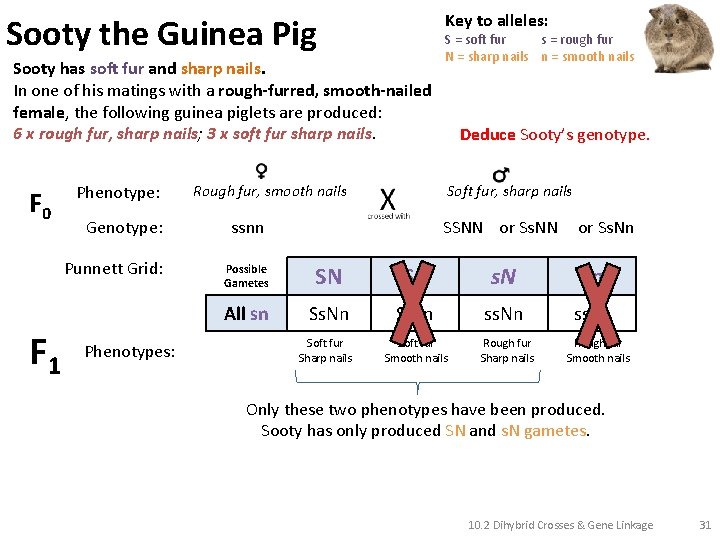
Key to alleles: Sooty the Guinea Pig Sooty has soft fur and sharp nails. In one of his matings with a rough-furred, smooth-nailed female, the following guinea piglets are produced: 6 x rough fur, sharp nails; 3 x soft fur sharp nails. F 0 Phenotype: Genotype: Punnett Grid: F 1 Phenotypes: Rough fur, smooth nails S = soft fur s = rough fur N = sharp nails n = smooth nails Deduce Sooty’s genotype. Soft fur, sharp nails ssnn SSNN or Ss. Nn Possible Gametes SN Sn s. N sn All sn Ss. Nn Ssnn ss. Nn ssnn Soft fur Sharp nails Soft fur Smooth nails Rough fur Sharp nails Rough fur Smooth nails Only these two phenotypes have been produced. Sooty has only produced SN and s. N gametes. 10. 2 Dihybrid Crosses & Gene Linkage 31
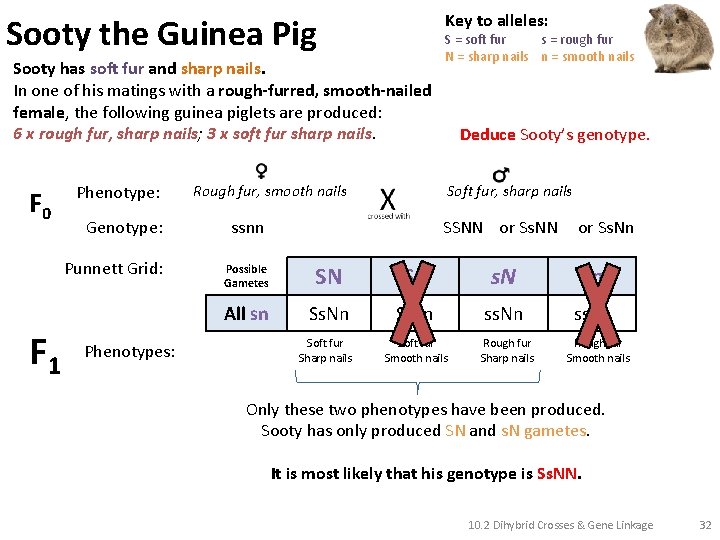
Key to alleles: Sooty the Guinea Pig Sooty has soft fur and sharp nails. In one of his matings with a rough-furred, smooth-nailed female, the following guinea piglets are produced: 6 x rough fur, sharp nails; 3 x soft fur sharp nails. F 0 Phenotype: Genotype: Punnett Grid: F 1 Phenotypes: Rough fur, smooth nails S = soft fur s = rough fur N = sharp nails n = smooth nails Deduce Sooty’s genotype. Soft fur, sharp nails ssnn SSNN or Ss. Nn Possible Gametes SN Sn s. N sn All sn Ss. Nn Ssnn ss. Nn ssnn Soft fur Sharp nails Soft fur Smooth nails Rough fur Sharp nails Rough fur Smooth nails Only these two phenotypes have been produced. Sooty has only produced SN and s. N gametes. It is most likely that his genotype is Ss. NN. 10. 2 Dihybrid Crosses & Gene Linkage 32
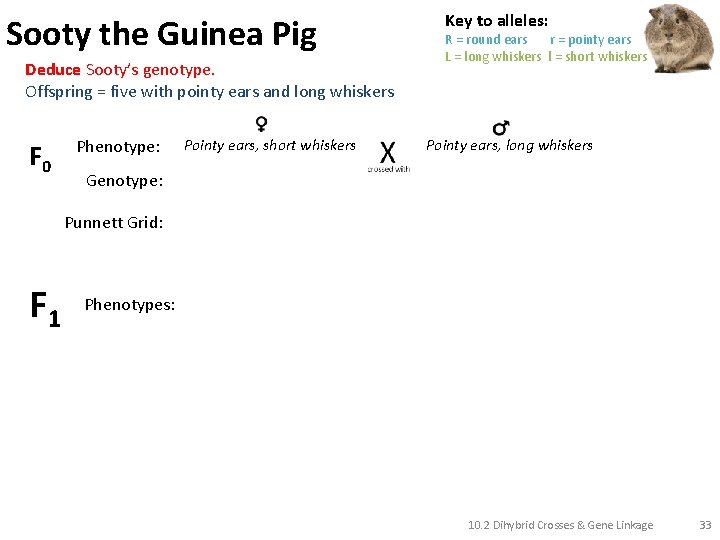
Sooty the Guinea Pig Deduce Sooty’s genotype. Offspring = five with pointy ears and long whiskers F 0 Phenotype: Pointy ears, short whiskers Key to alleles: R = round ears r = pointy ears L = long whiskers l = short whiskers Pointy ears, long whiskers Genotype: Punnett Grid: F 1 Phenotypes: 10. 2 Dihybrid Crosses & Gene Linkage 33
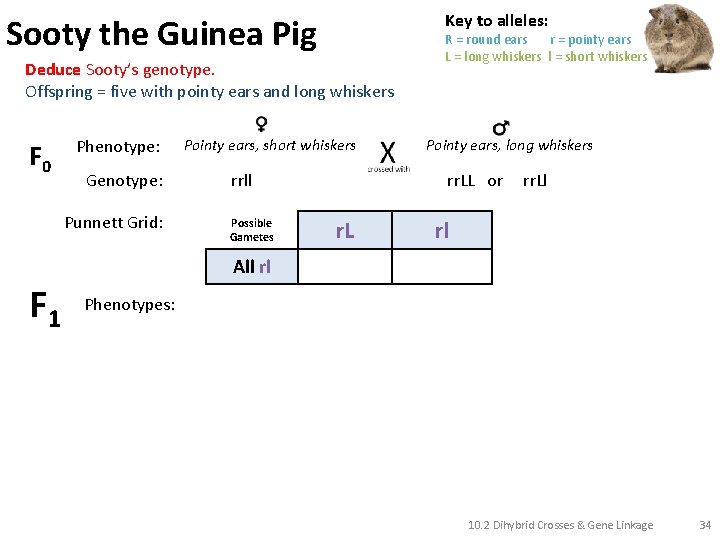
Key to alleles: Sooty the Guinea Pig Deduce Sooty’s genotype. Offspring = five with pointy ears and long whiskers F 0 Phenotype: Genotype: Punnett Grid: Pointy ears, short whiskers rrll Possible Gametes R = round ears r = pointy ears L = long whiskers l = short whiskers Pointy ears, long whiskers rr. LL or r. L rr. Ll rl All rl F 1 Phenotypes: 10. 2 Dihybrid Crosses & Gene Linkage 34
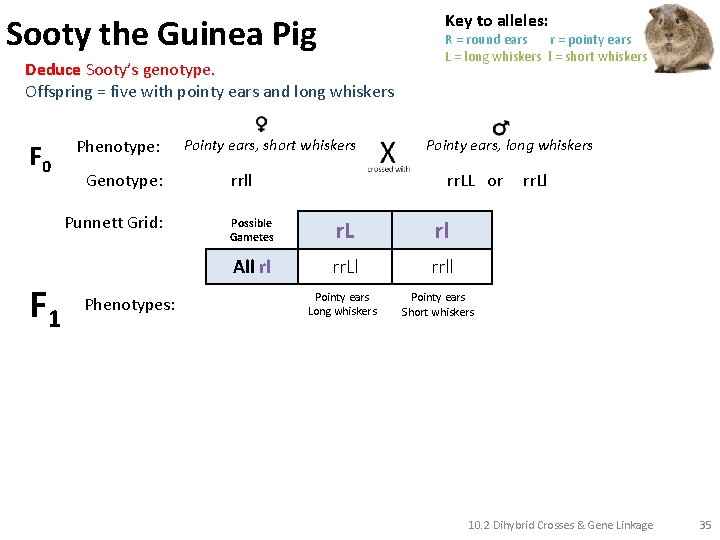
Key to alleles: Sooty the Guinea Pig Deduce Sooty’s genotype. Offspring = five with pointy ears and long whiskers F 0 Phenotype: Genotype: Punnett Grid: F 1 Phenotypes: Pointy ears, short whiskers rrll R = round ears r = pointy ears L = long whiskers l = short whiskers Pointy ears, long whiskers rr. LL or Possible Gametes r. L rl All rl rr. Ll rrll Pointy ears Long whiskers rr. Ll Pointy ears Short whiskers 10. 2 Dihybrid Crosses & Gene Linkage 35
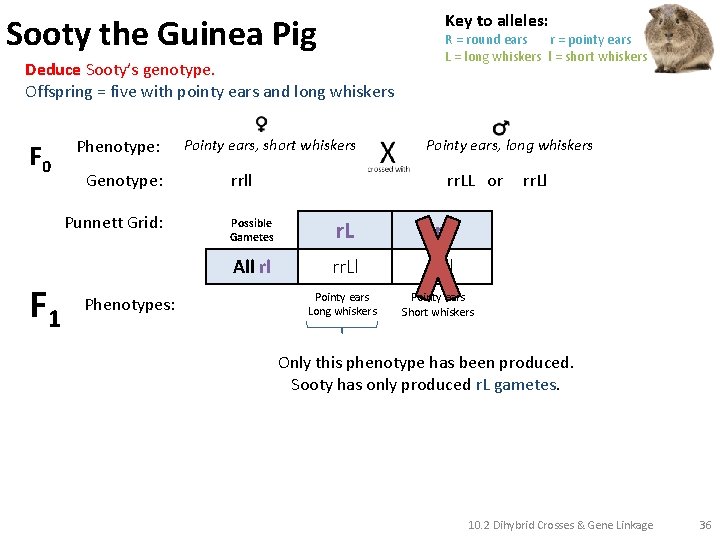
Key to alleles: Sooty the Guinea Pig Deduce Sooty’s genotype. Offspring = five with pointy ears and long whiskers F 0 Phenotype: Genotype: Punnett Grid: F 1 Phenotypes: Pointy ears, short whiskers rrll R = round ears r = pointy ears L = long whiskers l = short whiskers Pointy ears, long whiskers rr. LL or Possible Gametes r. L rl All rl rr. Ll rrll Pointy ears Long whiskers rr. Ll Pointy ears Short whiskers Only this phenotype has been produced. Sooty has only produced r. L gametes. 10. 2 Dihybrid Crosses & Gene Linkage 36
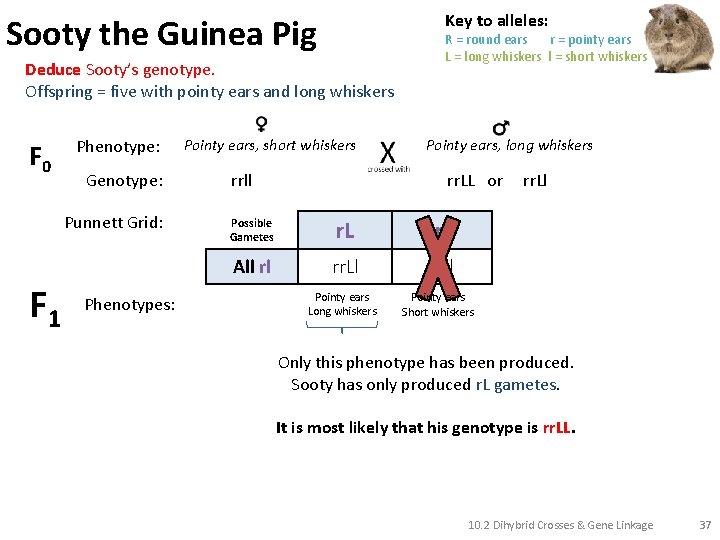
Key to alleles: Sooty the Guinea Pig Deduce Sooty’s genotype. Offspring = five with pointy ears and long whiskers F 0 Phenotype: Genotype: Punnett Grid: F 1 Phenotypes: Pointy ears, short whiskers rrll R = round ears r = pointy ears L = long whiskers l = short whiskers Pointy ears, long whiskers rr. LL or Possible Gametes r. L rl All rl rr. Ll rrll Pointy ears Long whiskers rr. Ll Pointy ears Short whiskers Only this phenotype has been produced. Sooty has only produced r. L gametes. It is most likely that his genotype is rr. LL. 10. 2 Dihybrid Crosses & Gene Linkage 37
Gene Interaction The expression of one gene is dependent upon the prior expression of another. 10. 2 Dihybrid Crosses & Gene Linkage 38
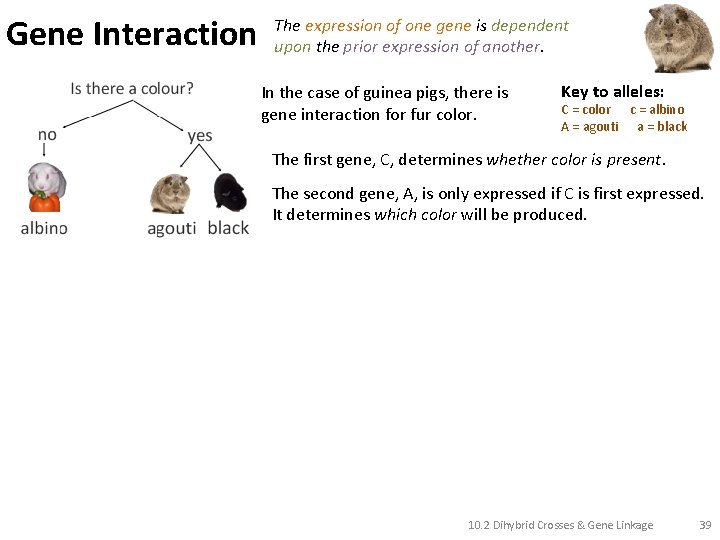
Gene Interaction The expression of one gene is dependent upon the prior expression of another. In the case of guinea pigs, there is gene interaction for fur color. Key to alleles: C = color c = albino A = agouti a = black The first gene, C, determines whether color is present. The second gene, A, is only expressed if C is first expressed. It determines which color will be produced. 10. 2 Dihybrid Crosses & Gene Linkage 39
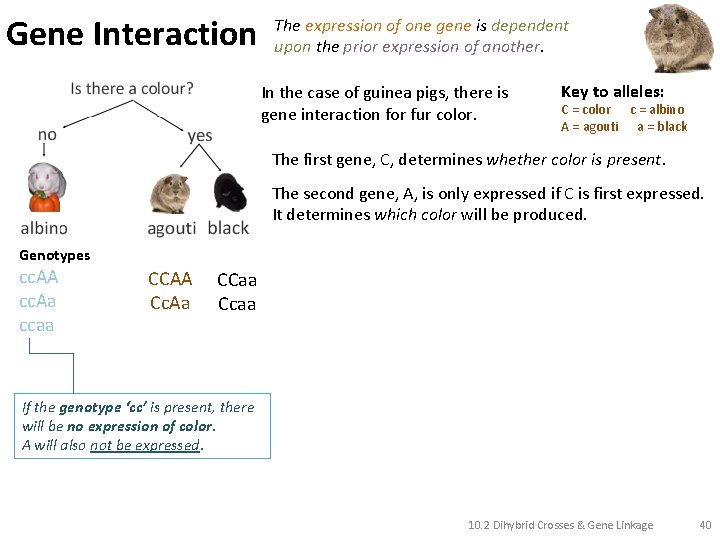
Gene Interaction The expression of one gene is dependent upon the prior expression of another. In the case of guinea pigs, there is gene interaction for fur color. Key to alleles: C = color c = albino A = agouti a = black The first gene, C, determines whether color is present. The second gene, A, is only expressed if C is first expressed. It determines which color will be produced. Genotypes cc. AA cc. Aa ccaa CCAA Cc. Aa CCaa Ccaa If the genotype ‘cc’ is present, there will be no expression of color. A will also not be expressed. 10. 2 Dihybrid Crosses & Gene Linkage 40
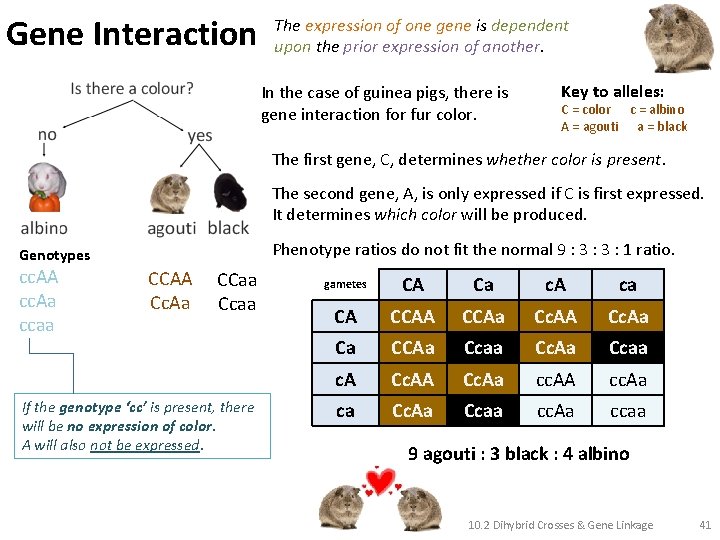
Gene Interaction The expression of one gene is dependent upon the prior expression of another. In the case of guinea pigs, there is gene interaction for fur color. Key to alleles: C = color c = albino A = agouti a = black The first gene, C, determines whether color is present. The second gene, A, is only expressed if C is first expressed. It determines which color will be produced. Phenotype ratios do not fit the normal 9 : 3 : 1 ratio. Genotypes cc. AA cc. Aa ccaa CCAA Cc. Aa CCaa Ccaa If the genotype ‘cc’ is present, there will be no expression of color. A will also not be expressed. gametes CA Ca c. A ca CA CCAa Cc. AA Cc. Aa Ca CCAa Ccaa Cc. Aa Ccaa c. A Cc. Aa cc. AA cc. Aa ca Cc. Aa Ccaa cc. Aa ccaa 9 agouti : 3 black : 4 albino 10. 2 Dihybrid Crosses & Gene Linkage 41
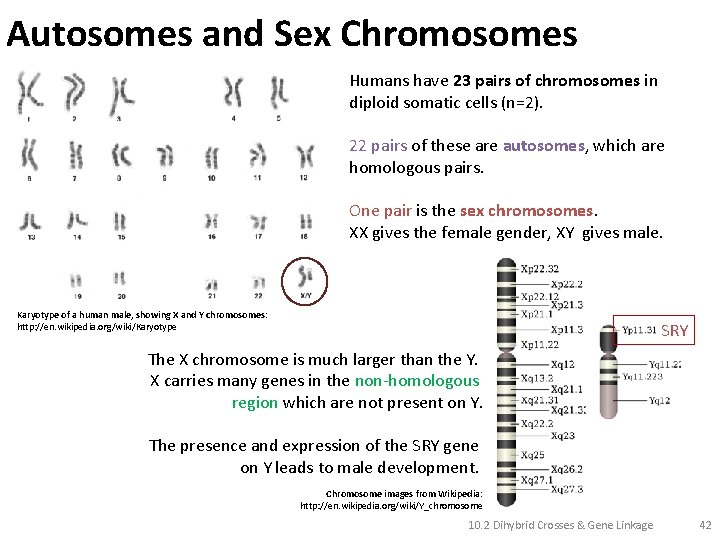
Autosomes and Sex Chromosomes Humans have 23 pairs of chromosomes in diploid somatic cells (n=2). 22 pairs of these are autosomes, which are homologous pairs. One pair is the sex chromosomes. XX gives the female gender, XY gives male. Karyotype of a human male, showing X and Y chromosomes: http: //en. wikipedia. org/wiki/Karyotype SRY The X chromosome is much larger than the Y. X carries many genes in the non-homologous region which are not present on Y. The presence and expression of the SRY gene on Y leads to male development. Chromosome images from Wikipedia: http: //en. wikipedia. org/wiki/Y_chromosome 10. 2 Dihybrid Crosses & Gene Linkage 42
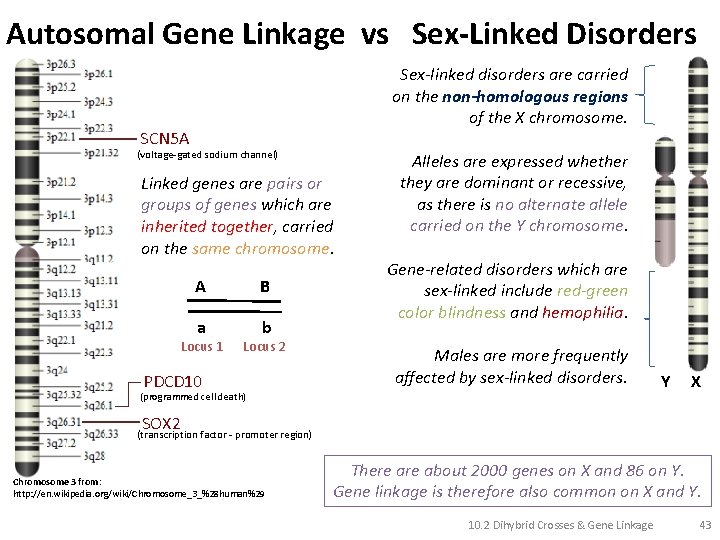
Autosomal Gene Linkage vs Sex-Linked Disorders Sex-linked disorders are carried on the non-homologous regions of the X chromosome. SCN 5 A (voltage-gated sodium channel) Linked genes are pairs or groups of genes which are inherited together, carried on the same chromosome. A B a b Locus 1 Locus 2 PDCD 10 Alleles are expressed whether they are dominant or recessive, as there is no alternate allele carried on the Y chromosome. Gene-related disorders which are sex-linked include red-green color blindness and hemophilia. Males are more frequently affected by sex-linked disorders. (programmed cell death) Y X SOX 2 (transcription factor - promoter region) Chromosome 3 from: http: //en. wikipedia. org/wiki/Chromosome_3_%28 human%29 There about 2000 genes on X and 86 on Y. Gene linkage is therefore also common on X and Y. 10. 2 Dihybrid Crosses & Gene Linkage 43
Autosomal Gene Linkage Linked genes are pairs or groups of genes which are inherited together, carried on the same chromosome. 10. 2 Dihybrid Crosses & Gene Linkage 44
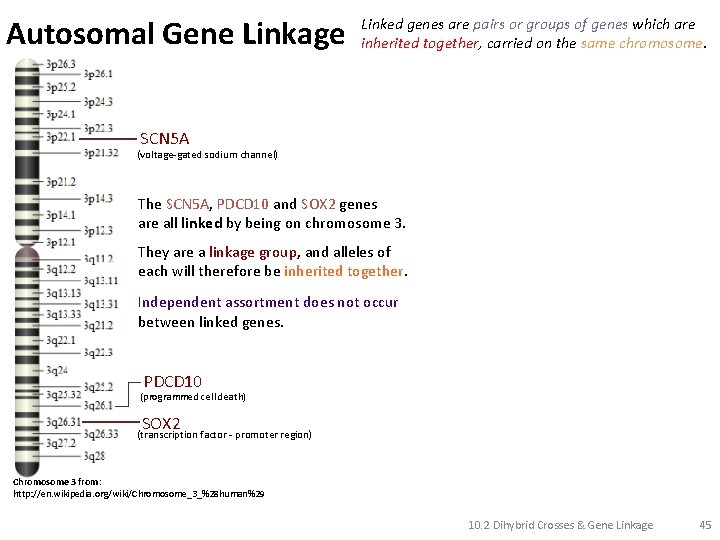
Autosomal Gene Linkage Linked genes are pairs or groups of genes which are inherited together, carried on the same chromosome. SCN 5 A (voltage-gated sodium channel) The SCN 5 A, PDCD 10 and SOX 2 genes are all linked by being on chromosome 3. They are a linkage group, and alleles of each will therefore be inherited together. Independent assortment does not occur between linked genes. PDCD 10 (programmed cell death) SOX 2 (transcription factor - promoter region) Chromosome 3 from: http: //en. wikipedia. org/wiki/Chromosome_3_%28 human%29 10. 2 Dihybrid Crosses & Gene Linkage 45
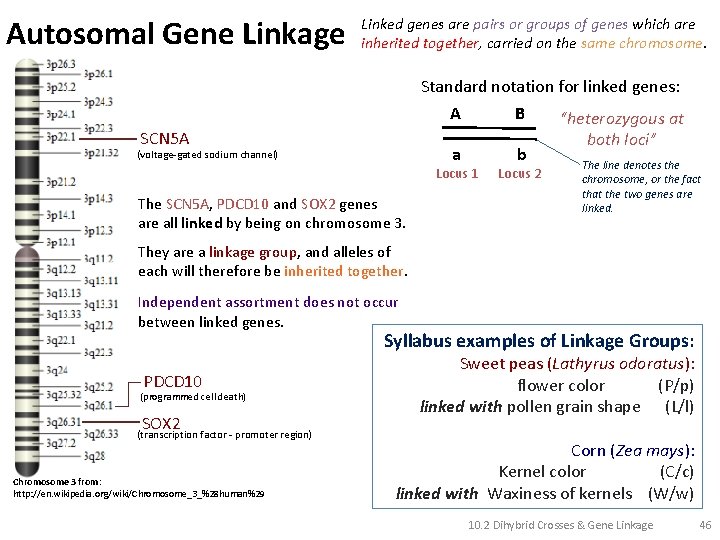
Autosomal Gene Linkage Linked genes are pairs or groups of genes which are inherited together, carried on the same chromosome. Standard notation for linked genes: A B “heterozygous at both loci” a b SCN 5 A (voltage-gated sodium channel) Locus 1 The SCN 5 A, PDCD 10 and SOX 2 genes are all linked by being on chromosome 3. Locus 2 The line denotes the chromosome, or the fact that the two genes are linked. They are a linkage group, and alleles of each will therefore be inherited together. Independent assortment does not occur between linked genes. Syllabus examples of Linkage Groups: PDCD 10 (programmed cell death) SOX 2 (transcription factor - promoter region) Chromosome 3 from: http: //en. wikipedia. org/wiki/Chromosome_3_%28 human%29 Sweet peas (Lathyrus odoratus): flower color (P/p) linked with pollen grain shape (L/l) Corn (Zea mays): Kernel color (C/c) linked with Waxiness of kernels (W/w) 10. 2 Dihybrid Crosses & Gene Linkage 46
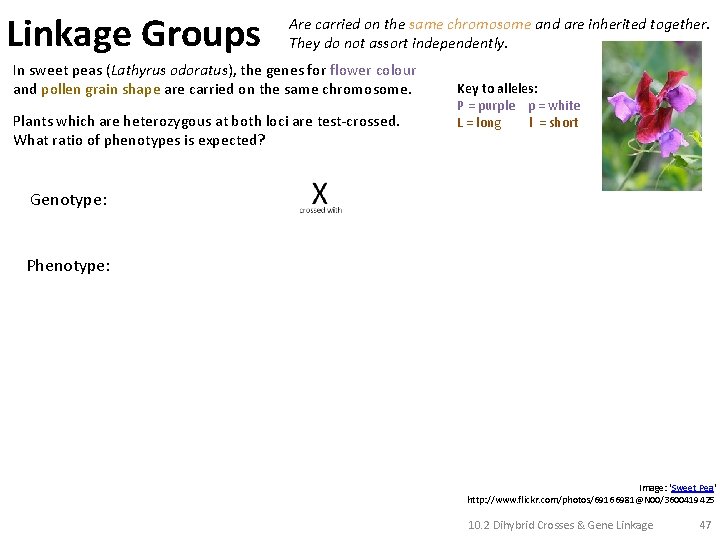
Linkage Groups Are carried on the same chromosome and are inherited together. They do not assort independently. In sweet peas (Lathyrus odoratus), the genes for flower colour and pollen grain shape are carried on the same chromosome. Plants which are heterozygous at both loci are test-crossed. What ratio of phenotypes is expected? Key to alleles: P = purple p = white L = long l = short Genotype: Phenotype: Image: 'Sweet Pea' http: //www. flickr. com/photos/69166981@N 00/3600419425 10. 2 Dihybrid Crosses & Gene Linkage 47
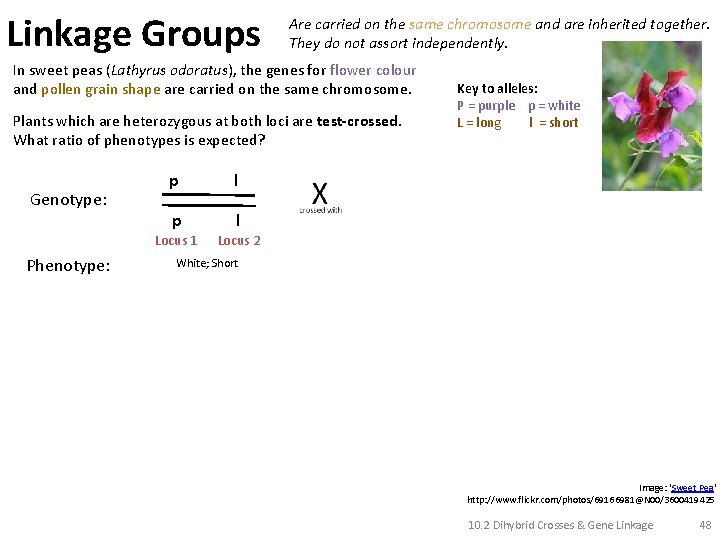
Linkage Groups Are carried on the same chromosome and are inherited together. They do not assort independently. In sweet peas (Lathyrus odoratus), the genes for flower colour and pollen grain shape are carried on the same chromosome. Plants which are heterozygous at both loci are test-crossed. What ratio of phenotypes is expected? Genotype: Phenotype: p l Locus 1 Locus 2 Key to alleles: P = purple p = white L = long l = short White; Short Image: 'Sweet Pea' http: //www. flickr. com/photos/69166981@N 00/3600419425 10. 2 Dihybrid Crosses & Gene Linkage 48
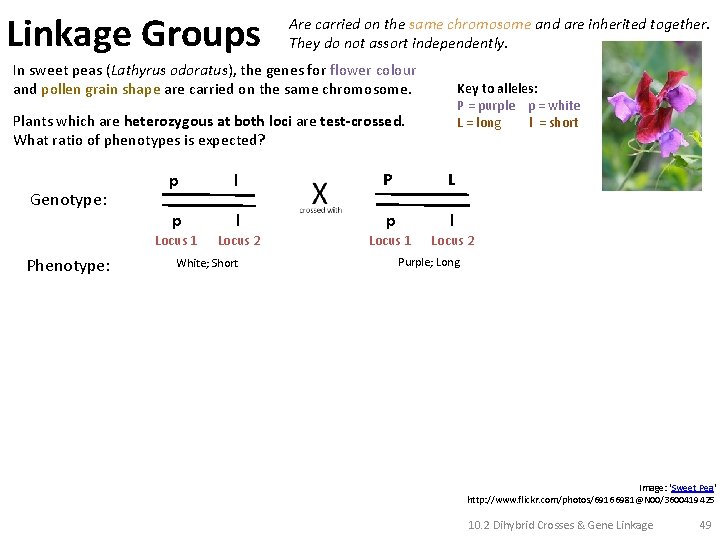
Linkage Groups Are carried on the same chromosome and are inherited together. They do not assort independently. In sweet peas (Lathyrus odoratus), the genes for flower colour and pollen grain shape are carried on the same chromosome. Key to alleles: P = purple p = white L = long l = short Plants which are heterozygous at both loci are test-crossed. What ratio of phenotypes is expected? Genotype: Phenotype: p l P L p l Locus 1 Locus 2 White; Short Purple; Long Image: 'Sweet Pea' http: //www. flickr. com/photos/69166981@N 00/3600419425 10. 2 Dihybrid Crosses & Gene Linkage 49
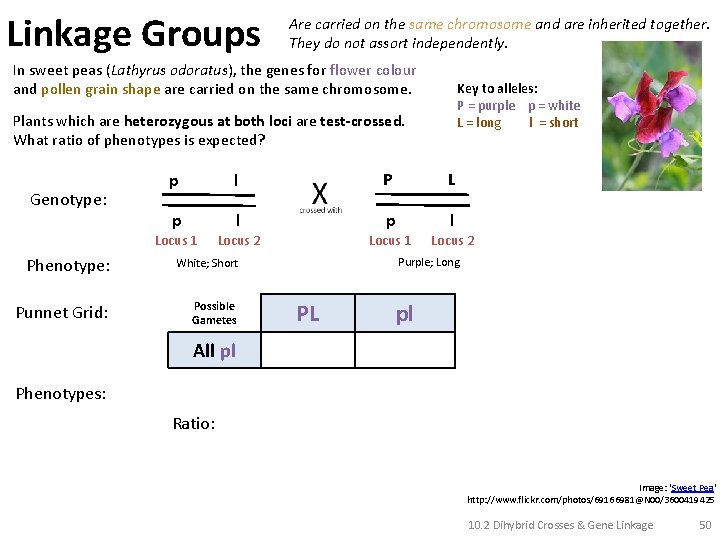
Linkage Groups Are carried on the same chromosome and are inherited together. They do not assort independently. In sweet peas (Lathyrus odoratus), the genes for flower colour and pollen grain shape are carried on the same chromosome. Key to alleles: P = purple p = white L = long l = short Plants which are heterozygous at both loci are test-crossed. What ratio of phenotypes is expected? Genotype: p l P L p l Locus 1 Locus 2 Phenotype: White; Short Punnet Grid: Possible Gametes Purple; Long PL pl All pl Phenotypes: Ratio: Image: 'Sweet Pea' http: //www. flickr. com/photos/69166981@N 00/3600419425 10. 2 Dihybrid Crosses & Gene Linkage 50
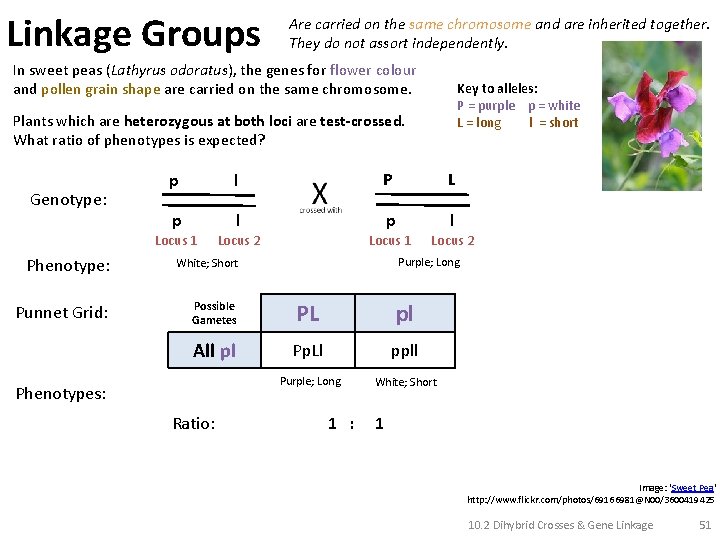
Linkage Groups Are carried on the same chromosome and are inherited together. They do not assort independently. In sweet peas (Lathyrus odoratus), the genes for flower colour and pollen grain shape are carried on the same chromosome. Key to alleles: P = purple p = white L = long l = short Plants which are heterozygous at both loci are test-crossed. What ratio of phenotypes is expected? Genotype: p l P L p l Locus 1 Locus 2 Phenotype: White; Short Punnet Grid: Possible Gametes PL pl All pl Pp. Ll ppll Purple; Long White; Short Phenotypes: Ratio: Purple; Long 1 : 1 Image: 'Sweet Pea' http: //www. flickr. com/photos/69166981@N 00/3600419425 10. 2 Dihybrid Crosses & Gene Linkage 51
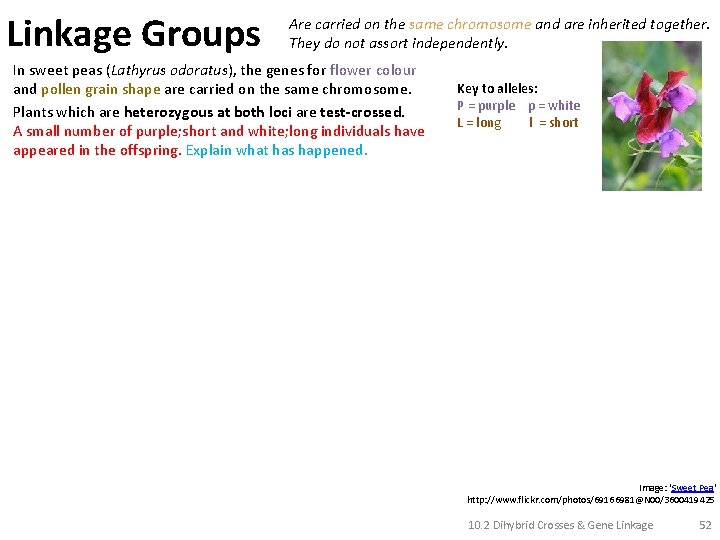
Linkage Groups Are carried on the same chromosome and are inherited together. They do not assort independently. In sweet peas (Lathyrus odoratus), the genes for flower colour and pollen grain shape are carried on the same chromosome. Plants which are heterozygous at both loci are test-crossed. A small number of purple; short and white; long individuals have appeared in the offspring. Explain what has happened. Key to alleles: P = purple p = white L = long l = short Image: 'Sweet Pea' http: //www. flickr. com/photos/69166981@N 00/3600419425 10. 2 Dihybrid Crosses & Gene Linkage 52
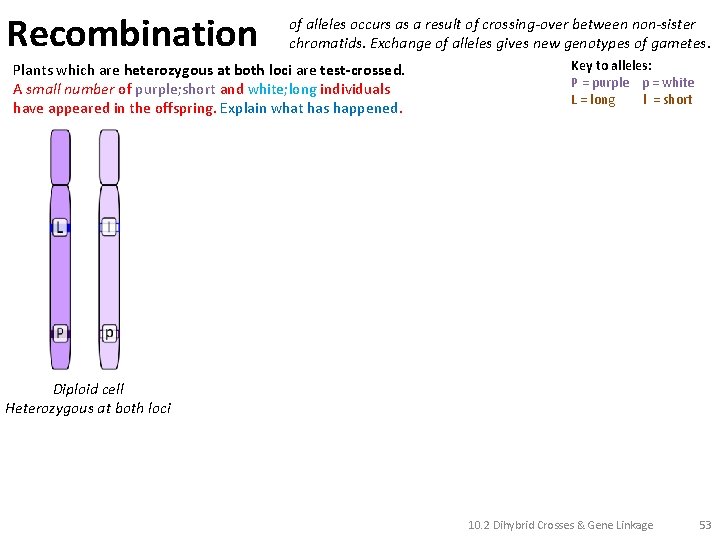
Recombination of alleles occurs as a result of crossing-over between non-sister chromatids. Exchange of alleles gives new genotypes of gametes. Plants which are heterozygous at both loci are test-crossed. A small number of purple; short and white; long individuals have appeared in the offspring. Explain what has happened. Key to alleles: P = purple p = white L = long l = short Diploid cell Heterozygous at both loci 10. 2 Dihybrid Crosses & Gene Linkage 53
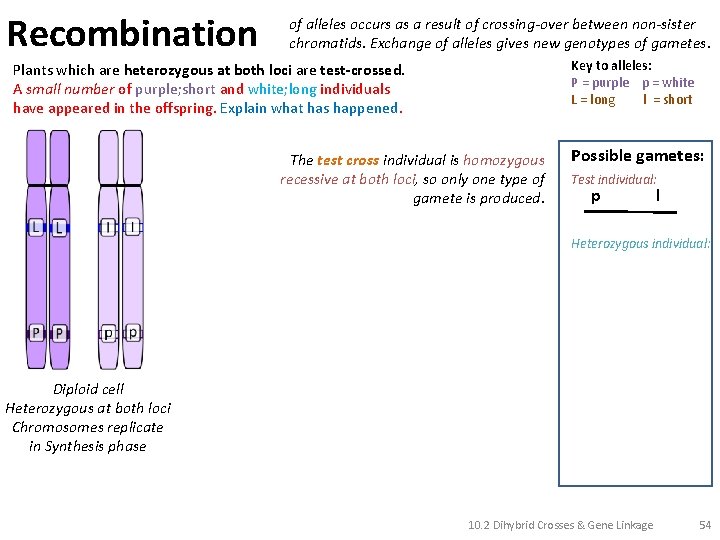
Recombination of alleles occurs as a result of crossing-over between non-sister chromatids. Exchange of alleles gives new genotypes of gametes. Key to alleles: P = purple p = white L = long l = short Plants which are heterozygous at both loci are test-crossed. A small number of purple; short and white; long individuals have appeared in the offspring. Explain what has happened. The test cross individual is homozygous recessive at both loci, so only one type of gamete is produced. Possible gametes: Test individual: p l Heterozygous individual: Diploid cell Heterozygous at both loci Chromosomes replicate in Synthesis phase 10. 2 Dihybrid Crosses & Gene Linkage 54
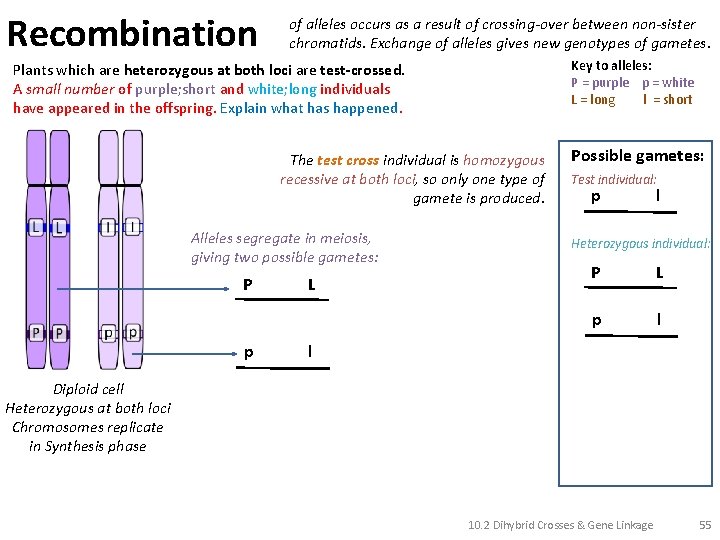
Recombination of alleles occurs as a result of crossing-over between non-sister chromatids. Exchange of alleles gives new genotypes of gametes. Key to alleles: P = purple p = white L = long l = short Plants which are heterozygous at both loci are test-crossed. A small number of purple; short and white; long individuals have appeared in the offspring. Explain what has happened. The test cross individual is homozygous recessive at both loci, so only one type of gamete is produced. Alleles segregate in meiosis, giving two possible gametes: P p L Possible gametes: Test individual: p l Heterozygous individual: P L p l l Diploid cell Heterozygous at both loci Chromosomes replicate in Synthesis phase 10. 2 Dihybrid Crosses & Gene Linkage 55
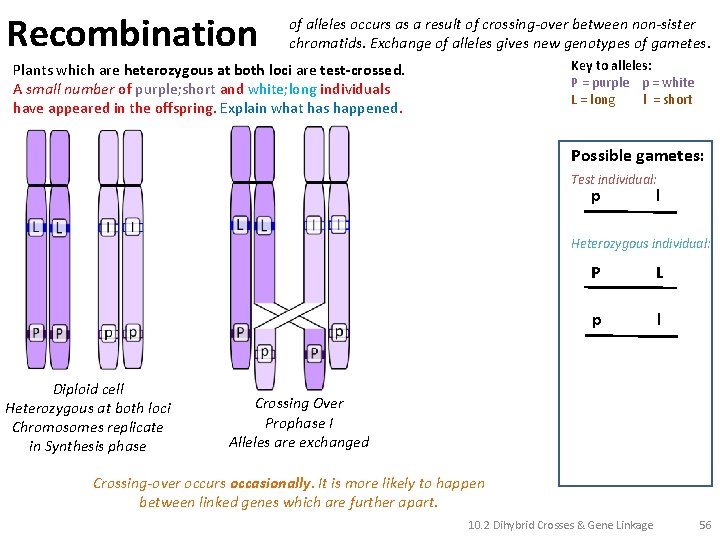
Recombination of alleles occurs as a result of crossing-over between non-sister chromatids. Exchange of alleles gives new genotypes of gametes. Key to alleles: P = purple p = white L = long l = short Plants which are heterozygous at both loci are test-crossed. A small number of purple; short and white; long individuals have appeared in the offspring. Explain what has happened. Possible gametes: Test individual: p l Heterozygous individual: Diploid cell Heterozygous at both loci Chromosomes replicate in Synthesis phase P L p l Crossing Over Prophase I Alleles are exchanged Crossing-over occurs occasionally. It is more likely to happen between linked genes which are further apart. 10. 2 Dihybrid Crosses & Gene Linkage 56
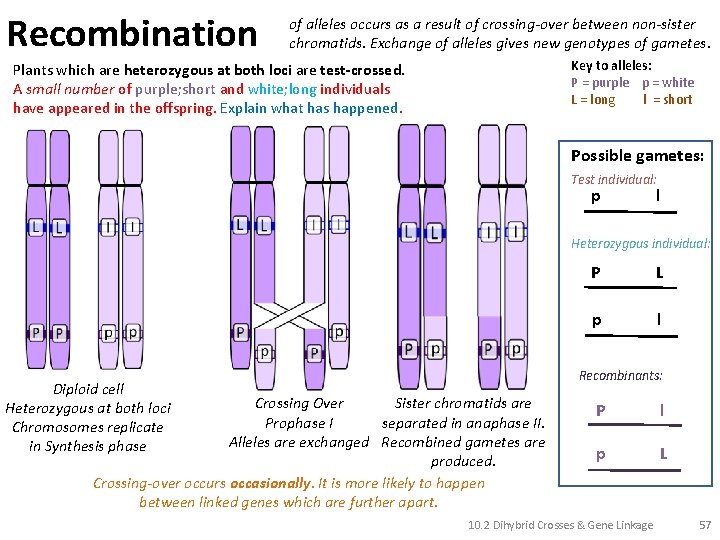
Recombination of alleles occurs as a result of crossing-over between non-sister chromatids. Exchange of alleles gives new genotypes of gametes. Key to alleles: P = purple p = white L = long l = short Plants which are heterozygous at both loci are test-crossed. A small number of purple; short and white; long individuals have appeared in the offspring. Explain what has happened. Possible gametes: Test individual: p l Heterozygous individual: Diploid cell Heterozygous at both loci Chromosomes replicate in Synthesis phase P L p l Recombinants: Crossing Over Sister chromatids are Prophase I separated in anaphase II. Alleles are exchanged Recombined gametes are produced. Crossing-over occurs occasionally. It is more likely to happen between linked genes which are further apart. P l p L 10. 2 Dihybrid Crosses & Gene Linkage 57
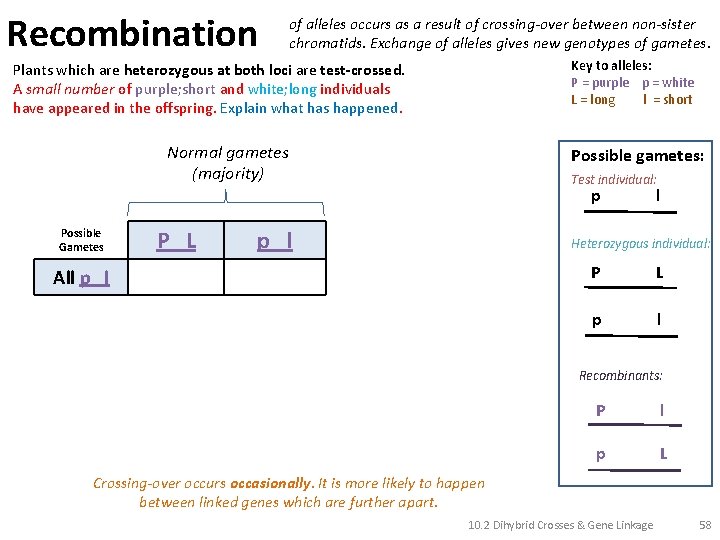
Recombination of alleles occurs as a result of crossing-over between non-sister chromatids. Exchange of alleles gives new genotypes of gametes. Key to alleles: P = purple p = white L = long l = short Plants which are heterozygous at both loci are test-crossed. A small number of purple; short and white; long individuals have appeared in the offspring. Explain what has happened. Normal gametes (majority) Possible Gametes P L Possible gametes: Test individual: p p l l Heterozygous individual: All p l P L p l Recombinants: P l p L Crossing-over occurs occasionally. It is more likely to happen between linked genes which are further apart. 10. 2 Dihybrid Crosses & Gene Linkage 58
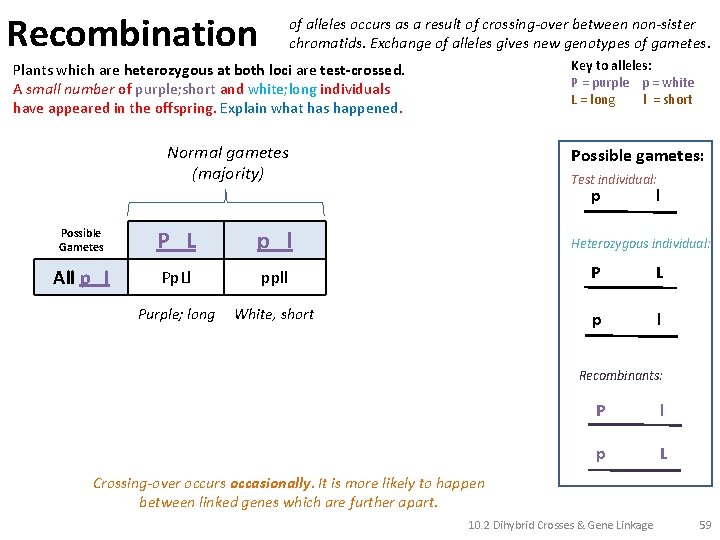
Recombination of alleles occurs as a result of crossing-over between non-sister chromatids. Exchange of alleles gives new genotypes of gametes. Key to alleles: P = purple p = white L = long l = short Plants which are heterozygous at both loci are test-crossed. A small number of purple; short and white; long individuals have appeared in the offspring. Explain what has happened. Normal gametes (majority) Possible gametes: Test individual: p l Possible Gametes P L p l All p l Pp. Ll ppll P L Purple; long White, short p l Heterozygous individual: Recombinants: P l p L Crossing-over occurs occasionally. It is more likely to happen between linked genes which are further apart. 10. 2 Dihybrid Crosses & Gene Linkage 59
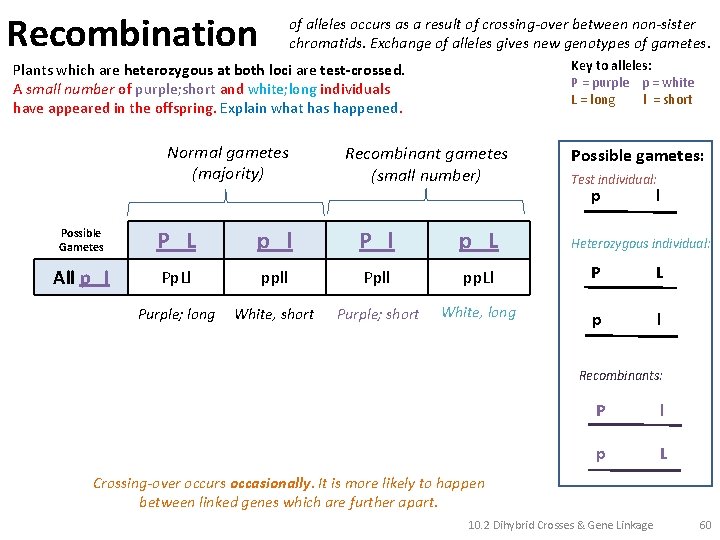
Recombination of alleles occurs as a result of crossing-over between non-sister chromatids. Exchange of alleles gives new genotypes of gametes. Key to alleles: P = purple p = white L = long l = short Plants which are heterozygous at both loci are test-crossed. A small number of purple; short and white; long individuals have appeared in the offspring. Explain what has happened. Normal gametes (majority) Recombinant gametes (small number) Possible gametes: Test individual: p l Possible Gametes P L p l P l p L All p l Pp. Ll ppll Ppll pp. Ll P L Purple; long White, short Purple; short White, long p l Heterozygous individual: Recombinants: P l p L Crossing-over occurs occasionally. It is more likely to happen between linked genes which are further apart. 10. 2 Dihybrid Crosses & Gene Linkage 60
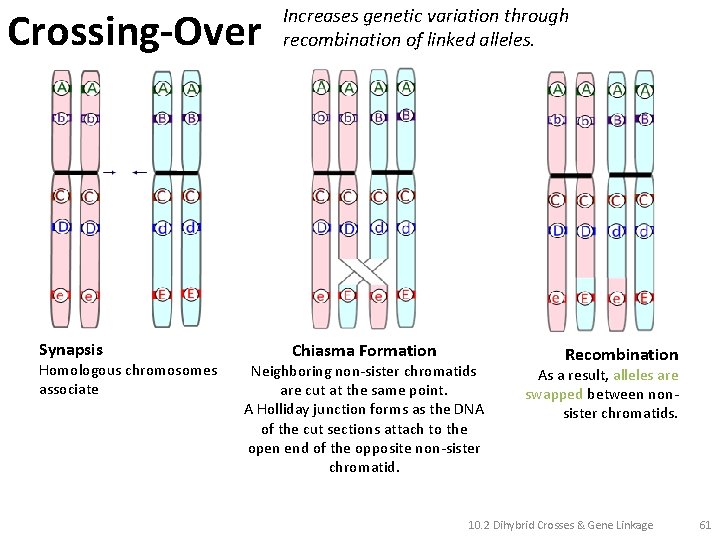
Crossing-Over Synapsis Homologous chromosomes associate Increases genetic variation through recombination of linked alleles. Chiasma Formation Neighboring non-sister chromatids are cut at the same point. A Holliday junction forms as the DNA of the cut sections attach to the open end of the opposite non-sister chromatid. Recombination As a result, alleles are swapped between nonsister chromatids. 10. 2 Dihybrid Crosses & Gene Linkage 61
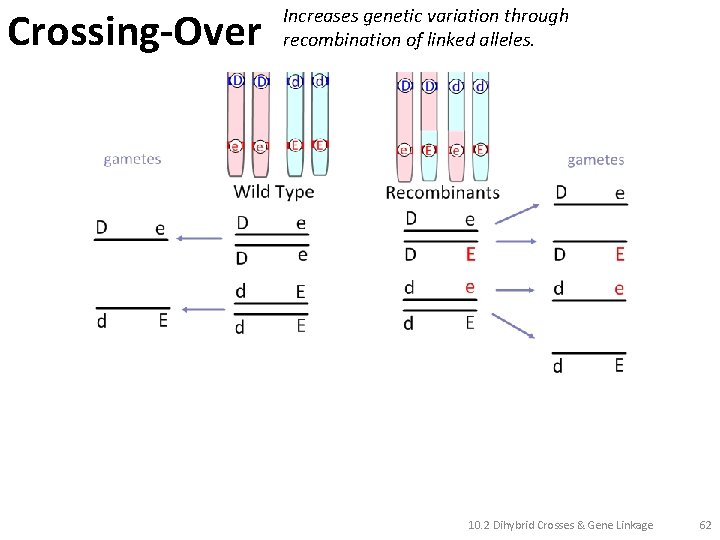
Crossing-Over Increases genetic variation through recombination of linked alleles. 10. 2 Dihybrid Crosses & Gene Linkage 62
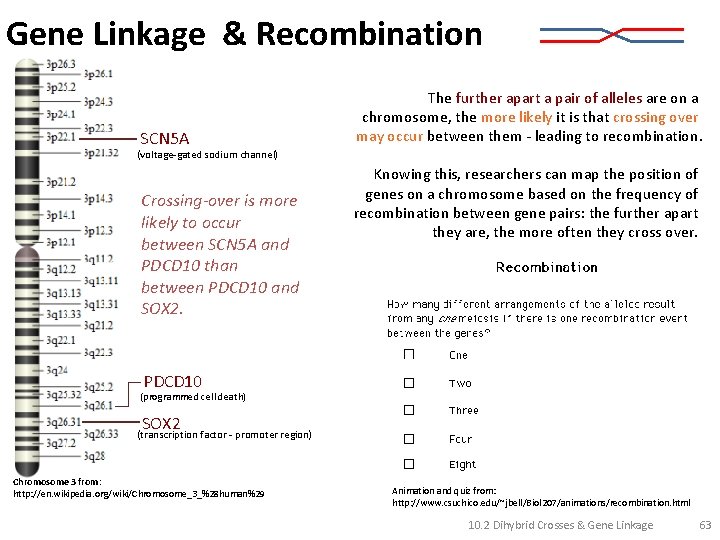
Gene Linkage & Recombination SCN 5 A The further apart a pair of alleles are on a chromosome, the more likely it is that crossing over may occur between them - leading to recombination. (voltage-gated sodium channel) Crossing-over is more likely to occur between SCN 5 A and PDCD 10 than between PDCD 10 and SOX 2. Knowing this, researchers can map the position of genes on a chromosome based on the frequency of recombination between gene pairs: the further apart they are, the more often they cross over. PDCD 10 (programmed cell death) SOX 2 (transcription factor - promoter region) Chromosome 3 from: http: //en. wikipedia. org/wiki/Chromosome_3_%28 human%29 Animation and quiz from: http: //www. csuchico. edu/~jbell/Biol 207/animations/recombination. html 10. 2 Dihybrid Crosses & Gene Linkage 63
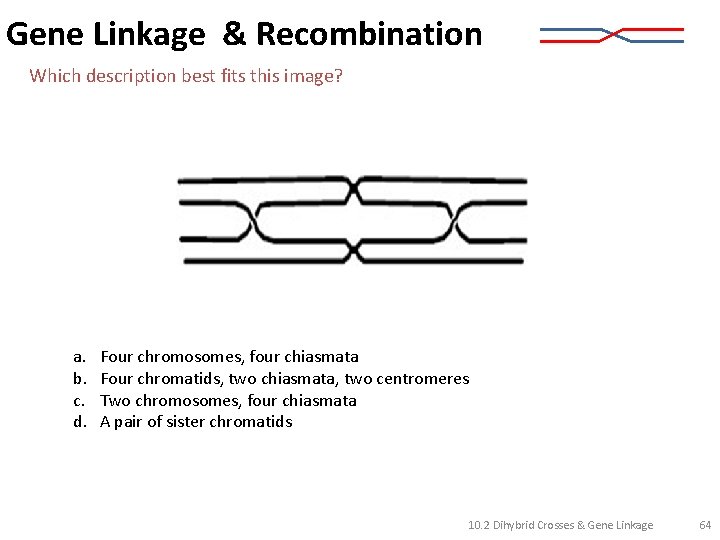
Gene Linkage & Recombination Which description best fits this image? a. b. c. d. Four chromosomes, four chiasmata Four chromatids, two chiasmata, two centromeres Two chromosomes, four chiasmata A pair of sister chromatids 10. 2 Dihybrid Crosses & Gene Linkage 64
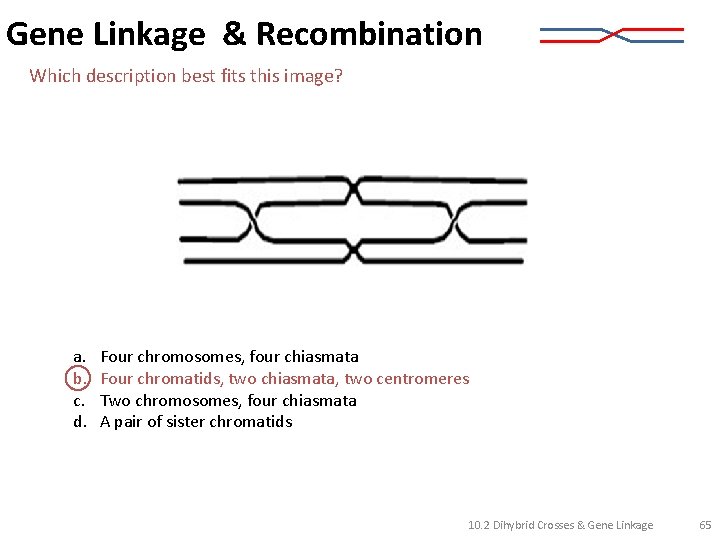
Gene Linkage & Recombination Which description best fits this image? a. b. c. d. Four chromosomes, four chiasmata Four chromatids, two chiasmata, two centromeres Two chromosomes, four chiasmata A pair of sister chromatids 10. 2 Dihybrid Crosses & Gene Linkage 65
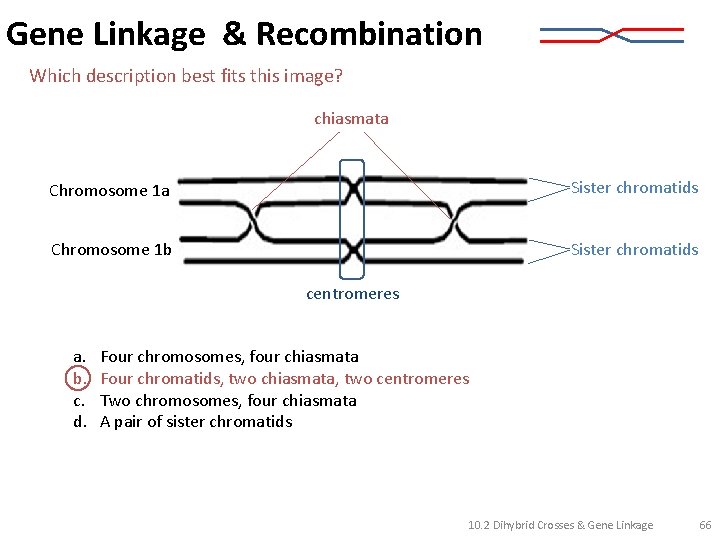
Gene Linkage & Recombination Which description best fits this image? chiasmata Chromosome 1 a Sister chromatids Chromosome 1 b Sister chromatids centromeres a. b. c. d. Four chromosomes, four chiasmata Four chromatids, two chiasmata, two centromeres Two chromosomes, four chiasmata A pair of sister chromatids 10. 2 Dihybrid Crosses & Gene Linkage 66
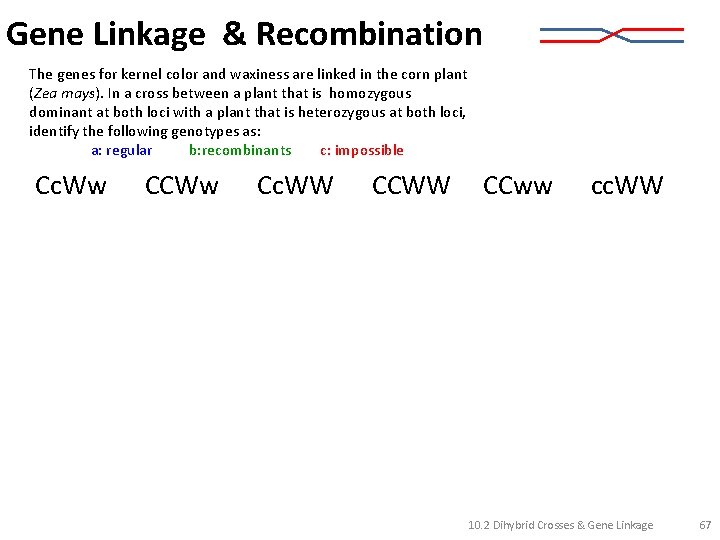
Gene Linkage & Recombination The genes for kernel color and waxiness are linked in the corn plant (Zea mays). In a cross between a plant that is homozygous dominant at both loci with a plant that is heterozygous at both loci, identify the following genotypes as: a: regular b: recombinants c: impossible Cc. Ww CCWw Cc. WW CCww cc. WW 10. 2 Dihybrid Crosses & Gene Linkage 67
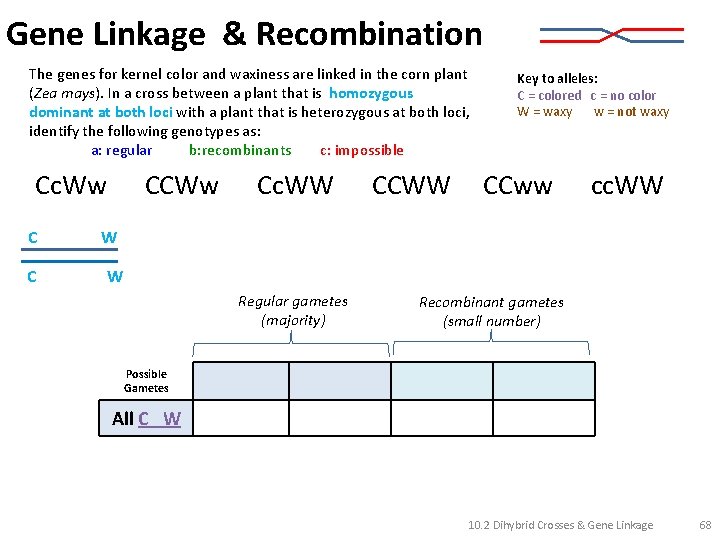
Gene Linkage & Recombination The genes for kernel color and waxiness are linked in the corn plant (Zea mays). In a cross between a plant that is homozygous dominant at both loci with a plant that is heterozygous at both loci, identify the following genotypes as: a: regular b: recombinants c: impossible Cc. Ww C C CCWw Cc. WW CCWW Key to alleles: C = colored c = no color W = waxy w = not waxy CCww cc. WW W W Regular gametes (majority) Recombinant gametes (small number) Possible Gametes All C W 10. 2 Dihybrid Crosses & Gene Linkage 68
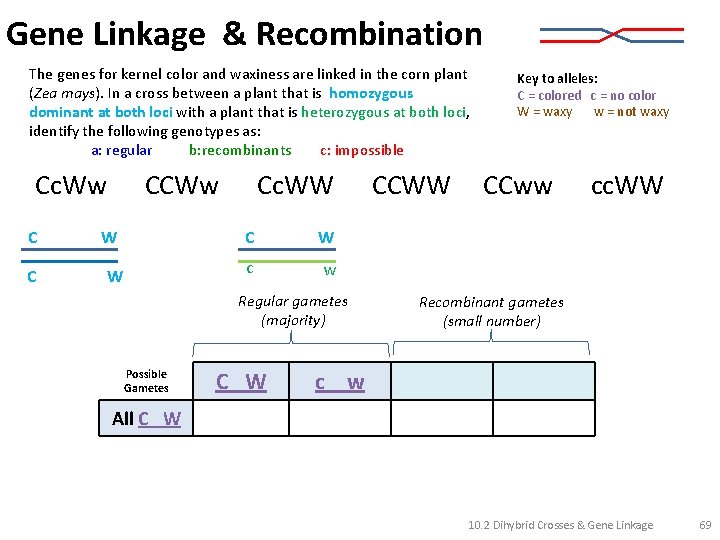
Gene Linkage & Recombination The genes for kernel color and waxiness are linked in the corn plant (Zea mays). In a cross between a plant that is homozygous dominant at both loci with a plant that is heterozygous at both loci, identify the following genotypes as: a: regular b: recombinants c: impossible Cc. Ww C C CCWw W W Cc. WW C W c w Regular gametes (majority) Possible Gametes C W CCWW Key to alleles: C = colored c = no color W = waxy w = not waxy CCww cc. WW Recombinant gametes (small number) c w All C W 10. 2 Dihybrid Crosses & Gene Linkage 69
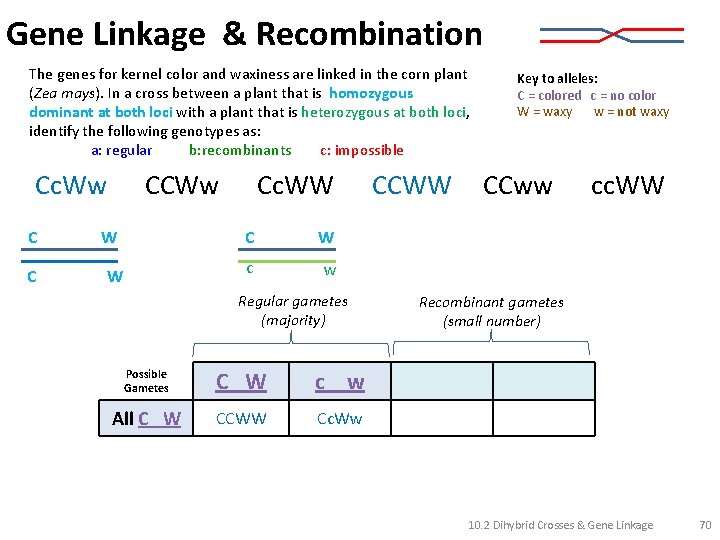
Gene Linkage & Recombination The genes for kernel color and waxiness are linked in the corn plant (Zea mays). In a cross between a plant that is homozygous dominant at both loci with a plant that is heterozygous at both loci, identify the following genotypes as: a: regular b: recombinants c: impossible Cc. Ww C C CCWw W W Cc. WW C W c w Regular gametes (majority) Possible Gametes C W c w All C W CCWW Cc. Ww CCWW Key to alleles: C = colored c = no color W = waxy w = not waxy CCww cc. WW Recombinant gametes (small number) 10. 2 Dihybrid Crosses & Gene Linkage 70
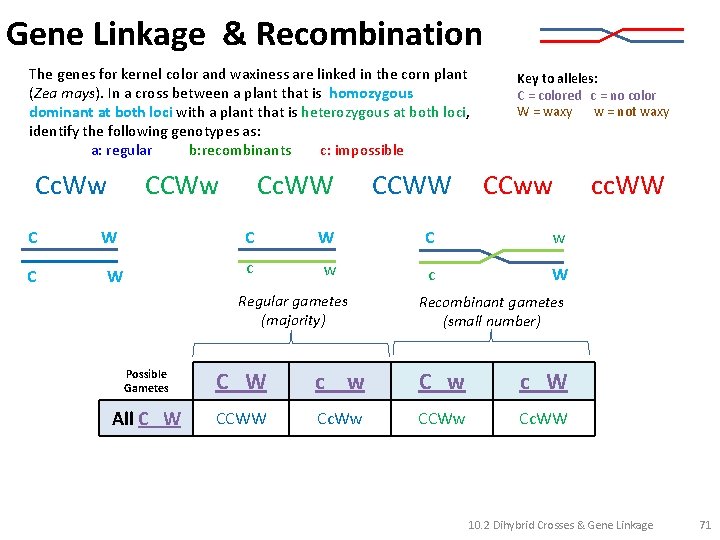
Gene Linkage & Recombination The genes for kernel color and waxiness are linked in the corn plant (Zea mays). In a cross between a plant that is homozygous dominant at both loci with a plant that is heterozygous at both loci, identify the following genotypes as: a: regular b: recombinants c: impossible Cc. Ww C C CCWw W W Cc. WW CCWW Key to alleles: C = colored c = no color W = waxy w = not waxy CCww C W C w c W Regular gametes (majority) cc. WW Recombinant gametes (small number) Possible Gametes C W c w C w c W All C W CCWW Cc. Ww CCWw Cc. WW 10. 2 Dihybrid Crosses & Gene Linkage 71
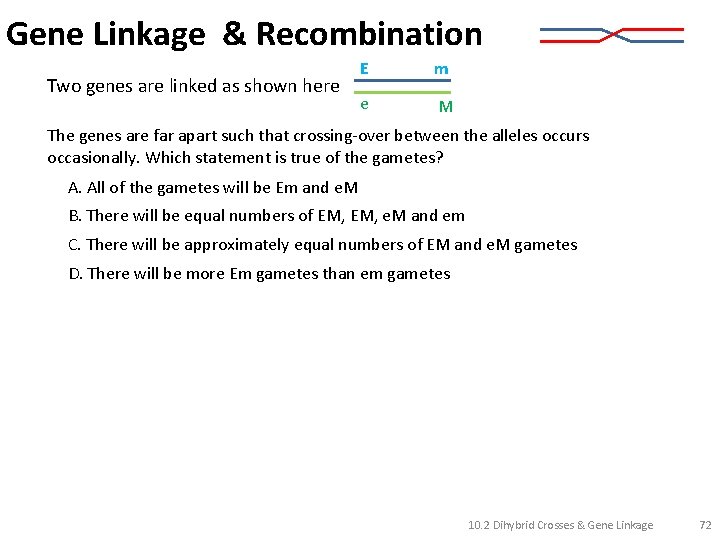
Gene Linkage & Recombination Two genes are linked as shown here E m e M The genes are far apart such that crossing-over between the alleles occurs occasionally. Which statement is true of the gametes? A. All of the gametes will be Em and e. M B. There will be equal numbers of EM, e. M and em C. There will be approximately equal numbers of EM and e. M gametes D. There will be more Em gametes than em gametes 10. 2 Dihybrid Crosses & Gene Linkage 72
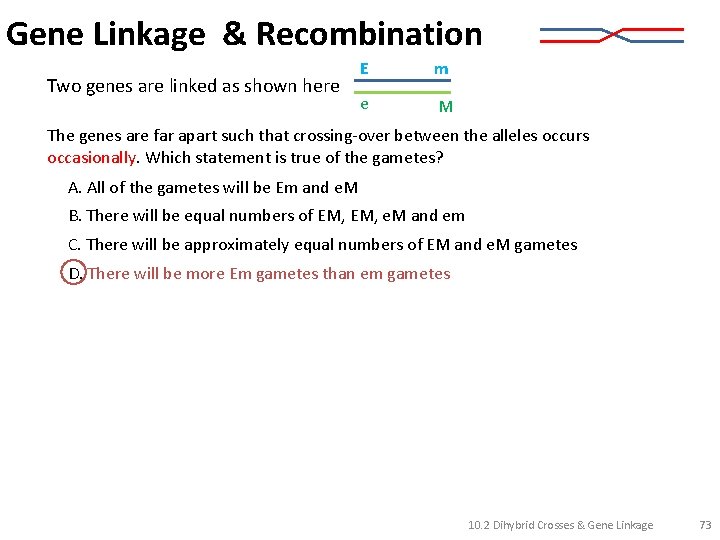
Gene Linkage & Recombination Two genes are linked as shown here E m e M The genes are far apart such that crossing-over between the alleles occurs occasionally. Which statement is true of the gametes? A. All of the gametes will be Em and e. M B. There will be equal numbers of EM, e. M and em C. There will be approximately equal numbers of EM and e. M gametes D. There will be more Em gametes than em gametes 10. 2 Dihybrid Crosses & Gene Linkage 73
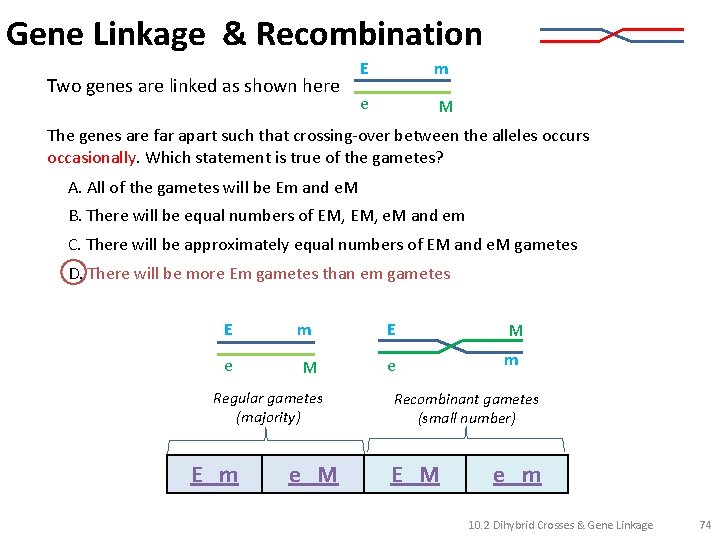
Gene Linkage & Recombination Two genes are linked as shown here E m e M The genes are far apart such that crossing-over between the alleles occurs occasionally. Which statement is true of the gametes? A. All of the gametes will be Em and e. M B. There will be equal numbers of EM, e. M and em C. There will be approximately equal numbers of EM and e. M gametes D. There will be more Em gametes than em gametes E m E M e m Regular gametes (majority) E m e M Recombinant gametes (small number) E M e m 10. 2 Dihybrid Crosses & Gene Linkage 74
- Slides: 74