
10 2 Factoring Using the Distributive Property OBJECTIVES
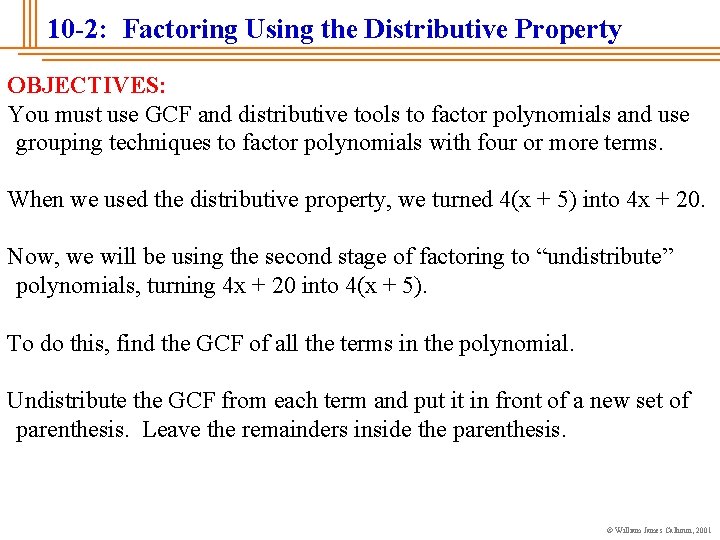
10 -2: Factoring Using the Distributive Property OBJECTIVES: You must use GCF and distributive tools to factor polynomials and use grouping techniques to factor polynomials with four or more terms. When we used the distributive property, we turned 4(x + 5) into 4 x + 20. Now, we will be using the second stage of factoring to “undistribute” polynomials, turning 4 x + 20 into 4(x + 5). To do this, find the GCF of all the terms in the polynomial. Undistribute the GCF from each term and put it in front of a new set of parenthesis. Leave the remainders inside the parenthesis. © William James Calhoun, 2001
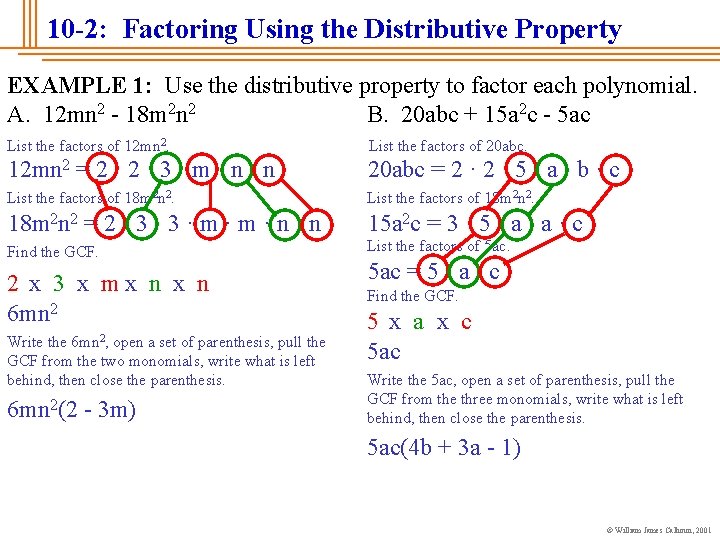
10 -2: Factoring Using the Distributive Property EXAMPLE 1: Use the distributive property to factor each polynomial. A. 12 mn 2 - 18 m 2 n 2 B. 20 abc + 15 a 2 c - 5 ac List the factors of 12 mn 2 = 2 · 3 List the factors of 20 abc. ·m·n·n List the factors of 18 m 2 n 2 = 2 · 3 ·m·m·n·n 20 abc = 2 · 5 · a · b · c List the factors of 18 m 2 n 2. 15 a 2 c = 3 · 5 · a · Find the GCF. List the factors of 5 ac. 2 x 3 x mx n 6 mn 2 Find the GCF. 6 mn 2, Write the open a set of parenthesis, pull the GCF from the two monomials, write what is left behind, then close the parenthesis. 6 mn 2(2 - 3 m) a·c 5 ac = 5 · a · c 5 x a x c 5 ac Write the 5 ac, open a set of parenthesis, pull the GCF from the three monomials, write what is left behind, then close the parenthesis. 5 ac(4 b + 3 a - 1) © William James Calhoun, 2001

10 -2: Factoring Using the Distributive Property Any time you encounter a polynomial with four terms and are asked to factor it, there will be only one option open to you. This rule will change in higher mathematics, but for now, you get the easy life. This next process will work for any 4 -nomials you encounter. EXAMPLE 3: Factor 12 ac + 21 ad + 8 bc + 14 bd. { { Group the first two terms. Group the second two terms. 3 a(4 c + 7 d) + 2 b(4 c + 7 d) Pull out the GCF of the first two. Pull out the GCF of the second two. Make sure the signs of the second pair of terms is the same as the (4 c + 7 d) ( 3 a + 2 b) signs of the first pair. If so, write a plus sign. If not, write a minus (4 c + 7 d)(3 a + 2 b) sign and change the signs of both the second pair. Now, you have two terms with something the same in them… Both terms have a (4 c + 7 d). Pull the (4 c + 7 d) out, open parenthesis, write what is left behind, and close the parenthesis. © William James Calhoun, 2001
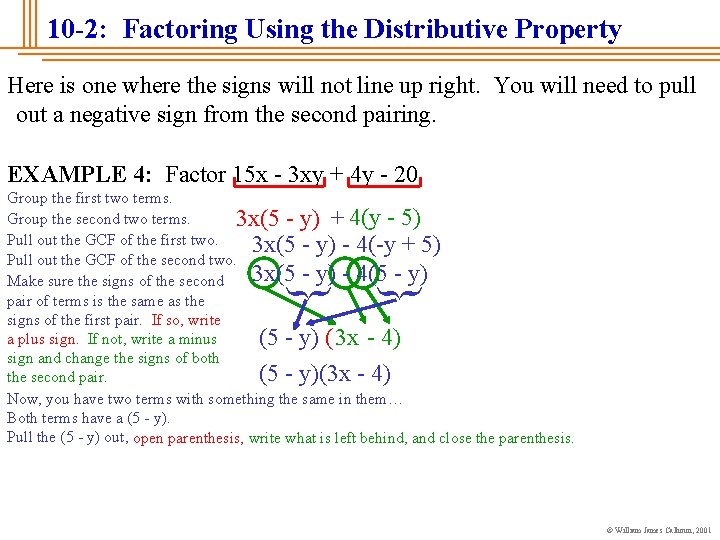
10 -2: Factoring Using the Distributive Property Here is one where the signs will not line up right. You will need to pull out a negative sign from the second pairing. EXAMPLE 4: Factor 15 x - 3 xy + 4 y - 20. { { Group the first two terms. Group the second two terms. 3 x(5 - y) + 4(y - 5) Pull out the GCF of the first two. 3 x(5 - y) - 4(-y + 5) Pull out the GCF of the second two. 3 x(5 - y) - 4(5 - y) Make sure the signs of the second pair of terms is the same as the signs of the first pair. If so, write a plus sign. If not, write a minus (5 - y) ( 3 x - 4) sign and change the signs of both (5 - y)(3 x - 4) the second pair. Now, you have two terms with something the same in them… Both terms have a (5 - y). Pull the (5 - y) out, open parenthesis, write what is left behind, and close the parenthesis. © William James Calhoun, 2001
10 -2: Factoring Using the Distributive Property HOMEWORK Page 569 #27 - 45 odd © William James Calhoun, 2001
- Slides: 5