
10 2 Correlation Introduce linear correlation independent and







- Slides: 67
10. 2 Correlation • Introduce linear correlation, independent and dependent variables, and the types of correlation • Find a correlation coefficient • Test a population correlation coefficient ρ using a table • Perform a hypothesis test for a population correlation coefficient ρ • Distinguish between correlation and causation
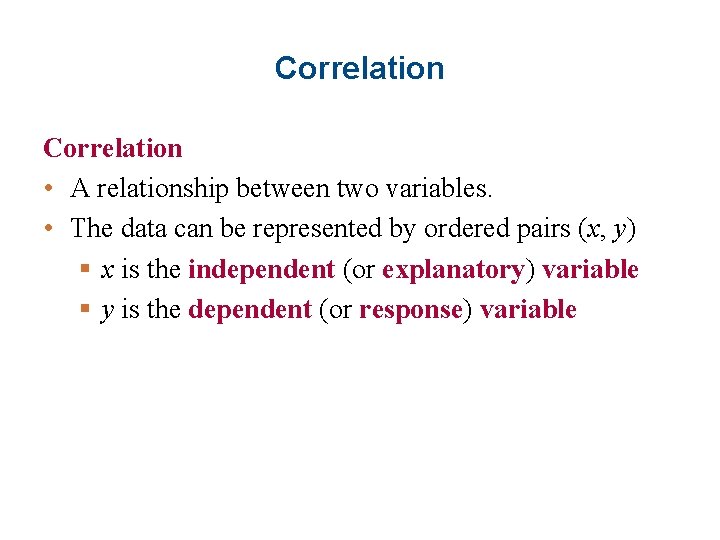
Correlation • A relationship between two variables. • The data can be represented by ordered pairs (x, y) § x is the independent (or explanatory) variable § y is the dependent (or response) variable
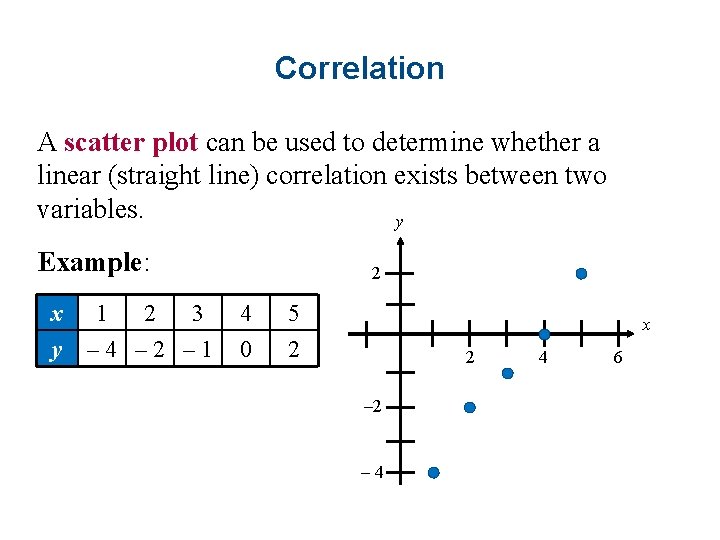
Correlation A scatter plot can be used to determine whether a linear (straight line) correlation exists between two variables. y Example: x y 1 2 3 – 4 – 2 – 1 2 4 0 5 2 x 2 – 4 4 6
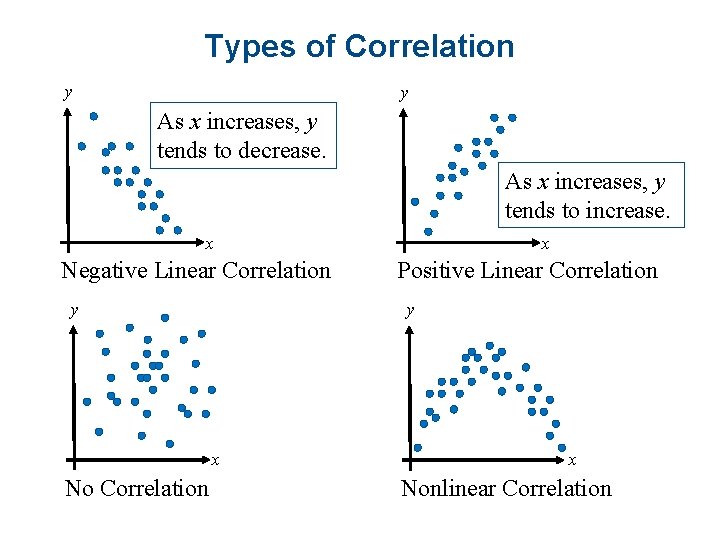
Types of Correlation y y As x increases, y tends to decrease. As x increases, y tends to increase. x x Negative Linear Correlation y y x No Correlation Positive Linear Correlation x Nonlinear Correlation
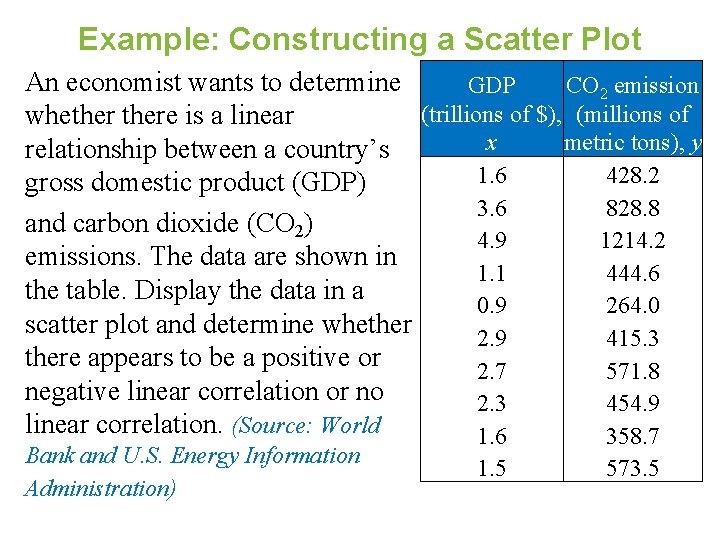
Example: Constructing a Scatter Plot An economist wants to determine GDP CO 2 emission (trillions of $), (millions of whethere is a linear x metric tons), y relationship between a country’s 1. 6 428. 2 gross domestic product (GDP) 3. 6 828. 8 and carbon dioxide (CO 2) 4. 9 1214. 2 emissions. The data are shown in 1. 1 444. 6 the table. Display the data in a 0. 9 264. 0 scatter plot and determine whether 2. 9 415. 3 there appears to be a positive or 2. 7 571. 8 negative linear correlation or no 2. 3 454. 9 linear correlation. (Source: World 1. 6 358. 7 Bank and U. S. Energy Information Administration) 1. 5 573. 5
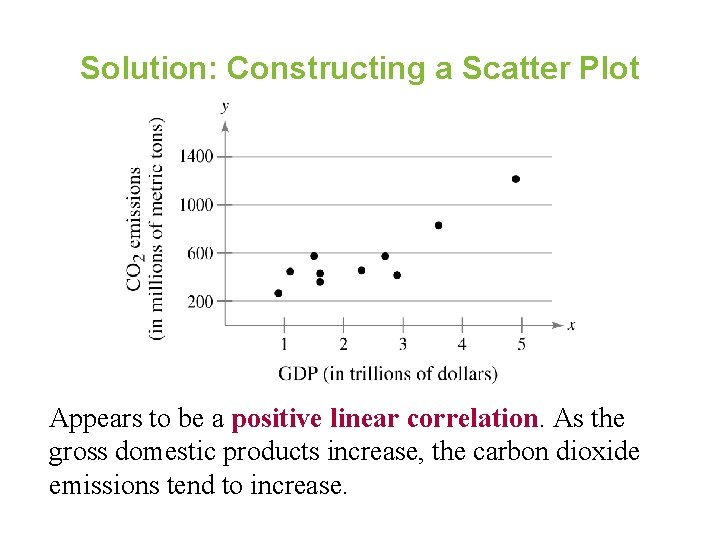
Solution: Constructing a Scatter Plot Appears to be a positive linear correlation. As the gross domestic products increase, the carbon dioxide emissions tend to increase.
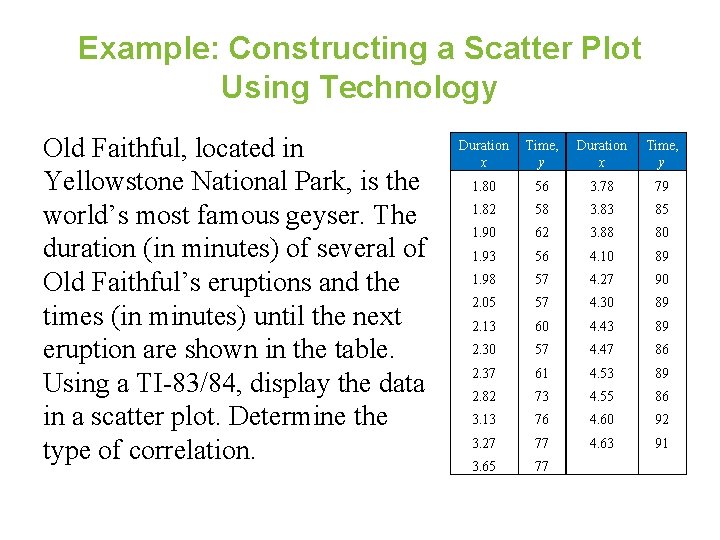
Example: Constructing a Scatter Plot Using Technology Old Faithful, located in Yellowstone National Park, is the world’s most famous geyser. The duration (in minutes) of several of Old Faithful’s eruptions and the times (in minutes) until the next eruption are shown in the table. Using a TI-83/84, display the data in a scatter plot. Determine the type of correlation. Duration x Time, y 1. 80 56 3. 78 79 1. 82 58 3. 83 85 1. 90 62 3. 88 80 1. 93 56 4. 10 89 1. 98 57 4. 27 90 2. 05 57 4. 30 89 2. 13 60 4. 43 89 2. 30 57 4. 47 86 2. 37 61 4. 53 89 2. 82 73 4. 55 86 3. 13 76 4. 60 92 3. 27 77 4. 63 91 3. 65 77
Solution: Constructing a Scatter Plot Using Technology • Enter the x-values into list L 1 and the y-values into list L 2. • Use Stat Plot to construct the scatter plot. STAT > Edit… STATPLOT 100 50 1 From the scatter plot, it appears that the variables have a positive linear correlation. 5
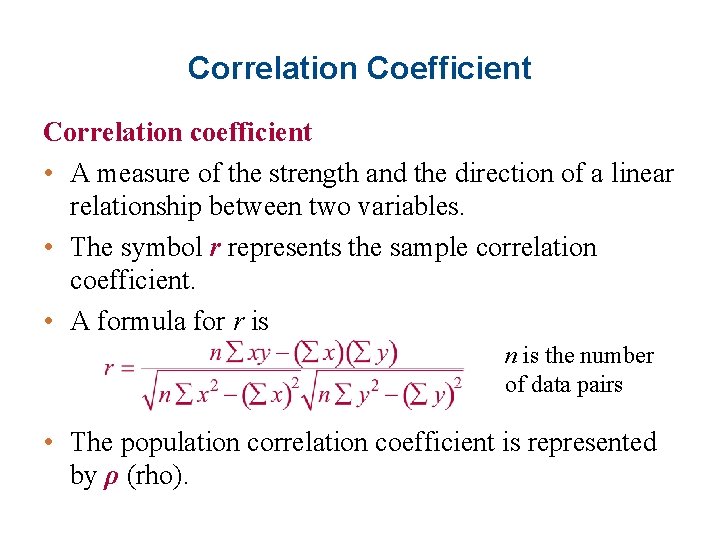
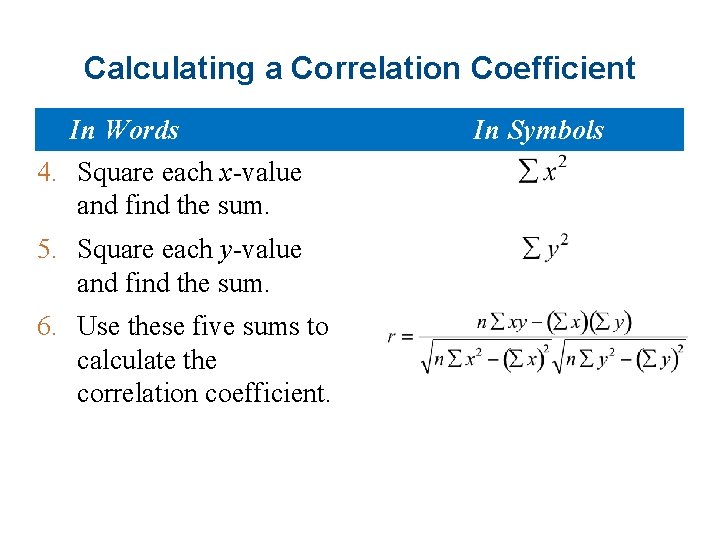
Correlation Coefficient Correlation coefficient • A measure of the strength and the direction of a linear relationship between two variables. • The symbol r represents the sample correlation coefficient. • A formula for r is n is the number of data pairs • The population correlation coefficient is represented by ρ (rho).
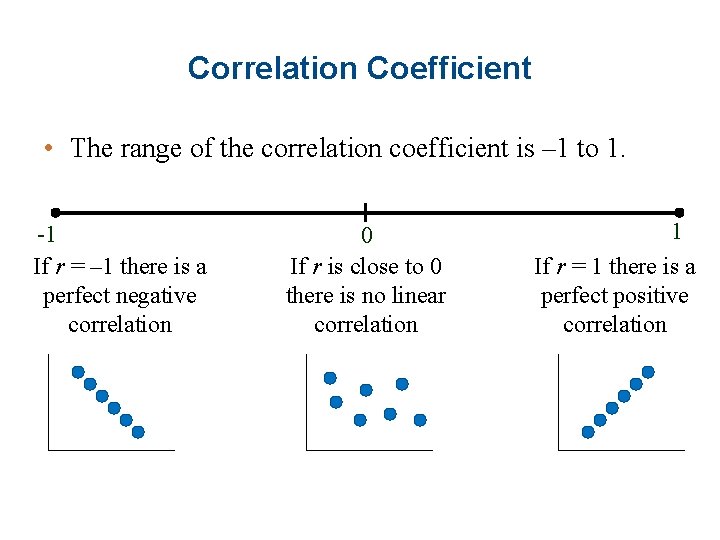
Correlation Coefficient • The range of the correlation coefficient is – 1 to 1. -1 If r = – 1 there is a perfect negative correlation 0 If r is close to 0 there is no linear correlation 1 If r = 1 there is a perfect positive correlation
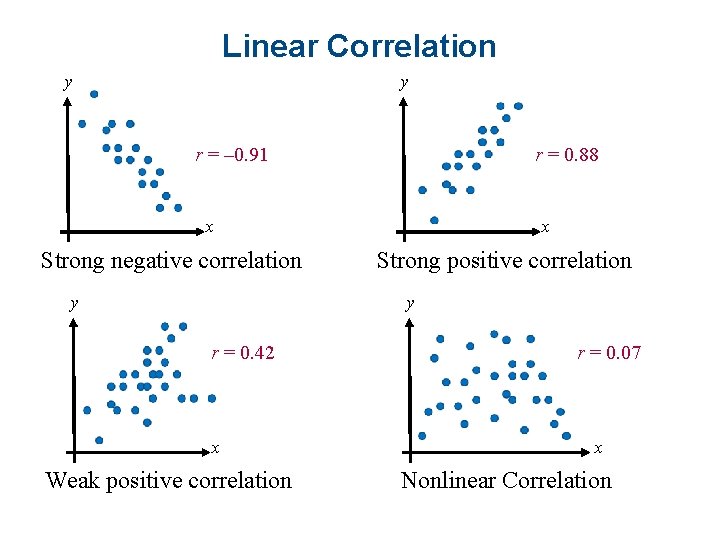
Linear Correlation y y r = – 0. 91 r = 0. 88 x Strong negative correlation y x Strong positive correlation y r = 0. 42 x Weak positive correlation r = 0. 07 x Nonlinear Correlation
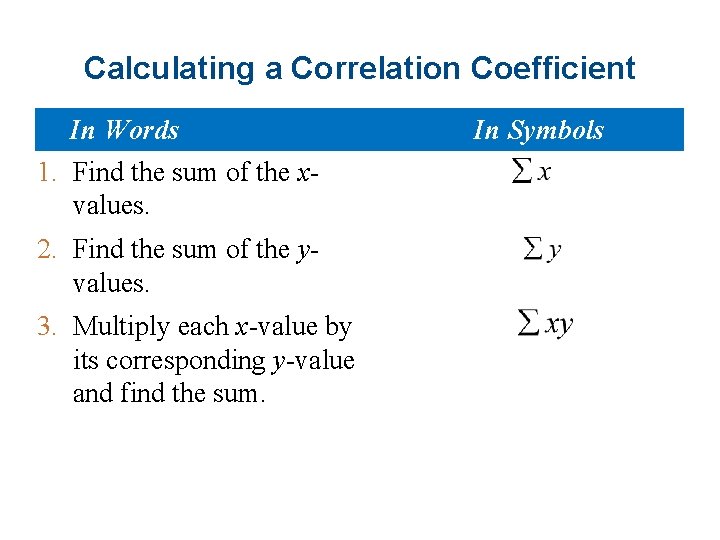
Calculating a Correlation Coefficient In Words 1. Find the sum of the xvalues. 2. Find the sum of the yvalues. 3. Multiply each x-value by its corresponding y-value and find the sum. In Symbols
Calculating a Correlation Coefficient In Words 4. Square each x-value and find the sum. 5. Square each y-value and find the sum. 6. Use these five sums to calculate the correlation coefficient. In Symbols
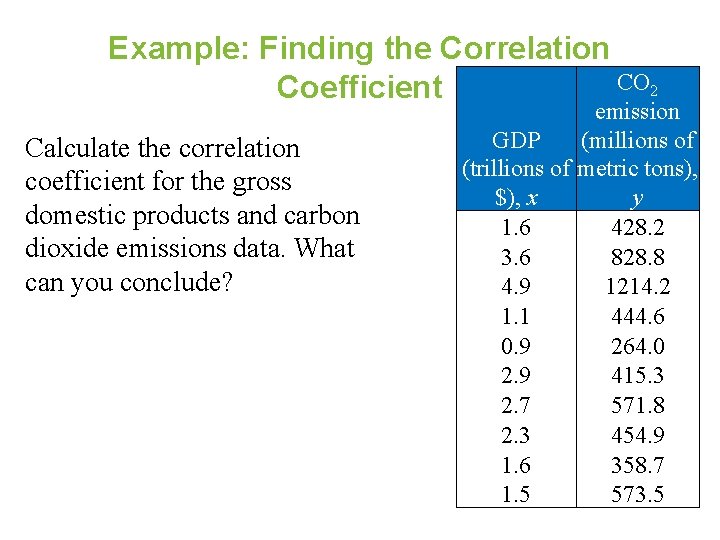
Example: Finding the Correlation CO 2 Coefficient Calculate the correlation coefficient for the gross domestic products and carbon dioxide emissions data. What can you conclude? emission GDP (millions of (trillions of metric tons), $), x y 1. 6 428. 2 3. 6 828. 8 4. 9 1214. 2 1. 1 444. 6 0. 9 264. 0 2. 9 415. 3 2. 7 571. 8 2. 3 454. 9 1. 6 358. 7 1. 5 573. 5
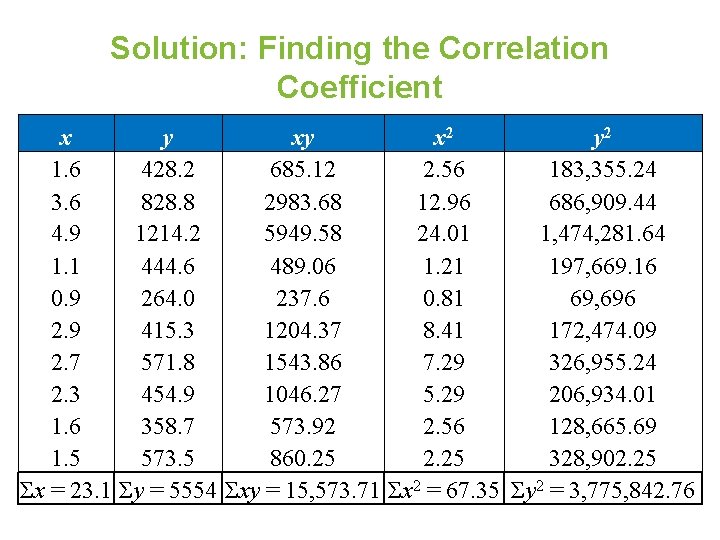
Solution: Finding the Correlation Coefficient x y xy x 2 y 2 1. 6 428. 2 685. 12 2. 56 183, 355. 24 3. 6 828. 8 2983. 68 12. 96 686, 909. 44 4. 9 1214. 2 5949. 58 24. 01 1, 474, 281. 64 1. 1 444. 6 489. 06 1. 21 197, 669. 16 0. 9 264. 0 237. 6 0. 81 69, 696 2. 9 415. 3 1204. 37 8. 41 172, 474. 09 2. 7 571. 8 1543. 86 7. 29 326, 955. 24 2. 3 454. 9 1046. 27 5. 29 206, 934. 01 1. 6 358. 7 573. 92 2. 56 128, 665. 69 1. 5 573. 5 860. 25 2. 25 328, 902. 25 Σx = 23. 1 Σy = 5554 Σxy = 15, 573. 71 Σx 2 = 67. 35 Σy 2 = 3, 775, 842. 76
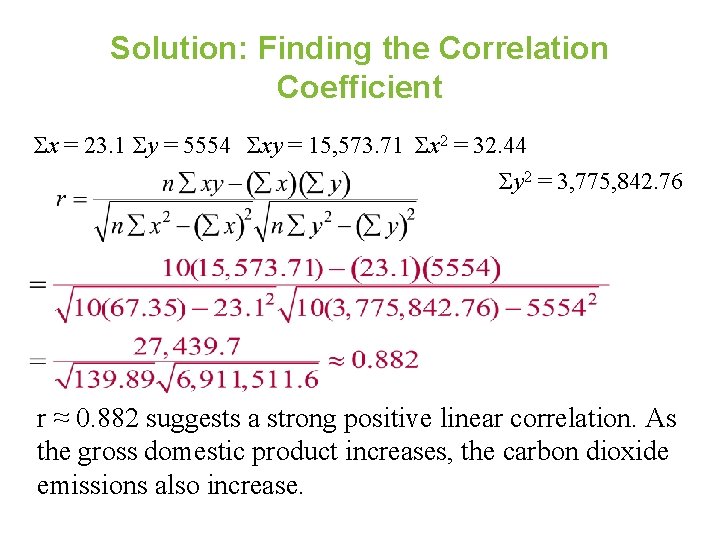
Solution: Finding the Correlation Coefficient Σx = 23. 1 Σy = 5554 Σxy = 15, 573. 71 Σx 2 = 32. 44 Σy 2 = 3, 775, 842. 76 r ≈ 0. 882 suggests a strong positive linear correlation. As the gross domestic product increases, the carbon dioxide emissions also increase.
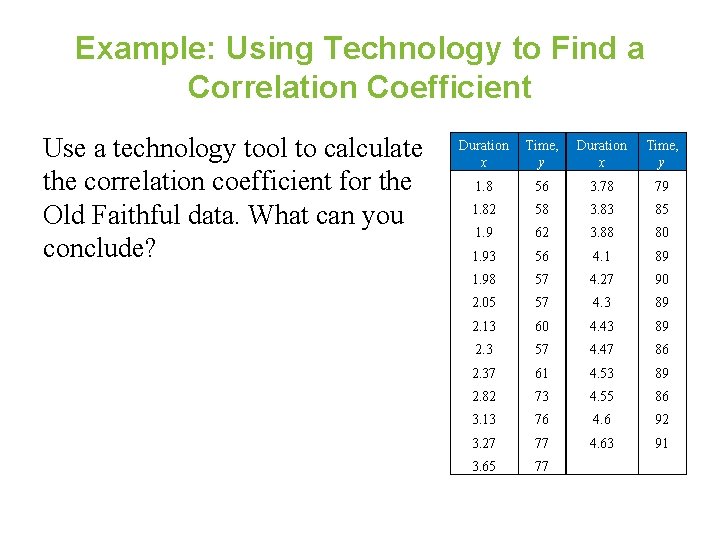
Example: Using Technology to Find a Correlation Coefficient Use a technology tool to calculate the correlation coefficient for the Old Faithful data. What can you conclude? Duration x Time, y 1. 8 56 3. 78 79 1. 82 58 3. 83 85 1. 9 62 3. 88 80 1. 93 56 4. 1 89 1. 98 57 4. 27 90 2. 05 57 4. 3 89 2. 13 60 4. 43 89 2. 3 57 4. 47 86 2. 37 61 4. 53 89 2. 82 73 4. 55 86 3. 13 76 4. 6 92 3. 27 77 4. 63 91 3. 65 77
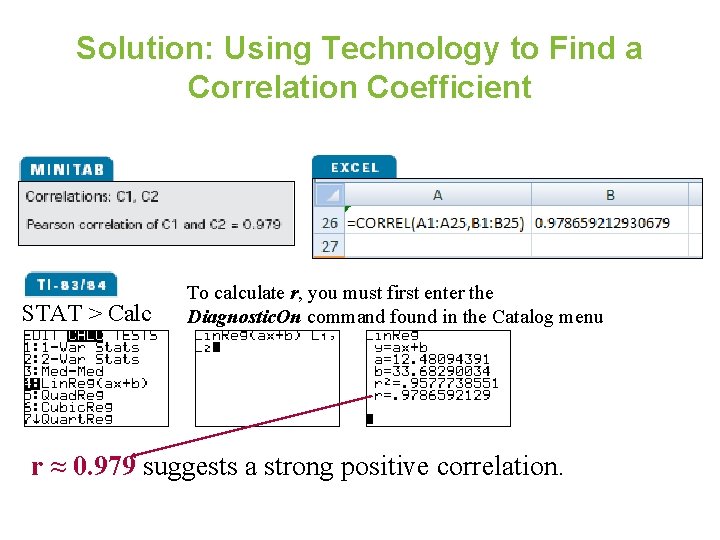
Solution: Using Technology to Find a Correlation Coefficient STAT > Calc To calculate r, you must first enter the Diagnostic. On command found in the Catalog menu r ≈ 0. 979 suggests a strong positive correlation.
Using a Table to Test a Population Correlation Coefficient ρ • Once the sample correlation coefficient r has been calculated, we need to determine whethere is enough evidence to decide that the population correlation coefficient ρ is significant at a specified level of significance. • Use Table A-5 in the insert. • If |r| is greater than the critical value, there is enough evidence to decide that the correlation coefficient ρ is significant.
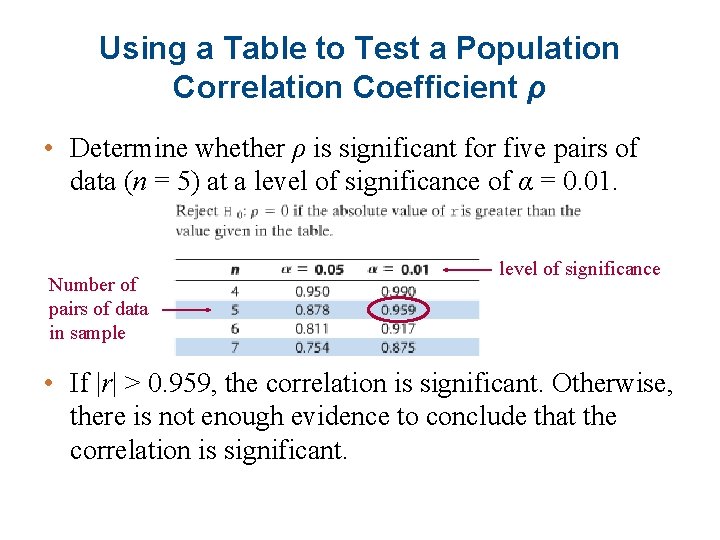
Using a Table to Test a Population Correlation Coefficient ρ • Determine whether ρ is significant for five pairs of data (n = 5) at a level of significance of α = 0. 01. Number of pairs of data in sample level of significance • If |r| > 0. 959, the correlation is significant. Otherwise, there is not enough evidence to conclude that the correlation is significant.
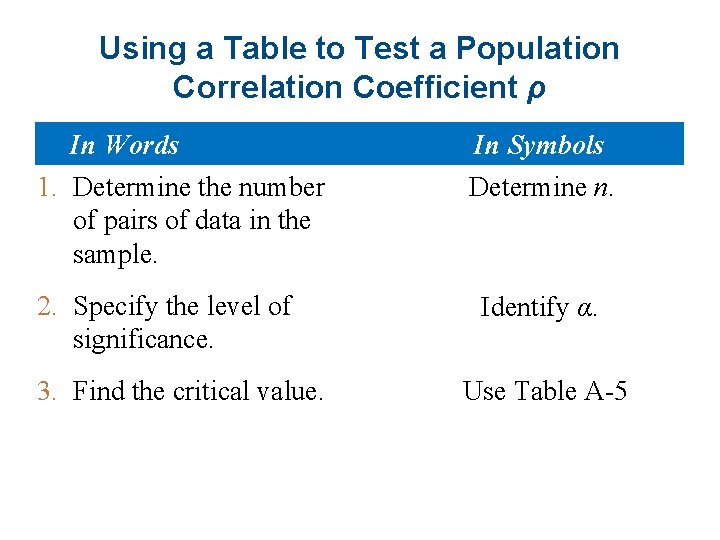
Using a Table to Test a Population Correlation Coefficient ρ In Words 1. Determine the number of pairs of data in the sample. 2. Specify the level of significance. 3. Find the critical value. In Symbols Determine n. Identify α. Use Table A-5
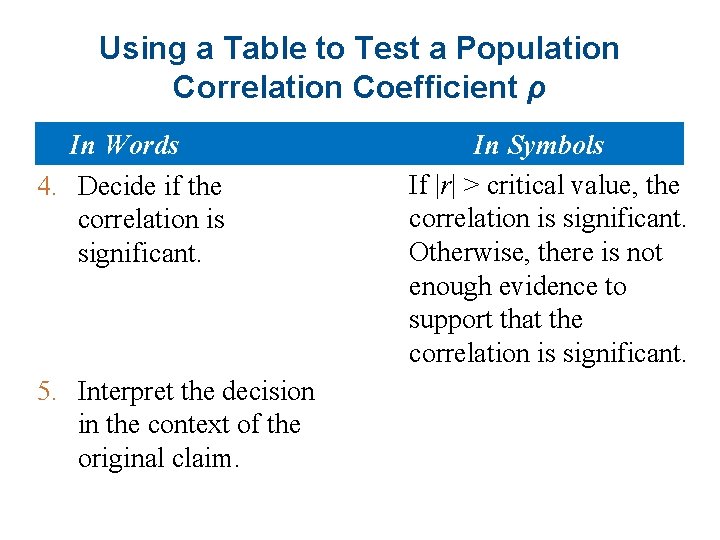
Using a Table to Test a Population Correlation Coefficient ρ In Words 4. Decide if the correlation is significant. 5. Interpret the decision in the context of the original claim. In Symbols If |r| > critical value, the correlation is significant. Otherwise, there is not enough evidence to support that the correlation is significant.
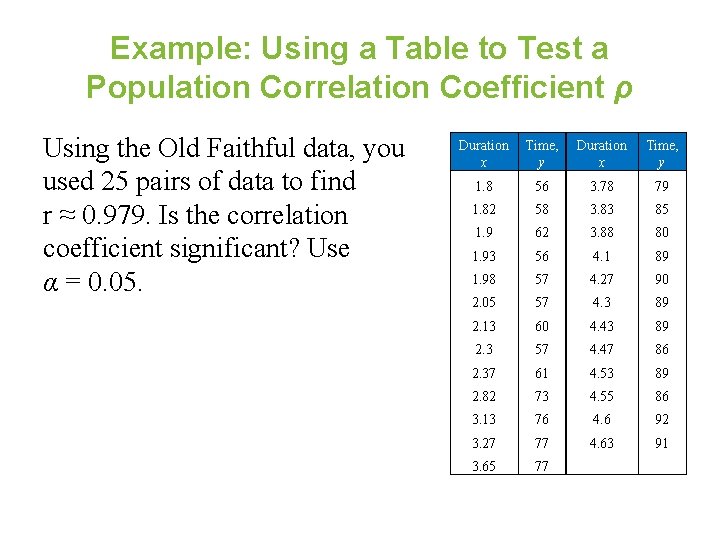
Example: Using a Table to Test a Population Correlation Coefficient ρ Using the Old Faithful data, you used 25 pairs of data to find r ≈ 0. 979. Is the correlation coefficient significant? Use α = 0. 05. Duration x Time, y 1. 8 56 3. 78 79 1. 82 58 3. 83 85 1. 9 62 3. 88 80 1. 93 56 4. 1 89 1. 98 57 4. 27 90 2. 05 57 4. 3 89 2. 13 60 4. 43 89 2. 3 57 4. 47 86 2. 37 61 4. 53 89 2. 82 73 4. 55 86 3. 13 76 4. 6 92 3. 27 77 4. 63 91 3. 65 77
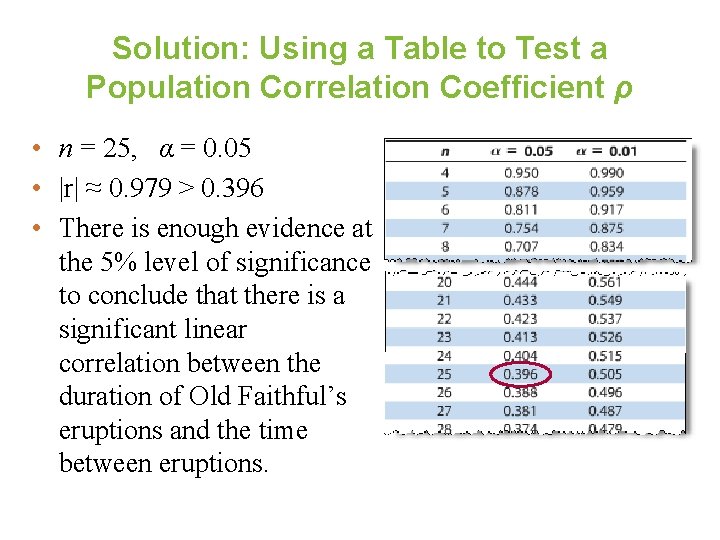
Solution: Using a Table to Test a Population Correlation Coefficient ρ • n = 25, α = 0. 05 • |r| ≈ 0. 979 > 0. 396 • There is enough evidence at the 5% level of significance to conclude that there is a significant linear correlation between the duration of Old Faithful’s eruptions and the time between eruptions.
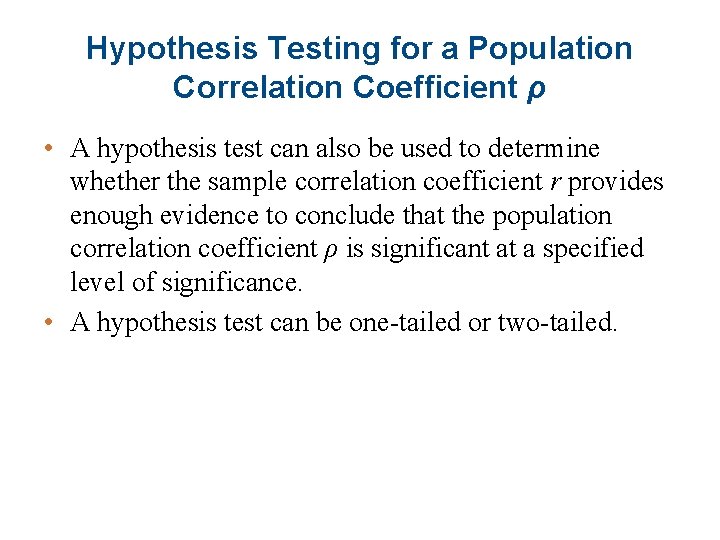
Hypothesis Testing for a Population Correlation Coefficient ρ • A hypothesis test can also be used to determine whether the sample correlation coefficient r provides enough evidence to conclude that the population correlation coefficient ρ is significant at a specified level of significance. • A hypothesis test can be one-tailed or two-tailed.
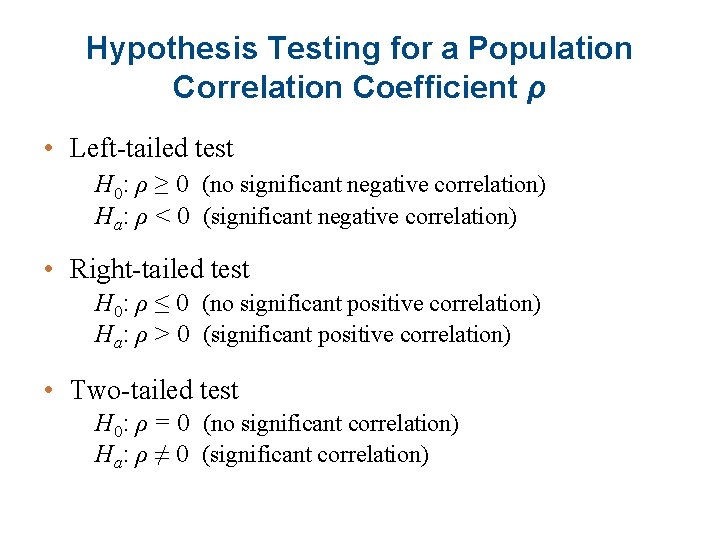
Hypothesis Testing for a Population Correlation Coefficient ρ • Left-tailed test H 0: ρ ≥ 0 (no significant negative correlation) Ha: ρ < 0 (significant negative correlation) • Right-tailed test H 0: ρ ≤ 0 (no significant positive correlation) Ha: ρ > 0 (significant positive correlation) • Two-tailed test H 0: ρ = 0 (no significant correlation) Ha: ρ ≠ 0 (significant correlation)
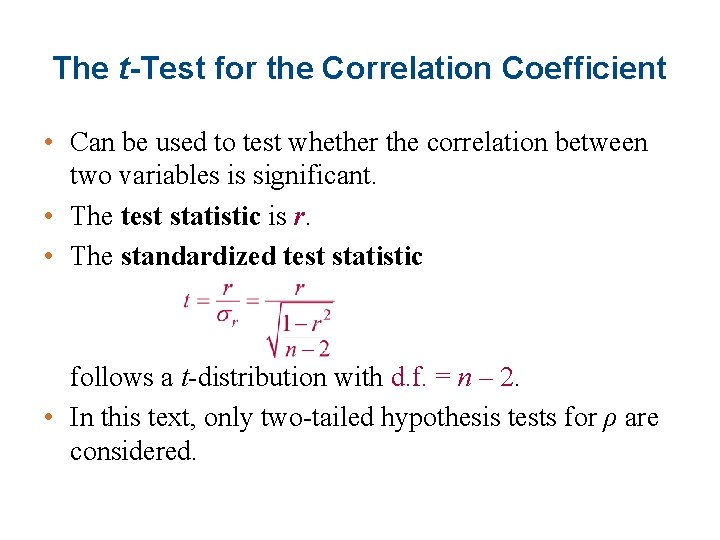
The t-Test for the Correlation Coefficient • Can be used to test whether the correlation between two variables is significant. • The test statistic is r. • The standardized test statistic follows a t-distribution with d. f. = n – 2. • In this text, only two-tailed hypothesis tests for ρ are considered.
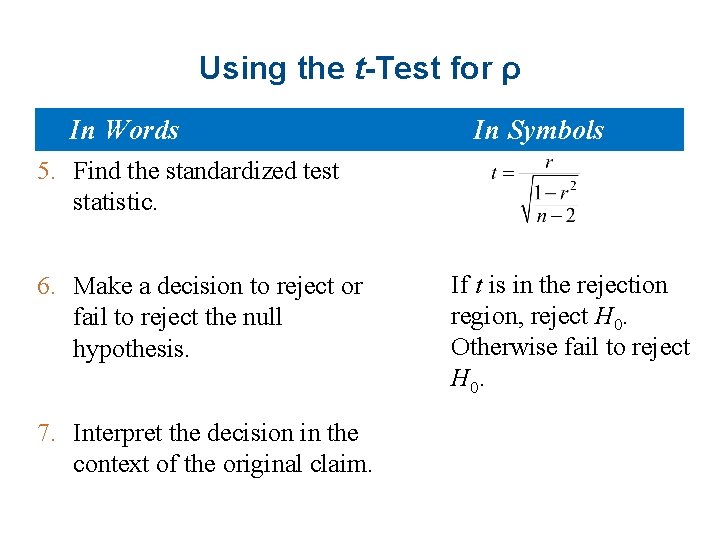
Using the t-Test for ρ In Words 1. State the null and alternative hypothesis. In Symbols State H 0 and Ha. 2. Specify the level of significance. Identify α. 3. Identify the degrees of freedom. d. f. = n – 2 4. Determine the critical value(s) and rejection region(s). Use calculator Or T-distr. table
Using the t-Test for ρ In Words In Symbols 5. Find the standardized test statistic. 6. Make a decision to reject or fail to reject the null hypothesis. 7. Interpret the decision in the context of the original claim. If t is in the rejection region, reject H 0. Otherwise fail to reject H 0.
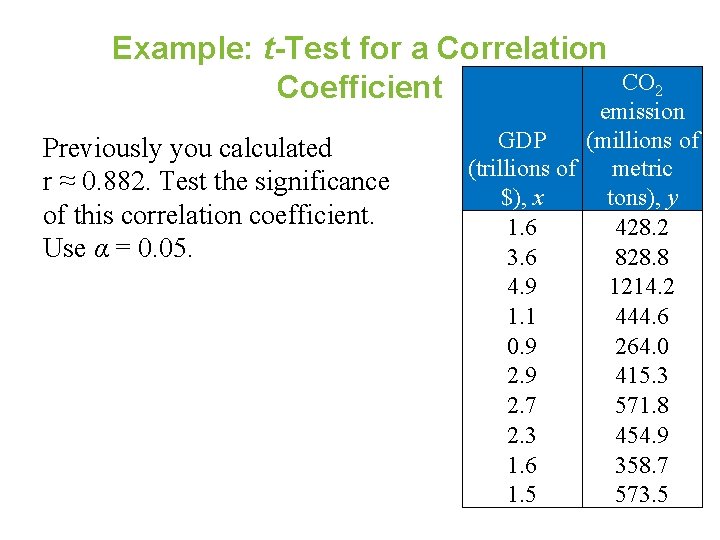
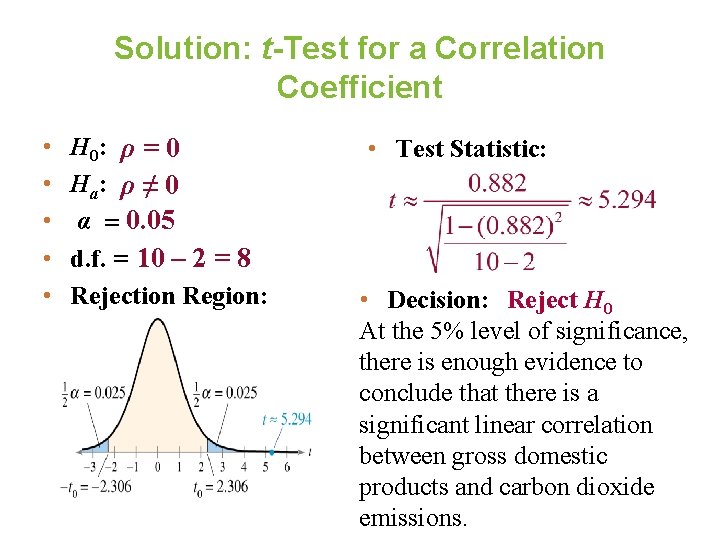
Example: t-Test for a Correlation Coefficient Previously you calculated r ≈ 0. 882. Test the significance of this correlation coefficient. Use α = 0. 05. CO 2 emission GDP (millions of (trillions of metric $), x tons), y 1. 6 428. 2 3. 6 828. 8 4. 9 1214. 2 1. 1 444. 6 0. 9 264. 0 2. 9 415. 3 2. 7 571. 8 2. 3 454. 9 1. 6 358. 7 1. 5 573. 5
Solution: t-Test for a Correlation Coefficient • • • H 0: ρ = 0 H a: ρ ≠ 0 α = 0. 05 d. f. = 10 – 2 = 8 Rejection Region: • Test Statistic: • Decision: Reject H 0 At the 5% level of significance, there is enough evidence to conclude that there is a significant linear correlation between gross domestic products and carbon dioxide emissions.
Correlation and Causation • The fact that two variables are strongly correlated does not in itself imply a cause-and-effect relationship between the variables. • If there is a significant correlation between two variables, you should consider the following possibilities. 1. Is there a direct cause-and-effect relationship between the variables? • Does x cause y?
Correlation and Causation 2. Is there a reverse cause-and-effect relationship between the variables? • Does y cause x? 3. Is it possible that the relationship between the variables can be caused by a third variable or by a combination of several other variables? 4. Is it possible that the relationship between two variables may be a coincidence?
10. 3 Linear Regression • Find the equation of a regression line • Predict y-values using a regression equation
Regression lines • After verifying that the linear correlation between two variables is significant, next we determine the equation of the line that best models the data (regression line). • Can be used to predict the value of y for a given value of x. y x
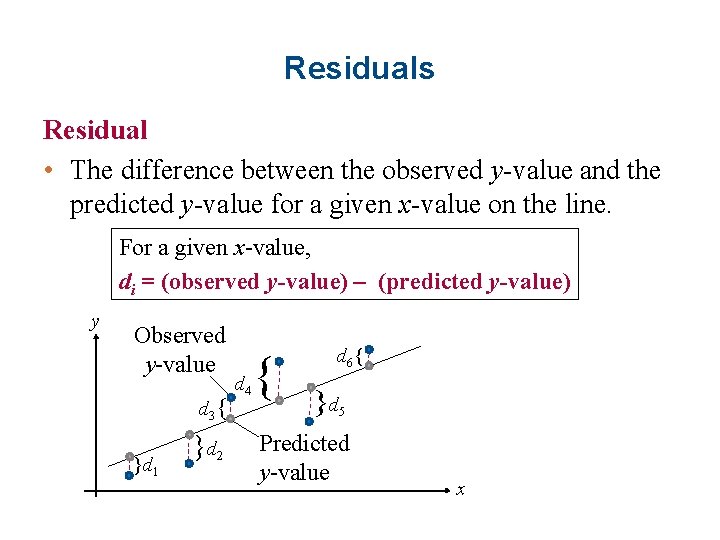
Residuals Residual • The difference between the observed y-value and the predicted y-value for a given x-value on the line. For a given x-value, di = (observed y-value) – (predicted y-value) y Observed y-value d 3{ }d 1 }d 2 d 4 { d 6{ }d 5 Predicted y-value x
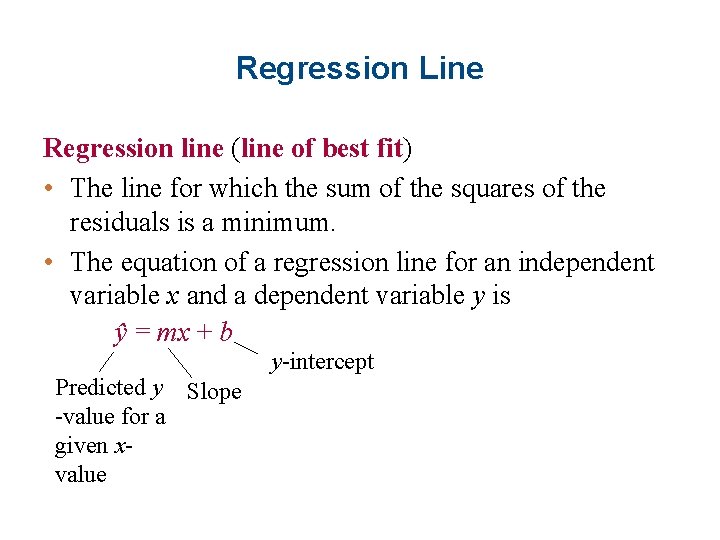
Regression Line Regression line (line of best fit) • The line for which the sum of the squares of the residuals is a minimum. • The equation of a regression line for an independent variable x and a dependent variable y is ŷ = mx + b Predicted y Slope -value for a given xvalue y-intercept
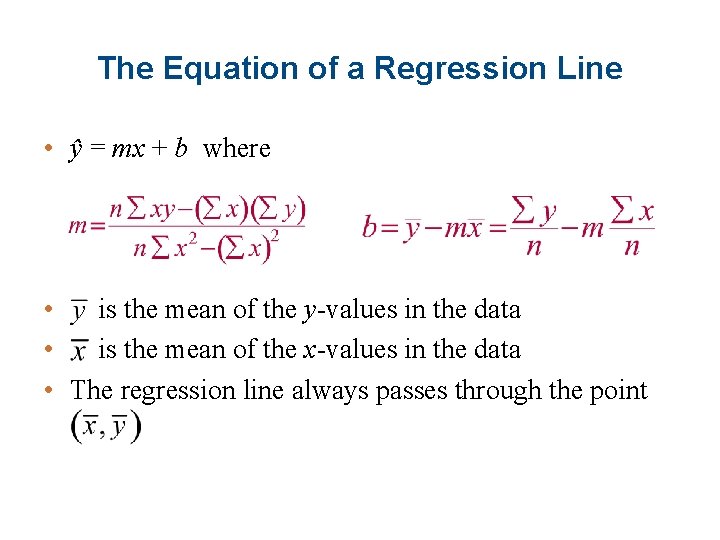
The Equation of a Regression Line • ŷ = mx + b where • is the mean of the y-values in the data • is the mean of the x-values in the data • The regression line always passes through the point
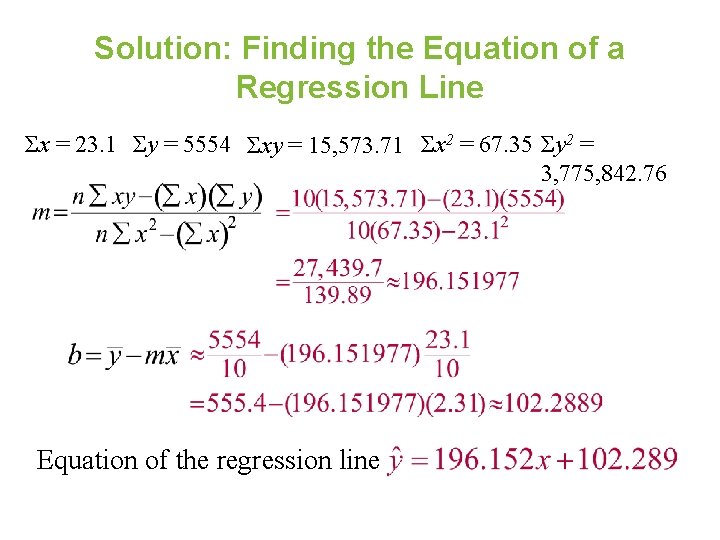
Example: Finding the Equation of a Regression Line Find the equation of the regression line for the gross domestic products and carbon dioxide emissions data. GDP CO 2 emission (trillions of $), (millions of x metric tons), y 1. 6 428. 2 3. 6 828. 8 4. 9 1214. 2 1. 1 444. 6 0. 9 264. 0 2. 9 415. 3 2. 7 571. 8 2. 3 454. 9 1. 6 358. 7 1. 5 573. 5
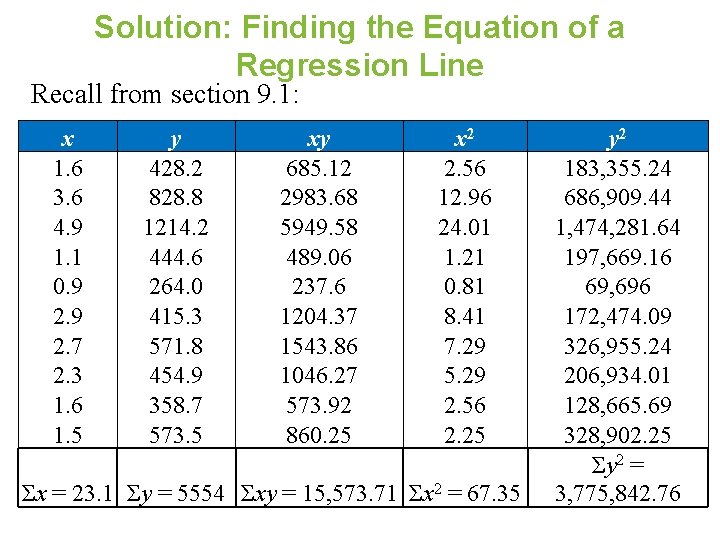
Solution: Finding the Equation of a Regression Line Recall from section 9. 1: x 1. 6 3. 6 4. 9 1. 1 0. 9 2. 7 2. 3 1. 6 1. 5 y 428. 2 828. 8 1214. 2 444. 6 264. 0 415. 3 571. 8 454. 9 358. 7 573. 5 xy 685. 12 2983. 68 5949. 58 489. 06 237. 6 1204. 37 1543. 86 1046. 27 573. 92 860. 25 x 2 2. 56 12. 96 24. 01 1. 21 0. 81 8. 41 7. 29 5. 29 2. 56 2. 25 Σx = 23. 1 Σy = 5554 Σxy = 15, 573. 71 Σx 2 = 67. 35 y 2 183, 355. 24 686, 909. 44 1, 474, 281. 64 197, 669. 16 69, 696 172, 474. 09 326, 955. 24 206, 934. 01 128, 665. 69 328, 902. 25 Σy 2 = 3, 775, 842. 76
Solution: Finding the Equation of a Regression Line Σx = 23. 1 Σy = 5554 Σxy = 15, 573. 71 Σx 2 = 67. 35 Σy 2 = 3, 775, 842. 76 Equation of the regression line
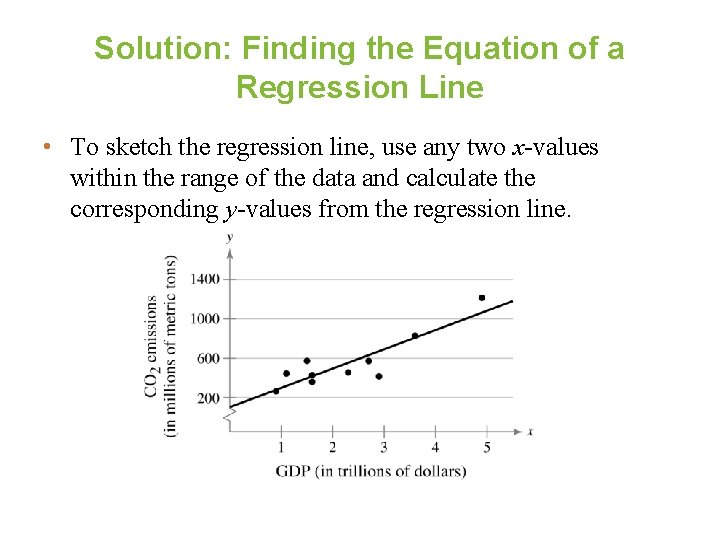
Solution: Finding the Equation of a Regression Line • To sketch the regression line, use any two x-values within the range of the data and calculate the corresponding y-values from the regression line.
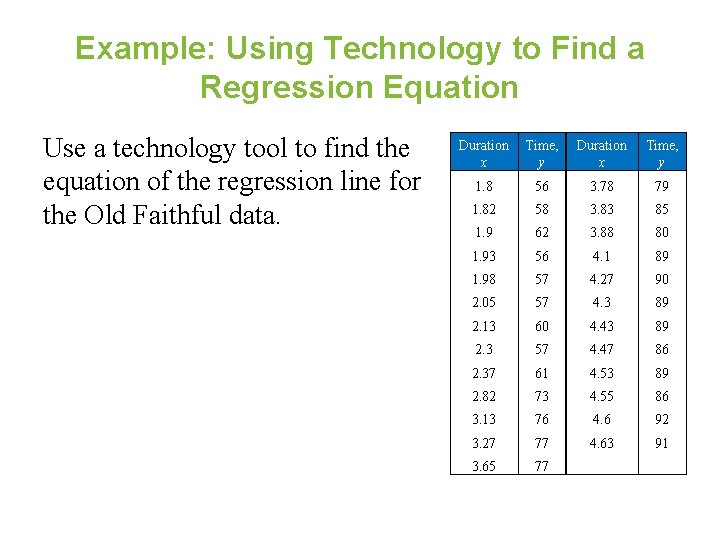
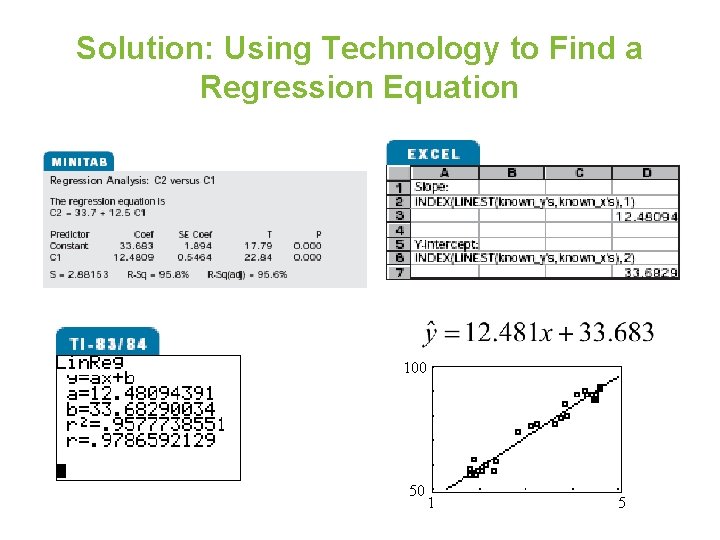
Example: Using Technology to Find a Regression Equation Use a technology tool to find the equation of the regression line for the Old Faithful data. Duration x Time, y 1. 8 56 3. 78 79 1. 82 58 3. 83 85 1. 9 62 3. 88 80 1. 93 56 4. 1 89 1. 98 57 4. 27 90 2. 05 57 4. 3 89 2. 13 60 4. 43 89 2. 3 57 4. 47 86 2. 37 61 4. 53 89 2. 82 73 4. 55 86 3. 13 76 4. 6 92 3. 27 77 4. 63 91 3. 65 77
Solution: Using Technology to Find a Regression Equation 100 50 1 5
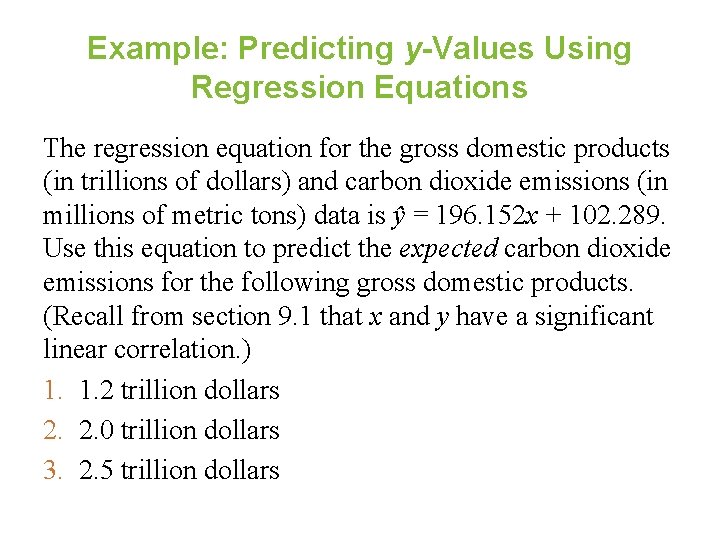
Example: Predicting y-Values Using Regression Equations The regression equation for the gross domestic products (in trillions of dollars) and carbon dioxide emissions (in millions of metric tons) data is ŷ = 196. 152 x + 102. 289. Use this equation to predict the expected carbon dioxide emissions for the following gross domestic products. (Recall from section 9. 1 that x and y have a significant linear correlation. ) 1. 1. 2 trillion dollars 2. 2. 0 trillion dollars 3. 2. 5 trillion dollars
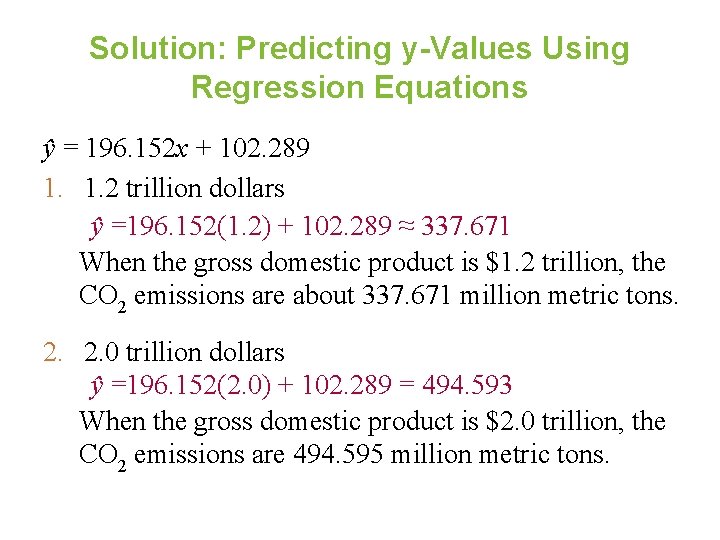
Solution: Predicting y-Values Using Regression Equations ŷ = 196. 152 x + 102. 289 1. 1. 2 trillion dollars ŷ =196. 152(1. 2) + 102. 289 ≈ 337. 671 When the gross domestic product is $1. 2 trillion, the CO 2 emissions are about 337. 671 million metric tons. 2. 2. 0 trillion dollars ŷ =196. 152(2. 0) + 102. 289 = 494. 593 When the gross domestic product is $2. 0 trillion, the CO 2 emissions are 494. 595 million metric tons.
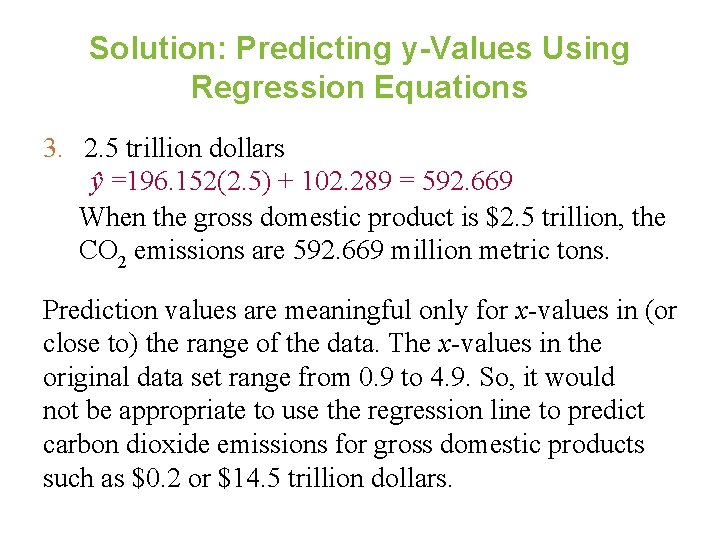
Solution: Predicting y-Values Using Regression Equations 3. 2. 5 trillion dollars ŷ =196. 152(2. 5) + 102. 289 = 592. 669 When the gross domestic product is $2. 5 trillion, the CO 2 emissions are 592. 669 million metric tons. Prediction values are meaningful only for x-values in (or close to) the range of the data. The x-values in the original data set range from 0. 9 to 4. 9. So, it would not be appropriate to use the regression line to predict carbon dioxide emissions for gross domestic products such as $0. 2 or $14. 5 trillion dollars.
10. 4 Measures of Regression and Prediction Intervals • Interpret the three types of variation about a regression line • Find and interpret the coefficient of determination • Find and interpret the standard error of the estimate for a regression line • Construct and interpret a prediction interval for y
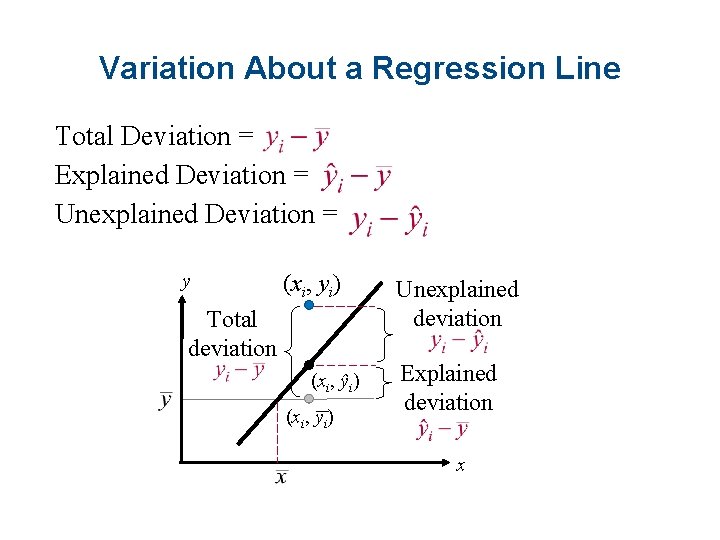
Variation About a Regression Line • Three types of variation about a regression line § Total variation § Explained variation § Unexplained variation • To find the total variation, you must first calculate § The total deviation § The explained deviation § The unexplained deviation
Variation About a Regression Line Total Deviation = Explained Deviation = Unexplained Deviation = y (xi, yi) Total deviation (xi, ŷi) (xi, yi) Unexplained deviation Explained deviation x
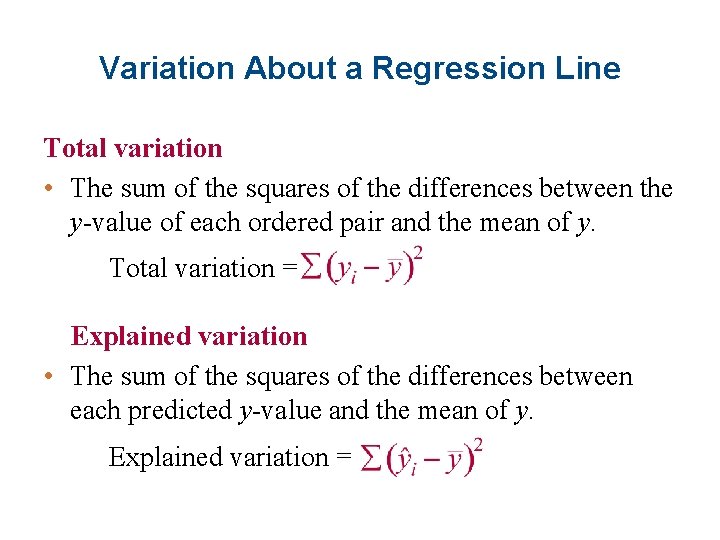
Variation About a Regression Line Total variation • The sum of the squares of the differences between the y-value of each ordered pair and the mean of y. Total variation = Explained variation • The sum of the squares of the differences between each predicted y-value and the mean of y. Explained variation =
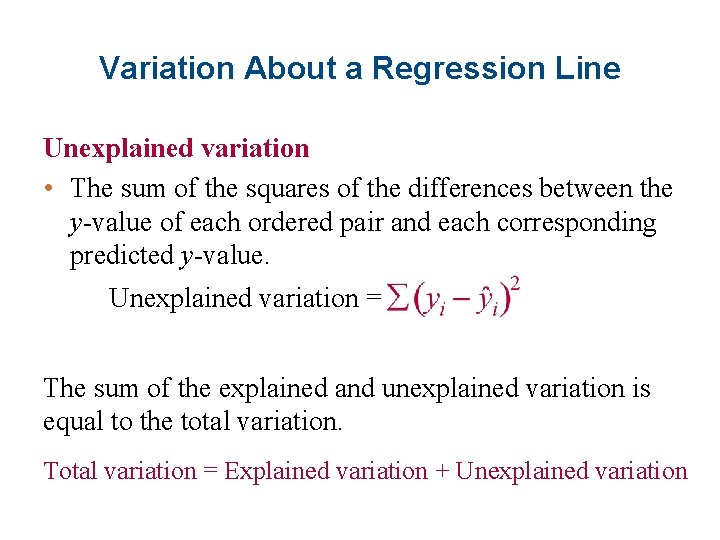
Variation About a Regression Line Unexplained variation • The sum of the squares of the differences between the y-value of each ordered pair and each corresponding predicted y-value. Unexplained variation = The sum of the explained and unexplained variation is equal to the total variation. Total variation = Explained variation + Unexplained variation
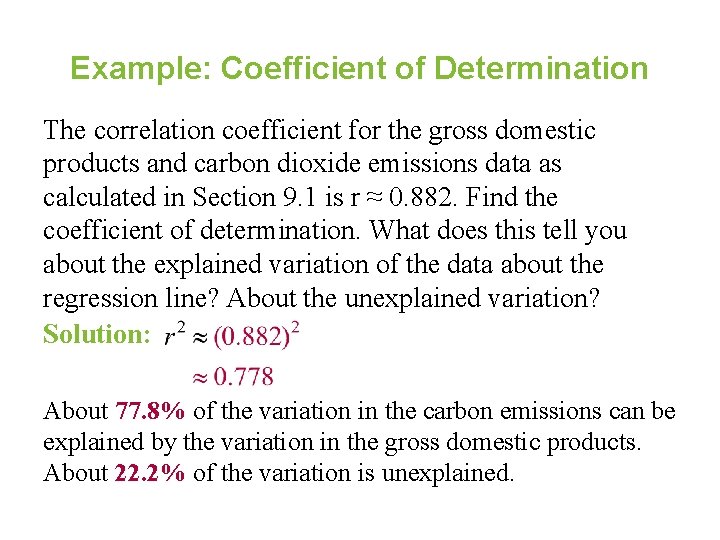
Coefficient of Determination Coefficient of determination • The ratio of the explained variation to the total variation. • Denoted by r 2
Example: Coefficient of Determination The correlation coefficient for the gross domestic products and carbon dioxide emissions data as calculated in Section 9. 1 is r ≈ 0. 882. Find the coefficient of determination. What does this tell you about the explained variation of the data about the regression line? About the unexplained variation? Solution: About 77. 8% of the variation in the carbon emissions can be explained by the variation in the gross domestic products. About 22. 2% of the variation is unexplained.
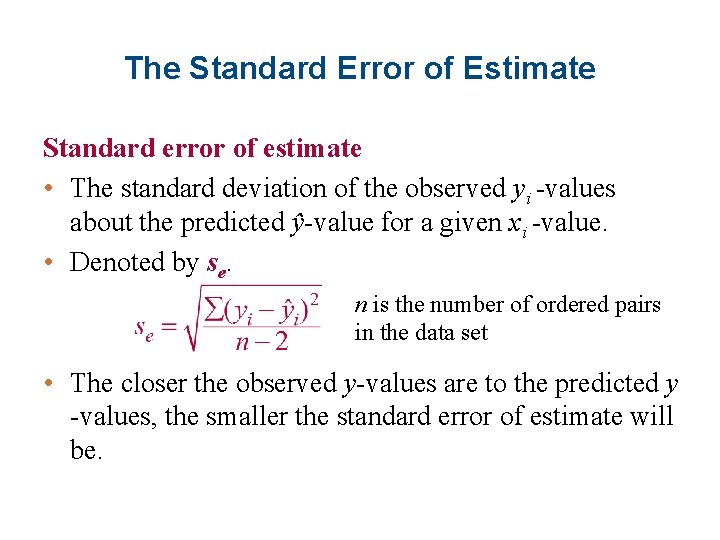
The Standard Error of Estimate Standard error of estimate • The standard deviation of the observed yi -values about the predicted ŷ-value for a given xi -value. • Denoted by se. n is the number of ordered pairs in the data set • The closer the observed y-values are to the predicted y -values, the smaller the standard error of estimate will be.
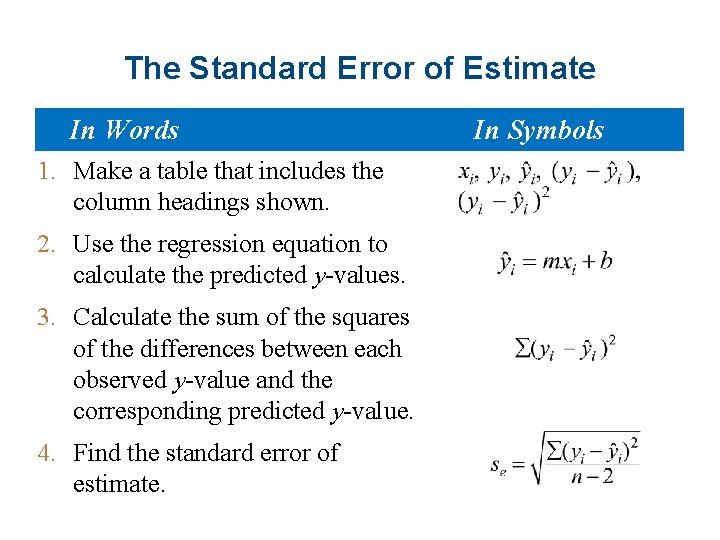
The Standard Error of Estimate In Words 1. Make a table that includes the column headings shown. 2. Use the regression equation to calculate the predicted y-values. 3. Calculate the sum of the squares of the differences between each observed y-value and the corresponding predicted y-value. 4. Find the standard error of estimate. In Symbols
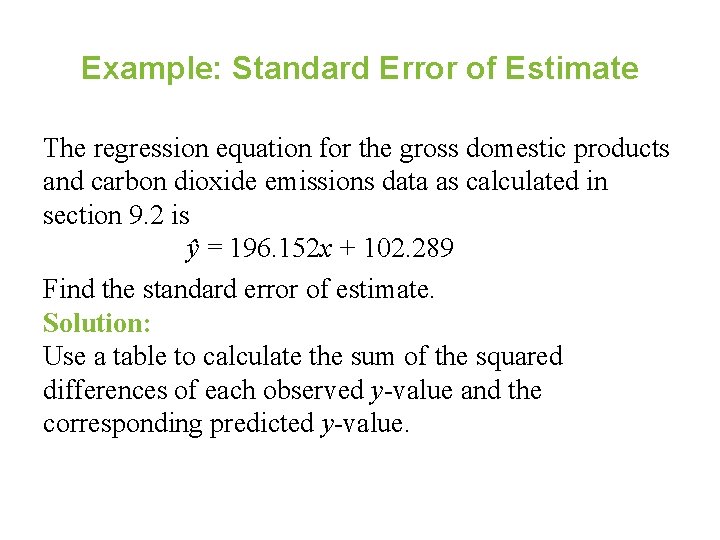
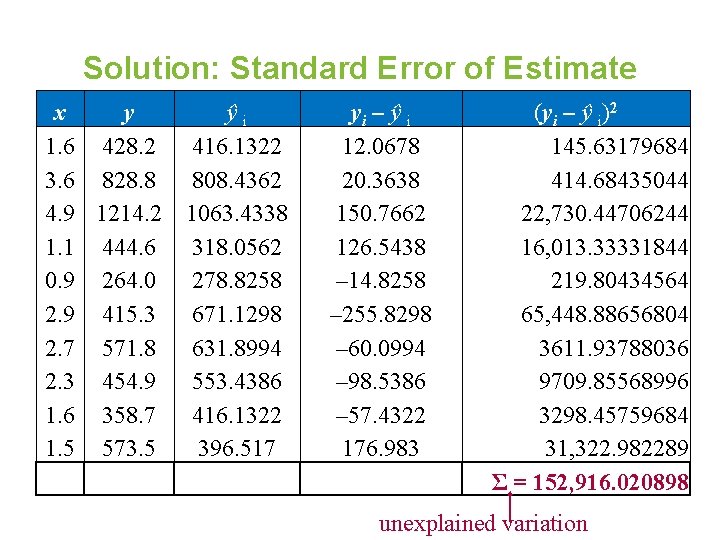
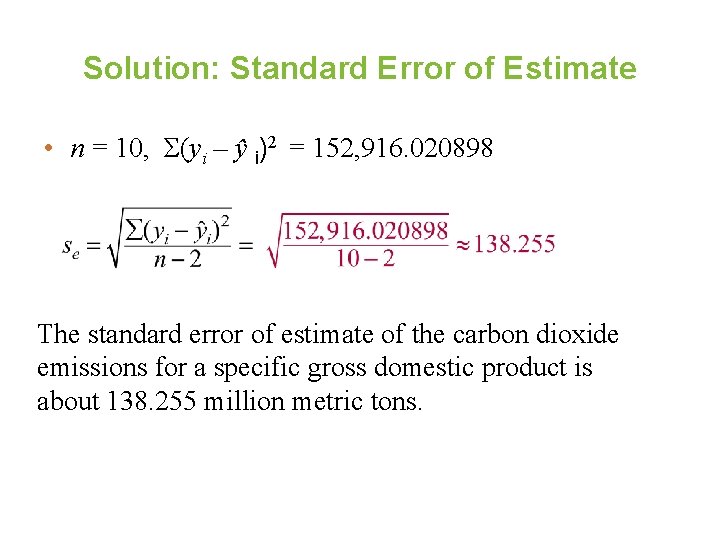
Example: Standard Error of Estimate The regression equation for the gross domestic products and carbon dioxide emissions data as calculated in section 9. 2 is ŷ = 196. 152 x + 102. 289 Find the standard error of estimate. Solution: Use a table to calculate the sum of the squared differences of each observed y-value and the corresponding predicted y-value.
Solution: Standard Error of Estimate x y 1. 6 428. 2 3. 6 828. 8 4. 9 1214. 2 1. 1 444. 6 0. 9 264. 0 2. 9 415. 3 2. 7 571. 8 2. 3 454. 9 1. 6 358. 7 1. 5 573. 5 ŷi 416. 1322 808. 4362 1063. 4338 318. 0562 278. 8258 671. 1298 631. 8994 553. 4386 416. 1322 396. 517 yi – ŷ i 12. 0678 20. 3638 150. 7662 126. 5438 – 14. 8258 – 255. 8298 – 60. 0994 – 98. 5386 – 57. 4322 176. 983 (yi – ŷ i)2 145. 63179684 414. 68435044 22, 730. 44706244 16, 013. 33331844 219. 80434564 65, 448. 88656804 3611. 93788036 9709. 85568996 3298. 45759684 31, 322. 982289 Σ = 152, 916. 020898 unexplained variation
Solution: Standard Error of Estimate • n = 10, Σ(yi – ŷ i)2 = 152, 916. 020898 The standard error of estimate of the carbon dioxide emissions for a specific gross domestic product is about 138. 255 million metric tons.
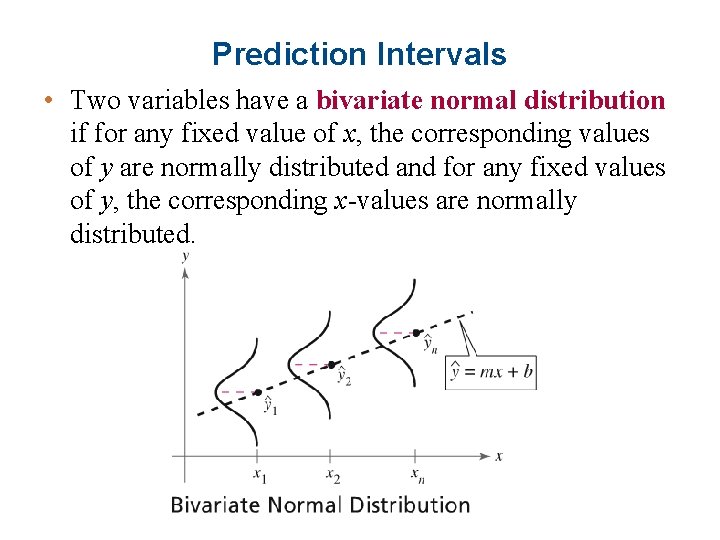
Prediction Intervals • Two variables have a bivariate normal distribution if for any fixed value of x, the corresponding values of y are normally distributed and for any fixed values of y, the corresponding x-values are normally distributed.
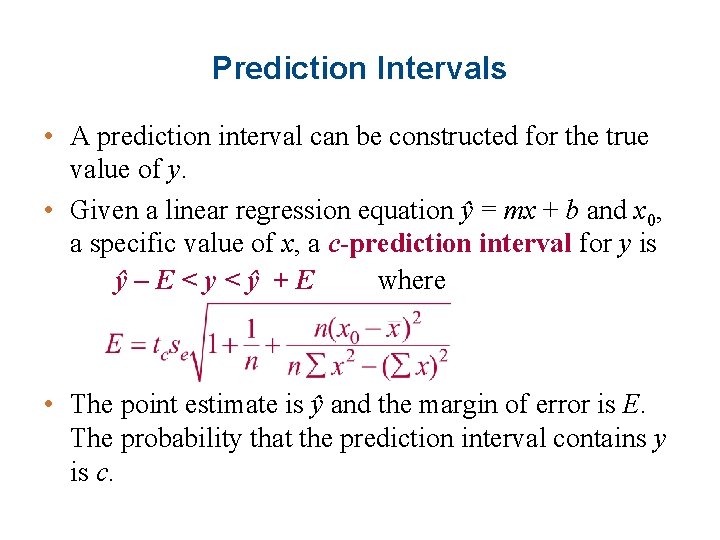
Prediction Intervals • A prediction interval can be constructed for the true value of y. • Given a linear regression equation ŷ = mx + b and x 0, a specific value of x, a c-prediction interval for y is ŷ–E<y<ŷ +E where • The point estimate is ŷ and the margin of error is E. The probability that the prediction interval contains y is c.
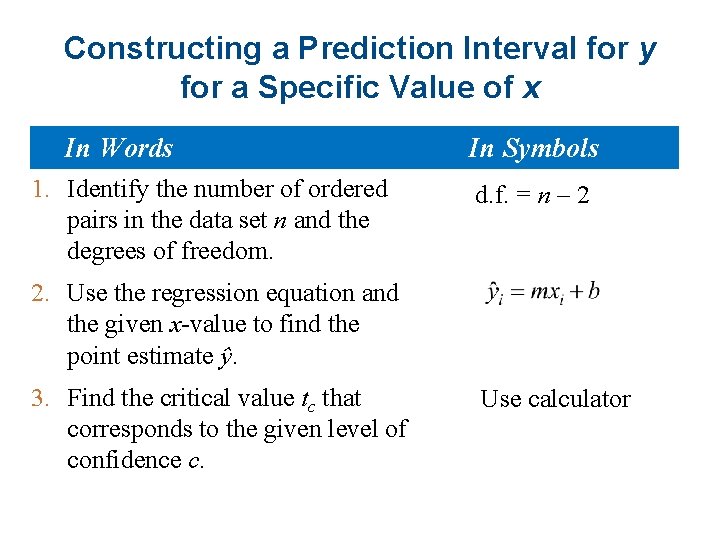
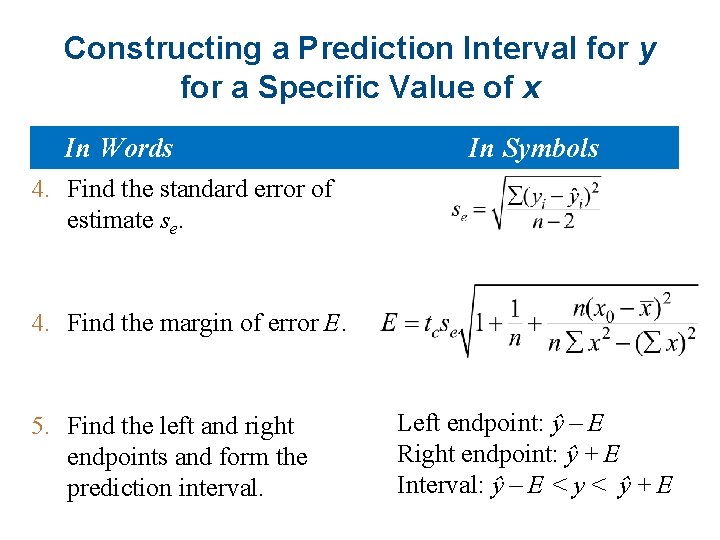
Constructing a Prediction Interval for y for a Specific Value of x In Words 1. Identify the number of ordered pairs in the data set n and the degrees of freedom. In Symbols d. f. = n – 2 2. Use the regression equation and the given x-value to find the point estimate ŷ. 3. Find the critical value tc that corresponds to the given level of confidence c. Use calculator
Constructing a Prediction Interval for y for a Specific Value of x In Words In Symbols 4. Find the standard error of estimate se. 4. Find the margin of error E. 5. Find the left and right endpoints and form the prediction interval. Left endpoint: ŷ – E Right endpoint: ŷ + E Interval: ŷ – E < y < ŷ + E
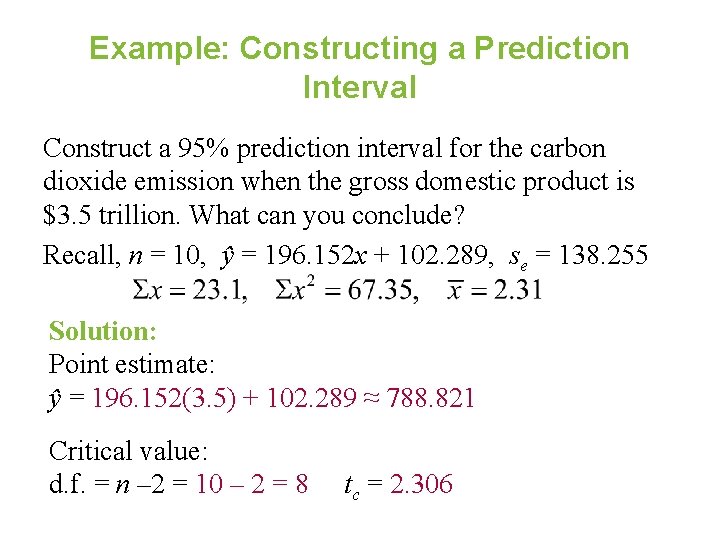
Example: Constructing a Prediction Interval Construct a 95% prediction interval for the carbon dioxide emission when the gross domestic product is $3. 5 trillion. What can you conclude? Recall, n = 10, ŷ = 196. 152 x + 102. 289, se = 138. 255 Solution: Point estimate: ŷ = 196. 152(3. 5) + 102. 289 ≈ 788. 821 Critical value: d. f. = n – 2 = 10 – 2 = 8 tc = 2. 306
Solution: Constructing a Prediction Interval Left Endpoint: ŷ – E 788. 821 – 349. 424 = 439. 397 Right Endpoint: ŷ + E 788. 821 + 349. 424 = 1138. 245 439. 397 < y < 1138. 245 You can be 95% confident that when the gross domestic product is $3. 5 trillion, the carbon dioxide emissions will be between 439. 397 and 1138. 245 million metric tons.
Multiple Regression Equation • In many instances, a better prediction can be found for a dependent (response) variable by using more than one independent (explanatory) variable. • For example, a more accurate prediction for the carbon dioxide emissions discussed in previous sections might be made by considering the number of cars as well as the gross domestic product.
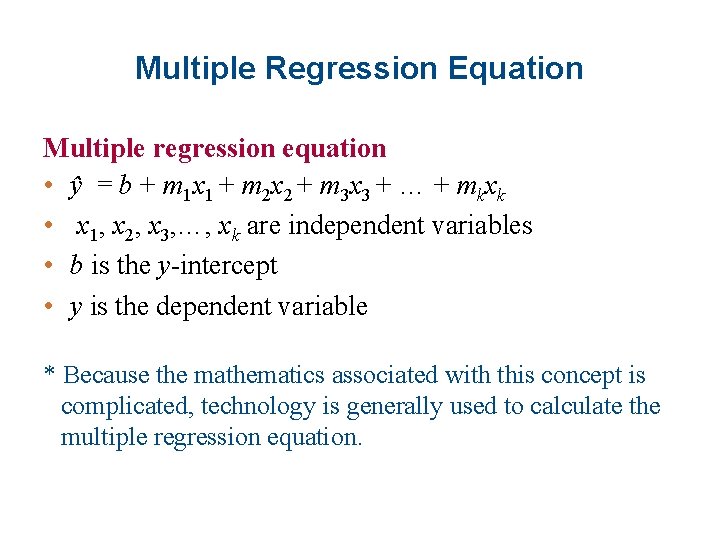
Multiple Regression Equation Multiple regression equation • ŷ = b + m 1 x 1 + m 2 x 2 + m 3 x 3 + … + mkxk • x 1, x 2, x 3, …, xk are independent variables • b is the y-intercept • y is the dependent variable * Because the mathematics associated with this concept is complicated, technology is generally used to calculate the multiple regression equation.