
10 2 const Constant Objects and const Member
10. 2 const (Constant) Objects and const Member Functions 1 • Principle of least privilege – One of the most fundamental principles of good software engineering – Applies to objects, too • const objects – Keyword const – Specifies that an object is not modifiable – Attempts to modify the object will result in compilation errors 2006 Pearson Education, Inc. All rights reserved.
10. 2 const (Constant) Objects and const Member Functions (Cont. ) 2 • const member functions – Only const member function can be called for const objects – Member functions declared const are not allowed to modify the object – A function is specified as const both in its prototype and in its definition – const declarations are not allowed for constructors and destructors 2006 Pearson Education, Inc. All rights reserved.
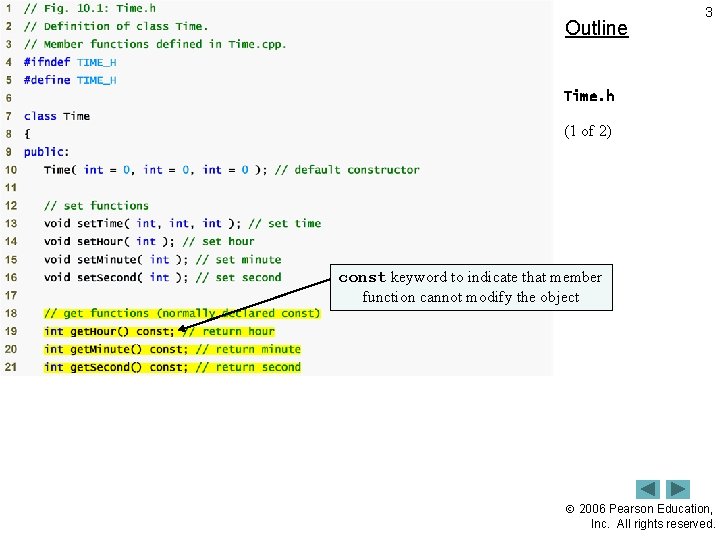
Outline 3 Time. h (1 of 2) const keyword to indicate that member function cannot modify the object 2006 Pearson Education, Inc. All rights reserved.
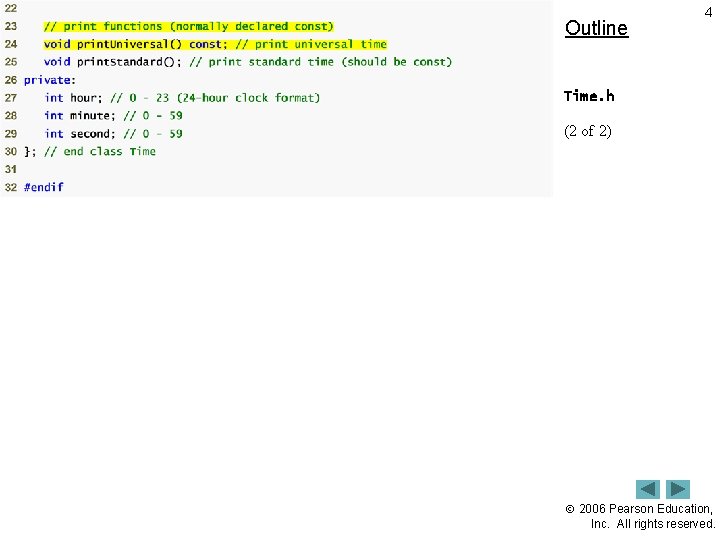
Outline 4 Time. h (2 of 2) 2006 Pearson Education, Inc. All rights reserved.
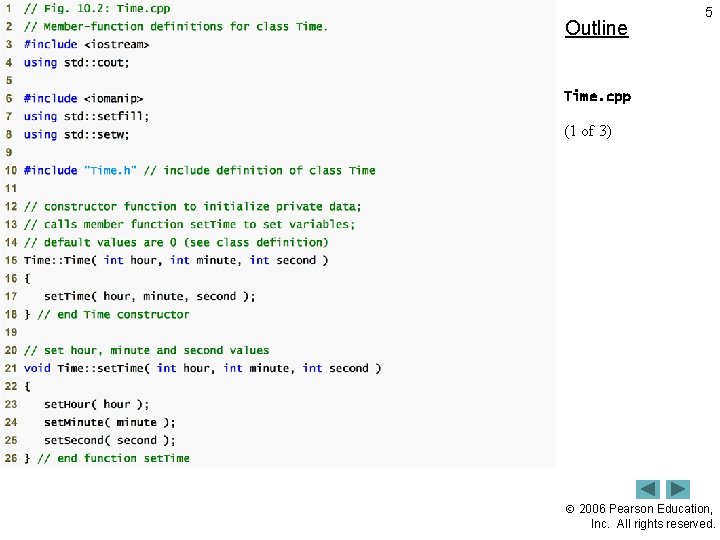
Outline 5 Time. cpp (1 of 3) 2006 Pearson Education, Inc. All rights reserved.
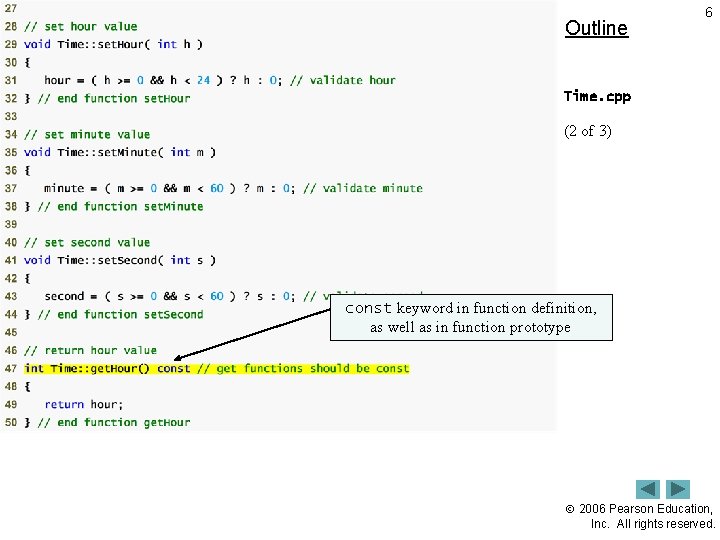
Outline 6 Time. cpp (2 of 3) const keyword in function definition, as well as in function prototype 2006 Pearson Education, Inc. All rights reserved.
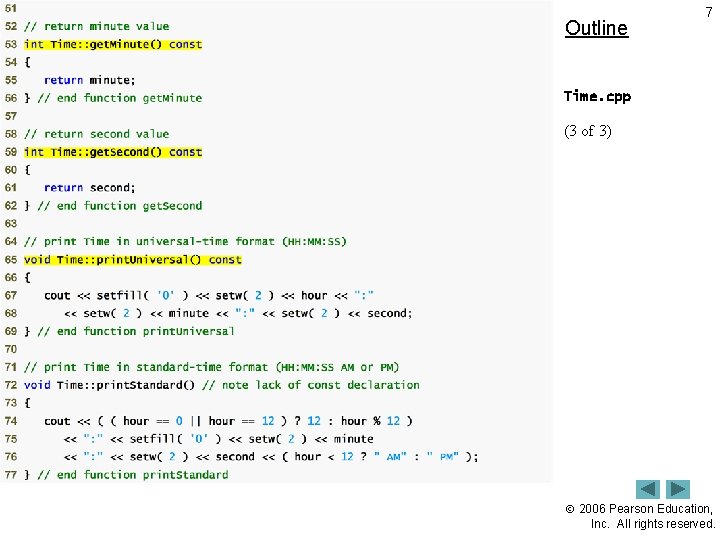
Outline 7 Time. cpp (3 of 3) 2006 Pearson Education, Inc. All rights reserved.
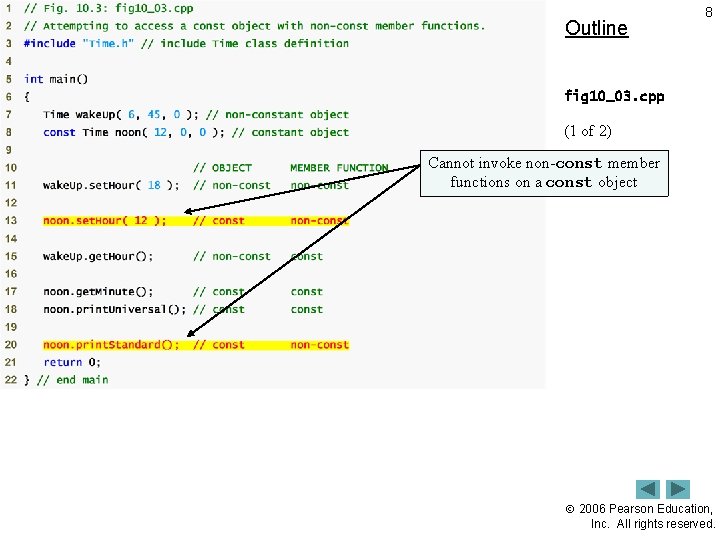
Outline 8 fig 10_03. cpp (1 of 2) Cannot invoke non-const member functions on a const object 2006 Pearson Education, Inc. All rights reserved.
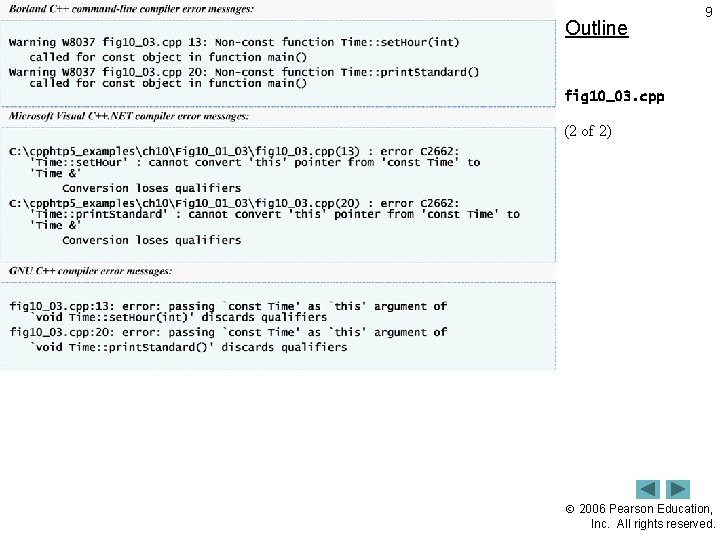
Outline 9 fig 10_03. cpp (2 of 2) 2006 Pearson Education, Inc. All rights reserved.
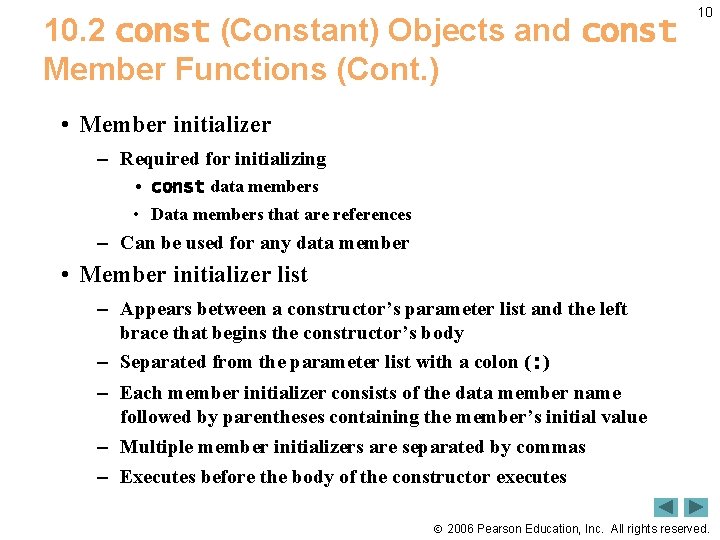
10. 2 const (Constant) Objects and const Member Functions (Cont. ) 10 • Member initializer – Required for initializing • const data members • Data members that are references – Can be used for any data member • Member initializer list – Appears between a constructor’s parameter list and the left brace that begins the constructor’s body – Separated from the parameter list with a colon (: ) – Each member initializer consists of the data member name followed by parentheses containing the member’s initial value – Multiple member initializers are separated by commas – Executes before the body of the constructor executes 2006 Pearson Education, Inc. All rights reserved.
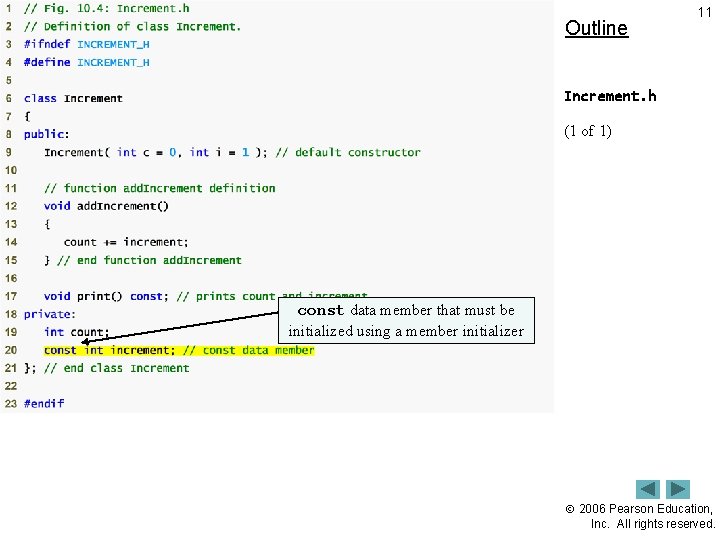
Outline 11 Increment. h (1 of 1) const data member that must be initialized using a member initializer 2006 Pearson Education, Inc. All rights reserved.
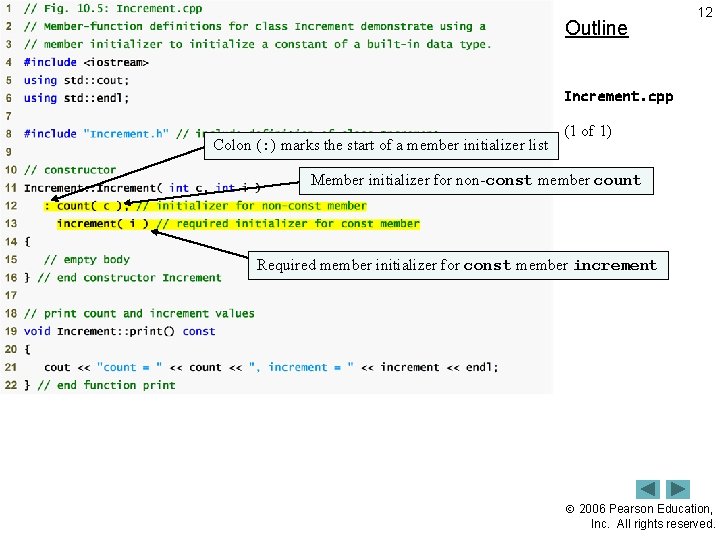
Outline 12 Increment. cpp Colon (: ) marks the start of a member initializer list (1 of 1) Member initializer for non-const member count Required member initializer for const member increment 2006 Pearson Education, Inc. All rights reserved.
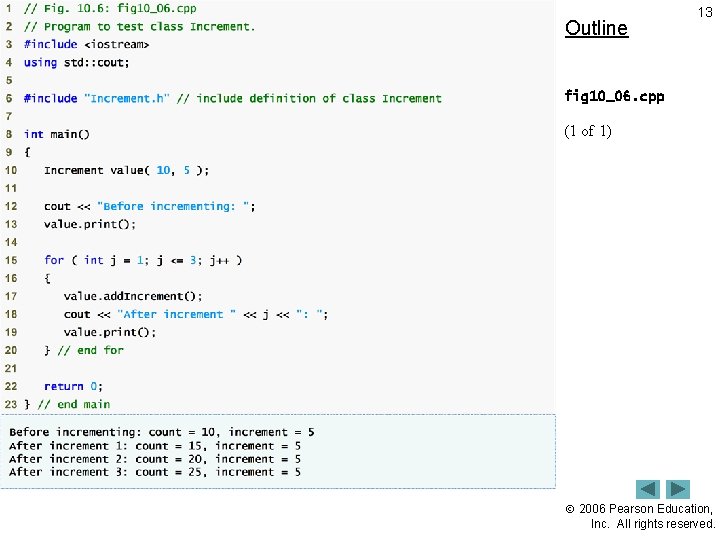
Outline 13 fig 10_06. cpp (1 of 1) 2006 Pearson Education, Inc. All rights reserved.
10. 3 Composition: Objects as Members of Classes 14 • Composition – Sometimes referred to as a has-a relationship – A class can have objects of other classes as members – A common form of software reusability is composition – Example • Alarm. Clock object with a Time object as a member 2006 Pearson Education, Inc. All rights reserved.
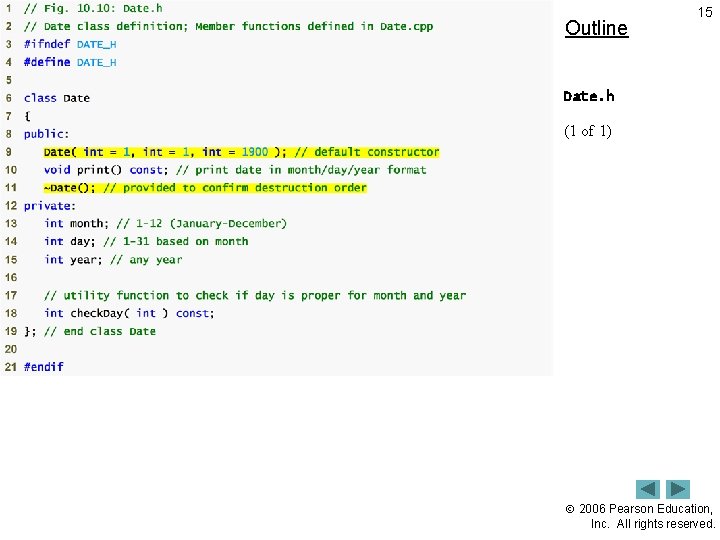
Outline 15 Date. h (1 of 1) 2006 Pearson Education, Inc. All rights reserved.
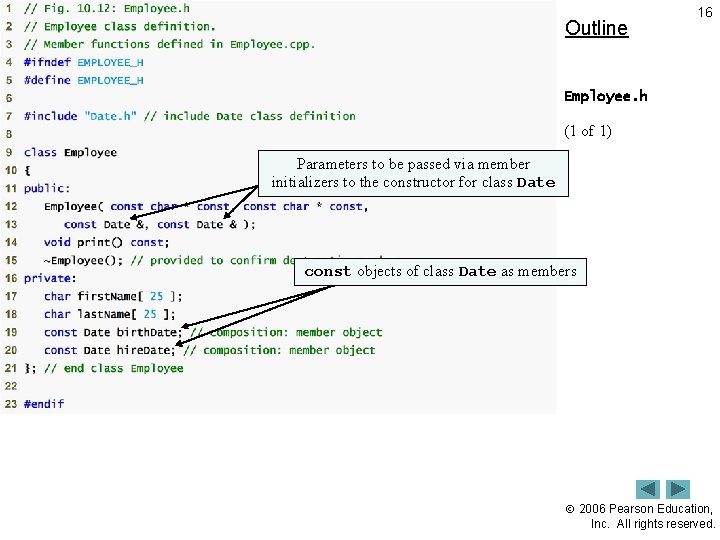
Outline 16 Employee. h (1 of 1) Parameters to be passed via member initializers to the constructor for class Date const objects of class Date as members 2006 Pearson Education, Inc. All rights reserved.
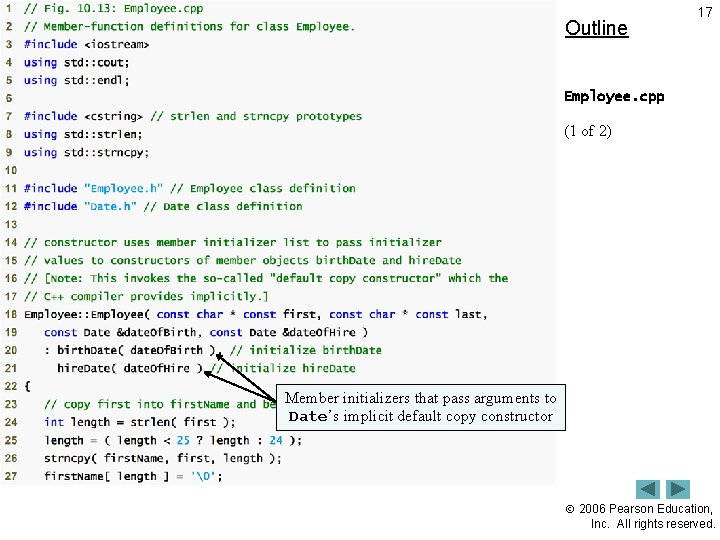
Outline 17 Employee. cpp (1 of 2) Member initializers that pass arguments to Date’s implicit default copy constructor 2006 Pearson Education, Inc. All rights reserved.
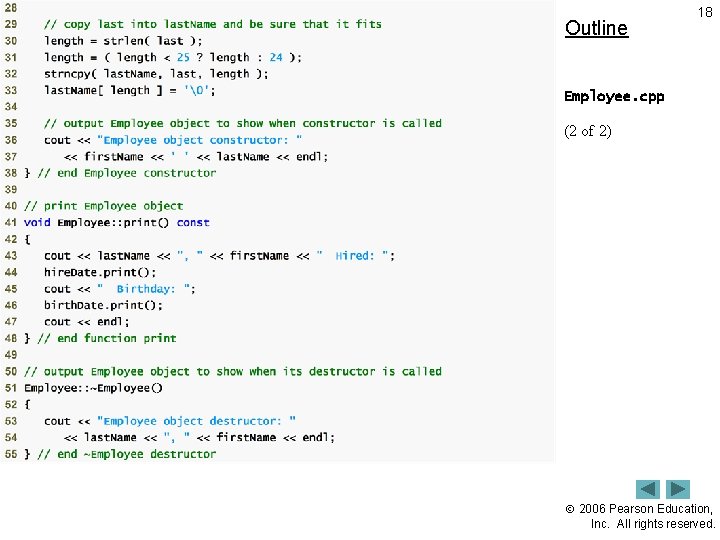
Outline 18 Employee. cpp (2 of 2) 2006 Pearson Education, Inc. All rights reserved.
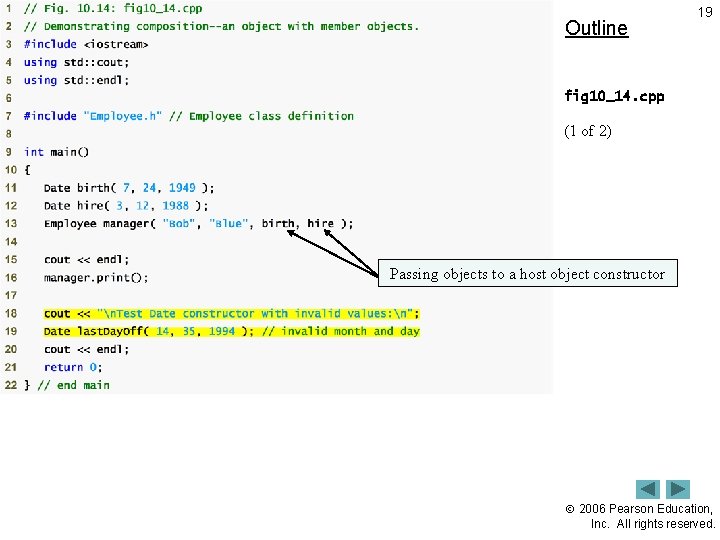
Outline 19 fig 10_14. cpp (1 of 2) Passing objects to a host object constructor 2006 Pearson Education, Inc. All rights reserved.
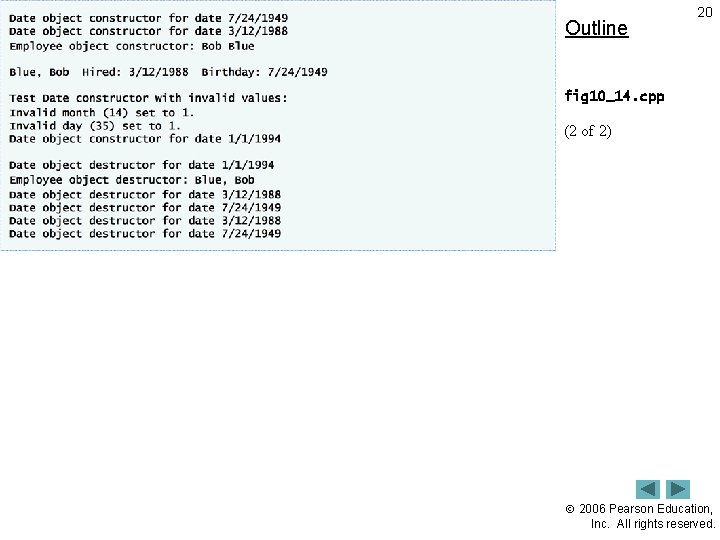
Outline 20 fig 10_14. cpp (2 of 2) 2006 Pearson Education, Inc. All rights reserved.
10. 4 friend Functions and friend Classes 21 • friend function of a class – Defined outside that class’s scope • Not a member function of that class – Yet has the right to access the non-public (and public) members of that class – Standalone functions or entire classes may be declared to be friends of a class – Can enhance performance – Often appropriate when a member function cannot be used for certain operations 2006 Pearson Education, Inc. All rights reserved.
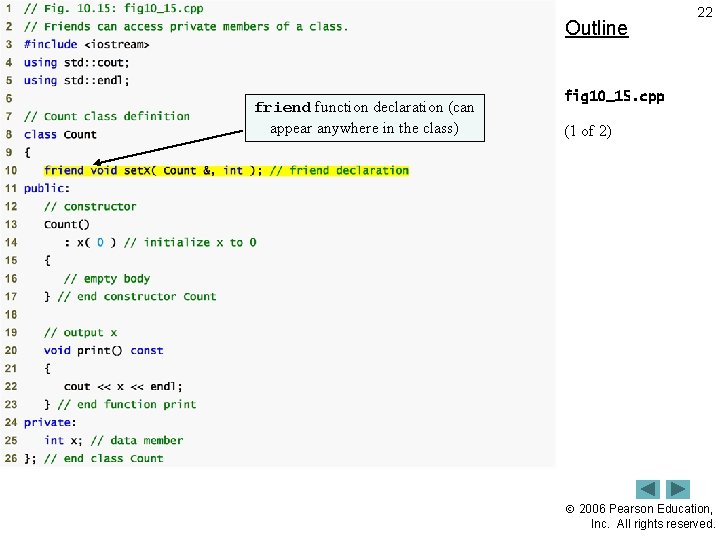
Outline friend function declaration (can appear anywhere in the class) 22 fig 10_15. cpp (1 of 2) 2006 Pearson Education, Inc. All rights reserved.
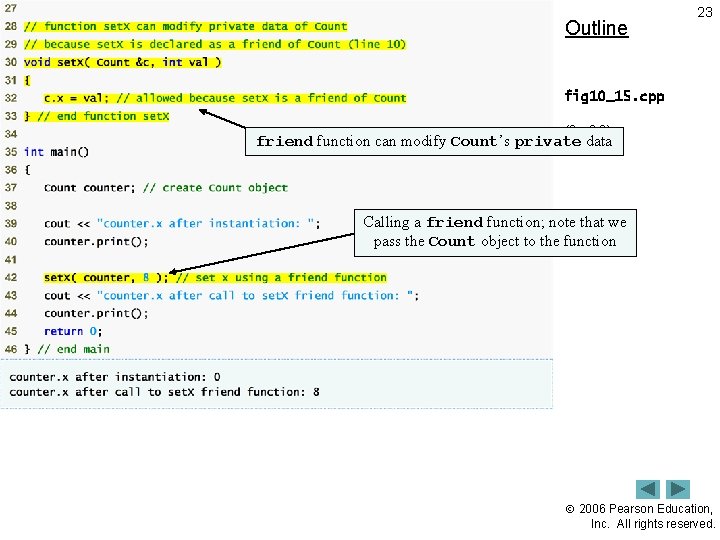
Outline 23 fig 10_15. cpp (2 of 2) friend function can modify Count’s private data Calling a friend function; note that we pass the Count object to the function 2006 Pearson Education, Inc. All rights reserved.
24 10. 5 Using the this Pointer • Member functions know which object’s data members to manipulate – Every object has access to its own address through a pointer called this (a C++ keyword) – An object’s this pointer is not part of the object itself – The this pointer is passed (by the compiler) as an implicit argument to each of the object’s non-static member functions • Objects use this pointer implicitly or explicitly – Implicitly when accessing members directly – Explicitly when using keyword this – Type of the this pointer depends on the type of the object and whether the executing member function is declared const 2006 Pearson Education, Inc. All rights reserved.
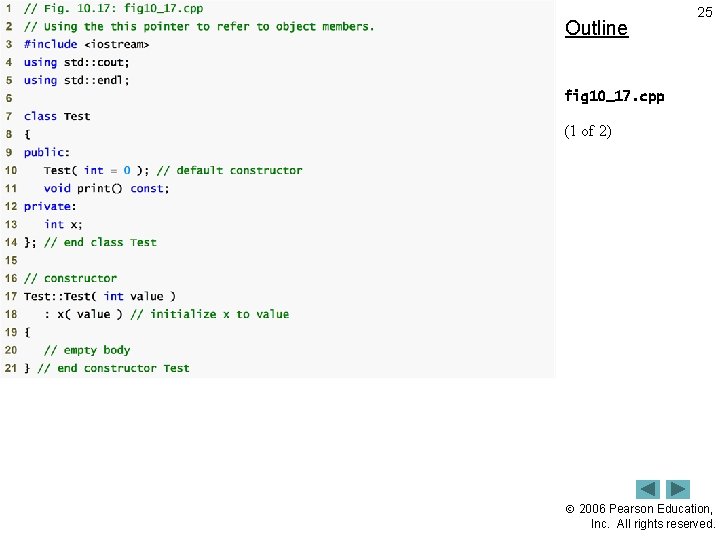
Outline 25 fig 10_17. cpp (1 of 2) 2006 Pearson Education, Inc. All rights reserved.
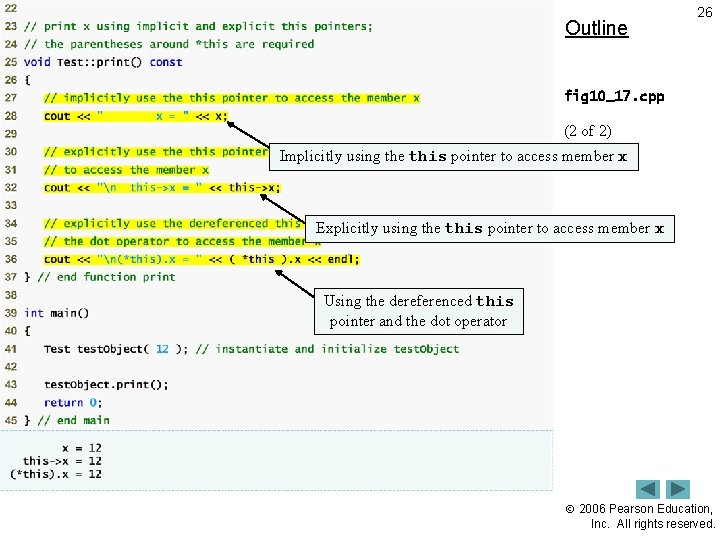
Outline 26 fig 10_17. cpp (2 of 2) Implicitly using the this pointer to access member x Explicitly using the this pointer to access member x Using the dereferenced this pointer and the dot operator 2006 Pearson Education, Inc. All rights reserved.
27 10. 5 Using the this Pointer (Cont. ) • Cascaded member-function calls – Multiple functions are invoked in the same statement – Enabled by member functions returning the dereferenced this pointer – Example • t. set. Minute( 30 ). set. Second( 22 ); – Calls t. set. Minute( 30 ); – Then calls t. set. Second( 22 ); 2006 Pearson Education, Inc. All rights reserved.
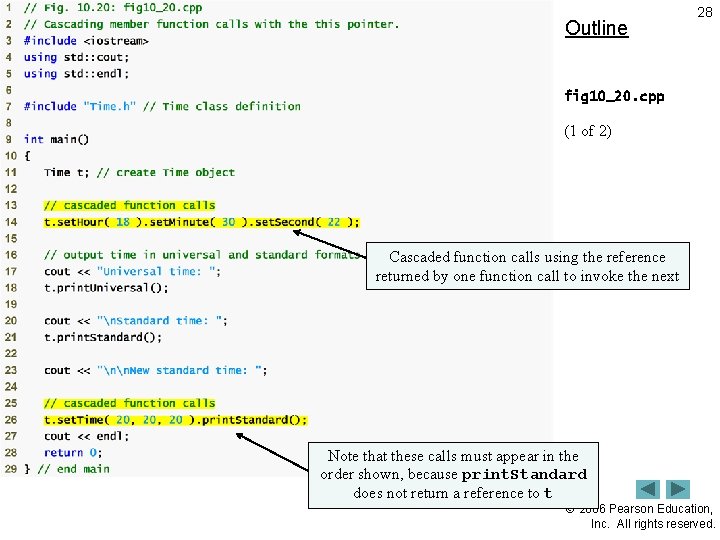
Outline 28 fig 10_20. cpp (1 of 2) Cascaded function calls using the reference returned by one function call to invoke the next Note that these calls must appear in the order shown, because print. Standard does not return a reference to t 2006 Pearson Education, Inc. All rights reserved.
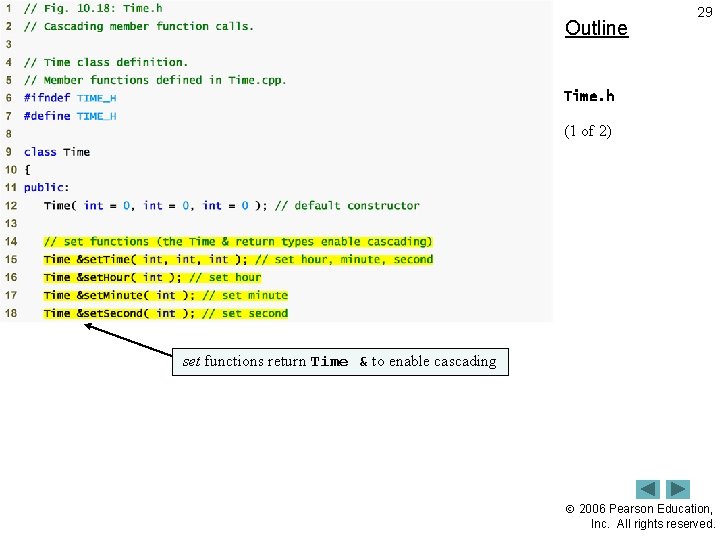
Outline 29 Time. h (1 of 2) set functions return Time & to enable cascading 2006 Pearson Education, Inc. All rights reserved.
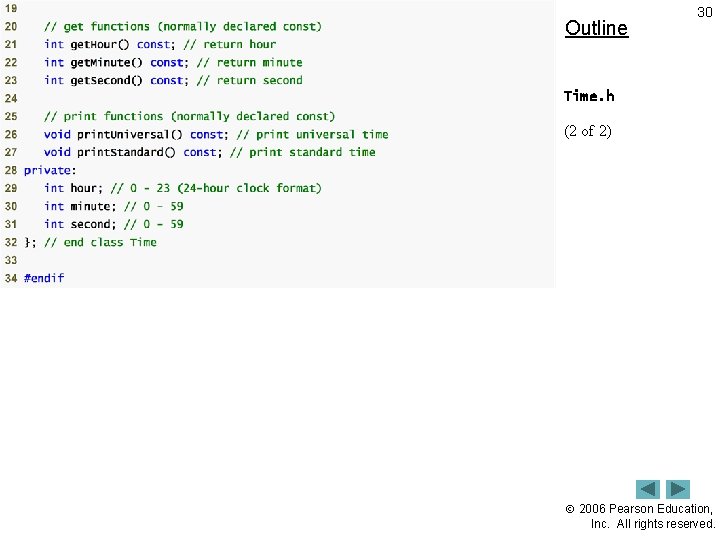
Outline 30 Time. h (2 of 2) 2006 Pearson Education, Inc. All rights reserved.
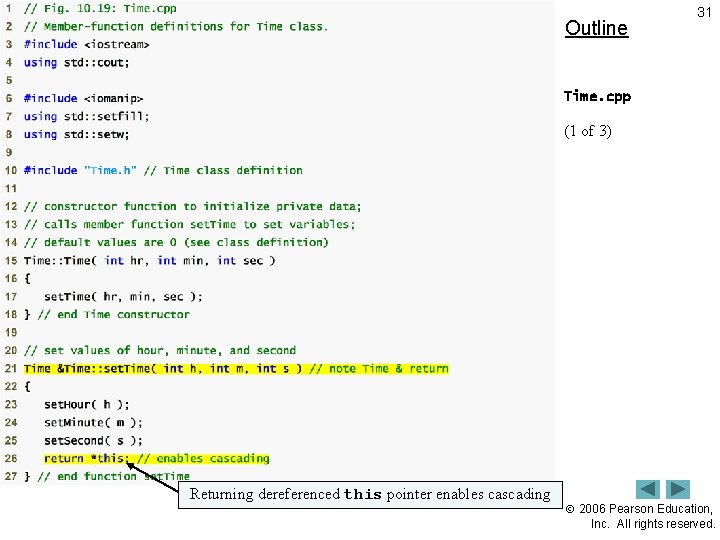
Outline 31 Time. cpp (1 of 3) Returning dereferenced this pointer enables cascading 2006 Pearson Education, Inc. All rights reserved.
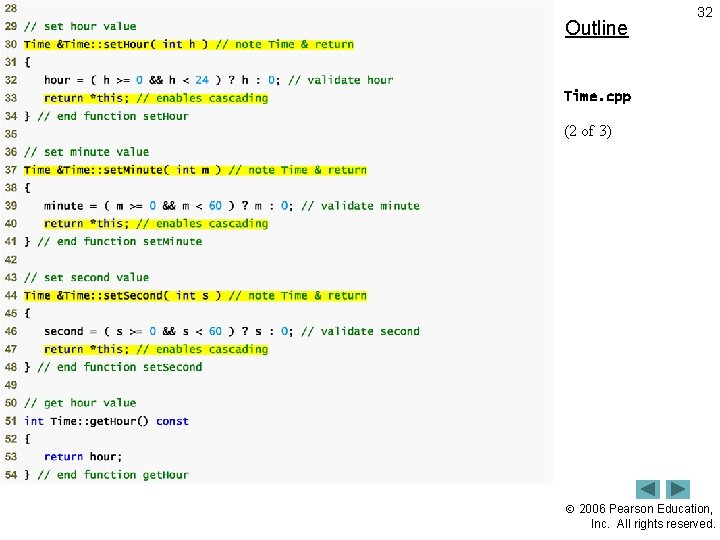
Outline 32 Time. cpp (2 of 3) 2006 Pearson Education, Inc. All rights reserved.
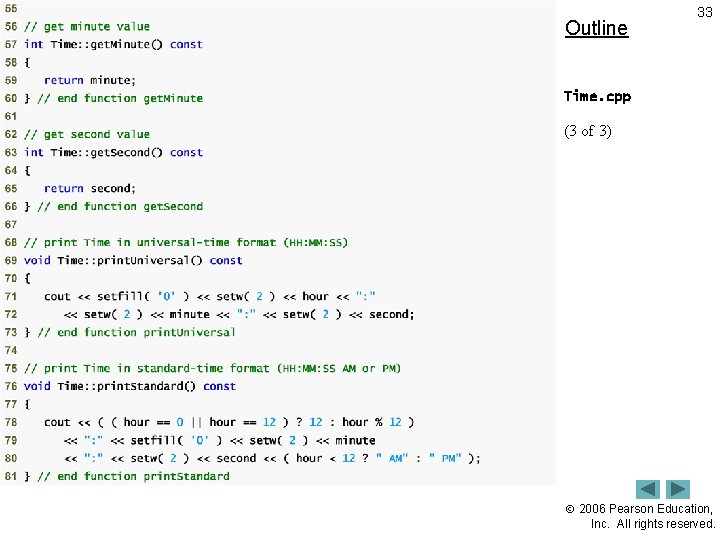
Outline 33 Time. cpp (3 of 3) 2006 Pearson Education, Inc. All rights reserved.
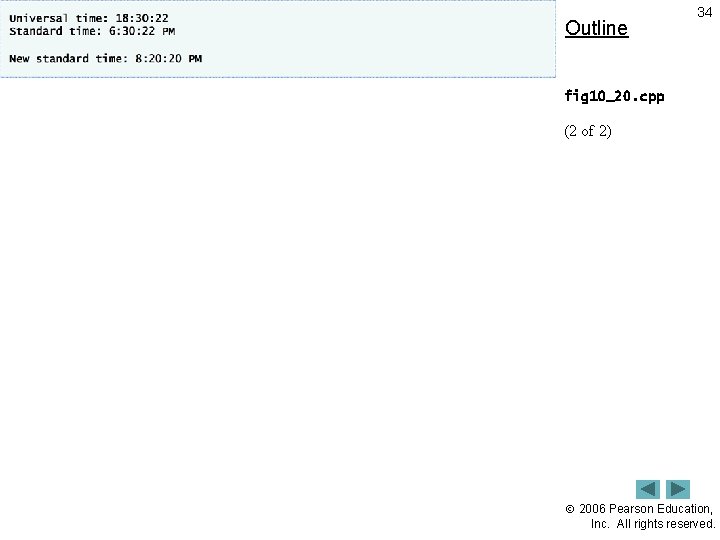
Outline 34 fig 10_20. cpp (2 of 2) 2006 Pearson Education, Inc. All rights reserved.
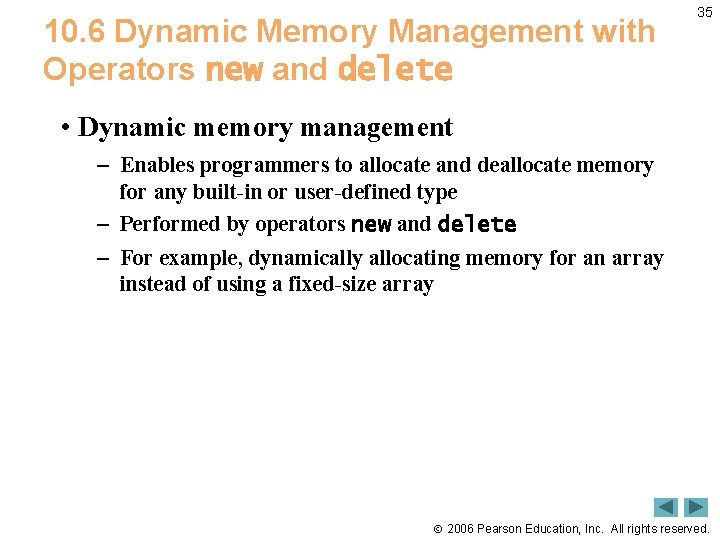
10. 6 Dynamic Memory Management with Operators new and delete 35 • Dynamic memory management – Enables programmers to allocate and deallocate memory for any built-in or user-defined type – Performed by operators new and delete – For example, dynamically allocating memory for an array instead of using a fixed-size array 2006 Pearson Education, Inc. All rights reserved.
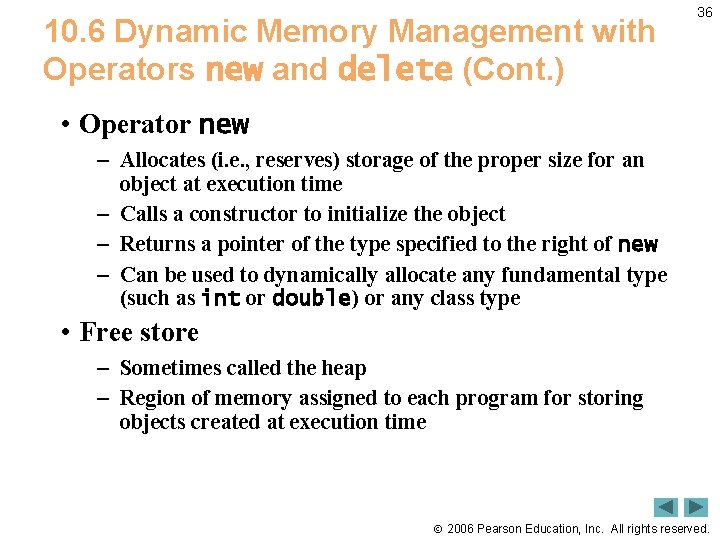
10. 6 Dynamic Memory Management with Operators new and delete (Cont. ) 36 • Operator new – Allocates (i. e. , reserves) storage of the proper size for an object at execution time – Calls a constructor to initialize the object – Returns a pointer of the type specified to the right of new – Can be used to dynamically allocate any fundamental type (such as int or double) or any class type • Free store – Sometimes called the heap – Region of memory assigned to each program for storing objects created at execution time 2006 Pearson Education, Inc. All rights reserved.
10. 6 Dynamic Memory Management with Operators new and delete (Cont. ) 37 • Operator delete – – Destroys a dynamically allocated object Calls the destructor for the object Deallocates (i. e. , releases) memory from the free store The memory can then be reused by the system to allocate other objects 2006 Pearson Education, Inc. All rights reserved.
10. 6 Dynamic Memory Management with Operators new and delete (Cont. ) 38 • Initializing an object allocated by new – Initializer for a newly created fundamental-type variable • Example – double *ptr = new double( 3. 14159 ); – Specify a comma-separated list of arguments to the constructor of an object • Example – Time *time. Ptr = new Time( 12, 45, 0 ); 2006 Pearson Education, Inc. All rights reserved.
39 Common Programming Error 10. 8 Not releasing dynamically allocated memory when it is no longer needed can cause the system to run out of memory prematurely. This is sometimes called a “memory leak. ” 2006 Pearson Education, Inc. All rights reserved.
10. 6 Dynamic Memory Management with Operators new and delete (Cont. ) 40 • new operator can be used to allocate arrays dynamically – Dynamically allocate a 10 -element integer array: int *grades. Array = new int[ 10 ]; – Size of a dynamically allocated array • Specified using any integral expression that can be evaluated at execution time 2006 Pearson Education, Inc. All rights reserved.
10. 6 Dynamic Memory Management with Operators new and delete (Cont. ) 41 • Delete a dynamically allocated array: delete [] grades. Array; – This deallocates the array to which grades. Array points – If the pointer points to an array of objects • First calls the destructor for every object in the array • Then deallocates the memory – If the statement did not include the square brackets ([]) and grades. Array pointed to an array of objects • Only the first object in the array would have a destructor call 2006 Pearson Education, Inc. All rights reserved.
![42 Common Programming Error 10. 9 Using delete instead of delete [] for arrays](http://slidetodoc.com/presentation_image_h2/085aff4f918a95ebabfa783aad04def1/image-42.jpg "42 Common Programming Error 10. 9 Using delete instead of delete [] for arrays")
42 Common Programming Error 10. 9 Using delete instead of delete [] for arrays of objects can lead to runtime logic errors. To ensure that every object in the array receives a destructor call, always delete memory allocated as an array with operator delete []. Similarly, always delete memory allocated as an individual element with operator delete. 2006 Pearson Education, Inc. All rights reserved.
43 10. 7 static Class Members • static data member – Only one copy of a variable shared by all objects of a class • “Class-wide” information • A property of the class shared by all instances, not a property of a specific object of the class – Declaration begins with keyword static 2006 Pearson Education, Inc. All rights reserved.
44 10. 7 static Class Members (Cont. ) • static data member (Cont. ) – Example • Video game with Martians and other space creatures – Each Martian needs to know the martian. Count – martian. Count should be static class-wide data – Every Martian can access martian. Count as if it were a data member of that Martian – Only one copy of martian. Count exists – May seem like global variables but have class scope – Can be declared public, private or protected 2006 Pearson Education, Inc. All rights reserved.
45 10. 7 static Class Members (Cont. ) • static data member (Cont. ) – Fundamental-type static data members • Initialized by default to 0 • If you want a different initial value, a static data member can be initialized once (and only once) – A const static data member of int or enum type • Can be initialized in its declaration in the class definition – All other static data members • Must be defined at file scope (i. e. , outside the body of the class definition) • Can be initialized only in those definitions – static data members of class types (i. e. , static member objects) that have default constructors • Need not be initialized because their default constructors will be called 2006 Pearson Education, Inc. All rights reserved.
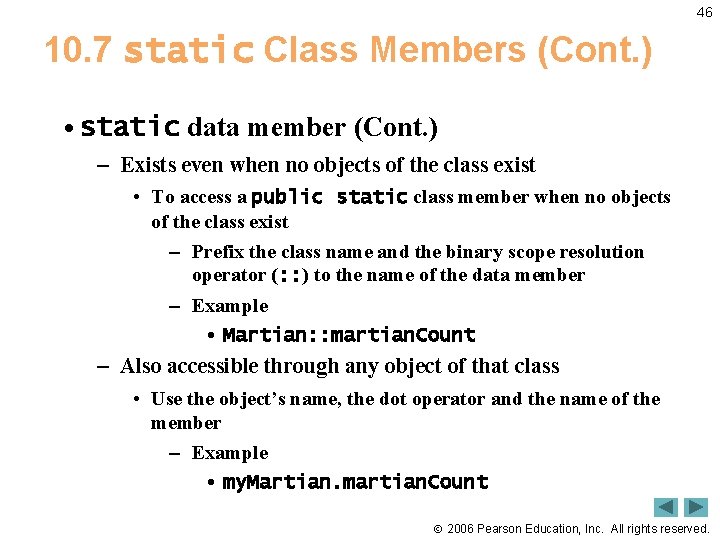
46 10. 7 static Class Members (Cont. ) • static data member (Cont. ) – Exists even when no objects of the class exist • To access a public static class member when no objects of the class exist – Prefix the class name and the binary scope resolution operator (: : ) to the name of the data member – Example • Martian: : martian. Count – Also accessible through any object of that class • Use the object’s name, the dot operator and the name of the member – Example • my. Martian. martian. Count 2006 Pearson Education, Inc. All rights reserved.
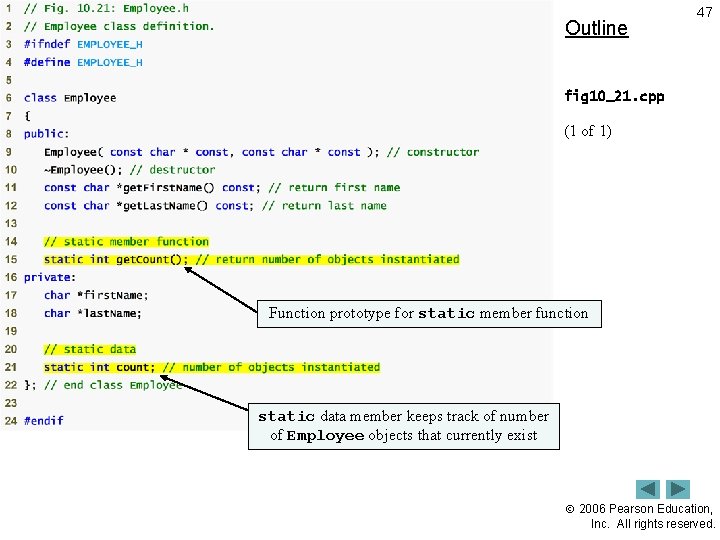
Outline 47 fig 10_21. cpp (1 of 1) Function prototype for static member function static data member keeps track of number of Employee objects that currently exist 2006 Pearson Education, Inc. All rights reserved.
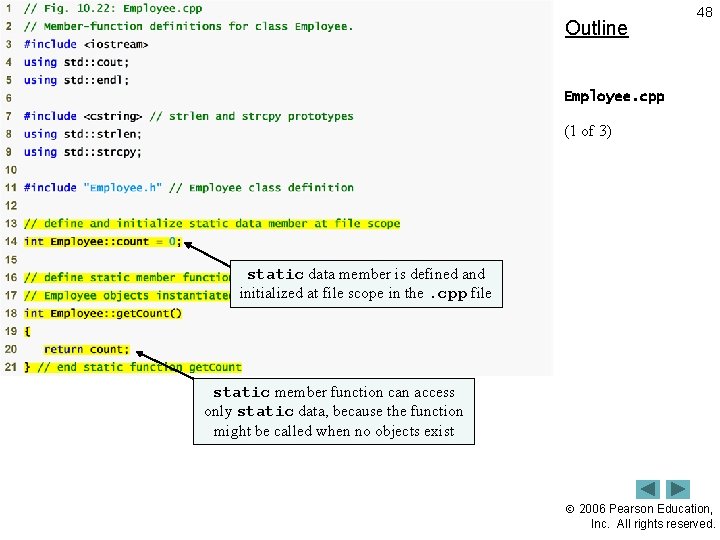
Outline 48 Employee. cpp (1 of 3) static data member is defined and initialized at file scope in the. cpp file static member function can access only static data, because the function might be called when no objects exist 2006 Pearson Education, Inc. All rights reserved.
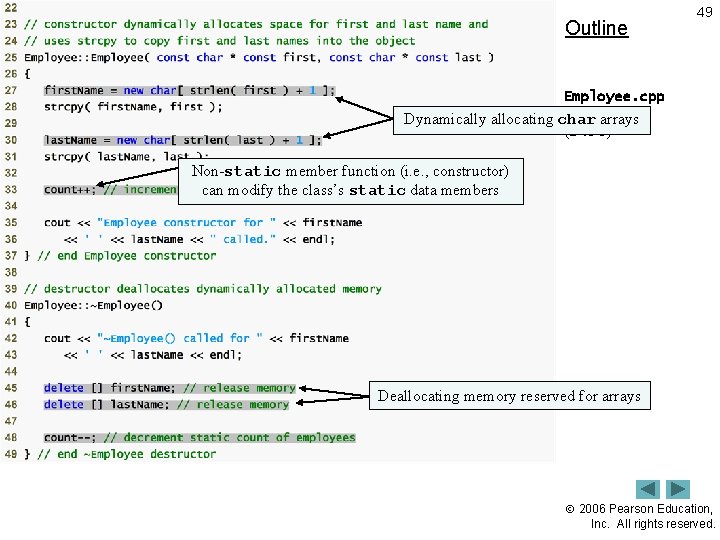
Outline 49 Employee. cpp Dynamically allocating char arrays (2 of 3) Non-static member function (i. e. , constructor) can modify the class’s static data members Deallocating memory reserved for arrays 2006 Pearson Education, Inc. All rights reserved.
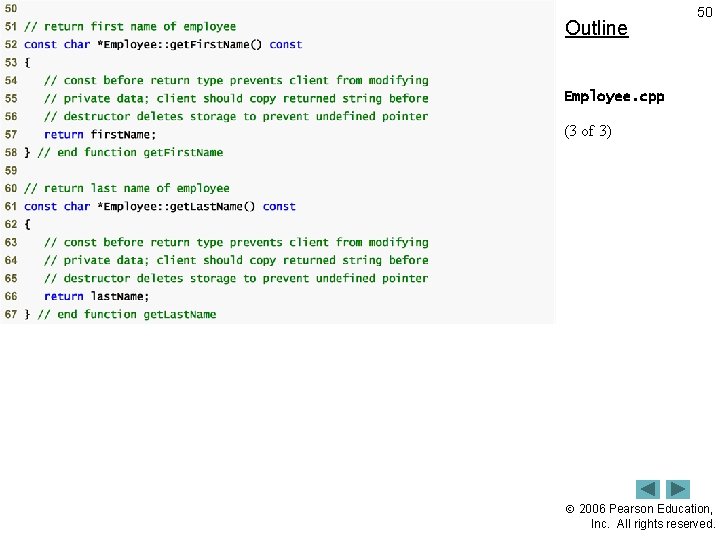
Outline 50 Employee. cpp (3 of 3) 2006 Pearson Education, Inc. All rights reserved.
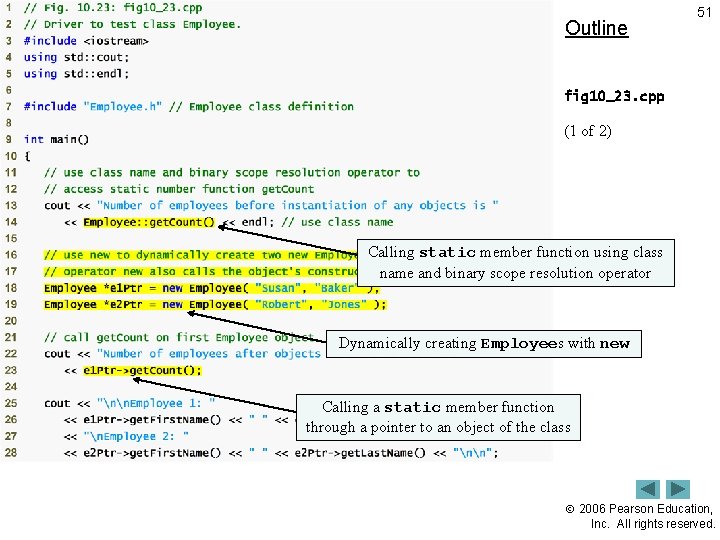
Outline 51 fig 10_23. cpp (1 of 2) Calling static member function using class name and binary scope resolution operator Dynamically creating Employees with new Calling a static member function through a pointer to an object of the class 2006 Pearson Education, Inc. All rights reserved.
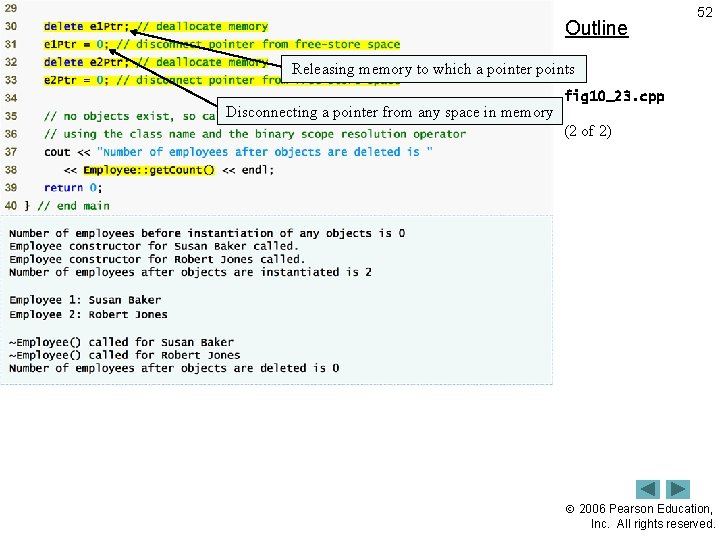
Outline 52 Releasing memory to which a pointer points Disconnecting a pointer from any space in memory fig 10_23. cpp (2 of 2) 2006 Pearson Education, Inc. All rights reserved.
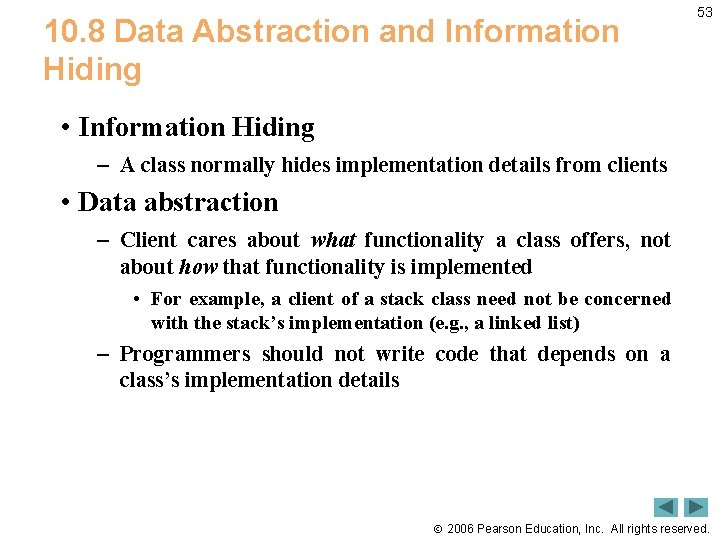
10. 8 Data Abstraction and Information Hiding 53 • Information Hiding – A class normally hides implementation details from clients • Data abstraction – Client cares about what functionality a class offers, not about how that functionality is implemented • For example, a client of a stack class need not be concerned with the stack’s implementation (e. g. , a linked list) – Programmers should not write code that depends on a class’s implementation details 2006 Pearson Education, Inc. All rights reserved.
10. 8 Data Abstraction and Information Hiding (Cont. ) 54 • Importance of data – Elevated in C++ and object-oriented community • Primary activities of object-oriented programming in C++ – Creation of types (i. e. , classes) – Expression of the interactions among objects of those types – Abstract data types (ADTs) • Improve the program development process 2006 Pearson Education, Inc. All rights reserved.
10. 8 Data Abstraction and Information Hiding (Cont. ) 55 • Abstract data types (ADTs) – Essentially ways of representing real-world notions to some satisfactory level of precision within a computer system – Types like int, double, char and others are all ADTs • e. g. , int is an abstract representation of an integer – Capture two notions: • Data representation • Operations that can be performed on the data – C++ classes implement ADTs and their services 2006 Pearson Education, Inc. All rights reserved.
56 10. 8. 1 Example: Array Abstract Data Type • Many array operations not built into C++ – e. g. , subscript range checking • Programmers can develop an array ADT as a class that is preferable to “raw” arrays – Can provide many helpful new capabilities • C++ Standard Library class template vector 2006 Pearson Education, Inc. All rights reserved.
57 Software Engineering Observation 10. 12 The programmer is able to create new types through the class mechanism. These new types can be designed to be used as conveniently as the built-in types. Thus, C++ is an extensible language. Although the language is easy to extend with these new types, the base language itself cannot be changed. 2006 Pearson Education, Inc. All rights reserved.
10. 8. 2 Example: String Abstract Data Type 58 • No string data type among C++’s built-in data types – C++ is an intentionally sparse language • Provides programmers with only the raw capabilities needed to build a broad range of systems • Designed to minimize performance burdens • Designed to include mechanisms for creating and implementing string abstract data types through classes – C++ Standard Library class string 2006 Pearson Education, Inc. All rights reserved.
10. 8. 3 Example: Queue Abstract Data Type 59 • Queue ADT – Items returned in first-in, first-out (FIFO) order • First item inserted in the queue is the first item removed from the queue – Hides an internal data representation that somehow keeps track of the items currently waiting in line – Good example of an abstract data type • Clients invoke enqueue operation to put things in the queue one at a time • Clients invoke dequeue operation to get those things back one at a time on demand – C++ Standard Library queue class 2006 Pearson Education, Inc. All rights reserved.
10. 9 Container Classes and Iterators (Cont. ) 60 • Iterator objects—or more simply iterators – Commonly associated with container classes – An object that “walks through” a collection, returning the next item (or performing some action on the next item) – A container class can have several iterators operating on it at once – Each iterator maintains its own “position” information 2006 Pearson Education, Inc. All rights reserved.
61 10. 10 Proxy Classes • Header files contain some portion of a class’s implementation and hints about others – For example, a class’s private members are listed in the class definition in a header file – Potentially exposes proprietary information to clients of the class 2006 Pearson Education, Inc. All rights reserved.
62 10. 10 Proxy Classes (Cont. ) • Proxy class – Hides even the private data of a class from clients – Knows only the public interface of your class – Enables the clients to use your class’s services without giving the client access to your class’s implementation details 2006 Pearson Education, Inc. All rights reserved.
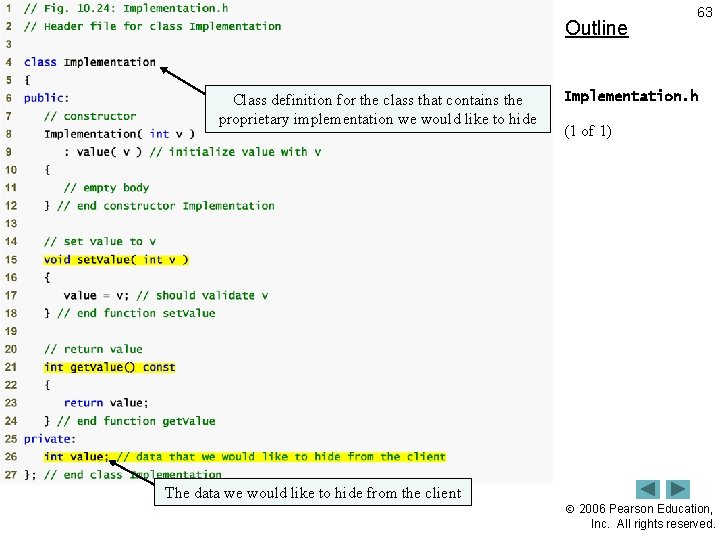
Outline Class definition for the class that contains the proprietary implementation we would like to hide 63 Implementation. h (1 of 1) The data we would like to hide from the client 2006 Pearson Education, Inc. All rights reserved.
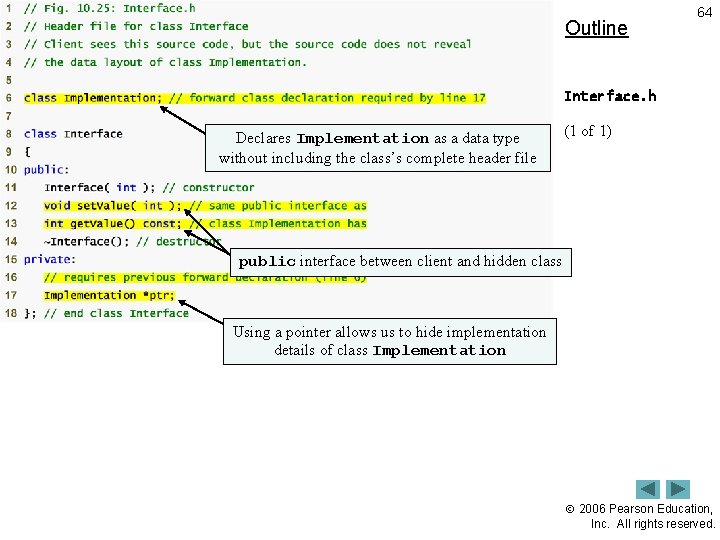
Outline 64 Interface. h Declares Implementation as a data type without including the class’s complete header file (1 of 1) public interface between client and hidden class Using a pointer allows us to hide implementation details of class Implementation 2006 Pearson Education, Inc. All rights reserved.
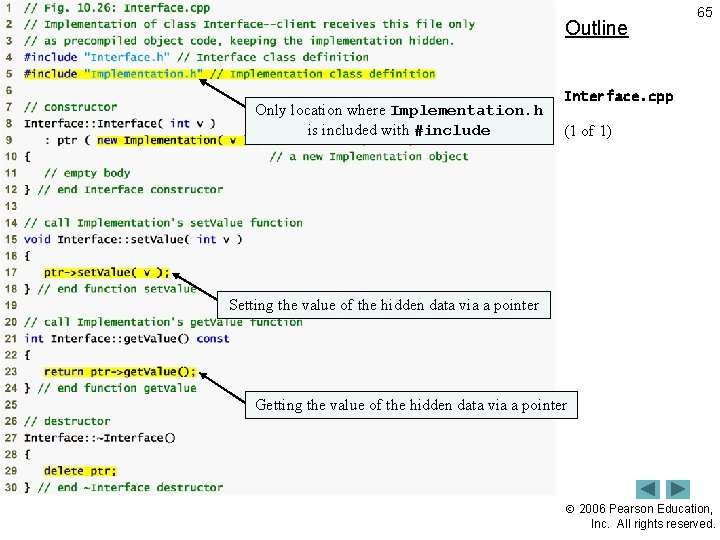
Outline Only location where Implementation. h is included with #include 65 Interface. cpp (1 of 1) Setting the value of the hidden data via a pointer Getting the value of the hidden data via a pointer 2006 Pearson Education, Inc. All rights reserved.
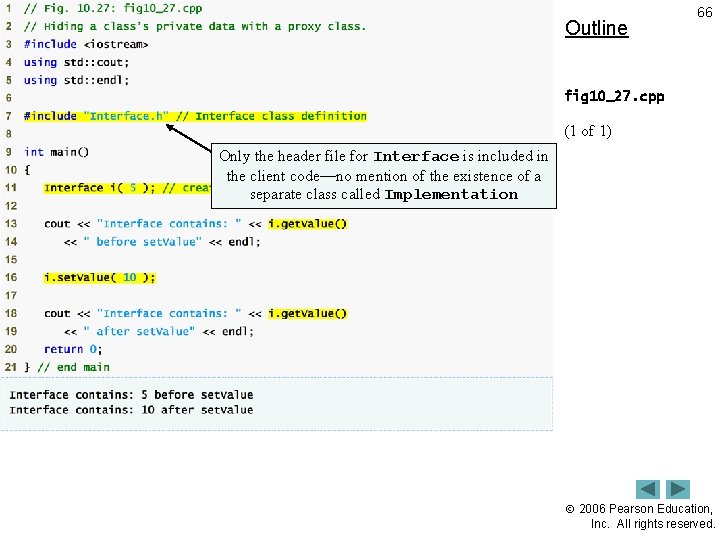
Outline 66 fig 10_27. cpp (1 of 1) Only the header file for Interface is included in the client code—no mention of the existence of a separate class called Implementation 2006 Pearson Education, Inc. All rights reserved.
67 Software Engineering Observation 10. 13 A proxy class insulates client code from implementation changes. 2006 Pearson Education, Inc. All rights reserved.
- Slides: 67