
10 10 17 Types of Scientific Investigations Do
- Slides: 17
10 -10 -17 Types of Scientific Investigations
Do Now • Read the provided article on the “ 5 -second rule” • Write a short paragraph that explains the central idea of the article. Use at least two details from the article to support your response. • Identify the following in Jillian Clarke’s experiment • Independent variable • Floor surface • Dependent variable • Amount of bacteria on gummy bears • Constant • Time spent on floor
Vocab Quiz Review 1. 2. 3. 4. 5. 6. Constants Control group Dependent variable Experimental group Independent variable Repeated trials Score Percentages 6/6 = 100% “A” 5. 5/6 = 91. 7% “A” 5/6 = 83% “B” 4/6 = 66. 7% “D” 3/6 = 50% “F” 2/6 = 33. 3% “F” 1/6 = 16. 7% “F”
Required Additional Practice for Retake • Write down vocab terms and definitions • Complete crossword puzzle
HW Review: Trade & Grade • Use only red ink • Only mark it if it is incorrect • Write in the correct answer
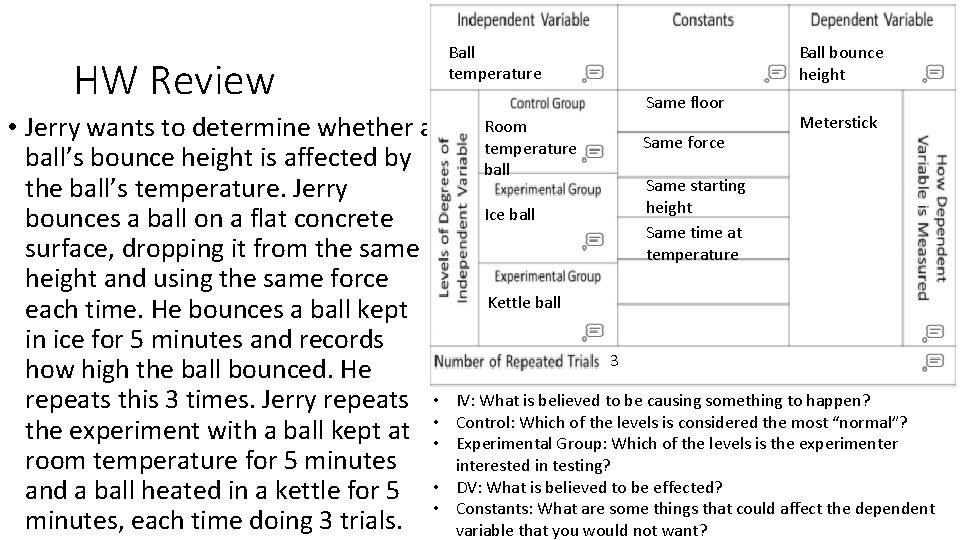
HW Review • Jerry wants to determine whether a ball’s bounce height is affected by the ball’s temperature. Jerry bounces a ball on a flat concrete surface, dropping it from the same height and using the same force each time. He bounces a ball kept in ice for 5 minutes and records how high the ball bounced. He repeats this 3 times. Jerry repeats • the experiment with a ball kept at • • room temperature for 5 minutes and a ball heated in a kettle for 5 • • minutes, each time doing 3 trials. Ball temperature Ball bounce height Same floor Room temperature ball Same force Meterstick Same starting height Same time at temperature Ice ball Kettle ball 3 IV: What is believed to be causing something to happen? Control: Which of the levels is considered the most “normal”? Experimental Group: Which of the levels is the experimenter interested in testing? DV: What is believed to be effected? Constants: What are some things that could affect the dependent variable that you would not want?
Types of Scientific Investigations Standard SC. 7. N. 1. 3 – Distinguish between an experiment (which must involve the identification and control of variables) and other forms of scientific investigation and explain that not all scientific knowledge is derived from experimentation. Lesson Objective: I can identify the different types of scientific investigations.
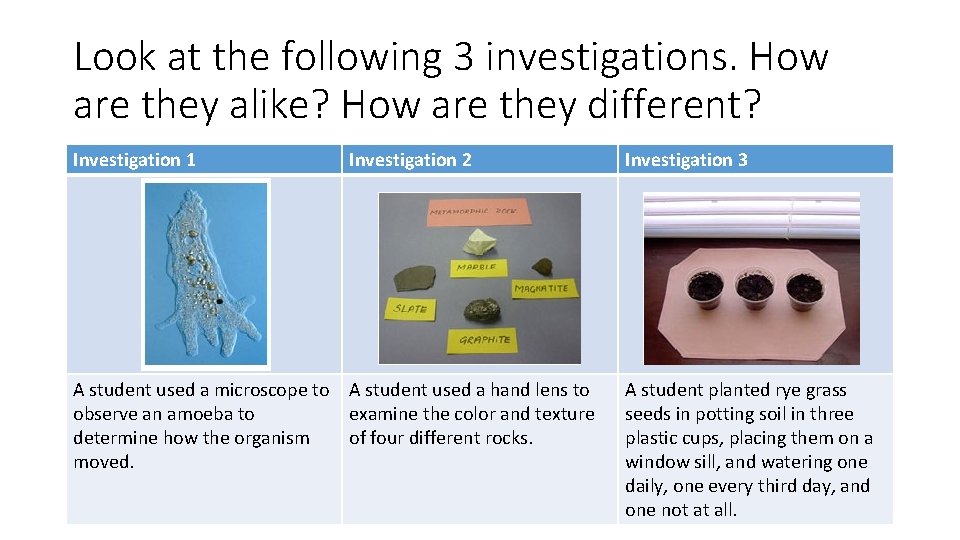
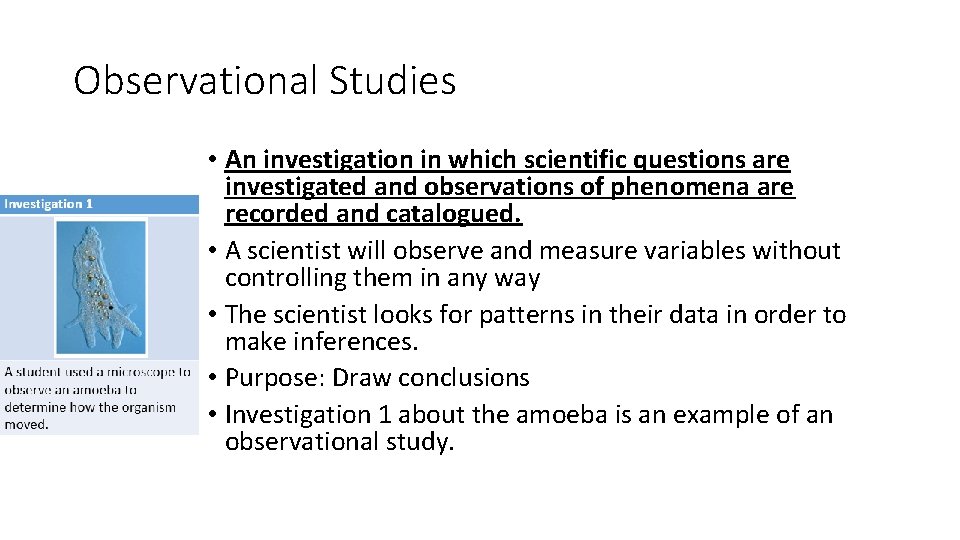
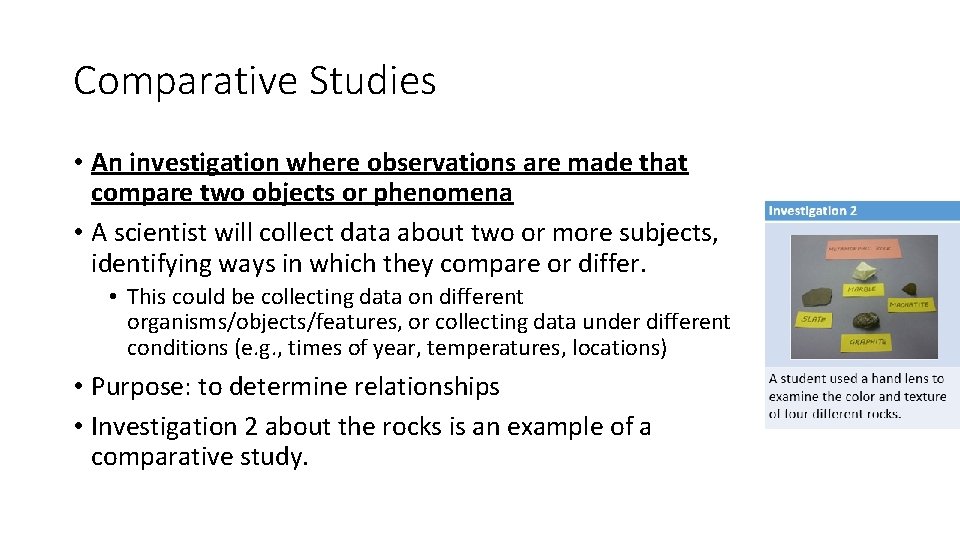
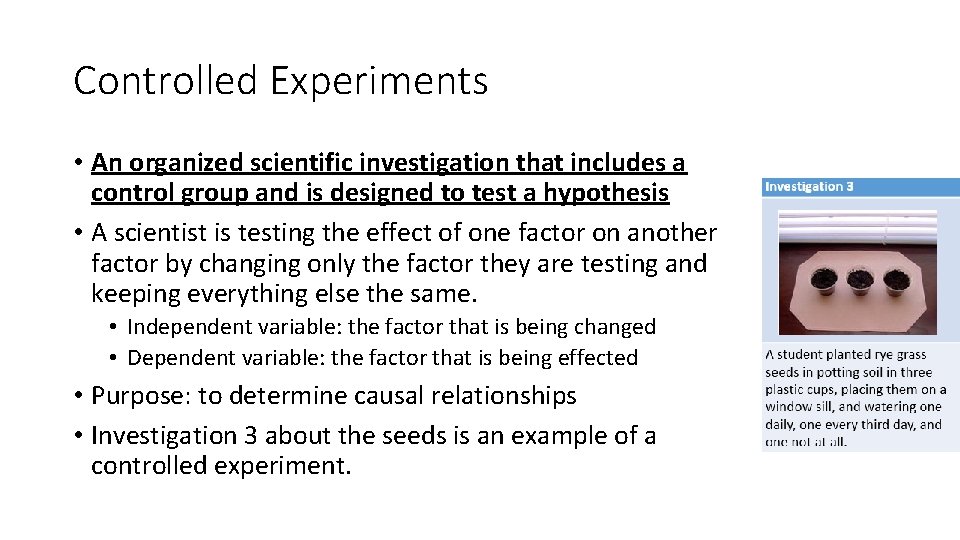
Look at the following 3 investigations. How are they alike? How are they different? Investigation 1 Investigation 2 A student used a microscope to A student used a hand lens to observe an amoeba to examine the color and texture determine how the organism of four different rocks. moved. Investigation 3 A student planted rye grass seeds in potting soil in three plastic cups, placing them on a window sill, and watering one daily, one every third day, and one not at all.
3 Types of Investigations • Scientists use 3 types of investigations to research and develop explanations for events in nature: • Observational Studies • Comparative Studies • Controlled Experiments
Observational Studies • An investigation in which scientific questions are investigated and observations of phenomena are recorded and catalogued. • A scientist will observe and measure variables without controlling them in any way • The scientist looks for patterns in their data in order to make inferences. • Purpose: Draw conclusions • Investigation 1 about the amoeba is an example of an observational study.
Observational Studies (cont. ) • Can include both quantitative and/or qualitative data. • Includes the following parts of scientific inquiry: • • Observations and asking questions Procedure Analyzing data Drawing conclusions • Does not include hypothesis or predictions • Can be identified with the following key words: • • Observe Describe List Identify
Comparative Studies • An investigation where observations are made that compare two objects or phenomena • A scientist will collect data about two or more subjects, identifying ways in which they compare or differ. • This could be collecting data on different organisms/objects/features, or collecting data under different conditions (e. g. , times of year, temperatures, locations) • Purpose: to determine relationships • Investigation 2 about the rocks is an example of a comparative study.
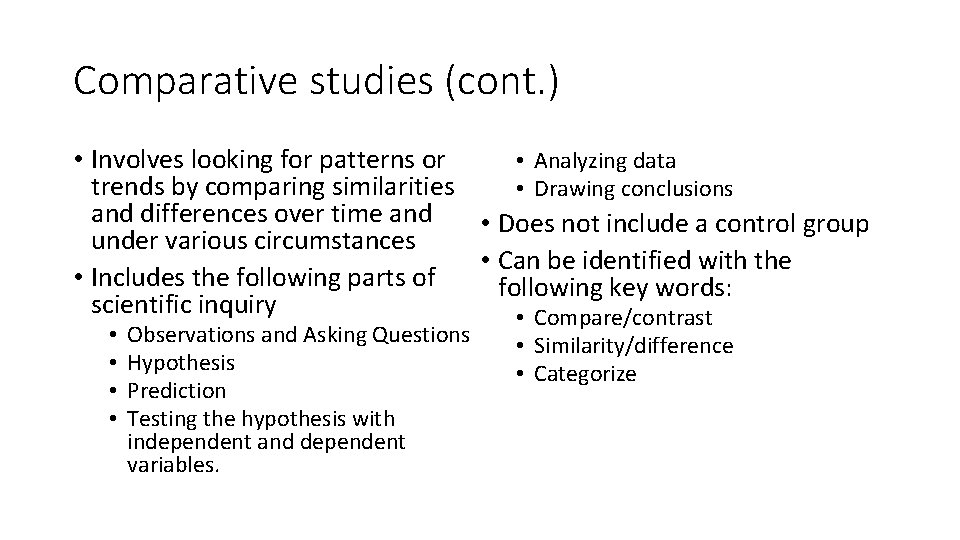
Comparative studies (cont. ) • Analyzing data • Involves looking for patterns or trends by comparing similarities • Drawing conclusions and differences over time and • Does not include a control group under various circumstances • Can be identified with the • Includes the following parts of following key words: scientific inquiry • Compare/contrast • • Observations and Asking Questions Hypothesis Prediction Testing the hypothesis with independent and dependent variables. • Similarity/difference • Categorize
Controlled Experiments • An organized scientific investigation that includes a control group and is designed to test a hypothesis • A scientist is testing the effect of one factor on another factor by changing only the factor they are testing and keeping everything else the same. • Independent variable: the factor that is being changed • Dependent variable: the factor that is being effected • Purpose: to determine causal relationships • Investigation 3 about the seeds is an example of a controlled experiment.
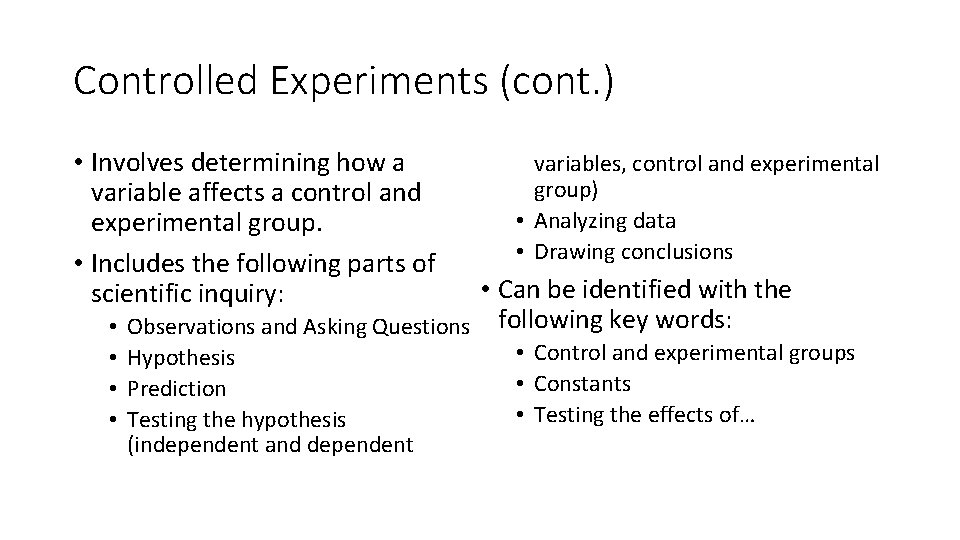
Controlled Experiments (cont. ) • Involves determining how a variable affects a control and experimental group. • Includes the following parts of scientific inquiry: variables, control and experimental group) • Analyzing data • Drawing conclusions • Can be identified with the • Observations and Asking Questions following key words: • Hypothesis • Prediction • Testing the hypothesis (independent and dependent • Control and experimental groups • Constants • Testing the effects of…
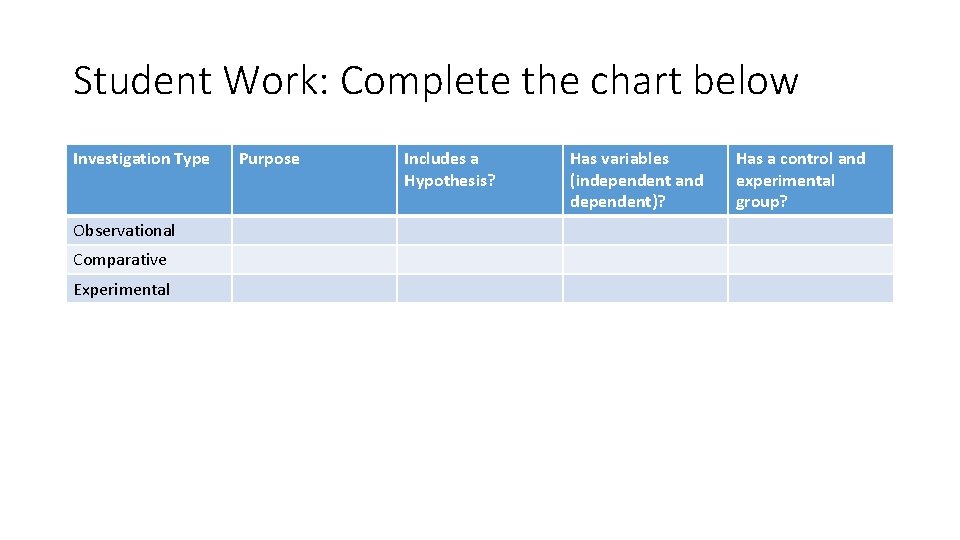
Student Work: Complete the chart below Investigation Type Observational Comparative Experimental Purpose Includes a Hypothesis? Has variables (independent and dependent)? Has a control and experimental group?
Exit Ticket • In your own words, define the following terms. • Independent variable • Dependent variable