
10 1 The Mole A Measurement of Matter

- Slides: 29
10. 1 The Mole: A Measurement of Matter > Chapter 10 Chemical Quantities 10. 1 The Mole: A Measurement of Matter 10. 2 Mole-Mass and Mole-Volume Relationships 10. 3 Percent Composition and Chemical Formulas 1 Copyright © Pearson Education, Inc. , or its affiliates. All Rights Reserved. .
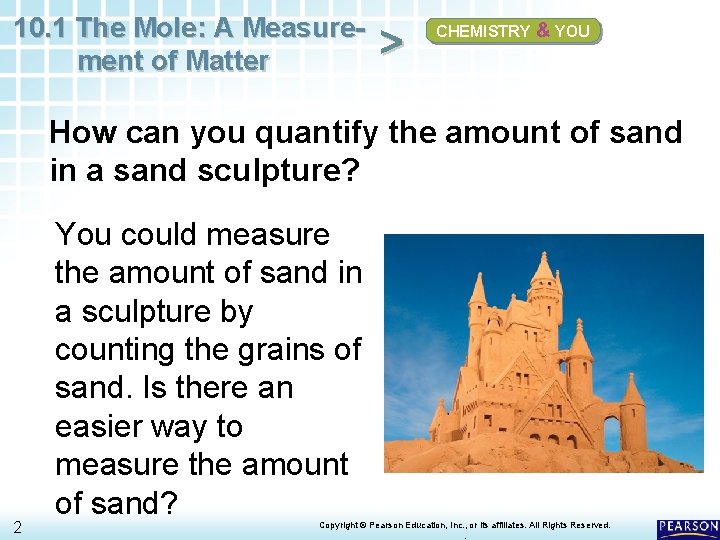
10. 1 The Mole: A Measurement of Matter > CHEMISTRY & YOU How can you quantify the amount of sand in a sand sculpture? 2 You could measure the amount of sand in a sculpture by counting the grains of sand. Is there an easier way to measure the amount of sand? Copyright © Pearson Education, Inc. , or its affiliates. All Rights Reserved. .
10. 1 The Mole: A Measurement of Matter > CHEMISTRY & YOU What are the different ways you can measure the amount of sand in a sand sculpture? You can measure the amount of sand in a sand sculpture by count (for example, number of buckets of sand in the sculpture), by mass (which can be calculated by multiplying the number of buckets of sand by how much each bucket weighs), or by volume (which can be calculated by multiplying the number of buckets by the volume the bucket holds). 3 Copyright © Pearson Education, Inc. , or its affiliates. All Rights Reserved. .
10. 1 The Mole: A Measurement of Matter > Measuring Matter Chemistry is a quantitative science. • In your study of chemistry, you will analyze the composition of samples of matter and perform chemical calculations that relate quantities of the reactants in a chemical reaction to quantities of the products. • To solve these and other problems, you will have to be able to measure the amount of matter you have. 4 Copyright © Pearson Education, Inc. , or its affiliates. All Rights Reserved. .
10. 1 The Mole: A Measurement of Matter > What Is a Mole? Recall that matter is composed of atoms, molecules, and ions. • These particles are much, much smaller than grains of sand, and an extremely large number of them are in a small sample of a substance. • Obviously, counting particles one by one is not practical. 5 Copyright © Pearson Education, Inc. , or its affiliates. All Rights Reserved. .
10. 1 The Mole: A Measurement of Matter > What Is a Mole? How do chemists count the number of atoms, molecules, or formula units in a substance? 6 Copyright © Pearson Education, Inc. , or its affiliates. All Rights Reserved. .
10. 1 The Mole: A Measurement of Matter > What Is a Mole? Counting with Moles Chemists use a unit that is a specified number of particles. • The unit is called the mole. • A mole (mol) of a substance is 6. 02 × 1023 representative particles of that substance and is the SI unit for measuring the amount of a substance. • The number of representative particles in a mole, 6. 02 × 1023, is called Avogadro’s number. 7 Copyright © Pearson Education, Inc. , or its affiliates. All Rights Reserved. .
10. 1 The Mole: A Measurement of Matter > What Is a Mole? Counting with Moles The term representative particle refers to the species present in a substance, usually atoms, molecules, or formula units. • The representative particle of most elements is the atom. • Iron is composed of iron atoms. Helium is composed of helium atoms. 8 Copyright © Pearson Education, Inc. , or its affiliates. All Rights Reserved. .
10. 1 The Mole: A Measurement of Matter > What Is a Mole? Counting with Moles Seven elements normally exist as diatomic molecules (H 2, N 2, O 2, F 2, Cl 2, Br 2, and I 2). • The representative particle of these elements and of all molecular compounds is the molecule. • The molecular compounds water (H 2 O) and sulfur dioxide (SO 2) are composed of H 2 O and SO 2 molecules, respectively. 9 Copyright © Pearson Education, Inc. , or its affiliates. All Rights Reserved. .
10. 1 The Mole: A Measurement of Matter > What Is a Mole? Counting with Moles For ionic compounds, such as calcium chloride, the representative particle is the formula unit Ca. Cl 2. 10 Copyright © Pearson Education, Inc. , or its affiliates. All Rights Reserved. .
10. 1 The Mole: A Measurement of Matter > What Is a Mole? Counting with Moles The mole allows chemists to count the number of representative particles in a substance. • A mole of any substance contains Avogadro’s number of representative particles, or 6. 02 × 1023 representative particles. 11 Copyright © Pearson Education, Inc. , or its affiliates. All Rights Reserved. .
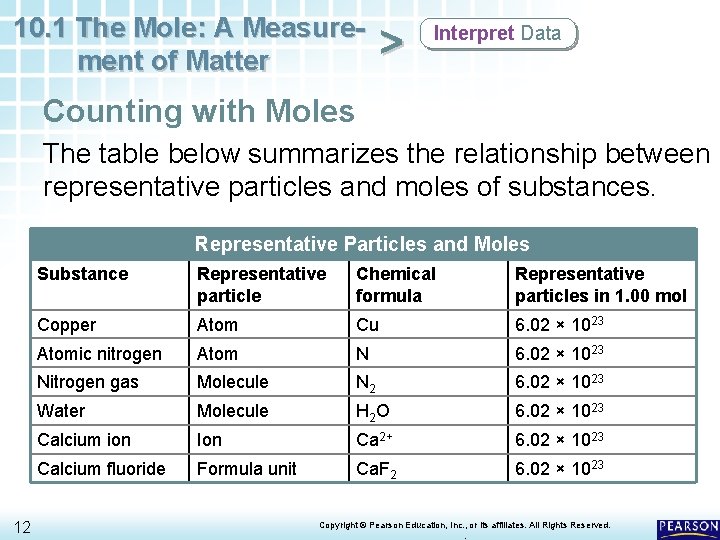
10. 1 The Mole: A Measurement of Matter > Interpret Data Counting with Moles The table below summarizes the relationship between representative particles and moles of substances. Representative Particles and Moles 12 Substance Representative particle Chemical formula Representative particles in 1. 00 mol Copper Atom Cu 6. 02 × 1023 Atomic nitrogen Atom N 6. 02 × 1023 Nitrogen gas Molecule N 2 6. 02 × 1023 Water Molecule H 2 O 6. 02 × 1023 Calcium ion Ion Ca 2+ 6. 02 × 1023 Calcium fluoride Formula unit Ca. F 2 6. 02 × 1023 Copyright © Pearson Education, Inc. , or its affiliates. All Rights Reserved. .
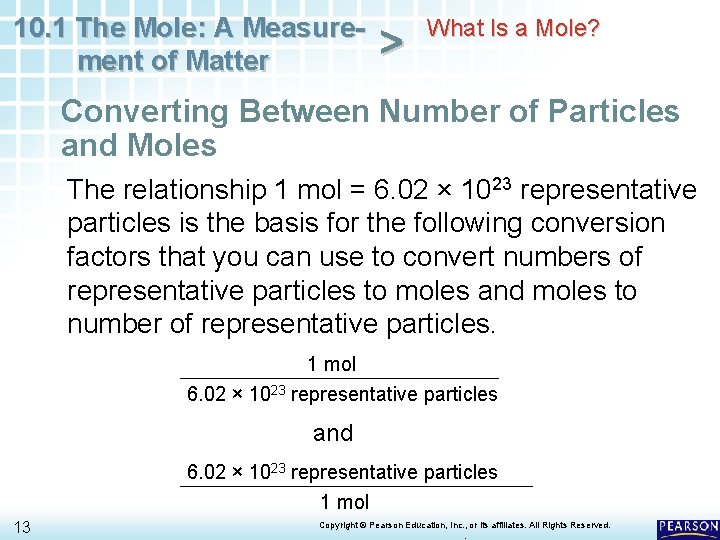
10. 1 The Mole: A Measurement of Matter > What Is a Mole? Converting Between Number of Particles and Moles The relationship 1 mol = 6. 02 × 1023 representative particles is the basis for the following conversion factors that you can use to convert numbers of representative particles to moles and moles to number of representative particles. 1 mol 6. 02 × 1023 representative particles and 6. 02 × 1023 representative particles 1 mol 13 Copyright © Pearson Education, Inc. , or its affiliates. All Rights Reserved. .
10. 1 The Mole: A Measurement of Matter > Sample Problem 10. 2 Converting Number of Atoms to Moles Magnesium is a light metal used in the manufacture of aircraft, automobile wheels, and tools. How many moles of magnesium is 1. 25 × 1023 atoms of magnesium? 14 Copyright © Pearson Education, Inc. , or its affiliates. All Rights Reserved. .
10. 1 The Mole: A Measurement of Matter > What Is a Mole? Converting Between Number of Particles and Moles Suppose you want to determine how many atoms are in a mole of a compound. • To do this, you must know how many atoms are in a representative particle of the compound. • This number is determined from the chemical formula. 15 Copyright © Pearson Education, Inc. , or its affiliates. All Rights Reserved. .
10. 1 The Mole: A Measurement of Matter > What Is a Mole? Converting Between Number of Particles and Moles In the formula for carbon dioxide (CO 2), the subscripts show that one molecule of carbon dioxide is composed of three atoms: one carbon atom and two oxygen atoms. • A mole of carbon dioxide contains Avogadro’s number of CO 2 molecules. • Each molecule contains three atoms, so a mole of carbon dioxide contains three times Avogadro’s number of atoms. 16 Copyright © Pearson Education, Inc. , or its affiliates. All Rights Reserved. .
10. 1 The Mole: A Measurement of Matter > What Is a Mole? Converting Between Number of Particles and Moles To find the number of atoms in a given number of moles of a compound, you must first determine the number of representative particles. • To convert the number of moles of a compound to the number of representative particles (molecules or formula units), multiply the number of moles by 6. 02 × 1023 representative particles/1 mol. • Then multiply the number of representative particles by the number of atoms in each molecule or formula unit. 17 Copyright © Pearson Education, Inc. , or its affiliates. All Rights Reserved. .
10. 1 The Mole: A Measurement of Matter > Sample Problem 10. 3 Converting Moles to Number of Atoms Propane is a gas used for cooking and heating. How many atoms are in 2. 12 mol of propane (C 3 H 8)? 18 Copyright © Pearson Education, Inc. , or its affiliates. All Rights Reserved. .
10. 1 The Mole: A Measurement of Matter > Molar Mass How do you determine the molar mass of an element and of a compound? 19 Copyright © Pearson Education, Inc. , or its affiliates. All Rights Reserved. .
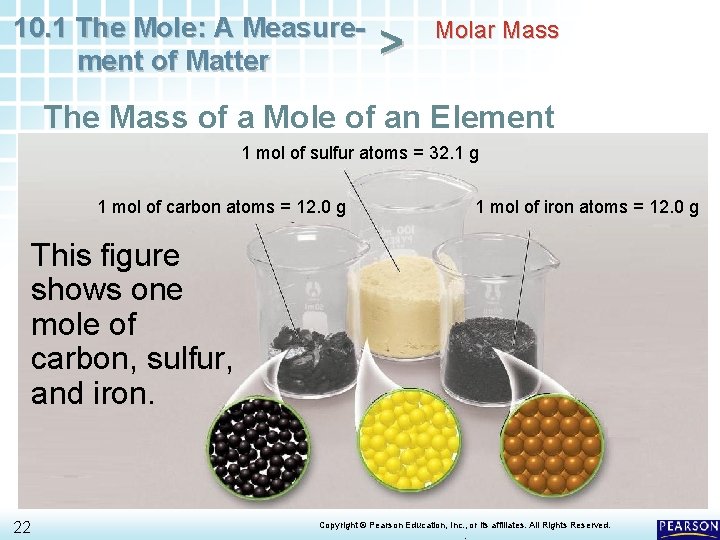
10. 1 The Mole: A Measurement of Matter > Molar Mass The Mass of a Mole of an Element The atomic mass of an element expressed in grams is the mass of a mole of the element. 20 Copyright © Pearson Education, Inc. , or its affiliates. All Rights Reserved. .
10. 1 The Mole: A Measurement of Matter > Molar Mass The Mass of a Mole of an Element The mass of a mole of an element is its molar mass. • For carbon, the molar mass is 12. 0 g. • For atomic hydrogen, the molar mass is 1. 0 g. 21 Copyright © Pearson Education, Inc. , or its affiliates. All Rights Reserved. .
10. 1 The Mole: A Measurement of Matter > Molar Mass The Mass of a Mole of an Element 1 mol of sulfur atoms = 32. 1 g 1 mol of carbon atoms = 12. 0 g 1 mol of iron atoms = 12. 0 g This figure shows one mole of carbon, sulfur, and iron. 22 Copyright © Pearson Education, Inc. , or its affiliates. All Rights Reserved. .
10. 1 The Mole: A Measurement of Matter > Molar Mass The Mass of a Mole of a Compound To calculate the molar mass of a compound, find the number of grams of each element in one mole of the compound. Then add the masses of the elements in the compound. • This method for calculating molar mass applies to any compound, molecular or ionic. 23 Copyright © Pearson Education, Inc. , or its affiliates. All Rights Reserved. .
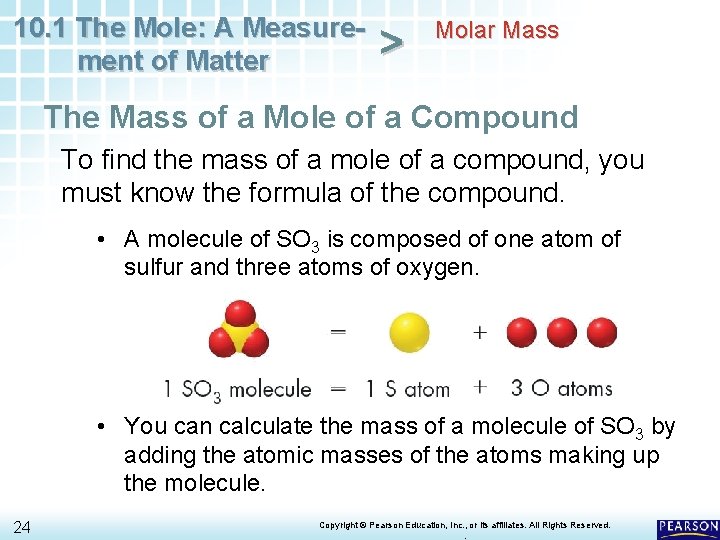
10. 1 The Mole: A Measurement of Matter > Molar Mass The Mass of a Mole of a Compound To find the mass of a mole of a compound, you must know the formula of the compound. • A molecule of SO 3 is composed of one atom of sulfur and three atoms of oxygen. • You can calculate the mass of a molecule of SO 3 by adding the atomic masses of the atoms making up the molecule. 24 Copyright © Pearson Education, Inc. , or its affiliates. All Rights Reserved. .
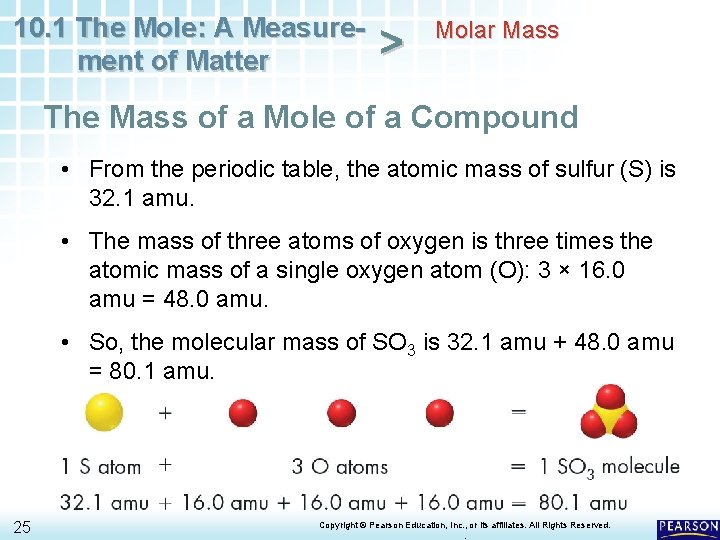
10. 1 The Mole: A Measurement of Matter > Molar Mass The Mass of a Mole of a Compound • From the periodic table, the atomic mass of sulfur (S) is 32. 1 amu. • The mass of three atoms of oxygen is three times the atomic mass of a single oxygen atom (O): 3 × 16. 0 amu = 48. 0 amu. • So, the molecular mass of SO 3 is 32. 1 amu + 48. 0 amu = 80. 1 amu. 25 Copyright © Pearson Education, Inc. , or its affiliates. All Rights Reserved. .
10. 1 The Mole: A Measurement of Matter > Molar Mass The Mass of a Mole of a Compound Now substitute the unit grams for atomic mass units to find the molar mass of SO 3. • 1 mol of SO 3 has a mass of 80. 1 g. • This is the mass of 6. 02 x 1023 molecules of SO 3. 26 Copyright © Pearson Education, Inc. , or its affiliates. All Rights Reserved. .
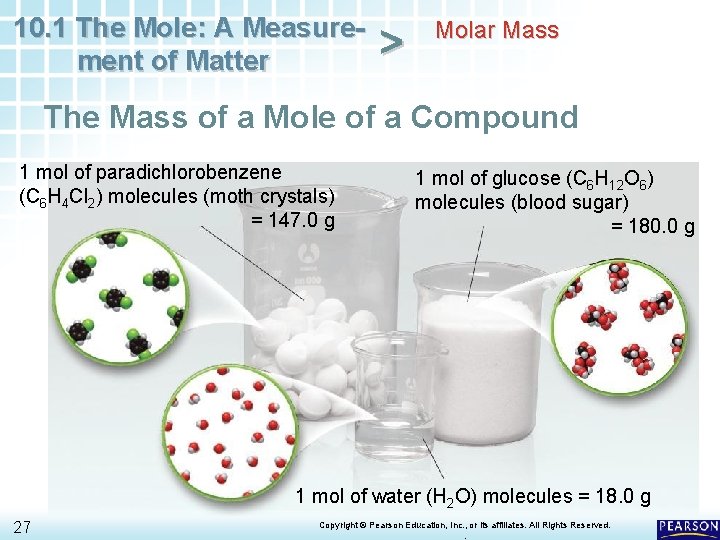
10. 1 The Mole: A Measurement of Matter > Molar Mass The Mass of a Mole of a Compound 1 mol of paradichlorobenzene (C 6 H 4 Cl 2) molecules (moth crystals) = 147. 0 g 1 mol of glucose (C 6 H 12 O 6) molecules (blood sugar) = 180. 0 g 1 mol of water (H 2 O) molecules = 18. 0 g 27 Copyright © Pearson Education, Inc. , or its affiliates. All Rights Reserved. .
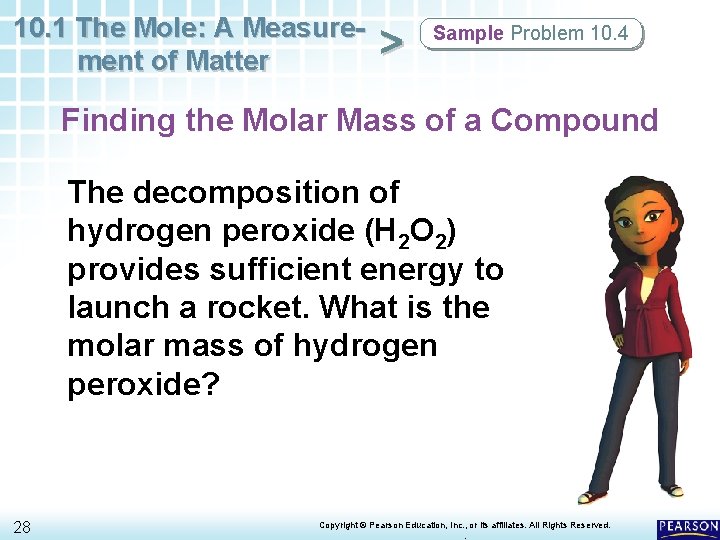
10. 1 The Mole: A Measurement of Matter > Sample Problem 10. 4 Finding the Molar Mass of a Compound The decomposition of hydrogen peroxide (H 2 O 2) provides sufficient energy to launch a rocket. What is the molar mass of hydrogen peroxide? 28 Copyright © Pearson Education, Inc. , or its affiliates. All Rights Reserved. .
10. 1 The Mole: A Measurement of Matter > END OF 10. 1 29 Copyright © Pearson Education, Inc. , or its affiliates. All Rights Reserved. .