
10 1 Electricity and Magnetism II Griffiths Chapter
- Slides: 13
10. 1 Electricity and Magnetism II Griffiths Chapter 10 Potentials & Fields Clicker Questions
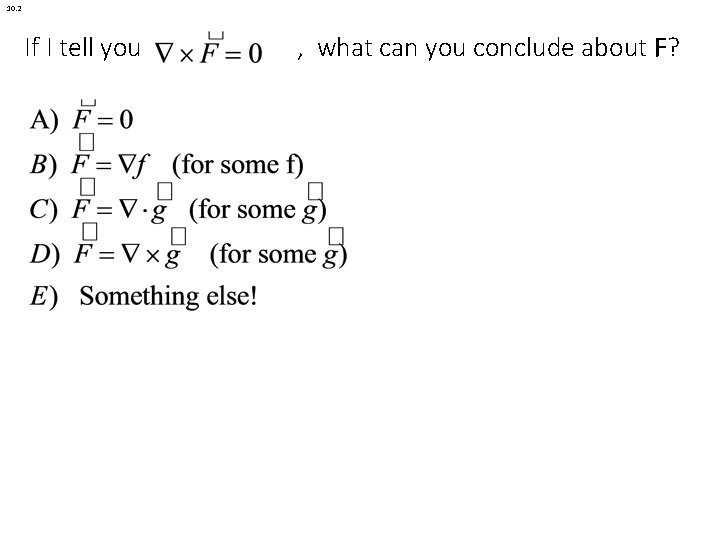
10. 2 If I tell you , what can you conclude about F?
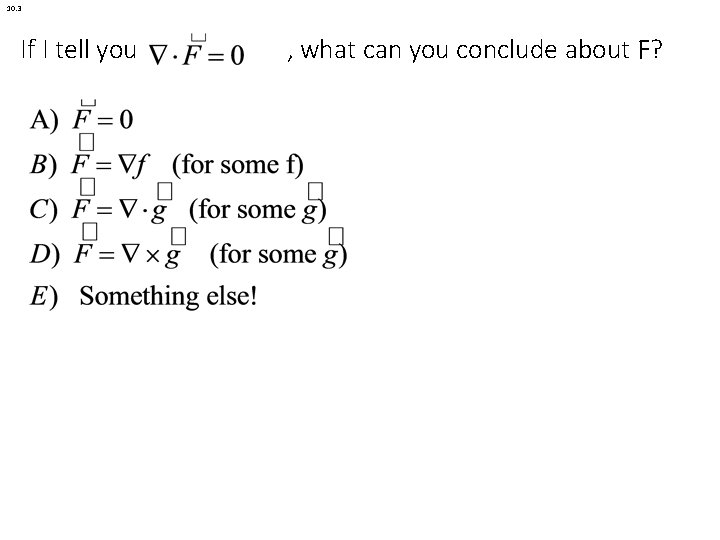
10. 3 If I tell you , what can you conclude about F?
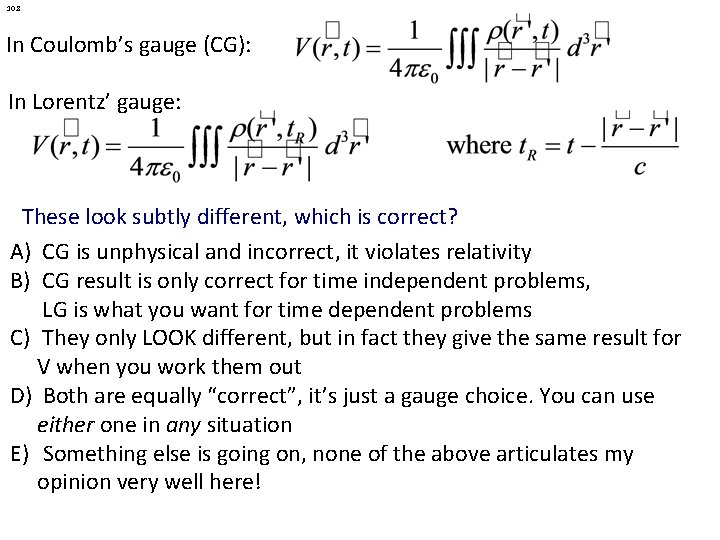
10. 8 In Coulomb’s gauge (CG): In Lorentz’ gauge: These look subtly different, which is correct? A) CG is unphysical and incorrect, it violates relativity B) CG result is only correct for time independent problems, LG is what you want for time dependent problems C) They only LOOK different, but in fact they give the same result for V when you work them out D) Both are equally “correct”, it’s just a gauge choice. You can use either one in any situation E) Something else is going on, none of the above articulates my opinion very well here!
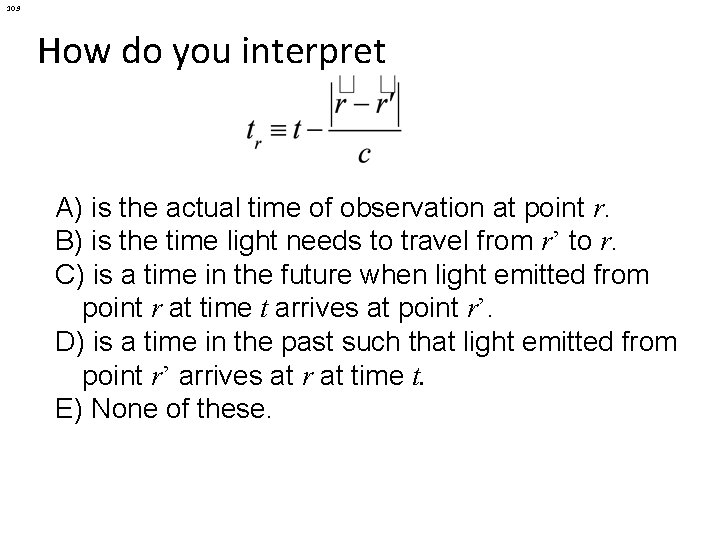
10. 9 How do you interpret A) is the actual time of observation at point r. B) is the time light needs to travel from r’ to r. C) is a time in the future when light emitted from point r at time t arrives at point r’. D) is a time in the past such that light emitted from point r’ arrives at r at time t. E) None of these.
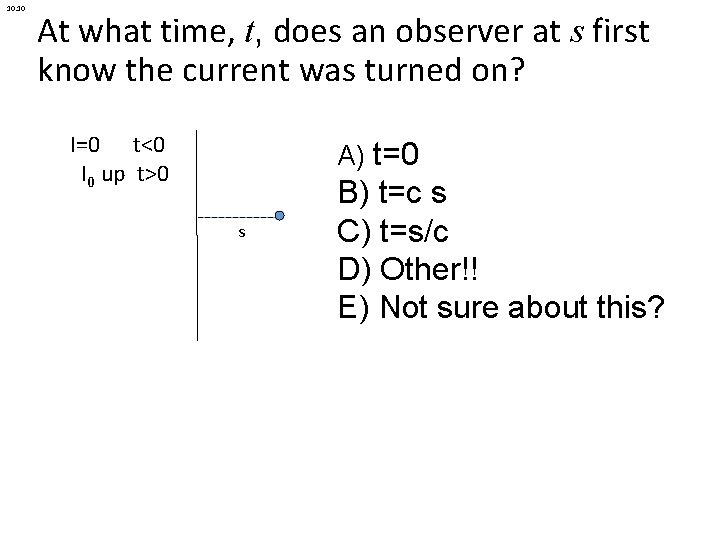
10. 10 At what time, t, does an observer at s first know the current was turned on? I=0 t<0 I 0 up t>0 A) t=0 s B) t=c s C) t=s/c D) Other!! E) Not sure about this?
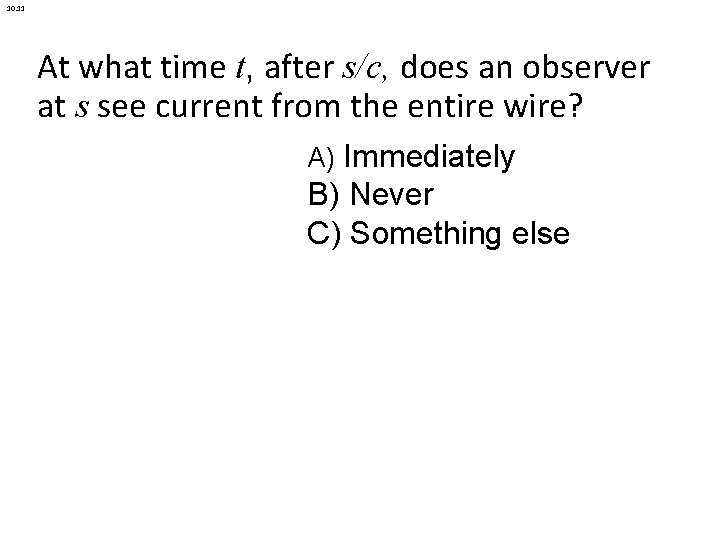
10. 11 At what time t, after s/c, does an observer at s see current from the entire wire? A) Immediately B) Never C) Something else
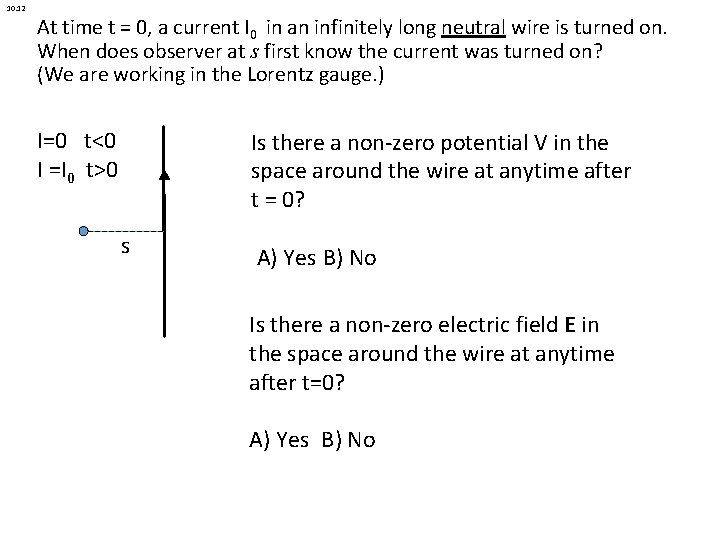
10. 12 At time t = 0, a current I 0 in an infinitely long neutral wire is turned on. When does observer at s first know the current was turned on? (We are working in the Lorentz gauge. ) I=0 t<0 I =I 0 t>0 Is there a non-zero potential V in the space around the wire at anytime after t = 0? s A) Yes B) No Is there a non-zero electric field E in the space around the wire at anytime after t=0? A) Yes B) No
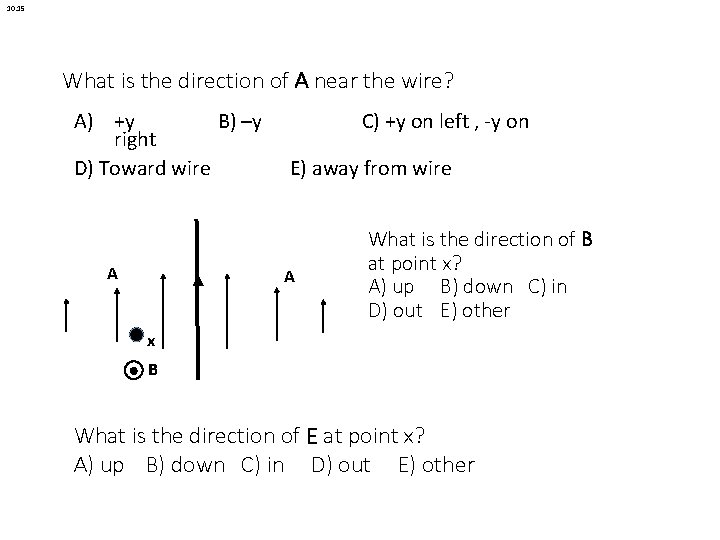
10. 15 What is the direction of A near the wire? A) +y B) –y right D) Toward wire A C) +y on left , -y on E) away from wire A What is the direction of B at point x? A) up B) down C) in D) out E) other x B What is the direction of E at point x? A) up B) down C) in D) out E) other
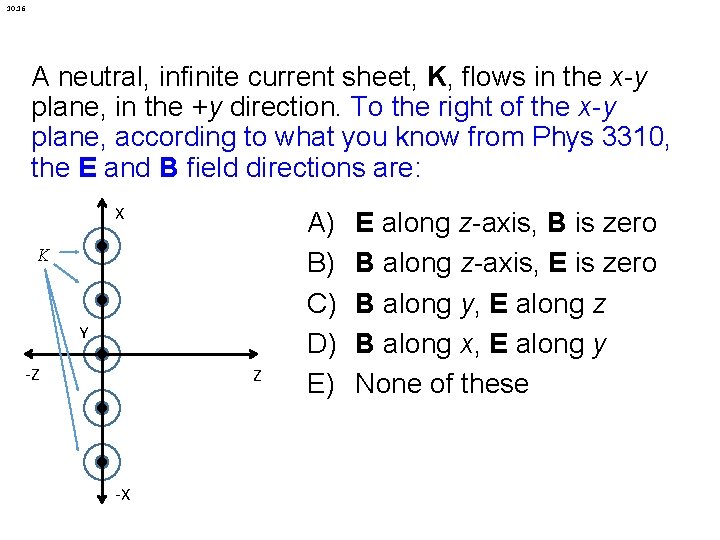
10. 16 A neutral, infinite current sheet, K, flows in the x-y plane, in the +y direction. To the right of the x-y plane, according to what you know from Phys 3310, the E and B field directions are: X K Y -Z Z -X A) B) C) D) E) E along z-axis, B is zero B along z-axis, E is zero B along y, E along z B along x, E along y None of these
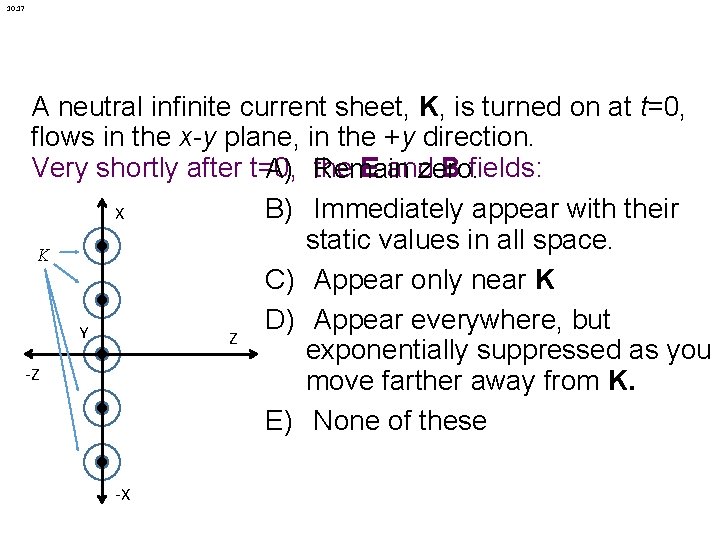
10. 17 A neutral infinite current sheet, K, is turned on at t=0, flows in the x-y plane, in the +y direction. Very shortly after t=0, the E and B fields: A) Remain zero. B) Immediately appear with their X static values in all space. K C) Appear only near K D) Appear everywhere, but Y Z exponentially suppressed as you -Z move farther away from K. E) None of these -X
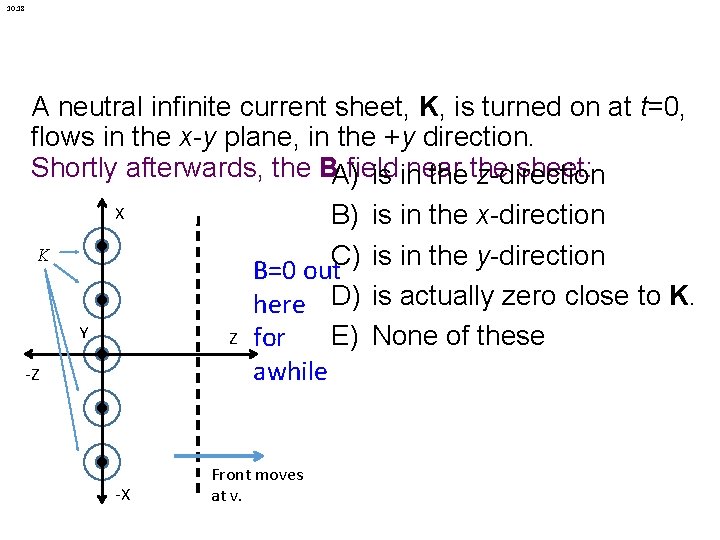
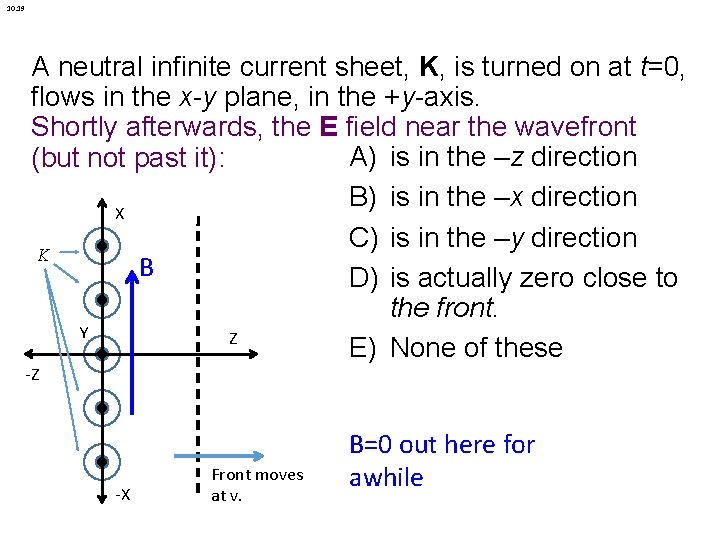
10. 18 A neutral infinite current sheet, K, is turned on at t=0, flows in the x-y plane, in the +y direction. Shortly afterwards, the BA)field near sheet: is in the z-direction X B) is in the x-direction K C) is in the y-direction B=0 out here D) is actually zero close to K. Y Z for E) None of these awhile -Z -X Front moves at v.
10. 19 A neutral infinite current sheet, K, is turned on at t=0, flows in the x-y plane, in the +y-axis. Shortly afterwards, the E field near the wavefront A) is in the –z direction (but not past it): B) is in the –x direction X C) is in the –y direction K B D) is actually zero close to the front. Y Z E) None of these -Z -X Front moves at v. B=0 out here for awhile