
10 1 Distribution Systems SESSION 10 Distribution Systems
10 -1 Distribution Systems SESSION 10 Distribution Systems Mc. Graw-Hill Higher Education Principles and Tools for Supply Chain Management, International Students Edition, by Scott Webster Copyright © 2008 by Mc. Graw-Hill Higher Education. All rights reserved.
10 -2 Distribution Systems · Learning outcomes (or objectives): · Distribution defined · Channel Intermediaries · Channel Strategy · Levels of Distribution Intensity · Channel Management
10 -3 Distribution Systems Introduction • Distribution - is a set of independent organizations involved in the process of making a product or service available for use or consumption by the consumer or business users. · Distribution Management: · overseeing the movement of goods from supplier or manufacturer to point of sale. It is refers to numerous activities and processes such as packaging, inventory, warehousing, supply chain and logistics.
10 -4 Distribution Systems Introduction · Distribution Channel: · is a system of institutions that promotes the physical flow of goods and services, along with ownership title, from producers to consumer or business user; also called a marketing channel. · Distribution Strategy: · is a plan of action designed to move goods and services from the source through a distribution channel, to the final customer. For product-focused entities, establishing the most appropriate distribution strategies is a major key to success.
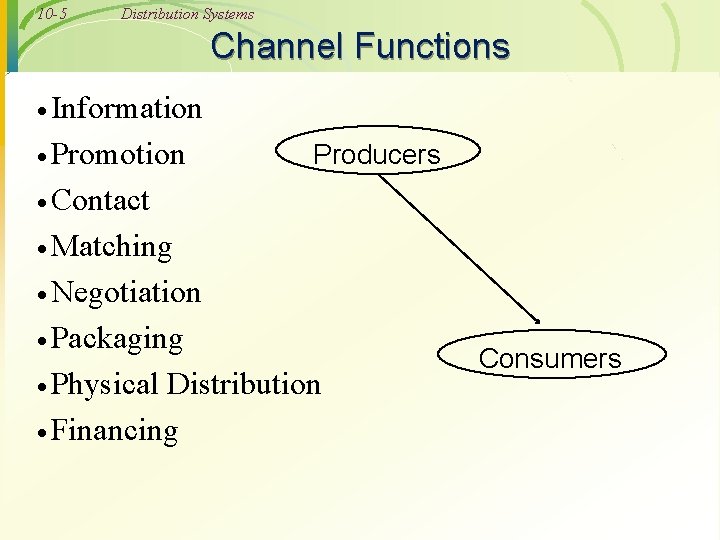
10 -5 Distribution Systems Channel Functions · Information · Promotion Producers · Contact · Matching · Negotiation · Packaging · Physical Distribution · Financing Consumers
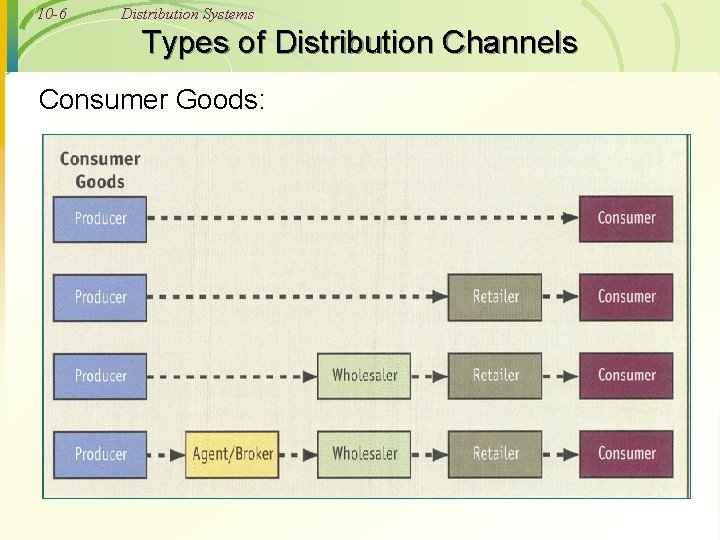
10 -6 Distribution Systems Types of Distribution Channels Consumer Goods:
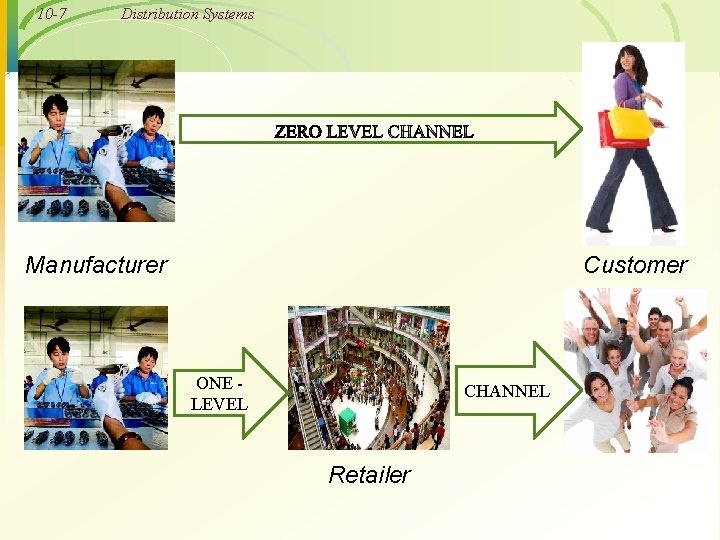
10 -7 Distribution Systems Manufacturer Customer ONE - LEVEL CHANNEL Retailer
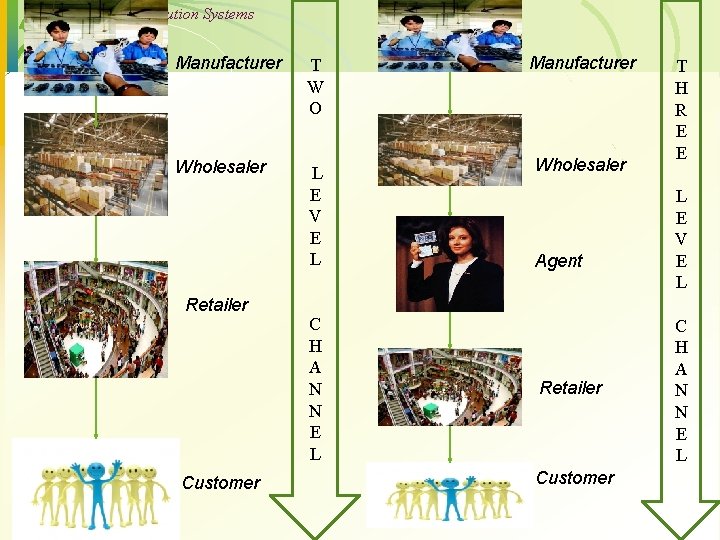
10 -8 Distribution Systems Manufacturer T W O Manufacturer Wholesaler L E V E L Wholesaler Retailer Customer C H A N N E L Agent Retailer Customer T H R E E L E V E L C H A N N E L
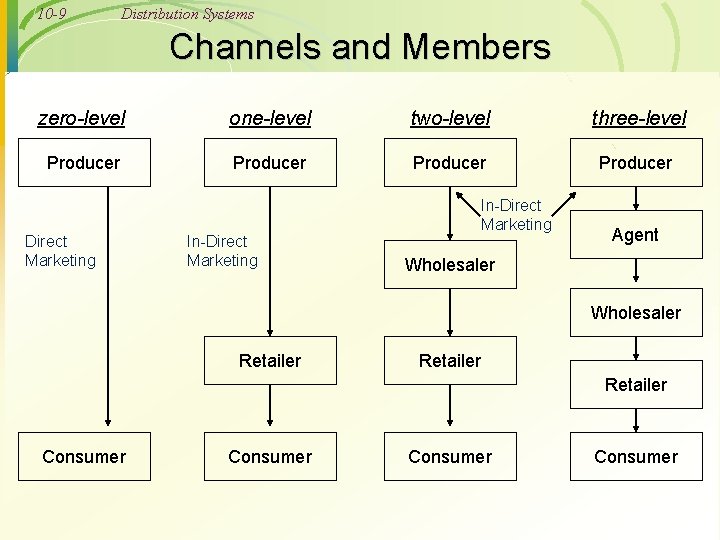
10 -9 Distribution Systems Channels and Members zero-level one-level two-level three-level Producer Direct Marketing In-Direct Marketing Agent Wholesaler Retailer Consumer
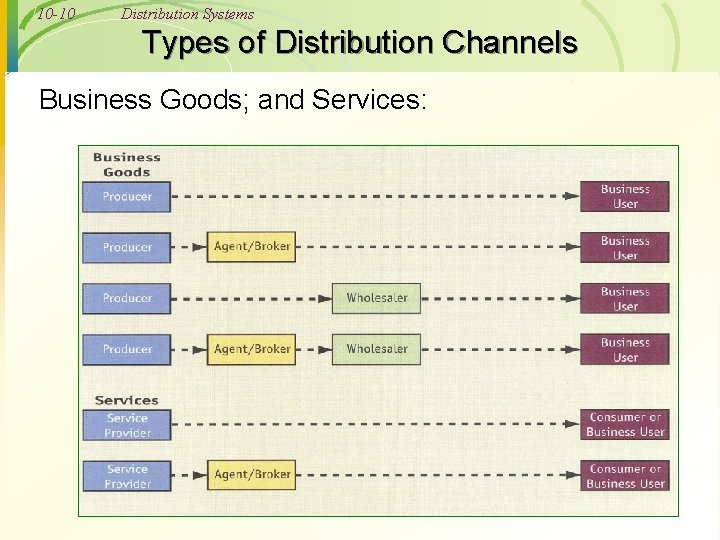
10 -10 Distribution Systems Types of Distribution Channels Business Goods; and Services:
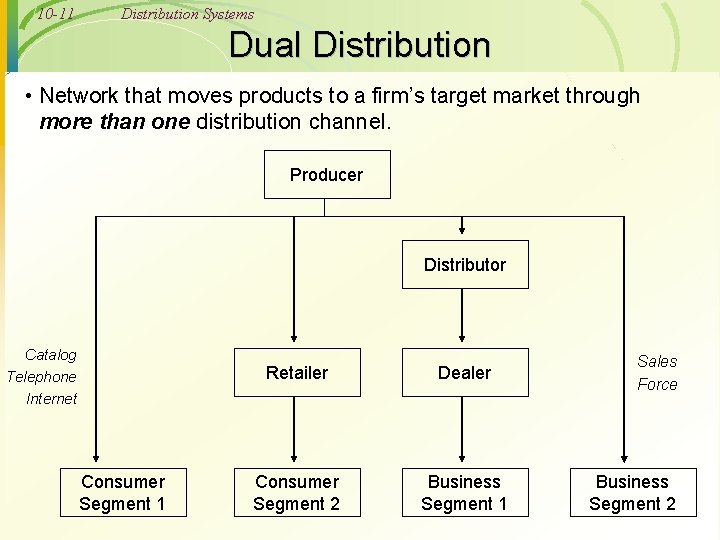
10 -11 Distribution Systems Dual Distribution • Network that moves products to a firm’s target market through more than one distribution channel. Producer Distributor Catalog Telephone Internet Consumer Segment 1 Retailer Dealer Consumer Segment 2 Business Segment 1 Sales Force Business Segment 2
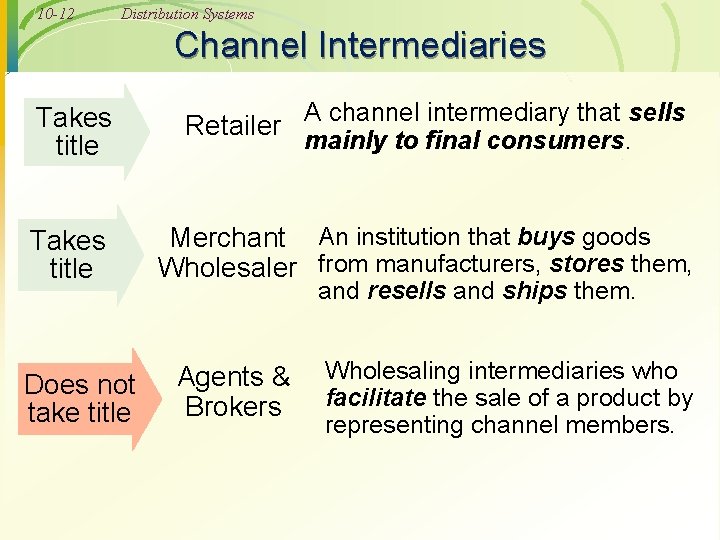
10 -12 Distribution Systems Channel Intermediaries Takes title Does not take title A channel intermediary that sells Retailer mainly to final consumers. Merchant An institution that buys goods Wholesaler from manufacturers, stores them, and resells and ships them. Agents & Brokers Wholesaling intermediaries who facilitate the sale of a product by representing channel members.
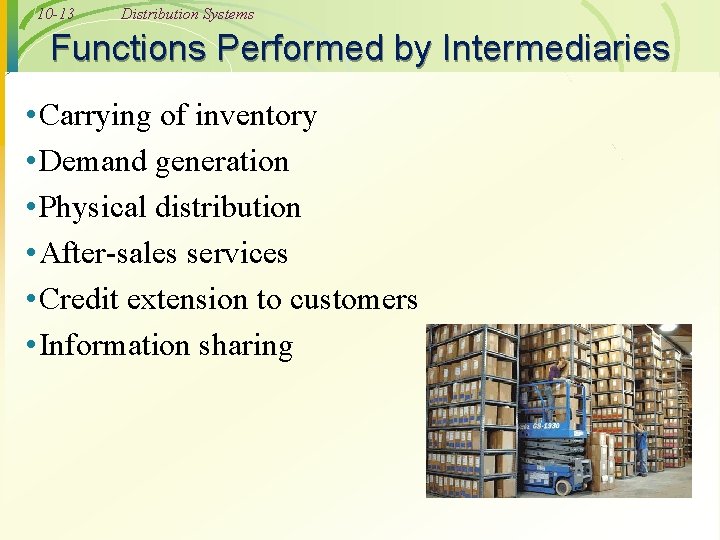
10 -13 Distribution Systems Functions Performed by Intermediaries • Carrying of inventory • Demand generation • Physical distribution • After-sales services • Credit extension to customers • Information sharing
10 -14 Distribution Systems Channel intermediaries - Retailer · Much stronger personal relationship with the consumer. · Hold a variety of products · Offer consumers credit · Promote and merchandise products · Price the final product · Build retailer ‘brand’ in the high street
10 -15 Distribution Systems Channel intermediaries - Wholesalers · Break down ‘bulk’ · Buys from producers and sells small quantities to retailers. · Provides storage facilities · Reduces contact cost between producer and consumer. · Wholesaler takes some of the marketing responsibility e. g. , sales force, promotions, credit, etc.
10 -16 Distribution Systems Channel intermediaries - Agents · Mainly used in international markets /trade · Commission agent - does not take title of the goods. Secures orders. · Stockist agent - hold ‘consignment’ stock · Control is difficult due to cultural differences · Training, motivation, etc. are expensive
10 -17 Distribution Systems Channel intermediaries - Internet · Sell to a geographically disperse market · Able to target and focus on specific segments · Relatively low set-up costs · Use of e-commerce technology (for payment, shopping software, etc. ) · Paradigm shift in commerce and consumption
10 -18 Distribution Systems Channel Strategy Decisions • Selection of a Distribution Channel • Factors which impact the selection of a marketing channel include: 1. External factors 2. Internal factors • External distribution factors: • Customer characteristics • Product / service nature • Nature of the demand • Level of competition • Legal regulations • Local business practices
10 -19 Distribution Systems Channel Strategy Decisions • Internal decision factors: • Types of intermediaries • Desired market coverage • Channel length (desired levels) • Control resources • Degree of integration • Need for information and process sharing • Determining Distribution Intensity – • number of intermediaries through which a manufacturer distributes its goods.
10 -20 Distribution Systems Six basic channel decisions · Direct or indirect channels · Single or multiple channels · Length of channel · Types of intermediaries · Number of intermediaries at each level · Which intermediaries? · Avoid intra-channel conflict Channel Strategy choices
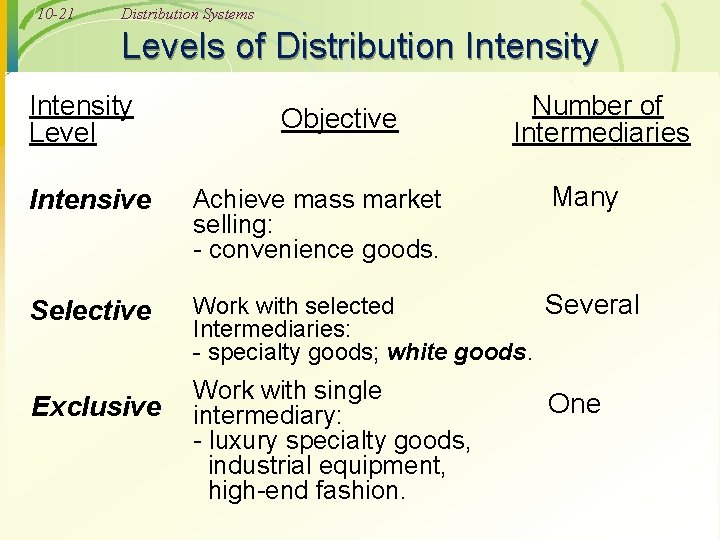
10 -21 Distribution Systems Levels of Distribution Intensity Level Objective Number of Intermediaries Many Intensive Achieve mass market selling: - convenience goods. Selective Work with selected Several Intermediaries: - specialty goods; white goods. Exclusive Work with single intermediary: - luxury specialty goods, industrial equipment, high-end fashion. One
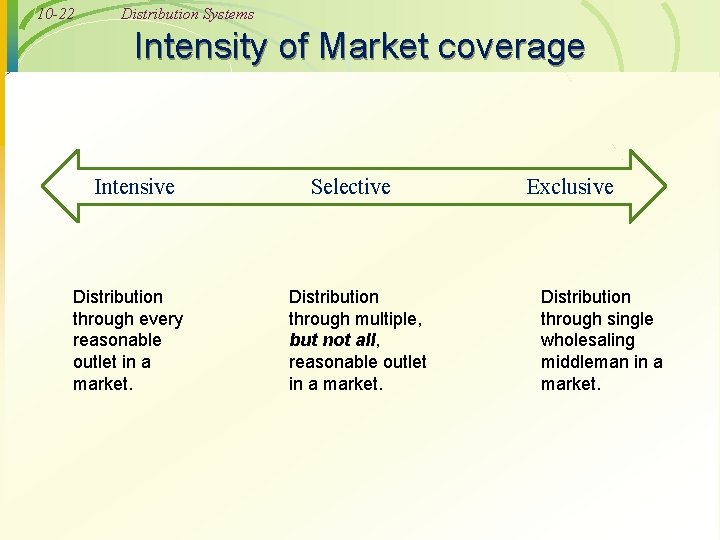
10 -22 Distribution Systems Intensity of Market coverage Intensive Distribution through every reasonable outlet in a market. Selective Distribution through multiple, but not all, reasonable outlet in a market. Exclusive Distribution through single wholesaling middleman in a market.
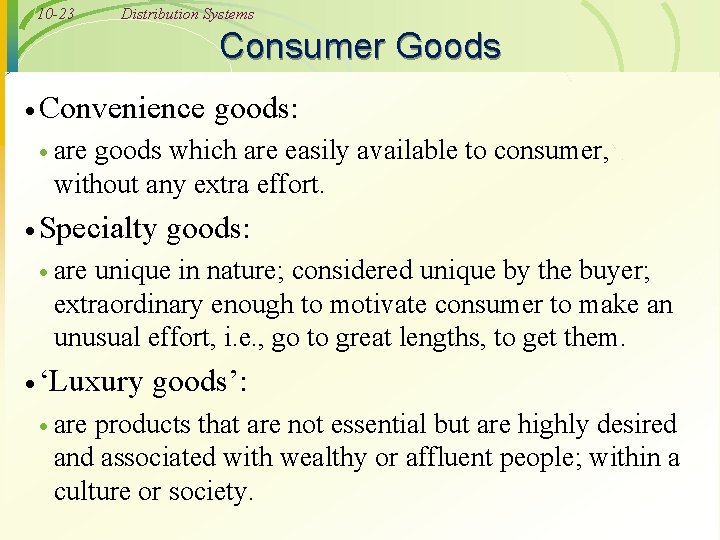
10 -23 Distribution Systems Consumer Goods · Convenience goods: · are goods which are easily available to consumer, without any extra effort. · Specialty goods: · are unique in nature; considered unique by the buyer; extraordinary enough to motivate consumer to make an unusual effort, i. e. , go to great lengths, to get them. · ‘Luxury goods’: · are products that are not essential but are highly desired and associated with wealthy or affluent people; within a culture or society.

10 -24 Distribution Systems Distribution Intensity • Intensive distribution - channel policy in which a manufacturer of a convenience product attempts to saturate the market. • Intensive market coverage: M = Manufacturer W = Wholesaler R = Retailer
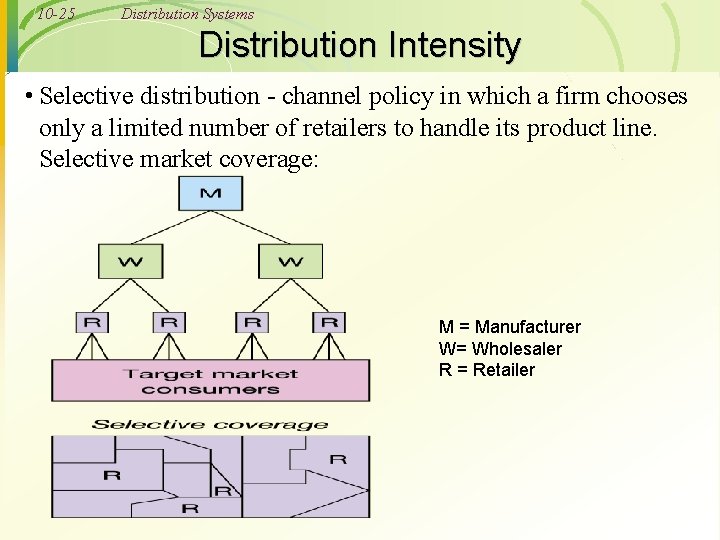
10 -25 Distribution Systems Distribution Intensity • Selective distribution - channel policy in which a firm chooses only a limited number of retailers to handle its product line. Selective market coverage: M = Manufacturer W= Wholesaler R = Retailer
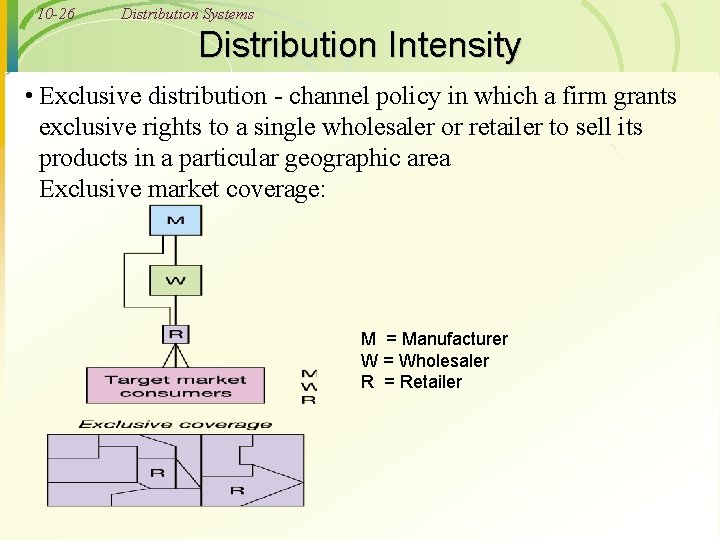
10 -26 Distribution Systems Distribution Intensity • Exclusive distribution - channel policy in which a firm grants exclusive rights to a single wholesaler or retailer to sell its products in a particular geographic area Exclusive market coverage: M = Manufacturer W = Wholesaler R = Retailer
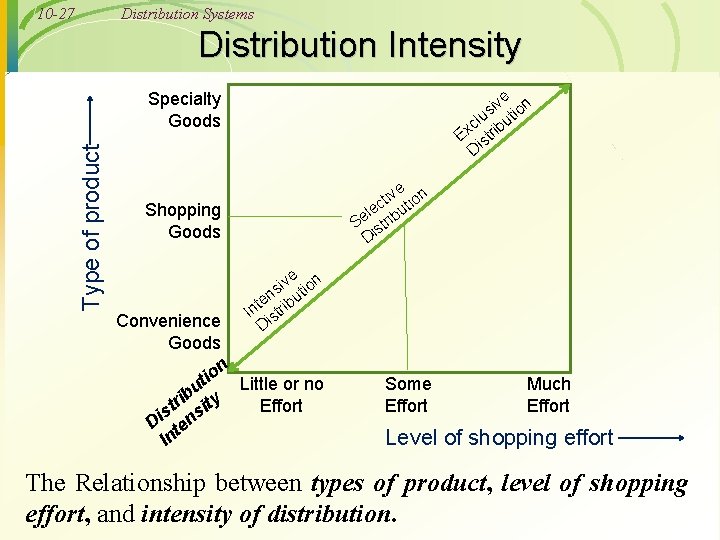
10 -27 Distribution Systems Distribution Intensity Type of product Specialty Goods e n v i s tio u l c ibu x E istr D ve on i t i lec ibut e S istr D Shopping Goods ive tion s n te ribu n I ist D Convenience Goods n io Little or no t u b i Effort tr sity s i D ten In Some Effort Much Effort Level of shopping effort The Relationship between types of product, level of shopping effort, and intensity of distribution.
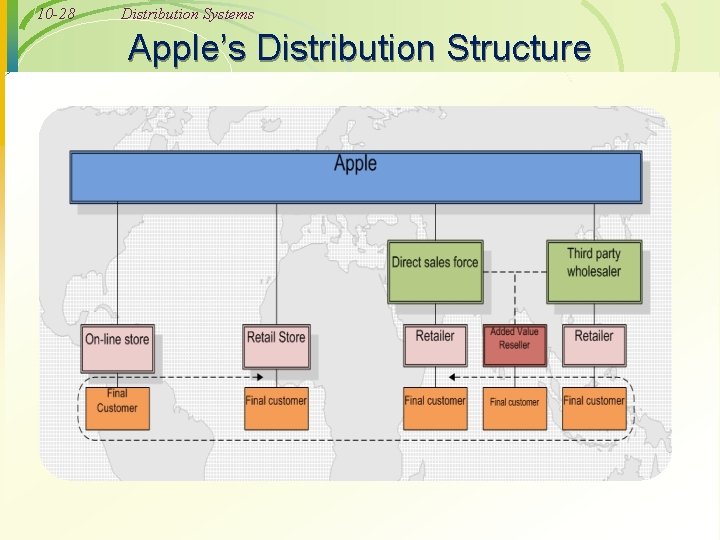
10 -28 Distribution Systems Apple’s Distribution Structure
10 -29 Distribution Systems Physical Distribution • A company’s physical distribution system contains the following elements: • Customer Service • Transportation • Inventory Control • Protective packaging and materials handling • Order Processing • Warehousing
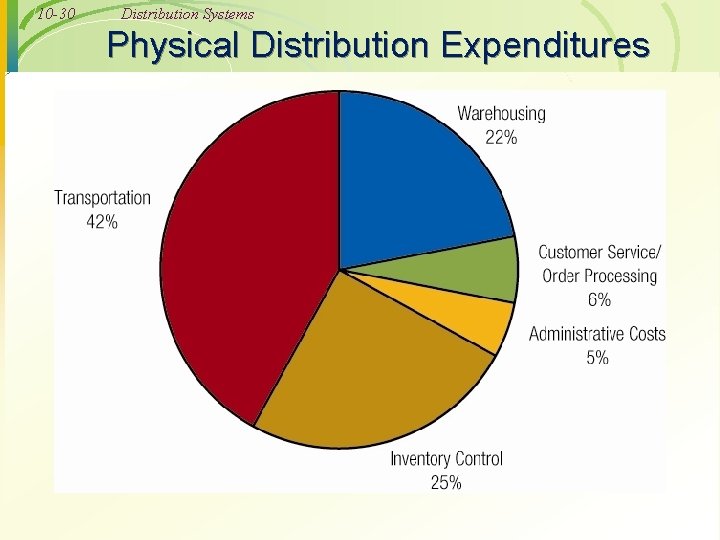
10 -30 Distribution Systems Physical Distribution Expenditures
10 -31 Distribution Systems Channel Management and Leadership • Channel captain - a dominant and controlling member of a distribution (marketing) channel. • Channel conflict: • Horizontal Conflict • Most often, horizontal conflict causes sparks between different types of marketing intermediaries that handle similar products. • Sometimes results from disagreements among channel members at the same level.
10 -32 Distribution Systems Channel Management and Leadership • Vertical Conflict • Channel members at different levels find many reasons for disputes. • e. g. , when retailers develop private brands to compete with producers’ brands or when producers establish their own retail outlets or internet sites. • The Grey Market (aka, parallel market) • Grey (or gray) good is a product made abroad under license from e. g. , a U. S. firm, and then sold back in the U. S. market in competition with that firm’s own domestic output. • Viewed by producers as undesired competition.
10 -33 Distribution Systems Conventional Distribution Channel vs. VMS, HMS • Conventional distribution channel: • is a channel consisting of one or more independent producers, wholesalers, and retailers, each a separate business seeking to maximize its own profits. • Vertical marketing system (VMS): • is a distribution channel structure in which producers, wholesalers, and retailers act as unified system. One channel member owns the others; or has contract with them; or has so much power that they cooperate.
10 -34 Distribution Systems TYPES OF VMS • Hindustan Unilever Ltd. ’s (HUL) distribution set-up is a classic example of a VMS. HUL is a market leader in Indian consumer products with a presence in over 20 consumer categories (soaps, detergents, tea, etc. ) with over 700 million Indian consumers using its products. It has a distribution channel of 6. 3 million outlets and owns 35 major Indian brands. • Corporate VMS: • is a vertical marketing system that combines successive stages of production and distribution under a single ownership - channel leadership is established through common ownership. e. g. , Mc. Donalds, Apple
10 -35 Distribution Systems TYPES OF VMS • Contractual VMS: • is a vertical marketing system in which independent firms of different level of production and distribution join together through contracts to obtain more economies or sales impact then they could achieve along, for example, a franchise. • Administered VMS: • is a vertical marketing system that coordinates successive stages of production and distribution not through common ownership of contractual ties but through the size and power of one of the parties. Manufacturers of top brands can obtain strong trade cooperation and support from resellers. e. g. , Wal-Mart.
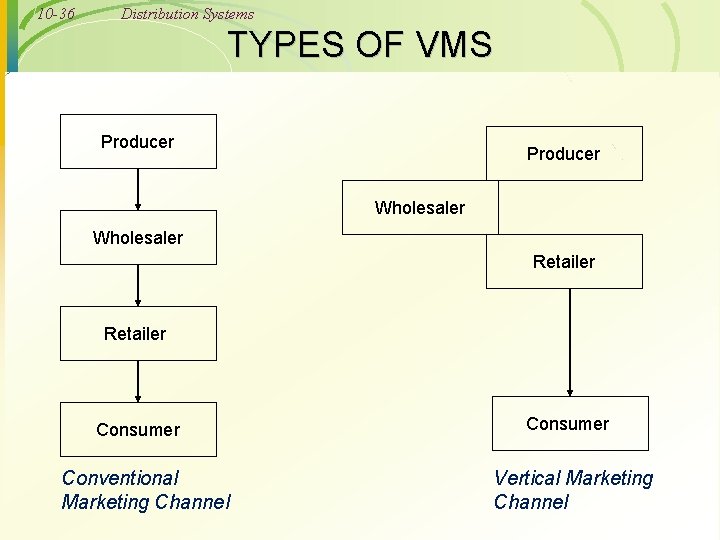
10 -36 Distribution Systems TYPES OF VMS Producer Wholesaler Retailer Consumer Conventional Marketing Channel Consumer Vertical Marketing Channel
10 -37 Distribution Systems Horizontal Marketing System (HMS) • HMS - is a channel arrangement in which two or more companies at one level join together to follow a new market opportunity. By working together companies can combine their financial, production and/or marketing resources to accomplish more than any one single company could alone. • e. g. , Apple & Starbucks announced music partnership in 2007; Nestle & Coca-Cola in Europe; Fiat & Tata Motor Ltd. , Auto Sales in India.

10 -38 Distribution Systems Homework - Essay · Word document
- Slides: 38