
10 1 Differential Analysis The Key to Decision




- Slides: 41
10 -1 Differential Analysis: The Key to Decision Making Chapter 10 Introduction to Managerial Accounting, Brewer, Garrison, Noreen Power Points from website - adapted by Cynthia Fortin, CPA, CMA http: //highered. mheducation. com/sites/0078025419/student_view 0/ch apter 12/index. html
10 -2 Managers make difficult decisions such as: • What to sell? • Make or buy a component part? • What price to charge? • What distribution channel to use? • Do we accept special orders at special prices? 10 -2
10 -3 Managers are handed a massive amount of data. • Only Costs and Benefits that differ between alternatives are relevant • Costs that are avoidable 10 -3
10 -4 Managers’ decision making skills – Able to • Ignore irrelevant costs • Recognie Avoidable cost o Costs can be eliminated by choosing one alternative over the other. 10 -4
B. R e n t i n g 10 -5 Avoidable cost of option A is the rental cost Avoidable cost of option B is the movie ticket. a 10 -5
10 -6 Keys to Successful Decision-Making 1. relevant only on costs 2. Ignore sunk costs and future costs and benefits that do not differ between the alternatives. 1. 3. Consider qualitative 10 -6
D i f f e r e n t P 10 -7 Costs that are relevant in one decision situation may not be relevant in another context. 10 -7
10 -8 Each decision situation requires the manager to examine the data at hand isolate the relevant costs. 10 -8
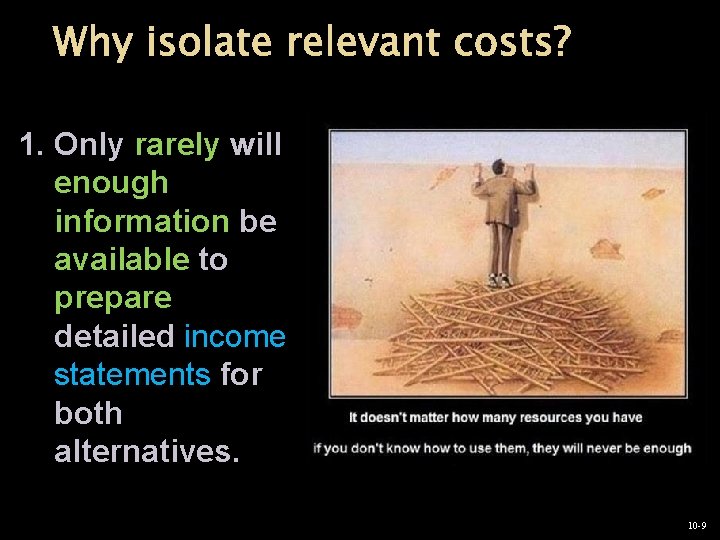
10 -9 Why isolate relevant costs? 1. Only rarely will enough information be available to prepare detailed income statements for both alternatives. 10 -9
Why isolate relevant costs? 10 -10 2. Mixing irrelevant costs with relevant costs may cause confusion and distract attention away from the information that is really critical. 10 -10
Keep or 10 -11 Drop Segments Also called adding new product lines or dropping old product lines 10 -11
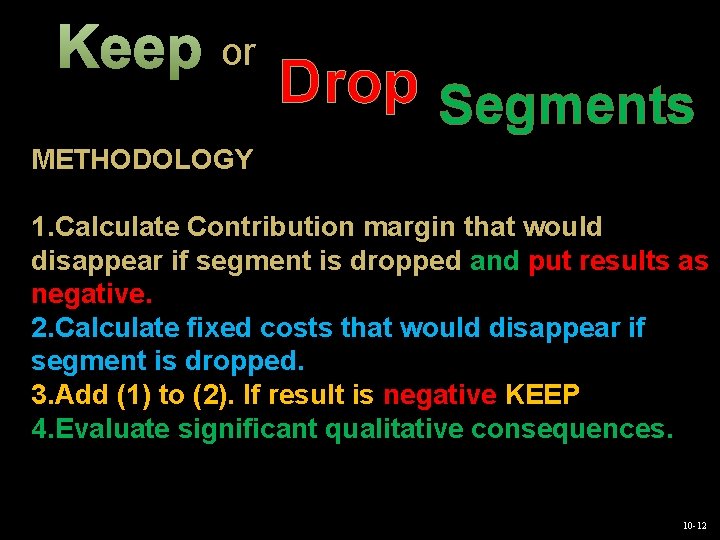
Keep or 10 -12 Drop Segments METHODOLOGY 1. Calculate Contribution margin that would disappear if segment is dropped and put results as negative. 2. Calculate fixed costs that would disappear if segment is dropped. 3. Add (1) to (2). If result is negative KEEP 4. Evaluate significant qualitative consequences. 10 -12
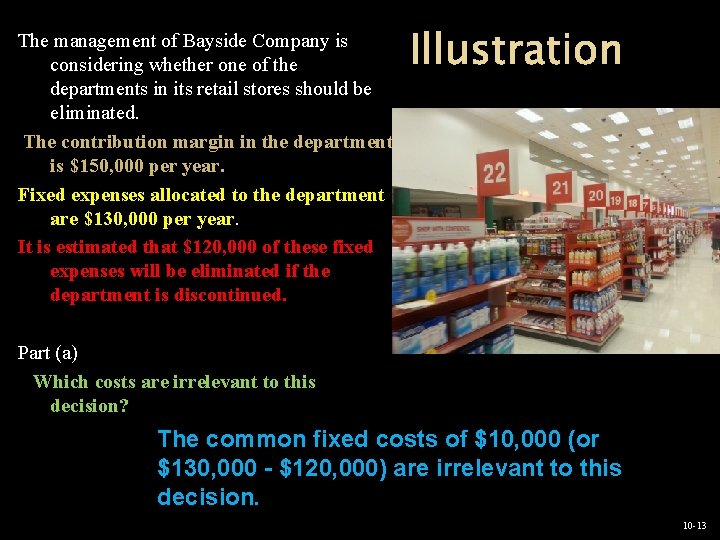
10 -13 The management of Bayside Company is considering whether one of the departments in its retail stores should be eliminated. The contribution margin in the department is $150, 000 per year. Fixed expenses allocated to the department are $130, 000 per year. It is estimated that $120, 000 of these fixed expenses will be eliminated if the department is discontinued. Illustration Part (a) Which costs are irrelevant to this decision? The common fixed costs of $10, 000 (or $130, 000 - $120, 000) are irrelevant to this decision. 10 -13
10 -14 Part (b) If the department is eliminated, what will be the impact on the company’s overall net operating income? CM that would be lost if department is discontinued $(150, 000) Less fixed costs that can be avoided if department is discontinued 120, 000 Increase (decrease) in net operating income (30, 000) Based on this information alone, because the company’s net operating income would decrease by $30, 000 per year, management should this department. 10 -14
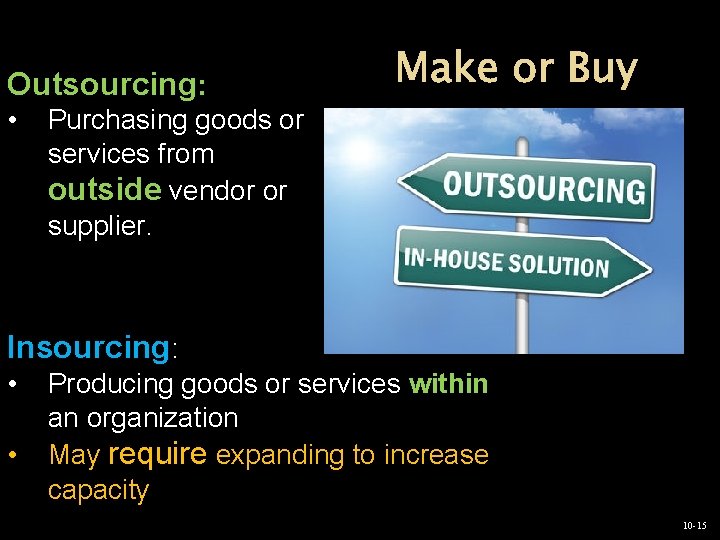
10 -15 Outsourcing: • Purchasing goods or services from outside vendor or supplier. Make or Buy Insourcing: • • Producing goods or services within an organization May require expanding to increase capacity 10 -15
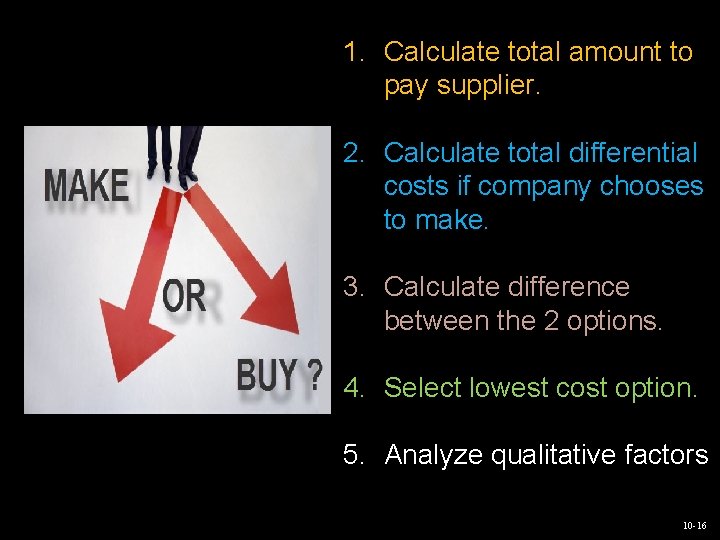
10 -16 1. Calculate total amount to pay supplier. 2. Calculate total differential costs if company chooses to make. 3. Calculate difference between the 2 options. 4. Select lowest cost option. 5. Analyze qualitative factors 10 -16
10 -17 Qualitative factors • Logistical considerations Ø distance from plant 10 -17
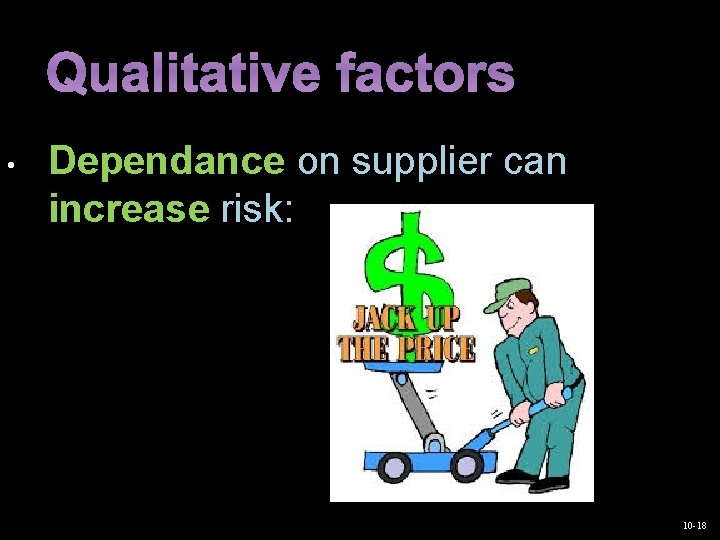
10 -18 Qualitative factors • Dependance on supplier can increase risk: 10 -18
y A n a l y s i s 10 -19 Idle space (caused by outsourcing) that has no alternative has an opportunity cost of $ 0. If there is an alternative consider the contribution margin of the opportunity. 10 -19
10 -20 § No longterm implications § There is existing idle capacity § Usually the price is lower than the regular product § There are variable and fixed relevant costs incurred 10 -20
10 -21 § Company must decide if the decision creates incremental net operating income § Fixed costs are sunk costs, therefore irrelevant § Absorption costing is not appropriate in the decision 10 -21
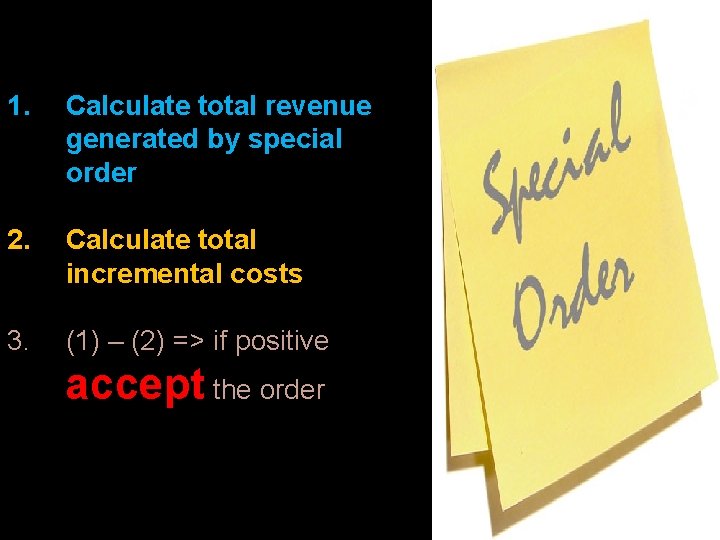
10 -22 1. Calculate total revenue generated by special order 2. Calculate total incremental costs 3. (1) – (2) => if positive accept the order 10 -22
10 -23 Qualitative factors 4. Will this impact regular customers? 5. Is there potential future business? 10 -23
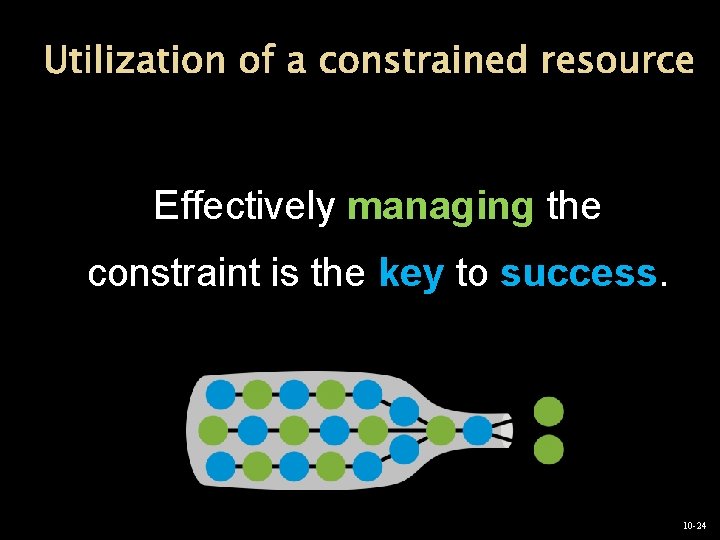
10 -24 Utilization of a constrained resource Effectively managing the constraint is the key to success. 10 -24
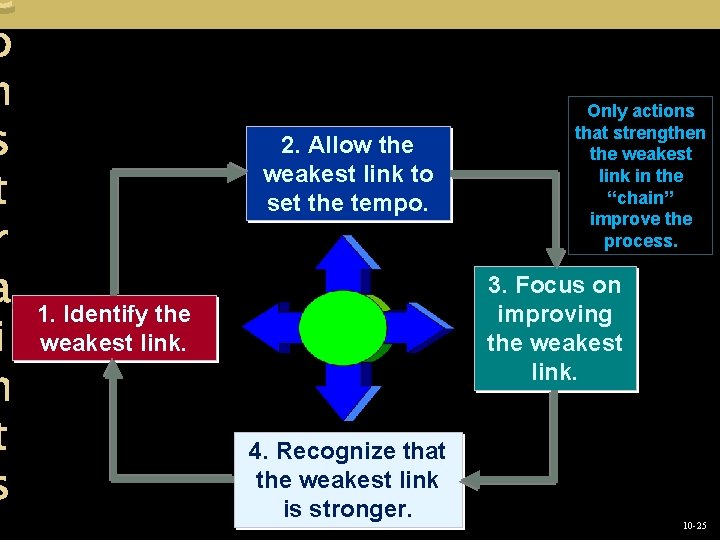
C o n s t r a i n t s 10 -25 2. Allow the weakest link to set the tempo. Only actions that strengthen the weakest link in the “chain” improve the process. 3. Focus on improving the weakest link. 1. Identify the weakest link. 4. Recognize that the weakest link is stronger. 10 -25
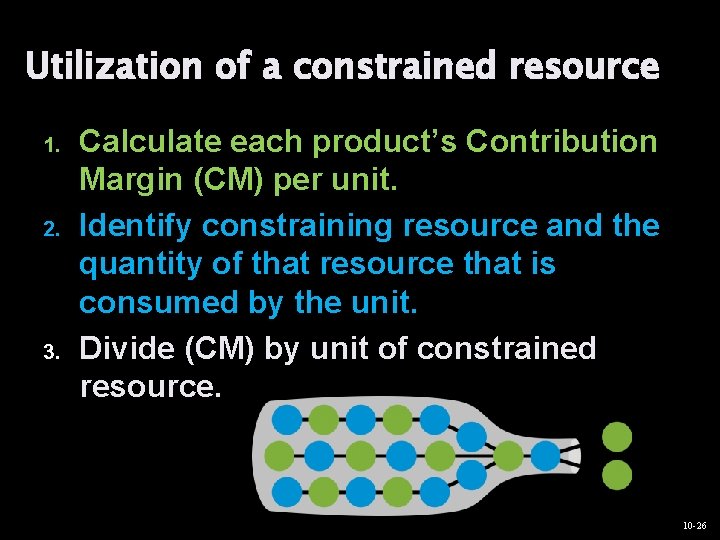
10 -26 Utilization of a constrained resource 1. 2. 3. Calculate each product’s Contribution Margin (CM) per unit. Identify constraining resource and the quantity of that resource that is consumed by the unit. Divide (CM) by unit of constrained resource. 10 -26
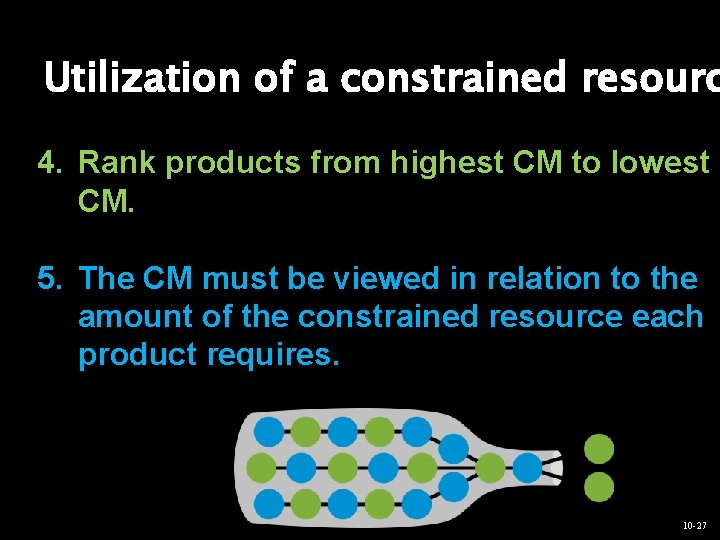
10 -27 Utilization of a constrained resourc 4. Rank products from highest CM to lowest CM. 5. The CM must be viewed in relation to the amount of the constrained resource each product requires. 10 -27
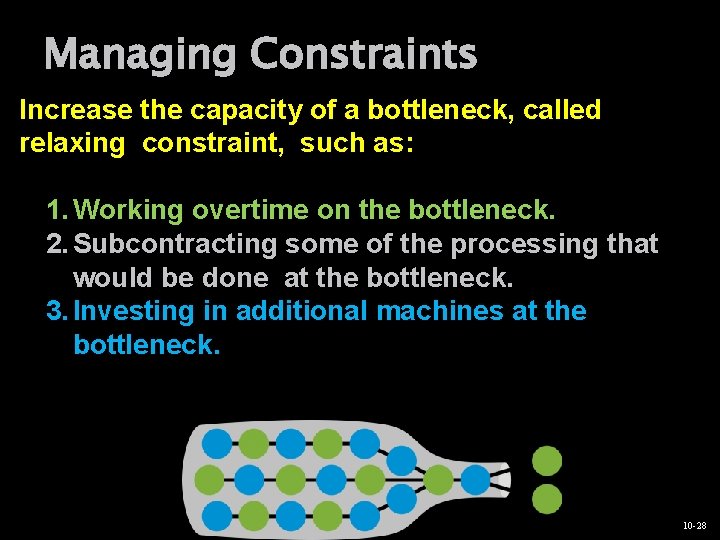
10 -28 Managing Constraints Increase the capacity of a bottleneck, called relaxing constraint, such as: 1. Working overtime on the bottleneck. 2. Subcontracting some of the processing that would be done at the bottleneck. 3. Investing in additional machines at the bottleneck. 10 -28
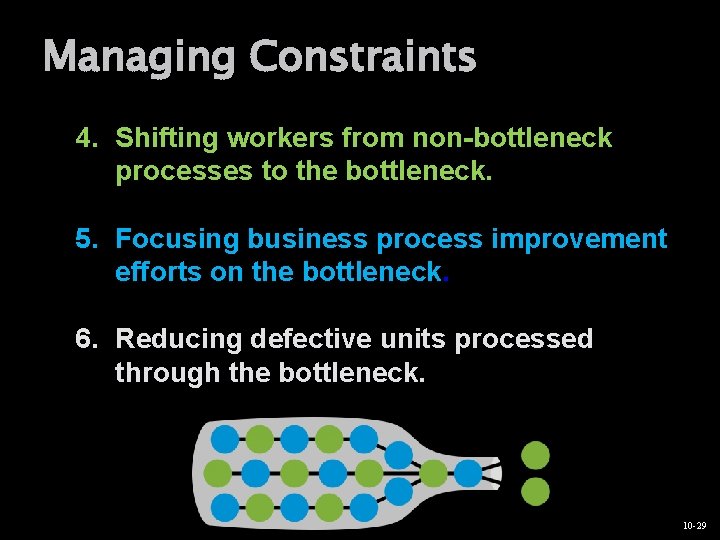
10 -29 Managing Constraints 4. Shifting workers from non-bottleneck processes to the bottleneck. 5. Focusing business process improvement efforts on the bottleneck. 6. Reducing defective units processed through the bottleneck. 10 -29
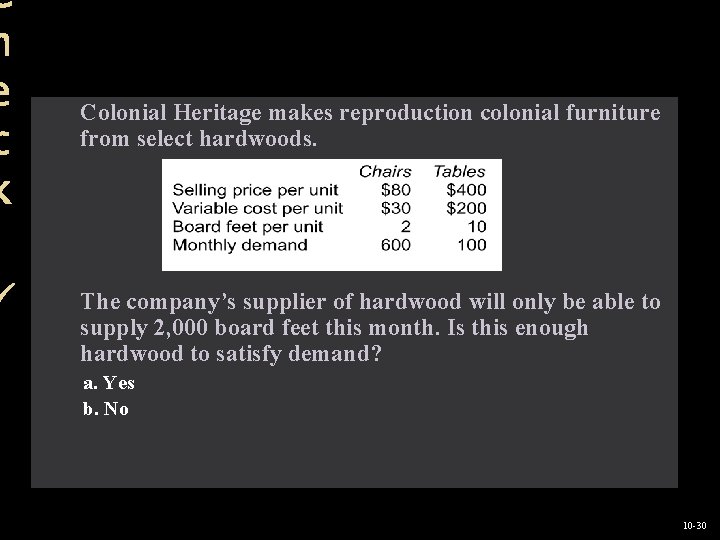
C h e c k 10 -30 Colonial Heritage makes reproduction colonial furniture from select hardwoods. The company’s supplier of hardwood will only be able to supply 2, 000 board feet this month. Is this enough hardwood to satisfy demand? a. Yes b. No 10 -30
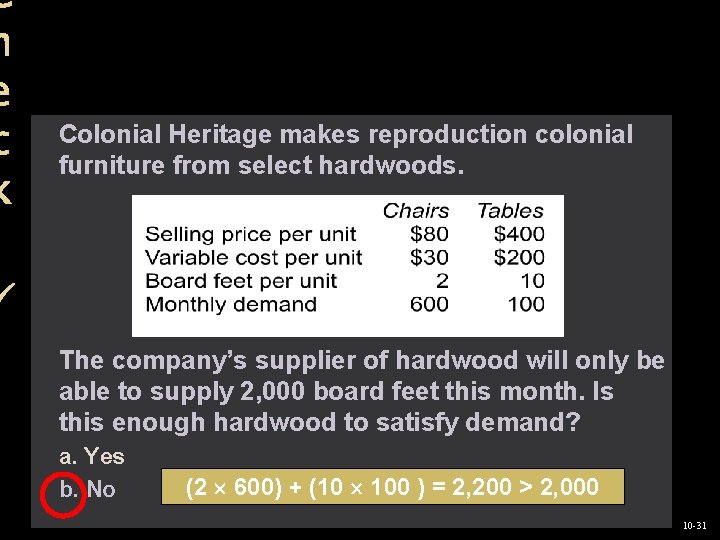
C h e c k 10 -31 Colonial Heritage makes reproduction colonial furniture from select hardwoods. The company’s supplier of hardwood will only be able to supply 2, 000 board feet this month. Is this enough hardwood to satisfy demand? a. Yes b. No (2 600) + (10 100 ) = 2, 200 > 2, 000 10 -31
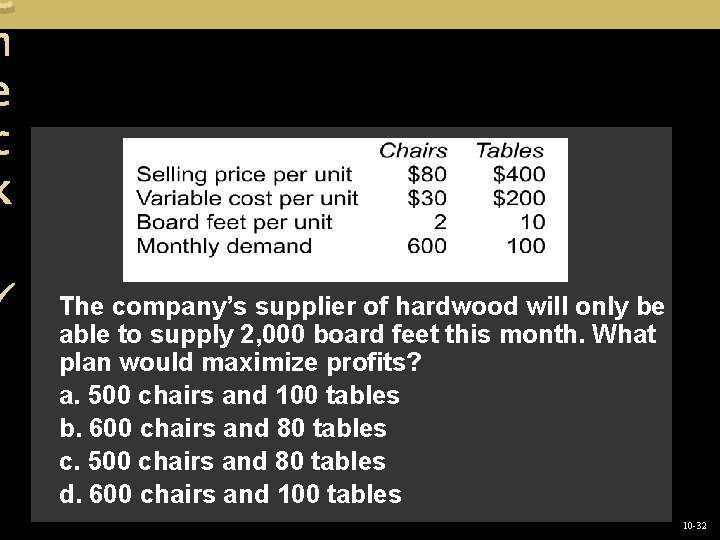
C h e c k 10 -32 The company’s supplier of hardwood will only be able to supply 2, 000 board feet this month. What plan would maximize profits? a. 500 chairs and 100 tables b. 600 chairs and 80 tables c. 500 chairs and 80 tables d. 600 chairs and 100 tables 10 -32
C h e c k 10 -33 The company’s supplier of hardwood will only be able to supply 2, 000 board feet this month. What plan would maximize profits? a. 500 chairs and 100 tables b. 600 chairs and 80 tables c. 500 chairs and 80 tables d. 600 chairs and 100 tables 10 -33
C h e c k 10 -34 A s b e f o r e , C o l o 10 -34
C h e c k 10 -35 As additional before, Colonial The wood. Heritage’s would besupplier used toofmake hardwood only be each able toboard supplyfoot 2, 000 tables. Inwill this use, ofboard feet this wood month. will Assume follows the additional allowthe thecompany to earn we have$20 proposed. Up to how margin much should anplan additional of contribution and Colonial Heritage be willing to pay above the profit. Therefore it’s the amount equal to the usual price to obtain more hardwood? contribution per board foot for the tables. a. $40 per board foot b. $25 per board foot c. $20 per board foot d. Zero 10 -35
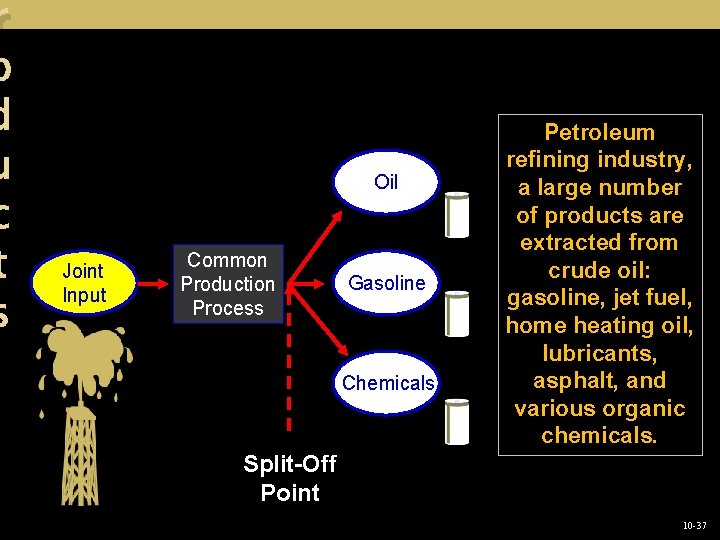
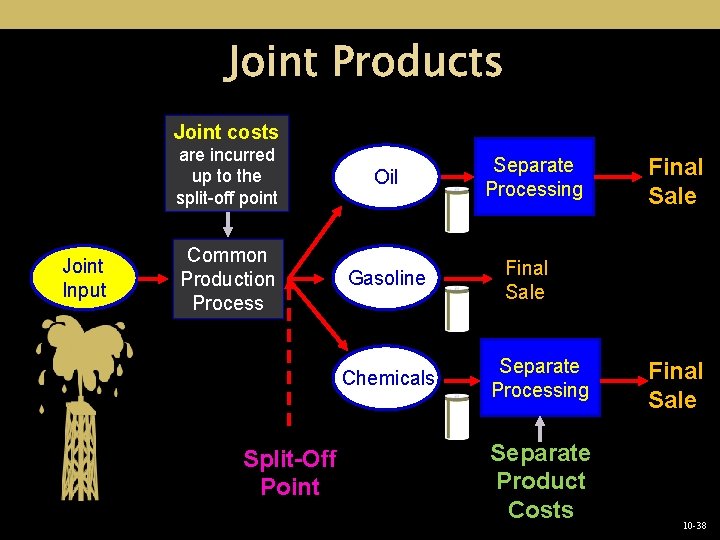
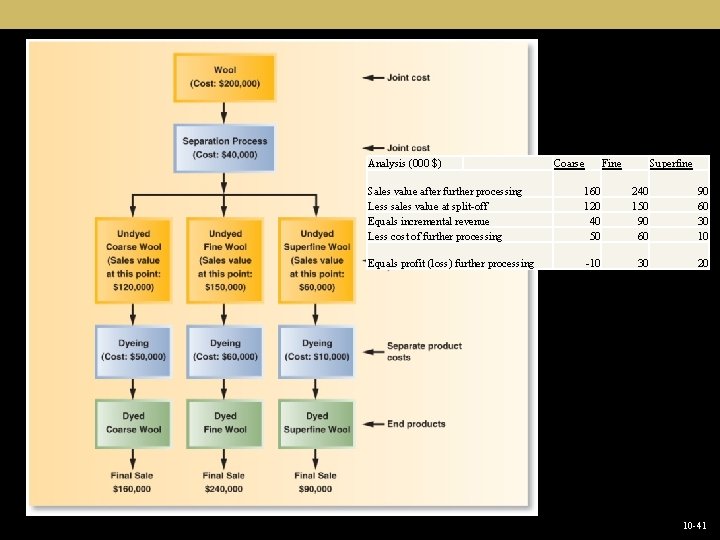
10 -36 Sell or Process further Joint Product Costs and Contribution Margin When 2 or more products are produced from a common input. Split-off point is when the diffferent products are separated. 10 -36
r o d u c t s 10 -37 Oil Joint Input Common Production Process Gasoline Chemicals Petroleum refining industry, a large number of products are extracted from crude oil: gasoline, jet fuel, home heating oil, lubricants, asphalt, and various organic chemicals. Split-Off Point 10 -37
10 -38 Joint Products Joint costs Joint Input are incurred up to the split-off point Oil Common Production Process Gasoline Chemicals Split-Off Point Separate Processing Final Sale Separate Processing Separate Product Costs Final Sale 10 -38
10 -39 or Process further Joint costs are irrelevant From the split-off point they cannot be avoided. Joint costs are common and should not be included in making decisions 10 -39
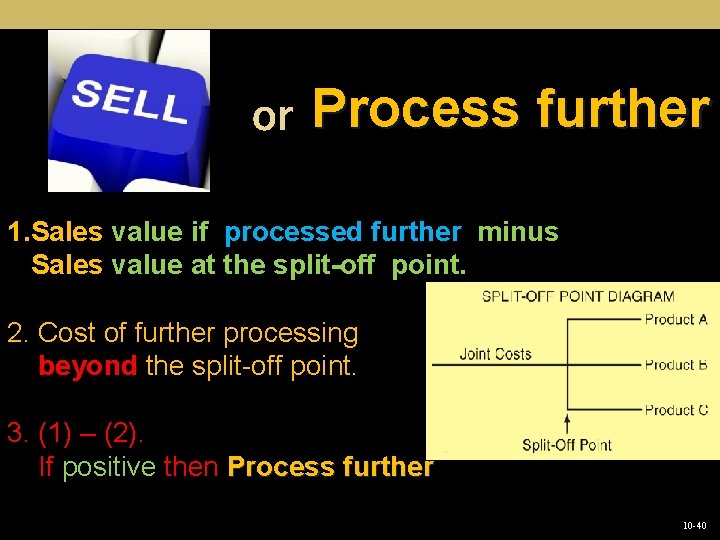
10 -40 or Process further 1. Sales value if processed further minus Sales value at the split-off point. 2. Cost of further processing beyond the split-off point. 3. (1) – (2). If positive then Process further 10 -40
10 -41 Analysis (000 $) Coarse Fine Superfine Sales value after further processing Less sales value at split-off Equals incremental revenue Less cost of further processing 160 120 40 50 240 150 90 60 30 10 Equals profit (loss) further processing -10 30 20 10 -41