
10 1 Benefits of Stock Ownership Voting rights
10 -1 Benefits of Stock Ownership • Voting rights • Dividend Rights • Sale or Liquidation Participant • Equity Growth Potential Realized at Take-Out Under Buy-Sell • Capital Gains Tax Break on Gain Recognized • Feel Better – Really Part of Team • Treated Better – Work With Owners, not For Owners Copyright 2005 Dwight Drake. All Rights Reserved. Business Planning: Closely Held Enterprises www. drake-business-planning. com
Equity Structural Factors 10 -2 • Real Cost Factor – Is anything going to be paid? • Value Now Factor – Instant value or look only to future? • Golden Handcuffs Factor - Can it be lost? • Cash-Out Factor - The Buy-Sell agreement challenge • Phantom Income Factor – A tax bill from paper stock certificate • Employer’s Tax Factor – Does employer get tax break? • Fall-Out Leverage Factor – If things blow, who has advantage? • Real Thing Factor – Is genuine thing important? Copyright 2005 Dwight Drake. All Rights Reserved. Business Planning: Closely Held Enterprises www. drake-business-planning. com
Incentive Stock Options 10 -3 What it is? Executive given right to buy designated number of shares at designated price over designated time frame. Advantages: • No income to executive at time of option grant • No income to executive at time of exercise (but tax preference item to extent of excess FMV over cost) • Capital gain at time of sale if not sold within two years of grant or one year of exercise Copyright 2005 Dwight Drake. All Rights Reserved. Business Planning: Closely Held Enterprises www. drake-business-planning. com
Incentive Stock Option Requirements 10 -4 • Plan adopted by shareholders within 12 months of board’s adoption. • Option granted within 10 years of plan adoption. • Option period may not exceed 10 years. • Option price not less than FMV of stock at time of grant. • Option not transferable by executive, except on death. • Executive can not own more than 10% of company. • FMV of all stock first subject to ISOs in same calendar year (determined as of grant date) can’t exceed 100 k. • Executive can’t sell within 2 yrs of grant or one year of exercise to get capital gains benefits. • Executive must be employee from time of grant until three months before exercise. Copyright 2005 Dwight Drake. All Rights Reserved. Business Planning: Closely Held Enterprises www. drake-business-planning. com
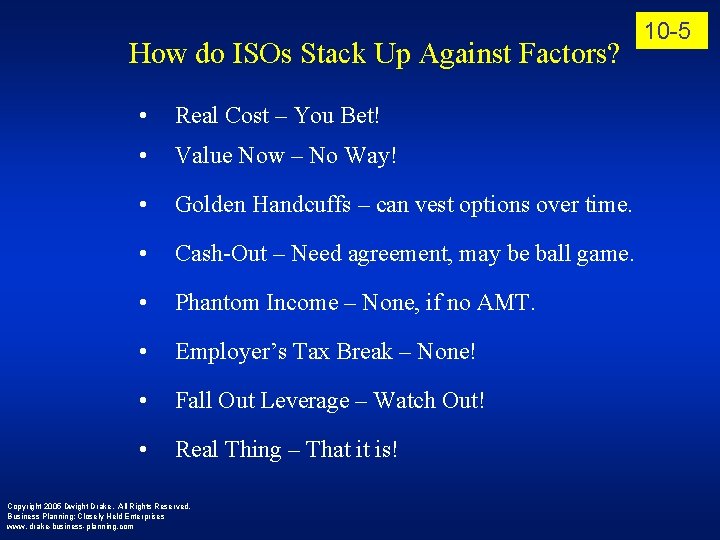
How do ISOs Stack Up Against Factors? • Real Cost – You Bet! • Value Now – No Way! • Golden Handcuffs – can vest options over time. • Cash-Out – Need agreement, may be ball game. • Phantom Income – None, if no AMT. • Employer’s Tax Break – None! • Fall Out Leverage – Watch Out! • Real Thing – That it is! Copyright 2005 Dwight Drake. All Rights Reserved. Business Planning: Closely Held Enterprises www. drake-business-planning. com 10 -5
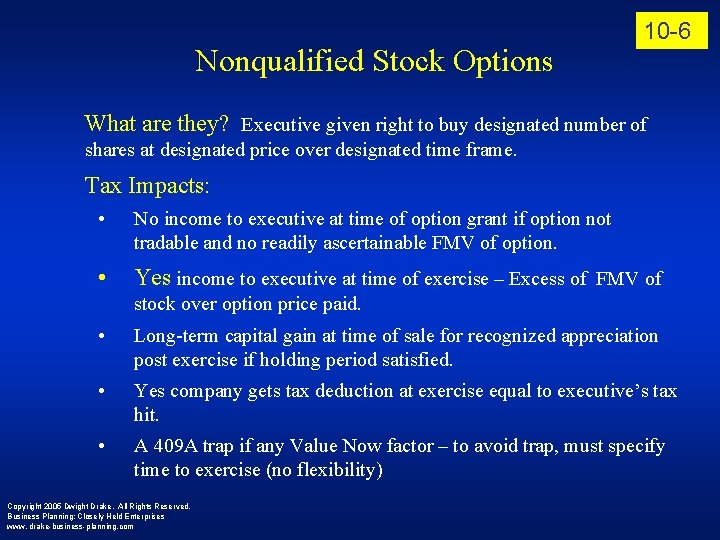
Nonqualified Stock Options 10 -6 What are they? Executive given right to buy designated number of shares at designated price over designated time frame. Tax Impacts: • No income to executive at time of option grant if option not tradable and no readily ascertainable FMV of option. • Yes income to executive at time of exercise – Excess of FMV of stock over option price paid. • Long-term capital gain at time of sale for recognized appreciation post exercise if holding period satisfied. • Yes company gets tax deduction at exercise equal to executive’s tax hit. • A 409 A trap if any Value Now factor – to avoid trap, must specify time to exercise (no flexibility) Copyright 2005 Dwight Drake. All Rights Reserved. Business Planning: Closely Held Enterprises www. drake-business-planning. com
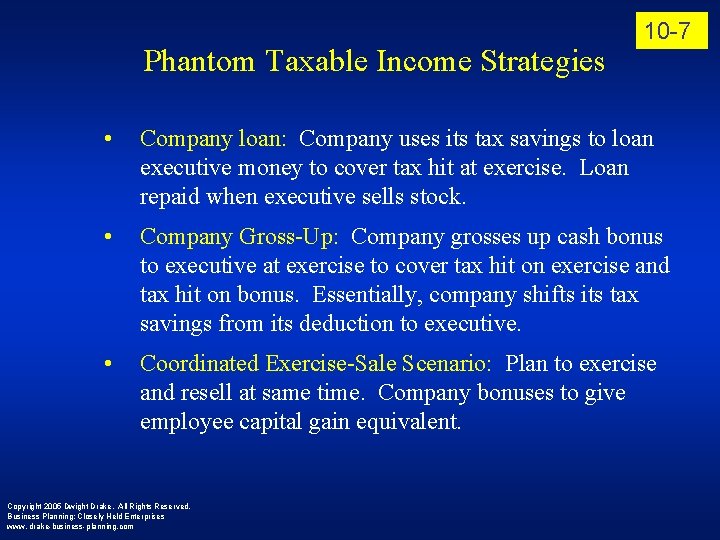
Phantom Taxable Income Strategies 10 -7 • Company loan: Company uses its tax savings to loan executive money to cover tax hit at exercise. Loan repaid when executive sells stock. • Company Gross-Up: Company grosses up cash bonus to executive at exercise to cover tax hit on exercise and tax hit on bonus. Essentially, company shifts its tax savings from its deduction to executive. • Coordinated Exercise-Sale Scenario: Plan to exercise and resell at same time. Company bonuses to give employee capital gain equivalent. Copyright 2005 Dwight Drake. All Rights Reserved. Business Planning: Closely Held Enterprises www. drake-business-planning. com
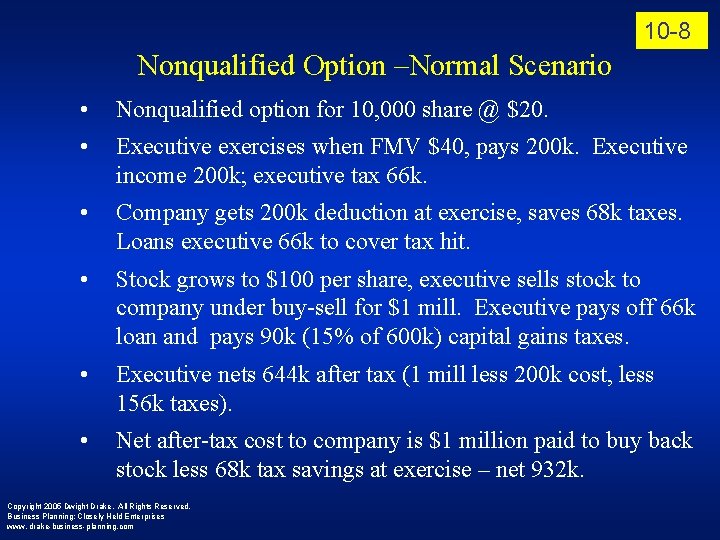
10 -8 Nonqualified Option –Normal Scenario • Nonqualified option for 10, 000 share @ $20. • Executive exercises when FMV $40, pays 200 k. Executive income 200 k; executive tax 66 k. • Company gets 200 k deduction at exercise, saves 68 k taxes. Loans executive 66 k to cover tax hit. • Stock grows to $100 per share, executive sells stock to company under buy-sell for $1 mill. Executive pays off 66 k loan and pays 90 k (15% of 600 k) capital gains taxes. • Executive nets 644 k after tax (1 mill less 200 k cost, less 156 k taxes). • Net after-tax cost to company is $1 million paid to buy back stock less 68 k tax savings at exercise – net 932 k. Copyright 2005 Dwight Drake. All Rights Reserved. Business Planning: Closely Held Enterprises www. drake-business-planning. com
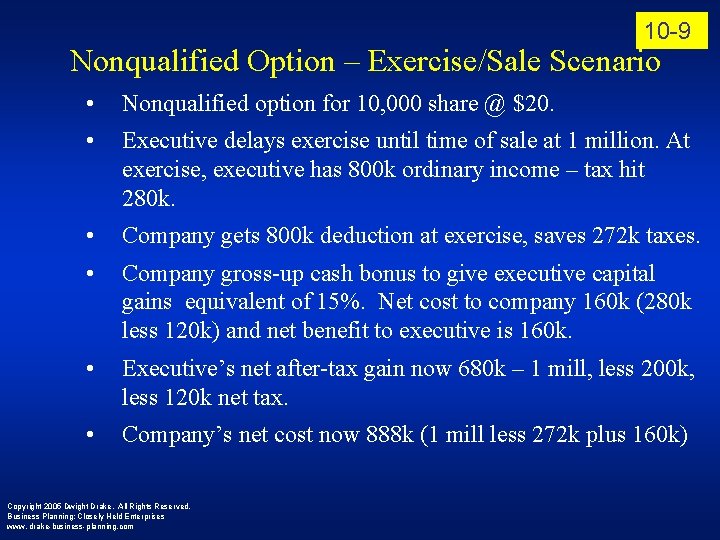
10 -9 Nonqualified Option – Exercise/Sale Scenario • Nonqualified option for 10, 000 share @ $20. • Executive delays exercise until time of sale at 1 million. At exercise, executive has 800 k ordinary income – tax hit 280 k. • Company gets 800 k deduction at exercise, saves 272 k taxes. • Company gross-up cash bonus to give executive capital gains equivalent of 15%. Net cost to company 160 k (280 k less 120 k) and net benefit to executive is 160 k. • Executive’s net after-tax gain now 680 k – 1 mill, less 200 k, less 120 k net tax. • Company’s net cost now 888 k (1 mill less 272 k plus 160 k) Copyright 2005 Dwight Drake. All Rights Reserved. Business Planning: Closely Held Enterprises www. drake-business-planning. com
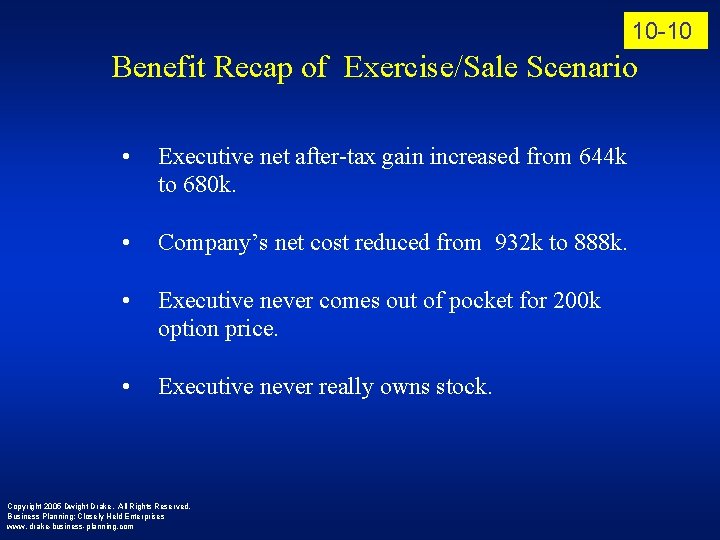
10 -10 Benefit Recap of Exercise/Sale Scenario • Executive net after-tax gain increased from 644 k to 680 k. • Company’s net cost reduced from 932 k to 888 k. • Executive never comes out of pocket for 200 k option price. • Executive never really owns stock. Copyright 2005 Dwight Drake. All Rights Reserved. Business Planning: Closely Held Enterprises www. drake-business-planning. com
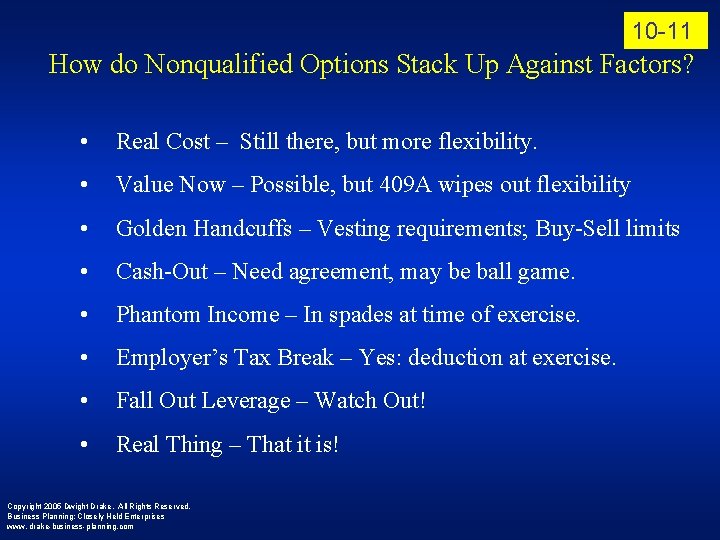
10 -11 How do Nonqualified Options Stack Up Against Factors? • Real Cost – Still there, but more flexibility. • Value Now – Possible, but 409 A wipes out flexibility • Golden Handcuffs – Vesting requirements; Buy-Sell limits • Cash-Out – Need agreement, may be ball game. • Phantom Income – In spades at time of exercise. • Employer’s Tax Break – Yes: deduction at exercise. • Fall Out Leverage – Watch Out! • Real Thing – That it is! Copyright 2005 Dwight Drake. All Rights Reserved. Business Planning: Closely Held Enterprises www. drake-business-planning. com
10 -12 Bonus Stock What it is: Company just bonuses stock to executive. Tax Impacts: • Section 83 income to executive based on FMV of stock. • Section 162 deduction to company. Copyright 2005 Dwight Drake. All Rights Reserved. Business Planning: Closely Held Enterprises www. drake-business-planning. com
10 -13 How does Bonus Stock Stack Up Against Factors? • Real Cost – None. • Value Now – Absolutely, but usually fewer shares. • Golden Handcuffs – None. • Cash-Out – Need agreement, may be ball game. • Phantom Income – In spades. • Employer’s Tax Break – Yes. • Fall Out Leverage – Watch Out! • Real Thing – That it is! Copyright 2005 Dwight Drake. All Rights Reserved. Business Planning: Closely Held Enterprises www. drake-business-planning. com
Restricted Stock 10 -14 What it is: Bonus stock with big twist – forfeiture restrictions for executive. Tax Impacts: • Section 83 income to executive based on FMV of stock when forfeiture restriction lapses. • Section 162 deduction to company. • 83(b) election to executive – take lower tax hit at grant to get bigger capital gain break down road. No offsetting benefit if end up forfeiting stock. • No 409 A concerns, even with income deferral resulting from forfeiture risks. Copyright 2005 Dwight Drake. All Rights Reserved. Business Planning: Closely Held Enterprises www. drake-business-planning. com
10 -15 How does Restricted Stock Stack Up Against Factors? • Real Cost – None. • Value Now – Absolutely, but usually fewer shares. • Golden Handcuffs – Mucho! • Cash-Out – Need agreement, may be ball game. • Phantom Income – In spades. • Employer’s Tax Break – Yep. • Fall Out Leverage – Watch Out! • Real Thing – That it is! Copyright 2005 Dwight Drake. All Rights Reserved. Business Planning: Closely Held Enterprises www. drake-business-planning. com
10 -16 Two None Real Thing Strategies Stock Appreciation Rights: Pretend stock where executive is given upside benefit in future growth as deferred compensation. Phantom Stock or Stock Equivalency: Pretend stock with present “Value Now” and future appreciation for executive, all wrapped in deferred compensation contract. Must comply with 409 A. May include grossup bonus that provides the executive with economic equivalent capital gains benefit. Copyright 2005 Dwight Drake. All Rights Reserved. Business Planning: Closely Held Enterprises www. drake-business-planning. com
10 -17 How do Non-Real Things Stack Up Against Factors? • Real Cost – None. • Value Now – Yes, but must comply with 409 A. • Golden Handcuffs – If desired • Cash-Out – Need agreement, may be ball game. Capital gains gross-up easy. • Phantom Income – None. • Employer’s Tax Break – The best, saves big. • Fall Out Leverage – None! • Real Thing – Never, only real negative Copyright 2005 Dwight Drake. All Rights Reserved. Business Planning: Closely Held Enterprises www. drake-business-planning. com
- Slides: 17