
1 Workforce Planning Developing Your Workforce Plan Webinar
1 Workforce Planning: Developing Your Workforce Plan Webinar Series Presented by: Office of Human Capital October 30, 2018 U. S. Department of the Interior U. S. Geological Survey
2 LEARNING OBJECTIVES The purpose of the webinar series is to: • Share workforce planning concepts and tools used during the workforce planning process to support Center/Office management in their workforce planning efforts.
3 LEARNING OBJECTIVES The learning objectives of this webinar are to: • Explore the importance of identifying the workforce you have vs what you will need in the short and long term
4 LEARNING OBJECTIVES
5 Future Workforce I. Future Workforce Description II. Gap Analysis
6 Future Workforce I. Description of the Future Workforce • A narrative describing the organization’s current workforce vs. the need for the next 3 -5 years • Focus on scientific expertise, technical skills and characteristic necessary. • Can be general workforce or specific numbers of positions
7 Future Workforce I. Description of the Future Workforce • A narrative describing the organization’s current workforce vs. the need for the next 3 -5 years • Focus on scientific expertise, technical skills and characteristic necessary. • Can be general workforce or specific numbers of positions
8 Future Workforce I. Description of the Future Workforce Guided Inquiry Questions: • What differences exist between the current and future workforce? • How will those differences evolve over the next 3 - 5 years? • Will there be a future shortage in a particular occupational series or skill? • Is there any anticipated over supply in a particular occupational series or skills? • What are the anticipated changes between your current and future organizational structure?
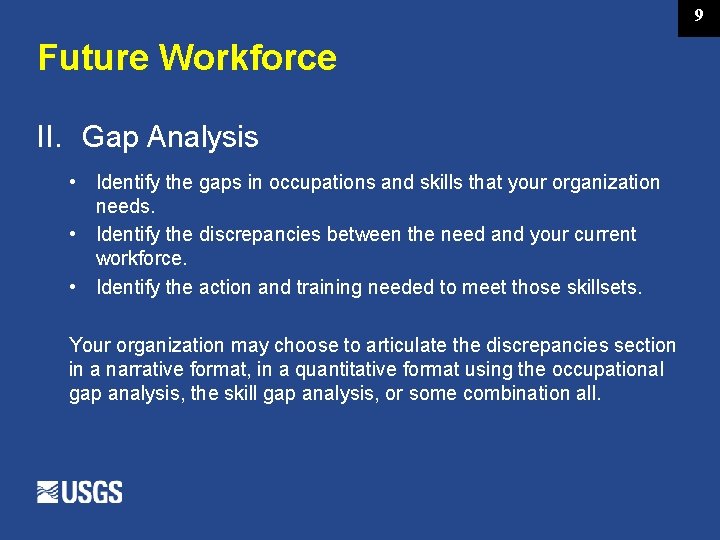
9 Future Workforce II. Gap Analysis • Identify the gaps in occupations and skills that your organization needs. • Identify the discrepancies between the need and your current workforce. • Identify the action and training needed to meet those skillsets. Your organization may choose to articulate the discrepancies section in a narrative format, in a quantitative format using the occupational gap analysis, the skill gap analysis, or some combination all.
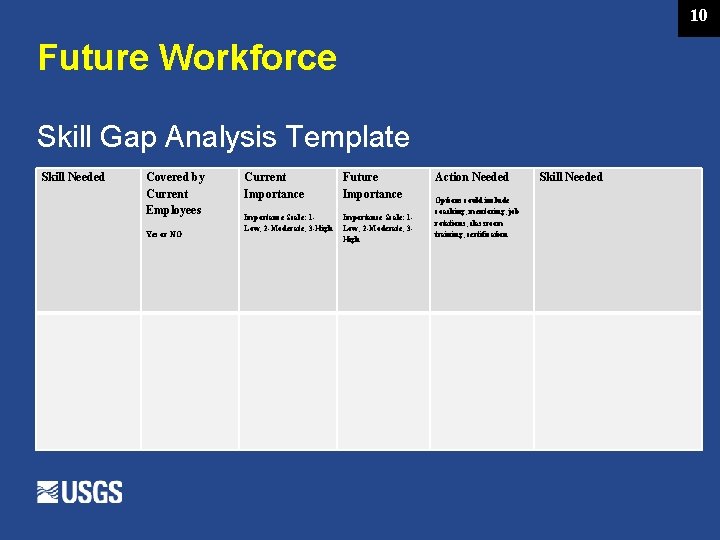
10 Future Workforce Skill Gap Analysis Template Skill Needed Covered by Current Employees Yes or NO Current Importance Future Importance Scale: 1 Low; 2 -Moderate; 3 -High Importance Scale: 1 Low; 2 -Moderate; 3 High Action Needed Skill Needed Options could include coaching, mentoring, job rotations, classroom training, certification
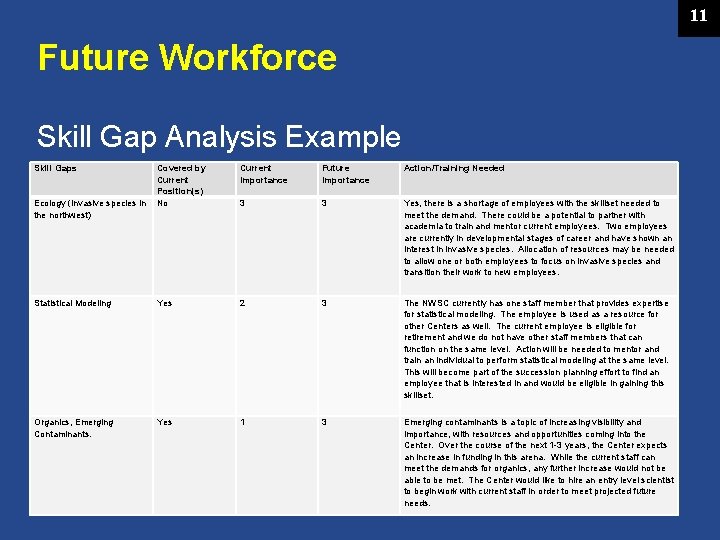
11 Future Workforce Skill Gap Analysis Example Skill Gaps Covered by Current Position(s) Ecology (invasive species in No the northwest) Current Importance Future Importance Action/Training Needed 3 3 Yes, there is a shortage of employees with the skillset needed to meet the demand. There could be a potential to partner with academia to train and mentor current employees. Two employees are currently in developmental stages of career and have shown an interest in invasive species. Allocation of resources may be needed to allow one or both employees to focus on invasive species and transition their work to new employees. Yes 2 3 The NWSC currently has one staff member that provides expertise for statistical modeling. The employee is used as a resource for other Centers as well. The current employee is eligible for retirement and we do not have other staff members that can function on the same level. Action will be needed to mentor and train an individual to perform statistical modeling at the same level. This will become part of the succession planning effort to find an employee that is interested in and would be eligible in gaining this skillset. Yes 1 3 Emerging contaminants is a topic of increasing visibility and importance, with resources and opportunities coming into the Center. Over the course of the next 1 -3 years, the Center expects an increase in funding in this arena. While the current staff can meet the demands for organics, any further increase would not be able to be met. The Center would like to hire an entry level scientist to begin work with current staff in order to meet projected future needs. Statistical Modeling Organics, Emerging Contaminants.
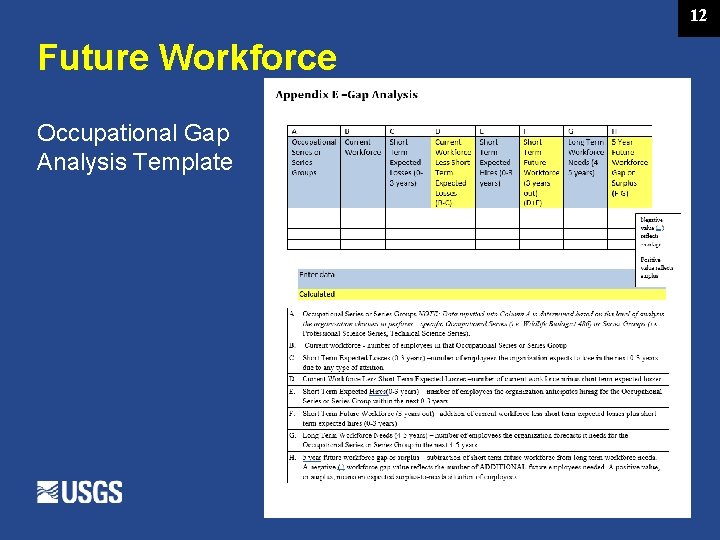
12 Future Workforce Occupational Gap Analysis Template
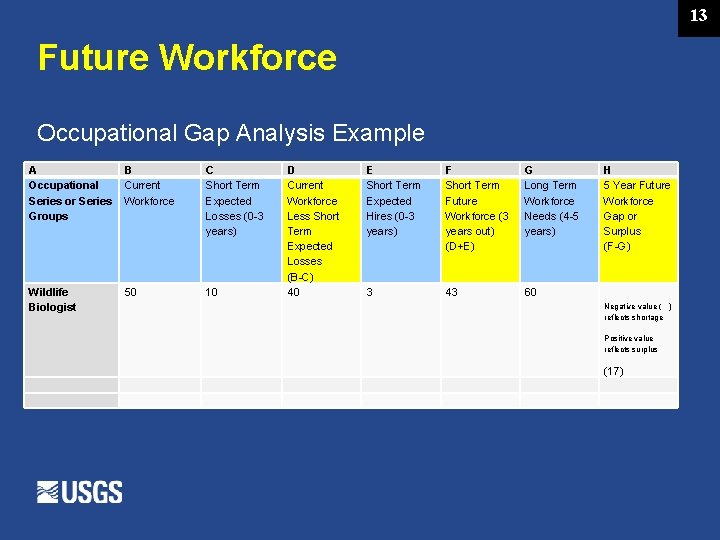
13 Future Workforce Occupational Gap Analysis Example A B Occupational Current Series or Series Workforce Groups C Short Term Expected Losses (0 -3 years) Wildlife Biologist 10 50 D Current Workforce Less Short Term Expected Losses (B-C) 40 E Short Term Expected Hires (0 -3 years) F Short Term Future Workforce (3 years out) (D+E) G Long Term Workforce Needs (4 -5 years) 3 43 60 H 5 Year Future Workforce Gap or Surplus (F-G) Negative value ( ) reflects shortage Positive value reflects surplus (17)
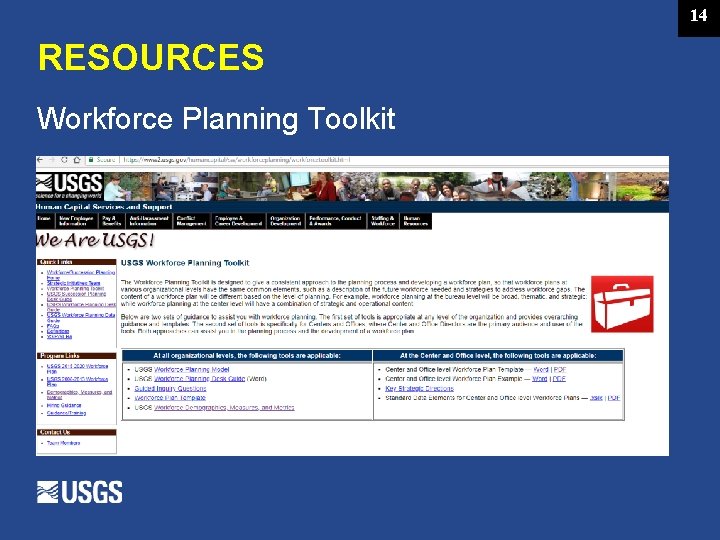
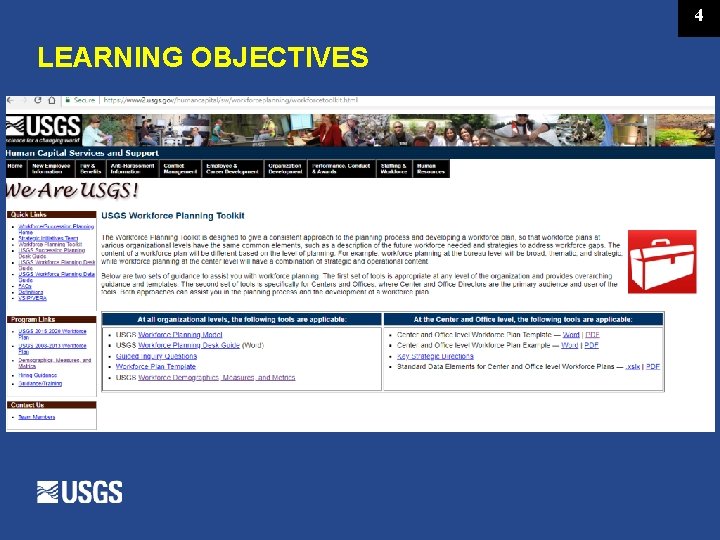
14 RESOURCES Workforce Planning Toolkit
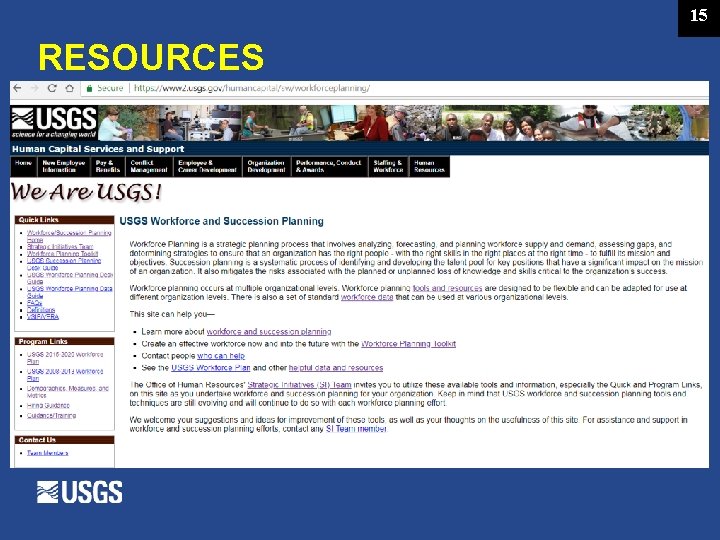
15 RESOURCES
16 RESOURCES The HR Strategic Initiatives Team, in cooperation with the Servicing HR Office, provides guidance and support on workforce and succession planning. • Pam Agnew, Workforce Data Program Manager, pagnew@usgs. gov, 703 -648 -7435 • Brian Arnold-Renicker, Program Analyst, brenicke@usgs. gov, 303 -236 -9578 • Jill Nissan, Workforce Planning Program Manager, jnissan@usgs. gov, 703 -648 -7427
17 On the Next Webinar: Action Plan Monitor, Evaluate and Revise
- Slides: 17