
1 Wind turbine design according to Betz and
1 Wind turbine design according to Betz and Schmitz
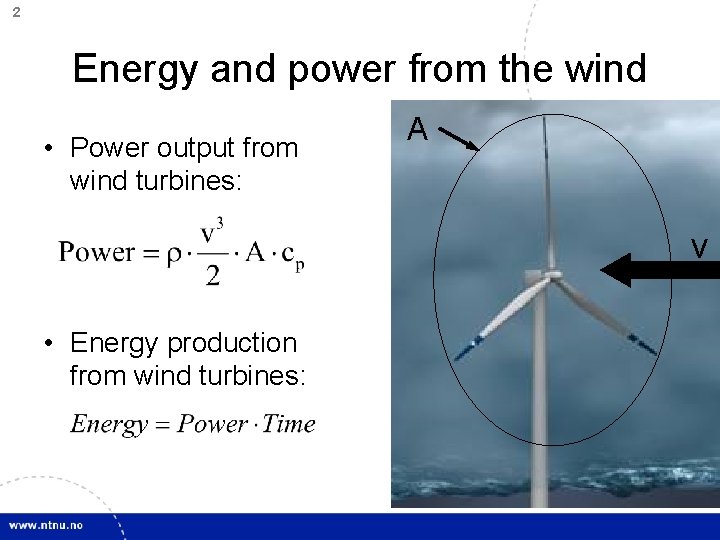
2 Energy and power from the wind • Power output from wind turbines: A v • Energy production from wind turbines:
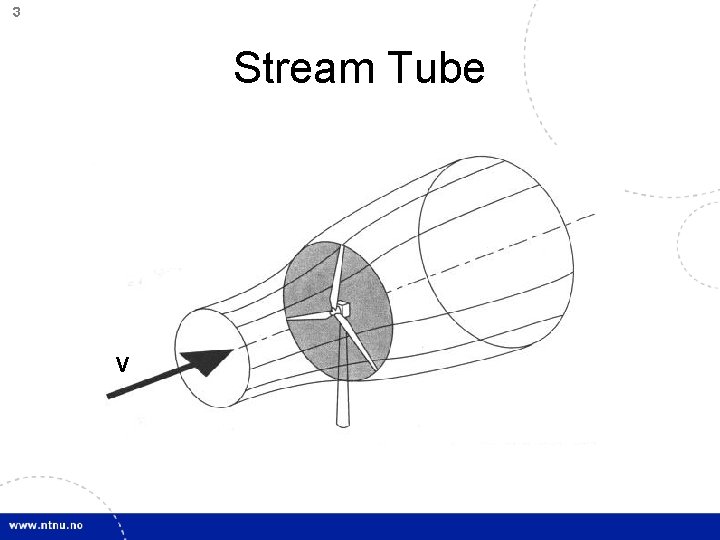
3 Stream Tube V

4 Extracted Energy and Power Where: E • ex = Extracted Energy Eex = Extracted Power m = Mass • m = Mass flow rate v = Velocity [J] [W] [kg/s] [m/s]
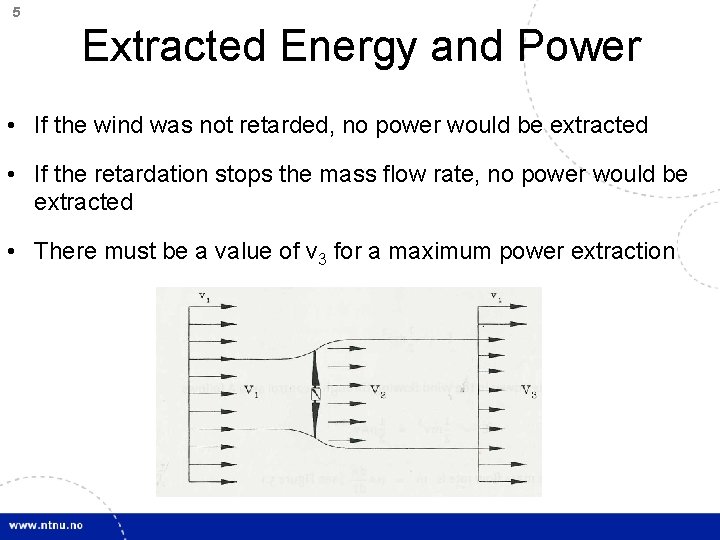
5 Extracted Energy and Power • If the wind was not retarded, no power would be extracted • If the retardation stops the mass flow rate, no power would be extracted • There must be a value of v 3 for a maximum power extraction
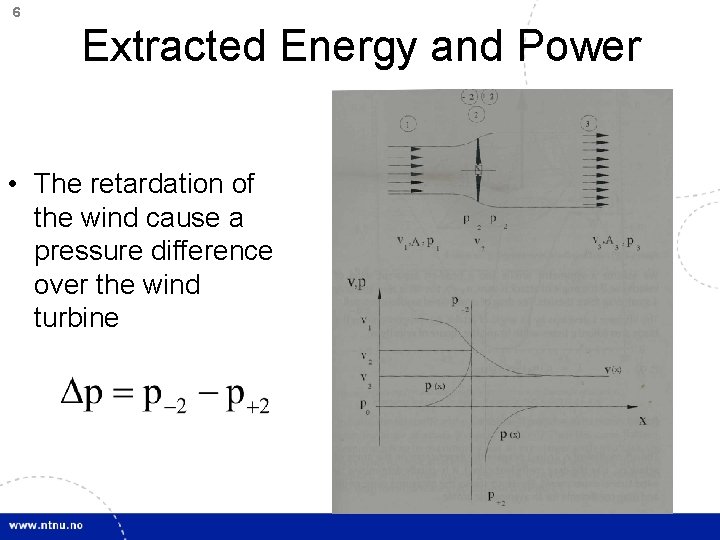
6 Extracted Energy and Power • The retardation of the wind cause a pressure difference over the wind turbine
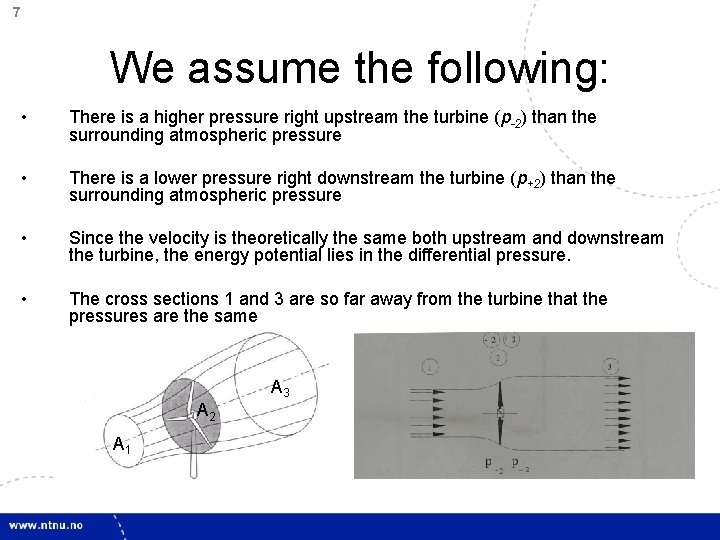
7 We assume the following: • There is a higher pressure right upstream the turbine (p-2) than the surrounding atmospheric pressure • There is a lower pressure right downstream the turbine (p+2) than the surrounding atmospheric pressure • Since the velocity is theoretically the same both upstream and downstream the turbine, the energy potential lies in the differential pressure. • The cross sections 1 and 3 are so far away from the turbine that the pressures are the same A 3 A 2 A 1
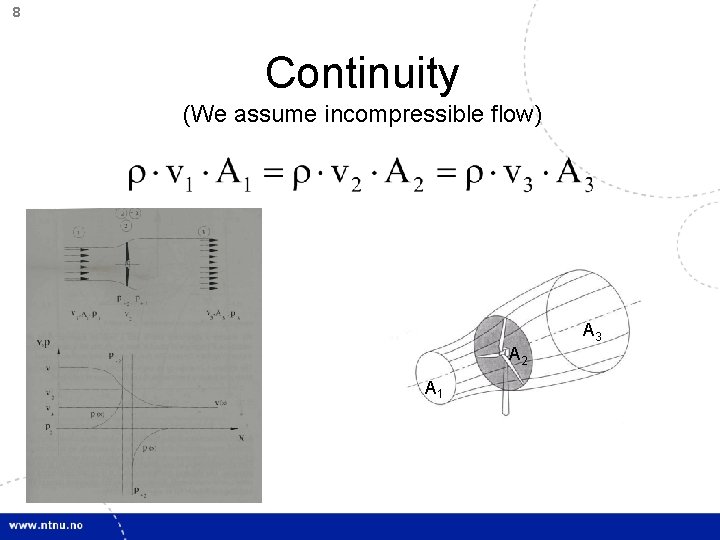
8 Continuity (We assume incompressible flow) A 3 A 2 A 1
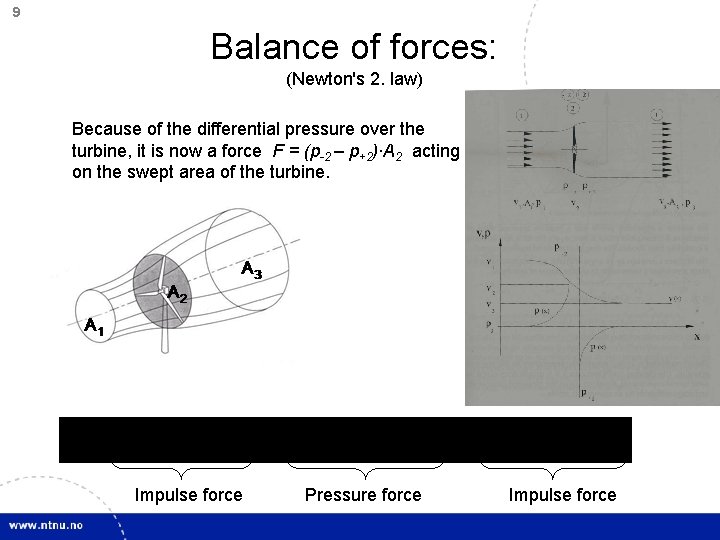
9 Balance of forces: (Newton's 2. law) Because of the differential pressure over the turbine, it is now a force F = (p-2 – p+2)∙A 2 acting on the swept area of the turbine. Impulse force Pressure force Impulse force
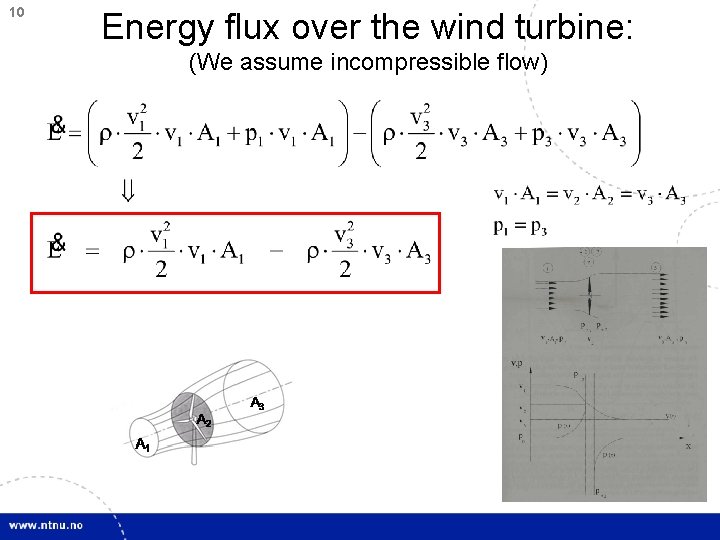
10 Energy flux over the wind turbine: (We assume incompressible flow)
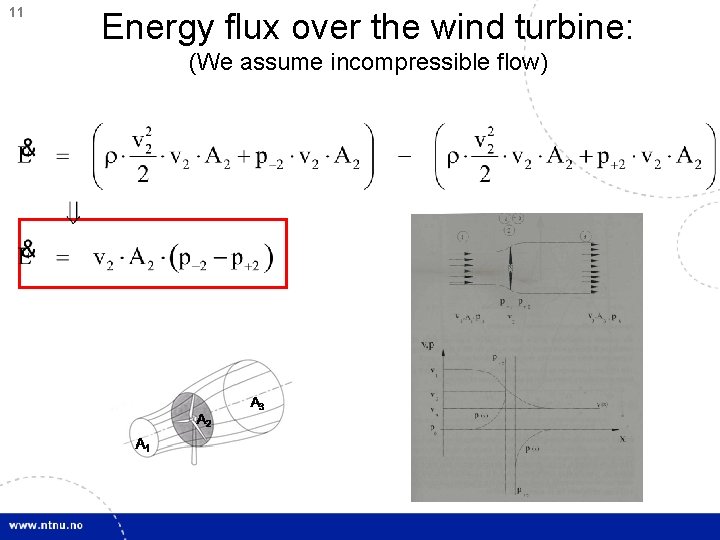
11 Energy flux over the wind turbine: (We assume incompressible flow)
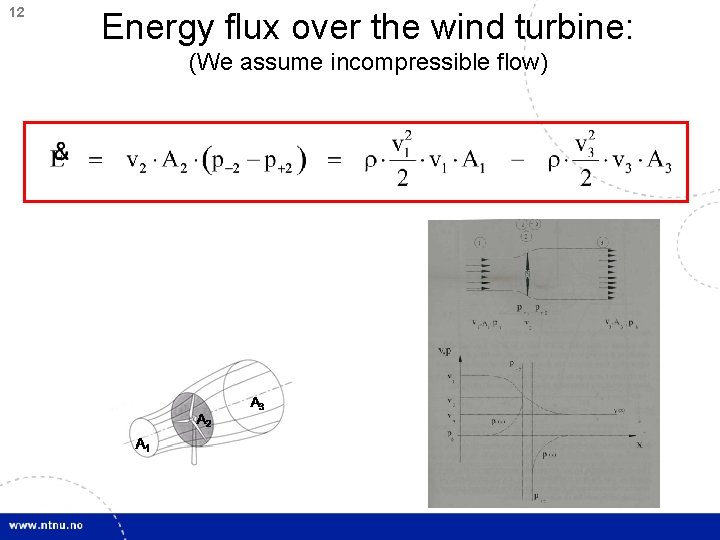
12 Energy flux over the wind turbine: (We assume incompressible flow)
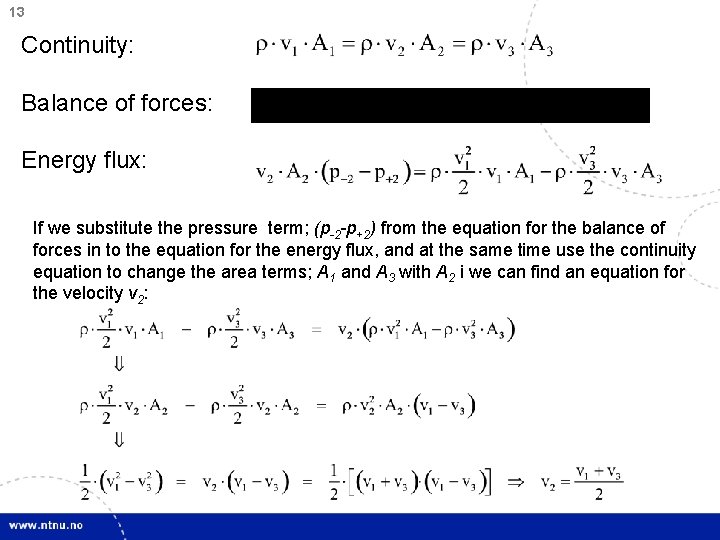
13 Continuity: Balance of forces: Energy flux: If we substitute the pressure term; (p-2 -p+2) from the equation for the balance of forces in to the equation for the energy flux, and at the same time use the continuity equation to change the area terms; A 1 and A 3 with A 2 i we can find an equation for the velocity v 2:
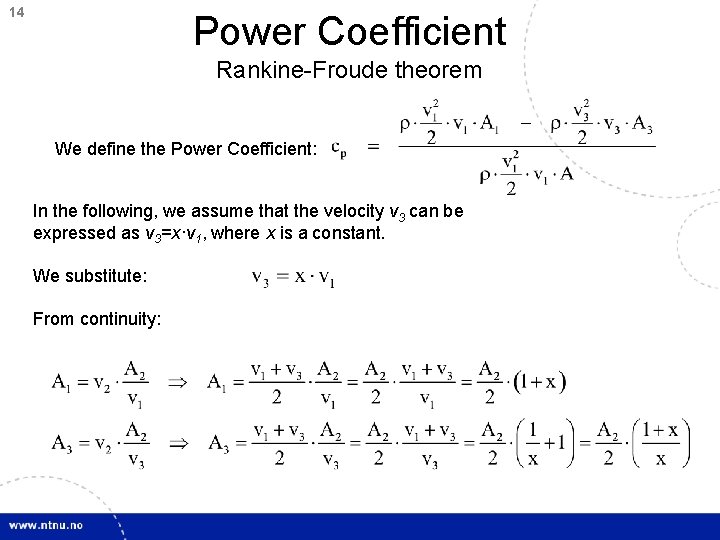
14 Power Coefficient Rankine-Froude theorem We define the Power Coefficient: In the following, we assume that the velocity v 3 can be expressed as v 3=x·v 1, where x is a constant. We substitute: From continuity:
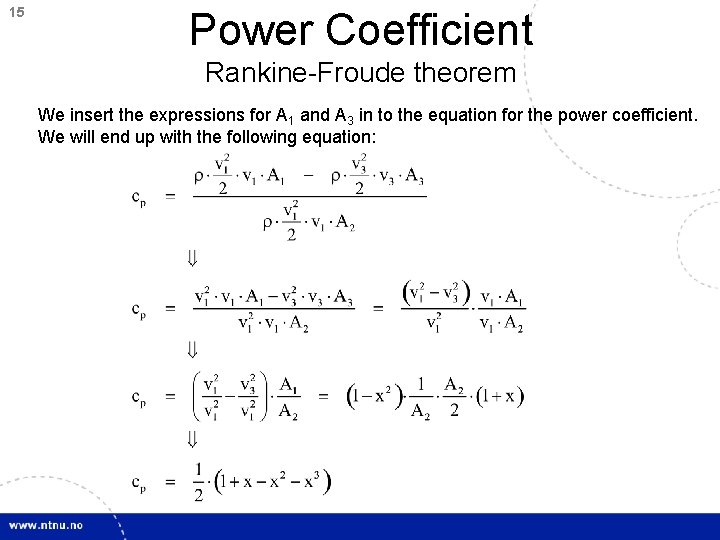
15 Power Coefficient Rankine-Froude theorem We insert the expressions for A 1 and A 3 in to the equation for the power coefficient. We will end up with the following equation:
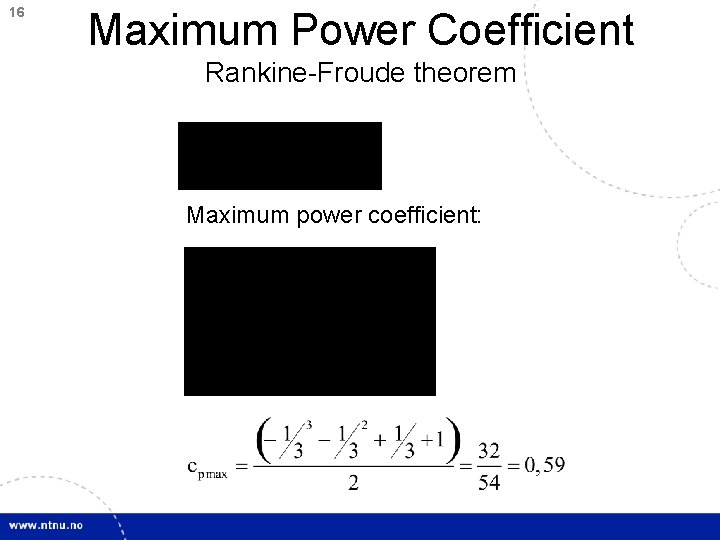
16 Maximum Power Coefficient Rankine-Froude theorem Maximum power coefficient:
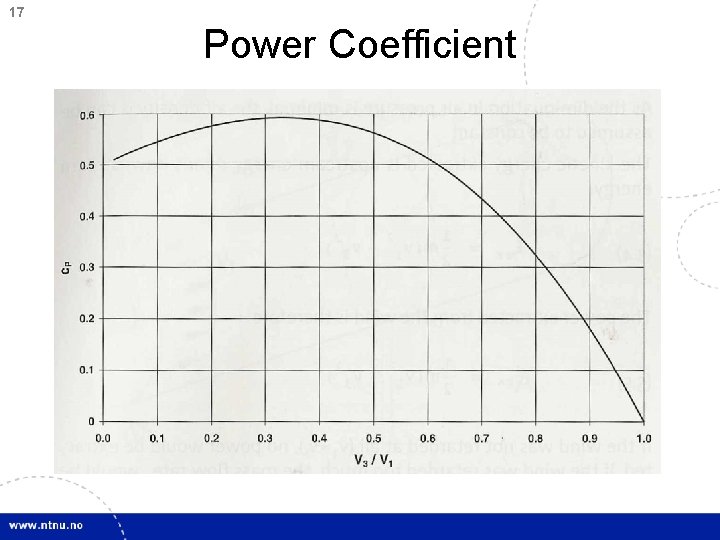
17 Power Coefficient

18 The Betz Power
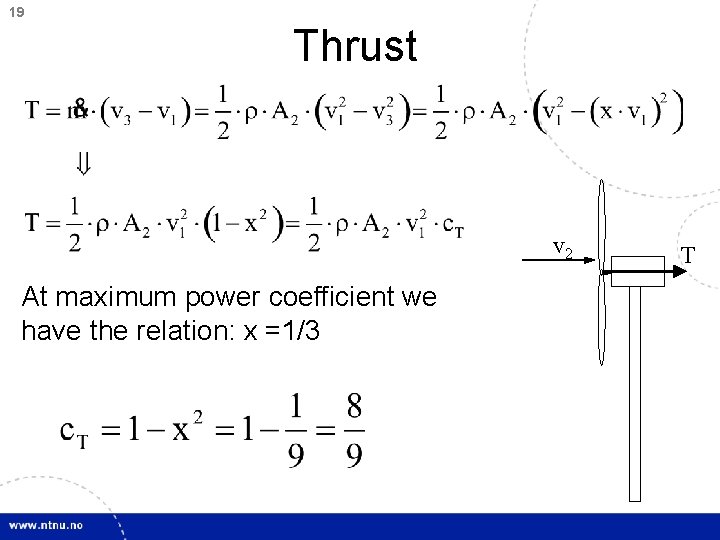
19 Thrust v 2 At maximum power coefficient we have the relation: x =1/3 T
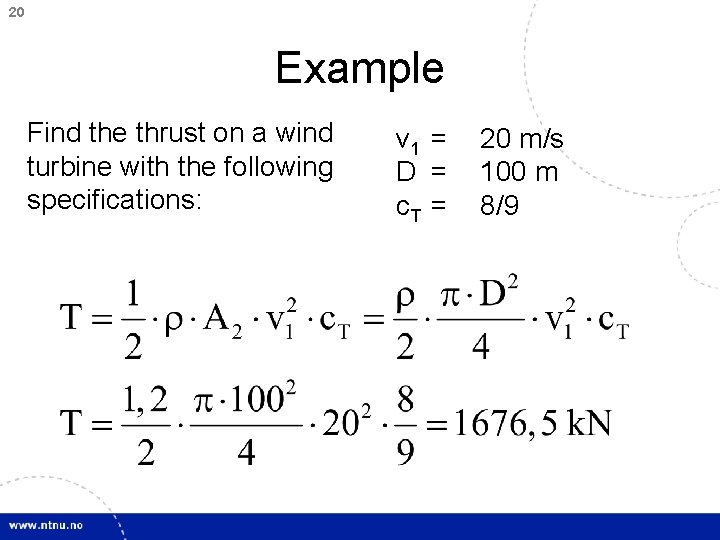
20 Example Find the thrust on a wind turbine with the following specifications: v 1 = D = c. T = 20 m/s 100 m 8/9
- Slides: 20