
1 Wind Forecast Improvement Project2 Improving Model Physics
- Slides: 28
1 Wind Forecast Improvement Project-2 Improving Model Physics in Complex Terrain Melinda Marquis, Joe Olson, James Kenyon, Stan Benjamin, Jim Wilczak, Laura Bianco, Irina Djalalova, Katherine Mc. Caffrey, Yelena Pichugina, Bob Banta, Aditya Choukulkar Richard Echman, Andy Clifton, Jacob Carley, Joel Cline. 6/11/15 NAWEA 2015, VA
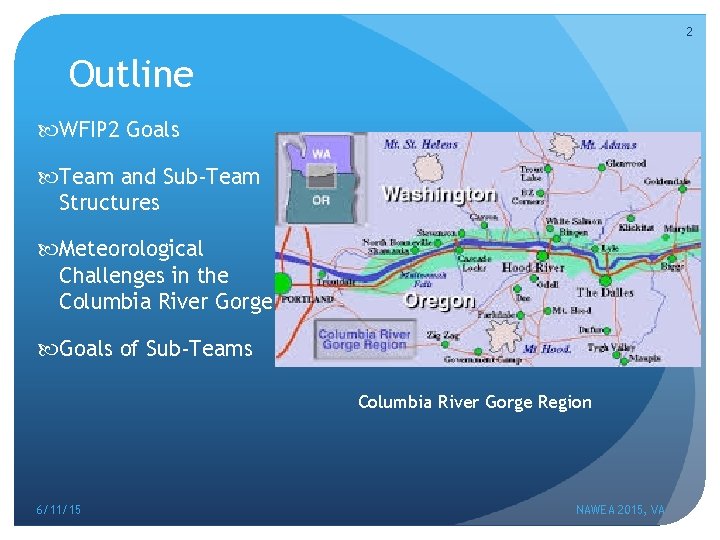
2 Outline WFIP 2 Goals Team and Sub-Team Structures Meteorological Challenges in the Columbia River Gorge Goals of Sub-Teams Columbia River Gorge Region 6/11/15 NAWEA 2015, VA
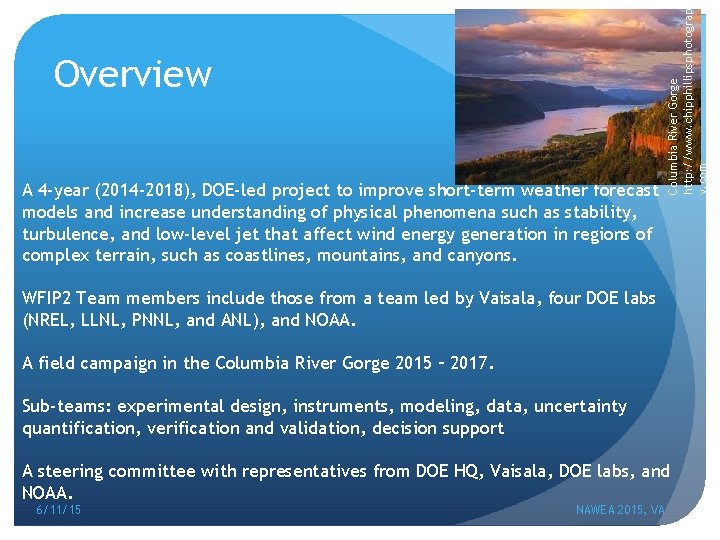
Columbia River Gorge http: //www. chipphillipsphotograph y. com 3 Overview A 4 -year (2014 -2018), DOE-led project to improve short-term weather forecast models and increase understanding of physical phenomena such as stability, turbulence, and low-level jet that affect wind energy generation in regions of complex terrain, such as coastlines, mountains, and canyons. WFIP 2 Team members include those from a team led by Vaisala, four DOE labs (NREL, LLNL, PNNL, and ANL), and NOAA. A field campaign in the Columbia River Gorge 2015 – 2017. Sub-teams: experimental design, instruments, modeling, data, uncertainty quantification, verification and validation, decision support A steering committee with representatives from DOE HQ, Vaisala, DOE labs, and NOAA. 6/11/15 NAWEA 2015, VA
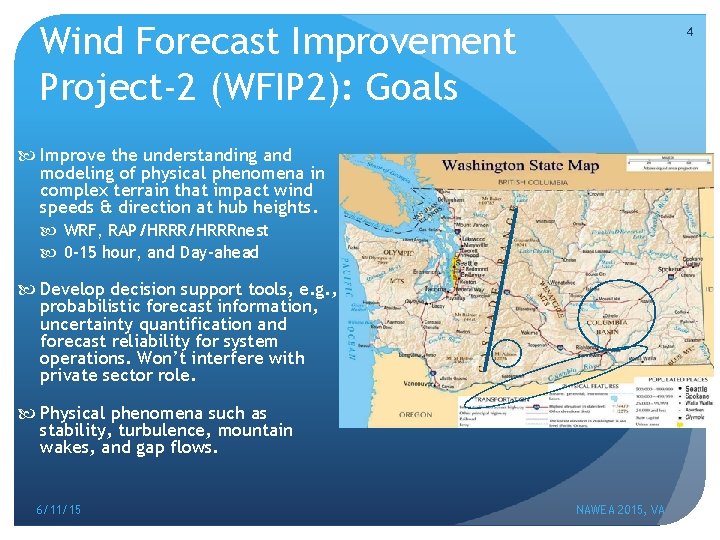
Wind Forecast Improvement Project-2 (WFIP 2): Goals 4 Improve the understanding and modeling of physical phenomena in complex terrain that impact wind speeds & direction at hub heights. WRF, RAP/HRRRnest 0 -15 hour, and Day-ahead Develop decision support tools, e. g. , probabilistic forecast information, uncertainty quantification and forecast reliability for system operations. Won’t interfere with private sector role. Physical phenomena such as stability, turbulence, mountain wakes, and gap flows. 6/11/15 NAWEA 2015, VA
5 WFIP-2 Team and Sub-Teams DOE FOA Awardee – Vaisala – leads a team including individuals from: Univ. Colorado NCAR Sharply Focused Lockheed Martin Texas Tech University of Notre Dame DOE National Labs: NREL, PNNL, LLNL, ANL NOAA (OAR: ESRL and ARL; NWS: NCEP) 6/11/15 NAWEA 2015, VA
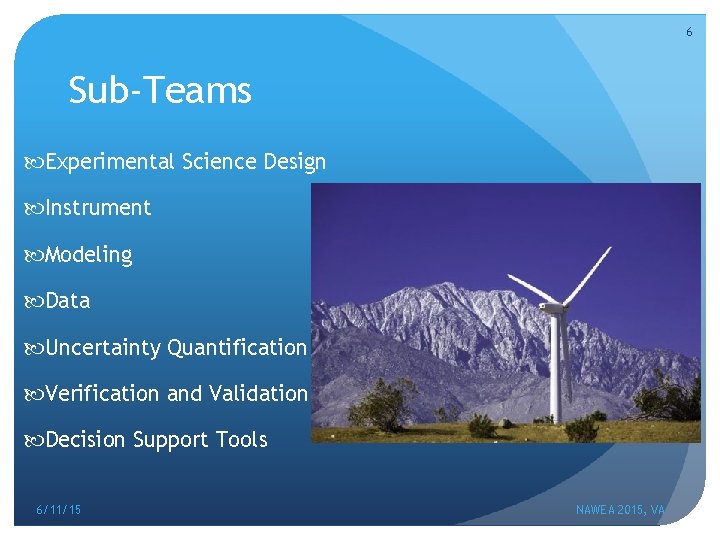
6 Sub-Teams Experimental Science Design Instrument Modeling Data Uncertainty Quantification Verification and Validation Decision Support Tools 6/11/15 NAWEA 2015, VA
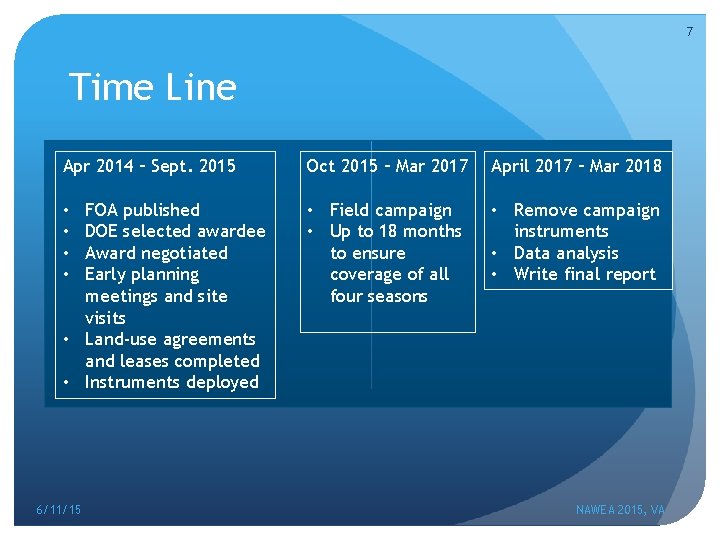
7 Time Line Apr 2014 – Sept. 2015 Oct 2015 – Mar 2017 April 2017 – Mar 2018 FOA published DOE selected awardee Award negotiated Early planning meetings and site visits • Land-use agreements and leases completed • Instruments deployed • Field campaign • Up to 18 months to ensure coverage of all four seasons • Remove campaign instruments • Data analysis • Write final report • • 6/11/15 NAWEA 2015, VA
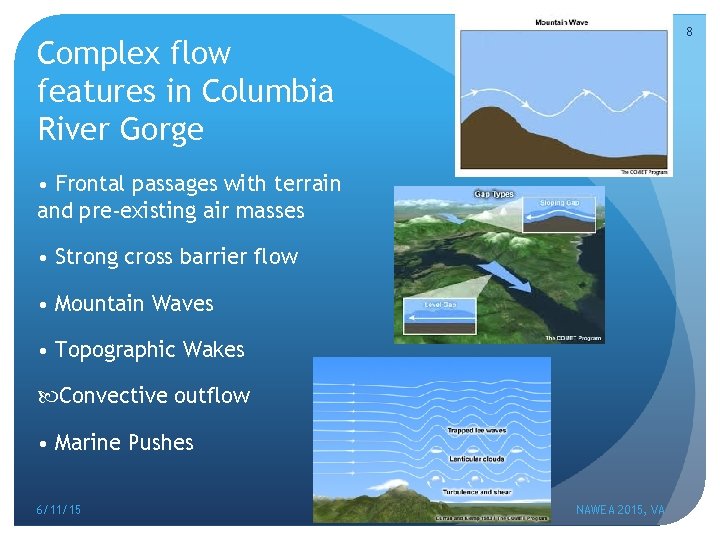
8 Complex flow features in Columbia River Gorge • Frontal passages with terrain and pre-existing air masses • Strong cross barrier flow • Mountain Waves • Topographic Wakes Convective outflow • Marine Pushes 6/11/15 NAWEA 2015, VA
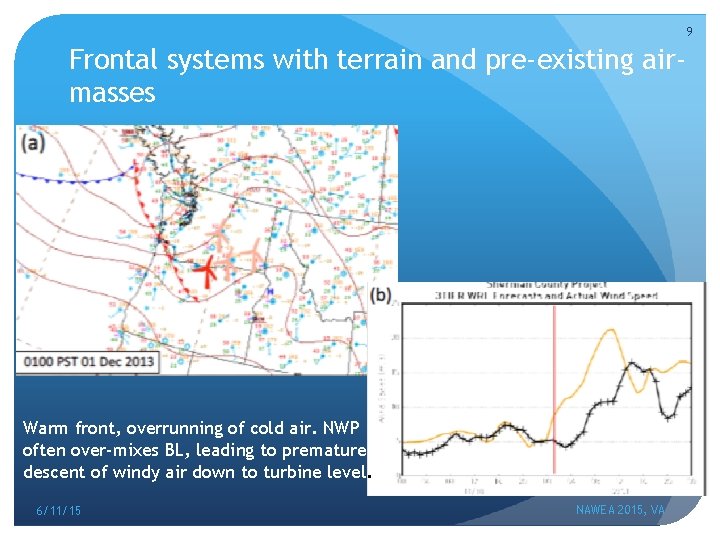
9 Frontal systems with terrain and pre-existing airmasses Warm front, overrunning of cold air. NWP often over-mixes BL, leading to premature descent of windy air down to turbine level. 6/11/15 NAWEA 2015, VA
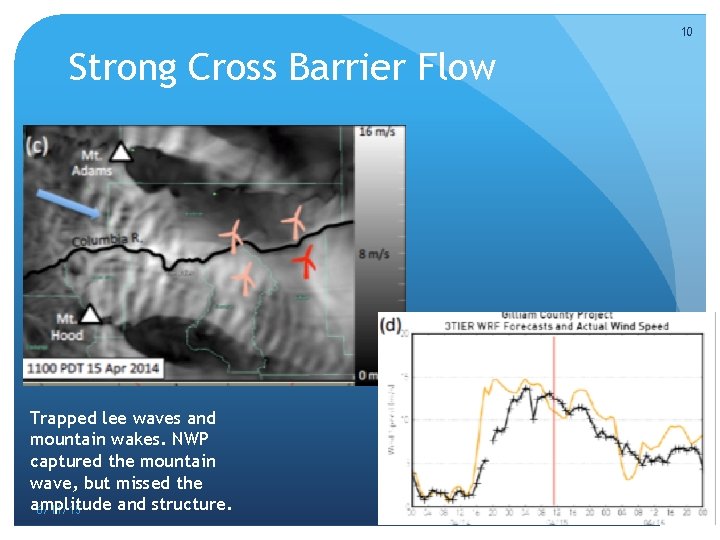
10 Strong Cross Barrier Flow Trapped lee waves and mountain wakes. NWP captured the mountain wave, but missed the amplitude and structure. 6/11/15 NAWEA 2015, VA
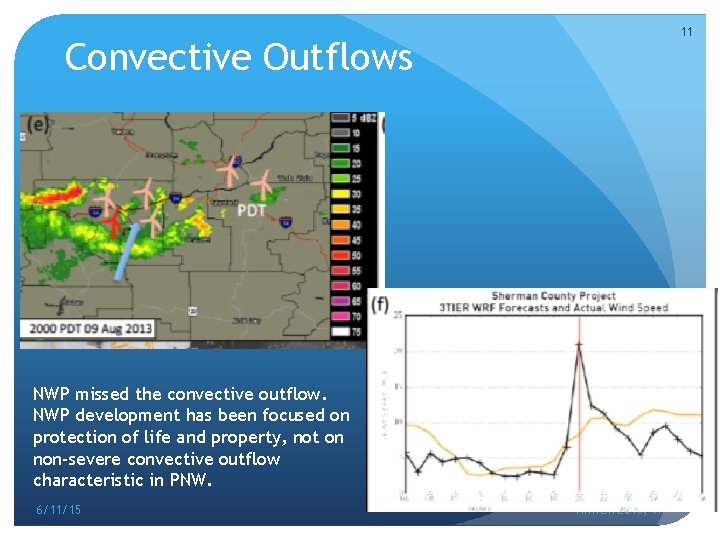
11 Convective Outflows NWP missed the convective outflow. NWP development has been focused on protection of life and property, not on non-severe convective outflow characteristic in PNW. 6/11/15 NAWEA 2015, VA
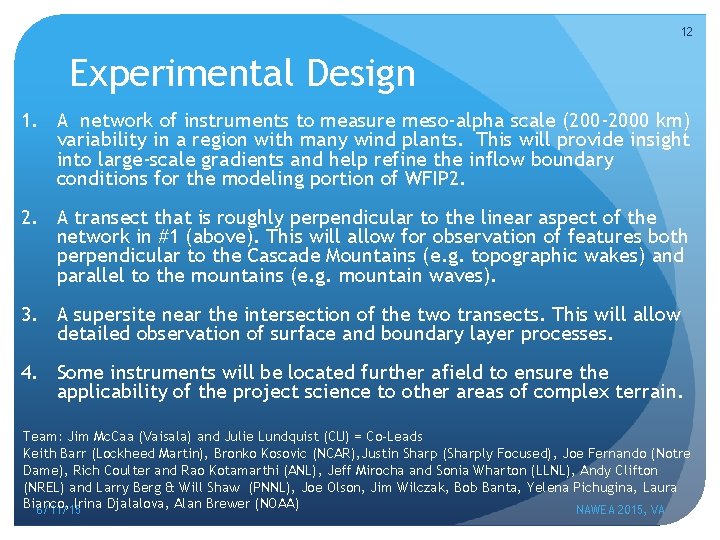
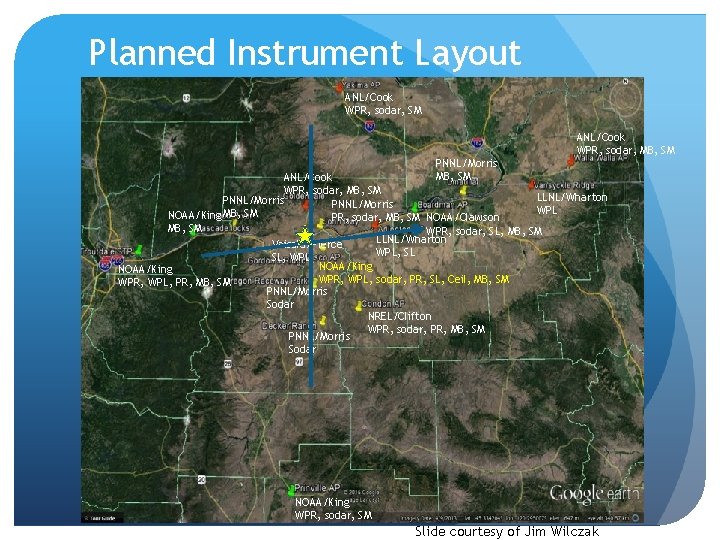
12 Experimental Design 1. A network of instruments to measure meso-alpha scale (200 -2000 km) variability in a region with many wind plants. This will provide insight into large-scale gradients and help refine the inflow boundary conditions for the modeling portion of WFIP 2. 2. A transect that is roughly perpendicular to the linear aspect of the network in #1 (above). This will allow for observation of features both perpendicular to the Cascade Mountains (e. g. topographic wakes) and parallel to the mountains (e. g. mountain waves). 3. A supersite near the intersection of the two transects. This will allow detailed observation of surface and boundary layer processes. 4. Some instruments will be located further afield to ensure the applicability of the project science to other areas of complex terrain. Team: Jim Mc. Caa (Vaisala) and Julie Lundquist (CU) = Co-Leads Keith Barr (Lockheed Martin), Bronko Kosovic (NCAR), Justin Sharp (Sharply Focused), Joe Fernando (Notre Dame), Rich Coulter and Rao Kotamarthi (ANL), Jeff Mirocha and Sonia Wharton (LLNL), Andy Clifton (NREL) and Larry Berg & Will Shaw (PNNL), Joe Olson, Jim Wilczak, Bob Banta, Yelena Pichugina, Laura Bianco, Irina Djalalova, Alan Brewer (NOAA) 6/11/15 NAWEA 2015, VA
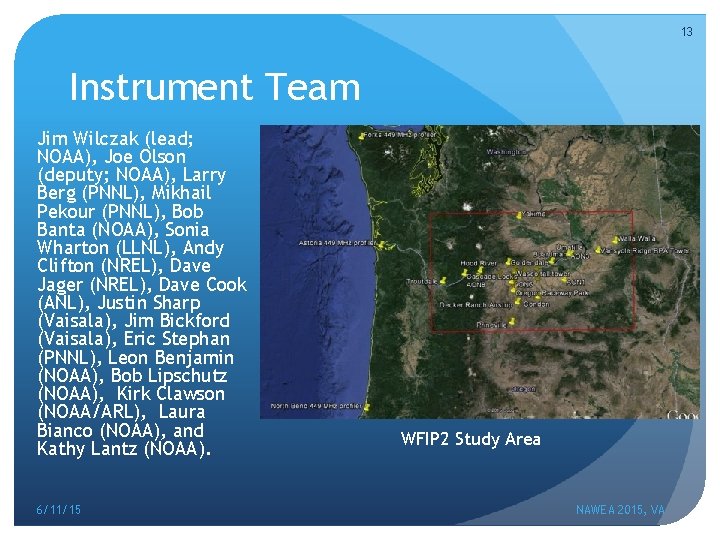
13 Instrument Team Jim Wilczak (lead; NOAA), Joe Olson (deputy; NOAA), Larry Berg (PNNL), Mikhail Pekour (PNNL), Bob Banta (NOAA), Sonia Wharton (LLNL), Andy Clifton (NREL), Dave Jager (NREL), Dave Cook (ANL), Justin Sharp (Vaisala), Jim Bickford (Vaisala), Eric Stephan (PNNL), Leon Benjamin (NOAA), Bob Lipschutz (NOAA), Kirk Clawson (NOAA/ARL), Laura Bianco (NOAA), and Kathy Lantz (NOAA). 6/11/15 WFIP 2 Study Area NAWEA 2015, VA
Planned Instrument Layout ANL/Cook WPR, sodar, SM ANL/Cook WPR, sodar, MB, SM PNNL/Morris MB, SM ANL/Cook WPR, sodar, MB, SM LLNL/Wharton PNNL/Morris WPL NOAA/King MB, SM PR, sodar, MB, SM NOAA/Clawson MB, SM WPR, sodar, SL, MB, SM LLNL/Wharton Vaisala/Pierce WPL, SL SL, WPL NOAA/King WPR, WPL, sodar, PR, SL, Ceil, MB, SM WPR, WPL, PR, MB, SM PNNL/Morris Sodar NREL/Clifton WPR, sodar, PR, MB, SM PNNL/Morris Sodar NOAA/King WPR, sodar, SM Slide courtesy of Jim Wilczak
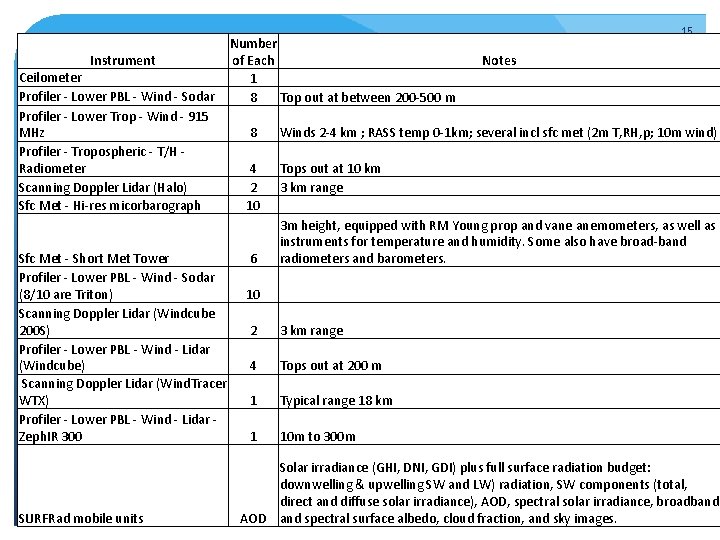
Instrument Ceilometer Profiler - Lower PBL - Wind - Sodar Profiler - Lower Trop - Wind - 915 MHz Profiler - Tropospheric - T/H - Radiometer Scanning Doppler Lidar (Halo) Sfc Met - Hi-res micorbarograph Number of Each 1 8 Top out at between 200 -500 m Sfc Met - Short Met Tower Profiler - Lower PBL - Wind - Sodar (8/10 are Triton) Scanning Doppler Lidar (Windcube 200 S) Profiler - Lower PBL - Wind - Lidar (Windcube) Scanning Doppler Lidar (Wind. Tracer WTX) Profiler - Lower PBL - Wind - Lidar - Zeph. IR 300 6/11/15 SURFRad mobile units 15 Notes 8 Winds 2 -4 km ; RASS temp 0 -1 km; several incl sfc met (2 m T, RH, p; 10 m wind) 4 2 10 6 Tops out at 10 km 3 km range 3 m height, equipped with RM Young prop and vane anemometers, as well as instruments for temperature and humidity. Some also have broad-band radiometers and barometers. 10 2 3 km range 4 Tops out at 200 m 1 Typical range 18 km 1 10 m to 300 m Solar irradiance (GHI, DNI, GDI) plus full surface radiation budget: downwelling & upwelling SW and LW) radiation, SW components (total, direct and diffuse solar irradiance), AOD, spectral solar irradiance, broadband NAWEA 2015, VA AOD and spectral surface albedo, cloud fraction, and sky images.
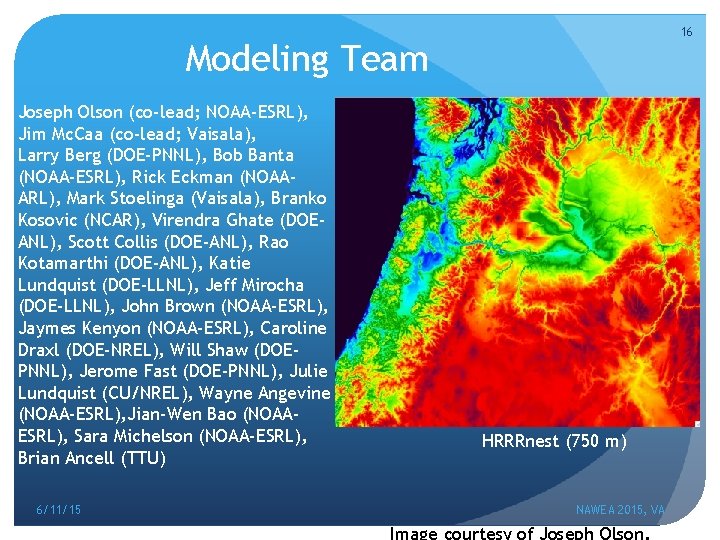
16 Modeling Team Joseph Olson (co-lead; NOAA-ESRL), Jim Mc. Caa (co-lead; Vaisala), Larry Berg (DOE-PNNL), Bob Banta (NOAA-ESRL), Rick Eckman (NOAAARL), Mark Stoelinga (Vaisala), Branko Kosovic (NCAR), Virendra Ghate (DOEANL), Scott Collis (DOE-ANL), Rao Kotamarthi (DOE-ANL), Katie Lundquist (DOE-LLNL), Jeff Mirocha (DOE-LLNL), John Brown (NOAA-ESRL), Jaymes Kenyon (NOAA-ESRL), Caroline Draxl (DOE-NREL), Will Shaw (DOEPNNL), Jerome Fast (DOE-PNNL), Julie Lundquist (CU/NREL), Wayne Angevine (NOAA-ESRL), Jian-Wen Bao (NOAAESRL), Sara Michelson (NOAA-ESRL), Brian Ancell (TTU) 6/11/15 HRRRnest (750 m) NAWEA 2015, VA
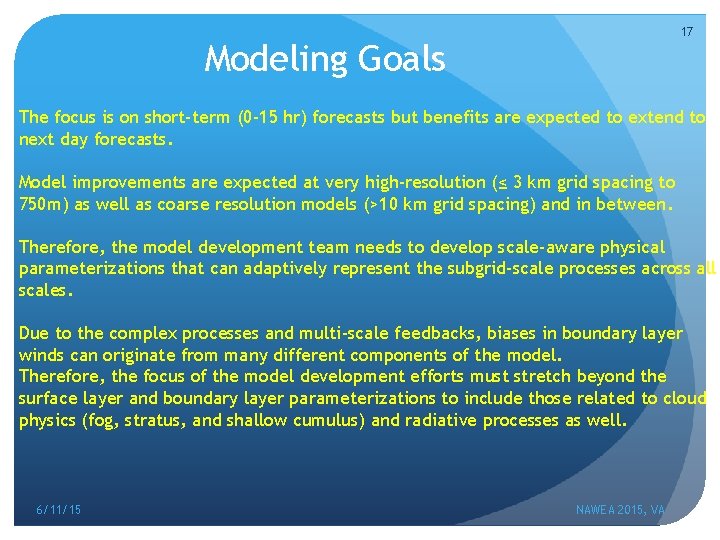
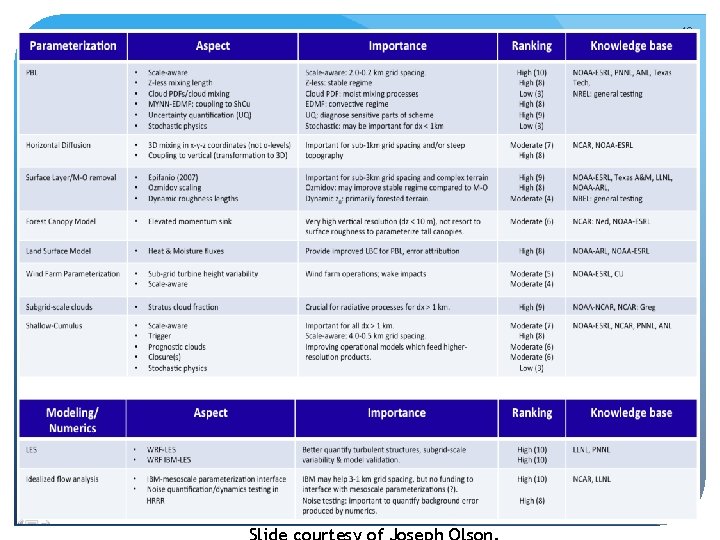
17 Modeling Goals The focus is on short-term (0 -15 hr) forecasts but benefits are expected to extend to next day forecasts. Model improvements are expected at very high-resolution (≤ 3 km grid spacing to 750 m) as well as coarse resolution models (>10 km grid spacing) and in between. Therefore, the model development team needs to develop scale-aware physical parameterizations that can adaptively represent the subgrid-scale processes across all scales. Due to the complex processes and multi-scale feedbacks, biases in boundary layer winds can originate from many different components of the model. Therefore, the focus of the model development efforts must stretch beyond the surface layer and boundary layer parameterizations to include those related to cloud physics (fog, stratus, and shallow cumulus) and radiative processes as well. 6/11/15 NAWEA 2015, VA
18 6/11/15 NAWEA 2015, VA
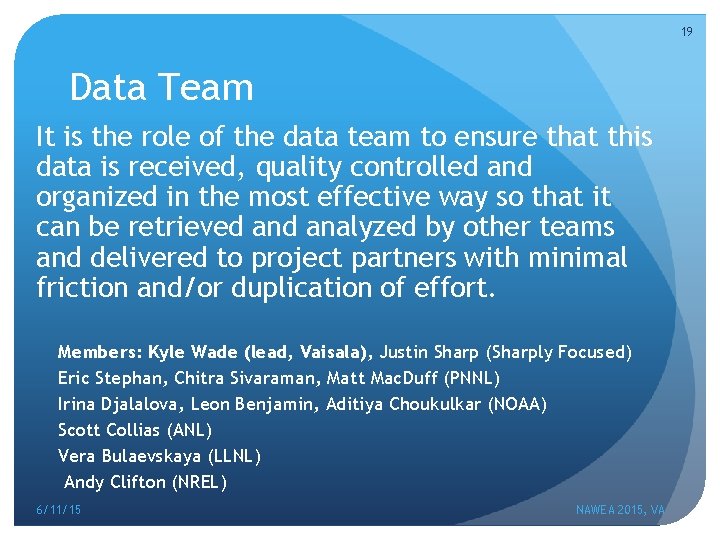
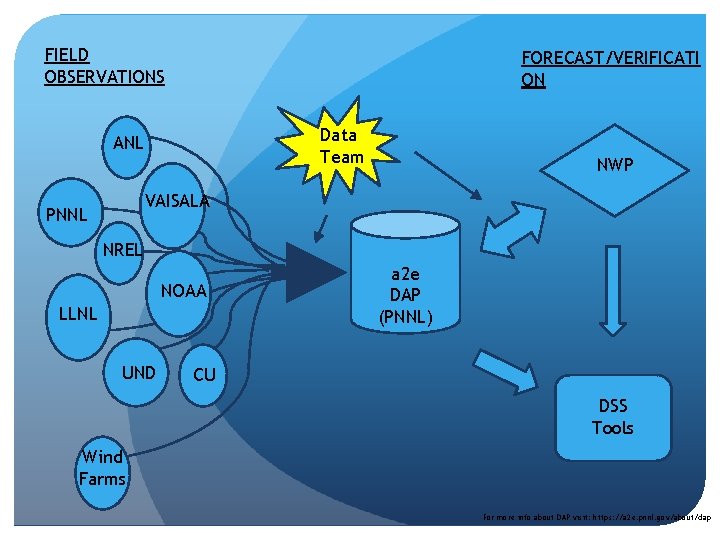
19 Data Team It is the role of the data team to ensure that this data is received, quality controlled and organized in the most effective way so that it can be retrieved analyzed by other teams and delivered to project partners with minimal friction and/or duplication of effort. Members: Kyle Wade (lead, Vaisala), Justin Sharp (Sharply Focused) Eric Stephan, Chitra Sivaraman, Matt Mac. Duff (PNNL) Irina Djalalova, Leon Benjamin, Aditiya Choukulkar (NOAA) Scott Collias (ANL) Vera Bulaevskaya (LLNL) Andy Clifton (NREL) 6/11/15 NAWEA 2015, VA
FIELD OBSERVATIONS FORECAST/VERIFICATI ON Data Team ANL NWP VAISALA PNNL NREL NOAA LLNL UND a 2 e DAP (PNNL) CU DSS Tools Wind Farms For more info about DAP visit: https: //a 2 e. pnnl. gov/about/dap
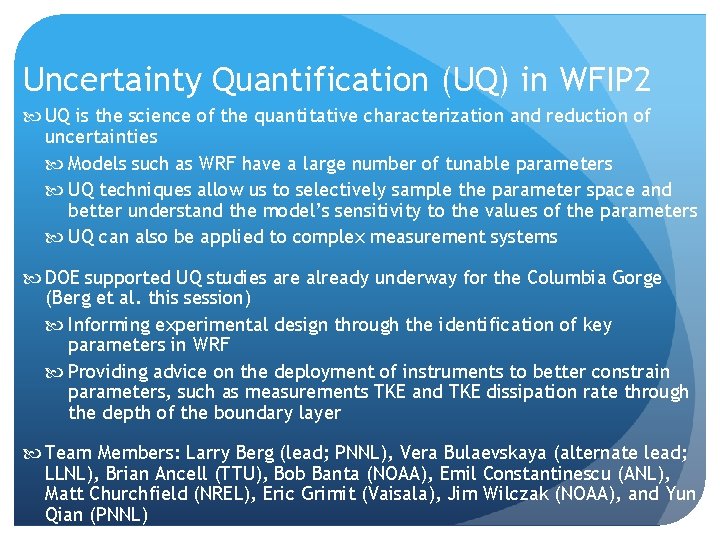
Uncertainty Quantification (UQ) in WFIP 2 UQ is the science of the quantitative characterization and reduction of uncertainties Models such as WRF have a large number of tunable parameters UQ techniques allow us to selectively sample the parameter space and better understand the model’s sensitivity to the values of the parameters UQ can also be applied to complex measurement systems DOE supported UQ studies are already underway for the Columbia Gorge (Berg et al. this session) Informing experimental design through the identification of key parameters in WRF Providing advice on the deployment of instruments to better constrain parameters, such as measurements TKE and TKE dissipation rate through the depth of the boundary layer Team Members: Larry Berg (lead; PNNL), Vera Bulaevskaya (alternate lead; LLNL), Brian Ancell (TTU), Bob Banta (NOAA), Emil Constantinescu (ANL), Matt Churchfield (NREL), Eric Grimit (Vaisala), Jim Wilczak (NOAA), and Yun Qian (PNNL)
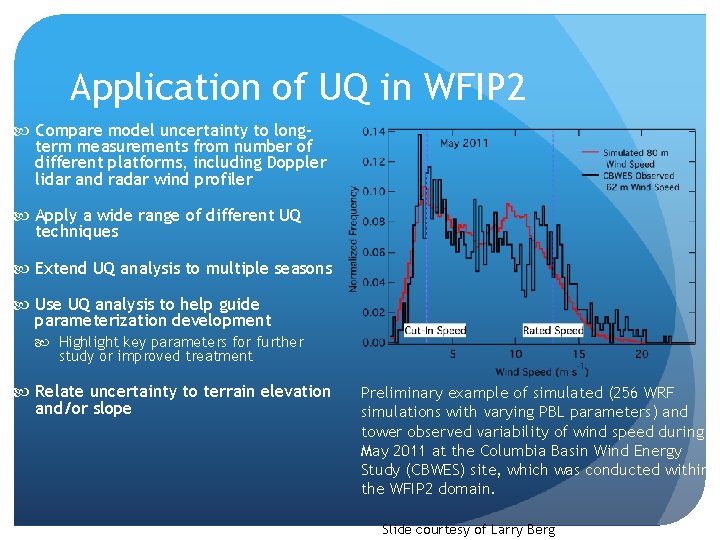
Application of UQ in WFIP 2 Compare model uncertainty to longterm measurements from number of different platforms, including Doppler lidar and radar wind profiler Apply a wide range of different UQ techniques Extend UQ analysis to multiple seasons Use UQ analysis to help guide parameterization development Highlight key parameters for further study or improved treatment Relate uncertainty to terrain elevation and/or slope Preliminary example of simulated (256 WRF simulations with varying PBL parameters) and tower observed variability of wind speed during May 2011 at the Columbia Basin Wind Energy Study (CBWES) site, which was conducted within the WFIP 2 domain. Slide courtesy of Larry Berg
23 Verification & Validation Team Goal: Define a strategy that the WFIP 2 participants will follow, ensuring that effects (individually and/or in total) of the model improvements have been quantified and documented. Team Members: Andy Clifton (Lead, NREL), Larry Berg (Deputy, PNNL), Eric Grimit (Vaisala), Rao Kotamarthi (ANL), Jeff Mirocha (LLNL), Katie Lundquist (LLNL), and Joe Olson, Aditya Choukulkar, Laura Bianco, Yelena Pichugina (NOAA). 6/11/15 NAWEA 2015, VA
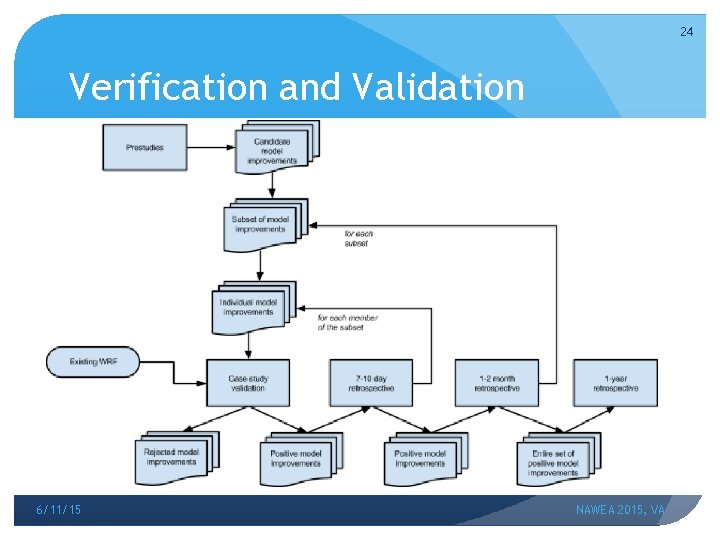
24 Verification and Validation 6/11/15 NAWEA 2015, VA
25 Decision Support Tools Lead to greater situational awareness and reduced decision-making time on the part of electric power system operators and wind power producers. Algorithms to detect phenomena based on enhanced HRRR forecasts and the uncertainty estimates made using the methods implemented by the Uncertainty Quantification (UQ) team. These tools will allow for the best use of the mesoscale models and not interfere with the private company roles of individual wind plant decision making. Members: Eric Grimit (Lead; Vaisala), Bri-Matthias Hodge (NREL), Yun Qian (PNNL), Jim Wilczak (NOAA). 6/11/15 NAWEA 2015, VA
26 Steering Committee Ensure the successful execution of the WFIP 2 effort. Provide high-level (big picture) project management to facilitate coordination across WFIP 2 teams and affiliations. Anticipate and mitigate risks to the project, catalyze productivity of the WFIP 2 teams, and ensure the project stays on schedule, scope and on budget. Joel Cline( Lead, DOE), Brad Ring (DOE Contracts), DOE Labs (Will Shaw), Jim Bickford (Vaisala), and Melinda Marquis (NOAA). 6/11/15 NAWEA 2015, VA
27 Summary 4 -year (2014 -2018), DOE-led project to improve short-term weather forecast models and increase understanding of physical phenomena such as stability, turbulence, and low-level jet that affect wind energy generation in regions of complex terrain, such as coastlines, mountains, and canyons. WFIP 2 Team members include those from a team led by Vaisala, four DOE labs (NREL, LLNL, PNNL, and ANL), and NOAA. A field campaign in the Columbia River Gorge will support these goals. Sub-teams for experimental design, instruments, modeling, data, uncertainty quantification, verification and validation, decision support tools will work those WFIP 2 goals. wfip. windforecast. org 6/11/15 NAWEA 2015, VA
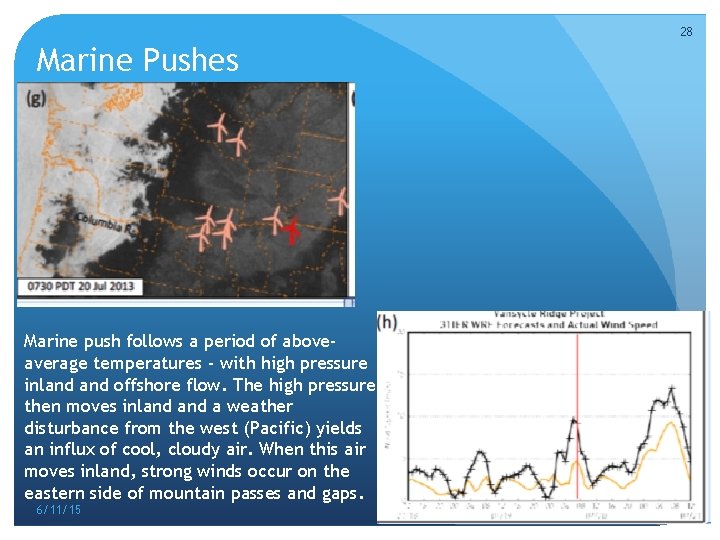
28 Marine Pushes Marine push follows a period of aboveaverage temperatures - with high pressure inland offshore flow. The high pressure then moves inland a weather disturbance from the west (Pacific) yields an influx of cool, cloudy air. When this air moves inland, strong winds occur on the eastern side of mountain passes and gaps. 6/11/15 NAWEA 2015, VA