
1 Which of the following is argued by
1) Which of the following is argued by James Madison in The Federalist paper number 10? a) A system of republican representation helps to limit the excesses of factionalism b) Small republics are better able to ensure individual liberty than are large republics c) The presence of a few large factions helps to protect the rights of minorities d) Participatory democracy is the surest way to prevent tyranny e) The elimination of the causes of factionalism is the best protection against tyranny
a) A system of republican representation helps to limit the excesses of factionalism!
2) All of the following were concerns about the Articles of Confederation that led to the calling of the constitutional Convention of 1787 except… a) Dissatisfaction over safeguards of individual rights and liberties b) Fear for the stability of the central government c) Desire to promote trade among the states d) The need to give the central government the power to levy taxes
b) Fear for the stability of the central government
3) In the organization of the government, the principle of federalism is illustrated best by the: • Presidents power as commander in chief • A separation of powers between the united states supreme court and congress • Representation system for electing senators • Qualifications for the office of president • Federal bureaucracy
Representation system for electing senators
4. The largest source of federal revenue is the _____. a) Capital gains tax b) Social security tax c) Property tax d) Income tax e) Sales tax
• d) Income tax Political Beliefs and Behaviors (1020%)
6. Voting patterns of members of congress correlate most strongly with. . a) The populations density of their districts b) Their economic background c) Their educational level d) Their political party affiliation e) The location of their districts
d) Their political party affiliation
7) Of the following, which best predicts the likelihood that citizens will vote? • Their race • Their religion • Their education level • Their gender • Their region of residence
Their education level
8) Of the following groups of eligible voters, which is the least likely to vote? • The young with low education levels • The middle-aged with low education levels • Middle-aged and older women • Blue-collar workers • Middle-class African American citizens
The young with low education levels
• Political Parties, Interest Groups, and Mass Media (10 -20%)
• 8. Which of the following is true of “amicus curiae” briefs? • A. They are used by interest groups to lobby courts • B. They are used exclusively by liberal interest groups • C. They are used exclusively by conservative interest groups • D. They are now unconstitutional • E. They are the means by which a litigant seeks Supreme Court review of a lower court decision
• A. They are used by interest groups to lobby courts
• 27. Lobbyists try to influence legislators mainly through: • A. “Winning and dining” legislators • B. Orchestrating petition drives and letter-writing campaigns • C. Placing persuasive advertisements in the media • D. Threatening to help the legislator’s opponent in the next election
D. Threatening to help the legislator’s opponent in the next election
9) The primary election system of selecting presidential candidates had which of the following effects? a) It has increased the importance of state party organizations b) It has loosened the hold of party leaders over the nomination process c) It has reduced the role of citizens in the candidate selection process d) It has lowered the cost of running for office e) It has led to a decline in the importance of party voter-registration drives
b) It has loosened the hold of party leaders over the nomination process
10) Political parties serve which of the following functions in the United States? • I. Informing the public about political issues • II. Mobilizing voters and getting them to the polls • III. Organizing diverse interests within a society • IV. Establishing the rules of governing financial contributions to political candidates a) II only b) I and II only c) III and IV only d) I, II, and III only e) I, III, and IV only

d) I, II, and III only
11. Which of the following statements about democrats and republicans is true? a) City dwellers are more likely to call themselves republicans than democrats b) Republicans are more likely than democrats to label themselves “conservatives” c) African American citizens are more likely to call themselves republicans than democrats d) Republicans are more likely than democrats to believe that adequate medical care should be guaranteed by the federal government e) People in working class occupations are more likely to call themselves republicans than democrats
b) Republicans are more likely than democrats to label themselves “conservatives”
12. All of the following contribute the success of incumbent members of congress in election campaigns except… A) Incumbents usually raise more campaign funds than do their challengers B) Incumbents tend to understand national issues better than do their challengers C) Incumbents are usually better known to voters than are their challengers D) Incumbents can use legislative staff to perform campaign services E) Incumbents often sit on committees that permit them to serve district interests
d) Incumbents can use legislative staff to perform campaign services
13) An interest group likely to have influence in Congress when the issue at stake… • • • Is a narrow in scope and low in public visibility Is part of the president’s legislative package Has been dramatized by the media Engages legislator’s deeply held convictions Divides legislators along party lines
Is a narrow in scope and low in public visibility
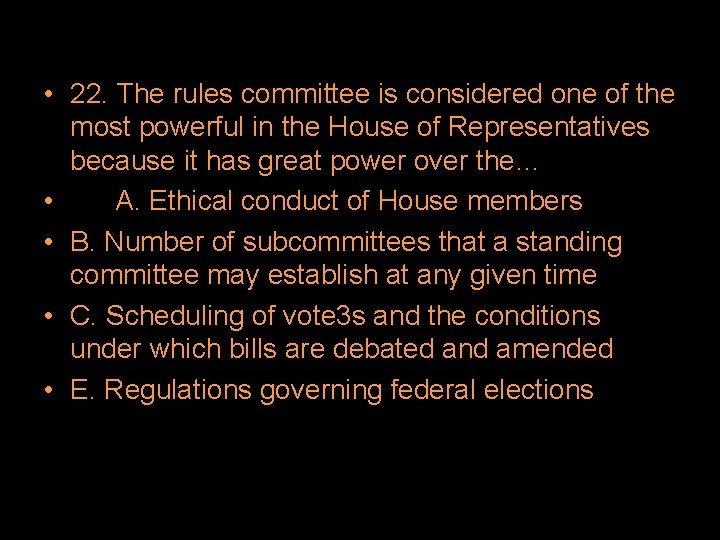
• 22. The rules committee is considered one of the most powerful in the House of Representatives because it has great power over the… • A. Ethical conduct of House members • B. Number of subcommittees that a standing committee may establish at any given time • C. Scheduling of vote 3 s and the conditions under which bills are debated and amended • E. Regulations governing federal elections
E. Regulations governing federal elections
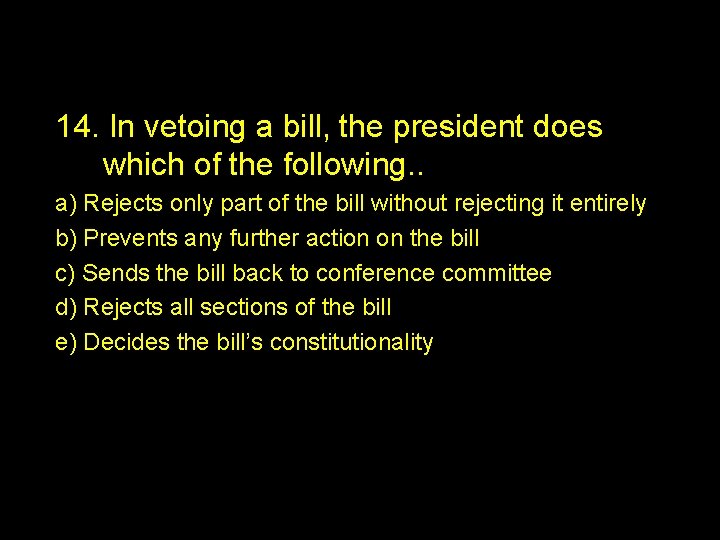
14. In vetoing a bill, the president does which of the following. . a) Rejects only part of the bill without rejecting it entirely b) Prevents any further action on the bill c) Sends the bill back to conference committee d) Rejects all sections of the bill e) Decides the bill’s constitutionality
d) Rejects all sections of the bill
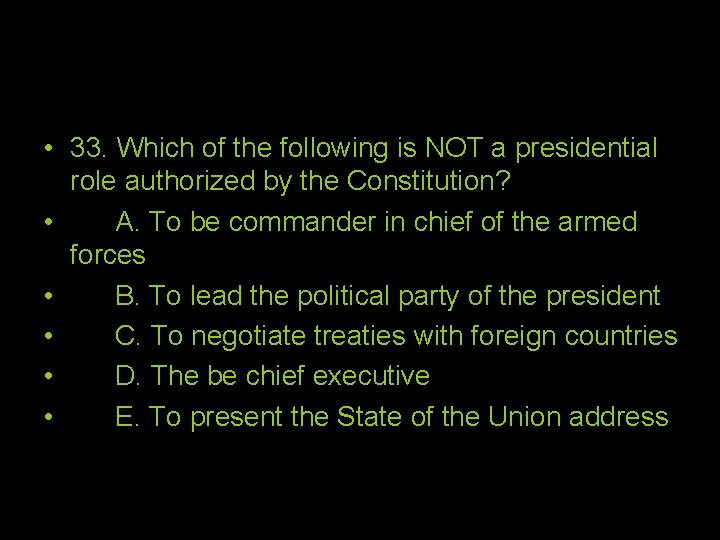
• 33. Which of the following is NOT a presidential role authorized by the Constitution? • A. To be commander in chief of the armed forces • B. To lead the political party of the president • C. To negotiate treaties with foreign countries • D. The be chief executive • E. To present the State of the Union address
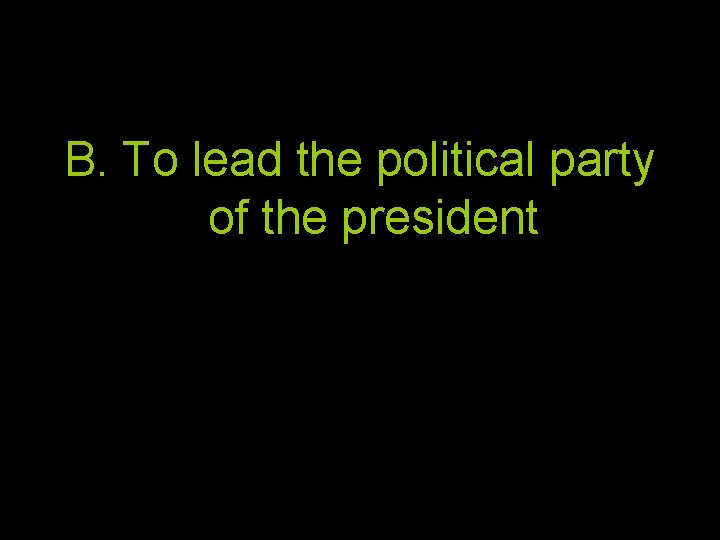
B. To lead the political party of the president
• 11. Which of the following committees of the House of Representatives sets the conditions for debate and amendment of most legislation? • A. Ways and Means • B. Appropriations • C. Judiciary • D. Rules • E. Government Operations
D. Rules
15. All of the following are true about the relationship between regulatory agencies and the industries they regulate, except a) Agency employees are often recruited from the regulative industry b) Agencies often rely on support from regulative industries and making budget requests before congress c) An agency’s relationship with a regulative industry may change when a new president takes office d) Agencies usually make decisions without consulting the regulative industry e) Agency employees often are employed by the regulated industry once they leave the agency
d) Agencies usually make decisions without consulting the regulative industry
• 38. The Supreme Court ruled the legislative veto unconstitutional on the grounds that such vetoes… • A. Were the province of the courts alone • B. Violated the principle of separation of powers • C. Would give the executive branch too much power • D. Would give too much authority to non elected officials • E. Were unwarranted infringement on the rights of state governments
B. Violated the principle of separation of powers
• 24. Which of the following is generally true of the gerrymandering of congressional districts? • A. It results in more Democrats being elected to the House. • B. It results in more Republicans being elected to the House. • C. It guarantees that all minority parties will be equally represented. • D. It creates districts that favor one political party over another • E. It violates the principle of one-person, onevote.
• D. It creates districts that favor one political party over another
• 22. The franking privilege often refers to the: • A. Federal Reserve Board’s control over interest rates • B. Practice of permitting senators to preview lists of judicial nominees • C. Practice whereby legislatures with the most seniority select the committees on which they want to serve • D. Right of the chair to control the schedule of his or her congressional committee • E. Right of members of congress to send mail to their constituents at the government’s expense
• E. Right of members of congress to send mail to their constituents at the government’s expense
16) Federal spending for which of the following is determined by laws that lie outside the regular budgetary process? • • Military procurement Regulatory agency funding Government-subsidized housing programs Educational assistance programs such as student loans • Entitlement programs such as Social Security
Entitlement programs such as Social Security
• 29. States and localities have the most discretion in establishing policy when federal funding is derived from: • A. Categorical grants • B. Matching grants • C. Block grants • D. Project grants • E. Grants-in-aid

C. Block grants
• 12. Of the following, which has been used most to expand the power of the national government? A. The commerce clause of the constitution • B. The habeas corpus clause of the constitution • C. The bill of attainder clause of the constitution • D. The first amendment • E. The Fifth Amendment
A. The commerce clause of the constitution
• 21. Congressional district boundaries are usually redrawn every ten years by the… • A. Bureau of the Census • B. State legislatures • C. President • D. House Rules Committee • E. Federal Election Commission
B. State legislatures
18. The constitution and its amendments expressly prohibit all of the following except… a) Slavery b) Double jeopardy c) Cruel and unusual punishment d) Unreasonable searches and seizures e) Sex discrimination in employment
e) Sex discrimination in employment
• 14. Following the civil war, the fourteenth amendment to the US constitution was designed to overturn the… • A. Dred Scott decision • B. Pressy v. Fergusen ruling • C. Emancipation Proclamation • D. Civil Right Act of 1866 • E. Slaughterhouse cases
A. Dred Scott decision
19. In Brown v. Board of Education of Topeka, the supreme court established which of the following principles? a) A school official can search the student for drugs b) Everyone must go to school at least until the age of sixteen c) Tuition for private schools cannot be tax deductible d) Separation of schools by race, even in equally good schools, is unconstitutional e) A moment of silent prayer at the beginning of the school day is allowable under the first amendment
d) Separation of schools by race, even in equally good schools, is unconstitutional

• 5. The Tenth Amendment to the Constitution has been interpreted by the Supreme Court to… • A. Prevent state from taxing agencies of the federal government • B. Reserve powers to the states • C. Restrict the application of judicial review • D. Allow for the burning of the flag as an expression of protest • E. Limit the use of the legislative veto

B. Reserve powers to the states
20) In the United States, which of the following is a rule on voting found in the Constitution or its amendments? a) No person may be denied the right to vote merely for lack of either state or federal citizenship b) No person eighteen years of age or older may be denied the right to vote on account of age c) No person may be denied the right to vote merely because he or she has previously served a prison sentence d) A state may not establish a residency requirement for voting e) A state may require a person to pay a poll tax in order to register to vote
b) No person eighteen years of age or older may be denied the right to vote on account of age
Political Beliefs and Behaviors (10 -20%)
• 18. In recent presidential administrations, the principle staff for the president has been made up of the members of the… • A. White House Office • B. Cabinet • C. Congress • D. National committee of the President’s party • E. Civil service
A. White House Office
The End
- Slides: 71