
1 What You Will Do Describe the progression
1
What You Will Do Describe the progression principle and how it applies to your fitness plan. Recognize the relationship between progression and trainability. Explain how overtraining and detraining contribute to negative health problems. Identify ways of optimizing your recovery from physical activity or exercise. 2
Terms to Know progression principle overuse injury trainability training plateau detraining cross-training overtraining fatigue insomnia restoration 3
Progression You have learned about two principles involved in exercise prescription: overload and specificity. Term to Know Progression principle As your fitness levels increase, so do the factors in your FITT. In this lesson, you will learn about a third principle: the progression principle. 4
Progression Term to Know Overuse injury When acquiring any new skill, you start slowly, then progress to more advanced levels. If you increase all the factors in your FITT at once, you risk and overuse injury. This is a muscular injury that results from overloading your muscles beyond a healthful point. 5
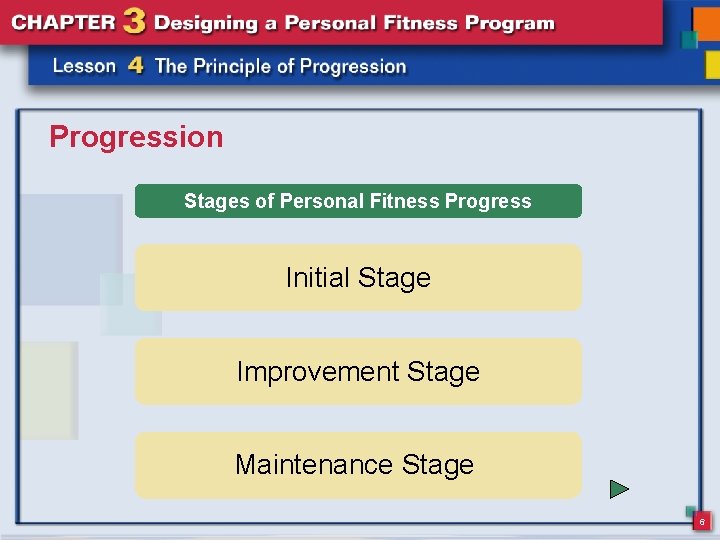
Progression Stages of Personal Fitness Progress Initial Stage Improvement Stage Maintenance Stage 6
Progression Term to Know Trainability These factors affect progression: Your initial fitness level Your heredity The rate at which you overload your body or change your FITT Your specific goals Your trainability The rate at which an individual’s fitness levels increase during fitness training. 7
Progression Term to Know Training plateau Trainability is determined, to a large extent, by heredity. Different people train at different rates. A period of time during training when little, if any, fitness improvement occurs. Training plateaus are a natural part of the training process. 8
Progression Term to Know Detraining People experience detraining if they lose the battle of will when a training plateau occurs. The loss of functional fitness that occurs when one stops fitness conditioning. 9
Progression Term to Know Cross-training One measure that can prevent detaining, particularly if you are injured, is cross-training. Varying your exercise or activity routine or type. 10
Progression Term to Know Overtraining is the leading cause of overuse injuries and burnout. Exercising, or being active to a point where it begins to have negative effects. 11
Progression Terms to Know Fatigue Health problems from overtraining include: Chronic fatigue Insomnia Constant muscle soreness Rapid weight loss Loss of appetite Elevated resting heart rate Elevated blood pressure Weakened immune system In females, absence of menstrual cycles, and possible infertility The feeling of being tired all the time. Insomnia Sleeplessness 12
Progression Term to Know Restoration The speed of restoration depends on your FITT. If you exercise daily, you will need to recover more quickly than if you worked out every other day. Ways in which you can optimize your recovery from physical activity or exercise. 13
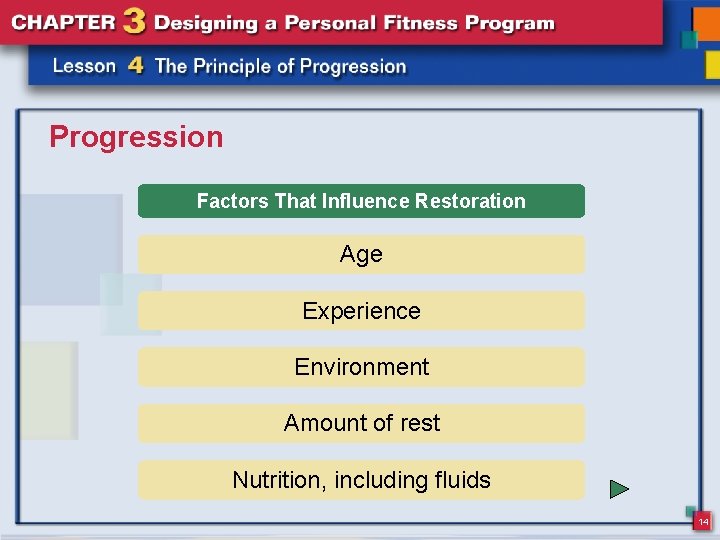
Progression Factors That Influence Restoration Age Experience Environment Amount of rest Nutrition, including fluids 14
Lesson 4 Reviewing Facts and Vocabulary 1. Vocabulary Describe the progression principle. Why is it important to your personal fitness program? 2. Recall What is a training plateau? What effect do plateaus have on an individual’s fitness conditioning? 1. Vocabulary 2. Recall 3. Individuals A training plateau isimprove when is the at a period of time during improvements different rates training due in trainability to the when little, ifoff. level “trainability” any, Some fitness principle. people want to improvement quit when theyoccurs. experience You a need to understand plateau. progression, or you may change your FITT and be injured. 3. Recall Why do some individuals progress in their fitness level at faster rates than others? 15
End of Table of Contents 16
- Slides: 16