
1 What is stau Wikipedia Stau may refer

](https://slidetodoc.com/presentation_image/d9ba52c5b8a6a16cbe52ccf69b07b299/image-21.jpg "Energy levels of the 7 Be. X + p reaction 8 B[p(3/2–), 7 Be(3/2–)](2+)")
- Slides: 25
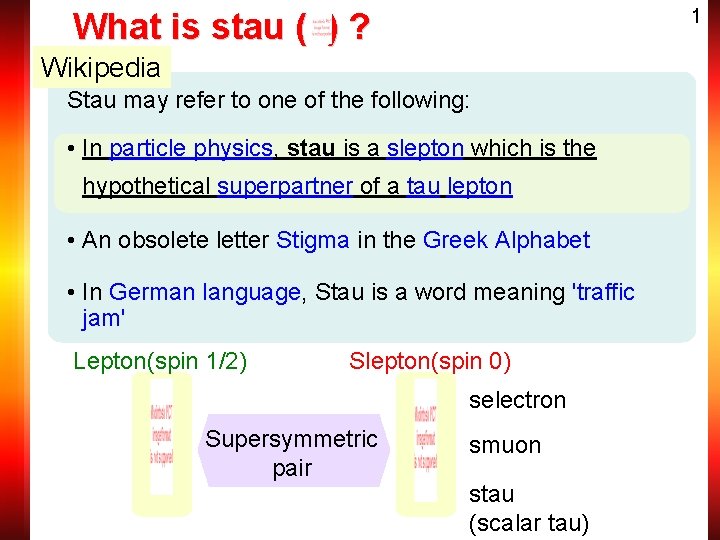
1 What is stau ( ) ? Wikipedia Stau may refer to one of the following: • In particle physics, stau is a slepton which is the hypothetical superpartner of a tau lepton • An obsolete letter Stigma in the Greek Alphabet • In German language, Stau is a word meaning 'traffic jam' Lepton(spin 1/2) Slepton(spin 0) selectron Supersymmetric pair smuon stau (scalar tau)
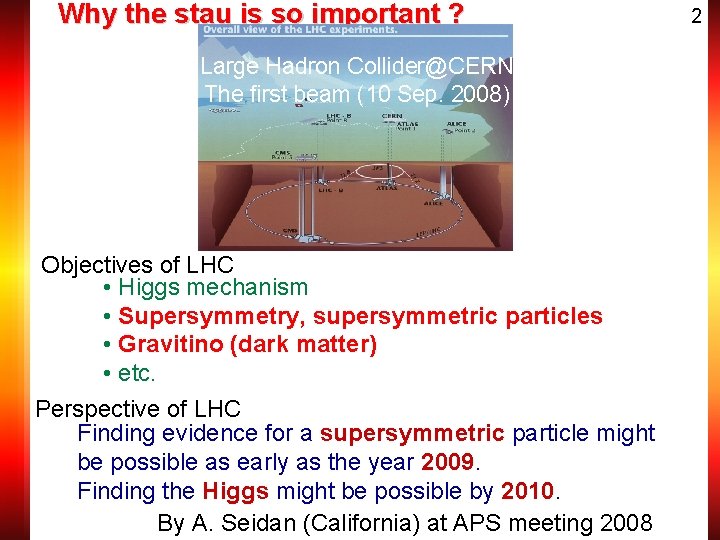
Why the stau is so important ? Large Hadron Collider@CERN The first beam (10 Sep. 2008) Objectives of LHC • Higgs mechanism • Supersymmetry, supersymmetric particles • Gravitino (dark matter) • etc. Perspective of LHC Finding evidence for a supersymmetric particle might be possible as early as the year 2009. Finding the Higgs might be possible by 2010. By A. Seidan (California) at APS meeting 2008 2
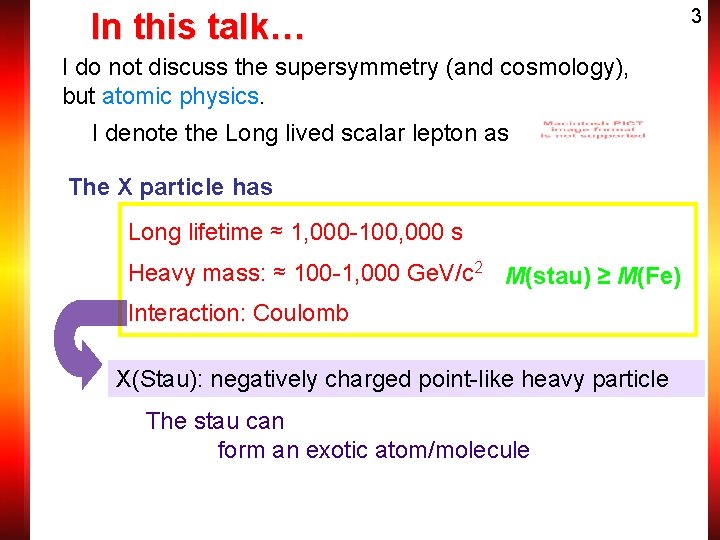
In this talk… I do not discuss the supersymmetry (and cosmology), but atomic physics. I denote the Long lived scalar lepton as The X particle has Long lifetime ≈ 1, 000 -100, 000 s Heavy mass: ≈ 100 -1, 000 Ge. V/c 2 M(stau) ≥ M(Fe) Interaction: Coulomb X(Stau): negatively charged point-like heavy particle The stau can form an exotic atom/molecule 3
Stau atom (for example; hydrogen like atom) m. X = 100 Ge. V/c 2 mp = 0. 94 Ge. V/c 2 Reduced mass Binding energy and Bohr radius (point nuclear charge) Root mean charge radius of nucleus 4
Nuclear charge density Gaussian distribution X 4 He : Hydrogen-like ion wavefunction Pure Coulombic potential b = 1. 37 fm for 4 He b = 1. 75 fm for d b = 2. 576 fm for 7 Be b = 0. 7144 fm for p 5
6 M. Pospelov (PRL 98, 231301, 2007) 6 Li production by X-particle atomic collision Lifetime: more than 1, 000 s nucleosynthesis (the first three minutes) catalyzed nuclear fusion Cf. muon catalyzed fusion
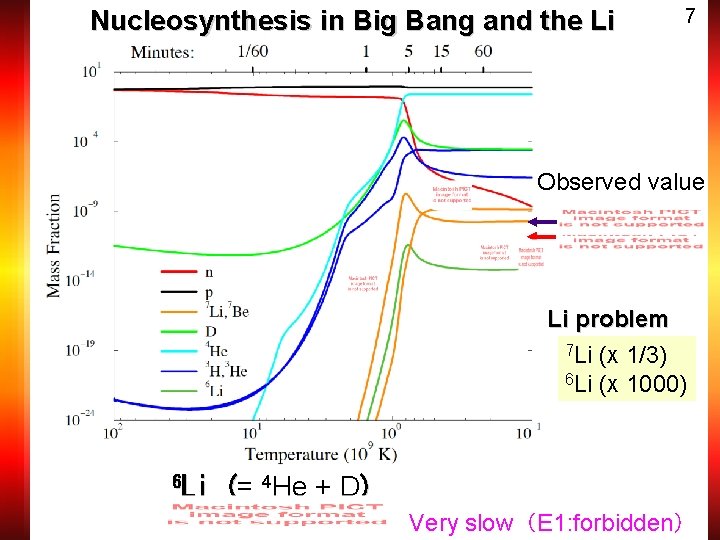
Nucleosynthesis in Big Bang and the Li problem 7 Observed value Li problem 7 Li (X 1/3) 6 Li (X 1000) 6 Li (= ( 4 He + D) Very slow(E 1: forbidden)
“The Economist” (June, 2007) Dr Pospelov's catalytic mechanism, by contrast, explains both discrepancies in one fell swoop. It also makes predictions about the detailed properties of the supersymmetric partners —and, as luck would have it, suggests that although they cannot be made on Earth at the moment, they should be in range of the Large Hadron Collider, a particle accelerator being built near Geneva, which should open for business later this year. It should not, therefore, take long to find out if his explanation for the lithium problem is correct. If it is, he can claim to have found SUSY's traces before the particle physicists did. Posperov’s result significantly limited the current understanding of stau.
Is it true? Particle phys. (U. Tokyo) Maybe yes, but… Nuclear Phys. Atomic Phys. (Exotic Atom) … Pospelov employed a simple scaling, and paid no attention to the nuclear interaction and low energy atomic collision. Stau could be created at big ban,
Catalyzed reactions Submitted to Prog. Theo. Phys. ar. Xiv: 0809. 4772 v 1
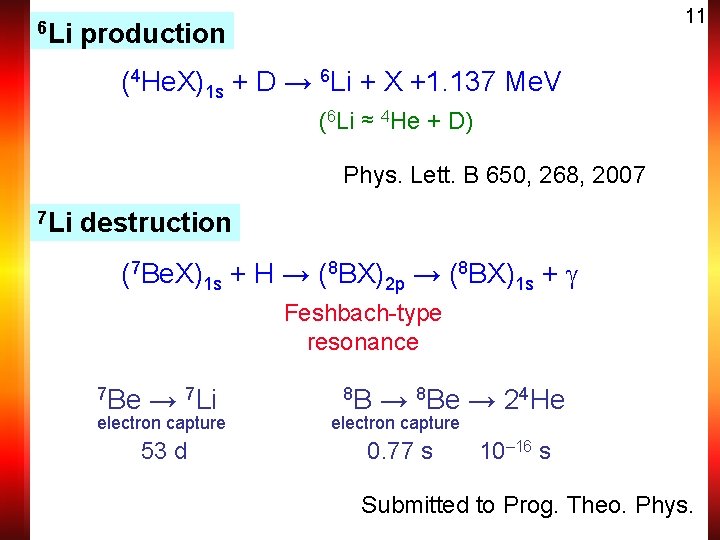
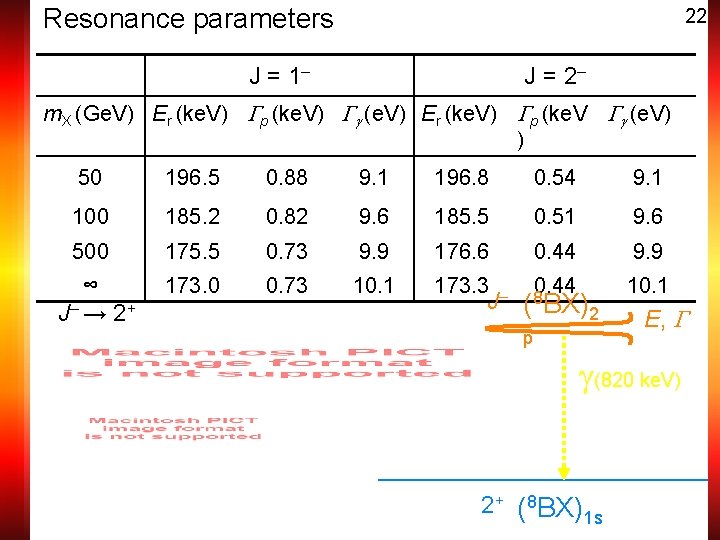
6 Li 11 production (4 He. X)1 s + D → 6 Li + X +1. 137 Me. V (6 Li ≈ 4 He + D) Phys. Lett. B 650, 268, 2007 7 Li destruction (7 Be. X)1 s + H → (8 BX)2 p → (8 BX)1 s + Feshbach-type resonance 7 Be → 7 Li 8 B → 8 Be → 24 He electron capture 53 d 0. 77 s 10– 16 s Submitted to Prog. Theo. Phys.
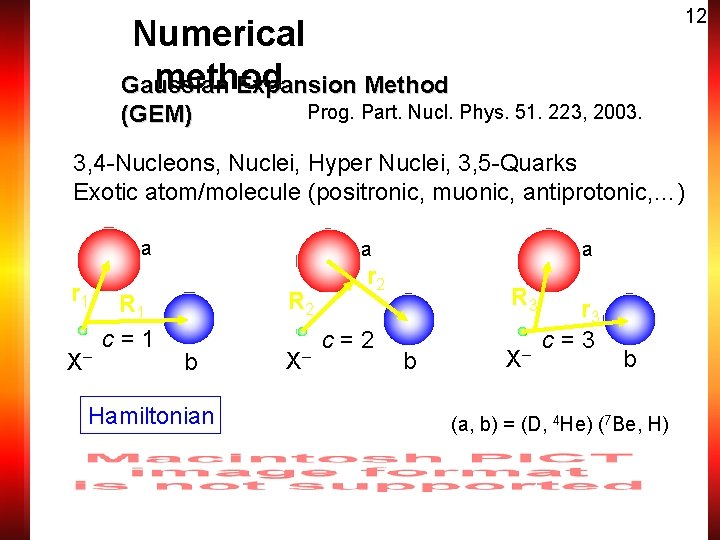
12 Numerical method Gaussian Expansion Method (GEM) Prog. Part. Nucl. Phys. 51. 223, 2003. 3, 4 -Nucleons, Nuclei, Hyper Nuclei, 3, 5 -Quarks Exotic atom/molecule (positronic, muonic, antiprotonic, …) a r 1 X– R 1 c=1 a R 2 b Hamiltonian X– a r 2 c=2 R 3 b X– r 3 c=3 b (a, b) = (D, 4 He) (7 Be, H)
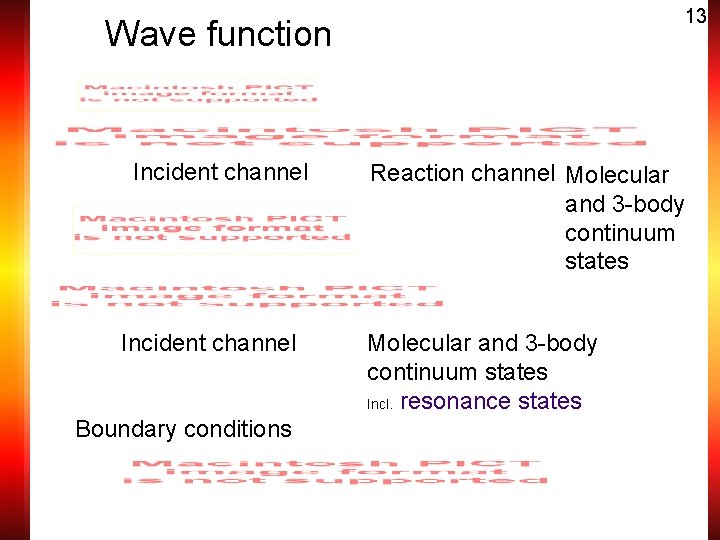
13 Wave function Incident channel Boundary conditions Reaction channel Molecular and 3 -body continuum states Incl. resonance states
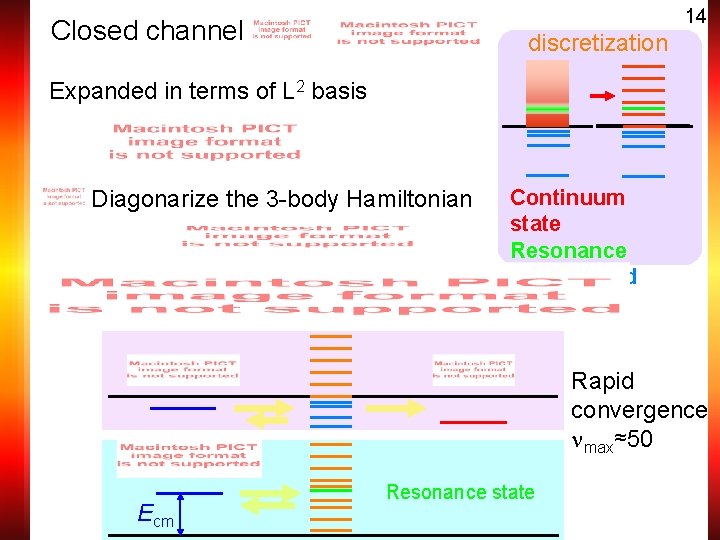
14 Closed channel discretization Expanded in terms of L 2 basis Diagonarize the 3 -body Hamiltonian Continuum state Resonance state Bound state Rapid convergence max≈50 Ecm Resonance state
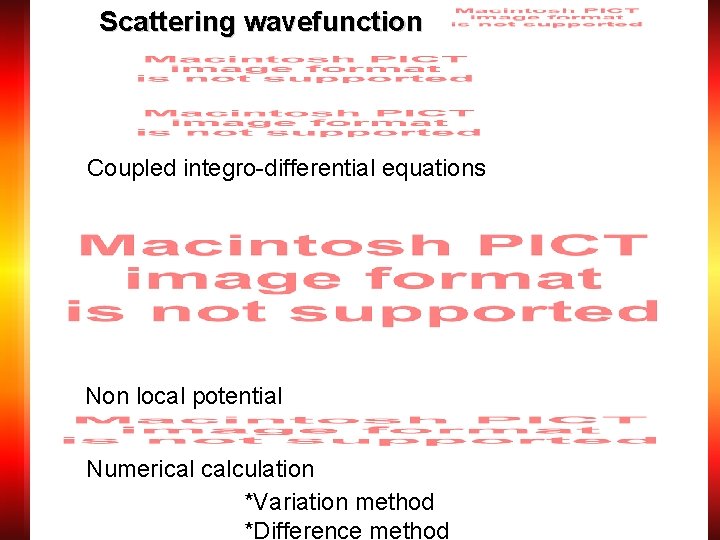
Scattering wavefunction Coupled integro-differential equations Non local potential Numerical calculation *Variation method *Difference method
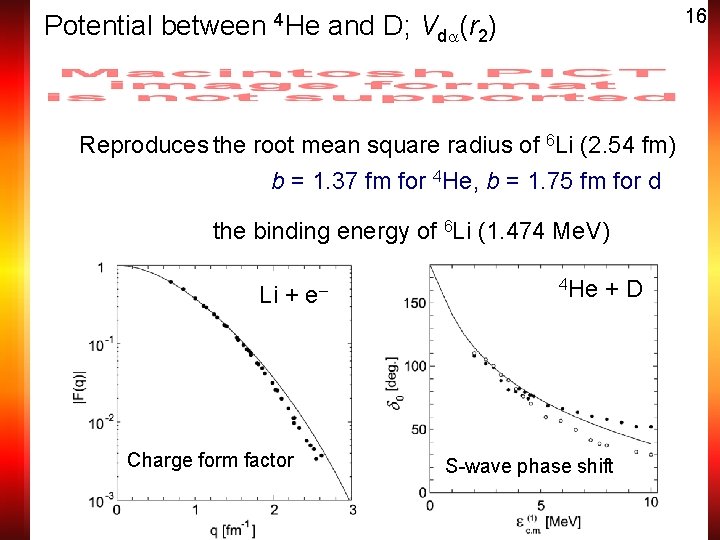
16 Potential between 4 He and D; Vd (r 2) Reproduces the root mean square radius of 6 Li (2. 54 fm) b = 1. 37 fm for 4 He, b = 1. 75 fm for d the binding energy of 6 Li (1. 474 Me. V) 4 He Li + e– +D 原子核電荷分布:ガウス型 b = 1. 37 fm for 4 He, b = 1. 75 fm for d Charge form factor S-wave phase shift
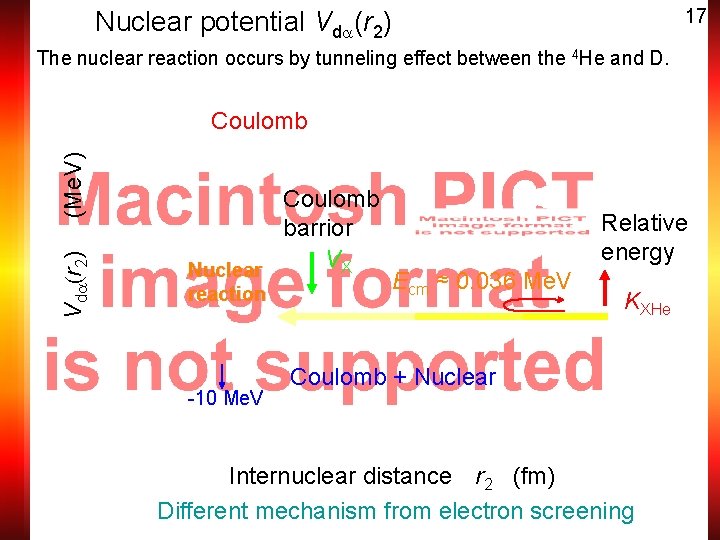
17 Nuclear potential Vd (r 2) The nuclear reaction occurs by tunneling effect between the 4 He and D. Vd r 2) (Me. V) Coulomb barrior VX Nuclear reaction -10 Me. V Relative energy Ecm ≈ 0. 036 Me. V KXHe Coulomb + Nuclear Internuclear distance r 2 (fm) Different mechanism from electron screening
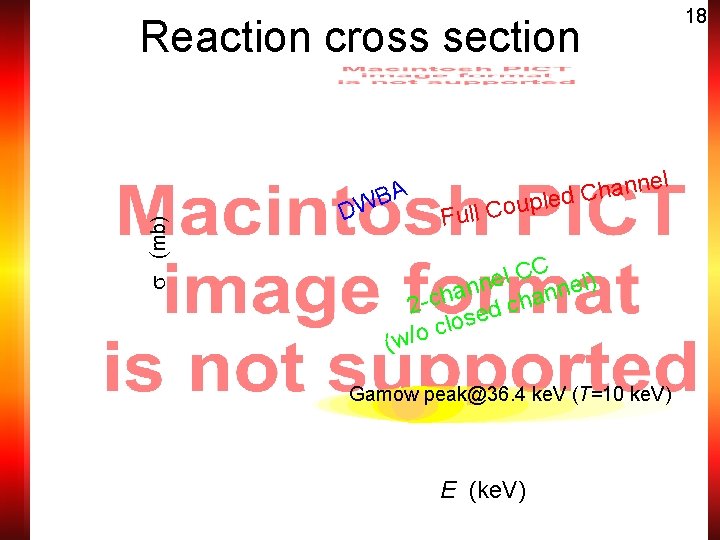
Reaction cross section mb) BA DW u Full Co el n n a h led C p C C l l) ne e n n a n h 2 -c ed cha s o l c (w/o Gamow peak@36. 4 ke. V (T=10 ke. V) E (ke. V) 18
DWBA 2 -channel CC Full CC
Energy levels of the 7 Be. X + p reaction 8 B[p(3/2–), 7 Be(3/2–)](2+) Vp-Be = VWS + Vls + VMC 7 Be 0 Me. V 8 B -0. 1375 Me. V Ein J– Gamov peak ≈ 114 ke. V (k. T ≈ 35 ke. V) (7 Be. X)1 s + p (8 BX)2 p -1. 33 Me. V Incident channel -1. 86 Me. V 2+ +X+p (8 BX)1 s +X E,
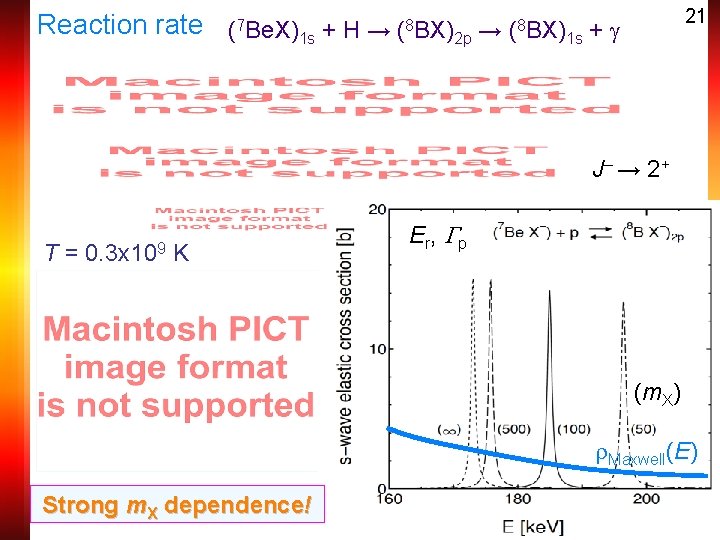
21 Reaction rate (7 Be. X)1 s + H → (8 BX)2 p → (8 BX)1 s + J– → 2+ T= 0. 3 x 10⁹ K E r, p (m. X) Maxwell(E) Strong m. X dependence!
Resonance parameters 22 J = 1– J = 2– m. X (Ge. V) Er (ke. V) p (ke. V) (e. V) Er (ke. V) p (ke. V (e. V) ) 50 196. 5 0. 88 9. 1 196. 8 0. 54 9. 1 100 185. 2 0. 82 9. 6 185. 5 0. 51 9. 6 500 175. 5 0. 73 9. 9 176. 6 0. 44 9. 9 ∞ 173. 0 0. 73 10. 1 173. 3 0. 44 10. 1 J– → 2+ J– (8 BX) 2 p E, (820 ke. V) 2+ (8 BX)1 s
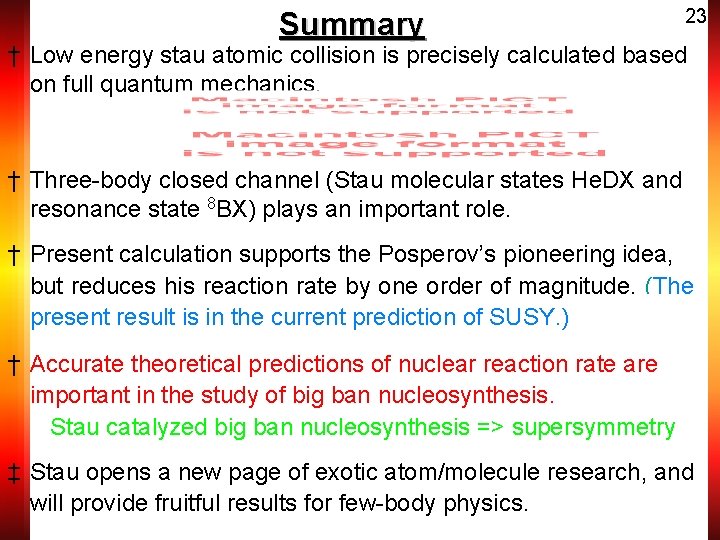
Summary 23 † Low energy stau atomic collision is precisely calculated based on full quantum mechanics. † Three-body closed channel (Stau molecular states He. DX and resonance state 8 BX) plays an important role. † Present calculation supports the Posperov’s pioneering idea, but reduces his reaction rate by one order of magnitude. (The present result is in the current prediction of SUSY. ) † Accurate theoretical predictions of nuclear reaction rate are important in the study of big ban nucleosynthesis. Stau catalyzed big ban nucleosynthesis => supersymmetry ‡ Stau opens a new page of exotic atom/molecule research, and will provide fruitful results for few-body physics.
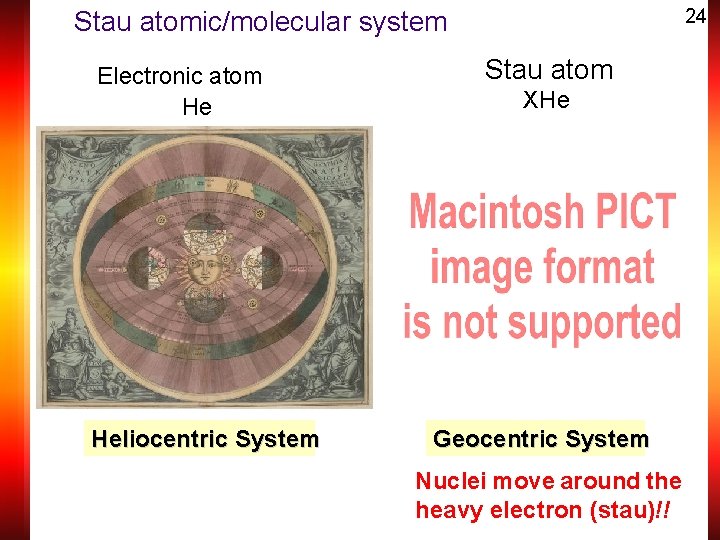
24 Stau atomic/molecular system Electronic atom He Heliocentric System Stau atom XHe Geocentric System Nuclei move around the heavy electron (stau)!!