
1 What is a Pointer A pointer is
![argv[0] - "myecho" argv[1] - "aaa" argv[2] - "bbb" argv[3] - "ccc" 19. What](https://slidetodoc.com/presentation_image_h/030dd9c0159e8eb1342d139b23a0fb54/image-20.jpg "argv[0] - \"myecho\" argv[1] - \"aaa\" argv[2] - \"bbb\" argv[3] - \"ccc\" 19. What")
- Slides: 49
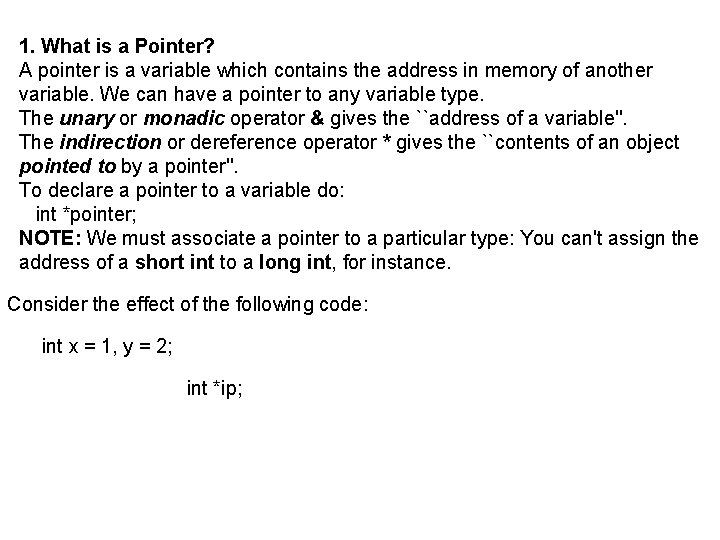
1. What is a Pointer? A pointer is a variable which contains the address in memory of another variable. We can have a pointer to any variable type. The unary or monadic operator & gives the ``address of a variable''. The indirection or dereference operator * gives the ``contents of an object pointed to by a pointer''. To declare a pointer to a variable do: int *pointer; NOTE: We must associate a pointer to a particular type: You can't assign the address of a short int to a long int, for instance. Consider the effect of the following code: int x = 1, y = 2; int *ip;
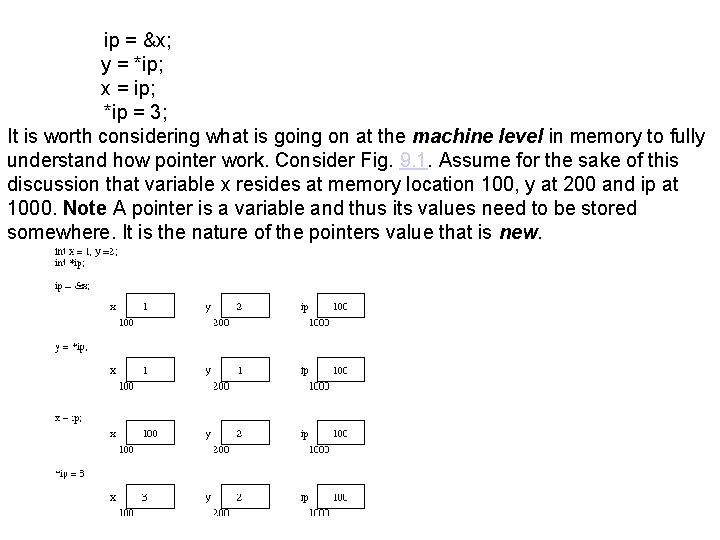
ip = &x; y = *ip; x = ip; *ip = 3; It is worth considering what is going on at the machine level in memory to fully understand how pointer work. Consider Fig. 9. 1. Assume for the sake of this discussion that variable x resides at memory location 100, y at 200 and ip at 1000. Note A pointer is a variable and thus its values need to be stored somewhere. It is the nature of the pointers value that is new.
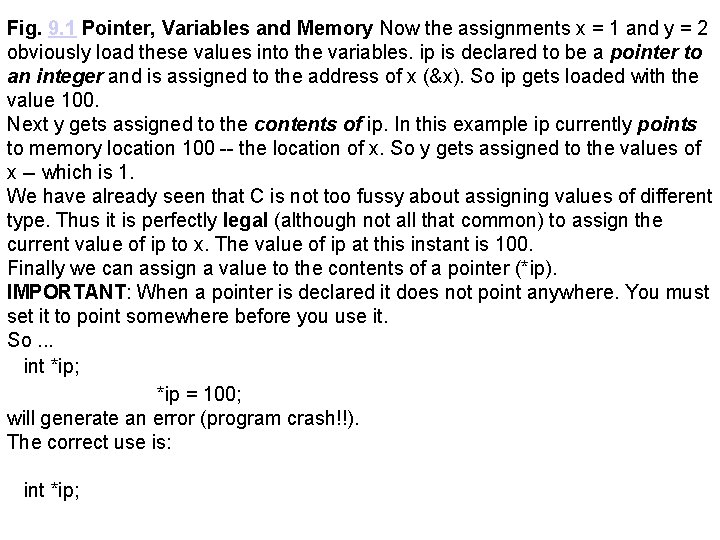
Fig. 9. 1 Pointer, Variables and Memory Now the assignments x = 1 and y = 2 obviously load these values into the variables. ip is declared to be a pointer to an integer and is assigned to the address of x (&x). So ip gets loaded with the value 100. Next y gets assigned to the contents of ip. In this example ip currently points to memory location 100 -- the location of x. So y gets assigned to the values of x -- which is 1. We have already seen that C is not too fussy about assigning values of different type. Thus it is perfectly legal (although not all that common) to assign the current value of ip to x. The value of ip at this instant is 100. Finally we can assign a value to the contents of a pointer (*ip). IMPORTANT: When a pointer is declared it does not point anywhere. You must set it to point somewhere before you use it. So. . . int *ip; *ip = 100; will generate an error (program crash!!). The correct use is: int *ip;
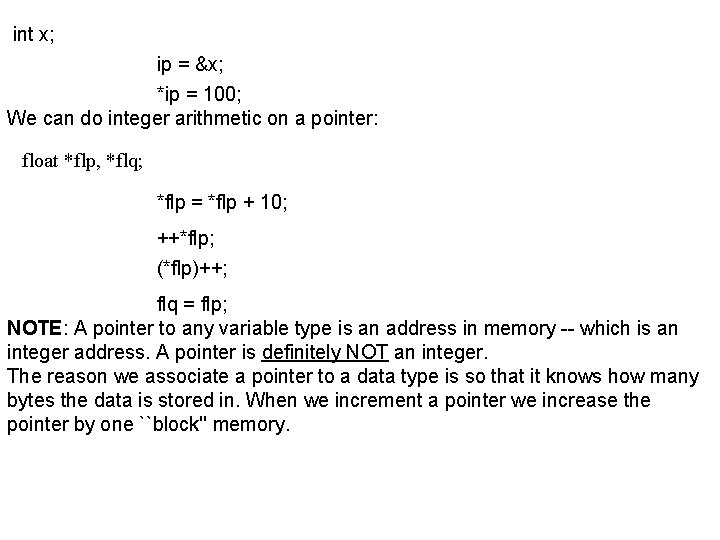
int x; ip = &x; *ip = 100; We can do integer arithmetic on a pointer: float *flp, *flq; *flp = *flp + 10; ++*flp; (*flp)++; flq = flp; NOTE: A pointer to any variable type is an address in memory -- which is an integer address. A pointer is definitely NOT an integer. The reason we associate a pointer to a data type is so that it knows how many bytes the data is stored in. When we increment a pointer we increase the pointer by one ``block'' memory.
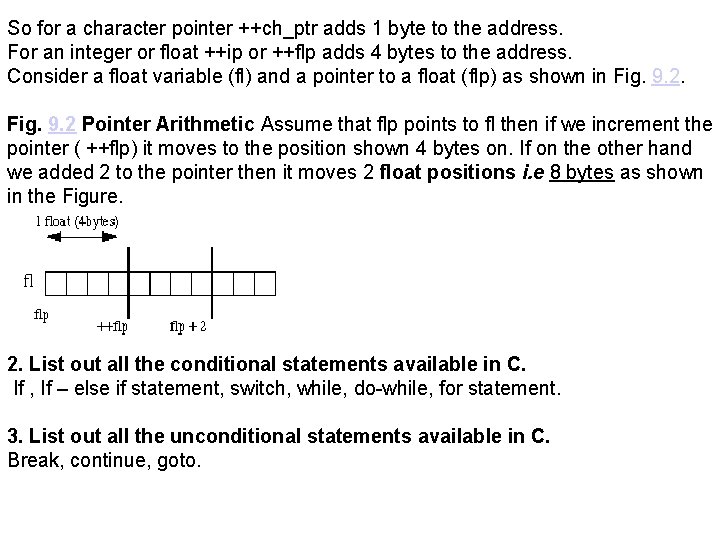
So for a character pointer ++ch_ptr adds 1 byte to the address. For an integer or float ++ip or ++flp adds 4 bytes to the address. Consider a float variable (fl) and a pointer to a float (flp) as shown in Fig. 9. 2 Pointer Arithmetic Assume that flp points to fl then if we increment the pointer ( ++flp) it moves to the position shown 4 bytes on. If on the other hand we added 2 to the pointer then it moves 2 float positions i. e 8 bytes as shown in the Figure. 2. List out all the conditional statements available in C. If , If – else if statement, switch, while, do-while, for statement. 3. List out all the unconditional statements available in C. Break, continue, goto.
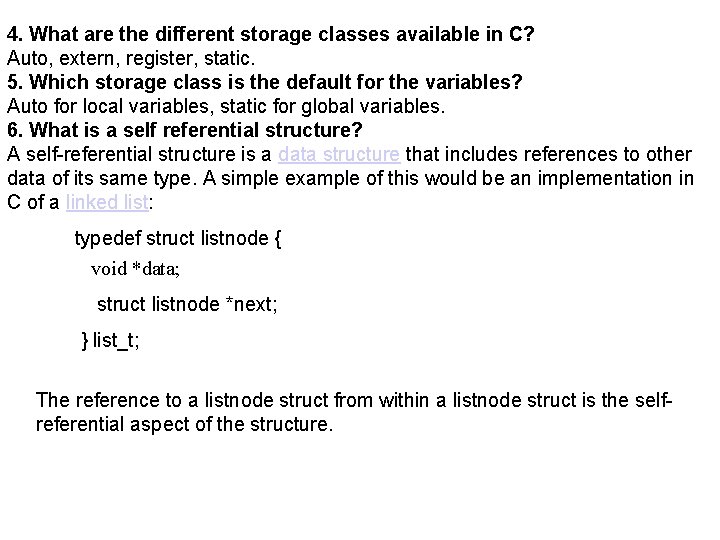
4. What are the different storage classes available in C? Auto, extern, register, static. 5. Which storage class is the default for the variables? Auto for local variables, static for global variables. 6. What is a self referential structure? A self-referential structure is a data structure that includes references to other data of its same type. A simple example of this would be an implementation in C of a linked list: typedef struct listnode { void *data; struct listnode *next; } list_t; The reference to a listnode struct from within a listnode struct is the selfreferential aspect of the structure.
7. What are the different iterative statements available in C? While , do-while, for. 8. Differentiate structure from union? (a) In union , the different members share the same memory location. The total memory allocated to the union is equal to the maximum size of the member. Union can hold data of only one member at a time. (b) In structure, the different members have different memory location. The total memory allocated to the structure is equal to the sum of memory allocated for each member. Structure can hold data of more than one member at a time.
10. What is preprocessor? The C preprocessor (cpp) is the preprocessor for the C programming language. In many C implementations, it is a separate program invoked by the compiler as the first part of translation. The preprocessor handles directives for source file inclusion (#include), macro definitions (#define), and conditional inclusion (#if). The language of preprocessor directives is not strictly specific to the grammar of C, so the C preprocessor can also be used independently to process other types of files. The transformations it makes on its input form the first four of C's so-called Phases of Translation. Though an implementation may choose to perform some or all phases simultaneously, it must behave as if it performed them one-by-one in order. Examples This section goes into some detail about C preprocessor usage. Good programming practice when writing C macros is crucial, particularly in a collaborative setting, so notes on this have been included. Of course, it is possible to abuse these features, but this is not recommended in a production environment.
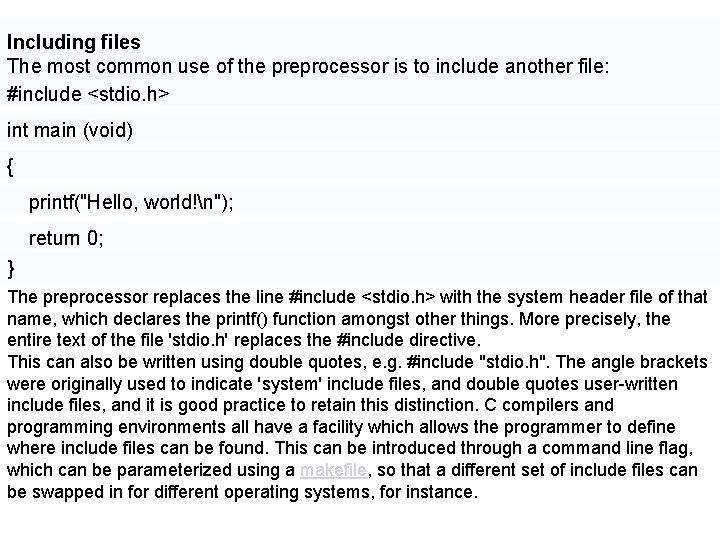
Including files The most common use of the preprocessor is to include another file: #include <stdio. h> int main (void) { printf("Hello, world!n"); return 0; } The preprocessor replaces the line #include <stdio. h> with the system header file of that name, which declares the printf() function amongst other things. More precisely, the entire text of the file 'stdio. h' replaces the #include directive. This can also be written using double quotes, e. g. #include "stdio. h". The angle brackets were originally used to indicate 'system' include files, and double quotes user-written include files, and it is good practice to retain this distinction. C compilers and programming environments all have a facility which allows the programmer to define where include files can be found. This can be introduced through a command line flag, which can be parameterized using a makefile, so that a different set of include files can be swapped in for different operating systems, for instance.
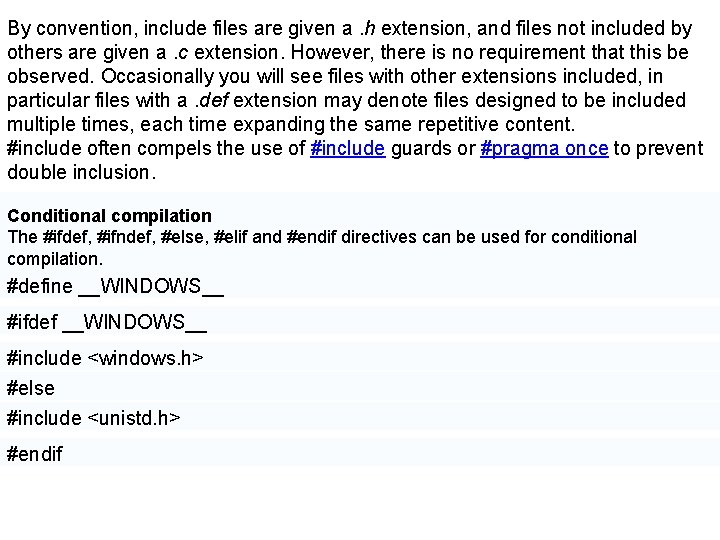
By convention, include files are given a. h extension, and files not included by others are given a. c extension. However, there is no requirement that this be observed. Occasionally you will see files with other extensions included, in particular files with a. def extension may denote files designed to be included multiple times, each time expanding the same repetitive content. #include often compels the use of #include guards or #pragma once to prevent double inclusion. Conditional compilation The #ifdef, #ifndef, #else, #elif and #endif directives can be used for conditional compilation. #define __WINDOWS__ #ifdef __WINDOWS__ #include <windows. h> #else #include <unistd. h> #endif
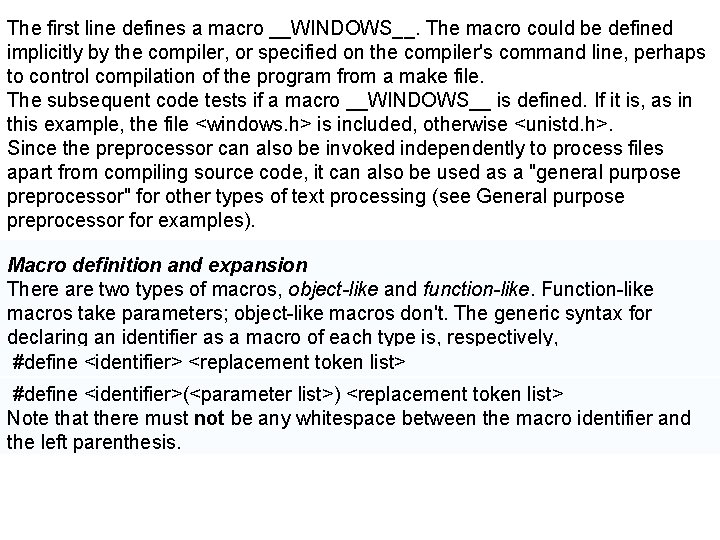
The first line defines a macro __WINDOWS__. The macro could be defined implicitly by the compiler, or specified on the compiler's command line, perhaps to control compilation of the program from a make file. The subsequent code tests if a macro __WINDOWS__ is defined. If it is, as in this example, the file <windows. h> is included, otherwise <unistd. h>. Since the preprocessor can also be invoked independently to process files apart from compiling source code, it can also be used as a "general purpose preprocessor" for other types of text processing (see General purpose preprocessor for examples). Macro definition and expansion There are two types of macros, object-like and function-like. Function-like macros take parameters; object-like macros don't. The generic syntax for declaring an identifier as a macro of each type is, respectively, #define <identifier> <replacement token list> #define <identifier>(<parameter list>) <replacement token list> Note that there must not be any whitespace between the macro identifier and the left parenthesis.
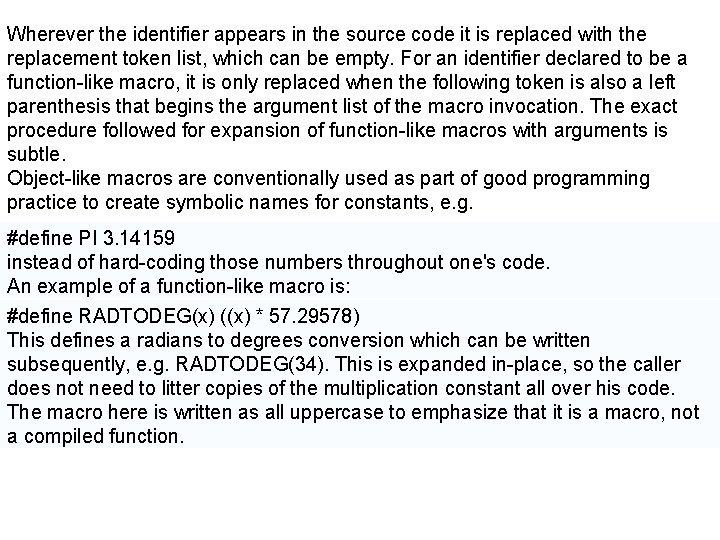
Wherever the identifier appears in the source code it is replaced with the replacement token list, which can be empty. For an identifier declared to be a function-like macro, it is only replaced when the following token is also a left parenthesis that begins the argument list of the macro invocation. The exact procedure followed for expansion of function-like macros with arguments is subtle. Object-like macros are conventionally used as part of good programming practice to create symbolic names for constants, e. g. #define PI 3. 14159 instead of hard-coding those numbers throughout one's code. An example of a function-like macro is: #define RADTODEG(x) ((x) * 57. 29578) This defines a radians to degrees conversion which can be written subsequently, e. g. RADTODEG(34). This is expanded in-place, so the caller does not need to litter copies of the multiplication constant all over his code. The macro here is written as all uppercase to emphasize that it is a macro, not a compiled function.
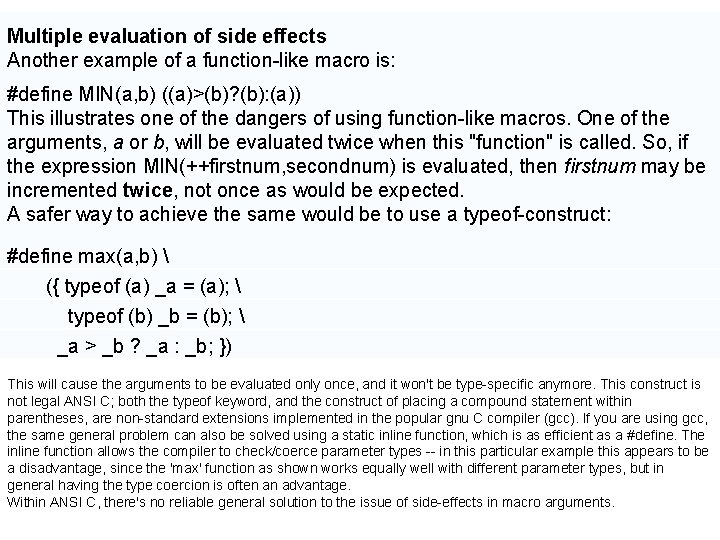
Multiple evaluation of side effects Another example of a function-like macro is: #define MIN(a, b) ((a)>(b)? (b): (a)) This illustrates one of the dangers of using function-like macros. One of the arguments, a or b, will be evaluated twice when this "function" is called. So, if the expression MIN(++firstnum, secondnum) is evaluated, then firstnum may be incremented twice, not once as would be expected. A safer way to achieve the same would be to use a typeof-construct: #define max(a, b) ({ typeof (a) _a = (a); typeof (b) _b = (b); _a > _b ? _a : _b; }) This will cause the arguments to be evaluated only once, and it won't be type-specific anymore. This construct is not legal ANSI C; both the typeof keyword, and the construct of placing a compound statement within parentheses, are non-standard extensions implemented in the popular gnu C compiler (gcc). If you are using gcc, the same general problem can also be solved using a static inline function, which is as efficient as a #define. The inline function allows the compiler to check/coerce parameter types -- in this particular example this appears to be a disadvantage, since the 'max' function as shown works equally well with different parameter types, but in general having the type coercion is often an advantage. Within ANSI C, there's no reliable general solution to the issue of side-effects in macro arguments.
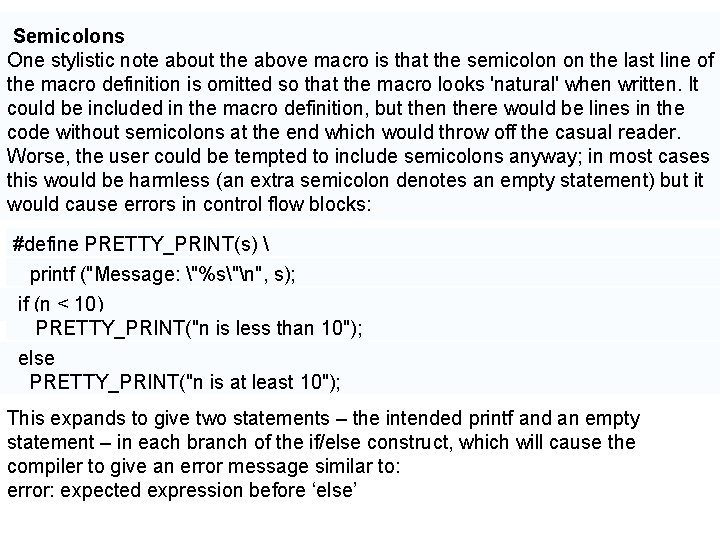
Semicolons One stylistic note about the above macro is that the semicolon on the last line of the macro definition is omitted so that the macro looks 'natural' when written. It could be included in the macro definition, but then there would be lines in the code without semicolons at the end which would throw off the casual reader. Worse, the user could be tempted to include semicolons anyway; in most cases this would be harmless (an extra semicolon denotes an empty statement) but it would cause errors in control flow blocks: #define PRETTY_PRINT(s) printf ("Message: "%s"n", s); if (n < 10) PRETTY_PRINT("n is less than 10"); else PRETTY_PRINT("n is at least 10"); This expands to give two statements – the intended printf and an empty statement – in each branch of the if/else construct, which will cause the compiler to give an error message similar to: error: expected expression before ‘else’
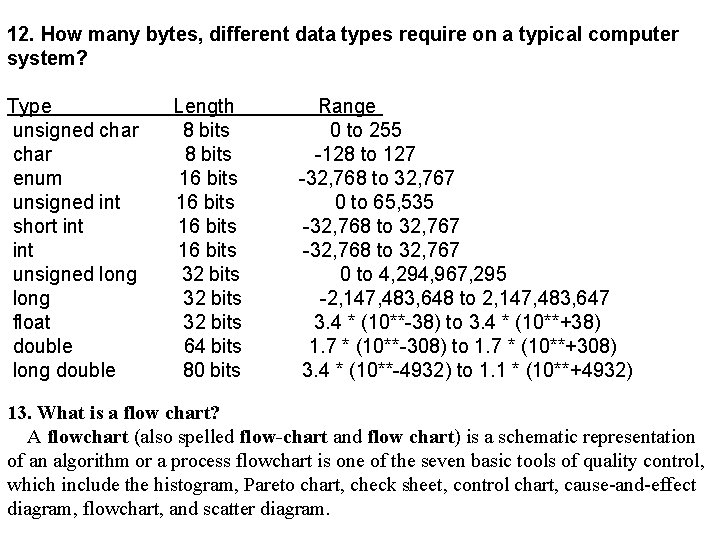
12. How many bytes, different data types require on a typical computer system? Type Length Range unsigned char 8 bits 0 to 255 char 8 bits -128 to 127 enum 16 bits -32, 768 to 32, 767 unsigned int 16 bits 0 to 65, 535 short int 16 bits -32, 768 to 32, 767 int 16 bits -32, 768 to 32, 767 unsigned long 32 bits 0 to 4, 294, 967, 295 long 32 bits -2, 147, 483, 648 to 2, 147, 483, 647 float 32 bits 3. 4 * (10**-38) to 3. 4 * (10**+38) double 64 bits 1. 7 * (10**-308) to 1. 7 * (10**+308) long double 80 bits 3. 4 * (10**-4932) to 1. 1 * (10**+4932) 13. What is a flow chart? A flowchart (also spelled flow-chart and flow chart) is a schematic representation of an algorithm or a process flowchart is one of the seven basic tools of quality control, which include the histogram, Pareto chart, check sheet, control chart, cause-and-effect diagram, flowchart, and scatter diagram.
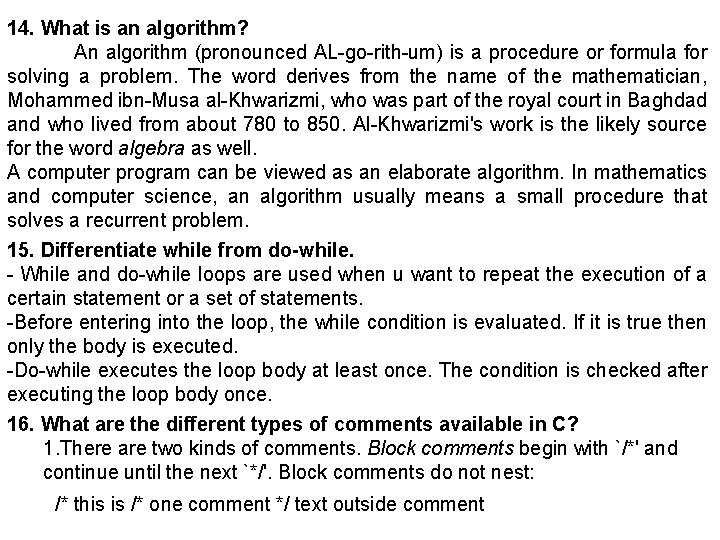
14. What is an algorithm? An algorithm (pronounced AL-go-rith-um) is a procedure or formula for solving a problem. The word derives from the name of the mathematician, Mohammed ibn-Musa al-Khwarizmi, who was part of the royal court in Baghdad and who lived from about 780 to 850. Al-Khwarizmi's work is the likely source for the word algebra as well. A computer program can be viewed as an elaborate algorithm. In mathematics and computer science, an algorithm usually means a small procedure that solves a recurrent problem. 15. Differentiate while from do-while. - While and do-while loops are used when u want to repeat the execution of a certain statement or a set of statements. -Before entering into the loop, the while condition is evaluated. If it is true then only the body is executed. -Do-while executes the loop body at least once. The condition is checked after executing the loop body once. 16. What are the different types of comments available in C? 1. There are two kinds of comments. Block comments begin with `/*' and continue until the next `*/'. Block comments do not nest: /* this is /* one comment */ text outside comment
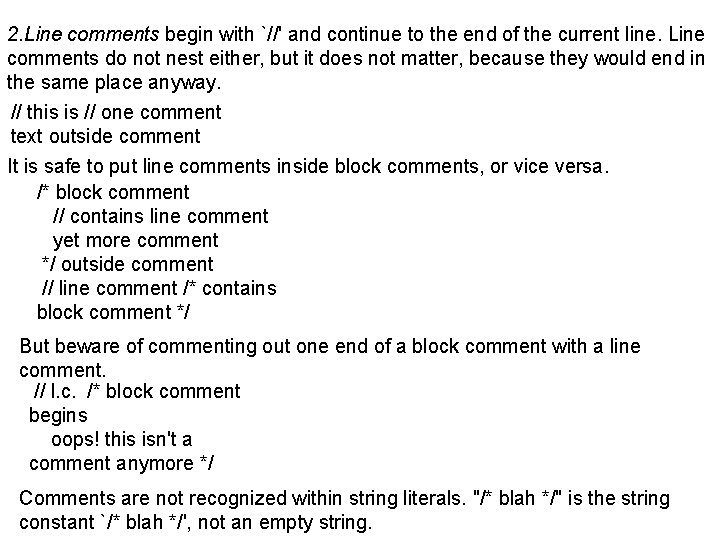
2. Line comments begin with `//' and continue to the end of the current line. Line comments do not nest either, but it does not matter, because they would end in the same place anyway. // this is // one comment text outside comment It is safe to put line comments inside block comments, or vice versa. /* block comment // contains line comment yet more comment */ outside comment // line comment /* contains block comment */ But beware of commenting out one end of a block comment with a line comment. // l. c. /* block comment begins oops! this isn't a comment anymore */ Comments are not recognized within string literals. "/* blah */" is the string constant `/* blah */', not an empty string.
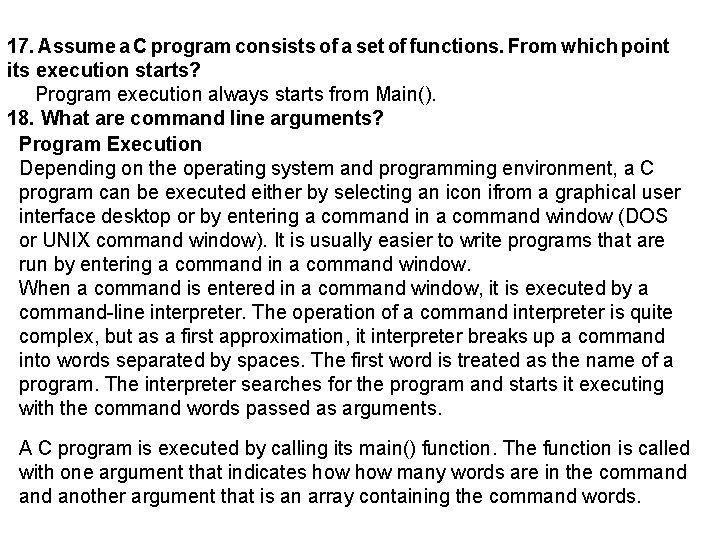
17. Assume a C program consists of a set of functions. From which point its execution starts? Program execution always starts from Main(). 18. What are command line arguments? Program Execution Depending on the operating system and programming environment, a C program can be executed either by selecting an icon ifrom a graphical user interface desktop or by entering a command in a command window (DOS or UNIX command window). It is usually easier to write programs that are run by entering a command in a command window. When a command is entered in a command window, it is executed by a command-line interpreter. The operation of a command interpreter is quite complex, but as a first approximation, it interpreter breaks up a command into words separated by spaces. The first word is treated as the name of a program. The interpreter searches for the program and starts it executing with the command words passed as arguments. A C program is executed by calling its main() function. The function is called with one argument that indicates how many words are in the command another argument that is an array containing the command words.
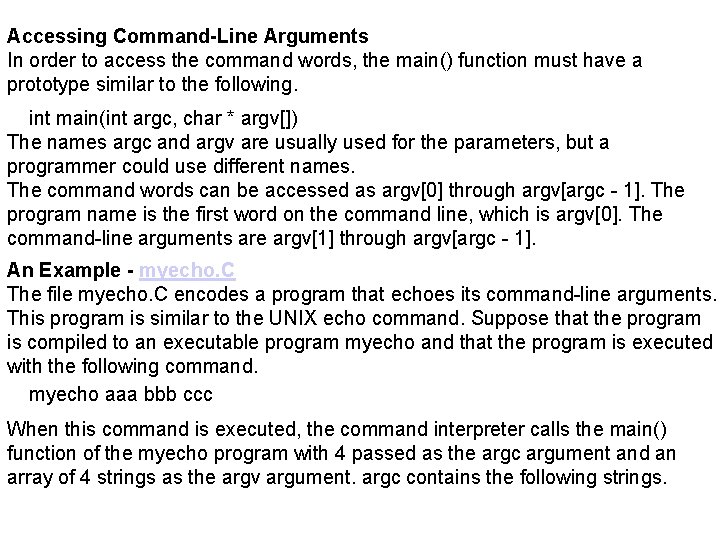
Accessing Command-Line Arguments In order to access the command words, the main() function must have a prototype similar to the following. int main(int argc, char * argv[]) The names argc and argv are usually used for the parameters, but a programmer could use different names. The command words can be accessed as argv[0] through argv[argc - 1]. The program name is the first word on the command line, which is argv[0]. The command-line arguments are argv[1] through argv[argc - 1]. An Example - myecho. C The file myecho. C encodes a program that echoes its command-line arguments. This program is similar to the UNIX echo command. Suppose that the program is compiled to an executable program myecho and that the program is executed with the following command. myecho aaa bbb ccc When this command is executed, the command interpreter calls the main() function of the myecho program with 4 passed as the argc argument and an array of 4 strings as the argv argument. argc contains the following strings.
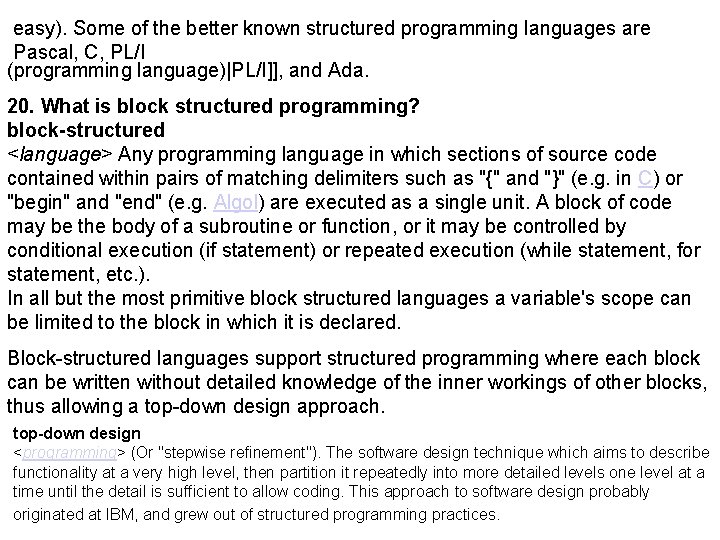
argv[0] - "myecho" argv[1] - "aaa" argv[2] - "bbb" argv[3] - "ccc" 19. What is structured programming? Structured programming is often (but not always) associated with a "top-down" approach to design. Structured programming languages It is possible to do structured programming in any programming language, though it is preferable to use something like a procedural programming language. Since about 1970 when structured programming began to gain popularity as a technique, most new procedural programming languages have included features to encourage structured programming (and sometimes have left out features that would make unstructured programming
easy). Some of the better known structured programming languages are Pascal, C, PL/I (programming language)|PL/I]], and Ada. 20. What is block structured programming? block-structured <language> Any programming language in which sections of source code contained within pairs of matching delimiters such as "{" and "}" (e. g. in C) or "begin" and "end" (e. g. Algol) are executed as a single unit. A block of code may be the body of a subroutine or function, or it may be controlled by conditional execution (if statement) or repeated execution (while statement, for statement, etc. ). In all but the most primitive block structured languages a variable's scope can be limited to the block in which it is declared. Block-structured languages support structured programming where each block can be written without detailed knowledge of the inner workings of other blocks, thus allowing a top-down design approach. top-down design <programming> (Or "stepwise refinement"). The software design technique which aims to describe functionality at a very high level, then partition it repeatedly into more detailed levels one level at a time until the detail is sufficient to allow coding. This approach to software design probably originated at IBM, and grew out of structured programming practices.
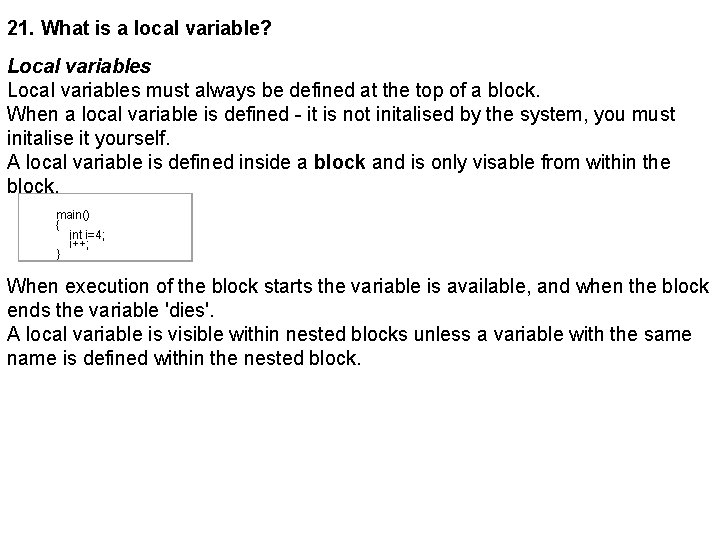
21. What is a local variable? Local variables must always be defined at the top of a block. When a local variable is defined - it is not initalised by the system, you must initalise it yourself. A local variable is defined inside a block and is only visable from within the block. main() { int i=4; i++; } When execution of the block starts the variable is available, and when the block ends the variable 'dies'. A local variable is visible within nested blocks unless a variable with the same name is defined within the nested block.
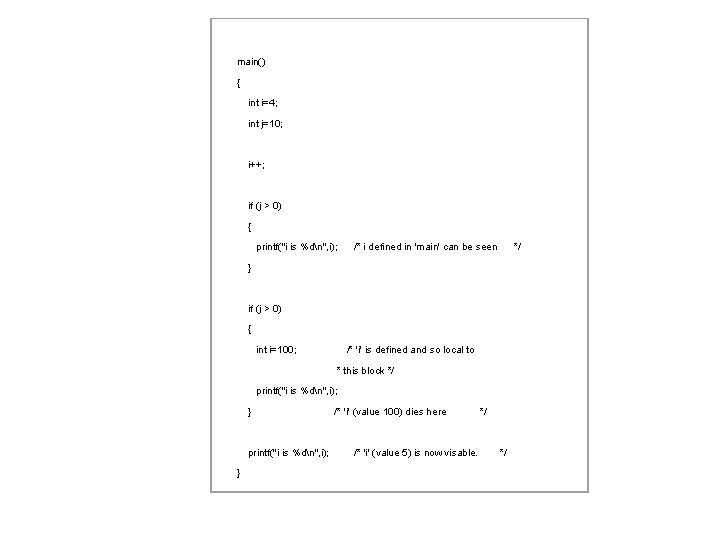
main() { int i=4; int j=10; i++; if (j > 0) { printf("i is %dn", i); /* i defined in 'main' can be seen */ } if (j > 0) { int i=100; /* 'i' is defined and so local to * this block */ printf("i is %dn", i); } /* 'i' (value 100) dies here */ printf("i is %dn", i); /* 'i' (value 5) is now visable. */ }
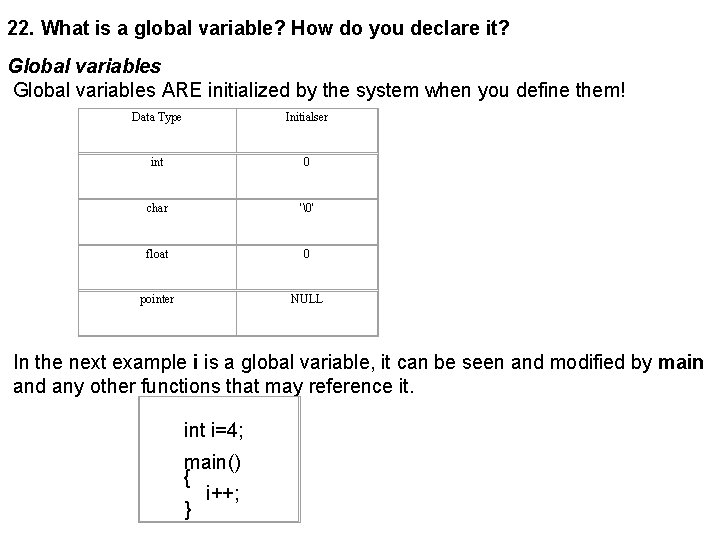
22. What is a global variable? How do you declare it? Global variables ARE initialized by the system when you define them! Data Type Initialser int 0 char '' float 0 pointer NULL In the next example i is a global variable, it can be seen and modified by main and any other functions that may reference it. int i=4; main() { i++; }
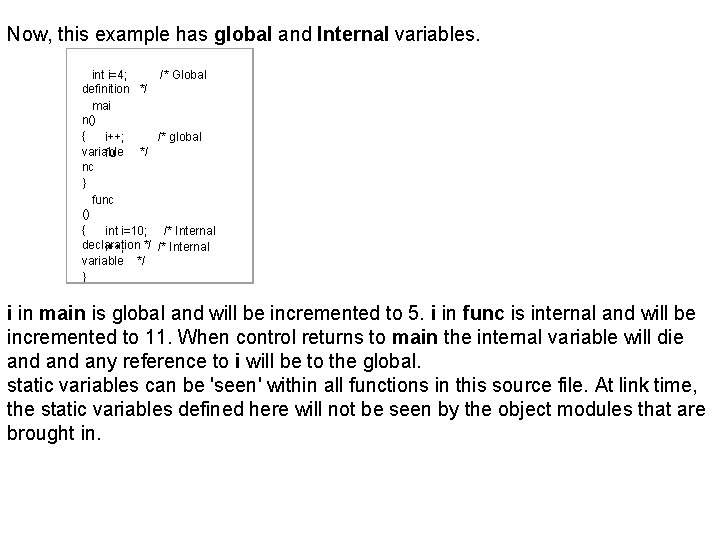
Now, this example has global and Internal variables. int i=4; /* Global definition */ mai n() { i++; /* global variable */ fu nc } func () { int i=10; /* Internal declaration */ i++; /* Internal variable */ } i in main is global and will be incremented to 5. i in func is internal and will be incremented to 11. When control returns to main the internal variable will die and any reference to i will be to the global. static variables can be 'seen' within all functions in this source file. At link time, the static variables defined here will not be seen by the object modules that are brought in.
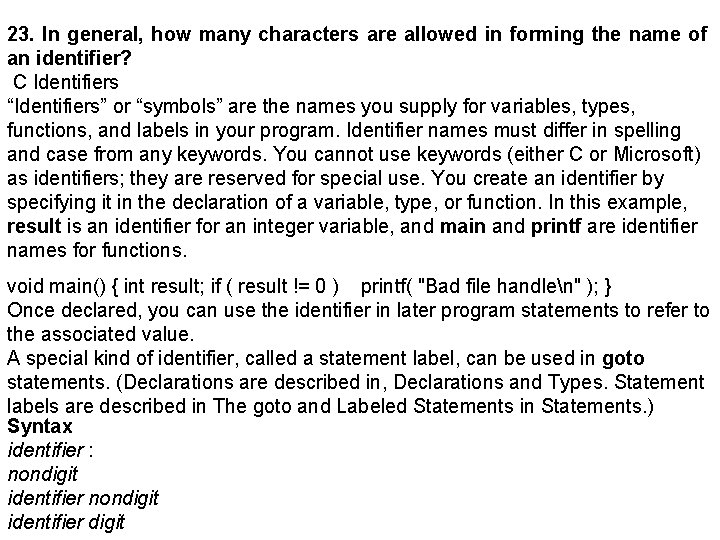
23. In general, how many characters are allowed in forming the name of an identifier? C Identifiers “Identifiers” or “symbols” are the names you supply for variables, types, functions, and labels in your program. Identifier names must differ in spelling and case from any keywords. You cannot use keywords (either C or Microsoft) as identifiers; they are reserved for special use. You create an identifier by specifying it in the declaration of a variable, type, or function. In this example, result is an identifier for an integer variable, and main and printf are identifier names for functions. void main() { int result; if ( result != 0 ) printf( "Bad file handlen" ); } Once declared, you can use the identifier in later program statements to refer to the associated value. A special kind of identifier, called a statement label, can be used in goto statements. (Declarations are described in, Declarations and Types. Statement labels are described in The goto and Labeled Statements in Statements. ) Syntax identifier : nondigit identifier digit
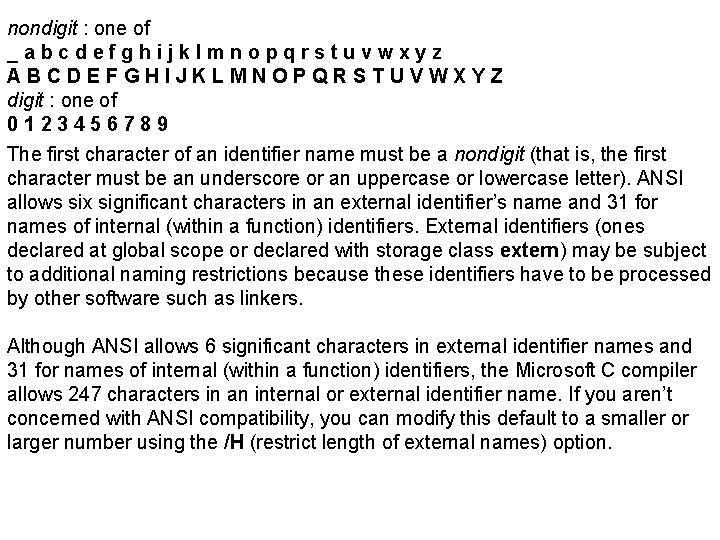
nondigit : one of _ a b c d e f g h i j k l m n o p q r s t u v w x y z A B C D E F G H I J K L M N O P Q R S T U V W X Y Z digit : one of 0 1 2 3 4 5 6 7 8 9 The first character of an identifier name must be a nondigit (that is, the first character must be an underscore or an uppercase or lowercase letter). ANSI allows six significant characters in an external identifier’s name and 31 for names of internal (within a function) identifiers. External identifiers (ones declared at global scope or declared with storage class extern) may be subject to additional naming restrictions because these identifiers have to be processed by other software such as linkers. Although ANSI allows 6 significant characters in external identifier names and 31 for names of internal (within a function) identifiers, the Microsoft C compiler allows 247 characters in an internal or external identifier name. If you aren’t concerned with ANSI compatibility, you can modify this default to a smaller or larger number using the /H (restrict length of external names) option.
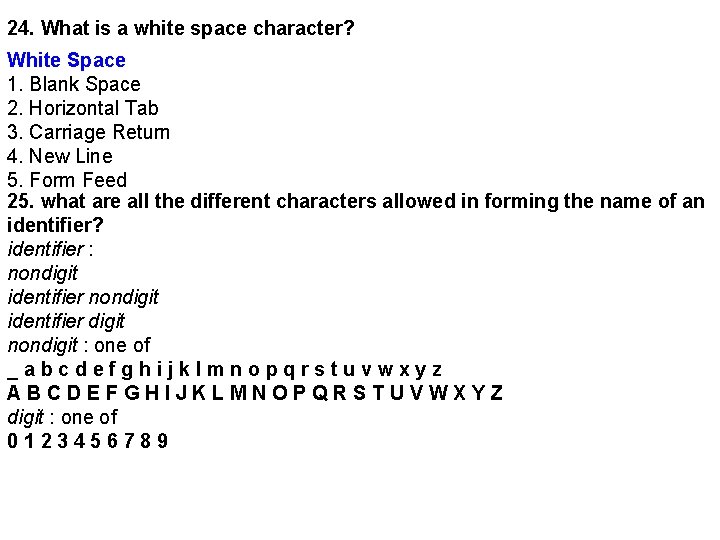
24. What is a white space character? White Space 1. Blank Space 2. Horizontal Tab 3. Carriage Return 4. New Line 5. Form Feed 25. what are all the different characters allowed in forming the name of an identifier? identifier : nondigit identifier digit nondigit : one of _ a b c d e f g h i j k l m n o p q r s t u v w x y z A B C D E F G H I J K L M N O P Q R S T U V W X Y Z digit : one of 0 1 2 3 4 5 6 7 8 9
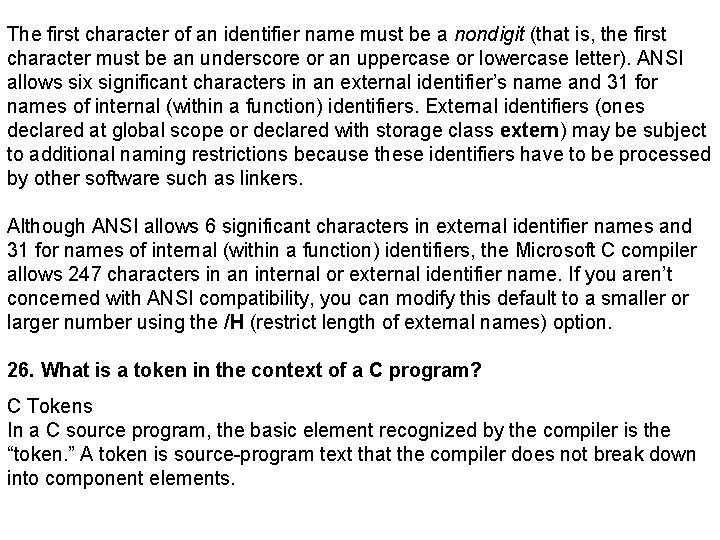
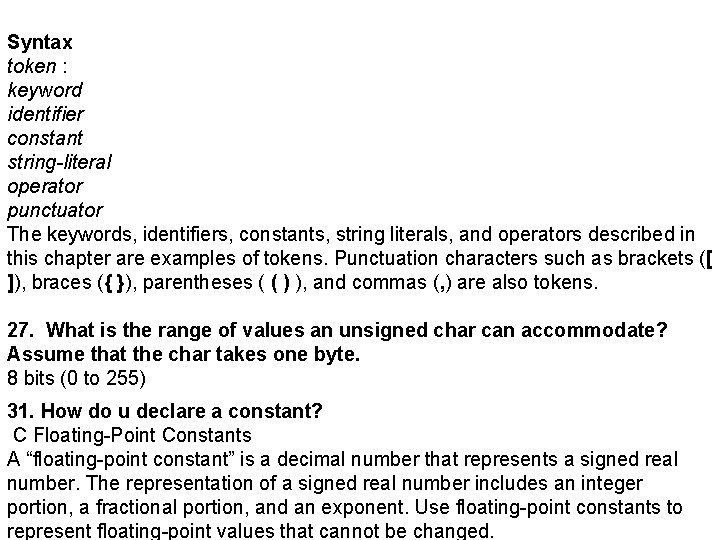
The first character of an identifier name must be a nondigit (that is, the first character must be an underscore or an uppercase or lowercase letter). ANSI allows six significant characters in an external identifier’s name and 31 for names of internal (within a function) identifiers. External identifiers (ones declared at global scope or declared with storage class extern) may be subject to additional naming restrictions because these identifiers have to be processed by other software such as linkers. Although ANSI allows 6 significant characters in external identifier names and 31 for names of internal (within a function) identifiers, the Microsoft C compiler allows 247 characters in an internal or external identifier name. If you aren’t concerned with ANSI compatibility, you can modify this default to a smaller or larger number using the /H (restrict length of external names) option. 26. What is a token in the context of a C program? C Tokens In a C source program, the basic element recognized by the compiler is the “token. ” A token is source-program text that the compiler does not break down into component elements.
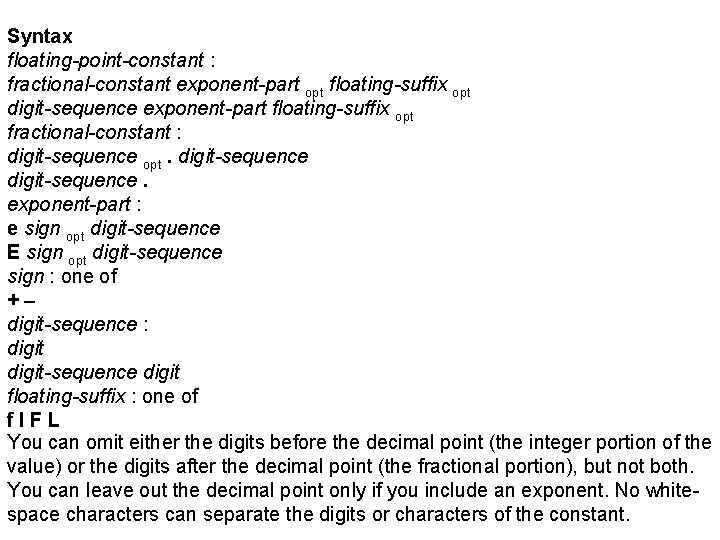
Syntax token : keyword identifier constant string-literal operator punctuator The keywords, identifiers, constants, string literals, and operators described in this chapter are examples of tokens. Punctuation characters such as brackets ([ ]), braces ({ }), parentheses ( ( ) ), and commas (, ) are also tokens. 27. What is the range of values an unsigned char can accommodate? Assume that the char takes one byte. 8 bits (0 to 255) 31. How do u declare a constant? C Floating-Point Constants A “floating-point constant” is a decimal number that represents a signed real number. The representation of a signed real number includes an integer portion, a fractional portion, and an exponent. Use floating-point constants to represent floating-point values that cannot be changed.
Syntax floating-point-constant : fractional-constant exponent-part opt floating-suffix opt digit-sequence exponent-part floating-suffix opt fractional-constant : digit-sequence opt. digit-sequence. exponent-part : e sign opt digit-sequence E sign opt digit-sequence sign : one of + – digit-sequence : digit-sequence digit floating-suffix : one of f l F L You can omit either the digits before the decimal point (the integer portion of the value) or the digits after the decimal point (the fractional portion), but not both. You can leave out the decimal point only if you include an exponent. No whitespace characters can separate the digits or characters of the constant.
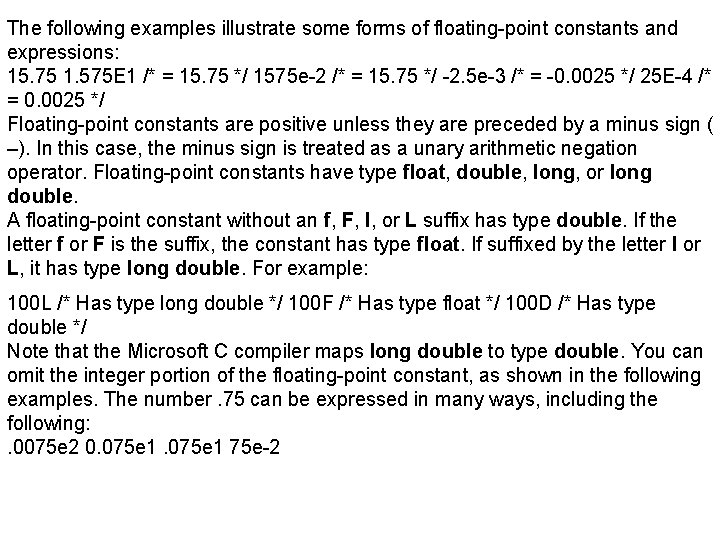
The following examples illustrate some forms of floating-point constants and expressions: 15. 75 1. 575 E 1 /* = 15. 75 */ 1575 e-2 /* = 15. 75 */ -2. 5 e-3 /* = -0. 0025 */ 25 E-4 /* = 0. 0025 */ Floating-point constants are positive unless they are preceded by a minus sign ( –). In this case, the minus sign is treated as a unary arithmetic negation operator. Floating-point constants have type float, double, long, or long double. A floating-point constant without an f, F, l, or L suffix has type double. If the letter f or F is the suffix, the constant has type float. If suffixed by the letter l or L, it has type long double. For example: 100 L /* Has type long double */ 100 F /* Has type float */ 100 D /* Has type double */ Note that the Microsoft C compiler maps long double to type double. You can omit the integer portion of the floating-point constant, as shown in the following examples. The number. 75 can be expressed in many ways, including the following: . 0075 e 2 0. 075 e 1 75 e-2
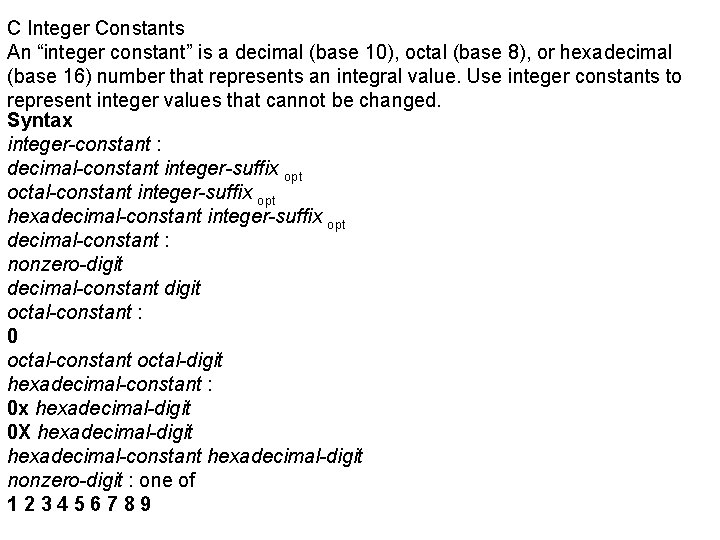
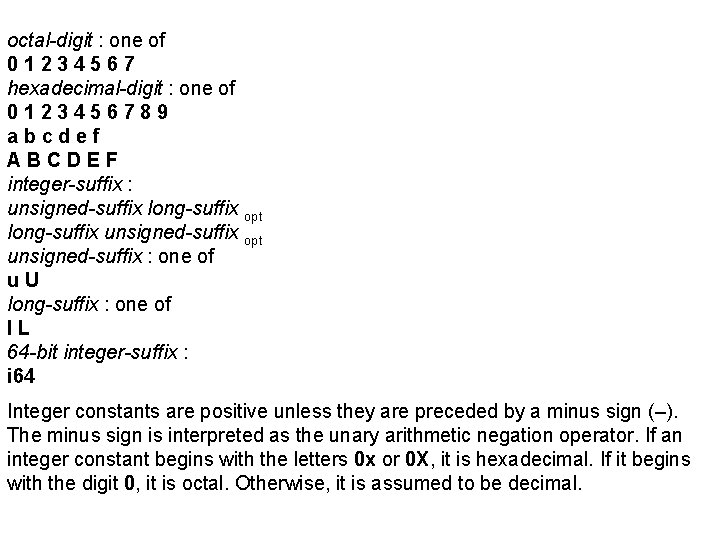
C Integer Constants An “integer constant” is a decimal (base 10), octal (base 8), or hexadecimal (base 16) number that represents an integral value. Use integer constants to represent integer values that cannot be changed. Syntax integer-constant : decimal-constant integer-suffix opt octal-constant integer-suffix opt hexadecimal-constant integer-suffix opt decimal-constant : nonzero-digit decimal-constant digit octal-constant : 0 octal-constant octal-digit hexadecimal-constant : 0 x hexadecimal-digit 0 X hexadecimal-digit hexadecimal-constant hexadecimal-digit nonzero-digit : one of 1 2 3 4 5 6 7 8 9
octal-digit : one of 0 1 2 3 4 5 6 7 hexadecimal-digit : one of 0 1 2 3 4 5 6 7 8 9 a b c d e f A B C D E F integer-suffix : unsigned-suffix long-suffix opt long-suffix unsigned-suffix opt unsigned-suffix : one of u U long-suffix : one of l L 64 -bit integer-suffix : i 64 Integer constants are positive unless they are preceded by a minus sign (–). The minus sign is interpreted as the unary arithmetic negation operator. If an integer constant begins with the letters 0 x or 0 X, it is hexadecimal. If it begins with the digit 0, it is octal. Otherwise, it is assumed to be decimal.
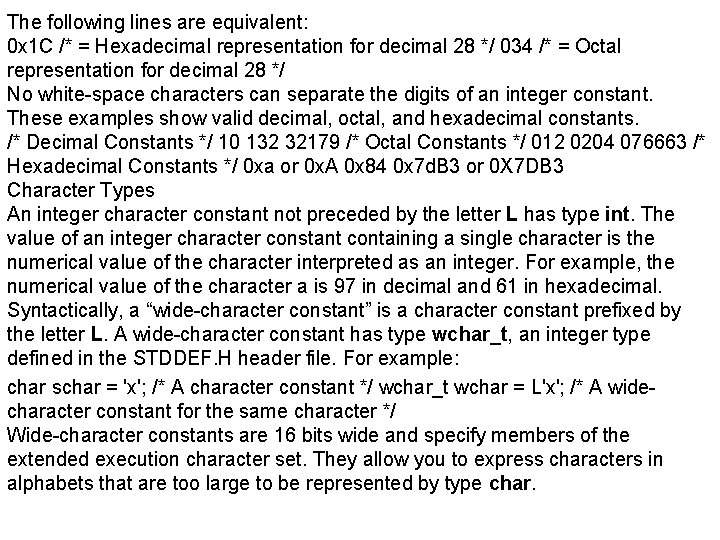
The following lines are equivalent: 0 x 1 C /* = Hexadecimal representation for decimal 28 */ 034 /* = Octal representation for decimal 28 */ No white-space characters can separate the digits of an integer constant. These examples show valid decimal, octal, and hexadecimal constants. /* Decimal Constants */ 10 132 32179 /* Octal Constants */ 012 0204 076663 /* Hexadecimal Constants */ 0 xa or 0 x. A 0 x 84 0 x 7 d. B 3 or 0 X 7 DB 3 Character Types An integer character constant not preceded by the letter L has type int. The value of an integer character constant containing a single character is the numerical value of the character interpreted as an integer. For example, the numerical value of the character a is 97 in decimal and 61 in hexadecimal. Syntactically, a “wide-character constant” is a character constant prefixed by the letter L. A wide-character constant has type wchar_t, an integer type defined in the STDDEF. H header file. For example: char schar = 'x'; /* A character constant */ wchar_t wchar = L'x'; /* A widecharacter constant for the same character */ Wide-character constants are 16 bits wide and specify members of the extended execution character set. They allow you to express characters in alphabets that are too large to be represented by type char.
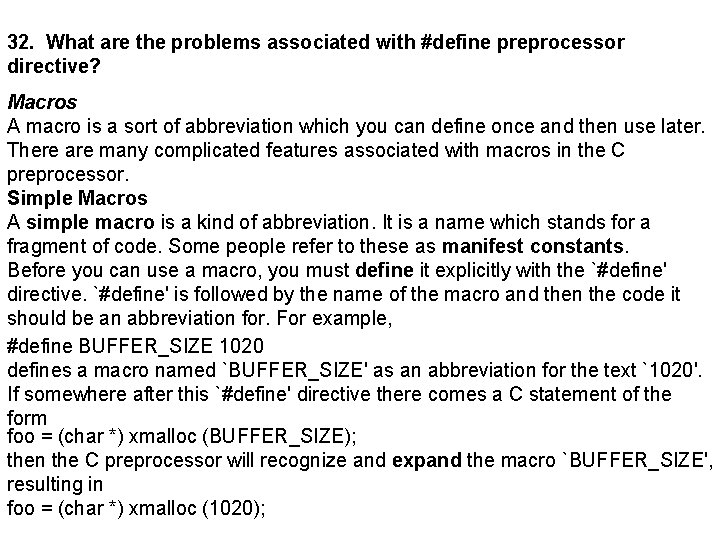
32. What are the problems associated with #define preprocessor directive? Macros A macro is a sort of abbreviation which you can define once and then use later. There are many complicated features associated with macros in the C preprocessor. Simple Macros A simple macro is a kind of abbreviation. It is a name which stands for a fragment of code. Some people refer to these as manifest constants. Before you can use a macro, you must define it explicitly with the `#define' directive. `#define' is followed by the name of the macro and then the code it should be an abbreviation for. For example, #define BUFFER_SIZE 1020 defines a macro named `BUFFER_SIZE' as an abbreviation for the text `1020'. If somewhere after this `#define' directive there comes a C statement of the form foo = (char *) xmalloc (BUFFER_SIZE); then the C preprocessor will recognize and expand the macro `BUFFER_SIZE', resulting in foo = (char *) xmalloc (1020);
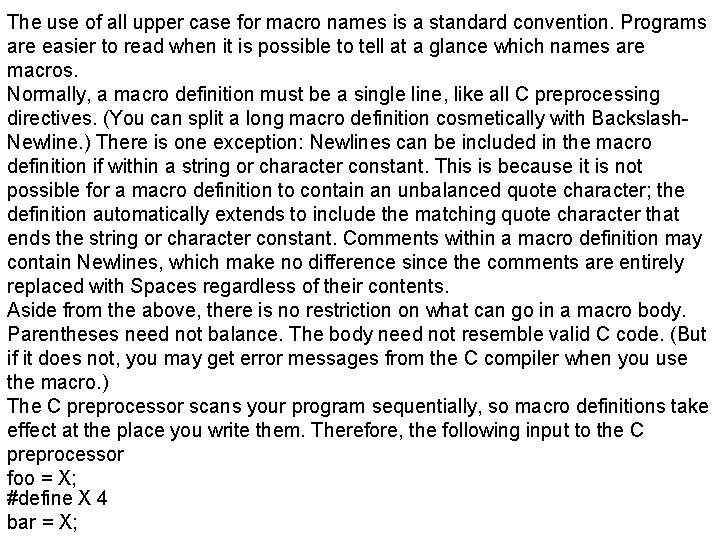
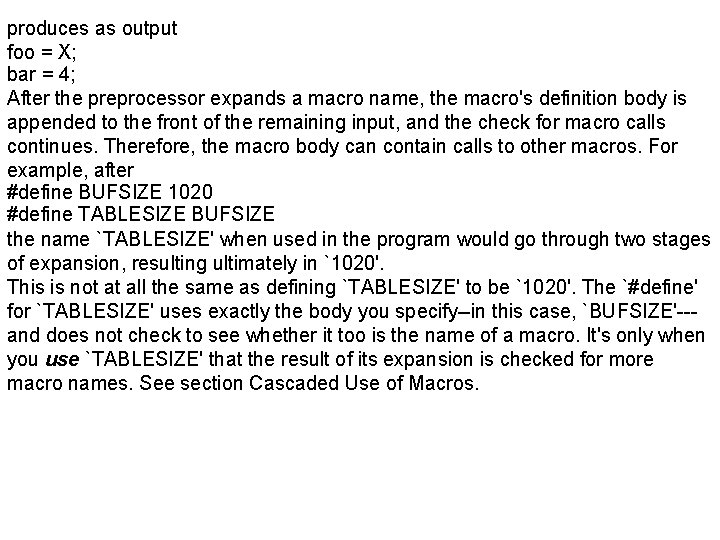
The use of all upper case for macro names is a standard convention. Programs are easier to read when it is possible to tell at a glance which names are macros. Normally, a macro definition must be a single line, like all C preprocessing directives. (You can split a long macro definition cosmetically with Backslash. Newline. ) There is one exception: Newlines can be included in the macro definition if within a string or character constant. This is because it is not possible for a macro definition to contain an unbalanced quote character; the definition automatically extends to include the matching quote character that ends the string or character constant. Comments within a macro definition may contain Newlines, which make no difference since the comments are entirely replaced with Spaces regardless of their contents. Aside from the above, there is no restriction on what can go in a macro body. Parentheses need not balance. The body need not resemble valid C code. (But if it does not, you may get error messages from the C compiler when you use the macro. ) The C preprocessor scans your program sequentially, so macro definitions take effect at the place you write them. Therefore, the following input to the C preprocessor foo = X; #define X 4 bar = X;
produces as output foo = X; bar = 4; After the preprocessor expands a macro name, the macro's definition body is appended to the front of the remaining input, and the check for macro calls continues. Therefore, the macro body can contain calls to other macros. For example, after #define BUFSIZE 1020 #define TABLESIZE BUFSIZE the name `TABLESIZE' when used in the program would go through two stages of expansion, resulting ultimately in `1020'. This is not at all the same as defining `TABLESIZE' to be `1020'. The `#define' for `TABLESIZE' uses exactly the body you specify--in this case, `BUFSIZE'--and does not check to see whether it too is the name of a macro. It's only when you use `TABLESIZE' that the result of its expansion is checked for more macro names. See section Cascaded Use of Macros.
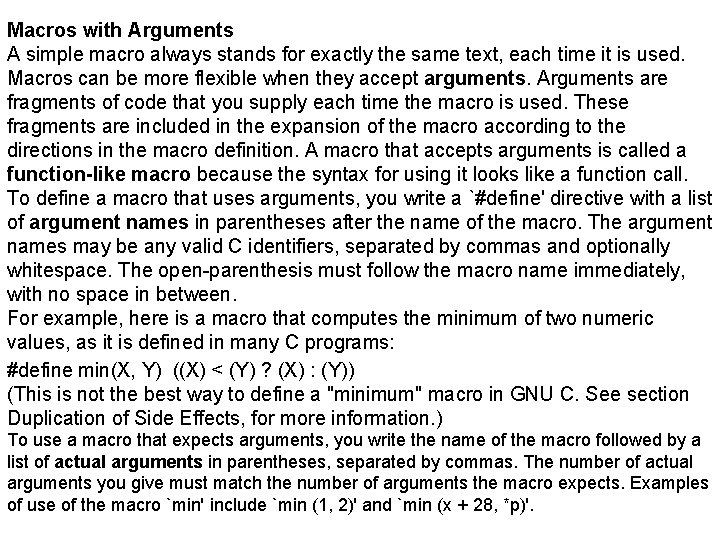
Macros with Arguments A simple macro always stands for exactly the same text, each time it is used. Macros can be more flexible when they accept arguments. Arguments are fragments of code that you supply each time the macro is used. These fragments are included in the expansion of the macro according to the directions in the macro definition. A macro that accepts arguments is called a function-like macro because the syntax for using it looks like a function call. To define a macro that uses arguments, you write a `#define' directive with a list of argument names in parentheses after the name of the macro. The argument names may be any valid C identifiers, separated by commas and optionally whitespace. The open-parenthesis must follow the macro name immediately, with no space in between. For example, here is a macro that computes the minimum of two numeric values, as it is defined in many C programs: #define min(X, Y) ((X) < (Y) ? (X) : (Y)) (This is not the best way to define a "minimum" macro in GNU C. See section Duplication of Side Effects, for more information. ) To use a macro that expects arguments, you write the name of the macro followed by a list of actual arguments in parentheses, separated by commas. The number of actual arguments you give must match the number of arguments the macro expects. Examples of use of the macro `min' include `min (1, 2)' and `min (x + 28, *p)'.
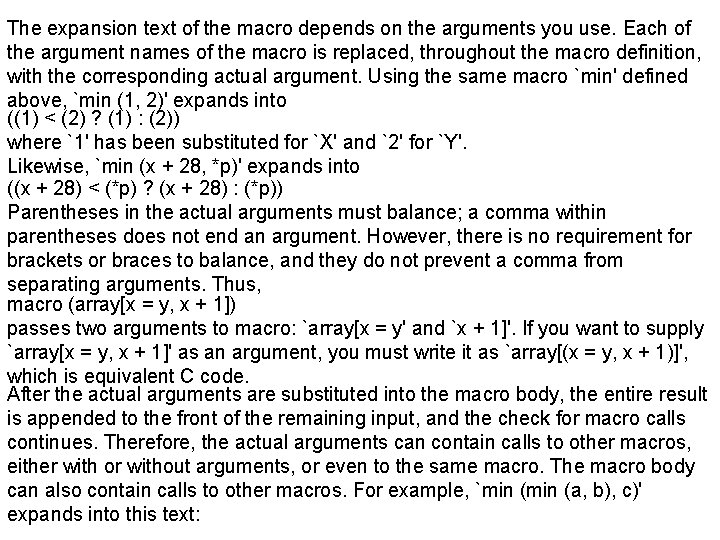
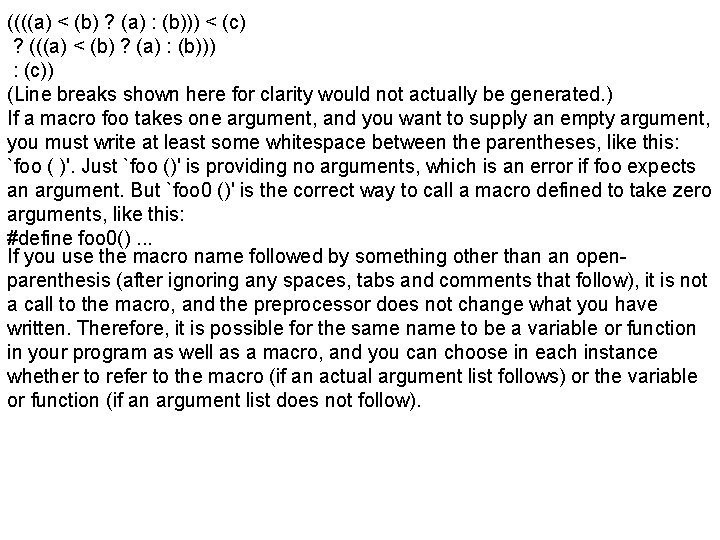
The expansion text of the macro depends on the arguments you use. Each of the argument names of the macro is replaced, throughout the macro definition, with the corresponding actual argument. Using the same macro `min' defined above, `min (1, 2)' expands into ((1) < (2) ? (1) : (2)) where `1' has been substituted for `X' and `2' for `Y'. Likewise, `min (x + 28, *p)' expands into ((x + 28) < (*p) ? (x + 28) : (*p)) Parentheses in the actual arguments must balance; a comma within parentheses does not end an argument. However, there is no requirement for brackets or braces to balance, and they do not prevent a comma from separating arguments. Thus, macro (array[x = y, x + 1]) passes two arguments to macro: `array[x = y' and `x + 1]'. If you want to supply `array[x = y, x + 1]' as an argument, you must write it as `array[(x = y, x + 1)]', which is equivalent C code. After the actual arguments are substituted into the macro body, the entire result is appended to the front of the remaining input, and the check for macro calls continues. Therefore, the actual arguments can contain calls to other macros, either with or without arguments, or even to the same macro. The macro body can also contain calls to other macros. For example, `min (a, b), c)' expands into this text:
((((a) < (b) ? (a) : (b))) < (c) ? (((a) < (b) ? (a) : (b))) : (c)) (Line breaks shown here for clarity would not actually be generated. ) If a macro foo takes one argument, and you want to supply an empty argument, you must write at least some whitespace between the parentheses, like this: `foo ( )'. Just `foo ()' is providing no arguments, which is an error if foo expects an argument. But `foo 0 ()' is the correct way to call a macro defined to take zero arguments, like this: #define foo 0(). . . If you use the macro name followed by something other than an openparenthesis (after ignoring any spaces, tabs and comments that follow), it is not a call to the macro, and the preprocessor does not change what you have written. Therefore, it is possible for the same name to be a variable or function in your program as well as a macro, and you can choose in each instance whether to refer to the macro (if an actual argument list follows) or the variable or function (if an argument list does not follow).
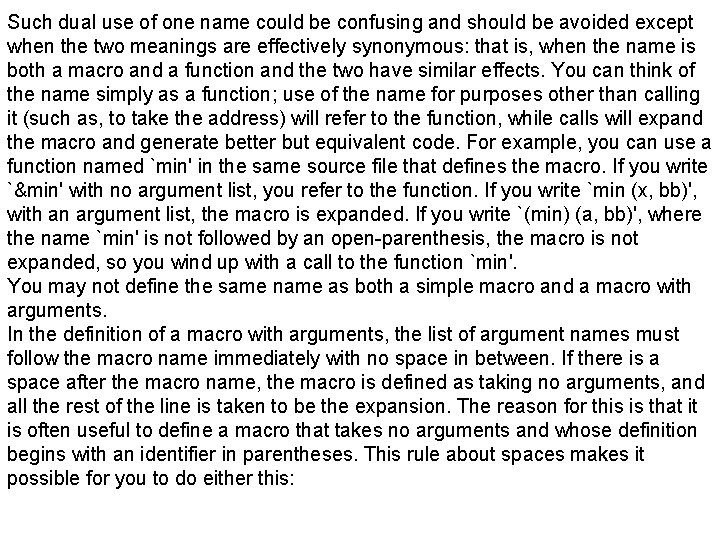
Such dual use of one name could be confusing and should be avoided except when the two meanings are effectively synonymous: that is, when the name is both a macro and a function and the two have similar effects. You can think of the name simply as a function; use of the name for purposes other than calling it (such as, to take the address) will refer to the function, while calls will expand the macro and generate better but equivalent code. For example, you can use a function named `min' in the same source file that defines the macro. If you write `&min' with no argument list, you refer to the function. If you write `min (x, bb)', with an argument list, the macro is expanded. If you write `(min) (a, bb)', where the name `min' is not followed by an open-parenthesis, the macro is not expanded, so you wind up with a call to the function `min'. You may not define the same name as both a simple macro and a macro with arguments. In the definition of a macro with arguments, the list of argument names must follow the macro name immediately with no space in between. If there is a space after the macro name, the macro is defined as taking no arguments, and all the rest of the line is taken to be the expansion. The reason for this is that it is often useful to define a macro that takes no arguments and whose definition begins with an identifier in parentheses. This rule about spaces makes it possible for you to do either this:
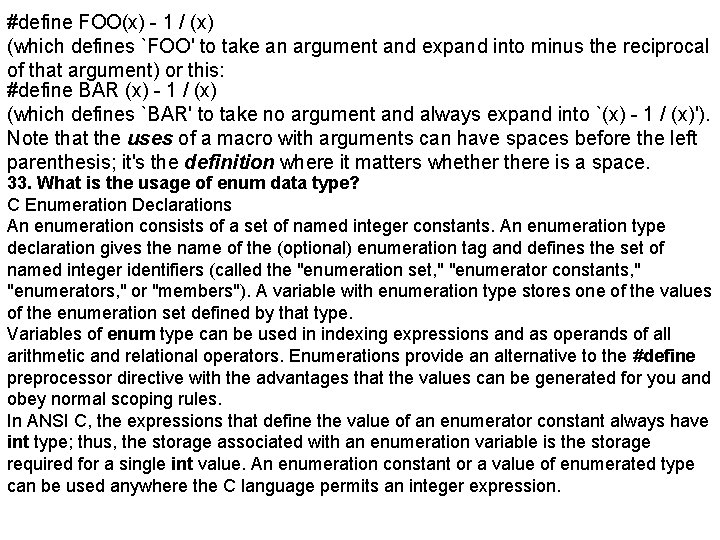
#define FOO(x) - 1 / (x) (which defines `FOO' to take an argument and expand into minus the reciprocal of that argument) or this: #define BAR (x) - 1 / (x) (which defines `BAR' to take no argument and always expand into `(x) - 1 / (x)'). Note that the uses of a macro with arguments can have spaces before the left parenthesis; it's the definition where it matters whethere is a space. 33. What is the usage of enum data type? C Enumeration Declarations An enumeration consists of a set of named integer constants. An enumeration type declaration gives the name of the (optional) enumeration tag and defines the set of named integer identifiers (called the "enumeration set, " "enumerator constants, " "enumerators, " or "members"). A variable with enumeration type stores one of the values of the enumeration set defined by that type. Variables of enum type can be used in indexing expressions and as operands of all arithmetic and relational operators. Enumerations provide an alternative to the #define preprocessor directive with the advantages that the values can be generated for you and obey normal scoping rules. In ANSI C, the expressions that define the value of an enumerator constant always have int type; thus, the storage associated with an enumeration variable is the storage required for a single int value. An enumeration constant or a value of enumerated type can be used anywhere the C language permits an integer expression.
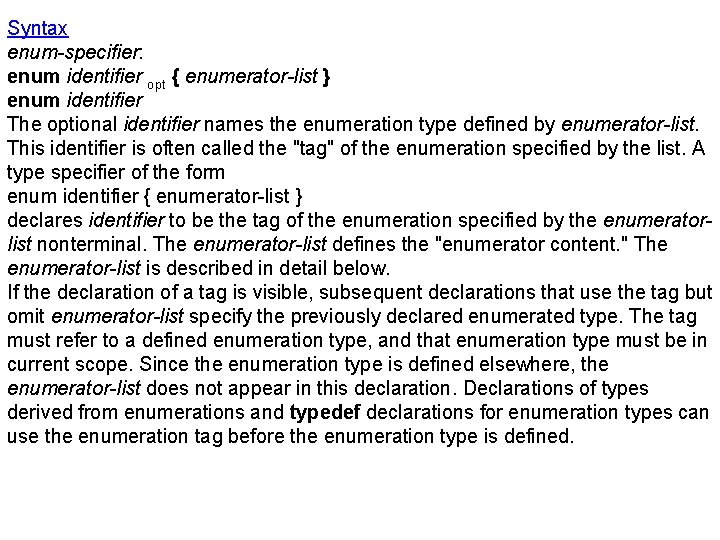
Syntax enum-specifier: enum identifier opt { enumerator-list } enum identifier The optional identifier names the enumeration type defined by enumerator-list. This identifier is often called the "tag" of the enumeration specified by the list. A type specifier of the form enum identifier { enumerator-list } declares identifier to be the tag of the enumeration specified by the enumeratorlist nonterminal. The enumerator-list defines the "enumerator content. " The enumerator-list is described in detail below. If the declaration of a tag is visible, subsequent declarations that use the tag but omit enumerator-list specify the previously declared enumerated type. The tag must refer to a defined enumeration type, and that enumeration type must be in current scope. Since the enumeration type is defined elsewhere, the enumerator-list does not appear in this declaration. Declarations of types derived from enumerations and typedef declarations for enumeration types can use the enumeration tag before the enumeration type is defined.
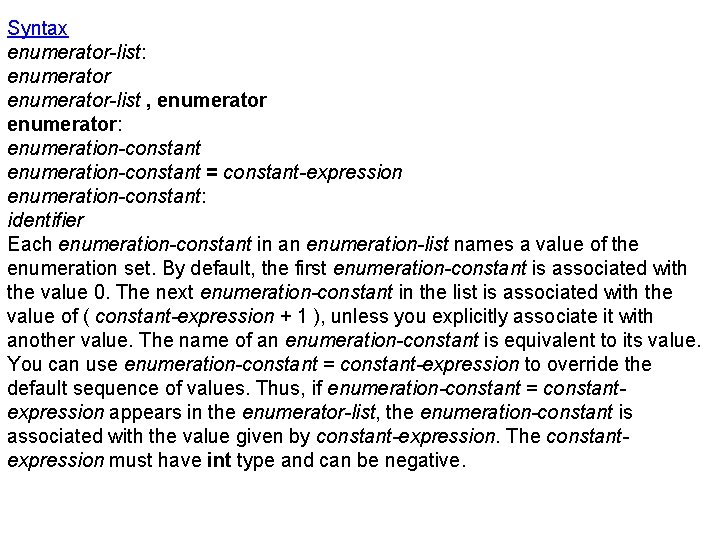
Syntax enumerator-list: enumerator-list , enumerator: enumeration-constant = constant-expression enumeration-constant: identifier Each enumeration-constant in an enumeration-list names a value of the enumeration set. By default, the first enumeration-constant is associated with the value 0. The next enumeration-constant in the list is associated with the value of ( constant-expression + 1 ), unless you explicitly associate it with another value. The name of an enumeration-constant is equivalent to its value. You can use enumeration-constant = constant-expression to override the default sequence of values. Thus, if enumeration-constant = constantexpression appears in the enumerator-list, the enumeration-constant is associated with the value given by constant-expression. The constantexpression must have int type and can be negative.
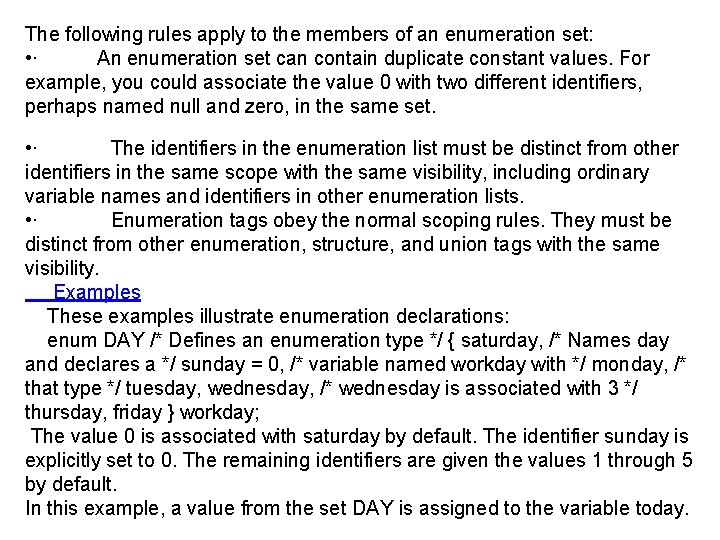
The following rules apply to the members of an enumeration set: • · An enumeration set can contain duplicate constant values. For example, you could associate the value 0 with two different identifiers, perhaps named null and zero, in the same set. • · The identifiers in the enumeration list must be distinct from other identifiers in the same scope with the same visibility, including ordinary variable names and identifiers in other enumeration lists. • · Enumeration tags obey the normal scoping rules. They must be distinct from other enumeration, structure, and union tags with the same visibility. Examples These examples illustrate enumeration declarations: enum DAY /* Defines an enumeration type */ { saturday, /* Names day and declares a */ sunday = 0, /* variable named workday with */ monday, /* that type */ tuesday, wednesday, /* wednesday is associated with 3 */ thursday, friday } workday; The value 0 is associated with saturday by default. The identifier sunday is explicitly set to 0. The remaining identifiers are given the values 1 through 5 by default. In this example, a value from the set DAY is assigned to the variable today.
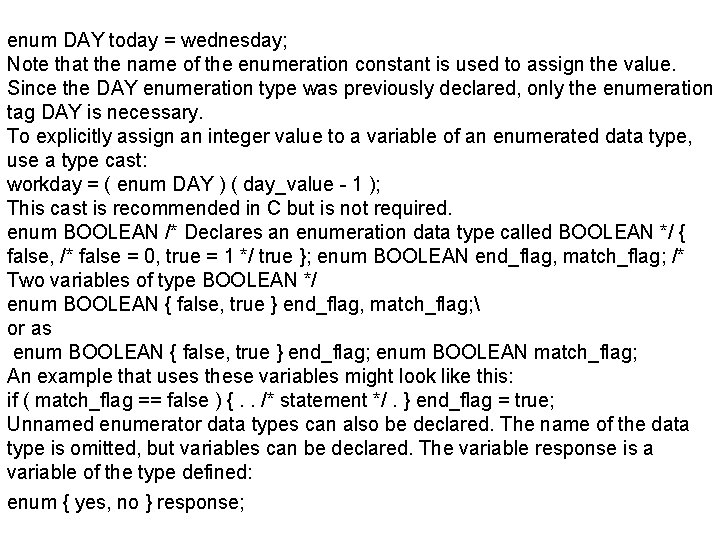
enum DAY today = wednesday; Note that the name of the enumeration constant is used to assign the value. Since the DAY enumeration type was previously declared, only the enumeration tag DAY is necessary. To explicitly assign an integer value to a variable of an enumerated data type, use a type cast: workday = ( enum DAY ) ( day_value - 1 ); This cast is recommended in C but is not required. enum BOOLEAN /* Declares an enumeration data type called BOOLEAN */ { false, /* false = 0, true = 1 */ true }; enum BOOLEAN end_flag, match_flag; /* Two variables of type BOOLEAN */ enum BOOLEAN { false, true } end_flag, match_flag; or as enum BOOLEAN { false, true } end_flag; enum BOOLEAN match_flag; An example that uses these variables might look like this: if ( match_flag == false ) {. . /* statement */. } end_flag = true; Unnamed enumerator data types can also be declared. The name of the data type is omitted, but variables can be declared. The variable response is a variable of the type defined: enum { yes, no } response;
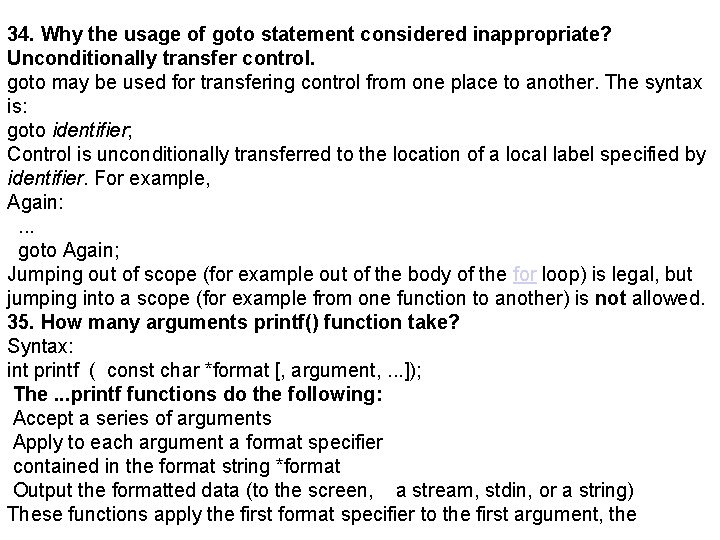
34. Why the usage of goto statement considered inappropriate? Unconditionally transfer control. goto may be used for transfering control from one place to another. The syntax is: goto identifier; Control is unconditionally transferred to the location of a local label specified by identifier. For example, Again: . . . goto Again; Jumping out of scope (for example out of the body of the for loop) is legal, but jumping into a scope (for example from one function to another) is not allowed. 35. How many arguments printf() function take? Syntax: int printf ( const char *format [, argument, . . . ]); The. . . printf functions do the following: Accept a series of arguments Apply to each argument a format specifier contained in the format string *format Output the formatted data (to the screen, a stream, stdin, or a string) These functions apply the first format specifier to the first argument, the
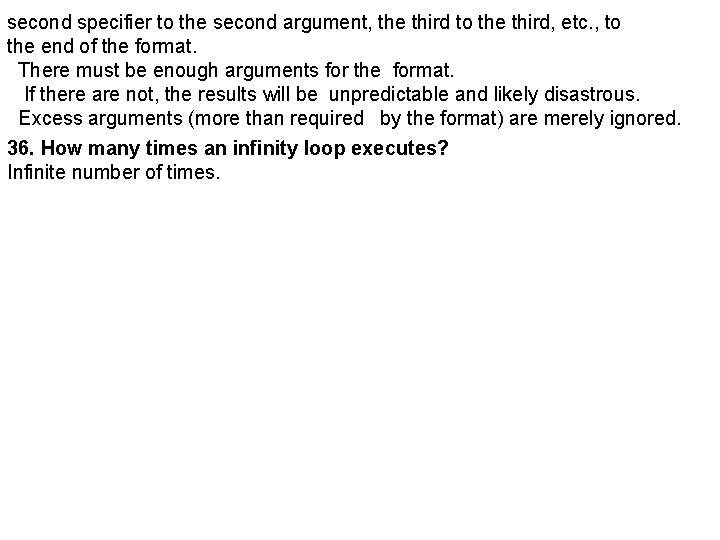
second specifier to the second argument, the third to the third, etc. , to the end of the format. There must be enough arguments for the format. If there are not, the results will be unpredictable and likely disastrous. Excess arguments (more than required by the format) are merely ignored. 36. How many times an infinity loop executes? Infinite number of times.