
1 We are now ready to move to
- Slides: 34
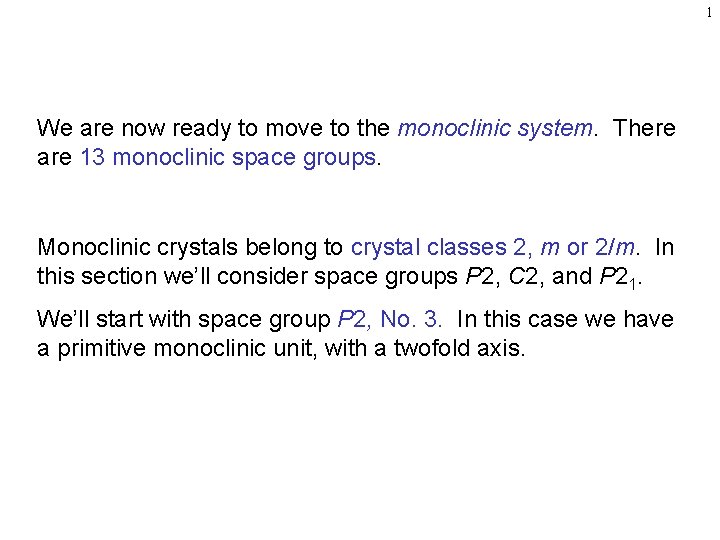
1 We are now ready to move to the monoclinic system. There are 13 monoclinic space groups. Monoclinic crystals belong to crystal classes 2, m or 2/m. In this section we’ll consider space groups P 2, C 2, and P 21. We’ll start with space group P 2, No. 3. In this case we have a primitive monoclinic unit, with a twofold axis.
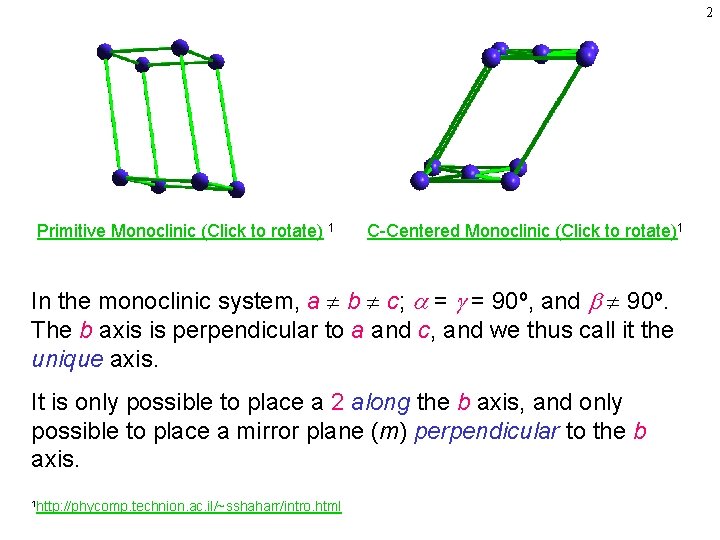
2 Primitive Monoclinic (Click to rotate) 1 C-Centered Monoclinic (Click to rotate)1 In the monoclinic system, a b c; = = 90º, and 90º. The b axis is perpendicular to a and c, and we thus call it the unique axis. It is only possible to place a 2 along the b axis, and only possible to place a mirror plane (m) perpendicular to the b axis. 1 http: //phycomp. technion. ac. il/~sshaharr/intro. html
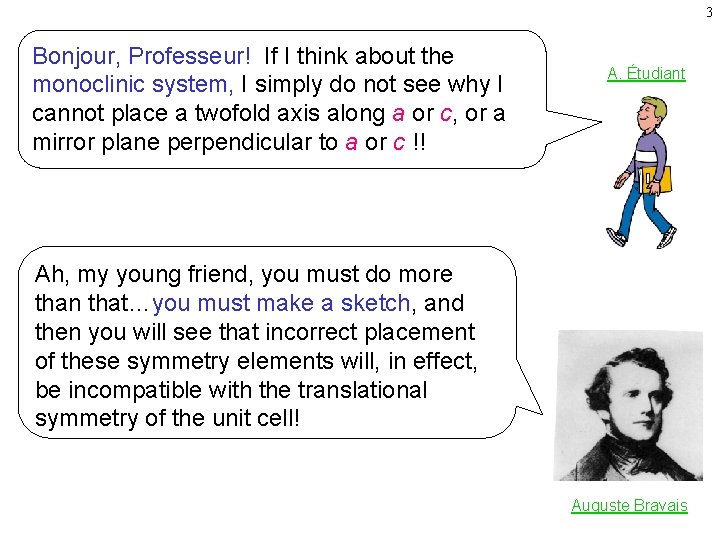
3 Bonjour, Professeur! If I think about the monoclinic system, I simply do not see why I cannot place a twofold axis along a or c, or a mirror plane perpendicular to a or c !! A. Étudiant Ah, my young friend, you must do more than that…you must make a sketch, and then you will see that incorrect placement of these symmetry elements will, in effect, be incompatible with the translational symmetry of the unit cell! Auguste Bravais
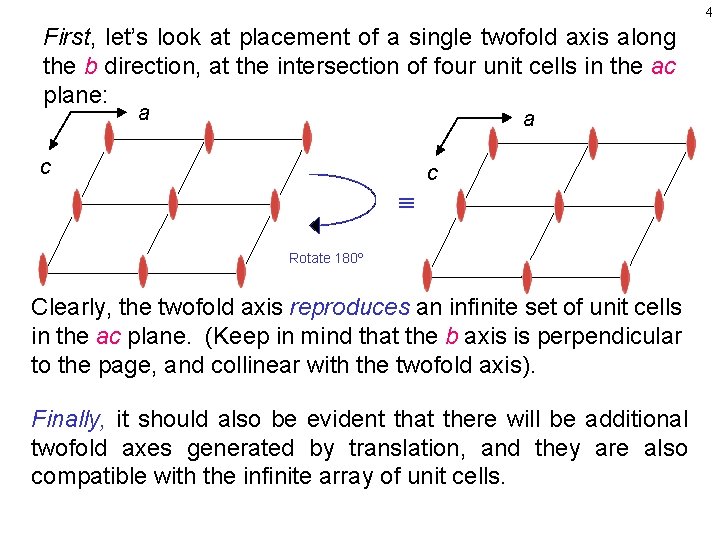
4 First, let’s look at placement of a single twofold axis along the b direction, at the intersection of four unit cells in the ac plane: a a c c Rotate 180º Clearly, the twofold axis reproduces an infinite set of unit cells in the ac plane. (Keep in mind that the b axis is perpendicular to the page, and collinear with the twofold axis). Finally, it should also be evident that there will be additional twofold axes generated by translation, and they are also compatible with the infinite array of unit cells.
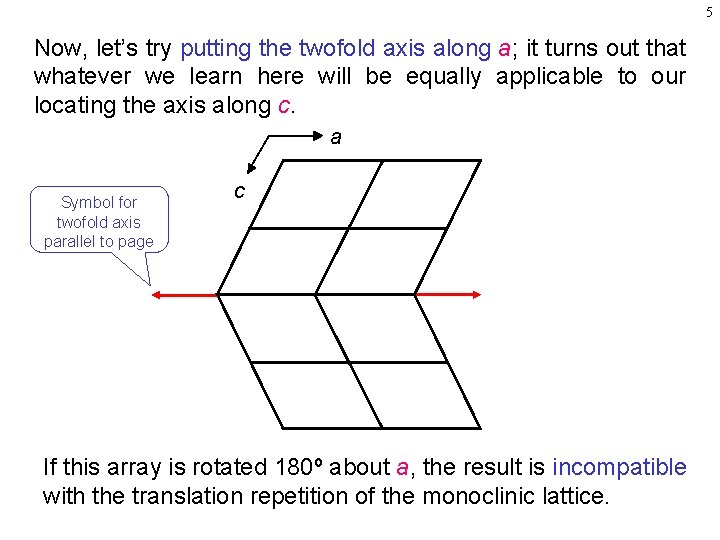
5 Now, let’s try putting the twofold axis along a; it turns out that whatever we learn here will be equally applicable to our locating the axis along c. a Symbol for twofold axis parallel to page c If this array is rotated 180º about a, the result is incompatible with the translation repetition of the monoclinic lattice.
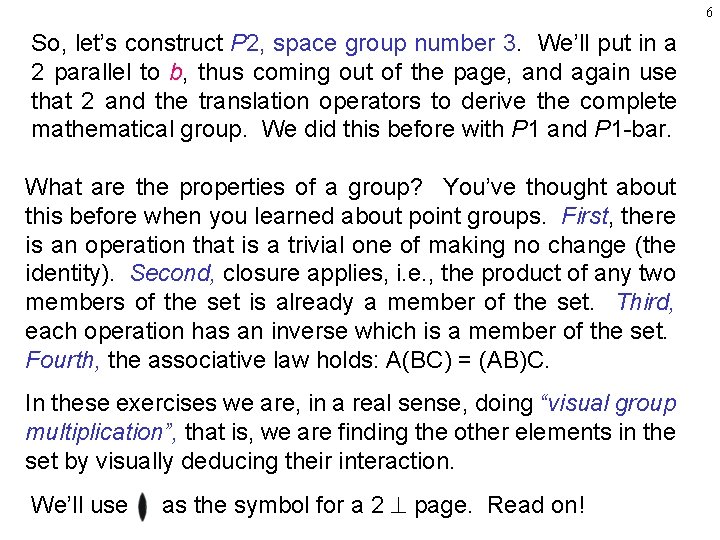
6 So, let’s construct P 2, space group number 3. We’ll put in a 2 parallel to b, thus coming out of the page, and again use that 2 and the translation operators to derive the complete mathematical group. We did this before with P 1 and P 1 -bar. What are the properties of a group? You’ve thought about this before when you learned about point groups. First, there is an operation that is a trivial one of making no change (the identity). Second, closure applies, i. e. , the product of any two members of the set is already a member of the set. Third, each operation has an inverse which is a member of the set. Fourth, the associative law holds: A(BC) = (AB)C. In these exercises we are, in a real sense, doing “visual group multiplication”, that is, we are finding the other elements in the set by visually deducing their interaction. We’ll use as the symbol for a 2 page. Read on!
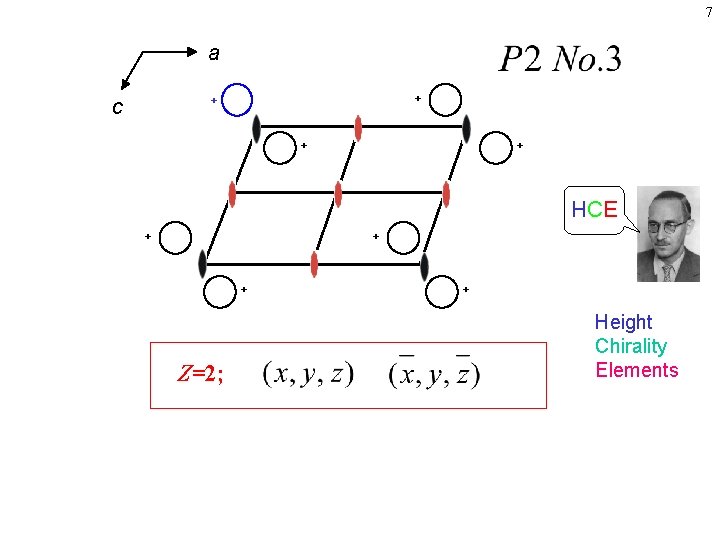
7 a c + + HCE + + + Z=2; + Height Chirality Elements
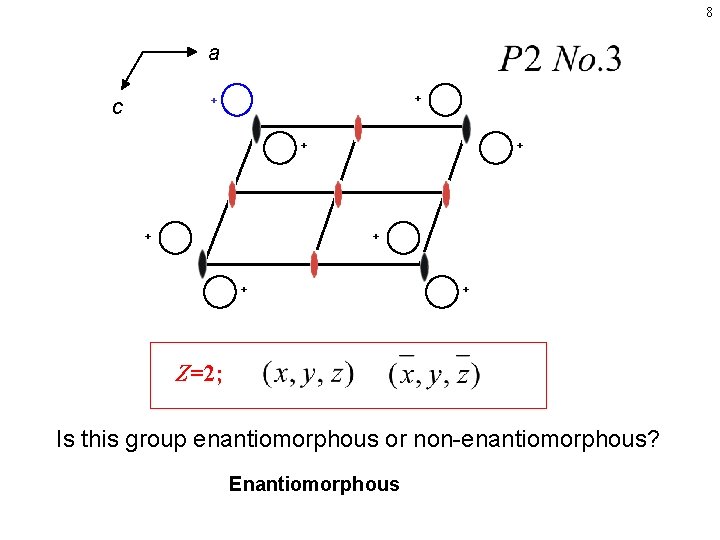
8 a c + + + + Z=2; Is this group enantiomorphous or non-enantiomorphous? Enantiomorphous
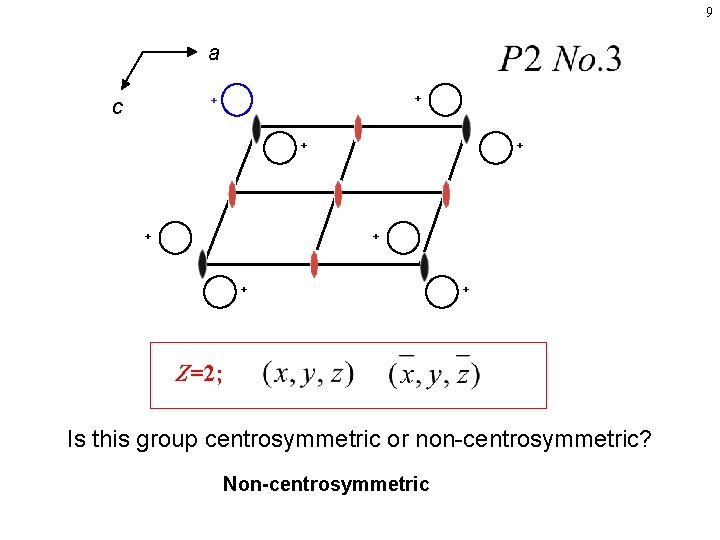
9 a c + + + + Z=2; Is this group centrosymmetric or non-centrosymmetric? Non-centrosymmetric
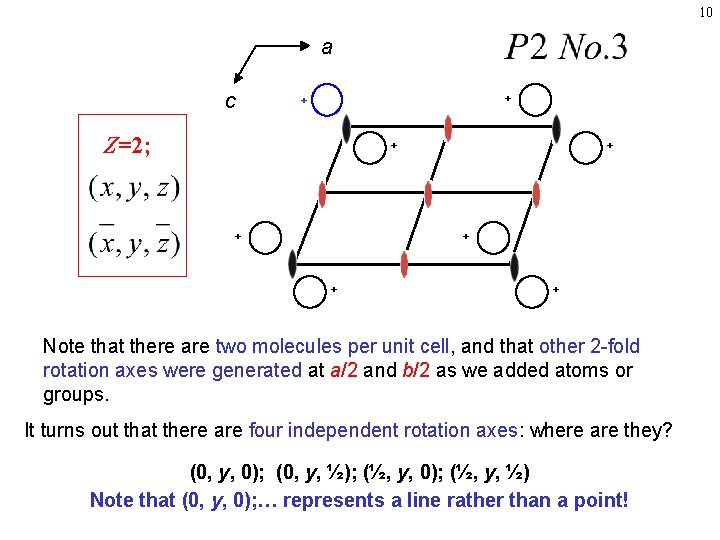
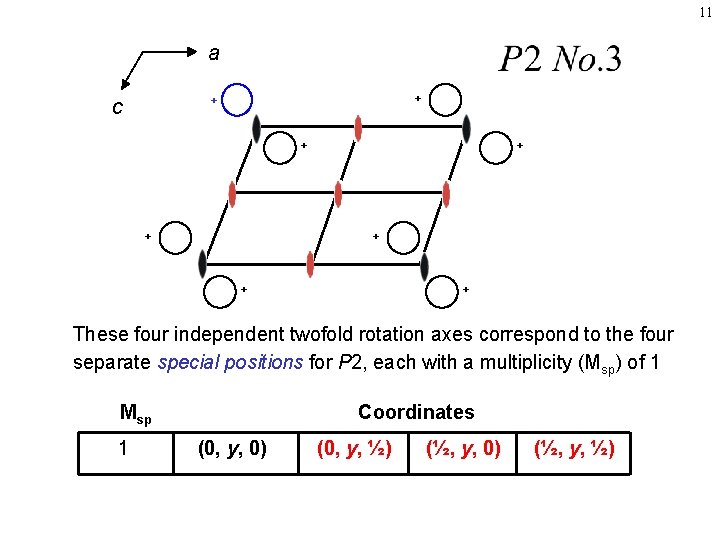
10 a c + + Z=2; + + + Note that there are two molecules per unit cell, and that other 2 -fold rotation axes were generated at a/2 and b/2 as we added atoms or groups. It turns out that there are four independent rotation axes: where are they? (0, y, 0); (0, y, ½); (½, y, 0); (½, y, ½) Note that (0, y, 0); … represents a line rather than a point!
11 a c + + + + These four independent twofold rotation axes correspond to the four separate special positions for P 2, each with a multiplicity (Msp) of 1 Msp 1 Coordinates (0, y, 0) (0, y, ½) (½, y, 0) (½, y, ½)
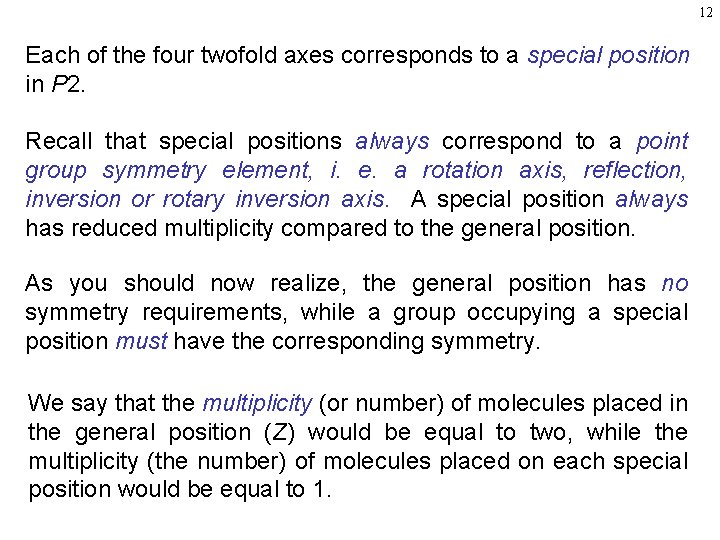
12 Each of the four twofold axes corresponds to a special position in P 2. Recall that special positions always correspond to a point group symmetry element, i. e. a rotation axis, reflection, inversion or rotary inversion axis. A special position always has reduced multiplicity compared to the general position. As you should now realize, the general position has no symmetry requirements, while a group occupying a special position must have the corresponding symmetry. We say that the multiplicity (or number) of molecules placed in the general position (Z) would be equal to two, while the multiplicity (the number) of molecules placed on each special position would be equal to 1.
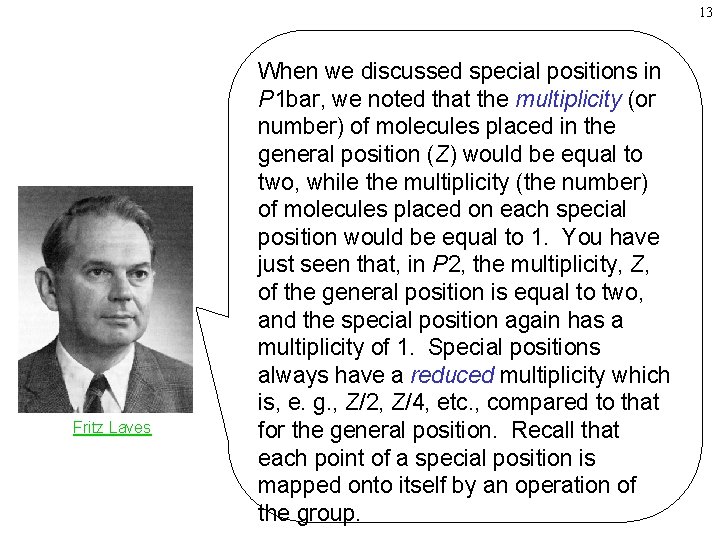
13 Fritz Laves When we discussed special positions in P 1 bar, we noted that the multiplicity (or number) of molecules placed in the general position (Z) would be equal to two, while the multiplicity (the number) of molecules placed on each special position would be equal to 1. You have just seen that, in P 2, the multiplicity, Z, of the general position is equal to two, and the special position again has a multiplicity of 1. Special positions always have a reduced multiplicity which is, e. g. , Z/2, Z/4, etc. , compared to that for the general position. Recall that each point of a special position is mapped onto itself by an operation of the group.
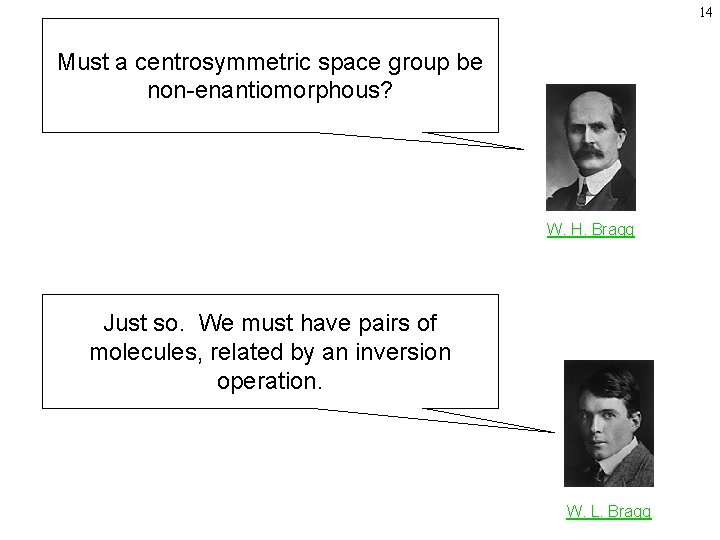
14 Must a centrosymmetric space group be non-enantiomorphous? W. H. Bragg Just so. We must have pairs of molecules, related by an inversion operation. W. L. Bragg
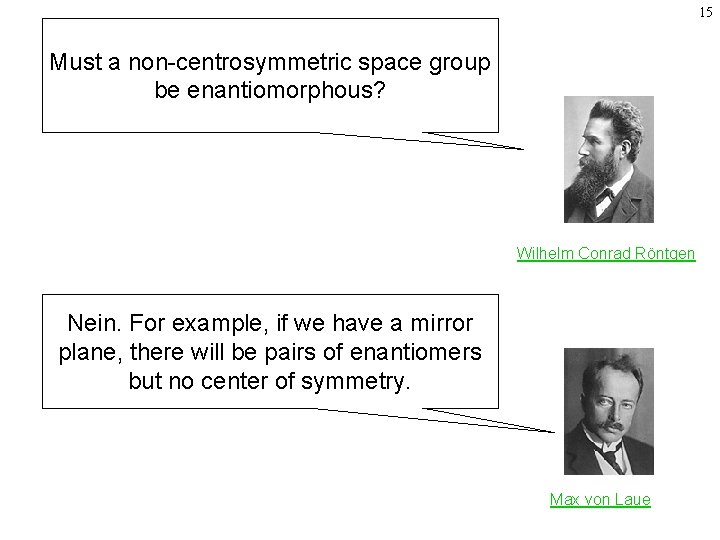
15 Must a non-centrosymmetric space group be enantiomorphous? Wilhelm Conrad Röntgen Nein. For example, if we have a mirror plane, there will be pairs of enantiomers but no center of symmetry. Max von Laue
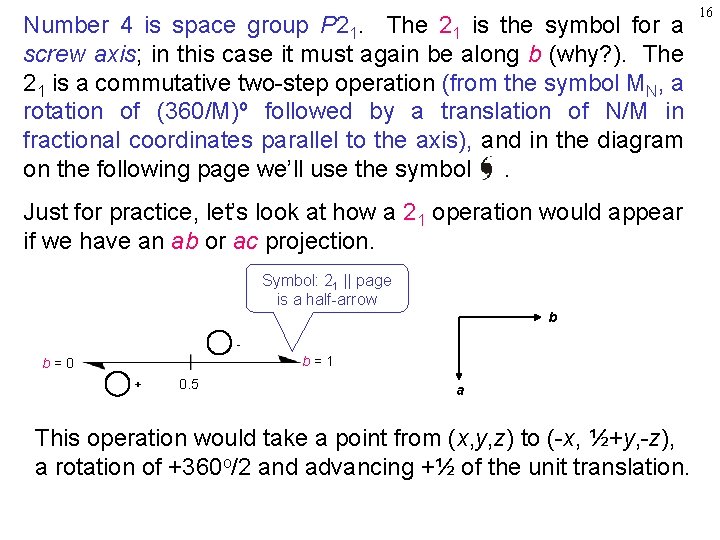
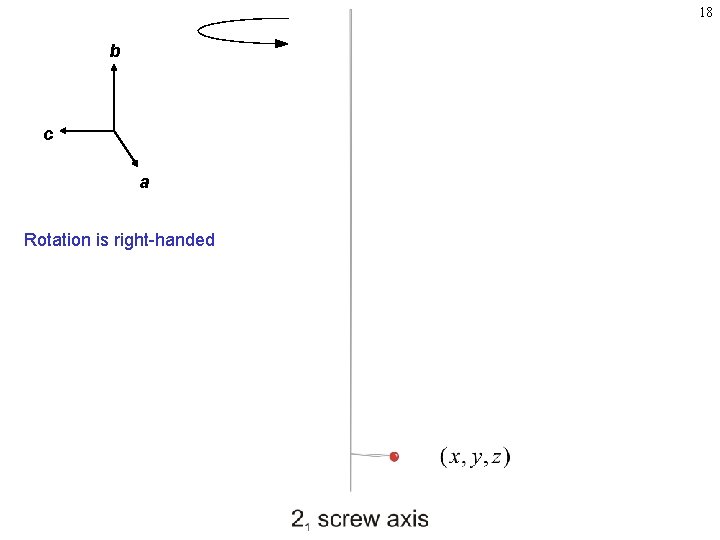
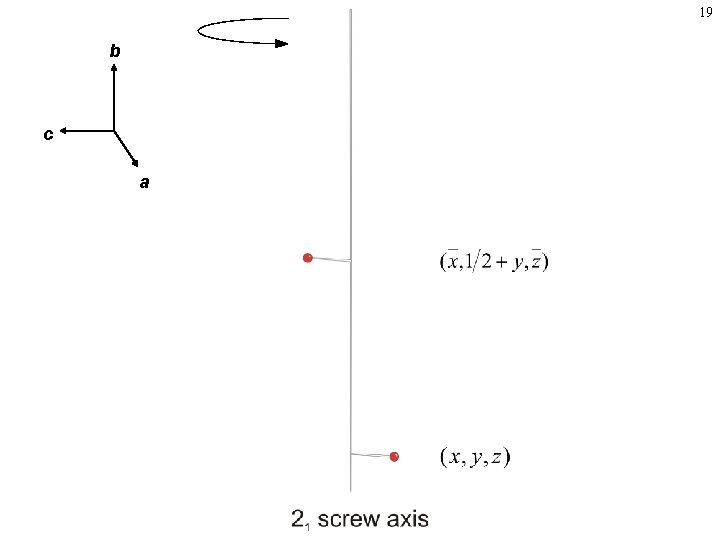
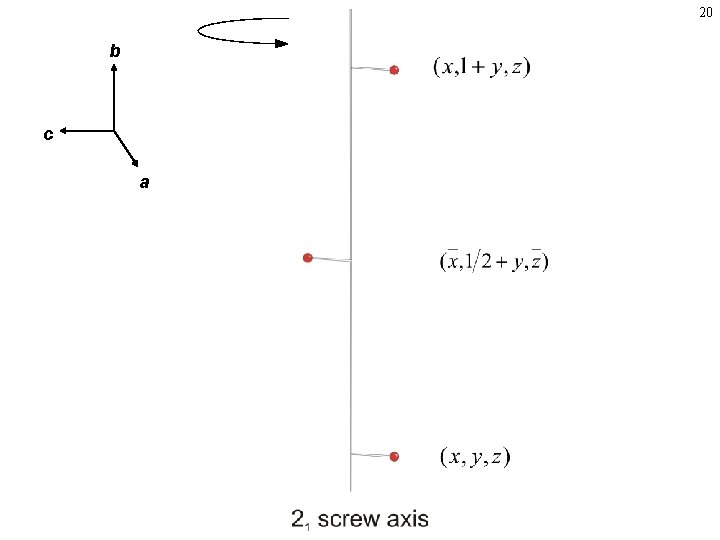
Number 4 is space group P 21. The 21 is the symbol for a screw axis; in this case it must again be along b (why? ). The 21 is a commutative two-step operation (from the symbol MN, a rotation of (360/M)º followed by a translation of N/M in fractional coordinates parallel to the axis), and in the diagram on the following page we’ll use the symbol. Just for practice, let’s look at how a 21 operation would appear if we have an ab or ac projection. Symbol: 21 || page is a half-arrow b - b=1 b=0 + 0. 5 a This operation would take a point from (x, y, z) to (-x, ½+y, -z), a rotation of +360 o/2 and advancing +½ of the unit translation. 16
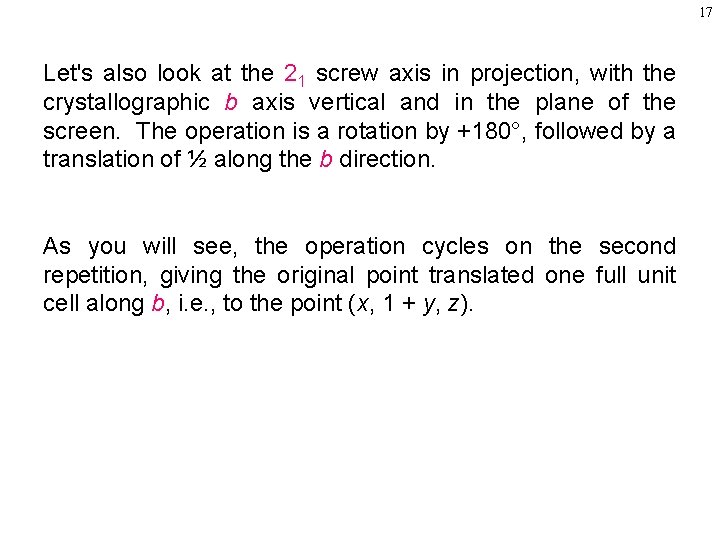
17 Let's also look at the 21 screw axis in projection, with the crystallographic b axis vertical and in the plane of the screen. The operation is a rotation by +180°, followed by a translation of ½ along the b direction. As you will see, the operation cycles on the second repetition, giving the original point translated one full unit cell along b, i. e. , to the point (x, 1 + y, z).
18 b c a Rotation is right-handed
19 b c a
20 b c a
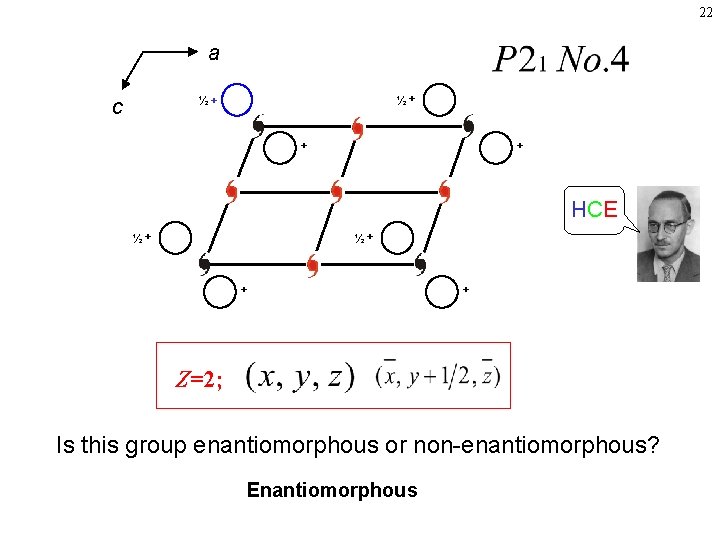
21 Now, let’s construct the International Tables Diagram for space group P 21.
22 a c ½+ ½+ + + HCE ½+ ½+ + + Z=2; Is this group enantiomorphous or non-enantiomorphous? Enantiomorphous
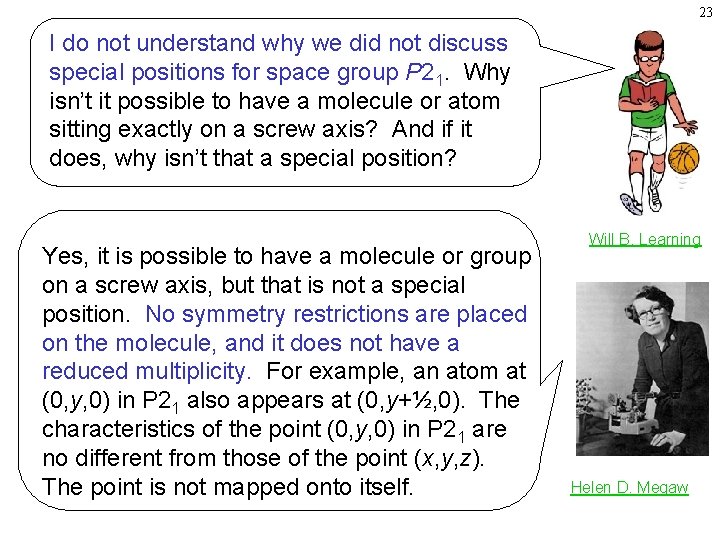
23 I do not understand why we did not discuss special positions for space group P 21. Why isn’t it possible to have a molecule or atom sitting exactly on a screw axis? And if it does, why isn’t that a special position? Yes, it is possible to have a molecule or group on a screw axis, but that is not a special position. No symmetry restrictions are placed on the molecule, and it does not have a reduced multiplicity. For example, an atom at (0, y, 0) in P 21 also appears at (0, y+½, 0). The characteristics of the point (0, y, 0) in P 21 are no different from those of the point (x, y, z). The point is not mapped onto itself. Will B. Learning Helen D. Megaw
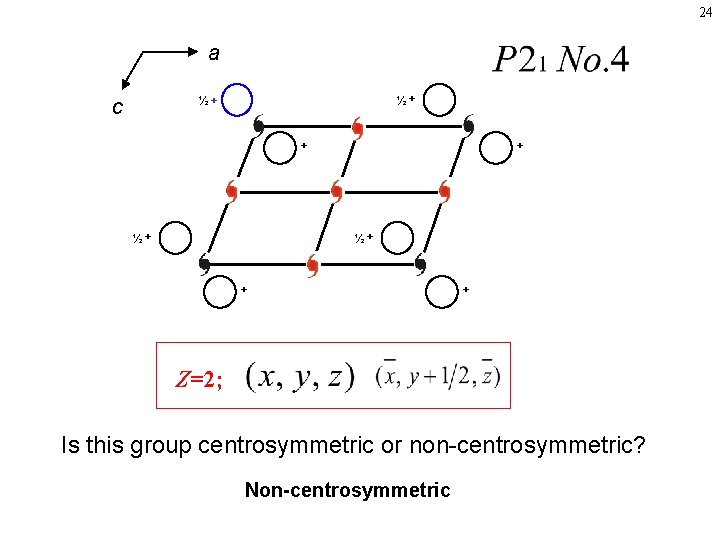
24 a c ½+ ½+ + + Z=2; Is this group centrosymmetric or non-centrosymmetric? Non-centrosymmetric
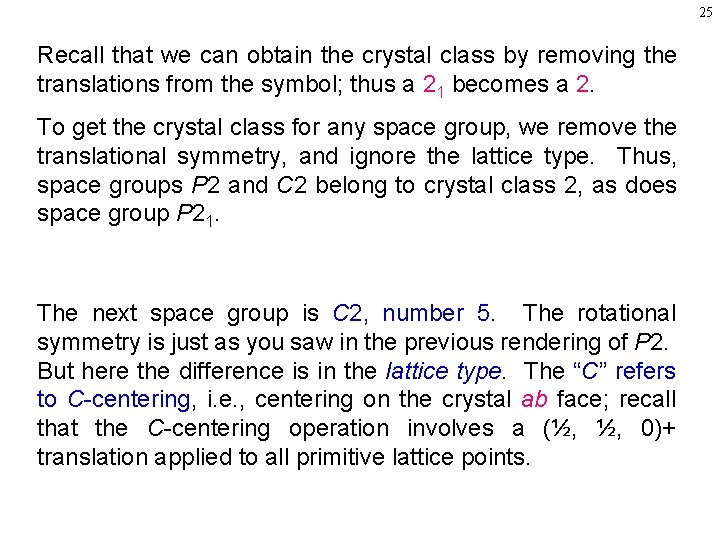
25 Recall that we can obtain the crystal class by removing the translations from the symbol; thus a 21 becomes a 2. To get the crystal class for any space group, we remove the translational symmetry, and ignore the lattice type. Thus, space groups P 2 and C 2 belong to crystal class 2, as does space group P 21. The next space group is C 2, number 5. The rotational symmetry is just as you saw in the previous rendering of P 2. But here the difference is in the lattice type. The “C” refers to C-centering, i. e. , centering on the crystal ab face; recall that the C-centering operation involves a (½, ½, 0)+ translation applied to all primitive lattice points.
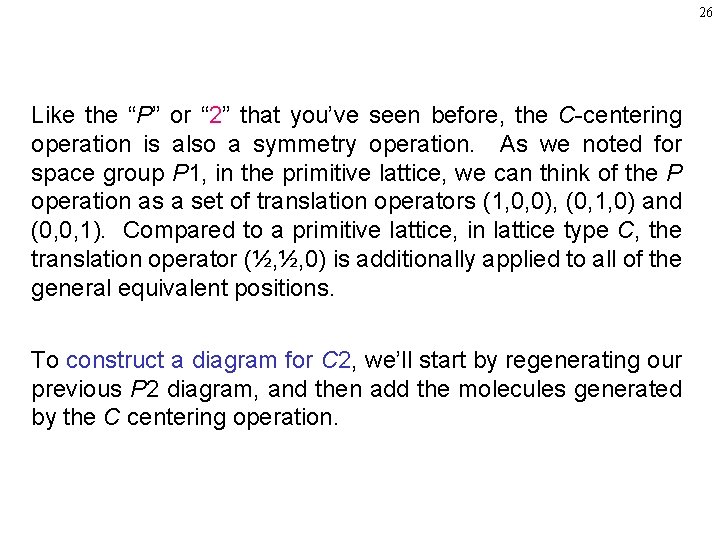
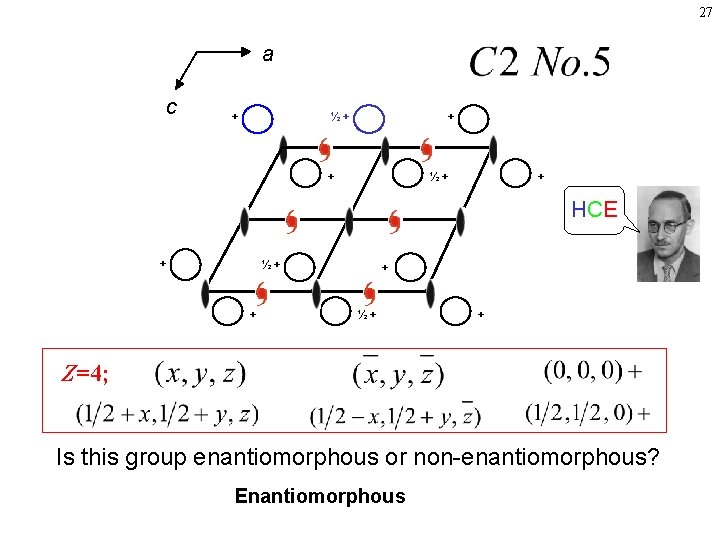
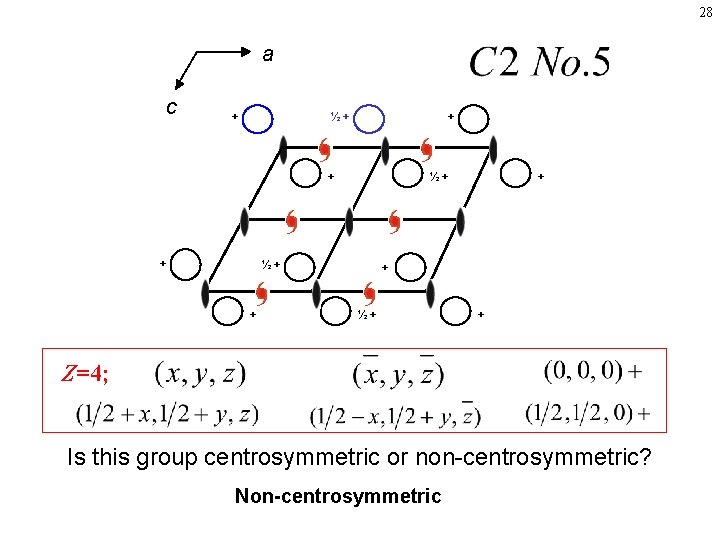
26 Like the “P” or “ 2” that you’ve seen before, the C-centering operation is also a symmetry operation. As we noted for space group P 1, in the primitive lattice, we can think of the P operation as a set of translation operators (1, 0, 0), (0, 1, 0) and (0, 0, 1). Compared to a primitive lattice, in lattice type C, the translation operator (½, ½, 0) is additionally applied to all of the general equivalent positions. To construct a diagram for C 2, we’ll start by regenerating our previous P 2 diagram, and then add the molecules generated by the C centering operation.
27 a c + ½+ + + HCE + ½+ + Z=4; Is this group enantiomorphous or non-enantiomorphous? Enantiomorphous
28 a c + ½+ + Z=4; Is this group centrosymmetric or non-centrosymmetric? Non-centrosymmetric
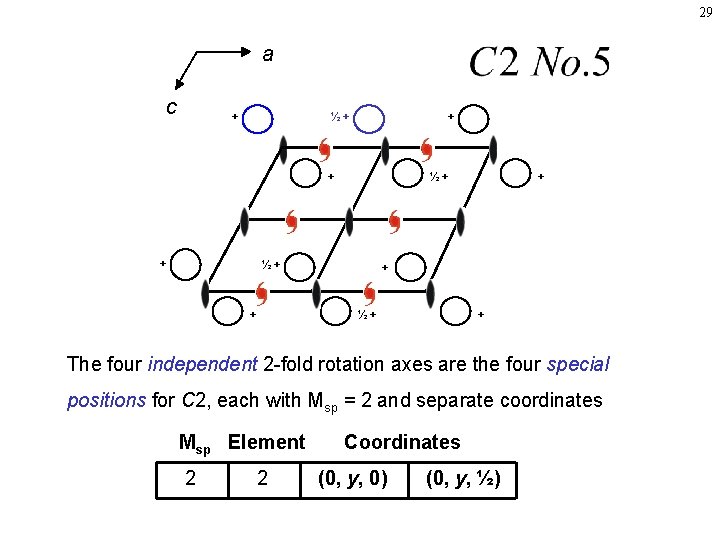
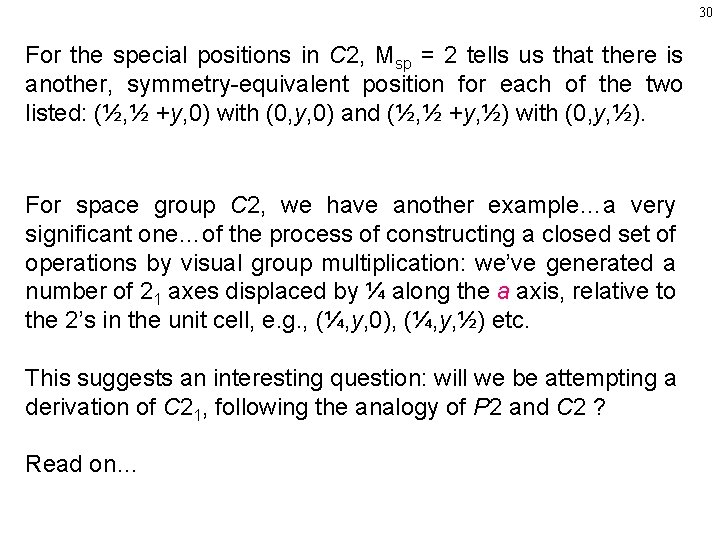
29 a c + ½+ + The four independent 2 -fold rotation axes are the four special positions for C 2, each with Msp = 2 and separate coordinates Msp Element 2 2 Coordinates (0, y, 0) (0, y, ½)
30 For the special positions in C 2, Msp = 2 tells us that there is another, symmetry-equivalent position for each of the two listed: (½, ½ +y, 0) with (0, y, 0) and (½, ½ +y, ½) with (0, y, ½). For space group C 2, we have another example…a very significant one…of the process of constructing a closed set of operations by visual group multiplication: we’ve generated a number of 21 axes displaced by ¼ along the a axis, relative to the 2’s in the unit cell, e. g. , (¼, y, 0), (¼, y, ½) etc. This suggests an interesting question: will we be attempting a derivation of C 21, following the analogy of P 2 and C 2 ? Read on…
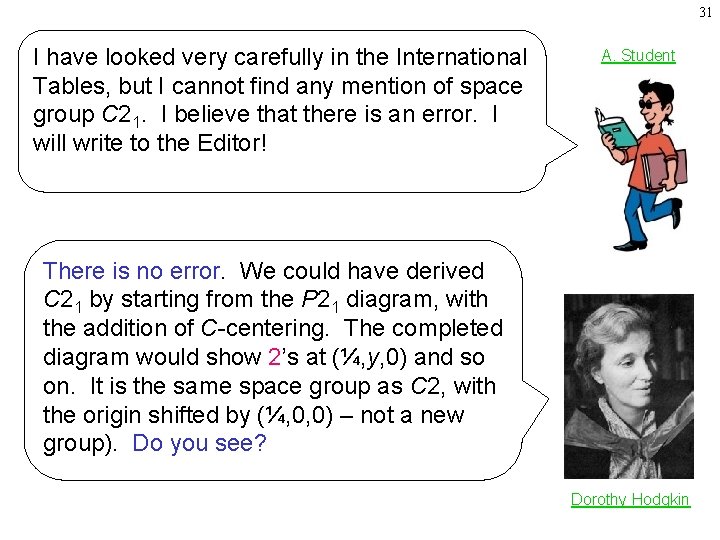
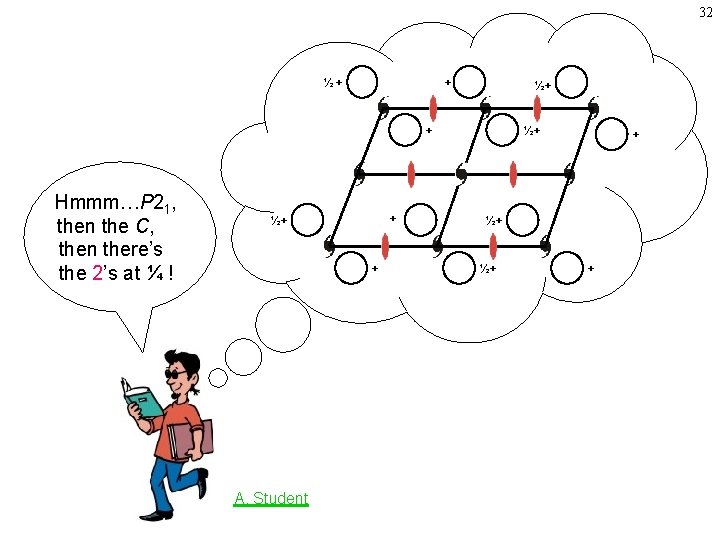
31 I have looked very carefully in the International Tables, but I cannot find any mention of space group C 21. I believe that there is an error. I will write to the Editor! A. Student There is no error. We could have derived C 21 by starting from the P 21 diagram, with the addition of C-centering. The completed diagram would show 2’s at (¼, y, 0) and so on. It is the same space group as C 2, with the origin shifted by (¼, 0, 0) – not a new group). Do you see? Dorothy Hodgkin
32 + ½+ ½+ ½+ + Hmmm…P 21, then the C, then there’s the 2’s at ¼ ! + ½+ + A. Student + ½+ ½+ +
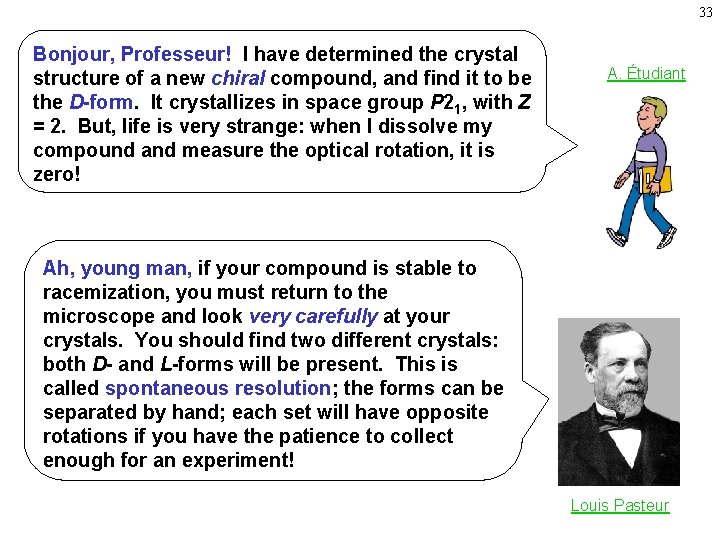
33 Bonjour, Professeur! I have determined the crystal structure of a new chiral compound, and find it to be the D-form. It crystallizes in space group P 21, with Z = 2. But, life is very strange: when I dissolve my compound and measure the optical rotation, it is zero! A. Étudiant Ah, young man, if your compound is stable to racemization, you must return to the microscope and look very carefully at your crystals. You should find two different crystals: both D- and L-forms will be present. This is called spontaneous resolution; the forms can be separated by hand; each set will have opposite rotations if you have the patience to collect enough for an experiment! Louis Pasteur
34 End of Section 2, Pointgroup 2